The plan is to present a live audio podcast entitled ‘Talking About a Revolution’ featuring renowned climate activist Roger Hallam and myself on 1st May 2024 at 7pm BST (GMT +1). We’re not proposing violent revolution, rather a serious huge economic, political and social transition away from Capitalism which is totally and incessantly destroying the planet.
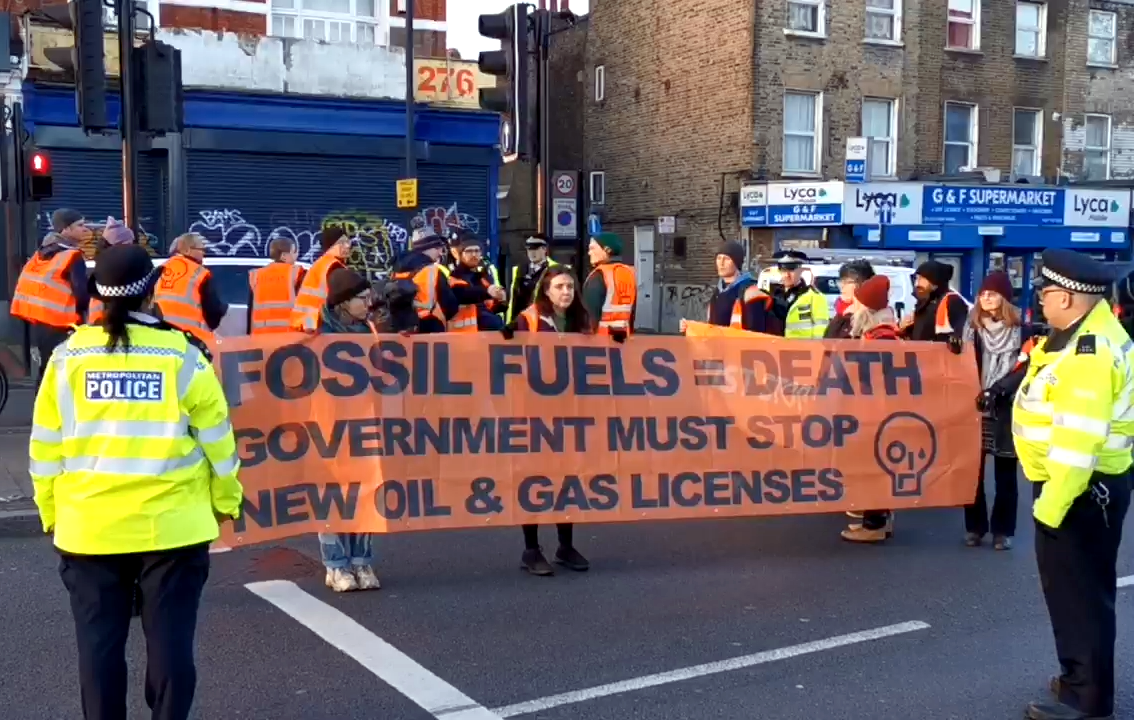
Just Stop Oil protesting in London 6 December 2022.
Roger has been active in founding many climate activist groups e.g. Extinction Rebellion, Insulate Britain and Just Stop Oil. Roger and myself are similar in many ways: We’re both about the same age, have Welsh histories, committed to being brutally honest and seem to have reached very similar conclusions i.e. the need for revolution, through different routes.
I’m also intending to host a live audio podcast a week earlier on 24 April at 7pm BST (GMT +1) featuring myself to test the tech since I’ve never done it before. There is a chance that it may not work of course which is part of why I’m doing it. It will likely be a monologue but I’m hoping to feature some special ‘guests’ in a not too serious programme. Not too serious because it’s probably a good response to laugh in the face of adversity.
Those of you who have attended universities will probably realise that they are are dumping grounds for insane but mostly harmless people who are basically fekking bonkers. I suggest that you should recognise that the same happens in contemporary politics: that politicans are totally fekking beserk who would not be tolerated in normal professions and have been successful in politics. Just consider our prime ministers FFS.
Spokesman Joost Thus: “The A12 blockades have ensured that the injustice of fossil subsidies is clear to everyone. 72% of Dutch people want to get rid of fossil subsidies [1] and more than three quarters of the Second Last October, the House voted in favor of a motion on phase-out plans. The success of the A12 blockades has set in motion an international movement. An international coalition of 25 movements from 14 countries will fight at EU level for an end to fossil subsidies. This week there are Stop Fossil Subsidies actions in 6 European countries. It will be announced on Saturday on the A12 how we will increase the international pressure on politics and the fossil industry in the near future.”
Phasing-out plans for the outgoing cabinet The outgoing cabinet presented the phasing-out plans for fossil subsidies in February. The abolition of fossil subsidies is postponed again until 2030 or even 2035. Moreover, the outgoing government states that phasing out a large part of fossil subsidies is difficult due to international agreements. But this goes directly against the international agreements that the Netherlands made at the G20 in 2009 (!) to phase out fossil subsidies before 2020.
Need to abolish fossil subsidies Fossil subsidies stimulate the large-scale consumption of fossil fuels. Companies such as Shell, Tata Steel and KLM receive huge discounts on the use of oil, gas and coal in the Netherlands. In total, this amounts to between 39.7 and 46.4 billion euros per year in the Netherlands alone. Globally, the IMF reserves an amount of $7 trillion for 2022 [2]. In this way, the use of energy sources whose emissions drive the climate and ecological crisis is supported and stimulated. While this crisis endangers the lives of millions of people, animals and ecosystems.
Greta Thunberg was detained by police in The Hague along with other climate protesters. Photograph: Peter Dejong/AP
Greta Thunberg was detained by police at a demonstration in The Hague, in the Netherlands.
The climate activist was put in a bus by local police along with other protesters who tried to block a major highway into the city on Saturday.
Thunberg had joined a protest by hundreds of activists and was detained when she joined a group of about 100 people who tried to block the A12 highway.
Before she was detained, Thunberg said: “We are in a planetary emergency and we are not going to stand by and let people lose their lives and livelihood and be forced to become climate refugees when we can do something.”
…
The Extinction Rebellion campaign group said before the demonstration that the activists would block a main highway into The Hague, but a heavy police presence, including officers on horseback, initially prevented the activists from getting on to the road.
A small group of people managed to sit down on another road and were detained after ignoring police orders to leave.
Extinction Rebellion activists have blocked the highway that runs past the temporary home of the Dutch parliament more than 30 times to protest against subsidies.
The demonstrators waved flags and chanted: “We are unstoppable, another world is possible.”
The Guardian article didn’t make clear that Dutch Extinction Rebellion is continuing it’s campaign against huge fossil fuel subsidies by the Dutch government that support the fossil fuel industry.
Getting to net zero emissions by mid-century is conventionally understood as humanity’s best hope for keeping Earth’s surface temperature (already 1.2°C above its pre-industrial level) from increasing well beyond 1.5°C – potentially reaching a point at which it could cause widespread societal breakdown.
At least one prominent climate scientist, however, disagrees.
James Hansen of Columbia University in the US published a paper with colleagues in November which claims temperatures are set to rise further and faster than the predictions of the Intergovernmental Panel on Climate Change (IPCC). In his view, the 1.5°C target is dead.
He also claims net zero is no longer sufficient to prevent warming of more than 2°C. To regain some control over Earth’s rising temperature, Hansen supports accelerating the retirement of fossil fuels, greater cooperation between major polluters that accommodates the needs of the developing world and, controversially, intervening in Earth’s “radiation balance” (the difference between incoming and outgoing light and heat) to cool the planet’s surface.
You can listen to more articles from The Conversation narrated by Noa.
There would probably be wide support for the first two prescriptions. But Hansen’s support for what amounts to the deliberate reduction of sunlight reaching Earth’s surface has brought into the open an idea that makes many uncomfortable.
Michael Mann from the University of Pennsylvania in the US and another titan of climate science, spoke for many when he dismissed solar radiation management as “potentially very dangerous” and a “desperate action” motivated by the “fallacy … that large-scale warming will be substantially greater than current-generation models project”.
Their positions are irreconcilable. So who is right – Hansen or Mann?
Earth’s radiation balance
First, an explanation.
There are only two ways to reduce global warming. One is to increase the amount of heat radiated from Earth’s surface that escapes to space. The other is to increase the amount of sunlight reflected back to space before it lands on something – whether a particle in the atmosphere or something on Earth’s surface – and is converted to heat.
There are many ways to do both. Anything that reduces the amount of greenhouse gas in the atmosphere will let more heat escape to space (replacing fossil fuels with renewables, eating less meat and tilling the soil less for example). Anything that makes the planet brighter will reflect more sunlight to space (such as refreezing the Arctic, making clouds whiter or putting more reflective particles in the atmosphere).
But the key difference between the two, in terms of their impact on global warming, is their response time. That is, the time it takes for a change in the factors that allow more heat to escape or sunlight to be reflected to appear as a change in Earth’s surface temperature.
Intervening to speed up the loss of heat from Earth’s surface cools the planet slowly, over decades and longer. Intervening to increase the sunlight Earth reflects back to space cools the planet more or less immediately.
The essence of the dispute between Mann and Hansen is whether reducing greenhouse gases, by a combination of reducing new emissions and permanently removing past emissions from the atmosphere, is now enough on its own to prevent warming from reaching levels that threaten economic and social stability.
Mann says it is. Hansen says that, while doing these things remains essential, it is no longer sufficient and we must also make Earth more reflective.
When will warming end?
Mann aligns with IPCC orthodoxy when he says that emissions reaching net zero will result, within a decade or two, in Earth’s surface temperature stabilising at the level it has then reached.
In effect, there is no significant warming in the pipeline from past emissions. All future warming will be due to future emissions. This is the basis for the global policy imperative to get to net zero.
In his new paper, Hansen argues that if the atmospheric concentration of greenhouse gases remains close to its current level, the surface temperature will stabilise after several hundred years between 8°C and 10°C above the pre-industrial level.
Of this, at least 2°C will emerge by mid-century, and probably a further 3°C a century from now. A temperature increase of this magnitude would be catastrophic for life on Earth. Hansen adds that to avoid such an outcome, brightening Earth is now necessary to halt the warming in the pipeline from past emissions.
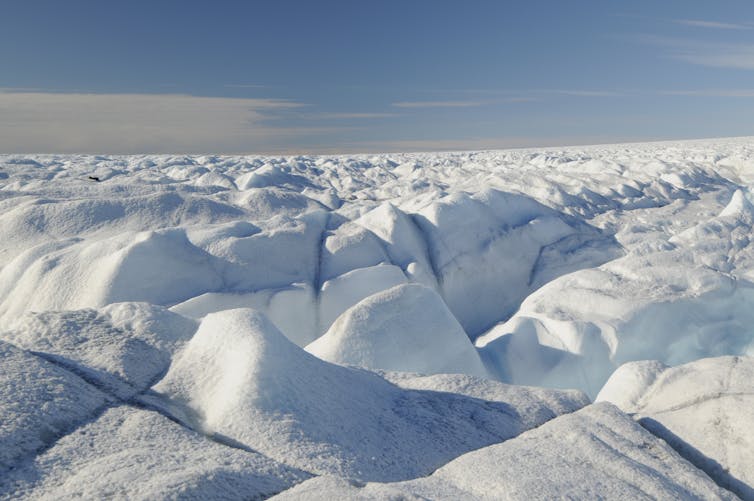
Bright surfaces, like ice sheets, reflect light to space. Tobetv/Shutterstock
But at the same time, we must also largely eliminate emissions if we are to stop recreating this problem in the future.
Still getting hotter…
We are scientists who study the feasibility and effectiveness of alternative responses to climate change, addressing both the engineering and political realities of enabling change at the scale and speed necessary.
We find Mann’s rebuttal of Hansen’s claims unconvincing. Crucially, Mann does not engage directly with Hansen’s analysis of new data covering the last 65 million years.
Hansen explains how the models used by IPCC scientists to assess future climate scenarios have significantly underestimated the warming effect of increased greenhouse gas emissions, the cooling effect of aerosols and how long the climate takes to respond to these changes.
Besides greenhouse gases, humanity also emits aerosols. These are tiny particles comprising a wide range of chemicals. Some, such as the sulphur dioxide emitted when coal and oil are burned, offset the warming from greenhouse gases by reflecting sunlight back to space.
Others, such as soot, have the opposite effect and add to warming. The cooling aerosols dominate by a large margin.
Hansen projects that in coming months, lower levels of aerosol pollution from shipping will cause warming of as much as 0.5°C more than IPCC models have predicted. This will take global warming close to 2°C as early as next year, although it is likely then to fall slightly as the present El Niño wanes.
Underpinning Hansen’s argument is his conviction that the climate is more sensitive to greenhouse gases than previously reported. The IPCC estimates that doubling atmospheric CO₂ raises Earth’s temperature by 3°C. Hansen calculates it to be 4.8°C.
This, and the much longer climate response time that Hansen calculates from the historical record, would have a significant impact on climate model projections.
Time for reflection
The differences between Mann and Hansen are significant for the global response to climate change.
Mann says that allowing emissions to reach net zero by mid-century is sufficient, while Hansen maintains that on its own it would be disastrous and that steps must now be taken in addition to brighten the planet.
Brightening Earth could also reverse the reductions in reflectivity already caused by climate change. Data indicates that from 1998 to 2017, Earth dimmed by about 0.5 watts per square metre, largely due to the loss of ice.
Given what’s at stake, we hope Mann and Hansen resolve these differences quickly to help the public and policymakers understand what it will take to minimise the likelihood of imminent massive and widespread ecosystem destruction and its disastrous effects on humanity.
While 1.5°C may be dead, there may still be time to prevent cascading system failures. But not if we continue to squabble over the nature and extent of the risks.
Don’t have time to read about climate change as much as you’d like?
Roger Hallam was involved in starting the climate activism groups Extinction Rebellion and Just Stop Oil. He is still involved with Just Stop Oil and often gets arrested and imprisoned. [22/3 Apologies had a typo calling Roger Roget]
I used to be a social science researcher at King’s College, London. The name of the game in that trade is to look at everything in context. So I will provide some context. There is overwhelming evidence that the climate science industry is structurally underestimating the realities we face. “Worst than expected” is the standard phrase of just about every article as new stats are published. A few years ago we were going to pass 1.5C around 2050 – now it is already happening. I remember reading reports that the Arctic will melt in the summer around 2100. Papers now predict 2035, if not before. AMOC – the ocean current that stops the 60 million people on these islands from starving to death – was going to collapse at some point next century. Now a recent paper tells us the odds are it will collapse by 2050. If you have not been paying attention, this will create a collapse of temperatures overnight of 3-8C across Europe. So don’t be surprised if it happens before your pension comes due.
I’m like you. I don’t like to believe things are true if they conflict with my baseline beliefs – like “we will muddle through”. But then it becomes more difficult when it actually comes true. Scientists have been telling us privately and then publicly for years that staying under 1.5C was bollocks – and now here we are. For two decades or more the best kept secret of the climate space has been that aerosols (pollution from burning fossil fuel emissions) have been holding down temperatures by .5C-1C. As we passed 1.8C last September the pretence started to collapse as scientists raged about each other on a dark corner of Twitter. It’s the start of the exposure of the world’s biggest cover up. That they knew we were fucked a decade or more ago. Not that the media is interested. Everyone is still in on the pretence, it seems.
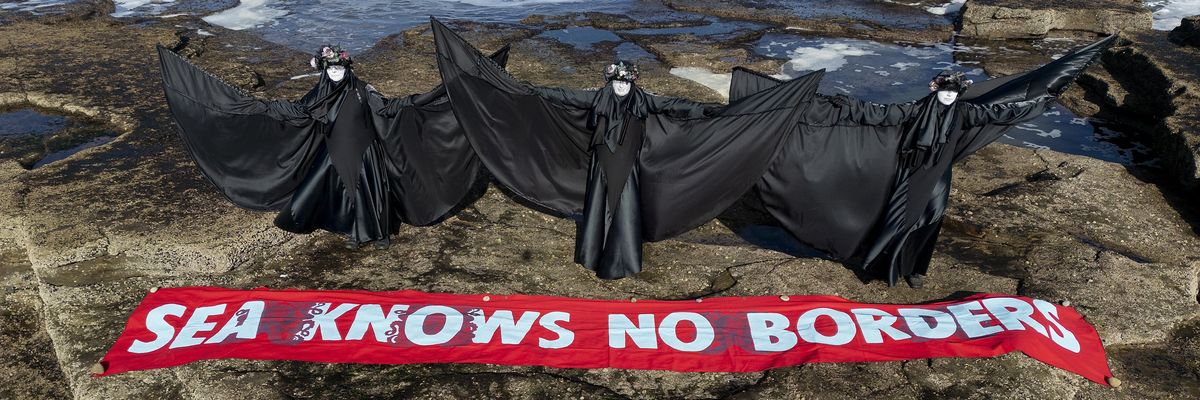
The “oil slicks” performance artist group demonstrates the impacts of a potential oil spill on Scotland’s Moray Firth as part of a North Sea-wide day of action on March 16, 2024. (Photo: XR Forres)
“Going full steam ahead with new North Sea oil and gas is a sure fire route to the worst climate scenarios,” one campaigner said.
Climate activists in six North Sea countries came together on Saturday to carry out acts of civil disobedience in protest of their governments’ continued fossil fuel development.
Demonstrators in the United Kingdom, Norway, Sweden, Denmark, Germany, and the Netherlands blockaded roads, ports, and refineries; dropped banners; and held solidarity concerts as part of the North Sea Fossil Free campaign to demand that their governments align their plans for the shared body of water with the Paris agreement goal of limiting global heating to 1.5°C above preindustrial levels.
“For too long, the U.K., Norway, and other North Sea countries have avoided scrutiny for their oil drilling plans as the emissions are not included in their national inventories,” a spokesperson for Extinction Rebellion U.K. told Common Dreams. “Going full steam ahead with new North Sea oil and gas is a sure fire route to the worst climate scenarios.”
“The only serious response we can make is for citizens to unite, but we need to see many many more people doing this work.”
The day of action, which was organized by Extinction Rebellion (XR), came days after a new report from Oil Change Internationalrevealed that none of five North Sea countries—Norway, the U.K., the Netherlands, Germany, and Denmark—have plans consistent either with limiting warming to 1.5°C or with the agreement to transition away from fossil fuels reached at last year’s United Nations COP28 climate conference. If the five countries were counted as one, they would be the seventh biggest producer of oil and gas in the world.
In particular, these governments continue to issue permits to explore for and develop oil and gas fields, despite the fact that the International Energy Agency has said that no new fossil fuel development is compatible with limiting global temperature rise to 1.5°C. In one high-profile example, the U.K. approved the undeveloped Rosebank oil field in September 2023. Taken together, these permits could lead to more than 10 billion metric tons of greenhouse gas emissions.
The worst offenders were Norway and the U.K., which could be among the top 20 developers of oil and gas fields through mid-century if they do not change course.
“The five major North Sea countries are at a crossroads: One path leads toward global leadership in climate action and green industries, where they take bold action to phase out oil and gas production that creates sustainable jobs and communities. The other path leads to catastrophic climate change, economic crisis, and the loss of status as climate leaders globally, as they cling to outdated practices while the world moves forward,” Silje Ask Lundberg, North Sea campaign manager at Oil Change International, said when the report was released.
Extinction Rebellion co-founder Clare Farrell said that the North Sea governments’ policies were a betrayal of their citizens and the world following the hottest year on record.
“Temperatures have tracked 1.5°C above average recently, almost 2°C,” Farrell said. “Our global commitments, such that they are, are being flushed away with no regard for what the public really want. Where’s the consent for that here in our democracies? No government has a mandate to do that. So people deserve to know that our governments are willfully destroying everything. The people of these North Sea nations have not consented to destroying civilization, but that’s what is going to happen. Their governments are unhinged and unchecked.”
Saturday’s protests, Farrell continued, were a way for the people in these countries to make their voices heard.
“The only serious response we can make is for citizens to unite, but we need to see many many more people doing this work,” Farrell said. “Direct action like this should shake us awake; our governments will destroy democracy and society if we let them continue, that’s the course we are on, and they are redoubling their efforts despite the facts and knowing how much suffering they are already causing all over the world as climate breaks down.”
The demands of Saturday’s protests were threefold: An end to new oil and gas infrastructure in the North Sea, for governments to tell the truth about the realities of the climate crisis, and for the countries to pursue a just transition to renewable energy. In addition, many activists made additional demands specific to their nations’ policies.
— Extinction Rebellion Nederland (@NLRebellion) March 16, 2024
In the Netherlands, activists with Extinction Rebellion and Scientist Rebellion blocked all roads and railways leading to the largest oil refinery in Europe: Shell’s Pernis refinery. They targeted Shell because the oil major has received new permits to drill in the Victory Gas Field and has also restarted its drilling in the Pierce Field. What’s more, the company has refused to clean up its aging equipment in the North Sea, leaving old pipelines and drilling platforms to rust and pollute the sea with mercury, polonium, and radioactive lead. While there are 75 aging Shell oil and gas platforms in the Dutch North Sea that should be removed by 2035, current efforts are not on track to meet this deadline.
“Like the rest of the fossil industry, Shell is only interested in profits and shareholder returns,” said Bram Kroezen of XR Netherlands, adding that Shell’s appeal of a landmark court ruling ordering it to reduce emissions showed that the company “completely lacks a moral compass.”
Germany
As part of today's concerted action #NorthSeaFossilFree, we shut down access inroads to water-bound LNG-infrastructure in #Brunsbüttel✊🏼
— Ende Gelände International #StopColonialViolence (@ende_gelande) March 16, 2024
Activists with Ende Gelände blocked off access to a floating liquefied natural gas (LNG) terminal in the port of Brunsbüttel, Germany, beginning at 9:00 am local time. The activists are calling for an end to LNG imports, as new science reveals the so-called “bridge” fuel may in fact be at least as damaging to the climate as coal due to previously unaccounted for methane leaks.
“LNG is a double climate killer,” Rita Tesch, spokesperson for Ende Gelände, said in a statement. “Because it consists of methane. Methane is even more harmful to the climate than carbon dioxide. It escapes into the atmosphere during transportation by LNG ships and at terminals such as here in Brunsbüttel, and heats it up rapidly. The carbon dioxide from burning it is on top of that. It’s clear: LNG imports are a climate crime!”
Norway
EXTINCTION REBELLION NORWAY BLOCKS RAFNES REFINERY Extinction Rebellion Norway (XR) is conducting a large-scale action aimed at Rafnes refinery in Bamble.XR-activists are now on their way into the security zone with a boat. Dozens of activists are blocking the main entrance on… pic.twitter.com/e2x9Vx1t6M
— Extinction Rebellion Norway (@XR_Norge) March 16, 2024
Activists with XR Norway targeted Rafnes Petroleum Refinery, with some blockading access on land while another group entered the security area by boat.
“I’m ashamed to be a Norwegian,” XR Norway spokesperson Jonas Kittelsen said in a statement. “Norway profits massively from aggressively expanding our oil and gas sector, causing mass suffering and death globally. My government portrays us as better than the rest of the world, which we are not.”
Denmark
Punkband Octopussy Riot is performing on top of a container next to the Total headquarter at Esbjerg Harbour in protest of new oil and gas extraction in the north sea. Becoming species and XR are part of an international action today all across The North Sea #NorthSeaFossilFreepic.twitter.com/wfheUpXVgd
— Extinction Rebellion Danmark (@ExtinctionRDK) March 16, 2024
Performance collective Becoming Species and Extinction Rebellion Denmark worked together to stage a creative protest targeting the oil company Total Energies, which is the leading oil and gas producer in the Danish North Sea and currently has plans to reopen “Tyra Feltet,” Denmark’s largest gas field. Four members of the band Octopussy Riot climbed a Total-owned container and staged a punk concert in Denmark’s Esbjerg Harbor.
“We octopuses have formed the band Octopussy Riot and have arrived here to play our song, a demand for you two-legs to stop oil and gas extraction,” performer Linh Le, said. “The sea is dying, our climate collapsing. We will not accept that the most rich and powerful destroy our home. We do not want to go extinct.”
Sweden
Kom till Göteborg nu på lördag 16:e mars och delta i denna kampanj mot ny fossil infrastruktur i Nordsjön: – Inga nya fossila investeringar i Nordsjön. – Fossilgas är inget alternativ. – Ta bort gamla oljeplattformar. – Sluta borra! pic.twitter.com/n3GzFhI05E
— Extinction Rebellion Sverige (@ExtinctionR_SV) March 14, 2024
Members of XR Sweden blocked the road to Gothenburg’s Oil Harbor, where the group has been protesting since May of 2022. The activists called on Sweden to stop investing in the harbor and on city officials to develop a plan to dismantle the harbor and refineries.
“Twenty-two million tons of oil enter Gothenburg’s port every year, which is owned by the city,” one activist said. “There is no plan for decommissioning. This does not go together with the climate goals.”
Scotland
XR Scotland Oil Slicks and Scottish groups in Forres, Shetland, Aberdeen and Dundee are supporting amazing #NorthSeaFossilFree blockades of fossil fuel infrastructure in 5 countries.
— Extinction Rebellion Scotland (@ScotlandXr) March 16, 2024
Finally, protesters across Scotland stood in solidarity with the other actions with performances and banner drops. In Aberdeen, activists unfurled banners outside the offices of Equinor, which owns 80% of Rosebank, and Ithaca, which owns the remaining 20%. The banners read, “North Sea Fossil Free,” “Stop Rosebank,” and “Sea knows no borders.” In Dundee, protesters targeted the Valaris 123 oil platform off the coast with banners. Shetland Stop Rosebank also brought signs to Lerwick Harbor, from where the first stage of Rosebank’s development is launching. XR Forres organized a performance of the group the “oil slicks” along the Moray Firth, to demonstrate what an oil spill would do to its unique coastal landscape.
“All countries should align their drilling plans with the Paris agreement now,” the XR U.K. spokesperson said. “We thank everyone who has taken action today in defense of a livable planet.”