New York City Mayor Zohran Mamdani delivers a speech to mark the 250th anniversary of the United States of America at City Hall on July 3, 2026 in New York City. (Photo by Anna Connors – Pool/Getty Images)
“At every moment in our past, those who led through exclusion and isolation have tried to win power for themselves by turning us against one another.”
New York City Mayor Zohran Mamdani on Friday delivered a speech commemorating the 250th anniversary of the founding of the United States of America that drew a sharp contrast with President Donald Trump’s vision for the country.
Speaking from New York City Hall, Mamdani recounted how his city had long served as a refuge for people from across the globe who came seeking a new life an opportunity.
It was these immigrants who ultimately shaped New York and made it into what it is today, said Mamdani—who is an immigrant and among the rising number of democratic socialists who have recently won at the ballot box.
The mayor then moved to the present day, where he took aim at the anti-immigrant rhetoric and policies emanating from Trump and his MAGA movement.
“The story of America has been written by those who have so often been told by those with power and influence and wealth that they were anything but exceptional,” Mamdani said. “For generation after generation, we have been told that when the world has sent its people to our shores, it has not sent its best.”
Mamdani took aim at the ideology espoused by many rich and powerful people who see America as “an arena of supremacy, where only a select few are allowed freedom, where not all are created equal.”
“America, if you ask them, becomes less the more people it welcomes,” the mayor continued. “America, they will tell you, belongs only to those with the right accent or the right shade of skin. The rest of us, they insist, should be grateful for merely being allowed to visit.”
“How small they are,” Mamdani remarked. “How weak, how unoriginal. At every moment in our past, those who led through exclusion and isolation have tried to win power for themselves by turning us against one another.”
The mayor then pivoted to a more hopeful tone by arguing that “time and again, including 250 years ago, those forces of division have been vanquished by the forces of progress.”
Mamdani insisted that the greed shown by American oligarchs and the division sown by its current political leadership are “not all we see when we look for America.”
“We see it too in the nurse who works a double shift and then stops on her way home to check on her ailing neighbor,” he said. “Yes, we see in America corporate landlords for whom negligence is a business model. We see it too in the father who tucks his children into bed in a ceiling stained with leaks, who wakes before dawn to go to work, and who still believes this country can do better by his family.”
In his conclusion, Mamdani paid tribute to “those ideals upon which our nation was built,” which he described as “strong enough to endure any authoritarian regime, but only if we reach for them.”
“Ours is a nation working each day towards the perfection in which it was conceived,” he said. “A nation striving each day to better itself. Therein lies the work of America: The striving, the bettering, the reaching towards perfection. What a privilege each of us has to live in a nation that every one of its inhabitants can shape.”
Orcas discuss rotting brain, front Orca says disinhibition and swearing are typical and common symptomsClimate science denier Donald Trump confirms that he knows nothing about democracy and that more liquid gold is being secured according to his policy of global privateering.Donald Trump sings and dances, says that it’s fun to kill everyone … unless he gets distracted or falls asleep.
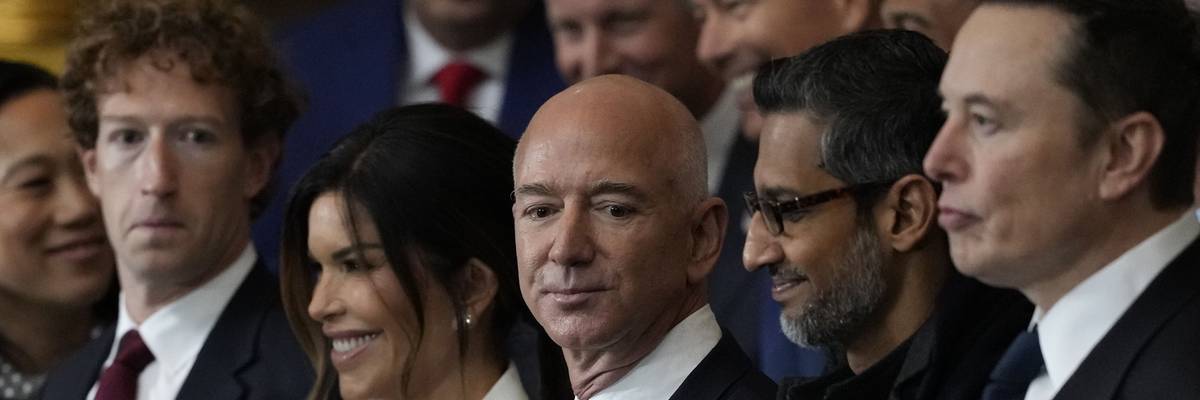
Elon Musk became—at least temporarily—the world’s first trillionaire on June 12 after his space, telecommunications and AI company SpaceX had the largest initial public offering in history. Initially priced at $135 per share for a valuation around $1.77 trillion, shares opened at $150 and peaked on June 16 at $225.64 (a valuation of nearly $3 trillion). The price spiked after Musk announced, before markets reopened on June 15, that he believes “SpaceX might be able to reach approximately $1T revenue in 2030” (CNBC, 6/15/26).
Since its June 16 peak, however, SpaceX’s share price has fallen, steadily declining until June 22 and settling around $160 since. Markets closed on Thursday, July 2, with a share price of $162.00.
SpaceX’s big slump coincided with a mass tech sell-off last week, prompted by mounting concerns that tech firms cannot generate the returns necessary to pay off the colossal debts financing massive AI infrastructure buildouts, especially as companies are beginning to rein in their spending on AI (404 Media, 6/24/26; TechCrunch, 6/24/26).
That was likely a surprise to viewers of CNBC, whose full-day IPO coverage pumped the stock by inviting sources with vested interests to celebrate Musk’s cult of personality and obfuscate the magical thinking behind the company’s projections.
All in on business-facing Grok
SpaceX‘s prospectus has lots of pictures of space, but the details make clear that it’s really envisioning itself as an AI company.
According to its own S-1 filing with the SEC, SpaceX anticipates that its greatest earnings potential does not come from the rocket business for which it is famous, but from selling AI to other businesses. The breathless CNBC discussions entirely omitted the dubious origins of SpaceX’s gargantuan estimate of its maximum potential revenue—a key investor metric known as total addressable market (TAM).
In its S-1 prospectus, SpaceX claims a TAM of $28.5 trillion, larger than the entire GDP of China.
The document separates this figure into SpaceX’s three sectors: space, connectivity and AI. Although the filing argues that space “represents the largest economic frontier in human history,” space makes up just $370 billion, or 1.3%, of SpaceX’s supposed TAM. Meanwhile, AI makes up $26.5 trillion, or 93%, the vast majority of which is for “enterprise applications.”
Enterprise AI is a broad category of business-oriented applications for firms looking to simplify and accelerate workflows, like converting text files into presentation formats, writing and debugging string code, and automating some sales, marketing, HR and IT functions. The most popular AI assistant by far is OpenAI’s ChatGPT, followed by Google’s Google Gemini and Anthropic’s Claude (TechCrunch, 6/16/26).
A closer reading of SpaceX’s S-1 filing reveals that its $22.7 trillion estimate for enterprise AI applications does not actually represent the TAM of the company’s enterprise AI, but is instead an estimate of the size of the entire digital economy—posing a hypothetical wherein xAI’s Grok Business and Grok Enterprise monopolize all digital commerce. It’s worth noting that xAI currently has extremely limited enterprise AI market share, with a March Enterprise Technology Research survey finding that just 7% of respondents use Grok (Wall Street Journal, 5/11/26).
After SpaceX adjusted its chatbot so it would “not shy away from making claims which are politically incorrect,” Grok declared that Adolf Hitler would “spot the pattern” and “handle it decisively, every damn time” (Politico, 7/10/25).
Note also that subscriptions to xAI‘s consumer AI, SuperGrok, on X (labeled “consumer subscriptions” in the chart) alone make up $760 billion, or 2.7% of SpaceX’s TAM. That’s calculated
based on the global population of individuals aged 10 and over in 2025 … multiplied by the weighted average monthly subscription revenue of $12, resulting in an annualized market opportunity of approximately $760 billion.
So if every person on the planet over the age of 9 sends SpaceX $12 every month to use Grok, the X chatbot that spent four days last year calling itself MechaHitler and promoting the Great Replacement Theory, SpaceX will take in $760 billion per year. Sounds like a business plan!
SpaceX’s public offering has all of the hallmarks of a pump-and-dump scheme, using a “staggered lock-up” schedule that allows insiders to sell off shares much earlier than most other publicly traded firms—enabling them to cash out while the stock is still grossly overvalued. This gambit is also called a “bagholder” scheme, as retail investors are left holding a rapidly depreciating asset.
While most IPOs prevent insiders from selling shares for the first 180 days of public trading, SpaceX uses an expedited schedule that allows most insiders to sell much sooner—selling off overvalued shares to retail customers.
While this pump-and-dump began with retail consumers who bought shares on the first day of public trading, these massive wealth transfers are being thrust upon working people whether they like them or not, as Musk successfully negotiated new rules that fast-trackSpaceX’s inclusion in major index funds, including the Russell 1000 and NASDAQ funds—transferring rapidly devaluing stock from SpaceX insiders to working people’s retirement accounts.
But none of this was explored on CNBC the day of the SpaceX IPO launch. FAIR could find not a single guest or anchor that mentioned that “Elon Musk’s rocket company” valued the potential for SuperGrok X subscriptions at more than twice the total projected TAM for the space industry, nor that SpaceX’s TAM is based on a scenario in which business-facing Grok controls all e-commerce—and certainly not that the IPO would essentially serve as a massive wealth transfer from retail investors to SpaceX insiders.
‘You should have bought as much as you could’
During a completely uncontentious interview with Squawk Box co-host Andrew Ross Sorkin (6/12/26), Elon Musk biographer Walter Isaacson muses, “Who knows, we may have the mining of rare earth minerals at some point—I guess we can’t call them rare earth if they’re not on earth. But I think what we’re seeing is the beginning of a whole new economy, a space-based economy.”
Instead, in the hours leading up to SpaceX’s first trade, CNBC viewers were primed by Squawk Box co-host Joe Kernen (6/12/26) lamenting that orders were being snatched up by large institutional investors, and hoping that trades would begin at under $300 per share. He assured viewers that, although he’s nervous, “whenever we’ve worried about any of these great tech companies…wherever it was on opening day, you should have bought them as much as you could.”
The rest of the influential three-hour morning program was as much of a commercial for SpaceX as this opening scene. Squawk Box‘s guests included SpaceX COO Gwynne Shotwell (interviewed by Morning Call host Morgan Brennan), Elon Musk biographer Walter Isaacson, long-time Musk investor David George, head of financial technology research at Citizens Bank Devin Ryan, and venture capitalist and investor Ben Narasin.
All but one of these guests have vested interests or are members of Musk’s inner circle, and used their airtime to generate excitement around the stock by focusing on Musk as a visionary key man. Kernen, co-host Andrew Ross Sorkin and guest host Melissa Lee offered no pushback.
During his conversation with Musk’s biographer Isaacson, Sorkin responded to a proposal that Musk could mine rare earth minerals in space: “I’m curious what you think of the valuation itself…. When you talk to investors, a lot of them say, ‘Look, the math may not actually math out on paper.’”
But before letting a question that could be interpreted as contentious hang too long, he answered for Isaacson:
But Elon Musk is the math. He’s been such a success over all these years. And just about everyone who’s invested with him in the past, he has found a way to make money, even if he didn’t plan to make money in a specific way originally. He then pivots and finds a way that also creates a key man risk. But I’m curious how you think about that.
Of eight guests and anchors featured to speak with Squawk Box hosts about the IPO, just one offered a critical perspective: final guest Ben Narasin, a founder of Tenacity Venture and self-described “long-term buyer of SpaceX.” Narasin contended that while he believes that SpaceX is “going to be a phenomenal company,” a bad post-IPO performance could “put a true chill on the market.”
Squawk Box also included almost no discussion of SpaceX’s TAM, with just one observation, about two hours into the broadcast, that David George, a partner at venture capital company Andreessen Horowitz, believes in it wholeheartedly. Musk is the “best entrepreneur of our generation,” George claimed, targeting “two of the most important markets in technology for our society.”
‘Doubt large numbers at your peril’
Encouraging his audience to buy into SpaceX, Mad Money host Jim Cramer (6/12/26) pitches, “Musk has the ideas and the execution. Historically, betting against him has been a terrible strategy. Betting with him? Hey, why the heck not? I’m surprised he even lets us tag along.”
Like his colleagues on Squawk Box, CNBC‘s Halftime Report host Scott Wapner (6/12/26) was also seemingly incapable of posing tough questions to those with vested interests—but when one guest expressed skepticism, he was happy to interrupt.
His guests—and SpaceX private shareholders—Altimeter Capital CEO Brad Gerstner, Hightower chief investment strategist Stephanie Link and Newedge Wealth CEO Rob Sechan pitched viewers directly to buy in early. (Link completely ignored Wapner’s question as to whether she bought into the IPO.)
Wapner jumped in to parrot Sequoia Capital partner (and Musk DOGE assistant) Shaun Maguire’s suggestion, during previous program Squawk on the Street, that SpaceX’s $28.5 TAM could be an underestimate. He echoed Maguire’s assertion that “this company has the most important mission of any company in history,” warning prospective retail investors to “doubt those large numbers at your own peril” (Halftime Report, 6/12/26).
But when Capital Area Planning Group managing partner Malcolm Ethridge expressed some skepticism as to why retail investors shouldn’t doubt the massive TAM—which, he noted, is almost the size of the US’s GDP—or buy equity in a cheaper space or AI firm with better sales, Wapner cut him off twice—once to rebut with a reminder that SpaceX’s largest revenue-generator is Starlink, and once to prompt Gerstner to offer the same explanation. (Starlink’s 2025 revenue was $11.4 billion, or about 0.04% of US GDP.)
Neither answered Ethridge’s question, but once the topic was successfully changed, Wapner and Gerstner continued peddling.
Meanwhile, during his speculative finance advice program Mad Money (6/12/26), host Jim Cramer likened SpaceX going public to putting a man on the Moon and winning the space race (an analogy he also shared during Squawk on the Street and The Exchange):
The SpaceX IPO felt just like when we put a man on the Moon. Most of you aren’t old enough to remember what that was like back then. We’ve been in a race against Russia for global suppremacy…and then we landed on the Moon…a recognition that we weren’t a nation of bozos competing as a nation of geniuses. These days, I feel the same way about China…. Then along comes Elon Musk, who’s winning the space race against the Chinese, and just got the money he needs to complete projects we haven’t even imagined yet. That’s why my emotion is one of pride.
Although he pointed out that SpaceX may be “outrageously overvalued” by “traditional metrics,” Cramer argued that he nonetheless sees it as a “long-term call on space exploration,” encouraging those who got in early to invest even more. He rattled off the often-repeated refrain that “Musk has the ideas and the execution. Historically, betting against [Elon Musk] has been a terrible strategy.” (Very famously, Musk frequently doesn’t deliver on his promises.)
‘A number so large it destroys your credibility’
CNBC‘s David Faber laughs as his guest NYU business school professor Aswath Damodaran jokes, “When I read [the S-1], I thought Grok had written the prospectus, because we know AI is subject to hallucinations.”This isn’t to say that CNBC’s coverage of SpaceX’s IPO was completely without critical perspectives: Squawk on the Street’s David Faber (6/12/26) spent much of his onscreen time grilling insider guests on whether they’ll sell early, and pushing back on vague, aspirational framing around the AI and space industries.
Faber repeatedly reminded his audience that the S-1 prospectus specifically sees most of SpaceX’s potential in enterprise AI. He skeptically took the projected $22.7 trillion TAM for enterprise AI as given, but pointed out that “it’s not clear” how SpaceX’s Grok could compete with other enterprise AI products:
It’s interesting, as much as we talk about SpaceX, as much as we hear Musk talking about space and then Starlink, the real opportunity in terms of addressing this enormous number is actually still the same opportunity that’s being sought after by Anthropic, and OpenAI, and Alphabet and others.
Squawk on the Street also featured the most critical guest by far, NYU business school professor Aswath Damodaran, who came closest to questioning the origin of the TAM of any host or guest on any of the programs:
When I read [the S-1], I thought Grok had written the prospectus, because we know AI is subject to hallucinations…. I don’t know if it’s a banker who wrote it, I would be embarrassed to even put that number out. I mean, it’s a big market. Why do you need to make up a number, a number so large it destroys your credibility?
But even in scrutinizing SpaceX’s prospects, or the true size of the enterprise AI market, Squawk on the Street’s criticism missed the bigger picture: SpaceX’s record-setting IPO is a pump-and-dump, and retail investments provide the exit liquidity for insiders looking to get out of a failing AI company.
Every day, dozens of guests representing various companies advertise their stock on CNBC for retail consumers, who trust the judgment of their favorite program hosts to give completely uncontentious interviews, essentially constituting a series of infomercials, rather than actual financial journalism. FAIR (3/18/09, 2/3/20) has criticized CNBC on this basis for decades.
So when CNBC invites SpaceX insiders with vested interests to pump the valuation of their stock on the air shortly before dumping it on retail consumers, it seems obvious why even the most critical host cannot alert his viewers to what is really going on: because CNBC’s reporting exists to boost stock, rather than protect consumers.
FAIR’s work is sustained by our generous contributors, who allow us to remain independent. Donate today to be a part of this important mission.
Hamish Falconer ran through traffic in Whitehall when asked why his government allows British citizens to fight in Gaza
Foreign minister Hamish Falconer refused to answer questions on Wednesday about the UK government’s failure to stop British nationals fighting for the Israeli army in Gaza.
It comes after more than 25,000 people signed a letter to the Foreign Office demanding they investigate UK citizens who fought in Gaza and may have committed war crimes.
Thousands of British nationals have served in the Israel Defence Forces (IDF) since the Gaza conflict began in 2023, according to a Freedom of Information response from the IDF first published by Declassified.
Britain’s Foreign Office does no monitoring of its own and was initially only aware of just 80 UK-Israeli soldiers. Falconer has specific responsibility for British policy towards the Middle East.
With the UK government yet to respond to the open letter, Declassified doorstepped Falconer while he walked from the Foreign Office to Parliament, asking him: “Are you worried that war criminals might be walking the streets of Britain?”
The UK Parliament, London. Photo by Hesther Ng/SOPA Images/Sipa USA via Reuters
Starmer is rushing legislation through parliament that experts say threatens free speech, public interest journalism and international humanitarian aid
Sir Keir Starmer’s historically unpopular and soon-to-be-replaced administration is using its last gasps to push through a new national security law that experts believe will pose serious threats to free speech, public interest journalism and the provision of international humanitarian aid.
The new legislation, called the national security (state threats) bill, is intended to update existing national security legislation. It has been introduced by the current home secretary, Shabana Mahmood. Mahmood is widely seen as a hardliner in Starmer’s government, responsible for introducing tougher restrictions on the settlement rights of asylum seekers and immigrants. The bill has been rushed through the Commons and is now being pushed at pace through the Lords. The government wants to have the law on the statute books within weeks.
…
Free speech and press freedom groups argue that the bill threatens public interest journalism – a view endorsed by two independent reviewers of terrorism legislation. David Anderson, the government’s former independent reviewer, has said that journalists would be “at risk of prosecution if they were to have contact of any kind with sources within designated bodies or their agents”. Any journalist who works with a source in a hostile foreign government, or simply approaches them for information, could face more than a decade in prison.
Jonathan Hall, the government’s current independent reviewer, has raised similar concerns. He has pushed for the law to include a “reasonable excuse” defence covering the exchange of information.
The practical implications of the bill for journalism are wide-ranging and devastating.
Elon Musk posted 303 times about race and immigration in the period leading up to SpaceX’s listing on the Nasdaq on 12 June. Photograph: Isaac Wasserman/NCAA Photos/Getty Images
Guardian analysis of X feed shows how keen world’s richest person was to air his views and ‘interfere’ in British politics
Elon Musk posted about race and immigration in the UK on his social media network X twice as often as he did about SpaceX, which he also owns, in the run-up to the aerospace and AI company’s initial public offering.
A Guardian analysis of Musk’s posts, replies and reposts between 31 May and 12 June has shown the extent to which the social media activity of the world’s richest person, who lives primarily in the US, has focused on UK politics.
The period was one of heightened tension and concern in the UK about online activity, particularly from rightwing social media accounts, after the sentencing of Vickrum Digwa for the murder of teenager Henry Nowak, which led to claims of “anti-white” policing, and far-right protesters clashing with police. It also coincided with violent riots across Belfast in Northern Ireland, when protests erupted after a knife attack.
While UK ministers were appealing for an end to the violence, in the US Musk was preparing for one of the biggest moments in his business career on 12 June. That was the day SpaceX, his social media, satellite internet and aerospace conglomerate went public, making him the world’s first trillionaire.
Elon Musk urges you to be a Fascist like him, says that you can ignore facts and reality then.A parody ‘Tesla – The Swasticar’ advert posted at a London bus stop. Photograph: People vs Elon