Zita Holbourne addresses a previous TUC Congress at Manchester Central in 2018
ANDY BURNHAM’S government remains complicit in genocide, unions said as TUC passed an historic vote to back the Palestinian-led BDS campaign against Israel today.
Ministers announced new restrictions on trade and weapons exports with illegal settlers in Palestine earlier this month.
Campaigners hailed delegates in Brighton for voting to support the “Palestinian-led boycott, divest and sanctions (BDS) movement” and call on the government to impose “wide-ranging sanctions on Israel until it complies with international law.”
Moving the motion, Artists Union England’s Zita Holbourne said that the government’s recent acceptance of a 2024 International Court of Justice ruling urging Israel not to commit genocide in Gaza “is not enough.”
“Palestinian society, including unions, have reiterated the call for the international community to implement BDS against ongoing crimes of genocide, apartheid and occupation,” she said.
The motion also called on ministers to “commit to freedom of speech and end attempts to censor artists and art organisations expressing solidarity with Palestine” after it emerged on Tuesday that rapper Macklemore was removed from an Ed Sheeran concert for backing the war-torn territory.
Seconding, Unison delegate Margaret McKee said that unions will continue to call on Labour to fully suspend arms trade with Israel and the Britain-Israel trade partnership agreement until “human rights and international law are respected.”
“If the government doesn’t do this, you are still being complicit in the genocide of the Palestinian people,” she said.
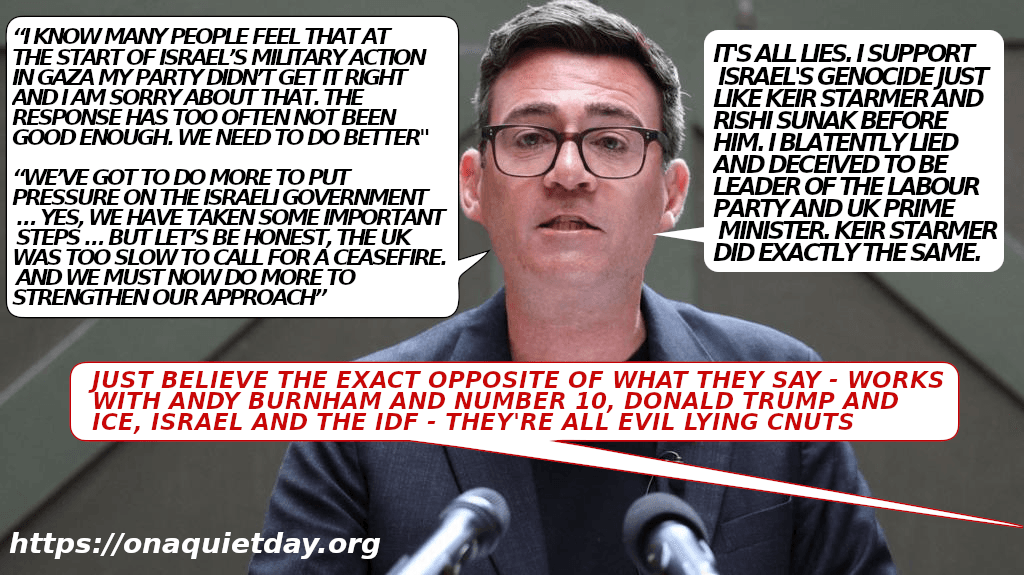
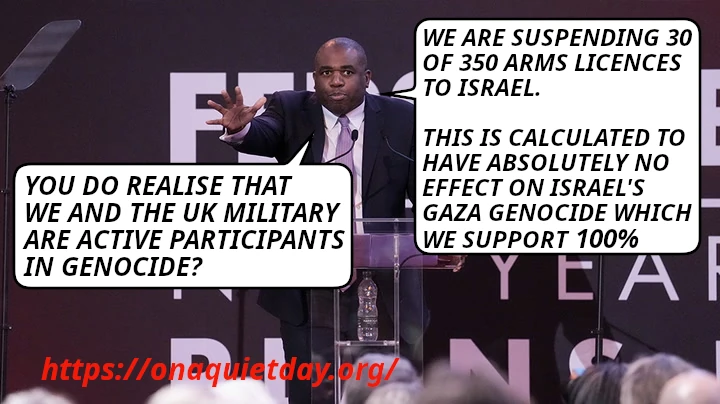
UK Prime Minister Andy Burnham admits to blatently lying and engaging in deception to become leader of the UK Labour Party and Prime Minister.Keir Starmer objects to criticism of the IDF. He asks how could anyone object to them starving people to death, forced marches like the Nazis did, bombing Gaza’s hospitals and universities, mass-murdering journalists, healthworkers and starving people queuing for food, killing and raping prisoners and murdering children. He calls for people to stop obstructing his genocide for Israel. New Labour UK Prime Minister Andy Burnham continues Labour party policy of active support and complicity in Israel’s genocide.Genocide denying [former] UK Foreign Secretary David Lammy says that UK is suspending 30 of 350 arms licences to Israel. He also confirms the UK government’s support for Israel’s Gaza genocide and the UK government and military’s active participation in genocide.
This work by Middle East Monitor is licensed under a Creative Commons Attribution-NonCommercial-ShareAlike 4.0 International License.
Israeli Prime Minister Benjamin Netanyahu gives a speech in Jerusalem. [Photo by DEBBIE HILL/AFP via Getty Images]
Israeli Prime Minister Benjamin Netanyahu vowed on Wednesday to revoke the citizenship of those who “defame” Israeli soldiers in NAZA, a documentary on killings in Gaza, and impose significantly higher financial penalties on them, Anadolu reports.
Netanyahu made the remarks in a video statement following the recent screening of the Israeli documentary at the Venice International Film Festival. The film documents alleged crimes committed by Israeli forces during the war on the Gaza Strip.
“Regarding the film NAZA, which portrayed Israeli army officers and soldiers as war criminals, I will now introduce two bills, both government bills,” Netanyahu said.
He said the first bill would revoke the citizenship of those who “defame Israeli army soldiers.”
The second, according to Netanyahu, would increase by 20-fold the amount of compensation that could be sought against them in defamation cases.
“We will hit them in their pockets and also in their citizenship, because their place is not among us,” he added.
On Saturday, NAZA won the Special Jury Prize at the 83rd Venice International Film Festival. The documentary was directed by Oscar-winning Israeli filmmakers Yuval Abraham and Rachel Szor.
NAZA is an abbreviation used by Israel’s military intelligence agency, Aman, to refer to the number of civilians expected to be killed in an airstrike.
The documentary was secretly filmed on rooftops in Tel Aviv over three years, with the identities, voices and appearances of participants digitally altered to protect them.
Israeli military personnel featured in the documentary said they had directly witnessed residential areas used by Palestinians as shelters being set ablaze, and people being killed during food distribution in Gaza.
Israeli army chief Eyal Zamir on Monday ordered the military prosecutor to examine possible legal action against those behind NAZA, while maintaining that the army operates in accordance with international law.
Israeli Culture and Sports Minister Miki Zohar also contacted Shin Bet chief David Zini on Wednesday to request an urgent investigation into the documentary, according to public broadcaster KAN.
Israel’s military campaign in Gaza since October 2023 has killed more than 73,000 Palestinians and injured over 174,000, most of them women and children, according to Palestinian authorities.
Donald Trump calls for help from NATO allies in securing the Strait of Hormuz despite saying on 7 March 2026 that they don’t need people to join wars after they’ve already won. He’s challenged with the claim that he lies as much as the IDF.Orcas discuss Donald Trump and the killer apes’ concept of democracy. Front Orca warns that Trump is crashing his country’s economy and that everything he does he does for the fantastically wealthy.
This work by Middle East Monitor is licensed under a Creative Commons Attribution-NonCommercial-ShareAlike 4.0 International License.
UK Foreign Secretary Ed Miliband leaves 10 Downing Street following the first cabinet meeting of the new legislative session in London, United Kingdom, on September 08, 2026. [Raşid Necati Aslım – Anadolu Agency]
The British foreign secretary said the Israeli government is losing friends and allies because of its actions in the Gaza Strip and the West Bank, which he said have mobilized people around the world, Anadolu reports.
The “Israeli government is losing friends. It’s not gaining allies; it’s lost allies. It’s losing allies all over,” Ed Miliband said Tuesday in an interview with UK-based podcast The Rest is Politics.
He noted that the recent sanctions announcement targeting illegal Israeli settlements in the occupied West Bank came after warnings that the two-state solution is being “destroyed by the facts on the ground.”
“All measures were to make a difference to that, the sanctions regime targeting the illegal occupation, not targeting or delegitimizing in any way the state of Israel,” he said.
“The status quo is not working,” noted Miliband, adding that Israel’s E1 settlement expansion project had long been seen as a “red line” for the international community “because it basically would split off East Jerusalem from West Bank (which) really makes Palestinian state unviable.”
He noted that the combination of the International Court of Justice’s 2024 ruling that Israel end its occupation, dismantle settlements and pay reparations; the length of the occupation of Palestinian territories; and the displacement of many Palestinians led the government to take that step.
“We can’t give up” in the face of “settler terrorism,” said Miliband, adding that he believes there is no stable Middle East without a two-state solution between Palestinians and Israelis.
“We have got to put a stop to settler terrorism, genuine terrorism, I used the term, ethnic cleansing by the settler terrorists, that’s what is happening,” he said.
Miliband said before his sanctions announcement he thought what would his mother say, who died in May.
“She would say, ‘Look at what is happening to Palestinians! Look at what is happening to these poor people; it’s wrong,” said the foreign secretary.
Miliband said he recently met a group of people, including a doctor who worked in Gaza, and said it is “absolutely unspeakable” and “appalling” what they were saying.
He also said Israel’s blocking of humanitarian aid entry into Gaza “seems like an absolutely deliberate strategy.”
“The situation on the ground is terrible,” he said. “Nothing can justify what has unfolded in Gaza.”
“Since the so-called ceasefire, 1,200 Palestinians have been killed. That’s not much of a ceasefire,” he said.
Miliband underlined that the UK can not give up in the face of “settler terrorism.”
“We don’t know what’s going to happen in Israeli elections on Oct. 27, but we are trying to send a very clear message to the Israeli people to say, ‘look, the international community is not going to stand by as this occupation proceeds,’” he added.
Miliband announced a series of measures last week, including a ban on imports from illegal Israeli settlements, sanctions on companies and individuals facilitating settlement expansion, and additional sanctions on extremist Israeli occupiers accused of supporting or inciting violence against Palestinians.
Donald Trump calls for help from NATO allies in securing the Strait of Hormuz despite saying on 7 March 2026 that they don’t need people to join wars after they’ve already won. He’s challenged with the claim that he lies as much as the IDF.Orcas discuss Donald Trump and the killer apes’ concept of democracy. Front Orca warns that Trump is crashing his country’s economy and that everything he does he does for the fantastically wealthy.
This work by Middle East Monitor is licensed under a Creative Commons Attribution-NonCommercial-ShareAlike 4.0 International License.
US Sen. Chris Van Hollen [Flickr]
US Sen. Chris Van Hollen vowed Wednesday to block a proposed $2.8 billion arms transfer to Israel, criticizing the provision of heavy munitions amid persistent bombardments across the Gaza Strip, Anadolu reports.
“Trump is sending $2.8 billion of bombs paid for by you, the American taxpayer, to a govt led by a wanted war criminal,” the Democratic lawmaker from the state of Maryland wrote on US social media company X.
Van Hollen argued that the military aid is moving forward while Israeli Prime Minister Benjamin Netanyahu “keeps bombing Gaza & blocks justice for Americans killed on his watch.” He questioned how the policy aligns with domestic interests and US President Donald Trump’s “America First” policy. “We will work to stop it,” he said.
The post follows reports that the Trump administration is preparing an arms package featuring 40,000 bombs weighing 2,000 pounds (907 kilograms) each, funded through US taxpayer resources. The proposal reportedly includes 20,000 MK-84 bombs, 20,000 BLU-117 munitions and 20,000 I-2000 Penetrator warheads.
Shipments of the MK-84, termed the “hammer” during the 1991 Gulf War, were temporarily paused in 2024 because of civilian casualty concerns before Trump reversed the restrictions in January 2025.
Multiple US nationals have been killed by Israeli forces and occupiers in Gaza and the occupied West Bank in recent years.
Netanyahu and former Defense Minister Yoav Gallant are wanted by the International Criminal Court for alleged war crimes and crimes against humanity in Gaza.
Donald Trump calls for help from NATO allies in securing the Strait of Hormuz despite saying on 7 March 2026 that they don’t need people to join wars after they’ve already won. He’s challenged with the claim that he lies as much as the IDF.Orcas discuss Donald Trump and the killer apes’ concept of democracy. Front Orca warns that Trump is crashing his country’s economy and that everything he does he does for the fantastically wealthy.
This work by Middle East Monitor is licensed under a Creative Commons Attribution-NonCommercial-ShareAlike 4.0 International License.
A vessel called “14th Goodness Ship”, carrying humanitarian aid for Gaza, docks at al-Arish Port in Arish, Egypt on January 29, 2025. [Stringer – Anadolu Agency]
Turkiye’s Disaster and Emergency Management Authority (AFAD) has delivered 2,000 tons of flour to Palestinian refugees and displaced families in Lebanon.
A ceremony marking the delivery was held on Wednesday at the Port of Beirut, attended by Turkiye’s Ambassador to Lebanon Murat Lutem, Lebanese Higher Relief Council chief Bassam Nabulsi, and the director of the UN agency for Palestinian refugees (UNRWA) in Lebanon, Dorothee Klaus.
The flour will be distributed to Palestinian refugees and families displaced by Israeli attacks.
Turkiye is expected to continue providing assistance to people in need across Lebanon.
‘Our solidarity with Lebanon will continue’
Speaking to Anadolu, Ambassador Lutem said Turkiye’s assistance to people in need in Lebanon was ongoing.
He recalled that the Health Ministry had recently sent medicine to Lebanon and said Turkiye had also supported efforts to meet the shelter needs of families displaced by Israeli attacks.
In addition to tents, Turkiye has sent food, clothing, and other humanitarian supplies, Lutem said.
“We see that the aid we have provided over the past 2 1/2 years has exceeded 4,000 tons as of today,” he said.
Lutem said Lebanon had endured suffering it did not deserve and noted that around 300,000 Lebanese people remained unable to return home due to destruction caused by Israeli attacks.
“Our country’s support will continue. Our president has said very clearly: The security of our country does not begin at our borders; it begins in Damascus and Beirut,” he said.
Highlighting Turkiye’s historic ties with Lebanon, Lutem added: “Our solidarity with Lebanon will continue.”
‘Sincere expression of solidarity, friendship, and humanitarian partnership’
Nabulsi said the delivery represented a continuation of Turkiye’s longstanding support for Lebanon through state institutions and humanitarian organizations, particularly AFAD.
“This meaningful initiative is a continuation of the support and humanitarian assistance that Turkiye has provided to Lebanon for many years through its state institutions and humanitarian organizations, particularly AFAD,” he said.
Nabulsi emphasized that Turkish institutions had stood by Lebanon during difficult periods and crises, adding that Lebanon placed great value on cooperation with Turkiye.
He identified Turkiye and UNRWA as two key partners in addressing humanitarian needs in Lebanon.
The flour was particularly important for meeting families’ basic needs and supporting food security, Nabulsi said.
“We do not view this contribution merely as material assistance. It is a sincere expression of solidarity, friendship, and humanitarian partnership,” he said.
Nabulsi thanked Turkiye for its longstanding support and continued cooperation with Lebanon.
‘Assistance will ease families’ expenses’
Klaus thanked Turkiye and AFAD for the aid during her address at the ceremony.
She said the assistance would help ease families’ financial burdens.
“This shipment will provide flour and bread to Palestinian refugees and displaced Lebanese people who have been affected by the economic consequences of the latest conflicts affecting Lebanon,” she said.
Donald Trump calls for help from NATO allies in securing the Strait of Hormuz despite saying on 7 March 2026 that they don’t need people to join wars after they’ve already won. He’s challenged with the claim that he lies as much as the IDF.Orcas discuss Donald Trump and the killer apes’ concept of democracy. Front Orca warns that Trump is crashing his country’s economy and that everything he does he does for the fantastically wealthy.

 Zita Holbourne addresses a previous TUC Congress at Manchester Central in 2018