Tens of Thousands Rally in Havana Against US Aggression as Cuba Prepares Citizens for War

Article by Brett Wilkins republished from Common Dreams under Creative Commons (CC BY-NC-ND 3.0).

Cubans hold photos of revolutionary hero and former President Raúl Castro outside the US Embassy in Havana on May 22, 2026 amid threats of attack by the United States. (Photo by Adalberto Roque/AFP via Getty Images)

“Here we are prepared to fight imperialism,” said Cuban lawmaker Mariela Castro, daughter of Raúl Castro. “Cuba is a small and poor country, but one with experience confronting US imperialism.”

Tens of thousands of Cubans rallied Friday in Havana to denounce the Trump administration’s indictment of former President Raúl Castro and threats to attack the island nation, whose socialist government has been preparing its citizens to defend their homeland and revolution against US aggression.

“No disrespect is shown to the heroes of the homeland!” Cuban President Miguel Díaz-Canel said as people flooded the streets outside the US Embassy in Havana. “History and traditions are not insulted without a response! That does not happen in Cuba!”

RECOMMENDED…

Marco Rubio

Trump Admin Claims of Cuban Plans for Drone Attacks Denounced as ‘Ludicrous Pretext’ for War

CUBA-POLITICS-ANNIVERSARY

Unlawful US Attack, Says Cuban President, ‘Would Trigger a Bloodbath With Incalculable Consequences’

The massive rally followed Wednesday’s US Department of Justice indictment of revolutionary hero Raúl Castro, who served as president for a decade after his older brother, Fidel Castro, stepped down in 2008. The DOJ indicted Castro for his alleged role in the 1996 shoot-down of planes operated by the counterrevolutionary group Brothers to the Rescue after repeated warnings that they had violated Cuban airspace.

Rallying under the slogan “Raúl is Raúl”—originally popularized during the transitional period of rule between the Castros to highlight the younger brother’s reforms—Cubans vowed to defend their revolution in the face of the latest US threats.

“This new aggression has united us more and elevated the honor, dignity, and anti-imperialist spirit of a people already recognized around the world for their brave resistance to any form of subordination to the empire,” Díaz-Canel said.

Cuban legislator Mariela Castro, Raúl’s granddaughter, told rallygoers that “we are prepared for combat.”

“No one is going to kidnap him. I can assure you of that,” she said, alluding to the US invasion and abduction of Venezuelan President Nicolás Maduro on dubious narco-terrorism charges earlier this year. “Neither him nor anyone else.”

“My father is very calm, watching and smiling,” Castro added. “Here, we are prepared to fight imperialism. Cuba is a small and poor country, but one with experience confronting US imperialism. We know that as long as there is an anti-imperialist revolution, there will be a gigantic and ruthless enemy.”

Critics noted the hypocrisy of the Castro indictment, given the ongoing illegal US bombing of boats that the Trump administration claims—without providing evidence—were smuggling drugs in the Caribbean Sea and Pacific Ocean.

“Washington has no moral authority to judge anyone,” Gerardo Hernández, coordinator of the Committees for the Defense of the Revolution, said, referring to the boat-bombing campaign, which has killed nearly 200 people in close to 60 reported attacks. “Cuba is a people of peace and reaffirms its legitimate right to self-defense.”

“Cuba does not constitute a threat to US security,” he continued. “On the contrary, Cuba is a state under attack by the United States.”

Observers have pointed to the decadeslong US-backed campaign of anti-Castro terrorism against the Cuban people, including the 1976 bombing of Cubana Flight 455, a commercial airliner with 73 people aboard, including 11 Guyanese nationals and 24 teenage members of Cuba’s junior Olympic fencing team. Perpetrators of the attack enjoyed safe haven in the United States, mainly in Miami, where the city celebrated a day in honor of one of the bombing’s alleged masterminds.

“The Cuban people reaffirm the unwavering decision to defend their homeland and revolution,” Hernández added. “With the greatest determination, they reaffirm their absolute and firm support for Army General Raúl Castro.”

Mariela Castro said that “my family, like all Cuban families, is waiting for instructions to know where we need to go” in the event of a US attack.

As US Secretary of State Marco Rubio—whose parents immigrated to the United States from Cuba during the US-backed dictatorship that preceded the Castro-led revolution—said Thursday that the chances of a “negotiated and peaceful agreement” with Havana are “not high,” Deputy Cuban Foreign Minister Carlos Fernández de Cossío acknowledged that his country is preparing for war, asserting that “we would be naive not to.”

Cuban officials have been circulating a pamphlet titled a “Family Guide for Protection Against Military Aggression.” The publication warns that the US is preparing “to launch a military assault and destroy our society with the aim of perpetuating capitalism… and annihilating the dream of our Commander-in-Chief, Fidel Castro.”

The pamphlet instructs Cubans to pack survival kits and seek shelter in the event of air-raid alerts. It also contains life-saving first aid instructions.

“Should the enemy attack, our Revolution will defend itself until victory is achieved and the aggressor is expelled,” the pamphlet states.

US President Donald Trump recently tightened the internationally condemned 65-year US economic embargo on Cuba, imposing a fuel blockade that has exacerbated an energy emergency characterized by blackouts and deadly suffering among the most vulnerable Cubans, including sick people and children.

Last month, Trump said that “we may stop by Cuba after we’re finished” with the illegal US-Israeli war of choice against Iran. The president has also stated he believes he’ll “be having the honor of taking Cuba,” language echoing the 19th-century US imperialists who conquered the island along with Puerto Rico, Guam, and the Philippines from Spain in another war waged on dubious pretense.

“Whether I free it, take it—I think I can do anything I want,” Trump said of the island and its 11 million inhabitants.

BreakThrough News interviewed Havana residents earlier this week about the specter of US attack.

“We Cubans have to protect ourselves,” elderly Havana resident Juan Hernández said. “We’re not going to hand any Cuban over to a foreigner, because that would be immoral. It would be treason.”

Hernández accused the US of “provocation” in order to “justify invading the country,” adding “that would only lead to bloodshed on both sides.”

“Besides,” he added, “Cuba isn’t a threat to them at all. What does Cuba have? Do we have atomic bombs? Do we have anything? We have nothing.”

Article by Brett Wilkins republished from Common Dreams under Creative Commons (CC BY-NC-ND 3.0).

Donald Trump sings and dances, says that it's fun to kill everyone ... unless he gets distracted or falls asleep.
Donald Trump sings and dances, says that it’s fun to kill everyone … unless he gets distracted or falls asleep.
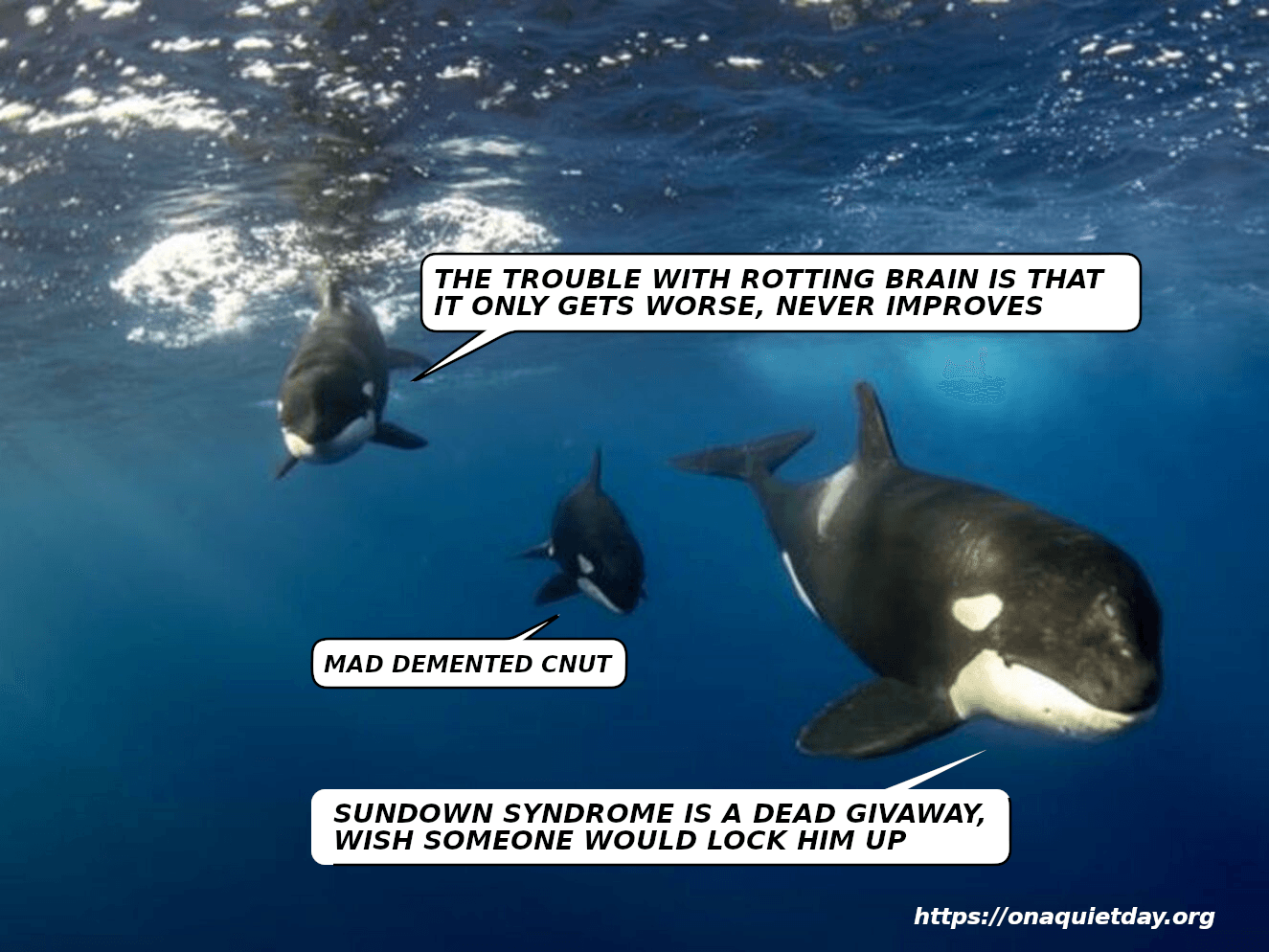
Orcas discuss how Trump was re-elected and him being an obviously insane, xenophobic Fascist.
Elon Musk urges you to be a Fascist like him, says that you can ignore facts and reality then.
Continue ReadingTens of Thousands Rally in Havana Against US Aggression as Cuba Prepares Citizens for War

Israel Denounced for ‘Killing Spree’ of Rescue Workers in Lebanon

Article by Brett Wilkins republished form Common Dreams under Creative Commons (CC BY-NC-ND 3.0).

Lebanese paramedic Mohammed Suleiman squats by the grave of colleague Ali Jaber, 22, who was killed in March by an Israeli strike while on the job, in Nabatiyeh, Lebanon, on April 28, 2026. (Photo by Scott Peterson/Getty Images)

“Israel’s wanton killing of rescue workers and targeting of medical infrastructure in Lebanon has been one of this war’s most brazen features,” Drop Site News noted.

Israeli attacks killed at least seven rescue workers in southern Lebanon on Thursday and Friday in violation of a US-brokered ceasefire, part of what critics say is a pattern of deliberate targeted murders of first responders that mirror the genocidal massacres committed in Gaza.

On Friday, paramedics from the al-Risala Association rushed to the site of an Israeli strike in Deir Qanun al-Nah, Tyre district, that reportedly killed a young girl and the village barber, identified by L’Orient Today as Ali Allameh. As they arrived on the scene, the paramedics were hit by a so-called “double-tap” strike—a follow-up bombing meant to eliminate survivors and first responders—that killed would-be rescuers Ali Abboud, Hussein Kassir, and Ahmad Hariri.

RECOMMENDED…

Israel Intensifies Attacks Across Lebanon Despite US-Iran Ceasefire Deal

UNICEF Decries ‘Intolerable’ Israeli Killing of Lebanese, Palestinian Children

Smoke rises following an Israeli airstrike on a Lebanese village

Demanding End to Unlawful US-Israeli Attacks, Amnesty Says ‘International Community Must Now Draw a Red Line’

Hariri was also a well-known photojournalist who earlier this week documented an Israeli massacre of 14 people—including four children and 11 members of one family—in Deir Qanun al-Nah.

L’Orient Today reported that Israeli forces bombed two Islamic Health Committee centers in Hanouiyeh overnight Thursday, killing four rescue workers and wounding two others. Earlier on Thursday, an Israeli airstrike near the Tebnine Hospital reportedly killed two people and injured another while damaging all three floors of the facility.

Lebanon’s Ministry of Public Health said more than 3,100 people have been killed by Israeli attacks since March 2, in addition to the more than 4,000 people, including nearly 800 women and over 300 children, slain in Israel’s 2023-25 attacks on its northern neighbor, where the militant resistance group Hezbollah is based. The dead from the current round of Israeli attacks include nearly 300 women, more than 210 children, and 123 medical and healthcare workers.

The Committee to Protect Journalists says 15 media professionals have also been killed in Lebanon since October 2023. One of them, Al-Akhbar correspondent Amal Khalil, was wounded last month by an Israeli strike while reporting on a previous bombing. Khalil was trapped under rubble, and as Red Cross workers attempted to extricate her, Israeli forces dropped a stun grenade on them as a warning to disperse. They were unable to rescue Khalil, who later died.

As in Gaza—where Israeli forces have killed or wounded more than 250,000 Palestinians since the Hamas-led attack of October 7, 2023—attacks by Israel have devastated Lebanon’s healthcare infrastructure.

Israel’s continued slaughter of Lebanese first responders comes as World Health Organization (WHO) member states gathered this week in Geneva, where they overwhelmingly backed a declaration of alarm over “the impact of the ongoing war on the Lebanese health systems, including attacks on health facilities and health workers, and the closure of dozens of primary healthcare centers and hospitals.”

The measure, which also called on the WHO to “scale up” support for Lebanon’s health system, passed by a vote of 95-2—with Israel and Honduras against—and 18 abstentions.

“Israeli military action has had unacceptable impacts on civilians and medical care,” the United Kingdom said in an explanation of its vote in favor of the declaration. “The conflict has led to the displacement of over 1 million people and the closure of several hospitals and health facilities. The WHO has reported over 150 verified attacks against healthcare, with over 100 healthcare workers killed.”

As Drop Site News reported Friday:

Israel’s wanton killing of rescue workers and targeting of medical infrastructure in Lebanon has been one of this war’s most brazen features. For the past five weeks, the relentless Israeli aerial and ground assault has continued despite a nominal ceasefire being announced by President Donald Trump on April 16. Last week, Israel and Lebanon agreed to a 45-day extension of the “ceasefire” after holding their third round of direct talks in Washington, of which Hezbollah is not a part. The declaration of a ceasefire has not stopped the Israeli military from continuing its bombardment of Lebanon, mostly in the south and the eastern Bekka Valley.

Rescue teams describe a pattern of repeated Israeli attacks directly targeting their members, often in double—or triple-tap strikes—where after a site is struck, it is struck a second or even third time as emergency crews arrive on the scene.

“We try to be careful and take safety precautions before interventions, like waiting 10 minutes to avoid the double taps,” Abdullah Halal, who leads a Civil Defense rescue team in Nabatiyeh, told Drop Site News.

“But,” the outlet noted, “even those precautions have not always been enough. Last week, Halal lost two of his two colleagues in a double-tap strike.”

Ali Saad, who is with the Lebanese Red Cross, told UN News on Wednesday that his colleagues share coordinates with Israeli forces and other belligerents, but rescue workers are still being targeted.

“This is why the Red Cross volunteers hug each other and say goodbye before every mission,” he said.

Article by Brett Wilkins republished form Common Dreams under Creative Commons (CC BY-NC-ND 3.0).

Keir Starmer explains that UK is actively supporting Israel's genocidal expansion and repeats his previous quotation that he supports Zionism "without qualification". Keir Starmer said “I said it loud and clear – and meant it – that I support Zionism without qualification.” here: https://www.jewishnews.co.uk/keir-starmer-interview-i-will-work-to-eradicate-antisemitism-from-day-one/
Keir Starmer explains that UK is actively supporting Israel’s genocidal expansion and repeats his previous quotation that he supports Zionism “without qualification”. Keir Starmer said “I said it loud and clear – and meant it – that I support Zionism without qualification.” here: https://www.jewishnews.co.uk/keir-starmer-interview-i-will-work-to-eradicate-antisemitism-from-day-one/
Donald Trump sings and dances, says that it's fun to kill everyone ... unless he gets distracted or falls asleep.
Donald Trump sings and dances, says that it’s fun to kill everyone … unless he gets distracted or falls asleep.
Elon Musk urges you to be a Fascist like him, says that you can ignore facts and reality then.

Continue ReadingIsrael Denounced for ‘Killing Spree’ of Rescue Workers in Lebanon

Five questions over Nigel Farage’s £5 million donation

EPA/ANDY RAIN

Sam Power, University of Bristol

Questions about a £5 million gift to the leader of Reform UK Nigel Farage from a crypto billionaire simply won’t go away. As someone who spends their life thinking, writing and talking about money in politics, I’ve been left with at least five questions that remain unanswered. These centre not just on the donation and Reform’s financial arrangements, but also on what it says about the system of political finance in the UK.

1. Should he have declared it?

It appears so. It was reported in late April that Farage had received the cash from Christopher Harborne. This was shortly before deciding to stand in the seat of Clacton in the 2024 general election, which he subsequently won.

Farage claims that because it was a personal gift it did not need to be registered. However, the House of Commons code of conduct states that the possible motive of the gifter and what the donation is to be used for should be considered. If there is doubt, the code is clear that it should be registered.

Harborne has said he expected nothing in return, but only wanted to ensure Farage’s security. But given the timing of the gift, in 2024, questions might be asked about his motive. At this time, according to the Electoral Commission, Harborne had given about £1.5 million to the Conservatives (and £1 million to Boris Johnson’s private office). He had also given millions to Reform ahead of its 2019 general election campaign.

As such, Harborne was not some unknown benefactor. This information, at the very least, creates doubt about whether the donation ought to be declared. And there have also been questions over a house Farage bought weeks after receiving the £5 million.

But the question of whether the money should have been declared is now one for the parliamentary standards commissioner, which is investigating whether Farage broke the rules.

2. What does it tell us about how Reform is funded?

One thing that we know about Reform is that its funding base is remarkably shallow. In fact, investigative journalist Peter Geoghegan has found that 75% of all the reportable donations Reform has received came from just three men. They are Christopher Harborne, millionaire businessman Jeremy Hosking and Reform’s own deputy leader, Richard Tice.

Reform’s deputy leader Richard Tice is one of the three main donors bankrolling the party. EPA/NEIL HALL

I have shown in my research that the UK is very much a donor-led democracy where the few get more of a say than the many. So concerns about the wealthy having a larger influence on the way politics is run are certainly not a Reform-shaped novelty.

3. Should the public be worried?

Yes. It has been argued that for elections to have integrity, four things need to be on show: participation, contestation, deliberation and adjudication. Importantly, perception is as important as reality here.

Public opinion fluctuates, but one of the more robust polling findings is that the public has always been and remains concerned that donors have an outsized influence on British politics. So whether they do or not (and it’s notoriously hard to prove), the damage is done.

4. Should Reform be worried?

When he was questioned about Farage’s £5 million, Tice maintained that voters knew about it and “they said, we want more Nigel”. It is true that if you ask the UK public to rank issues that matter to them, then (unless you happen to knock on my door) party funding wouldn’t come close to the top ten.

And yet standards never seem to matter to politicians – until they really do. Just ask Boris Johnson, Keir Starmer or Peter Mandelson, all of whom have faced questions of their own. There are many populists who build personas as mavericks who refuse to play by the rules. While voters might not always agree with their methods, they get results. (And some voters might even think: gosh, you can’t help but love them a little bit for it.)

Nigel Farage might not think the public cares about this. But it appears that they do. And maybe Farage knows this too. If not, he’d probably have been happy to mention the £5 million in the first place.

5. Why don’t Labour care?

It remains astonishing that Labour seems to be so uninterested in addressing a financial pattern of behaviour that could risk undermining democracy – which the party is professing to protect.

It seems even more astonishing that the party seems so casual about addressing the issue of mega-donors while a bill is going through parliament that is quite literally designed to restore faith in politics.

But it may be that the government doesn’t want to cap donations (as many other countries do) because it thinks it would mean introducing more state funding. But the problem has now become too stark to ignore, and a compromise position is imperative.

This could be a “democracy backstop” donation cap of £1 million. This is far higher than any other cap I know of around the world. But it would reflect the voluntarist tradition of the UK – and could start a conversation. Get a backstop in place, and then conduct research on how much it can be lowered without a) risking the financial ruin of parties or b) the need for further state support.

After the May elections, Labour said it was listening to voters and that as a government it needed to be bold. It’s time for the party to put its money where its mouth is. That is, before a mega-donor does it for them.

Sam Power, Lecturer in Politics, University of Bristol

This article is republished from The Conversation under a Creative Commons license. Read the original article.

Nigel Farage urges you to ignore facts and reality and be a climate science denier like him and his Deputy Richard Tice. He says that Reform UK has received £Millions and £Millions from the fossil fuel industry to promote climate denial and destroy the planet.
Nigel Farage explains the politics of Reform UK: Racism, Fake anti-establishmentism, Deregulation, Corporatism, Climate Change Denial, Mysogyny and Transphobia.
Elon Musk urges you to be a Fascist like him, says that you can ignore facts and reality then.
Continue ReadingFive questions over Nigel Farage’s £5 million donation

Tuna has overtaken cod as the UK’s top‑selling seafood – here’s why

Atlantic bluefin tuna hunting garfish off the Devon coast in 2024. Rupert Kirwood

Angus Atkinson, Plymouth Marine Laboratory and Simon Thomas, University of Plymouth

Awesome, unexpected and unforgettable: a sudden bolt of silver as a tuna jumped clear of the sea. Nobody else saw it, and I (Angus Atkinson) almost thought I was hallucinating. But since I first saw one from a boat just off the south Devon coast ten years ago, Atlantic bluefin tuna have steadily increased in the southwest UK. Last year I even saw them from the shore, and tuna now supports a local fishery.

Tuna is not the only species to make a rapid change in the southwest UK about a decade ago. Blue, thresher and porbeagle sharks suddenly increased dramatically. Spiny lobsters suddenly increased. Meanwhile basking sharks and many important fish species like cod and pollack declined. What is going on?

Fortunately, in the southwest UK, help is at hand. Not only does this peninsula host some of the most complete long-term recordings of observations in the UK, we also have a burgeoning network of marine observers.

This was the brainchild of marine consultant Bob Earll, who 15 years ago set up a network called South West Marine Ecosystems. This links scientists, marine charities, fishermen, conservation trusts, managers and citizen scientists many of whom have natural history skills to match the best. This network enables members to more easily share observations and recordings about marine life.

Alongside established high-tech and long-term monitoring such as at the Western Channel Observatory (a set of sampling sites at sea within a 30-mile-radius from Plymouth), many pairs of eyes are looking at the sea along the entire coast of this peninsula. Each year we meet and put data together to report on the status of everything in the marine ecosystem, whether it swims, crawls or flies, and from nutrients right up to the numbers of stranded whales.

South West Marine Ecosystems’ annual reports and annual conferences put the previous year’s observations into the context of all that has gone before. That includes strange new events such as the 2025 octopus outburst. This near-real time reporting, with everyone comparing notes, provided a lightbulb moment: these species shifts were not continuous but seemed to be concentrated into a short intense period of massive change around 2014 to 2016.

In the southwest UK, tuna have increased to the extent that they support a tightly regulated fishery, with a UK catch quota of 230 tonnes for 2026-28. Fishing is always an emotive subject, and some people say we should be leaving these beautiful animals alone.

Kayakers have a close encounter with tuna while photographing marine wildlife off the coast of Devon in 2024.

A recent announcement by the Marine Stewardship Council (MSC) offers some hope that tuna fisheries worldwide are moving in the right direction.

The MSC endorses those seafood sources that have been harvested sustainably, meaning that they abide by the rules of well-managed fisheries based on scientific advice, with minimal collateral ecological damage. This most recent announcement shows an important positive result: the proportion of tuna products available with an MSC endorsement has just risen to nearly 50%, compared to less than 20% only five years ago.

Remarkably, tuna has just overtaken cod as the main seafood bought in the UK. This probably reflects the increasing availability of more sustainably-sourced tuna and sharply declining cod stocks.

A state of flux

Managing these fisheries involves treading that tightrope between allowing livelihoods for the fishing industry, but allowing the whole ecosystem to flourish. The challenges of climate change, shifting distributions and fishing pressure combine into a real headache to manage fisheries responsibly.

Abrupt shifts in ecosystems, as we have witnessed in the southwest of the UK, are critical for fisheries management. In just a few years an ecosystem can lurch into a different operating space with different species and links.

Computer simulation models of ecosystems can broadly project how food webs might respond to the average pace of climate change. Importantly, these models are notoriously poor for predicting abrupt shifts, often known as regime shifts, that punctuate the steadier pace of change.

With these challenges, fisheries managers need all the help they can get to understand abrupt ecosystem shifts. The tuna increase was well documented by South West Marine Ecosystems. The success of this network means that similar programmes are spinning up around the other coasts of the UK.

Similar initiatives are underway elsewhere. The Norwegian Institute of Marine Research provides a data network from public reporting of jellyfish increases, which are important for the management of Norwegian aquaculture.

Joined-up science efforts like South West Marine Ecosystems, alongside long-term scientific monitoring studies and, of course, traditional fish stock assessments, will help us know better whether tuna should stay on the menu.

Angus Atkinson, Professor of Marine Ecology, Plymouth Marine Laboratory and Simon Thomas, Visiting Fellow, Marine Ecology, University of Plymouth

This article is republished from The Conversation under a Creative Commons license. Read the original article.

Continue ReadingTuna has overtaken cod as the UK’s top‑selling seafood – here’s why