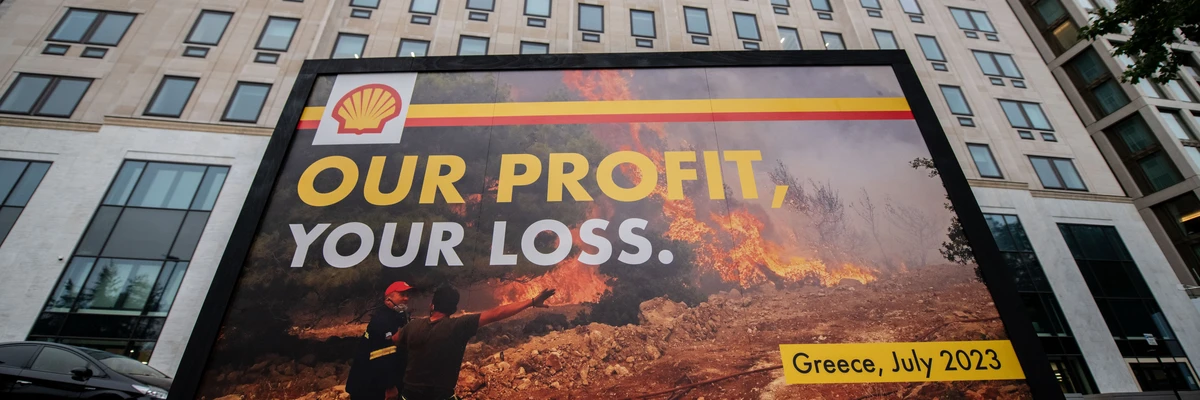
Greenpeace activists display a billboard during a protest outside Shell headquarters on July 27, 2023 in London. (Photo: Handout/Chris J. Ratcliffe for Greenpeace via Getty Images)
BP is expected to announce it will slash its renewable energy investments and instead focus on increasing oil and gas production.
The energy giant will outline its strategy later following pressure from some investors unhappy its profits and share price have been much lower than its rivals.
Shell and Norwegian company Equinor have already scaled back their plans to invest in green energy. Meanwhile US President Donald Trump’s “drill baby drill” comments have encouraged investment in fossil fuels and a move away from low carbon projects.
Some shareholders and environmental groups have voiced concerns over any potential ramping up on production of fossil fuels.
Five years ago, BP set some of the most ambitious targets among large oil companies to cut production of oil and gas by 40% by 2030, while significantly ramping up investment in renewables.
It is now expected to abandon it altogether while confirming it is cutting investments in renewable energy by more than half in what chief executive Murray Auchincloss called a “fundamental reset”.
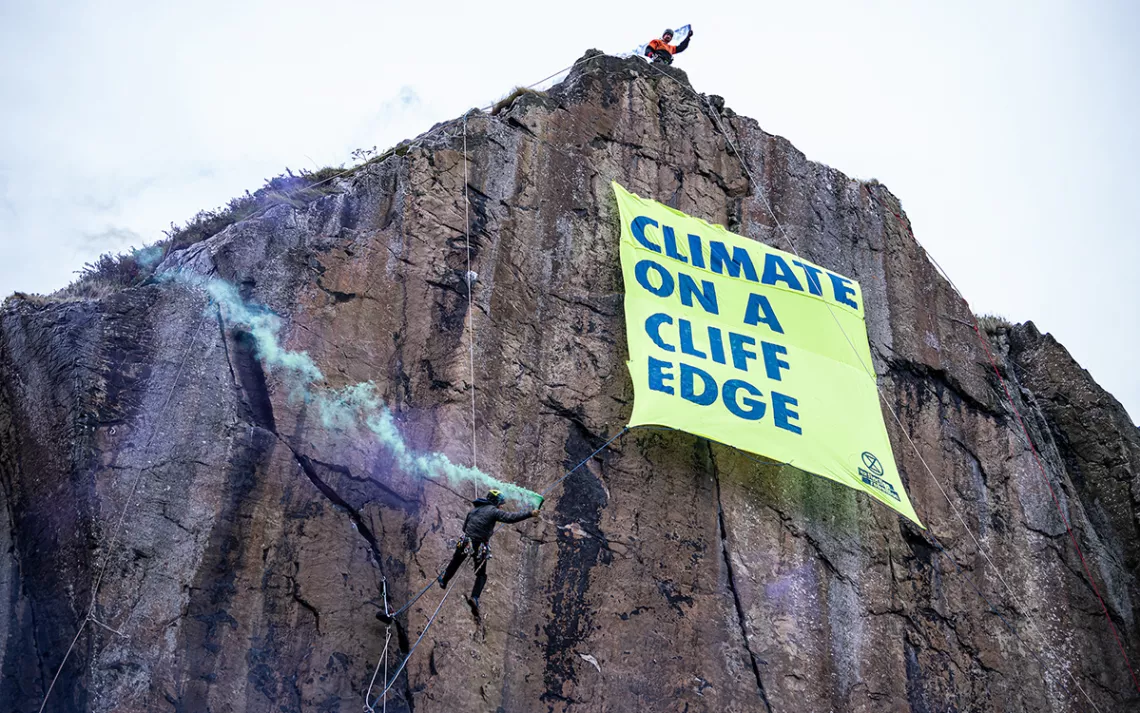
Experienced climbers scale a rock face near the historic Dumbarton castle in Glasgow, releasing a banner that reads “Climate on a Cliff Edge.” One activist, dressed as a globe, symbolically looms near the edge, while another plays the bagpipes on the shores below. | Photo courtesy of Extinction Rebellion and Mark RichardsNeo-Fascist Climate Science Denier Donald Trump says Burn, Baby, Burn.
dizzy: Fossil fuels are no longer reliable high-return investments.
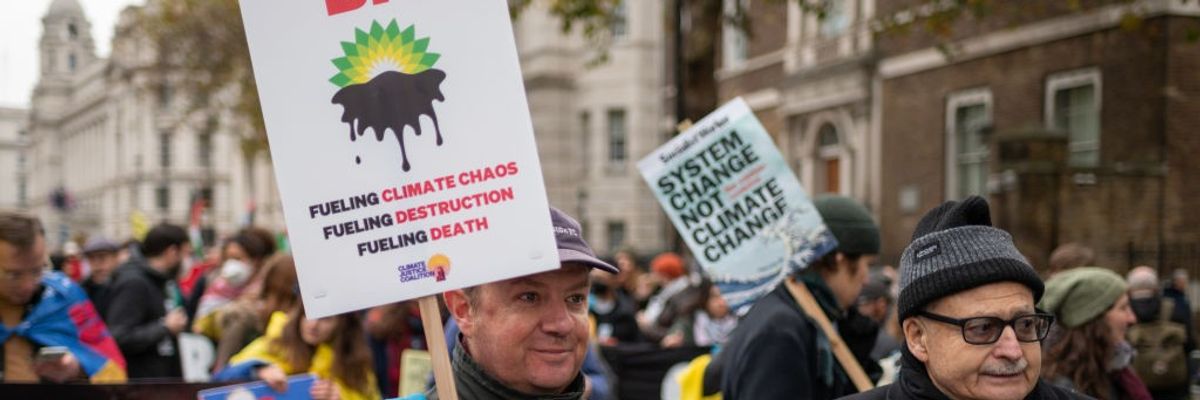
A demonstrator is seen marching while holding a placard criticizing BP in London on November 16, 2024. (Photo: David Tramontan/SOPA Images/LightRocket via Getty Images)
“By facilitating the transport of oil that fuels military operations in Gaza, BP has contributed to the humanitarian catastrophe unfolding in the region,” said the director of the organization backing the claimants.
A group of Palestinians whose family members have been killed in Israeli attacks on the Gaza Strip over the past 14 months have initiated legal action in the United Kingdom against the British fossil fuel giant BP, arguing the company is aiding the assault on the enclave via its ownership of a pipeline that provides Israel with crude oil.
In a 36-page letter before claim, the group contends that BP’s role in supplying oil to Israel violates the company’s stated commitments to human rights, including its expressed support for the United Nations Guiding Principles on Business and Human Rights.
“Israel relies heavily on crude oil and refined petroleum imports to run its large fleet of fighter jets, tanks, and other military vehicles and operations, as well as the bulldozers implicated in clearing Palestinian homes and olive groves to make way for unlawful Israeli settlements,” the letter notes. “Some fuel from refineries goes directly to the armed forces, while much of the rest appears to go to ordinary gas stations where military personnel can refuel their vehicles under a government contract.”
The group demands from BP an “immediate cessation of oil supply to Israel and facilitation through” the Baku-Tbilisi-Ceyhan pipeline as well as an “admission liability and a commitment to mediation for assessing damages.”
“Our clients seek justice for the profound suffering and loss they have endured and call on BP to act responsibly by immediately halting its involvement.”
Tayab Ali, head of international law at Bindmans LLP and director of the International Centre of Justice for Palestinians (ICJP)—which is supporting the group of claimants—said in a statement Monday that “this legal action marks a new phase in accountability for those that are complicit in alleged war crimes and crimes against humanity.”
“The evidence against BP demonstrates a clear failure to adhere to its own human rights policies and international law,” said Ali. “By facilitating the transport of oil that fuels military operations in Gaza, BP has contributed to the humanitarian catastrophe unfolding in the region. Our clients seek justice for the profound suffering and loss they have endured and call on BP to act responsibly by immediately halting its involvement.”
According to ICJP, the claimants include “a British citizen of Palestinian origin who lost 16 family members to Israeli airstrikes,” “a second British Palestinian claimant whose relatives in Gaza have suffered fatalities and displacement,” and “additional claimants who have endured catastrophic physical and psychological harm including amputations and loss of family members.”
The group sent its legal letter just over a month after a coalition of environmental groups published a report identifying BP as one of the “top corporate suppliers of oil to Israel.”
“The major international oil companies, including BP, Chevron, Eni, ExxonMobil, Shell, and TotalEnergies, may be linked to 35% of the crude oil supplied to Israel since October [2023],” the report states. “These companies, as well as state-owned entities and other private and publicly traded oil producers, profit from supplying oil to Israel’s refineries, where a proportion is likely refined into fuels for Israel’s war machine.”
Last week, the Centre for Research on Multinational Corporations argued that “foreign governments have an obligation” under international law “to end the supply of fuel to Israel unless they can guarantee it will only be used for nonmilitary purposes.”
“This includes both a ban on the export of crude oil, military jet fuel, and other fuels, as well as a prohibition on the transport of these commodities through their territory,” the group said.
NatWest among several banks in ‘net zero’ alliance continuing to support the fossil fuel industry
At a glance
Banks with net zero pledges helped raise $1 trillion for companies expanding fossil fuels
Among them is NatWest, which may have broken climate pledge by funding BP
BP is developing a ‘carbon bomb’ in Azerbaijan, host of COP climate talks
Less than a hundred miles from where world leaders are discussing how to meet their climate pledges, BP is drilling for gas.
The Shafag-Asiman project, a sprawling gas field off the Azerbaijani coast, could inject more than 1 billion tonnes of carbon into the atmosphere. That is more than the UK would emit over three years, striking a major blow to efforts to slow down global warming.
BP has said it intends to invest heavily in new oil and gas fields in the coming years. But it would be unable to pursue these dirty projects without billions in support from big banks. NatWest, for one, helped BP raise almost $500m last year in an apparent breach of its climate commitments.
Banks will be in focus at Cop29, currently underway in Baku, Azerbaijan, as world leaders discuss how to raise trillions of dollars for countries suffering the effects of climate change.
Although talks are unlikely to address their continued support for dirty energy, more than 140 banks worldwide have pledged to cut emissions associated with their lending and investments to almost zero by 2050.
In May 2021, the IEA, the global body coordinating countries’ energy policies, sounded the alarm. Any new oil and gas developments would make it inevitable that temperatures would rise by more than 1.5 degrees. In other words, they would devastate the planet.
Meanwhile, at BP’s Shafag-Asiman field, engineers were celebrating after finding fossil gas several thousand metres under the seabed – a new discovery that could significantly increase its output from the region. And the bankers were preparing to raise billions more for BP.
That’s not all. Since May 2021, global banks that have committed to net zero have poured almost $1 trillion into companies pursuing expansion of oil and gas projects that would push the world beyond its survivable limits. Taken together these projects would produce almost seven times the annual emissions of the US.
“It’s indefensible,” said John Lang, founder of the Net Zero Tracker, which evaluates big companies’ green plans. “There’s no way we can meet the temperature goals of the Paris Agreement if we continue financing the exploration of oil and gas.”
He said banks with net zero commitments covering direct and indirect emissions could not fund oil and gas expansion. “It’s greenwashing, plain and simple.”
NatWest said it could not comment on specific customers. It said it had conducted a review into its relationships with a number of oil and gas companies “to ensure they had a credible transition plan aligned with the 2015 Paris Agreement”. It refuted the suggestion it had not met its public commitments.
BP said it is aiming to be a net zero company by 2050 or sooner and believes its strategy is consistent with the goals of the Paris Agreement.
‘Net zero’
It was at Cop26 three years ago that a number of major banks first pledged that by 2050 they would cut almost all the emissions from their lending and investments to zero and invest in financial products to offset the remaining emissions – which has come to be known as “net zero”. NatWest, for instance, promised to stop funding companies that do not have a credible plan to shift their business away from fossil fuels. Its support for BP suggests it may have broken that promise.
BP reported record profits in February last year and promptly announced it would scale back its climate commitments and increase investments in oil and gas. It then enlisted the help of NatWest and a host of other ‘net zero’ banks to raise a total of $5.3bn in 2023 – and went on to invest $4.8bn in its oil and gas operations in the first half of this year.
In April, BP announced the first oil to be extracted from a new platform off the coast of Azerbaijan, which is expected to be operating until at least 2049, just a year before the world is supposed to have cut its dependence on fossil fuels.
The world-leading Grantham Research Institute assessed how credible the largest oil and gas companies’ transition plans were. It said BP’s fell short by a significant margin.
Many of the world’s biggest banks trumpet their net zero pledges to bolster their green credentials. But Nigel Topping, a member of the UK’s Climate Change Committee, explains that even when banks commit to cutting emissions associated with their financing in line with net zero, “it doesn’t stop them from financing companies who are continuing to expand [oil and gas production]”.
More than 180 companies expanding fossil fuel production have raised money from ‘net zero’ banks since May 2021, according to an analysis of data from the environmental campaign group, Rainforest Action Network. Their expansion projects are spread across the globe, from ConocoPhillips in the Arctic circle to Petrobras near the mouth of the Amazon river, and Shell in the UK’s North Sea.
A TBIJ analysis of the Global Oil and Gas Exit list, compiled by environmental campaign group Urgewald, shows these expansionary projects could produce almost 90 billion barrels of oil equivalent, which scientists say should stay in the ground. Around half of that is oil and half is gas, according to Urgewald, and calculations suggest it could generate more than 34 billion tonnes of CO2 emissions when burned.
Topping said: “The fundamental problem is that the transition is not driven by regulation … The only people who can make companies change are regulators, and the regulators are letting us down.”
Lead image: Offshore oil rigs at Baku Bay, near Baku, Azerbaijan. Anatoliy Zhdanov / Sipa US / Alamy Stock Photo
Reporter: Josephine Moulds Environment editor: Rob Soutar Deputy editors: Katie Mark & Chrissie Giles Editor: Franz Wild Production editor: Alex Hess Fact checker: Somesh Jha
TBIJ has a number of funders, a full list of which can be found here. None of our funders have any influence over editorial decisions or output.
A small tax on just seven of the world’s biggest oil and gas companies could grow the UN Fund for Responding to Loss and Damage by more than 2000% and help address the costs of extreme weather events, according to new analysis published today by Greenpeace International and Stamp Out Poverty. The organisations are calling for a long term global tax on fossil fuel extraction, with year-on-year increases, combined with taxes on excess profits and other levies.
A ‘Climate Damages Tax’ would put a cost on every tonne of carbon emitted by the coal, oil and gas extracted – starting at $5 per tonne and rising each year thereafter. If it was imposed on ExxonMobil, Shell, Chevron, TotalEnergies, BP, Equinor and ENI it could raise $15 billion in the first year alone to help the world’s most climate-vulnerable countries pay for the escalating cost of damage caused by climate change. Currently, just $702 million has been pledged to the loss and damage fund, while the combined profits of those fossil fuel companies exceeds $148 billion.
Greenpeace activists display a billboard during a protest outside Shell headquarters on July 27, 2023 in London. (Photo: Handout/Chris J. Ratcliffe for Greenpeace via Getty Images)
Earlier this month, Barbados Prime Minister Mia Mottley, French President Emmanuel Macron and Kenyan President William Ruto stated their support for a Climate Damages Tax.
The briefing also highlights the financial costs of some of this year’s worst weather events that have been attributed to climate change, totalling over $64bn. These include Hurricane Beryl, Hurricane Helene, the heatwave in India in May, Typhoon Carina/Gaemi, the floods in Brazil in May, and the floods in Kenya and Tanzania in April. The costs of damage from the disasters surveyed range from US$2.9bn (Typhoon Carina) to US$ 25bn (heatwaves in India), and present just a fraction of the total cost of loss and damage globally over the last year.
A Climate Damages Tax imposed only on wealthy OECD countries could play an essential role in helping the poorest and most vulnerable to rebuild after climate-related disasters. Increasing annually by US$5 per tonne of CO2-equivalent based on the volumes of oil and gas extracted, the tax could raise an estimated US$900 billion by 2030 to support governments and communities around the world as they face growing climate impacts.
“While oil and gas giants keep raking in grotesque levels of profit from exploiting resources, the damages resulting from the industry’s operations are disproportionately borne by people who did not cause the crisis,” said David Hillman, Director of Stamp Out Poverty. “A climate damages tax – along with other levies on fossil fuels and high-emitting sectors – will make polluters pay for the cost of climate impacts, as well as supporting workers and affected communities in the transition to clean energy, jobs, and transport.”
“Who should pay? This is fundamentally an issue of climate justice and it is time to shift the financial burden for the climate crisis from its victims to the polluters behind it,” said Abdoulaye Diallo, Co-Head of Greenpeace International’s Stop Drilling Start Paying campaign. “Our analysis lays bare the scale of the challenge posed by climate loss and damage and the urgent need for innovative solutions to raise the funds to meet it. We reject Big Oil’s assault on people and democracy and call on governments worldwide to adopt the Climate Damages Tax and other mechanisms to extract revenue from the oil and gas industry.”
The Loss and Damage Fund was announced at COP27 in Egypt to help developing countries pay for impacts of natural disasters caused by climate change. Recently renamed the Fund for Responding to Loss and Damage (FRLD), it currently has US$702 million in pledged funds. According to Greenpeace International and Stamp Out Poverty’s calculations, a Climate Damages Tax levied on seven major international oil and gas companies would add in the first year alone US$15.02 billion, corresponding to over 21 times what is currently pledged to the fund.
Experienced climbers scale a rock face near the historic Dumbarton castle in Glasgow, releasing a banner that reads “Climate on a Cliff Edge.” One activist, dressed as a globe, symbolically looms near the edge, while another plays the bagpipes on the shores below. | Photo courtesy of Extinction Rebellion and Mark Richards
A new report shows oil majors fall short of meeting Paris Agreement targets while fueling global military conflicts.
Oil majors are not on track to hit Paris Agreement climate targets that limit global temperature rise to 1.5°C, a new report reveals.
Eight fossil fuel giants – Chevron, ExxonMobil, Shell, TotalEnergies, BP, Eni, Equinor, and ConocoPhillips – are on course to use 30 percent of the world’s remaining carbon budget for that 1.5°C goal, according to the Big Oil Reality Check report by nonprofit Oil Change International (OCI).
Combined, the oil and gas companies’ extraction plans are consistent with a temperature rise of over 2.4°C, the report found.That level of warming, according to the Intergovernmental Panel on Climate Change, will reduce food security, risk irreversible loss of ecosystems, and increase heat waves, rainfall, and extreme weather events.
“We analyzed the climate promises and plans of the largest eight international oil and gas companies that are owned in North America and Europe. What would it take for an oil and gas producer to align their production with limiting warming to 1.5?” David Tong, global industry campaign manager at OCI and co-author of the report, told DeSmog.
“If an oil and gas company were serious about transitioning its business model, the first step would be ending all new production and then setting a Paris-aligned phaseout plan,” he added.
‘No New Fossil’ Standard
A recent paper by academics at University College London and the International Institute for Sustainable Development, published in Science in May, calls for stopping fossil fuel expansion and building a “No New Fossil” global norm. According to the authors, this would make it “easier to phase down fossil fuels” and achieve the Paris Agreement climate goals.
No new fossil fuel projects would be needed in a 1.5°C world, they wrote, because the “existing fossil fuel capital stock” is sufficient to meet energy demand. The authors also note that preventing new fossil fuel projects is, in general, more feasible than closing existing projects from an economic, political, and legal viewpoint.
In the face of continuing global pressure to stop fossil fuel expansion, Chevron, ConocoPhillips, Equinor, Eni, ExxonMobil, and TotalEnergies have goals to increase oil and gas production within the next three years or beyond, the OCI report finds. While Shell does not quantify a target, the company plans to keep oil production steady while growing gas production in the near future, OCI said.
#BigOil has, in recent years, made splashy climate pledges to cut their greenhouse gas emissions & take on the climate crisis, but those plans don't stand up to scrutiny.
— Center for International Environmental Law (@ciel_tweets) May 27, 2024
“None of those companies came anywhere close to alignment [with climate goals],” said Tong. “Six of the eight companies we analyzed have explicit plans to increase their oil and gas production in this critical decade when we need to be cutting our reliance on fossil fuels, cutting oil, gas, and oil production.”
Plateauing oil and expanding gas production, like some of these companies plan to do, is “grossly insufficient” compared with the action that’s needed, Tong added. Even commitments to make businesses more efficient aren’t going to cut it alone, he said.
“It’s like a cigarette company claiming that it will solve lung cancer by producing cigarettes more efficiently,” he noted. “That’s not just not a credible claim. It’s a promise to become a more efficient climate breaker.”
Big Oil and War
According to the OCI report, all the oil majors fail to meet basic criteria for just transition plans for workers and communities where they operate.
“A number of these companies also face significant ongoing, unresolved allegations of human rights … and Indigenous people’s rights violations,” Tong told me.
A March 2024 investigation, commissioned by OCI and conducted by DataDesk, revealed that ExxonMobil, Chevron, TotalEnergies, BP, Shell, and Eni are “complicit in facilitating the supply of crude oil to Israel.” These findings are particularly noteworthy in the context of “Israel’s mounting evidence of war crimes” against Palestinians in Gaza, the OCI states in its new report.
Diesel and gasoline for tanks and other military vehicles are supplied by Israel’s refineries, which rely on regular imports of crude oil by these companies and, since October 2023, supplies mainly from Azerbaijan, Kazakhstan/Russia, Gabon, and Brazil, the research has found.
The fossil fuel industry is “fueling war and military conflicts” in many regions of the world, said Svitlana Romanko, a prominent Ukrainian activist and founder and director of Razom We Stand, a Ukrainian organization campaigning to ban all imports of fossil fuels from Russia.
According to Romanko, the OCI Big Oil Reality Check report “reinforces the importance of moving away from fossil fuels and investing into distributed renewable energy.”
A new analysis by a group of climate experts estimates that the first two years of Russia’s war on Ukraine resulted in greenhouse gas emissions equivalent to around 175 million tonnes of carbon dioxide. The estimated global cost of this warming in extreme weather impacts: $32 billion.
After Russia launched its full-scale invasion of Ukraine in February 2022, Russia earned over 681 billion euros in revenue from fossil fuel exports. European Union countries purchased fossil fuels from Russia for more than 195 billion euros.
Big Oil, as well as Russia, is profiting from the war, Romanko said. After the invasion, BP, Chevron, Equinor, ExxonMobil, Shell, and TotalEnergies raked in $219 billion, more than double their profits compared to the previous year.
“Most [governments] subsidize fossil fuels, and these subsidies are accounting for trillions of U.S. dollars annually,” Romanko said. “This is a big part of fossil fuel profits, and the more fossil fuels are subsidized, [the] less investments are made available for renewable energies.”
She pointed out that the partnership between TotalEnergies and Russia’s largest private gas producer, Novatek, was also “instrumental” in helping Russia get access to technologies and engineering services to launch Novatek’s Yamal LNG and Arctic LNG 2 projects.
Romanko notes that fossil fuel infrastructure can also constitute a liability for military attacks and quickly become a target.
“Centralized infrastructure endangers energy supply and overall safety of the supply,” she said. In Ukraine, a massive effort to install solar power plants in schools and hospitals helped decentralize this key resource, Romanko explained. “Decentralized energy supply is essential to building true energy independence,” she added. “And this is the future.”
Pressure for Accountability
Some of the eight oil majors in OCI’s report have faced more international and national scrutiny than others. Such pressure can facilitate accountability, but that’s less likely when the fossil fuel company is closely intertwined with the institutional, political, and economic life of its country.
“We need to look at what has succeeded in putting so much pressure on companies like Shell and BP,” OCI’s Tong said.
One factor: when communities in a company’s home country work closely in partnership with communities in fossil fuel-producing countries. Tong said that positive results also happen when campaigners use a range of strategies to expose producers, from nonviolent direct action to op-eds, research, and court action.
“This is particularly challenging with Eni, TotalEnergies, and Equinor in different ways because of the close interactions that each of the companies have with their home states,” he added.
Public, political, and legal pressure for accountability must also be coupled with industry regulation, according to Tong.
“We concluded that there is no evidence that the oil and gas sector will voluntarily transition to renewable energy, or voluntarily act to align their production with what’s needed for the Paris Agreement,” Tong said. Instead, governments must no longer license new production sites.
The strong right-wing result in the latest EU Parliament elections could also affect Big Oil’s energy transition.
“The more the links between the state and big polluters are overt, the more people get out in the streets and protest,” Tong said.
What is safe to say is that Big Oil’s business as usual will increase climate change effects.
“Floods, hurricanes, extreme weather events, and the millions of human lives affected and lost – this damage to nature, to human lives and to life on earth will only mount,” Romanko said. “What will be lost in a few more years will also mount if fossil fuel companies are allowed to continue with business as usual.”