Fossil fuel giant BP is profiteering at the expense of people and planet, say the Scottish Greens. The comments from the party’s climate spokesperson, Patrick Harvie, come as BP has published its profits for Q3 2025.
Earlier this year BP announced that it would cut its renewable energy investments and instead focus on increasing oil and gas production.
Patrick said:
“It has been yet another year of climate chaos around the world, with wildfires and flooding taking a deadly toll.
“Yet times have rarely been better for the polluters and fossil fuel giants who are raking in eye-watering profits while our planet burns and households and families are hammered with escalating bills.
“What makes BP’s profiteering particularly obscene is that they know the damage they are doing and are doubling down on it by rolling back on the few climate commitments that they had made.
“Our energy market will never be fit for purpose as long as it is run by and for multibillion pound corporations like BP and those who are determined to exploit every last drop of oil at the expense of people and planet.”
Patrick added:
“The UK government has a major decision on its hands when it comes to Rosebank. Will they keep the ban in place, or will they cave-in to pressure from the polluter lobby?
“Scotland has a huge renewables potential, but we need our governments to step up, do the work and make the investment that is needed in workers and green jobs.”
Nigel Farage urges you to ignore facts and reality and be a climate science denier like him and his Deputy Richard Tice. He says that Reform UK has received £Millions and £Millions from the fossil fuel industry to promote climate denial and destroy the planet.Neo-Fascist Climate Science Denier Donald Trump says Burn, Baby, Burn.Orcas comment on killer apes destroying the planet by continuing to burn fossil fuels.
Reform UK leader Nigel Farage speaking in Aberdeen. Credit: Reform UK / YouTube
Nigel Farage’s party was told by Offshore Energies UK to rethink its plan to thwart clean energy.
LIVERPOOL – The UK’s largest oil and gas trade body has criticised Reform UK’s plans to “turn off the tap” on renewable energy.
Nigel Farage’s party has tried to present itself as the oil and gas industry’s closest ally, vowing to “drill, baby, drill” in the North Sea and scrap the windfall tax on excess profits, while meeting with oil executives, and courting donations from the sector.
However, on a panel at the Labour Party’s annual conference in Liverpool on Monday (29 September), a spokesperson for Offshore Energies UK (OEUK) criticised Reform’s plans to end state support for clean energy.
Natalie Coupar, communications and marketing director at OEUK – members of which include fossil fuel giants BP, Shell, ExxonMobil, TotalEnergies, and Equinor – said the group is “apolitical” but gives “hard truths to all parties”.
She said: “One of the things we’ve been saying to Reform very much is, you know, if you’re going to turn on the taps for oil and gas, there’s almost really no point if you’re just going to turn off the taps to renewables.
“That doesn’t help. We need to keep both those streams open.”
According to the Confederation of British Industry (CBI), the UK’s net zero economy grew by 10 percent in 2024, employing almost a million people in full-time jobs.
Coupar also said it was essential to “hold the consensus on tackling climate change and growing our energy future”.
A panel at 2025 Labour Party conference sponsored by Offshore Energies UK (OEUK). Credit: DeSmog
Reform’s Oil Campaign
Reform has vowed to stop all government subsidies for renewable energy, and has pledged to block solar and onshore wind farms in the local authorities it controls.
In May, the party’s deputy leader Richard Ticesaid: “Whether it’s planning blockages, whether it’s judicial reviews, whether it’s lawsuits, whether it’s health and safety notices, we will use every available legal measure to an extreme way in order to frustrate these people.”
Tice – who has said “there’s no evidence that man-made CO2 is going to change the climate” – met with senior oil executives in May and promised to approve new drilling licences “on day one” of a Reform government.
Last month, he pledged to overturn the UK’s ban on fracking for shale gas, which he calls “treasure beneath our feet”, and told the industry to “get ready”.
In April, Reform party treasurer and a billionaire property developer Nick Candy said he was trying to secure donations from oil and gas executives, claiming to have raised £100,000 from one, though this has yet to appear on Reform’s donations register.
As DeSmog has reported, 92 percent of Reform’s funding between the 2019 and 2024 general elections came from climate science deniers or those with highly polluting interests – a total of £2.3 million.
Since his election as an MP last year, Farage has spoken at a string of events in the U.S. organised by radical groups backing U.S. President Donald Trump’s pro-fossil fuel agenda. Last December, Farage launched the UK-EU branch of the Heartland Institute, a U.S. climate denial think tank.
Speaking at the Alliance for Responsible Citizenship conference in London in February, Farage claimed it was “absolutely nuts” for CO2 to be considered to a pollutant. However, he added: “I’m not a scientist. I can’t tell you whether CO2 is leading to warming or not, but there are so many other massive factors.”
Climate scientists at the UN’s Intergovernmental Panel on Climate Change (IPCC), the world’s leading climate science body, have stressed that “it is a statement of fact, we cannot be any more certain; it is unequivocal and indisputable that humans are warming the planet”.
Nigel Farage urges you to ignore facts and reality and be a climate science denier like him and his Deputy Richard Tice. He says that Reform UK has received £Millions and £Millions from the fossil fuel industry to promote climate denial and destroy the planet.Elon Musk urges you to be a Fascist like him, says that you can ignore facts and reality then.Nigel Farage reminds you that he’s the man that brought you Brexit and asks what could possibly go wrong.
Global warming linked to the world’s biggest oil and gas companies made all “major” 21st century heatwaves more intense and frequent.
This is according to new research, published in Nature, which uses “extreme event attribution” to assess the impact of climate change on all 21st-century heatwaves that were classified as “major disasters”.
The authors find one-quarter of the 213 heatwaves would have been “virtually impossible” without human-caused global warming.
They add that the effect of climate change on heatwave frequency and intensity is becoming more pronounced as the planet warms.
The study estimates the emissions stemming from the operations and production of more than 100 “carbon majors”, such as ExxonMobil, BP, Saudi Aramco and Shell.
The fossil fuels produced by these companies account for 60% of all human-caused CO2 emissions over 1850-2023, the study says.
The authors find that heatwaves recorded over 2000-23 were made, on average, 1.7C hotter due to climate change, with half of this increase due to the emissions originating from carbon majors.
This study “could be used to support future climate lawsuits and aid diplomatic negotiation”, according to a scientist not involved in the research.
The EM-DAT database catalogues all “major disasters” that have been reported since the year 1900 – defined as events that cause at least 10 fatalities, affect at least 100 people, or result in the declaration of state of emergency or a call for international assistance.
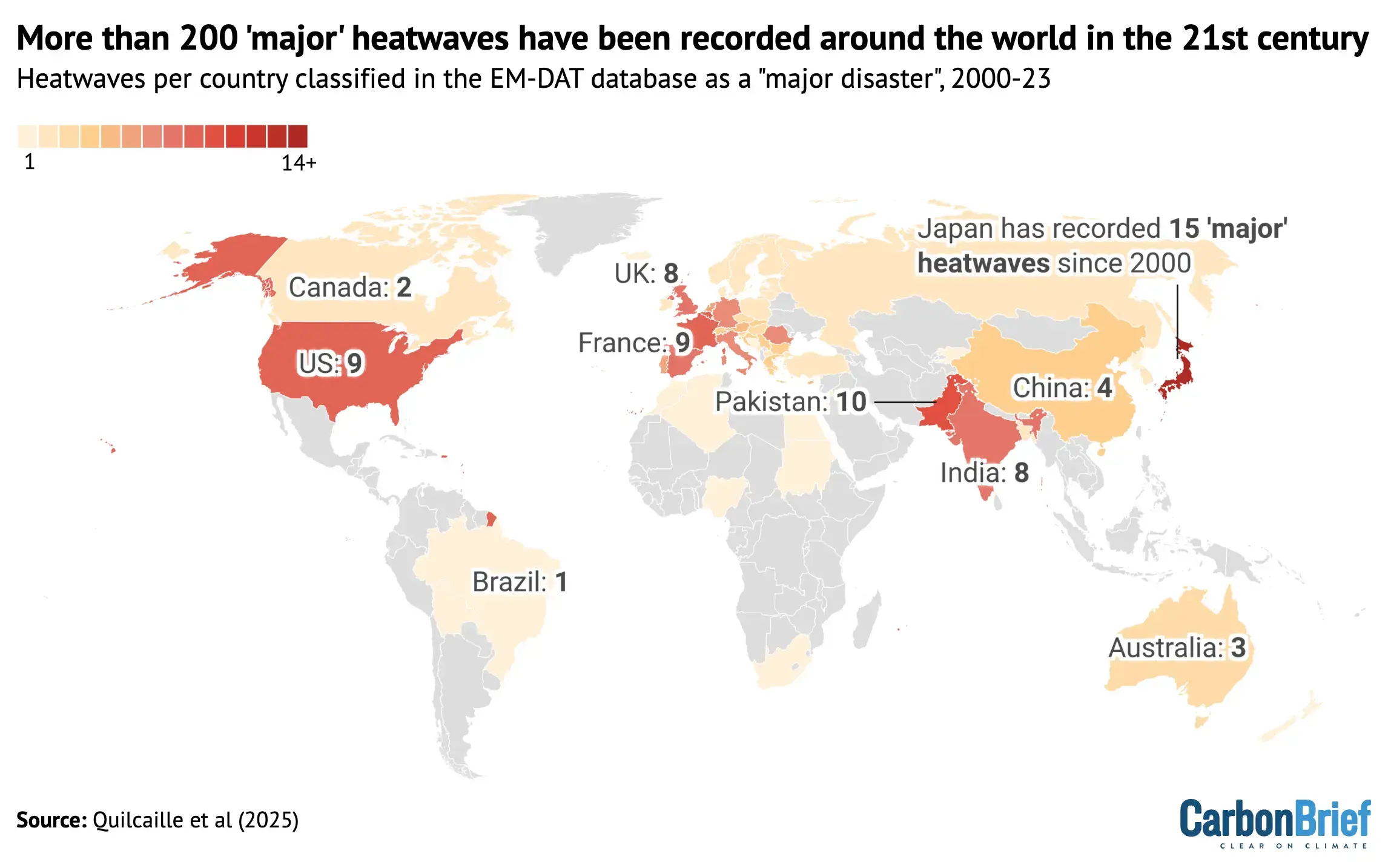
Between 2000 and 2023, the database lists more than 200 heatwaves. These are shown on the map below, where darker pink indicates a greater number of heatwaves. Countries with no reported heatwaves are shown in grey.
The map below shows the number of heatwaves per country recorded over 2000-23 on the EM-DAT database. Data: Quilcaille et al (2025).
The study authors acknowledge that heatwave reporting is “highly uneven”, with only nine of the heatwaves reported in the database since the year 2000 in Africa, Latin America or the Caribbean. (This is largely because extreme heat events in these regions are not routinely monitored.)
They then carried an attribution analysis on each heatwave to identify whether it was made more likely or intense due to human-caused climate change.
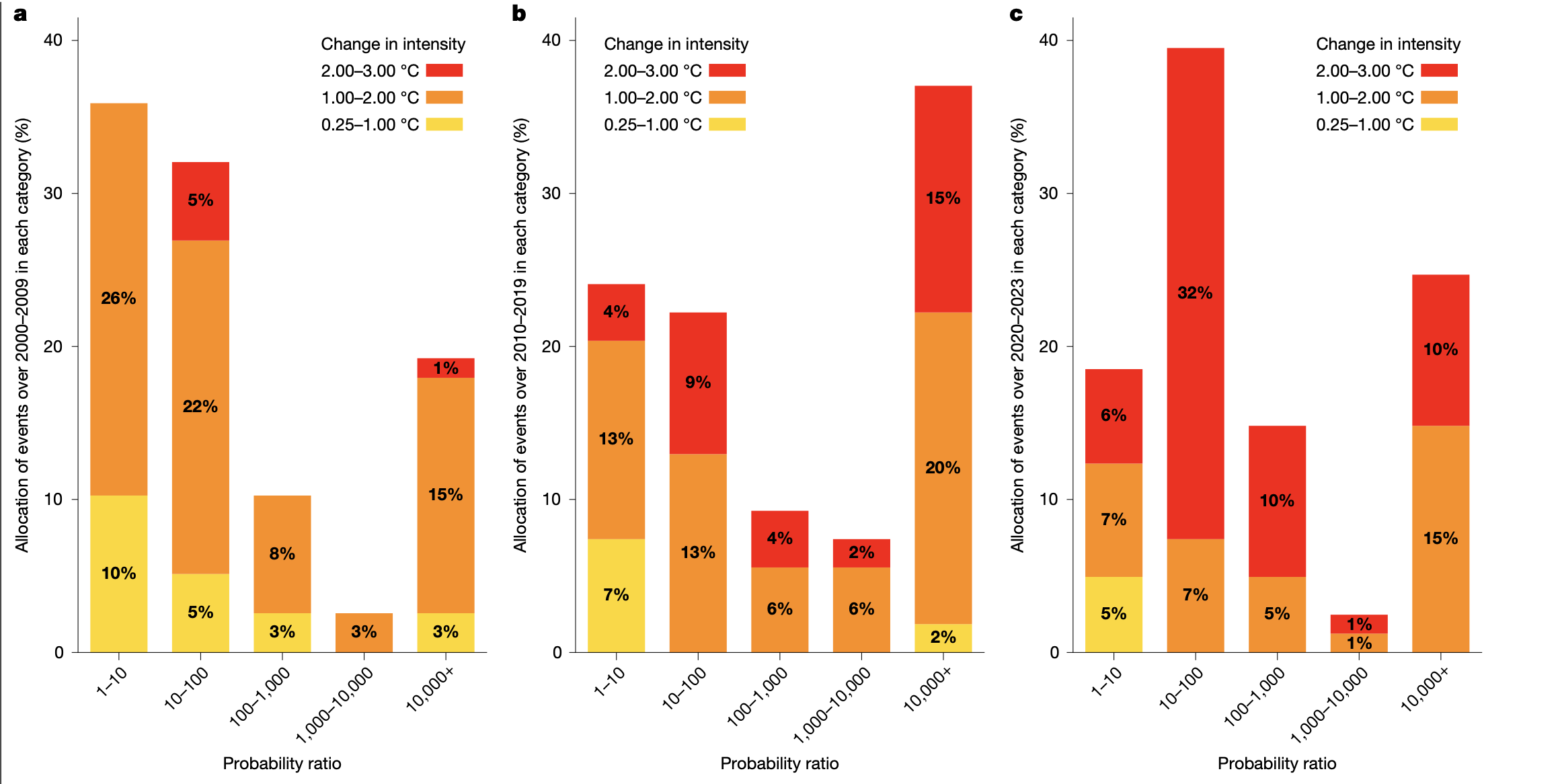
The chart below shows how climate changes increased the intensity and frequency of the 78 heatwaves assessed over 2000-09 (left), 54 heatwaves assessed over 2010-19 (middle) and 81 heatwaves assessed over 2020-23 (right).
The authors find that climate change increased the intensity and probability of all 213 heatwaves in the study. They add that the influence of climate change on heatwaves is strengthening over time.
In each panel, the bars show the percentage of heatwaves in that time period that were made 0.25-1.0C (yellow), 1.0-2.0C (orange) or 2.0-3.0C (red) hotter due to climate change.
The position of bars indicate the change in likelihood of the heatwaves. This ranges from those made 1-10 times more likely due to climate change (left-most bar in each panel) to those made more than 11,000 times more likely (right-most bar in each panel).
The extent to which climate changes increased the intensity and frequency of the 78 heatwaves assessed over 2000-09 (left), 54 heatwaves assessed over 2010-19 (middle) and 81 heatwaves assessed over 2020-23 (right). These are shown by colours and bar heights respectively. Source: Quilcaille et al (2025).
Heatwaves recorded over 2000-09 were, on average, 20 times more likely due to climate change, according to the authors. Meanwhile, those recorded over 2010-19 were about 200 times more likely.
Similarly, 2000-09 heatwaves were 1.4C hotter due to human-caused climate change on average, according to the study, while 2010-19 heatwaves were made 1.7C hotter.
The study finds that human-caused climate change made 55 heatwaves at least 10,000 times more likely. According to the authors, this is “equivalent to saying that they would have been virtually impossible” without the influence of human activity.
Carbon majors
To assess the contribution to heatwaves by oil and gas companies’ products, the authors use a database of carbon dioxide and methane emissions from 180 carbon majors over 1854-2023. This includes direct emissions from the companies, as well as the emissions released when the oil and gas they produced is used by others.
The 180 carbon majors in the database represent 60% of all human-caused CO2 emissions, including land use, over 1850-2023, according to the study. The paper adds that 14 companies, including ExxonMobil, BP, Saudi Aramco and Shell, are responsible for almost half of these emissions.
Using the Earth system model OSCAR, the authors estimate that global average surface temperatures increased by 1.3C between the 1850-1900 average and the year 2023.
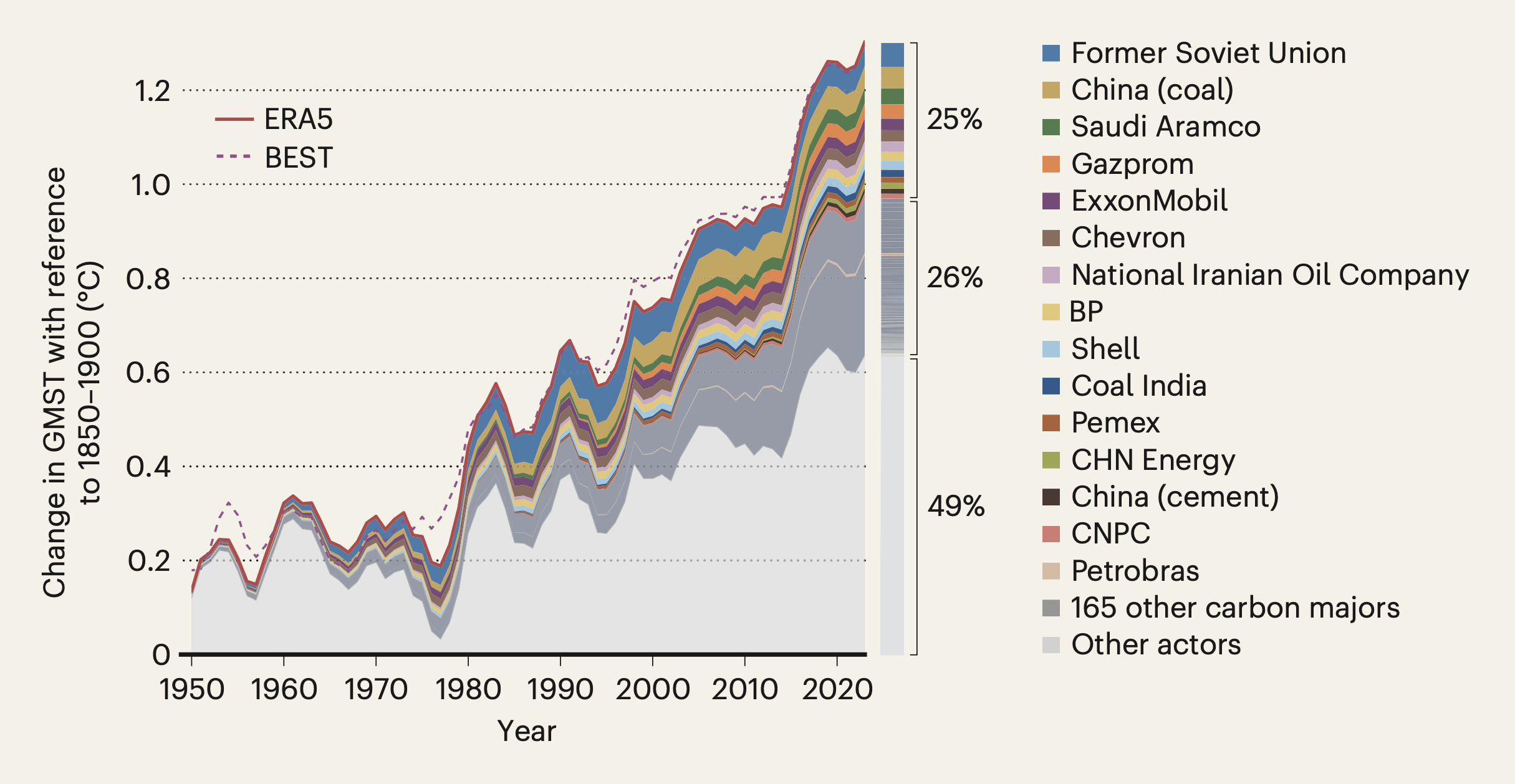
They find that 0.7C of this increase was linked to the carbon majors, with 0.3C due to the emissions of the 14 largest.
The chart below, taken from an accompanying Nature “news and views” article, shows the contribution of oil and gas companies’ products to increasing global average surface temperatures over 1950-2023, compared to the 1850-1900 average.
Each colour indicates a carbon major, while grey indicates other sources of temperature increase, such as land-use change.
The contribution of oil and gas companies to increasing global average surface temperatures over 1950-2023, compared to the 1850-1900 average. Each colour indicates a company, while grey indicates other sources of temperature increase. Source: Haustein (2025).
Heatwaves recorded over 2000-23 were, on average, 1.7C hotter due to climate change, according to the study. The authors find that emissions originating from carbon majors and their products contributed about half of the increase in intensity of heatwaves seen since pre-industrial times.
The authors then break down the contribution of emissions from each carbon major on each heatwave in their analysis.
For example, they find that the emissions linked to Saudi Aramco made 51 heatwaves at least 10,000 times more likely. They add that on average, emissions tied to the company made the 213 heatwaves 0.04C hotter.
Legal action
Attribution studies already play an important role in courts by providing evidence that helps judges to determine liability.
Dr Rupert Stuart-Smith is a research associate in climate science and the law at the University of Oxford’s Sustainable Law Programme. He was not involved in the study, but has published separate work showing that the emissions linked to each of the six largest corporate emitters cause one heat-related death in Zurich alone, every summer.
Stuart-Smith tells Carbon Brief that the new paper is a “high-quality analysis and a meaningful step forward for the field of climate change attribution”. He adds:
“With more and more lawsuits aiming to hold high-emitting companies responsible for their contributions to climate change impacts or compel state and corporate actors to reduce their emissions and prevent rising climate harms, work like this provides the basis for well-informed judicial decision-making.”
Dr Yann Quilcaille is a researcher at ETH Zürich and lead author of the study. He stresses the importance of attribution research for court cases, telling Carbon Brief that he hopes his work “can be used by legal practitioners”.
However, he also says that his role as a scientist is not to assign “responsibility” for climate change, but to “provide information to governments for decision making and to courts for litigation”.
Mankin tells Carbon Brief that the new paper is “very closely” linked to his research.
Callahan says the new paper is “an important contribution to an emerging literature that illustrates how individual emitters can be linked to the change risk of extreme climate conditions and human impacts”.
He explains that “this kind of evidence will be important in courtrooms – holding emitters legally accountable requires demonstrating a causal nexus between that emitter and a particularised harm suffered by a plaintiff”.
Attribution
The cutting-edge field of extreme weather attribution seeks to establish the role that human-caused warming played in these events. Attribution studies have been carried out on hundreds of heatwaves all around the world, as shown in Carbon Brief’s interactive map.
The new paper uses one of the earliest and most commonly used methods of attribution, called “probabilistic attribution”.
The authors first chose a temperature “threshold” to define their heatwave.
They then used a global climate model to simulate two worlds – one mirroring the world as it was during the heatwave and the other using the climate of 1850-1900. This second scenario is used to represent the climate in a world without human-caused climate change.
The authors run their models thousands of times in each scenario. As the world’s climate is inherently chaotic, each model “run” – individual simulations of how the climate progresses over many years – produces a slightly different progression of temperatures. This means that some runs simulate the heatwave, while others do not.
The authors count how many times the threshold temperature was in each model run. They then compared the likelihood of crossing the threshold temperature in the world with – and a world without – climate change.
For example, they find that the 2021 Pacific north-west heatwave was made 3.1C hotter due to human caused climate change and more than 10,000 times more likely.
(A study by the WWA at the time of the heatwave found that the heatwave was made 150 times more likely. The discrepancy is due to differences in the definition of the event, as well as its “very unlikely nature” according to the study authors.)
Dr Frederieke Otto is a professor at Imperial College London and founder of the WWA initiative. She tells Carbon Brief that the new study is “very similar to some other recent studies on impacts, based on the hazard attribution method used by WWA”, but says that “this is the most high profile and wide-reaching one”.
Otto adds:
“I do hope that many more impact attribution studies will follow, based on our or other extreme event attribution studies. We need more research on this.”
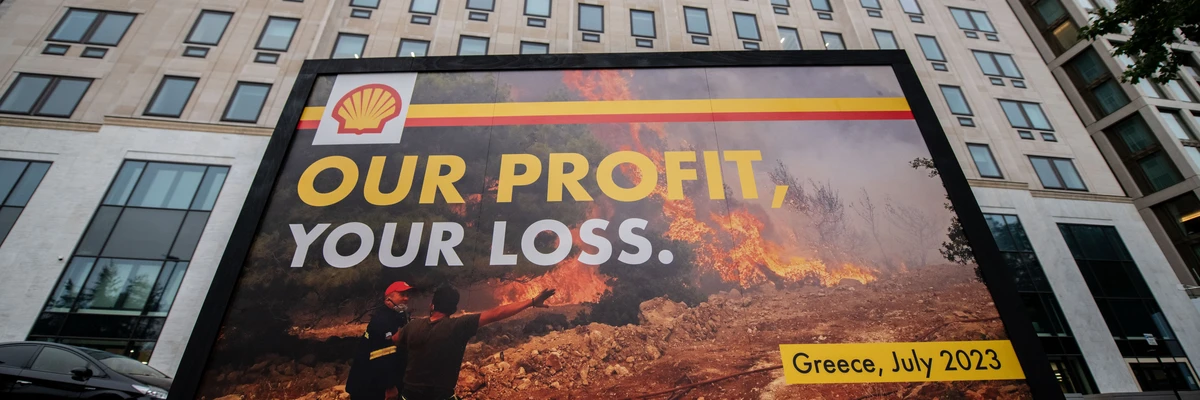
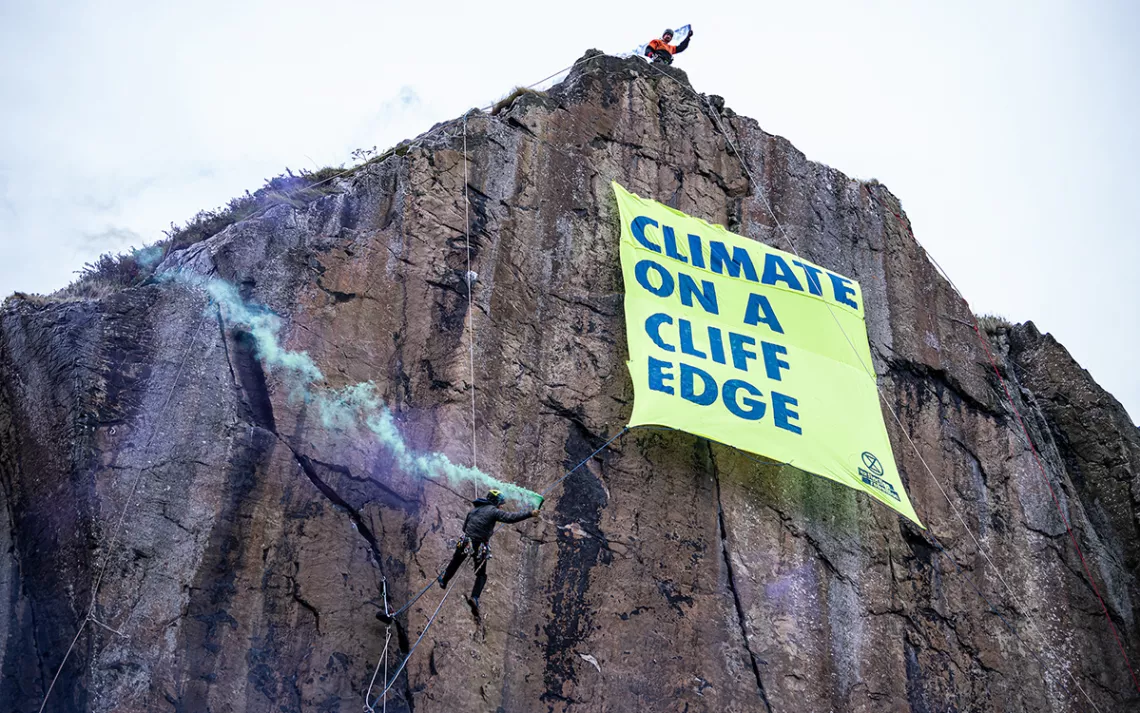
Donald Trump urges you to be a Climate Science denier like him. He says that he makes millions and millions for destroying the planet, Burn, Baby, Burn and Flood, Baby, Flood.Nigel Farage urges you to ignore facts and reality and be a climate science denier like him. He says that Reform UK has received millions and millions from the fossil fuel industry to promote climate denial and destroy the planet.Greenpeace activists display a billboard during a protest outside Shell headquarters on July 27, 2023 in London. (Photo: Handout/Chris J. Ratcliffe for Greenpeace via Getty Images)Experienced climbers scale a rock face near the historic Dumbarton castle in Glasgow, releasing a banner that reads “Climate on a Cliff Edge.” One activist, dressed as a globe, symbolically looms near the edge, while another plays the bagpipes on the shores below. | Photo courtesy of Extinction Rebellion and Mark Richards
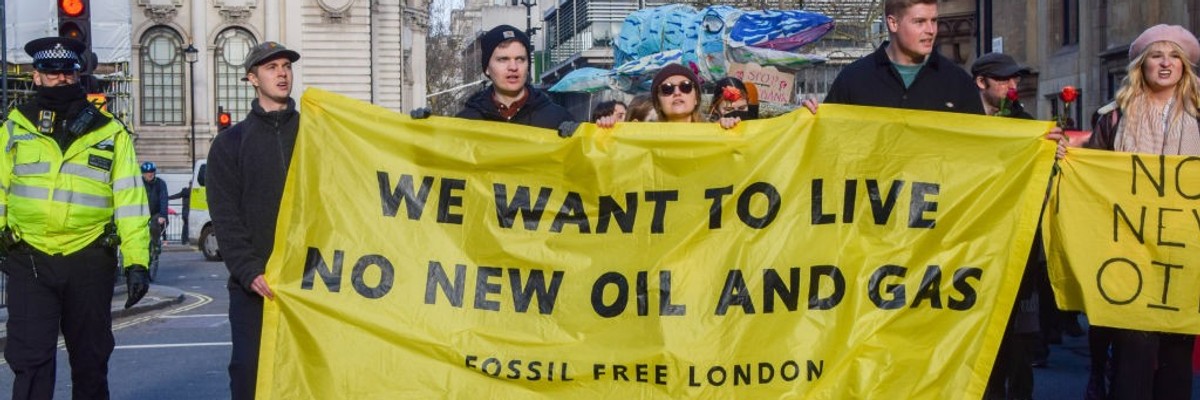
Protesters march with an anti-fossil fuel banner during the demonstration in London on January 15, 2023. (Photo: Vuk Valcic/SOPA Images/LightRocket via Getty Images)
“The only sensible thing to do is to pivot the North Sea to something we have an abundance of, and something that will never run out—wind,” argued one climate advocate.
As the United Kingdom on Monday faced the onset of its fourth heatwave of this summer, climate campaigners continued to call out BP for its decision to plow ahead with reopening the Murlach oil field in the North Sea, despite fossil fuels pushing up global temperatures and the U.K. government’s efforts to limit extraction in the region.
“This is climate vandalism, pure and simple,” Kate Blagojevic, Europe team lead at the group 350.org, said in a Monday statement. “BP is putting its profit margins above the survival of communities, ecosystems, and future generations. Every barrel of oil from this project pushes us closer to climate breakdown, more floods, more fires, more heatwaves.”
“The era of fossil fuels is over, and BP’s desperate attempts to wring out the last drops of oil from the North Sea are a reckless betrayal of the public and the planet. They should be winding down, not doubling down,” she declared.
Greenpeace U.K. policy director Doug Parr was similarly critical, saying in a statement that “the North Sea is on death’s door. Reserves are drying up, and what’s left and untapped is barely enough to keep it on life support.”
The Telegraph on Sunday noted recent research from the government’s North Sea Transition Authority that found there were over 3 billion barrels of oil and gas in fields already in production, 6 billion barrels in known potential developments, and 3.5 billion barrels in identified exploration zones.
According to the newspaper, BP said the Murlach field contains 20 million barrels of recoverable oil and 600 million cubic meters of gas, and is “expected to produce around 20,000 barrels of oil and 17 million cubic feet of gas per day,” due to new technologies that weren’t around when it was shut down over two decades ago.
Parr said that “3 billion barrels wouldn’t last more than a few years at current rates of consumption, and even that assumes it is economic to extract. Whatever the political rhetoric, the oil and gas is pretty much gone, and soon, so too will the jobs of thousands of workers.”
“Unless we want to remain dependent on overseas imports and watch an entire industry collapse with no plan for workers,” he added, “the only sensible thing to do is to pivot the North Sea to something we have an abundance of, and something that will never run out—wind.”
Although the U.K’s current Labour Party leaders have pledged to avoid new licensing for fossil fuel projects in the North Sea, “BP won agreement to reopen Murlach, 120 miles east of Aberdeen, under the previous government and has since been installing equipment, with production potentially restarting next month,” The Telegraph explained.
A spokesperson for Ed Miliband, U.K. secretary of state for energy security and net zero, said Sunday that “we are committed to delivering the manifesto commitment to not issue new licences to explore new fields because they will not take a penny off bills, cannot make us energy secure, and will only accelerate the worsening climate crisis.”
“We are delivering a fair and orderly transition in the North Sea, with the biggest ever investment in offshore wind and two first-of-a-kind carbon capture and storage clusters,” the spokesperson added.
Miliband in June announced new guidance for environmental impact assessments of proposed oil and gas projects in licensed fields, which came in response to last year’s landmark U.K. Supreme Court ruling. After that decision, Judge Andrew Stewart of Scotland’s Court of Session ruled in January that Equinor and Shell, which are respectively behind the Rosebank oil and gas field and the Jackdaw gas project, can’t move ahead with extraction.
The June guidance means offshore developers can now submit applications for extractions in fields that are already licensed, including Rosebank and Jackdaw. In response to that development earlier this year, Mel Evans, Greenpeace U.K.’s head of climate, said that “it’s only right for the government to take into account the emissions from burning oil and gas when deciding whether to approve fossil fuel projects currently pending.”
“Since Rosebank and other drilling sites will pump out a lot of carbon while providing little benefit to the economy and no help to bill payers, they should fail the criteria ministers have just set out,” Evans added. “Real energy security and future-proofed jobs for energy workers can only come through homegrown, cheap renewable energy, and that’s what ministers should focus on.”
Experienced climbers scale a rock face near the historic Dumbarton castle in Glasgow, releasing a banner that reads “Climate on a Cliff Edge.” One activist, dressed as a globe, symbolically looms near the edge, while another plays the bagpipes on the shores below. | Photo courtesy of Extinction Rebellion and Mark RichardsDonald Trump urges you to be a Climate Science denier like him. He says that he makes millions and millions for destroying the planet, Burn, Baby, Burn and Flood, Baby, Flood.Nigel Farage urges you to ignore facts and reality and be a climate science denier like him. He says that Reform UK has received millions and millions from the fossil fuel industry to promote climate denial and destroy the planet.
Last year, when UN Secretary General António Guterres said PR firms were “acting as enablers to planetary destruction” by working for fossil fuel clients, he didn’t name WPP specifically. But they were the main company he was talking about. The advertising behemoth has more clients in the oil industry than any rival.
Guterres, being a diplomat, uses mild language. In my opinion, WPP is the world’s leading spin doctor for planetary death.
And so I was surprised when I checked in on who David Lammy had appointed to the Foreign Office supervisory board, to see WPP’s recent UK President Karen Blackett is now one of the four non-executive directors – as I revealed last week over on Democracy for Sale.
The supervisory board provides “strategic direction,” and “oversight” for the department. Adverts for the roles say they are “significant contributors to both the operational and strategic leadership of the department. Their primary objective is to bring independent advice, support and challenge… helping to shape the department’s work.”
In February, lawyers for campaign group Badvertising and others submitted a complaint about WPP to the Organisation for Economic Co-operation and Development, arguing it was breaching its international guidelines on corporate responsibility. Its work for a number of fossil fuel and pollution intensive corporations, the lawyers said, “directly increases demand for carbon intensive products and undermines global efforts to reduce greenhouse gas emissions”.
Why is that an organisation whose recently departed UK boss you’d want overseeing British foreign policy? Blackett spent 29 years working for WPP – three decades as a spin doctor at an advertising behemoth which represents some of the most destructive corporations on the planet. How can her advice possibly be independent? How can the perspectives and viewpoints of clients not have imprinted on her?
As the Badvertising website says, “for every rights-abusing, climate-wrecking corporation, there’s an advertising agency working hard to clean up their public image. And no one does this better than the world’s biggest ad firm, WPP”.
Last month, climate activists occupied WPP’s London headquarters, demanding it cut ties with clients including Shell, BP, Total, ExxonMobil, Drax and Saudi Aramco.
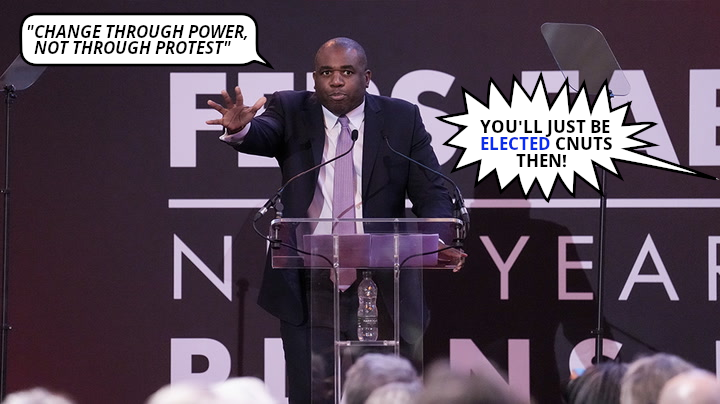
UK Labour Party Shadow Foreign Secretary repeatedly heckled at a speech to the Fabian Society over his and the Labour Party’s support for and complicity in Israel’s genocide of Gaza.Greenpeace activists display a billboard during a protest outside Shell headquarters on July 27, 2023 in London. (Photo: Handout/Chris J. Ratcliffe for Greenpeace via Getty Images)Experienced climbers scale a rock face near the historic Dumbarton castle in Glasgow, releasing a banner that reads “Climate on a Cliff Edge.” One activist, dressed as a globe, symbolically looms near the edge, while another plays the bagpipes on the shores below. | Photo courtesy of Extinction Rebellion and Mark Richards