NHS news review

Spread the love

Labour intends to force a vote in the Lords to suspend considering the Health and Social Care / Destroy the NHS Bill until the secret report on its risks to the NHS is released by the Con-Dem scum government. The Information Commissioner has ruled that the suppressed report should be published.

I can exclusively reveal a brief summary of the suppressed report. It says “The Health and Social Care Bill is likely to destroy the NHS as a viable health care system. Having abolished the NHS, private healthcare and health insurance will develop on the American model. The plebs will be f****d but the ultra-rich who don’t use the NHS will be fine”.

The government suffered a minor defeat on the Health and Social Care / Destroy the NHS Bill in the House of Lords over the issue of charities having to pay VAT. There is symbolism to this defeat i.e. further aspects can be defeated.

Cathy Warwick, chief executive of the Royal College of Midwives has criticied the Health and Social Care / Destroy the NHS Bill as a ‘pointless waste’ and attacked the banks for causing the huge national debt.
UK Uncut

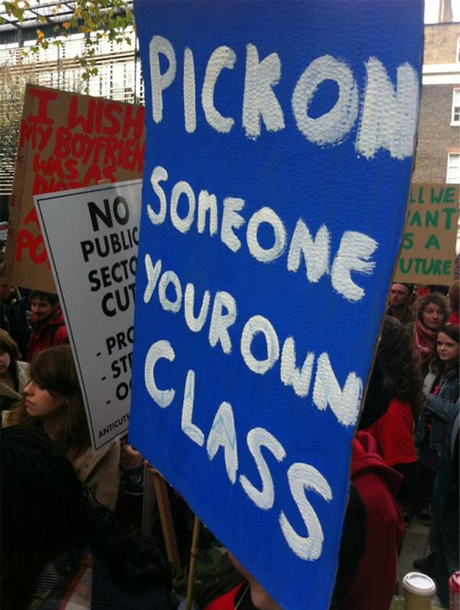
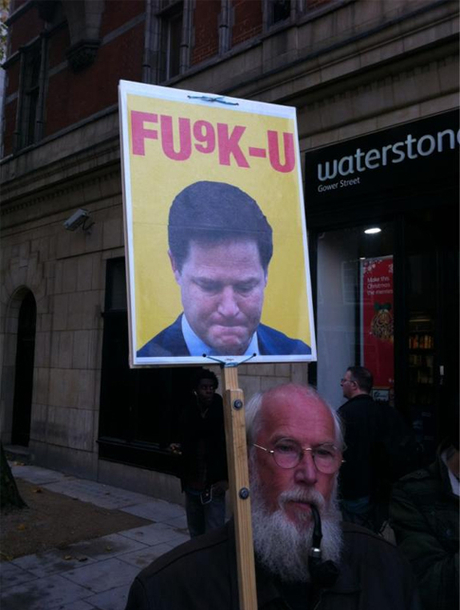
Student protest November 9, 2011

Philip Green is a multi-billionaire businessman, who runs some of the biggest names on British high streets. His retail empire includes brands such as Topshop, Topman, Dorothy Perkins, Burton, Miss Selfridge and British Home Stores.

Philip Green is not a non-dom. He lives in the UK. He works in the UK. He pays tax on his salary in the UK. All seems to be in order. Until you realise that Philip Green does not actually own any of the Arcadia group that he spends every day running. Instead, it is in the name of his wife who has not done a single day’s work for the company. Mrs Green lives in Monaco, where she pays not a penny of income tax.

In 2005 Philip Green awarded himself £1.2bn, the biggest paycheck in British corporate history. But this dividend payout was channeled through a network of offshore accounts, via tax havens in Jersey and eventually to Green’s wife’s Monaco bank account. The dodge saved Green, and cost the tax payer, close to £300m. This tax arrangement remains in place. Any time it takes his fancy, Green can pay himself huge sums of money without having to pay any tax.

Before the election, the Lib Dems liked to talk tough on tax avoiders. But as soon as they entered the coalition, this pre-election bluster became just another inconvenient promise they quietly forgot. In August David Cameron appointed the country’s most notorious serial-tax avoider to advise the government on how best to slash public spending. Not a single Lib Dem minister uttered a word of complaint. A Guardian editorial denounced this as “shameful”.

Philip Green’s £285m tax dodge could pay for:

* The full, hiked up £9,000 fees for almost 32,000 students
* Pay the salaries of 20,000 NHS nurses

And if that’s not reason enough to take action against Sir Philip, it is worth noting that he has built his £5bn fortune on the back of sweatshop labour, using Mauritius sweatshops where Sri Lankans, Indians and Bangladeshis toil 12 hours a day, six days a week, for minimal pay.

In the press

* Philip Green is an odd choice for efficiency tsar
* Philip Green’s tax affairs should be investigated, Lib Dem MPs urge
* Sir Philip Green under attack over personal tax affairs
* Vince Cable’s dig at Sir Philip Green’s tax status
* Sir Philip Green tax avoider gets job on the side
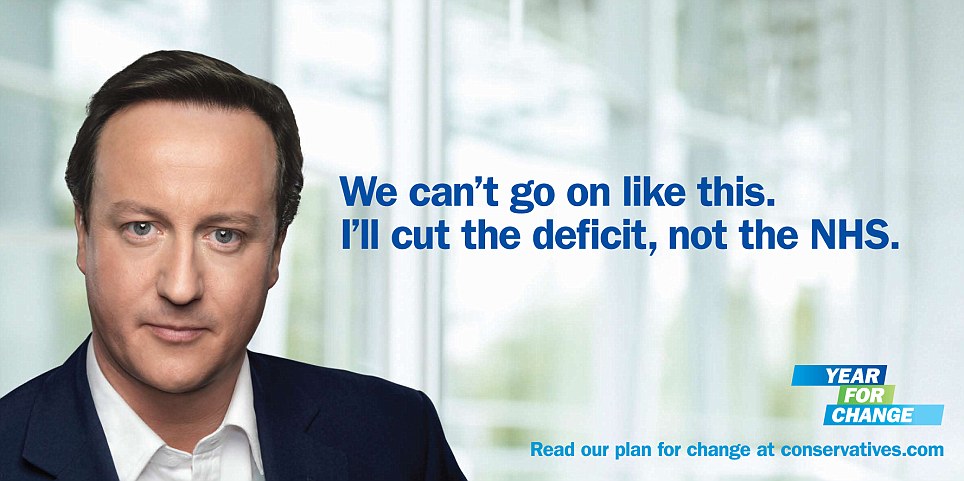
Conservative election poster 2010

A few recent news articles about the UK’s Conservative and Liberal-Democrat (Conservative) coalition government – the ConDem’s – brutal attack on the National Health Service.

Labour to force early vote on secret NHS report – Burnham & Thornton | The Labour Party

Labour will force a vote in the House of Lords this Wednesday to put further pressure on the Government to release its assessment of the risks to the NHS posed by its re-organisation.

Last week, the Information Commissioner ordered the release of the Department’s risk register, following pressure by Labour. The Government has fought to keep it out of the public domain and has yet to respond to the ruling.

On Wednesday, Labour will ask the House of Lords to postpone further consideration of the Health & Social Care Bill until the register has been released.

Andy Burnham MP, Labour’s Shadow Health Secretary, has today written to Andrew Lansley requesting immediate release and said:

“Following this ruling, Andrew Lansley has nowhere left to hide. The information is vital to a full understanding of his Bill and the risks it poses to the NHS.

“I have always said that combining the biggest ever reorganisation and facing the financial challenge will expose the NHS to unacceptable risk.

“The ruling clearly said it’s in the public interest to have this information in the public domain. If he digs in and fights this, people will begin to ask what has the Health Secretary has to hide.”

Baroness Thornton, Labour’s Shadow Health Minister, speaking at the start of proceedings this afternoon, described the document’s publication as “completely pertinent” to the passage of the Bill through the Lords. Glenys Thornton called on the Government to make the document readily available before Wednesday, or Labour will force a vote in the Lords to suspend the Bill’s reading until the register is released.

Express.co.uk – Home of the Daily and Sunday Express | UK News :: Government defeated over NHS reform

The Government has suffered a defeat in the Lords over its controversial health care reforms.

The Government has suffered a defeat in the Lords over its controversial health care reforms.

Peers voted by 195 to 183, majority 12, to require the Health Secretary to report on the VAT treatment of supplies by charities providing health care services for the NHS.

It was the first defeat inflicted on ministers during the Health and Social Care Bill’s marathon 14-day report stage.

Moving the amendment to the Bill, Labour’s Lord Patel of Bradford warned of “major inequality” over irrecoverable VAT for charities providing health care services.

He said that while the NHS was able to recover VAT on certain supplies, charities were not.

And when services were transferred from the NHS to the charitable sector there was a “VAT gap” that had to be filled by charitable funds.

NHS reforms are a ‘pointless waste’ top midwife warns – Telegraph

The NHS reforms are ‘yet another pointless reorganisation’ that will ‘waste’ several billion pounds, the head of the Royal College of Midwives has warned.

Cathy Warwick, chief executive of the College, said the reforms, which will see doctors-led groups handling most of the NHS budget, were ‘risky and ill-thought through’.

Speaking at the annual conference in Brighton, Prof Warwick also attacked the banks, saying irresponsible and reckless behaviour’ had caused the huge national debt and the pensions of public sector workers, including midwives, were being sacrificed to clear the black hole.

She warned that maternity services were being stretched and midwives’ pensions were being sacrificed in order to clear the national debt ’caused by the irresponsible and reckless behaviour of the banks’.

The proportion of NHS money spent on maternity care is at its lowest point since the 1990s, Prof Warwick said, despite the country facing a major baby boom.

She added: “There is a growing disparity between the increasing demands that are made on midwives and the dwindling resources that they have at their disposal.

“This is compounded by a widening gap between the rhetoric about how maternity services should be and the reality that midwives experience on a daily basis.

“When it comes to staffing, the rhetoric is that there are more midwives than ever before.

“The reality in England is that the midwifery shortage is becoming a crisis.

“Yes the number of midwives in England has increased but by nowhere near enough to keep pace with the growth in their workload.”

On funding, she said the rhetoric was that the NHS budget has been maintained and there are no cuts to front line services.

“The reality, as you will know all too well, is that budgets are being squeezed and services are being cut.”

Continue ReadingNHS news review

NHS news review

Spread the love

Many commentators are critical of private company Circle Health running Hinchingbrooke hospital. Andrew Lansley and Con-Dem scum claim that they are not privatising the NHS…

Circle admits that care at the Hinchingbrooke is at risk:

“Circle’s growth has placed, and its anticipated growth will continue to place, a strain on its managerial, administrative, operational, financial, information technology and other resources and could affect its ability to provide a consistent level of service to its patients.”

Conservative election poster 2010

A few recent news articles about the UK’s Conservative and Liberal-Democrat (Conservative) coalition government – the ConDem’s – brutal attack on the National Health Service.

Andrew Lansley’s NHS is all about private sector hype | John Lister | Comment is free | guardian.co.uk

Circle has little know-how on running a hospital the size of Hinchingbrooke, but that doesn’t seem to bother the government

The government’s decision to sign a 10-year contract worth £1bn for an untested private company to manage the heavily indebted Hinchingbrooke hospital really is the triumph of hype over experience.

The hype has come thick and fast from Circle Healthcare’s smooth-talking boss, former Goldman Sachs banker Ali Parsadoust (known as Ali Parsa), who gives the impression that Circle is some kind of altruistic workers’ co-operative, while in fact it is controlled by private equity and hedge funds. Far from handing control to the workers, Circle takes a negative view of trade unions and will have to resort to old-fashioned cuts in the workforce if it is to generate the “efficiency savings” it needs to put the hospital into surplus.

More hype has come from the architect of the contract, NHS East of England’s director of strategy Dr Stephen Dunn, an enthusiastic advocate of private sector provision (which he denies is privatisation), whose unstinting efforts to secure this deal won him an award this year from HealthInvestor magazine.

But there is little in Circle’s record to justify Dunn’s belief that the company has the expertise to take on a project on the scale of Hinchingbrooke. The company has yet to make a success even of running its two tiny (30-bed) private hospitals, which were extravagantly expensive to build, and has run up six years of losses so far: hardly a good base to take on the bigger challenge of managing of a debt-ridden NHS general hospital 10 times the size and many more times more complex.

Even the NHS workforce that Circle will be attempting to manage at Hinchingbrooke is three times larger than the grand total of 568 people working for the whole Circle group. Only one of the company’s senior managers has any experience of managing an NHS hospital and he has left the company to rejoin the NHS. And so far they have set out no concrete proposals on how they plan to save money and turn around the finances when they take over in February.

The uncertainty over the Hinchingbrooke contract is even greater since Circle will only be paid a share of any surplus the hospital makes. It might not make any. The PCT (and GP commissioners) are trying to cut the numbers of patients treated in hospital, and squeezing down tariffs for treatment as part of the NHS-wide drive to make £20bn of “efficiency savings” by 2014.

But as it takes over Hinchingbrooke, Circle’s own financial situation is worrying. It has already lost two ISTC contracts: and its £34m-a-year ISTC contract in Nottingham, currently the company’s main income stream, has only two more years to run. In the last three years Circle’s losses were £40m, £20m and £35m. Its new showpiece hospital in Bath has only just begun to generate a modest trickle of income.

The Hinchingbrooke contract is a gamble with high stakes, and with only slim chances of success: yet remarkably it’s already being discussed as a model for other struggling trusts. Don’t ask for evidence, just go with the private sector hype. That’s the future under Lansley’s NHS.


NHS privateer: Care is at risk / Britain / Home – Morning Star

The first private company to take over the running of an NHS hospital has admitted that patient care may have to take a back seat to its ambition to buy up more public hospitals.

Circle Health, which has been awarded a £1 billion contract to take over the running of Hinchingbrooke hospital in Cambridgeshire, said in a share prospectus that it plans to take over more NHS hospitals, but patient care may be affected.

“As well as the establishment of further independent hospitals, Circle intends to significantly expand its NHS business,” the company states.

“Circle’s growth has placed, and its anticipated growth will continue to place, a strain on its managerial, administrative, operational, financial, information technology and other resources and could affect its ability to provide a consistent level of service to its patients.”

Campaign group Health Emergency and Unison have already raised concerns as to how Circle, which recorded losses of over £27 million from its own clinics last year, can successfully combat the £39m debt run up at Hinchingbrooke.

The latest revelation indicates that Circle is in agreement with its critics.

Unison head of health Christina McAnea said: “Circle’s takeover of Hinchingbrooke is an accident waiting to happen.

“The company is currently in a vulnerable state and the takeover could lead to a second Southern Cross, putting patients at serious risk.

“Their management band is stuffed full of bankers and managers from private industry, who have no experience of health care.

“Yet this is a company now responsible for the lives of hundreds of thousands of patients.

“The hospital could have been kept running for the benefit of patients, rather than profiteers.

“This must not become a precedent for the NHS, or millions more staff and patients will be put at risk.”

Related: Care may suffer, admits private company taking over NHS hospital | Politics | The Observer

Continue ReadingNHS news review

NHS news review

Spread the love

Conservative election poster 2010

A few recent news articles about the UK’s Conservative and Liberal-Democrat (Conservative) coalition government – the ConDem’s – brutal attack on the National Health Service.


The Evening Standard has secured a decision by the Information Commissioner Christopher Graham that Lansley and the ‘Department of Health’ has to publish a secret report on the risks being taken with the NHS.

“The document is expected to reveal the risks to patient safety, finances and the very workings of the NHS from the unprecedented reshaping of the health service.”

Andrew Lansley ordered to reveal secret health report | Politics

Labour’s former health spokesman John Healey, who put in a similar FOI request for the risk documents which was also upheld by the Information Commissioner’s Office, was scathing about the department’s conduct.

He said: “The year-long cover-up is a disgrace, especially when doctors, nurses, patients groups and the public are all so worried about the Tories’ NHS plans. The commissioner’s report is a demolition job of Lansley’s attempts to keep the truth from the public.”

He called on David Cameron to order the Health Secretary to “hand over the documents in full”.

In his ruling, Mr Graham said: “Disclosure would significantly aid public understanding of risks related to the proposed reforms and it would also inform participation in the debate about the reforms.”

Many commentaries on the private company Circle Healthcare running Hinchingbrooke hospital.

Andrew Lansley’s NHS is all about private sector hype | John Lister | Comment is free | guardian.co.uk

The government’s decision to sign a 10-year contract worth £1bn for an untested private company to manage the heavily indebted Hinchingbrooke hospital really is the triumph of hype over experience.

The hype has come thick and fast from Circle Healthcare’s smooth-talking boss, former Goldman Sachs banker Ali Parsadoust (known as Ali Parsa), who gives the impression that Circle is some kind of altruistic workers’ co-operative, while in fact it is controlled by private equity and hedge funds. Far from handing control to the workers, Circle takes a negative view of trade unions and will have to resort to old-fashioned cuts in the workforce if it is to generate the “efficiency savings” it needs to put the hospital into surplus.

More hype has come from the architect of the contract, NHS East of England’s director of strategy Dr Stephen Dunn, an enthusiastic advocate of private sector provision (which he denies is privatisation), whose unstinting efforts to secure this deal won him an award this year from HealthInvestor magazine.

But there is little in Circle’s record to justify Dunn’s belief that the company has the expertise to take on a project on the scale of Hinchingbrooke. The company has yet to make a success even of running its two tiny (30-bed) private hospitals, which were extravagantly expensive to build, and has run up six years of losses so far: hardly a good base to take on the bigger challenge of managing of a debt-ridden NHS general hospital 10 times the size and many more times more complex.

Even the NHS workforce that Circle will be attempting to manage at Hinchingbrooke is three times larger than the grand total of 568 people working for the whole Circle group. Only one of the company’s senior managers has any experience of managing an NHS hospital and he has left the company to rejoin the NHS. And so far they have set out no concrete proposals on how they plan to save money and turn around the finances when they take over in February.

Bungling privateer takes over Hinchingbrooke hospital / Britain / Home – Morning Star

A health privateer that posted millions in losses last year became the first company to get the green light to take over an NHS hospital today.

Circle, described as a “John Lewis-style” business because it is partly owned by clinicians, has signed a 10-year contract worth £1 billion to run Hinchingbrooke Health Care NHS Trust in Cambridgeshire.

The contract, which starts in February, marks the first time a private company delivers a full range of NHS district general hospital services.

Other firms only operate units within the NHS, such as hip replacement centres.

Unison head of health Christina McAnea warned that the takeover was “an accident waiting to happen,” put patients at risk and could lead to a second Southern Cross-style crisis.

The company has been given the task of combating Hinchingbrooke’s £39 million debt – though Circle itself recorded £27.4m losses in 2010.

Health Emergency director John Lister said the sums didn’t add up.

“It defies all logic when Circle cannot make a profit on its own tiny hospitals that it be handed over the running of an entire NHS hospital,” he said.

“Hinchingbrooke is 10 times bigger than any hospital Circle has ever run, with a vastly larger workforce as well as A&E.

“It will be totally out of its depth.”

How the Tories fake co-op friends are biting a chunk out of the NHS | openDemocracy


Today you will hear repeated mentions of ‘mutualism’ and ‘employee owned’. Indeed, journalists are being briefed that Circle is what ministers regard as a model mutual – a ‘John Lewis’ approach to public services. Circle even provides information, via the Cabinet Office’s mutual helpline, about setting up new healthcare mutuals.

Circle is not a mutual. Indeed, it stretches the term slightly to call John Lewis a mutual (rather than an employee owned partnership). Circle Healthcare is minority owned by senior clinicians – not all of the hospital staff – and majority owned by private backers, including major Conservative Party donors. It is a listed business with the primary purpose of turning a profit, rather than delivering benefit to its members (let alone patients).

To use the term “mutual” in the same breath as “Circle Healthcare” is crass misrepresentation. It is a discredit to the century and a half development of the co-operative and mutual movement, which grew from working people pooling their resources to benefit themselves and their communities, intimately entwined with the labour and trades union movements.

RCN demands transparency as firm takes over hospital | News | Nursing Times

The Royal College of Nursing today called for full “openness and transparency” over the deal signed by the government last night which hands a private company management control of an NHS trust.

The contract, signed at 11pm on Wednesday night hands Circle Health a 10-year management franchise of Cambridgeshire-based Hinchingbrooke Health Care Trust, beginning in February 2012.

Royal College of Nursing chief executive and general secretary Peter Carter said the deal was a “hugely significant development, with wider implications for the provision of health services across the UK”.

He added: “It is vital that there is full openness and transparency around the deal and that Circle continues to provide a comprehensive range of services that can be easily accessed by the local community.

“We know the NHS is under huge financial pressure to save £20 billion by 2014 and that Hinchingbrooke Hospital is carrying about £40m of debt. These financial gaps must not be plugged by cutting local services such as accident and emergency in the future.

Continue ReadingNHS news review

NHS news review

Spread the love

Clare Gerada discusses her opposition to the Health and Social Care / Destroy the NHS Bill.

Private company Circle to run a hospital for profit.

Tax boss most wined and dined mandarin – study | Business | The Guardian

HMRC head David Hartnett attended 107 events in three years, with accountancy firms among those extending largesse

Britain’s most senior official in charge of collecting tax was named yesterday as the most wined and dined mandarin in Whitehall. According to an investigation, David Hartnett, the permanent secretary for tax at HM Revenue and Customs, accepted invitations to eat and drink 107 times over the past three years.

Prominent among those extending corporate largesse were the top accountancy firms, which are paid by big business to find ways of avoiding paying tax.

Hartnett, 59, who lists his recreations as food and wine in Who’s Who, has been accused of being too cosy with large corporations. He emerged top of the league in an investigation by the Bureau of Investigative Journalism, a not-for-profit body based at City University London, which collated more than 3,000 instances of hospitality given to top civil servants in the past three years.

Hartnett sat down with representatives of the “big four” accountancy firms 27 times. He ate with KPMG 10 times and went to one reception. He also accepted hospitality from PricewaterhouseCoopers seven times, Ernst & Young four times and Deloitte three. Last September he clocked up four dinners, two lunches and two breakfasts paid for by, among others, unnamed private equity chief executives, PWC and KMPG. On 17 September he had breakfast courtesy of the now merged City firms JP Morgan and Cazenove, followed by lunch the same day with accountants from BDO Stoy Hayward.

Corporate hospitality is part of Hartnett’s approach to raising tax from big firms. Rather than confronting them, he has relied on persuading them to pay their share of tax.

Protesters demand resignation of HMRC boss for colluding with tax avoiders | Left Foot Forward

Protesters are descending on Whitehall today to demand the resignation of HM Revenue & Customs (HMRC) boss Dave Hartnett for his role in approving deals that allow big companies to avoid billions in tax.

Activists from UK Uncut and Occupy London are protesting Hartnett’s role in approving “secret sweetheart deals” to allow feral companies to dodge billions in tax – money that could have been used to fund public services going into the pockets of the irresponsible rich.

Hartnett was made to answer MPs’ questions over the scandal, which enabled Vodafone and Goldman Sachs to effectively rob the taxpayer of £6 billion and £10 million respectively. MPs on the public accounts committee have accused Hartnett of abusing his position to “cover up his own mistakes”.

A survey in 2010 revealed Hartnett to be Britain’s most ‘wined and dined’ civil servant, treated by corporations 107 times in three years. Commentators from across the political spectrum and even Conservative MPs have also called on Hartnett to resign.

As Occupy London’s Kyshia Davey says:

“HMRC has just announced it will be going after 146,000 pensioners to demand hundreds of pounds from them following a tax code cock-up. Meanwhile, its boss is striking secret deals with opulent corporations to let them off billions of pounds in tax.

“Hartnett is fatally undermining public confidence in the UK’s tax system at a time of austerity and he must resign immediately.”

And UK Uncut’s Sam Gilbert adds:

“Whilst 25,000 rank-and-file staff at HMRC have been fired, leaving the organisation almost incapable of functioning, Hartnett has been carving out a career as the most ‘wined and dined’ civil servant in Whitehall.

“The money from Vodafone’s £6bn tax dodge alone could have prevented all of the cuts in public services over the past year.”

All in it together?

MPs hit out at Vodafone ‘tax let-off’ – UK Politics – UK – The Independent

HM Revenue & Customs officials were criticised yesterday for
allowing Vodafone to pay just £1.25bn in a tax dispute with the
Government, despite a potential tax bill of what could be as much
as £8bn.

MPs from the Commons Public Accounts Committee quizzed tax officials over deals made with Vodafone and investment bank Goldman Sachs. HMRC branded reports earlier this year that Vodafone escaped paying £6bn in tax “absurd”.

But Stephen Barclay, an MP on the committee, put the possible sum even higher. “We are looking at potentially £8bn of tax lost,” he said. “We’re looking at a company that was given five years to pay even though it was sitting on a cash pile.”

HMRC officials were also questioned about a debt deal with Goldman Sachs, which is believed could have cost the taxpayer a potential £10m.

Tax chief Dave Hartnett said an error that slashed Goldman Sachs’ debt was dealt with through a staff member’s annual appraisal. HMRC has been accused of giving Goldman a “sweetheart” deal that waived £10m of interest on a £30m bill from a failed tax avoidance scheme on bankers’ bonuses. Mr Hartnett is said to have personally sealed the agreement with a Goldman executive last November, after being advised by an official that there was a “legal impediment” to charging interest.


Conservative election poster 2010

A few recent news articles about the UK’s Conservative and Liberal-Democrat (Conservative) coalition government – the ConDem’s – brutal attack on the National Health Service.

New Statesman – Royal College of GPs chair attacks NHS reforms

Royal College of GPs chair attacks NHS reforms

Clare Gerada tells the New Statesman: “This reform is so large you can see it from outer space”

In this week’s magazineClare Gerada, physician and chairman of the Royal College of General Practitioners, talks to the New Statesman’s Sophie Elmhirst about her fears for the future of the NHS, David Cameron’s betrayal, and the ways in which patients will suffer as a result of Health Secretary Andrew Lansley’s reforms:

We’ve got three big things going on at the same time – a massive reorganisation of the health service, alongside a serious financial situation, alongside the NHS having to make £20bn efficiency savings. So it is difficult to say which one is going to cause “X, Y, Z”, but certainly patients are going to experience longer waiting lists; they’ll see less choice available. Irrespective of whether the government says there is going to be more choice: there won’t be more choice.

In line with the General Practitioners’ Committee’s stance against the reform bill’s Quality Premium, Gerada is outspoken about performance-related bonuses for GPs:

In the [reform] bill, the government is suggesting that GPs be rewarded for keeping in budget. There is no problem in GPs having an incentive to practise good, evidence-based medicine. Where it becomes a step too far is where we are rewarded for keeping patients out of hospital. Because you have to trust me, you have to trust that I have stopped you from going to hospital because it is in your best interests, not because I am going to get £10, £15, £20 or whatever it is. And that begins to distort the doctor/patient relationship, which has to be fundamentally built upon trust — otherwise what’s the point of it?

Gerada speaks of being “absolutely surprised” by the reforms proposed by a coalition government she has had no discussions with:

Like others, I heard David Cameron say “no top-down reorganisation of the NHS”. I was so relieved, because I had lived through 15 reorganisations . . . [But this reform] isn’t so much putting GPs in charge of commissioning, but about dismantling the systems and the architecture of the NHS.

The NHS is our NHS. It is one of the last things that we as the people – the taxpayers – own, and by owning it our Health Secretary and our parliament is responsible for it. For £120 billion of taxpayers’ money, somebody has to be accountable to parliament. . . . It is symbolic if [Health Secretary Andrew Lansley] is no longer accountable for our national health service.


BBC News – Circle in deal to run Hinchingbrooke NHS hospital

A groundbreaking £1bn, 10-year deal for a private firm to run a struggling NHS hospital has been confirmed.

Circle, which is part-listed on the London Stock Exchange, is to take over Hinchingbrooke hospital in Huntingdon, Cambridgeshire, from 1 February 2012.

The deal will see Circle assume the financial risks of making the hospital more efficient and paying off its debts but the hospital will stay in the NHS.

The company must maintain services but unions fear staff numbers could be cut.

Although private sector firms already operate units that treat NHS patients – such as hip replacement centres – the firm will become the first non-state provider to manage a full range of NHS district general hospital services.

Hinchingbrooke hospital is one of about 20 hospitals in England which has faced an uncertain future, and the possibility of closure, because of long-term financial problems.

It is carrying about £40m of debt and its financial status has been given a high risk red rating by the NHS. The franchise deal with Circle was developed after concerns that the hospital had become unviable, and a local campaign to maintain services.

Circle describes itself as a social enterprise because 49.9% is owned by a partnership of employees. Others see it as a private business as the rest is owned by its parent company, Circle Holdings, which is listed on the stock market.

27/11/13 Having received a takedown notice from the Independent newspaper for a different posting, I have reviewed this article which links to an article at the Independent’s website in order to attempt to ensure conformance with copyright laws.

I consider this posting to comply with copyright laws since
a. Only a small portion of the original article has been quoted satisfying the fair use criteria, and / or
b. This posting satisfies the requirements of a derivative work.

Please be assured that this blog is a non-commercial blog (weblog) which does not feature advertising and has not ever produced any income.

dizzy

Continue ReadingNHS news review

NHS news review

Spread the love

Bob Hudson discusses how Lansley and the ConDems are getting away with destroying the NHS.

NHS cuts in North Yorkshire.

Wendy Savage supports the campaign to prevent NHS Gloucestershire transferring community hospitals to a Community Interest Company.

Department of Health legal gag on an NHS whistleblower makes a mockery of the many recent DoH claims on whistleblowers.

UK Uncut

Student protest November 9, 2011

Philip Green is a multi-billionaire businessman, who runs some of the biggest names on British high streets. His retail empire includes brands such as Topshop, Topman, Dorothy Perkins, Burton, Miss Selfridge and British Home Stores.

Philip Green is not a non-dom. He lives in the UK. He works in the UK. He pays tax on his salary in the UK. All seems to be in order. Until you realise that Philip Green does not actually own any of the Arcadia group that he spends every day running. Instead, it is in the name of his wife who has not done a single day’s work for the company. Mrs Green lives in Monaco, where she pays not a penny of income tax.

In 2005 Philip Green awarded himself £1.2bn, the biggest paycheck in British corporate history. But this dividend payout was channeled through a network of offshore accounts, via tax havens in Jersey and eventually to Green’s wife’s Monaco bank account. The dodge saved Green, and cost the tax payer, close to £300m. This tax arrangement remains in place. Any time it takes his fancy, Green can pay himself huge sums of money without having to pay any tax.

Before the election, the Lib Dems liked to talk tough on tax avoiders. But as soon as they entered the coalition, this pre-election bluster became just another inconvenient promise they quietly forgot. In August David Cameron appointed the country’s most notorious serial-tax avoider to advise the government on how best to slash public spending. Not a single Lib Dem minister uttered a word of complaint. A Guardian editorial denounced this as “shameful”.

Philip Green’s £285m tax dodge could pay for:

* The full, hiked up £9,000 fees for almost 32,000 students
* Pay the salaries of 20,000 NHS nurses

And if that’s not reason enough to take action against Sir Philip, it is worth noting that he has built his £5bn fortune on the back of sweatshop labour, using Mauritius sweatshops where Sri Lankans, Indians and Bangladeshis toil 12 hours a day, six days a week, for minimal pay.

In the press

* Philip Green is an odd choice for efficiency tsar
* Philip Green’s tax affairs should be investigated, Lib Dem MPs urge
* Sir Philip Green under attack over personal tax affairs
* Vince Cable’s dig at Sir Philip Green’s tax status
* Sir Philip Green tax avoider gets job on the side

Conservative election poster 2010

A few recent news articles about the UK’s Conservative and Liberal-Democrat (Conservative) coalition government – the ConDem’s – brutal attack on the National Health Service.

Why reforms are destroying the essence of the NHS | Society | guardian.co.uk

The NHS will be unrecognisable in 10 years’ time, says Bob Hudson, if the current bill succeeds – which it looks likely to do

• Bob Hudson is a professor in the School of Applied Social Sciences, Durham University

“How is Lansley getting away with it?” I was asked recently by a senior NHS manager. Given that the NHS bill looks likely to make the statute book in the teeth of well-nigh universal opposition, it’s an interesting question. Part of the answer lies in the policy rhetoric – an attractive world of shared decision-making (“no decision about me without me”, said the white paper), with the cosy and familiar GP’s surgery said to be “the new headquarters of the NHS”. Who could possibly object?’

Opening up public services to greater patient engagement is indeed a desirable objective, but the crucial (and little debated) issue is how this is undertaken. The bill’s decentralised model of professional-patient interaction seems to offer a palace of varieties – better sources of information for patients, listening to the patients’ experience via Patient Reported Outcome Measures, recognition of the “expert patient” in the case of many long-term conditions, the roll-out of personal health budgets and – most important – the prioritisation of patient choice in the “any qualified provider” (AQP) model. It is not an agenda without virtue, but does it tell the full story?

There are other ways of increasing the stake of the public in decision-making. The most recognised route is through some form of representative democracy, and here again the government trumpets the virtue of its proposed changes – the 2010 consultation paper on democratic legitimacy, for example, boasted that “for the first time in 40 years there will be real democratic accountability and legitimacy in the NHS”.

Student protest November 9, 2011

There seems to be much on offer in this respect, too, but closer scrutiny suggests a flawed approach: health and wellbeing boards will have few formal powers and could degenerate into talking shops; clinical commissioning groups have little transparency and only vague obligations; foundation trusts in the future will be accountable only to feeble governing bodies elected by a small membership; and the new Local HealthWatch organisations will be weak and underfunded. Meanwhile the really big beasts – the NHS Commissioning Board and Monitor – will hold huge sway over local decision-making, yet be totally unaccountable to localities. Individual citizens wishing to help shape their local health services will not find it easy to gain leverage in this world.

The limitations of the “individual co-production” and “representative democracy” proposals should alert us to the real agenda for opening up the NHS – increasing diversity of supply. Although there is much rhetoric in official documents about the importance of social enterprise models and the role of the third sector, it is clear that the main alternative supply will come from the private sector. NHS staff are rightly suspicious of the denuded version of social enterprise being offered to them, consisting of guaranteed short-term contracts followed by competitive tendering against larger and better-equipped private providers. Meanwhile, the AQP agenda privileges patient choice above any other considerations (such as equity, quality and continuity) and makes the unlikely assumption that patients will readily assume the role of rational consumers. Transparency and accountability simply do not figure in this model.

NHS cuts decisions due (From York Press)

HEALTH bosses in North Yorkshire are now deciding how to deliver far-reaching savings following recommendations that bed numbers must be cut.

The loss of 200 hospital beds in York and North Yorkshire was only one of the “essential” measures needed to help the local NHS authority save £230 million by 2015, according to an independent report published in August on behalf of the region’s strategic health authority.

Professor in NHS battle | This is Gloucestershire

THE campaign to stop community hospitals leaving the NHS has been boosted by a visit from campaigner Professor Wendy Savage.

There was standing room only at public meeting in Stroud where she said they must fight to keep the NHS public.

Prof Wendy Savage, a General Medical Council Member, backed the campaign to stop NHS Gloucestershire transferring community hospitals to a Community Interest Company. The transfer is on hold following a legal challenge. Prof Savage also attacked the Government’s Health and Social Care Bill.

“What they are setting out to do is make the NHS into a market,” said Prof Savage. “If this goes through people will see the NHS being broken up into competing businesses.”

Chief executive of NHS Gloucestershire Jan Stubbings said: “If taken to its logical conclusion, the legal challenge would mean that services would be competitively tendered.”

Medicine Balls, Private Eye, Issue 1301, November 9, 2011 | drphilhammond.com

The most keenly awaited NHS employment tribunal in years has ended in secrecy, making a mockery of the government’s commitments to transparency, accountability, patient safety and the protection of whistleblowers. Gary Walker, the former chief executive of the United Lincoln Hospitals Trust (ULHT), lost his job in February 2010 after blowing the whistle on how government targets were harming patient care. The trust claims he was sacked for saying ‘fuck’ nine times over 2 years.

The tribunal was important because Walker had blown the whistle both to his SHA chief executive, Barbara Hakin – now the DoH’s Director of Commissioning – and the NHS chief executive David Nicholson. The allegation that the two most senior managers in the NHS may have played a role in the destruction of Walker’s career whilst failing to address patient harm should have been dissected under oath but the NHS legal machine ensured the claim was ‘settled’ on the eve of the tribunal.

Walker is now not able to speak about the case. Ever. Neither can any of his many witnesses who were prepared to testify about serious cases of patient harm, fiddling of figures, the bullying behaviour of the strategic health authority and a whitewash external review that only looked for bullying ‘in writing.’ Neither will any witnesses confirm or deny the existence of any gagging clause. All those who were due to testify against the trust, the SHA, the DoH, Nicholson and Hakin – and substantiate allegations of ‘third world care’ and avoidable patient harm – have been so effectively silenced at public cost that they are too scared to say how or why.

Continue ReadingNHS news review