NHS news review

Spread the love

Cameron and Lansley have been claiming that NHS cancer figures are bad while actually they are extrememly good.

38 Degrees explain their legal advice about the Health Secretary’s responsibilities: It’s about distancing the Health Secretary from responsibilty for the NHS.

http://www.ukuncut.org.uk/targets

The banks have run the global economy into the ground. Bankers, encouraged by the government, gambled recklessly with our money, and they lost. Spectacularly. Remember 2008? In the UK, the government decided it had to step in with a bail-out because these banks were ‘too big to fail’. According to the Bank of England, the cost of this bail-out now exceeds £1trillion. The result is that all high street banks- from Barclays to RBS- owe their existence to public financing.

What did we get for our billions? A banking system that serves ordinary people rather than the super-rich? No. Regretful bankers who refuse to reward themselves with massive bonuses? No. How about increased financial regulation to ensure this crisis couldn’t happen again? No. The government has done nothing to stop it being business as usual for banks.

What’s worse, the money that was given to the bankers is the money now being taken from the poorest in society, guaranteeing a rise in poverty, debt and inequality. Nearly £7 billion will be paid out in bank bonuses this year. This sum is more than the first wave of public spending cuts. We are not all in this together because it’s us who will pay if education, health, housing, libraries, woodland and much, much more, disappears from our lives.

Who’s telling us we must make these cuts? A government led by a cabinet of millionaires, in bed with the bankers, which is now pulling off an audacious con-trick in front of our eyes.

This is how their story goes. The crisis was caused by a bloated public sector. We binged away all our money on luxuries like healthcare and free education and council services, care for the elderly, for people with disabilities, school sports and free school meals for children living in poverty. Now the country is bankrupt and we must repent, detox, cut back. We have to relinquish our welfare state to appease the circling money men. Welcome to the Age of Austerity but don’t worry because we are all in this together.

We say – don’t believe their lies. This is their crisis, but there is no austerity for the bankers.
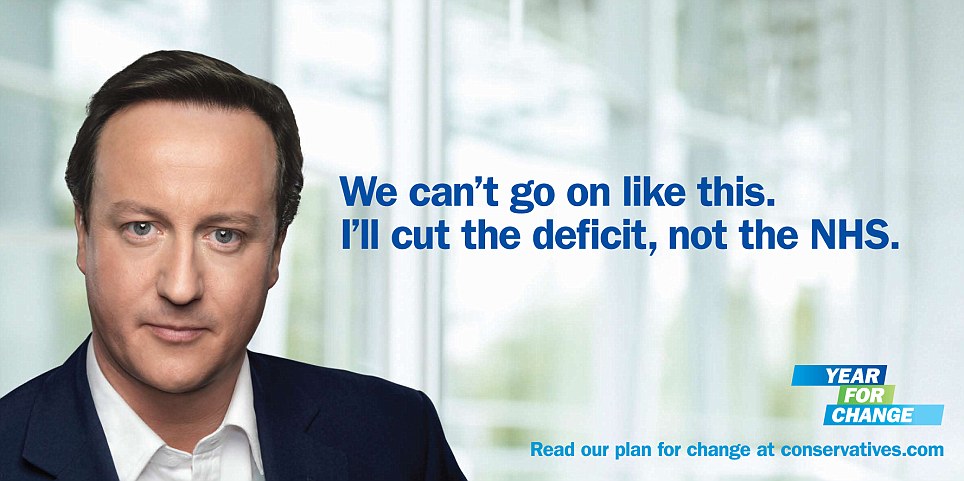
 

Conservative election poster 2010

A few recent news articles about the UK’s Conservative and Liberal-Democrat (Conservative) coalition government – the ConDem’s – brutal attack on the National Health Service.

NHS cancer figures contradict David Cameron and Andrew Lansley’s claims | Society | The Guardian

The prime minister and health secretary have criticised the NHS on cancer, but new figures suggest the service is a world leader

David Cameron and Andrew Lansley’s repeated criticisms of the NHS’s record on cancer have been contradicted by new research that shows the health service to be an international leader in tackling the disease.

The findings challenge the government’s claims that NHS failings on cancer contribute to 5,000-10,000 unnecessary cancer deaths a year, which ministers have used as a key reason for pushing through their radical shakeup of the service.

In fact, the NHS in England and Wales has helped achieve the biggest drop in cancer deaths and displayed the most efficient use of resources among 10 leading countries worldwide, according to the study published in the British Journal of Cancer.

“These results challenge the feeble justification of the government’s changes, which appear to be based upon overhyped media representation, rather than hard comparable evidence. This paper should be a real boost to cancer patients and their families because the NHS’s performance on cancer is much better than the media presents. It challenges the government’s assertion that the NHS is inefficient and ineffective at treating cancer – an argument for reforming the NHS,” said Prof Colin Pritchard, a health academic at Bournemouth University.

38 Degrees | Blog | NHS bill: “hands-off clause” advice

A few months ago, we asked one of the legal experts we funded for his view on the “autonomy clause”, or Clause 4 in the bill.

The full advice is here, but below are the main points on the “hands-off clause”.

Our legal advice:

30. However, what is proposed to be a new section 1C of the NHS Act 2006, does seem to me to be of importance. This would read

―1C Duty as to promoting autonomy
In exercising functions in relation to the health service, the Secretary of State must, so far as is consistent with the interests of the health service, act with a view to securing—

(a) that any other person exercising functions in relation to the health service or providing services for its purposes is free to exercise those functions or provide those services in the manner that it considers most appropriate, and

(b) that unnecessary burdens are not imposed on any such person.”

31. Therefore, so long as the Secretary of State does not think that it is inconsistent with the interests of the NHS, s/he must positively act to allow any other person exercising health service functions to do so in the way that that person thinks appropriate. This is what I described in conference as a “hands off” clause. Although the Secretary of State keeps some form of oversight, it is the other persons and bodies delivering the health service whose views are important as to how those services are to be delivered. This is further explained in the Explanatory Notes as follows

74. This clause seeks to establish an overarching principle that the Secretary of State should act with a view to promoting autonomy in the health service. It identifies two constituent elements of autonomy: freedom forbodies/persons in the health service (such as commissioning consortia or Monitor) to exercise their functions in a manner they consider most appropriate (1C(a)), and not imposing unnecessary burdens from those bodies/persons (1C(b)). The clause requires the Secretary of State to act with a view to securing these aspects of autonomy in exercising his functions in relation to the health service, so far as is consistent with the interests of the health service.

75. This duty would therefore require the Secretary of State, when considering whether to place requirements on the NHS, to make a judgement as to whether these were in the interests of the health service. If challenged, the Secretary of State would have to be able to justify why these requirements were necessary.

32. This kind of wording is often used in statutes to mean that a public body only has the power to act when steps to be taken are “really needed” or “essential”, rather than because the public body thinks something is desirable or appropriate. A court looking at this kind of wording would expect the public body (the Secretary of State in this case) to demonstrate why no other course of action could be followed, which is a high test to meet.

33. I think the reference to potential challenges at the end of this note is significant and reflects the limit of the Secretary of State’s powers. If the Secretary of State attempts to use his or her powers to impose requirements on commissioning consortia, for example, then there could well be a judicial review challenge from a consortium which opposed the requirements on the basis that they infringed the principle of autonomy in the new section 1C and could not be justified as necessary or essential. This approach replaces the, more or less, unfettered power that the Secretary of State has to make directions currently to be found in s8 NHS Act 2006 (as explained above), with a duty not to interfere unless essential to do so. It is also noteworthy that the same “autonomy” or “hands off” duty is also placed on the NHS Commissioning Board, by what would be a new s13E of the NHS Act 2006 (and it is, of course, the Board who will have closer contact with commissioning consortia than will the Secretary of State).

Continue ReadingNHS news review

NHS news review

Spread the love

The Mirror reports that Shadow Health Secretary Andrew Burnham has called for the Health and Social Care / Destroy the NHS Bill to be dropped.

Boston & Skegness Conservative MP Mark Simmonds is paid £50,000 a year to advise a private health firm that stands to make a fortune under Coalition plans for the NHS. Further similar revelations about the motivations of MPs would be useful.

More on the NHS Croydon £25Million black hole.

UK Uncut

We start with some simple points of agreement. The brutal cuts to services about to be inflicted by the current Government are unnecessary, unfair and ideologically motivated. The coalition are particularly fond of two obscene catchphrases: ‘There is no alternative’ and ‘We’re all in this together.’ Both slogans are empty and untrue. The cuts will dismantle the welfare state, send inequality sky-rocketing and hit the poorest and most vulnerable hardest. A cabinet of millionaires have decided that libraries, healthcare, education funding, voluntary services, sports, the environment, the disabled, the poor and the elderly must pay the price for the recklessness of the rich.

Austerity-economics is the policy of the powerful. It cannot be stopped by asking nicely. We cannot wait until the next election. If we want to win the fight against these cuts (and we can win) then we must make it impossible to ignore our arguments and impossible to resist our demands. This means building a powerful grassroots mass movement, able to resist the Government cuts at every turn.

UK Uncut

The Government’s Line lies


“There is no alternative.”

We are told that the only way to reduce the deficit is to cut public services. This is certainly not the case. There are alternatives, but the government chooses to ignore them, highlighting the fact that the cuts are based on ideology, not necessity.

  • One alternative is to clamp down on tax avoidance by corporations and the rich and tax evasion, estimated to cost the state £95bn a year
  • Another is to make the banks pay for free insurance provided to them by the taxpayer: a chief executive at the Bank of England put the cost of this subsidy at £100bn in a single year

Either the tax avoided and evaded in a single year or the taxpayer subsidy to the banking industry could pay for all of the £81bn, four-year cuts programme.

“We are all in this together.”

Since the banking crisis:

David Cameron himself has said that the cuts will change Britain’s “whole way of life”. Every aspect of what was fought for by generations seems under threat – from selling off the forests, privatising health provision, closing the libraries and swimming pools, to scrapping rural bus routes. What Cameron doesn’t say is that the cuts will also disproportionately hit the poor and vulnerable, with cuts to housing benefit, disability living allowance, the childcare element of working tax credits, EMA, the Every Child a Reader programme, Sure Start and the Future Jobs Fund to name a few.

The facts speak for themselves; we are not all in this together, we are paying for the folly of reckless bankers whilst the rich profit.


The government are forced to claim that there is no alternative to making drastic public sector cuts as they know that people would never accept their plan otherwise. By repeating the same lies over and over again, they hope to brainwash people into inaction.

There are alternatives to the cuts, and we are not all in this together. But unless we take action, and take the facts to our friends, our families and those around us, they will get away with it.

Conservative election poster 2010

A few recent news articles about the UK’s Conservative and Liberal-Democrat (Conservative) coalition government – the ConDem’s – brutal attack on the National Health Service.

Shadow Health Secretary Andy Burnham: It’s time to Drop the Bill – mirror.co.uk

WHEN he was looking for votes, David Cameron made a simple promise on the NHS: If he became PM, there would be no more top-down re-organisations.

He even put it in the Coalition Agreement. But after entering No10, he ordered the biggest and most dangerous upheaval of the NHS since it began in 1948.

GPs don’t want it. Nurses don’t want it. But, most importantly, patients don’t want it – because they can all see it spells the end of the NHS as we know it.

Nye Bevan famously said there would be an NHS for “as long as there are folk left with the faith to fight for it”.

Now that fight is upon us – and I know Mirror readers will sign the petition to save the NHS from this damaging “reform”. Our aim is to rally people in a deafening roar. It’s time for the Government to put the NHS first. It’s time to Drop the Bill.

‘Shock’ over MP’s health links – Community – Skegness Standard

A SKEGNESS councillor has accused a local Conservative MP of walking a dangerous ethical minefield after it was reported that he is paid £50,000 a year to advise a private health firm that stands to make a fortune under Coalition plans for the NHS.

Last week the national press revealed that Boston & Skegness member Mark Simmonds is paid £400 an hour to advise Circle Health, which was the first firm to win control of an NHS hospital under government reforms.

Mr Simmonds has stressed that his involvement with Circle Health is on his official register of interests in parliament and that no rules have been broken.

But Skegness Coun Mark Anderson has spoken of his shock at the news, and has branded it a worrying conflict of interests.

“I’m obviously very concerned about his involvement in this at a time when our own local health care, such as Boston’s Pilgrim Hospital, is having such difficulties.

“There are so many problems at Pilgrim Hospital and he’s even made a statement before that he wouldn’t send his own family there in its current state – and yet he lets his own constituents continue to go there while he’s earning money from private care.

“There are ethical questions here. It’s a sad reflection – it looks like he’s using his position as MP.”

Hospitals hit by NHS Croydon deficit (From Kingston Guardian)

Millions of pounds will have to be cut from NHS budgets after a massive hole was discovered in the finances of a neighbouring trust.

Independent auditors were called into NHS Croydon after a deficit of up to £25m was discovered by its financial team.

NHS Kingston will not be asked to bail out the trust but neighbouring NHS Richmond will be asked to increase the surplus it makes this year from £4.2m to £5.6m. Another trust, NHS Wandsworth, will be asked to find £14.5m, up from its original target of £12.3m.

Health campaigner Geoff Martin, of London Health Emergency, said: “In the run-up to the busy winter months, NHS Croydon patients will die unnecessarily as a result of this.

“I think the people who created this crisis and have presided over it should be forced to resign.”

NHS Kingston has been temporarily merged with Croydon, Richmond, Sutton and Merton, and Wandsworth in the run-up to spending power being fully handed over to GP commissioners next April.

A spokesman for the new organisation, called NHS South West London, admitted it had a “significant budgetary challenge” and was developing an action plan to get back into the black, using existing financial resources if possible.

The trusts are already trying to find £64.5m in savings out of their joint £2.2bn budget as part of a review of healthcare in south-west London.

Continue ReadingNHS news review

NHS news review

Spread the love

Unison votes to strike over pensions on 30 November. Many other unions are also set to ballot for strike action on 30 November. The government commented on the limited turnout suggesting that there was very limited support for striking. That’s the rules though government – same as electing scum politicians.

GPs are very concerned about the demands being made of them as members of commissioning consortia.

Cornish paramedics are being asked to take a pay cut.

NHS Croydon £25M in debt: services cut

The best course of action would be to abandon the Health and Social Care / Destroy the NHS Bill as suggested by the BMA

Conservative election poster 2010

A few recent news articles about the UK’s Conservative and Liberal-Democrat (Conservative) coalition government – the ConDem’s – brutal attack on the National Health Service.

Unison members vote to strike – Home News – UK – The Independent

The Government was tonight facing the biggest outbreak of industrial unrest since the 1979 Winter of Discontent after members of the largest public sector union voted in favour of strikes in the bitter row over pensions.

Unison said its members, ranging from school dinner ladies and refuse collectors to social workers and NHS staff, backed a campaign of industrial action by 245,358 votes to 70,253, in a 29% turnout.

The union is now set to strike on November 30, when teachers, civil servants and other public sector workers will also be staging a walkout in protest at the Government’s plans to increase pension contributions.

Over 220,000 teachers belonging to the NASUWT will start voting tomorrow on industrial action, while other unions will announce the result of their ballots in the coming weeks.

Eight in 10 GPs prefer not to be given reins / Britain / Home – Morning Star

Over 80 per cent of GPs feel they lack the skills to handle the commissioning roles foisted on them by the government’s high-handed NHS Bill, a new study has revealed.

Doctors themselves felt that plans to shut down primary care trusts (PCTs) and create clinical commissioning groups made up of GP practices would be unworkable without a huge investment in commercial skills training.

In a survey commissioned by law firm DMH Stallard LLP and consultancy group Kurt Salmon 85 per cent of 400 GPs interviewed felt they did not have the necessary skills to handle their commissioning roles and almost 90 per cent have real concerns about their legal responsibilities as members of a consortia.

“It is quite clear that GPs, who will be expected to manage and deliver these fundamental reforms, currently have real worries as to how they will make them work in practice,” says Andrew Lentin, a partner at Kurt Salmon.

“Almost a third of GPs think that something as basic as the government’s target date of April 2013 when the commissioning groups will inherit control from their PCT is unachievable.”

Pirate FM – News – Cornish Ambulance Staff Face Pay Cut

Cornish paramedics are being asked to take a pay cut.

South Western Ambulance says it needs to save four million pounds a year.

Holiday leave, overtime and sickness benefits could change too.

Paramedic Alan Lofthouse speaks for Unison.

He blames government cuts:

“It is incredibly demanding, both physically and mentally. But, ambulance staff do do it to the best of their abilities, saving lives, every day. The government needs to really consider how it’s funding the NHS to make sure that there aren’t these shortfalls which mean that employers have to come to staff and ask them to make up that shortfall in their pay”

“Coming to people who’ve had to put up with a two year pay freeze and are looking at a potential pension contribution increase coming up, it’s not really fair to come to them and ask them to pay more for what is essentially the bankers mistakes with government funding”

A consultation is underway. A Trust spokesperson said:

“Like all public sector organisations, South Western Ambulance Service NHS Foundation Trust (SWASFT) service has savings to make. For the financial year 2011/12 efficiency saving are necessary to address amongst other things, inflationary pressures and escalating fuel costs.

NHS Croydon admit they could be faced with up to £25m deficit (From Your Local Guardian)

Millions of pounds are missing from an NHS trust budget, which could have far reaching consequences for patients, health experts warned.

An independent review has been commissioned into the 2010-11 accounts for NHS Croydon after a massive deficit of up to £25m was discovered by its financial team.

The discovery of the shortfall comes only four months after an independent audit of the accounts.

Geoff Martin of London Health Emergency, an independent watchdog, said: “In the run up to the busy winter months NHS Croydon patients will die unnecessarily as a result of this.

“I think the people responsible who created this crisis and have presided over it should be forced to resign.”

He said he believed the level of debt could be as high as £38m, and this had resulted in a freeze on spending for the rest of the financial year.

He said: “In some respects the level of deficit isn’t important. The main thing is in the run up to winter they are going to make huge cuts, which is going to drastically affect the level of care.

27/11/13 Having received a takedown notice from the Independent newspaper for a different posting, I have reviewed this article which links to an article at the Independent’s website in order to attempt to ensure conformance with copyright laws.

I consider this posting to comply with copyright laws since
a. Only a small portion of the original article has been quoted satisfying the fair use criteria, and / or
b. This posting satisfies the requirements of a derivative work.

Please be assured that this blog is a non-commercial blog (weblog) which does not feature advertising and has not ever produced any income.

dizzy

Continue ReadingNHS news review

NHS news review

Spread the love

The main NHS news is that a vote by the House of Lords on political accountability has been postponed for months. There were two amendments: one by Lib-Dem Shirley Williams seeking to maintain that the Home Secretary is responsible for providing a health service and one by Tory Lord Mackay seeking to have the government responsible in exceptional circumstances. Williams and Mackay withdrew their amendments which are expected to be reconsidered at report stage in three or four months time.

This isssue of responsibility seems to be fundamental to the very notion of a National Health Service – that it is the government that is responsible for providing the health service. It appears that the Williams amendment may have passed were it not withdrawn. The Lib-Dem coalition government can’t be trusted on the NHS – we need to watch for gerrymandering, more lies and misdirection, etc…

The King’s Fund thinktank reports that Monitor – the new health service regulator – could fail unless the NHS bill passing through the upper house is amended.

Conservative election poster 2010

A few recent news articles about the UK’s Conservative and Liberal-Democrat (Conservative) coalition government – the ConDem’s – brutal attack on the National Health Service.

NHS bill clause put on hold to stave off revolt by Liberal Democrat peers | Politics | The Guardian

Vote over key issue of political control over NHS will not be resolved until January at earliest to avoid a Lords rebellion

The government has “paused” a key part of its NHS bill to stave off an embarrassing rebellion from key Liberal Democrats in the House of Lords – a move that ensures peers will now debate the controversial legislation until Christmas.

At the heart of the debate is the government’s plan to hand over its “constitutional responsibility” to provide NHS services to a quango. But a number of Lib Dem peers, led by Lady Williams, had insisted the health secretary should be responsible for the provision of health services.

The powerful Lords constitutional committee, on which sits some of the political world’s most prominent legal minds, warned last month about the “extent to which the chain of constitutional responsibility as regard to the NHS [will be] severed”. However both Williams and former Tory lord chancellor James Mackay, who had tabled a fresh amendment seeking to accommodate Lib Dem and Tory visions, agreed to drop their proposals once the government announced it would have a further “period of reflection”.

Earl Howe, the health minister, told the peers to “use the time between now and report stage to reflect further on this matter in the spirit of co-operation”. This means the issue about political control of the NHS will not be resolved by a vote until January at the earliest. It could also see the constitution committee and other lawyers re-examine the issue again, ahead of the bill’s scrutiny at report stage next month.

Such a timetable means that the bill will last in the upper house for much longer than expected as the government is unable to “guillotine” the bill through – causing concerns that it may not be ready by April, at the end of the parliamentary session. Last night sources close to Lansley admitted it “would be a close run thing” but expected the NHS bill to be law in March.

Labour, who had managed to get more than 150 peers out on to the red leather benches, claimed it was “a mess of Andrew Lansley’s own making”. The shadow health spokesman, Andy Burnham, said: “Last week the government indicated they were ready to make concessions and accept the amendment. Today they have been forced to withdraw it for fear of losing the vote. After 10 months of debate on the health bill, it is an indictment that the government does not know what it thinks on a question as basic as the responsibilities of the secretary of state. It is yet more evidence that this Tory-led government has failed to establish a consensus on this bill. They should drop the bill and focus on the financial challenges facing our NHS.”

It is unlikely that the Lib Dem rebels will back down. Williams’s amendment had insisted the “duty to provide” NHS services rests with the health secretary. She told the house that “I in no way resile from the amendment … because we do believe it’s important to have an absolutely solid basis on which the whole of the house will understand about exactly what are the accountabilities and responsibilities of the secretary of state.”

Health policy, leadership, events, information – The King’s Fund

Monitor’s new role may be too wide and complex and could lack independence from ministerial interference, warns a King’s Fund thinktank report

The government’s new health service regulator “may fail” unless the controversial NHS bill passing through the upper house is amended, the King’s Fund has warned.

In a report examining Andrew Lansley’s proposals for Monitor, the NHS regulator, the health thinktank says the health bill expands the regulator’s role from overseeing NHS foundation trusts with a set of “wide-ranging new powers” that will allow economic supervision of the entire health sector.

Under the health secretary’s plans, Monitor will become responsible for setting prices for NHS-funded services, ensuring competition works in the health service and maintaining essential services if hospitals go bust. The new body will have 500 staff and a budget of £82m a year.

But with increased size comes increasing complexity and potential confusion, says the King’s Fund. It warns that “the large number of objectives Monitor has been set may cause confusion and risks diluting the focus of its work”.

The report also warns of a possible clash between other bodies that will seek to exercise control over doctors and hospitals: “A lack of clarity about how it will work alongside other key health bodies, including the NHS Commissioning Board and Care Quality Commission, risks creating tension and unresolved disputes.”

Continue ReadingNHS news review

NHS news review

Spread the love

The House of Lords is debating the Health and Social Care / Destroy the NHS Bill. Rebel Liberal-Democrat peer Shirley Williams has proposed an amendment that maintains the “duty to provide” NHS services. Shadow Health Secretary Andrew Burnham has asked for Liberal-Democrat support for the Williams amendment.

An analysis by the Unite Union reveals that many peers supporting the destruction of the NHS have private healthcare interests which will benefit.

Andrew ‘McDonald’ Lansley’s voluntary deal with alcohol producers and junk food companies is criticised by the Health Select Committee.

Scotland keeps its NHS public

North of England loses NHS funding

Conservative election poster 2010

A few recent news articles about the UK’s Conservative and Liberal-Democrat (Conservative) coalition government – the ConDem’s – brutal attack on the National Health Service.

House of Lords will be able to vote on key NHS clause | Society | The Guardian

Peers will be able to vote on the government’s controversial plan to hand over its “constitutional responsibility” to provide NHS services to an unelected quango on Wednesday.

The government is attempting to convince Liberal Democrats to back a measure proposed by a former Tory lord chancellor, Lord Mackay, which would allow the health secretary to take control of the health service only in the event of “emergency, failure or breach”. But an amendment by Lib Dem rebel Lady Williams, which revives the original “duty to provide” NHS services, is likely to find significant support in the upper house.

In a letter to Lib Dem leader Nick Clegg, Labour’s health secretary Andrew Burnham asks for support to “stand firm with us” behind the Williams amendment, which has been backed by Labour’s health spokesperson in the upper house, Baroness Thornton.

With peers beginning line-by-line scrutiny of the coalition’s NHS bill on Wednesday, the government has been attempting to rebut detractors of all political persuasions influenced by the powerful Lords constitutional committee. The committee warned last month about the “extent to which the chain of constitutional responsibility as regard to the NHS [will be] severed”.

‘Peers with private healthcare links vote for NHS privatisation’ says Unite

The second reading of the bill saw a record turnout for the modern House of Lords, with the largest numbers of peers voting since the 1993 Maastricht Treaty debate.

But an examination of the division lists shows that many of those who turned up to vote through the bill worked for companies that stand to directly benefit financially from the bill or work as lobbyists, and do not routinely attend House of Lords votes.

The so-called ‘backwoodsmen’ – Tory peers, often hereditary, who do not normally attend parliament but can be turned out occasionally to pass controversial legislation, such as the poll tax – were historically criticised as one of the most unacceptable features of the unelected upper chamber.

The passage of the bill suggests that the government is now resorting to Thatcher’s old tactics again – but with big business interests also playing a role.

Criticism will be fuelled by the revelation that the peers identified did not stay to vote on the Localism bill, which was debated immediately after the health bill and voted on before 6.00pm on the same day.

The following Lords were highlighted by the investigation:

* Baroness Bottomley of Nettlestone, the former Tory health secretary and now a director of BUPA, has an attendance rate of just 20 per cent since 2005 and has voted on less than half the Lords’ voting days this year. She has, however, turned up for every day of the health bill.
* Baroness Cumberlege of Newick is another former Tory health minister who runs her own lobbying firm, Cumberlege Connections, which works ‘extensively’ with major pharmaceuticals interests. She has recorded votes on just 22 days this year, but has voted in every division on the Health and Social Care bill.
* Notorious tax avoider and billionaire Tory bankroller Lord Ashcroft ‘of Belize’ has had investments in, at least, two private healthcare groups. His business interests have led to an attendance rate of just 16 per cent and he voted on less than a quarter of voting days this year, but did make a rare appearance to help ram through the privatisation of the NHS.
* Tim Bell, the founder of Saatchi & Saatchi and Tory advertising guru and now Lord Bell, is another businessman whose appearances in the Lords are rare. He has attended only a fifth of voting days this year. But as chairman of Chime Communications, which owns lobbying firms such as Bell Pottinger, he represents health companies including BT Health, pharma giant AstraZeneca, and the now-infamous Southern Cross, and he voted to pass the Tories’ health bill.
* Lord Chadlington is another Tory peer who appears to make his money in the lobbying industry, and his work as chief executive of the Huntworth communications group has kept him away from most votes in the Lords this year, but again he voted for the health bill.
* Lord Coe is a Tory grandee with one of the worst attendance records in parliament, at less than 10 per cent, and his name appears on the division list on only five days this year, but the government relied on him to get the bill through its second reading. He is a director of AMT-Sybex Group, which is the IT supplier to the NHS, and IT is one of many areas that the bill could lead to lucrative new opportunities for health contractors.

MPs deride Lansley’s ‘nudging’ deal with food and drink firms | Politics | The Guardian

Coalition deal with food and drink firms will not improve public health, the Commons health select committee has warned

The deal done by the coalition with food and drink firms in an attempt to improve public health will not solve what are huge problems of obesity and chronic drinking, MPs warn in a report on Wednesday.

The Commons health select committee also says the government’s other reforms risk widening health inequalities, and that frontline public health services are being cut because of the NHS squeeze, despite ministerial assurances to the contrary.

The cross-party group of MPs have serious doubts about the effectiveness of health secretary Andrew Lansley’s Public Health Responsibility Deal, whereby fast food firms, drinks makers and supermarket chains help shape the coalition’s approach to public health, and thus avoid being subjected to further legislation, in return for what critics say are inadequate changes, such as cutting salt in food.

The report echoes concerns expressed by the British Medical Association, campaigners, and celebrity chef Jamie Oliver at ministers’ reliance on voluntary agreements with big business. The government must be ready to use legislation if efforts to “nudge” people fail, the MPs say.

While not opposed to “nudging” per se, they are “unconvinced the deal will be effective in obesity and alcohol abuse, and expect the Department of Health to set out how progress will be monitored and regulation applied if necessary”. The committee, led by former Conservative health secretary Stephen Dorrell, believes “partnership with commercial organisations has a place” but adds: “Those with a financial interest must not be allowed to set the agenda.”

Related:

McDonald’s and PepsiCo to help write UK health policy | Politics | The Guardian

Leading doctors call for urgent crackdown on junk food | Politics | The Observer

Scotland keeps its NHS public | Healthcare Network | Guardian Professional

The Scottish Nationalist administration has deliberately minimised the role of the private sector in the NHS

During this year’s Scottish Parliament election campaign Alex Salmond, the SNP leader and first minister of Scotland, made a memorable appearance on the BBC’s Question Time staged in Liverpool. He boasted that his government had “eradicated the private sector” from the NHS in Scotland. Furthermore, Salmond implored the predominantly English audience not to allow the Conservatives, Liberal Democrats and Labour to “destroy” their English NHS.

The audience gave Salmond’s words a warm reception. “We knew health would come up,” explained one of the first minister’s aides, “and the point we wanted to make was not that we do things so much better in Scotland, but to make the contrast.” The aide added: “That was the key moment – he [Salmond] spoke to them as if they were Scottish voters.”

Indeed, for a party whose ultimate aim remains ‘independence’ for Scotland, repeatedly highlighting the differences between public service delivery north and south of the border is simply good politics. At the recent SNP conference in Inverness Nicola Sturgeon, the Scottish health secretary, echoed her boss’s theme, telling delegates it now seemed “inevitable that the Tories, aided and abetted by their Liberal [Democrat] partners, will break up the NHS in England.”

Complaint lodged in Gloucestershire NHS row | This is Gloucestershire

NHS Gloucestershire boss Jan Stubbings makes an official complaint about being questioned by a councillor.

TOUGH questioning on controversial NHS changes could land popular county councillor Brian Oosthuysen in hot water.

The Labour member for Rodborough’s exchanges with NHS Gloucestershire boss Jan Stubbings offended her so much that she has lodged an official complaint.

He had pressed her on several aspects of the handover of staff and services from NHS Gloucestershire to a community interest company.

That plan is on hold after a legal challenge from pensioner Michael Lloyd, backed by Stroud Against the Cuts.

“As far as I am concerned, I simply was asking questions of the chief executive and she got angry about one or two of the questions I asked,” said Coun Oosthuysen.

NHS funding shake-up could cost region £90m, warn MPs – Main Section – Yorkshire Post

HEALTH inequalities could widen following controversial reforms which it is claimed could see Yorkshire lose nearly £90m in NHS funding, MPs warn today.

A Health Select Committee report criticises a decision by Ministers to cut the weighting in NHS funding for health inequalities which will shift resources from the North to the South.

Public health experts in Manchester suggest Yorkshire could lose £87m once the full effects of the changes work through. Worst hit would be Barnsley, losing £14.7m, and Hull, losing £13.2m.

Only North Yorkshire and the East Riding would gain in the region under the change in the NHS funding formula which would leave Surrey as the biggest winner, picking up £61.4m extra.

The report also claims coalition reforms of public health, which will hand responsibilities to local authorities, pose a “significant risk” of widening health inequalities further.

It raises concerns about plans for a health premium – funding allocated to councils for good results – warning it will “undermine” areas struggling most to tackle problems.

Committee chairman Stephen Dorrell said: “The effect of this policy appears to be to target resources towards those areas which have made greatest progress with their public health challenges and away from areas which face the greatest outstanding problems.”

Continue ReadingNHS news review