Tag: net zero

  • ‘In Even the Best Coverage There Is No Accountability for the Fossil Fuel Industry’

    Spread the love

    Original article by JANINE JACKSON republished from FAIR under a Creative Commons Attribution-NonCommercial-NoDerivs 3.0 Unported License.

    CounterSpin interview with Evlondo Cooper on climate coverage

    Janine Jackson interviewed Media Matters’ Evlondo Cooper about climate coverage for the March 22, 2024, episode of CounterSpin. This is a lightly edited transcript.

    Audio Player

    00:00

    00:00

    Use Up/Down Arrow keys to increase or decrease volume. [Available at the original article]

    Media Matters (3/14/24)

    Janine Jackson: Climate disruption is, of course, one of the most disastrous phenomena of today’s life, affecting every corner of the globe. It’s also one of the most addressable. We know what causes it, we know what meaningful intervention would entail. So it’s a human-made tragedy unfolding in real time before our eyes.

    To understate wildly, we need to be talking about it, learning about it, hearing about it urgently, which is why the results of our next guest’s research are so alarming. I’ll just spoil it: Broadcast news coverage of the climate crisis is going down.

    Evlondo Cooper is a senior writer with the Climate and Energy Program at Media Matters for America. He joins us now by phone from Washington state. Welcome to CounterSpin, Evlondo Cooper.

    Evlondo Cooper: Thank you for having me. I’m excited about our conversation today.

    JJ: We’re talking about the latest of Media Matters’ annual studies of climate crisis coverage. First of all, just tell us briefly what media you are looking at in these studies.

    EC: So we’re looking at corporate broadcast network coverage. That’s ABC, CBS and NBC. And for the Sunday morning shows, we also include Fox Broadcasting—Fox News Sunday.

    JJ: All right. And then, for context, this decline in coverage that you found in the most recent study, that’s down from very little to even less.
    Media Matters (3/14/24)

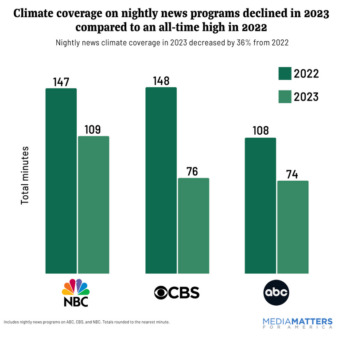
    EC: Yeah, so a little context: 2021 and 2022 were both record years for climate coverage, and that coverage was a little bit more than 1%. This year, we saw a 25% decrease from 2022, which brought coverage to a little bit less than 1%. We want to encourage more coverage, but even in the years where they were doing phenomenal, it was only about 1% of total coverage. And so this retrenchment by approximately 25% in 2023 is not a welcome sign, especially in a year where we saw record catastrophic extreme weather events, and scientists are predicting that 2024 might be even worse than ’23.

    JJ: Let’s break out some of the things that you found. We’re talking about such small numbers—when you say 1%, that’s 1% of all of the broadcast coverage; of their stories, 1% were devoted to the climate crisis. But we’ve seen, there’s little things within it. For example, we are hearing more from actual climate scientists?

    EC: That was a very encouraging sign, where this year we saw 41 climate scientists appeared, which was 10% of the featured guests in 2023, and that’s up from 4% in 2022. So in terms of quality of coverage, I think we’re seeing improvements. We’re seeing a lot of the work being done by dedicated climate correspondents, and meteorologists who are including climate coverage as part of their weather reports and their own correspondents’ segments, a bigger part of their reporting.

    So there are some encouraging signs. I think what concerns us is that these improvements, while important and necessary and appreciated, are not keeping up with the escalating scale of climate change.

    Media Matters (3/14/24)

    JJ: It’s just not appropriate to the seriousness of the topic. And then another thing is, you could say the dominance of white men in the conversation, which I know is another finding, that’s just kind of par for the elite media course; when folks are talked to, they are overwhelmingly white men. But it might bear some relation to what you’re seeing as an underrepresentation of climate-impacted populations, looking at folks at the sharp end of climate disruption. That’s something you also consider.

    EC: Yeah, we look at coverage of, broadly, climate justice. I think a lot of people believe it’s representation for representation’s sake, but I think when people most impacted by climate change—and we’re talking about communities of color, we’re talking about low-income communities, we’re talking about low-wealth rural communities—when these folks are left out of the conversation, you’re missing important context about how climate change is impacting them, in many cases, first and worse. And you’re missing important context about the solutions that these communities are trying to employ to deal with it. And I think you’re missing an opportunity to humanize and broaden support for climate solutions at the public policy level.

    So these aren’t communities where these random acts of God are occurring; these are policy decisions, or indecisions, that have created an environment where these communities are being most harmed, but least talked about, and they’re receiving the least redress to their challenges. And so those voices are necessary to tell those stories to a broad audience on the corporate broadcast networks.

    JJ: Yes, absolutely.

    CBS (7/17/23)

    Another finding that I thought was very interesting was that extreme weather seemed to be the biggest driver of climate coverage, and that, to me, suggests that the way corporate broadcast media are coming at climate disruption is reactive: “Look at what happened.”

    EC: Totally.

    JJ:  And even when they say, “Look at what’s happening,” and you know what, folks pretty much agree that this is due to climate disruption, these houses sliding into the river, it’s still not saying, “While you look at this disaster, know that this is preventable, and here is who is keeping us from acting on it and why.”

    EC: Yeah, that is so insightful, because that’s a core critique of even the best coverage we see, that there is no accountability for the fossil fuel industry and other industries that are driving the crisis. And then there’s no real—solutions are mentioned in about 20% of climate segments this year. But the solutions are siloed, like there are solution “segments.”

    But to your point, when we’re talking about extreme weather, when you have the most eyeballs hearing about climate change, to me, it would be very impactful to connect what’s happening in that moment—these wildfires, these droughts, these heat waves, these hurricanes and storms and flooding—to connect that to a key driver, fossil fuel industry, and talk about some potential solutions to mitigate these impacts while people are actually paying the most attention.

    CNN (3/3/23)

    JJ: And then take it to your next story about Congress, or your next story about funding, and connect those dots.

    EC: Exactly. I mean, climate is too often siloed. So you could see a really great segment, for instance, on the Willow Project, at the top of the hour—and this is on cable, but the example remains—and then later in the hour, you saw a story about an extreme weather event. But those things aren’t connected, they’re siloed.

    And so a key to improving coverage in an immediate way would be to understand that the climate crisis is the background for a range of issues, socioeconomic, political. Begin incorporating climate coverage in a much broader swath of stories that, whether you know it or not, indirectly or directly, are being impacted by global warming.

    JJ: It’s almost as though corporate media have decided that another horrible disaster due to climate change, while it’s a story, it’s basically now like a dog-bites-man story. And if they aren’t going to explore these other angles, well, then there really isn’t anything to report until the next drought or the next mudslide. And that’s just a world away from what appropriate, fearless, future-believing journalism would be doing right now.

    Evlondo Cooper: “It doesn’t have to be about just showing the destruction and carnage. There are ways that you can empower people to take action.”

    EC: It’s out of step, right? Pull up the poll showing bipartisan support for government climate action, because, whether people know it or not, as far as the science, —and there’s some deniers out there, but anecdotally, people know something is happening, something is changing in their lives. We’re seeing record-breaking things that no one’s ever experienced, and they want the government to do something about it.

    And so it’s important to cover extreme weather and to cover these catastrophes. And I know there’s a range of thought out there that says if you’re just focusing on devastating impacts, it could dampen public action. But to me, to your point, report on it and connect it to solutions, empower people to call their congressperson, their representative, their senator, to vote in ways that have local impacts to deal with the local climate impacts.

    It doesn’t have to be about just showing the destruction and carnage. There are ways that you can empower people to take action in their own lives, and to galvanize public support.

    And the public wants it. The public is asking for this. So I think just being responsive to what these polls are showing would be a way to immediately improve the way that they cover climate change right now.

    JJ: All right, then. We’ve been speaking with Evlondo Cooper of Media Matters for America. You can find this work and much else at MediaMatters.org. Evlondo Cooper, thank you so much for joining us this week on CounterSpin.

    EC: Thank you for having me.

    Original article by JANINE JACKSON republished from FAIR under a Creative Commons Attribution-NonCommercial-NoDerivs 3.0 Unported License.
  • The disagreement between two climate scientists that will decide our future

    Spread the love

    Vladi333/Shutterstock

    Robert Chris, The Open University and Hugh Hunt, University of Cambridge

    Getting to net zero emissions by mid-century is conventionally understood as humanity’s best hope for keeping Earth’s surface temperature (already 1.2°C above its pre-industrial level) from increasing well beyond 1.5°C – potentially reaching a point at which it could cause widespread societal breakdown.

    At least one prominent climate scientist, however, disagrees.

    James Hansen of Columbia University in the US published a paper with colleagues in November which claims temperatures are set to rise further and faster than the predictions of the Intergovernmental Panel on Climate Change (IPCC). In his view, the 1.5°C target is dead.

    He also claims net zero is no longer sufficient to prevent warming of more than 2°C. To regain some control over Earth’s rising temperature, Hansen supports accelerating the retirement of fossil fuels, greater cooperation between major polluters that accommodates the needs of the developing world and, controversially, intervening in Earth’s “radiation balance” (the difference between incoming and outgoing light and heat) to cool the planet’s surface.


    You can listen to more articles from The Conversation narrated by Noa.


    There would probably be wide support for the first two prescriptions. But Hansen’s support for what amounts to the deliberate reduction of sunlight reaching Earth’s surface has brought into the open an idea that makes many uncomfortable.

    Michael Mann from the University of Pennsylvania in the US and another titan of climate science, spoke for many when he dismissed solar radiation management as “potentially very dangerous” and a “desperate action” motivated by the “fallacy … that large-scale warming will be substantially greater than current-generation models project”.

    Their positions are irreconcilable. So who is right – Hansen or Mann?

    Earth’s radiation balance

    First, an explanation.

    There are only two ways to reduce global warming. One is to increase the amount of heat radiated from Earth’s surface that escapes to space. The other is to increase the amount of sunlight reflected back to space before it lands on something – whether a particle in the atmosphere or something on Earth’s surface – and is converted to heat.

    There are many ways to do both. Anything that reduces the amount of greenhouse gas in the atmosphere will let more heat escape to space (replacing fossil fuels with renewables, eating less meat and tilling the soil less for example). Anything that makes the planet brighter will reflect more sunlight to space (such as refreezing the Arctic, making clouds whiter or putting more reflective particles in the atmosphere).

    But the key difference between the two, in terms of their impact on global warming, is their response time. That is, the time it takes for a change in the factors that allow more heat to escape or sunlight to be reflected to appear as a change in Earth’s surface temperature.

    Intervening to speed up the loss of heat from Earth’s surface cools the planet slowly, over decades and longer. Intervening to increase the sunlight Earth reflects back to space cools the planet more or less immediately.

    The essence of the dispute between Mann and Hansen is whether reducing greenhouse gases, by a combination of reducing new emissions and permanently removing past emissions from the atmosphere, is now enough on its own to prevent warming from reaching levels that threaten economic and social stability.

    Mann says it is. Hansen says that, while doing these things remains essential, it is no longer sufficient and we must also make Earth more reflective.

    When will warming end?

    Mann aligns with IPCC orthodoxy when he says that emissions reaching net zero will result, within a decade or two, in Earth’s surface temperature stabilising at the level it has then reached.

    In effect, there is no significant warming in the pipeline from past emissions. All future warming will be due to future emissions. This is the basis for the global policy imperative to get to net zero.

    In his new paper, Hansen argues that if the atmospheric concentration of greenhouse gases remains close to its current level, the surface temperature will stabilise after several hundred years between 8°C and 10°C above the pre-industrial level.

    Of this, at least 2°C will emerge by mid-century, and probably a further 3°C a century from now. A temperature increase of this magnitude would be catastrophic for life on Earth. Hansen adds that to avoid such an outcome, brightening Earth is now necessary to halt the warming in the pipeline from past emissions.

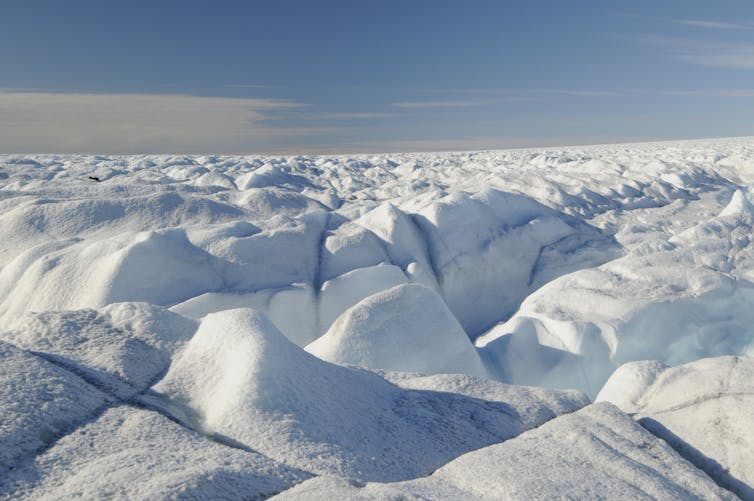
    Crevices in an ice sheet.
    Bright surfaces, like ice sheets, reflect light to space.
    Tobetv/Shutterstock

    But at the same time, we must also largely eliminate emissions if we are to stop recreating this problem in the future.

    Still getting hotter…

    We are scientists who study the feasibility and effectiveness of alternative responses to climate change, addressing both the engineering and political realities of enabling change at the scale and speed necessary.

    We find Mann’s rebuttal of Hansen’s claims unconvincing. Crucially, Mann does not engage directly with Hansen’s analysis of new data covering the last 65 million years.

    Hansen explains how the models used by IPCC scientists to assess future climate scenarios have significantly underestimated the warming effect of increased greenhouse gas emissions, the cooling effect of aerosols and how long the climate takes to respond to these changes.

    Besides greenhouse gases, humanity also emits aerosols. These are tiny particles comprising a wide range of chemicals. Some, such as the sulphur dioxide emitted when coal and oil are burned, offset the warming from greenhouse gases by reflecting sunlight back to space.

    Others, such as soot, have the opposite effect and add to warming. The cooling aerosols dominate by a large margin.

    Hansen projects that in coming months, lower levels of aerosol pollution from shipping will cause warming of as much as 0.5°C more than IPCC models have predicted. This will take global warming close to 2°C as early as next year, although it is likely then to fall slightly as the present El Niño wanes.

    Underpinning Hansen’s argument is his conviction that the climate is more sensitive to greenhouse gases than previously reported. The IPCC estimates that doubling atmospheric CO₂ raises Earth’s temperature by 3°C. Hansen calculates it to be 4.8°C.

    This, and the much longer climate response time that Hansen calculates from the historical record, would have a significant impact on climate model projections.

    Time for reflection

    The differences between Mann and Hansen are significant for the global response to climate change.

    Mann says that allowing emissions to reach net zero by mid-century is sufficient, while Hansen maintains that on its own it would be disastrous and that steps must now be taken in addition to brighten the planet.

    Brightening Earth could also reverse the reductions in reflectivity already caused by climate change. Data indicates that from 1998 to 2017, Earth dimmed by about 0.5 watts per square metre, largely due to the loss of ice.

    Given what’s at stake, we hope Mann and Hansen resolve these differences quickly to help the public and policymakers understand what it will take to minimise the likelihood of imminent massive and widespread ecosystem destruction and its disastrous effects on humanity.

    While 1.5°C may be dead, there may still be time to prevent cascading system failures. But not if we continue to squabble over the nature and extent of the risks.


    Imagine weekly climate newsletter

    Don’t have time to read about climate change as much as you’d like?

    Get a weekly roundup in your inbox instead. Every Wednesday, The Conversation’s environment editor writes Imagine, a short email that goes a little deeper into just one climate issue. Join the 20,000+ readers who’ve subscribed so far. The Conversation


    Robert Chris, Honorary Associate, Geography, The Open University and Hugh Hunt, Professor of Engineering Dynamics and Vibration, University of Cambridge

    This article is republished from The Conversation under a Creative Commons license. Read the original article.

    Roger Hallam was involved in starting the climate activism groups Extinction Rebellion and Just Stop Oil. He is still involved with Just Stop Oil and often gets arrested and imprisoned. [22/3 Apologies had a typo calling Roger Roget]

    https://rogerhallam.com/starmers-treason/

    …

    I used to be a social science researcher at King’s College, London. The name of the game in that trade is to look at everything in context. So I will provide some context. There is overwhelming evidence that the climate science industry is structurally underestimating the realities we face. “Worst than expected” is the standard phrase of just about every article as new stats are published. A few years ago we were going to pass 1.5C around 2050 – now it is already happening. I remember reading reports that the Arctic will melt in the summer around 2100. Papers now predict 2035, if not before. AMOC – the ocean current that stops the 60 million people on these islands from starving to death – was going to collapse at some point next century. Now a recent paper tells us the odds are it will collapse by 2050. If you have not been paying attention, this will create a collapse of temperatures overnight of 3-8C across Europe. So don’t be surprised if it happens before your pension comes due. 

    I’m like you. I don’t like to believe things are true if they conflict with my baseline beliefs – like “we will muddle through”. But then it becomes more difficult when it actually comes true. Scientists have been telling us privately and then publicly for years that staying under 1.5C was bollocks – and now here we are. For two decades or more the best kept secret of the climate space has been that aerosols (pollution from burning fossil fuel emissions) have been holding down temperatures by .5C-1C. As we passed 1.8C last September the pretence started to collapse as scientists raged about each other on a dark corner of Twitter. It’s the start of the exposure of the world’s biggest cover up. That they knew we were fucked a decade or more ago. Not that the media is interested. Everyone is still in on the pretence, it seems.

    …

    Roger Hallam https://rogerhallam.com/starmers-treason/ An interesting article. [22/3 Apologies had a typo calling Roger Roget]

  • Lord Deben: ‘Why I’m backing court action against the government’s weak climate strategy’

    Spread the love

    https://www.politics.co.uk/comment/2024/03/10/lord-deben-why-im-backing-court-action-against-the-governments-weak-climate-strategy/

    Urgency is a word in constant use to emphasise the immediacy and scale at which our changing climate demands action. After more than ten years at the helm of the Climate Change Committee (CCC), I recognise the opportunities that this urgent action offers — economic, social, and environmental — as well as the disastrous consequences of failing to respond quickly enough.

    Yet, the meaning of  ‘urgency’ seems lost on those who need to grasp it most – our political leaders. They alone have the power to set in motion the rapid transformation that is necessary to deliver on our climate goals. That was recognised by the UK when they hosted the UN climate talks in Glasgow in 2021. We led the world in setting the tough targets we need to avert disaster and to turn this immense problem into a real opportunity to build a better world. Alok Sharma and his team rose to the occasion and, with all its deficiencies, my view is that COP26 set us on the path to Net Zero in 2050.

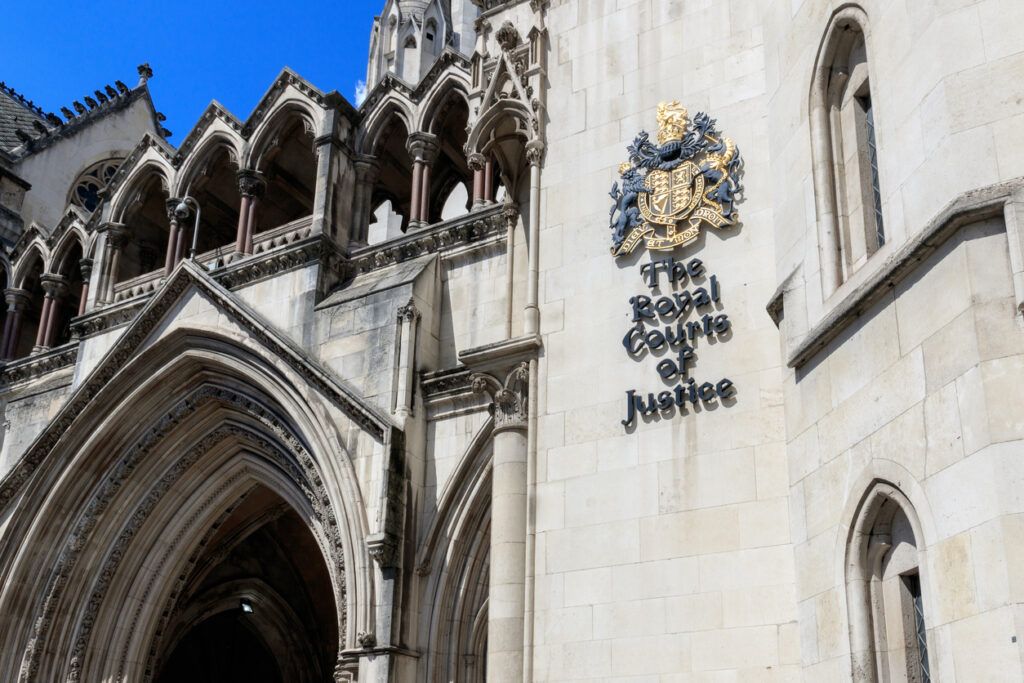
    Yet, necessary as they are, targets are only the beginning of the process and the CCC has consistently emphasised the necessity of a detailed programme if those targets are to be achieved. It was the lack of that which led the High Court to insist that this Government produce a clear delivery programme by the end of March 2023. In response, the Government published a many-paged document which, it claimed, met the Court’s requirement.  In fact, upon detailed expert analysis, it became clear that this document gave even less assurance of meeting our legally binding targets than had been previously thought. It was because of this that I took the decision to support a legal challenge in the High Court by Friends of the Earth. Their challenge over the inadequacy of the government’s climate strategy was heard last month alongside two separate, but related, cases brought by Good Law Project and ClientEarth.

    I was still in post at the CCC at the time the Government produced its updated climate strategy. In the many years I led the organisation, the CCC would get advanced information about any plans published under the 2008 Climate Change Act. Yet ahead of the publication of the UK’s new climate strategy in March 2023, this failed to happen. The departure from established ways of working has led me to believe the Government did not want its official advisers to examine the draft plan before it was published.

    …

    https://www.politics.co.uk/comment/2024/03/10/lord-deben-why-im-backing-court-action-against-the-governments-weak-climate-strategy/

  • Government accused of ‘conjuring up culture war with energy policy,’ as Rees-Mogg calls for ‘indefinite’ postponement of Net Zero targets

    Spread the love

    https://leftfootforward.org/2024/03/government-accused-of-conjuring-up-culture-war-with-energy-policy-as-rees-mogg-calls-for-indefinite-postponement-of-net-zero-targets/

    ‘Another step backwards on the critical road to Net Zero.’

    Conservative MP Jacob Rees-Mogg has called for Net Zero targets to be postponed ‘indefinitely.’

    The comments were made after Rishi Sunak announced that Britain needs to build new, gas-fired power stations to ensure the country’s energy security. The stations would replace many aging existing plants. However, the plans do not include climate-change measures, which critics say could threaten a legally binding commitment to cut carbon emissions to Net Zero by 2050.

    Shadow energy secretary Ed Miliband accused the Tories of “persisting with the ludicrous ban on onshore wind, bungling the offshore wind auctions, and failing on energy efficiency.”

    Liberal Democrat energy and climate change spokesperson Wera Hobhouse said that announcement was “another step backwards on the critical road to Net Zero.”

    But for Jacob Rees-Mogg, who has a long record of climate denialism, the government’s announcement to build new gas-fired power stations is a good first step against what he referred to as the Net Zero ‘obsession.’

    …

    https://leftfootforward.org/2024/03/government-accused-of-conjuring-up-culture-war-with-energy-policy-as-rees-mogg-calls-for-indefinite-postponement-of-net-zero-targets/

  • Shell abandons 2035 emissions target and weakens 2030 goal && Shell boss got £8m pay package in first year

    Spread the love
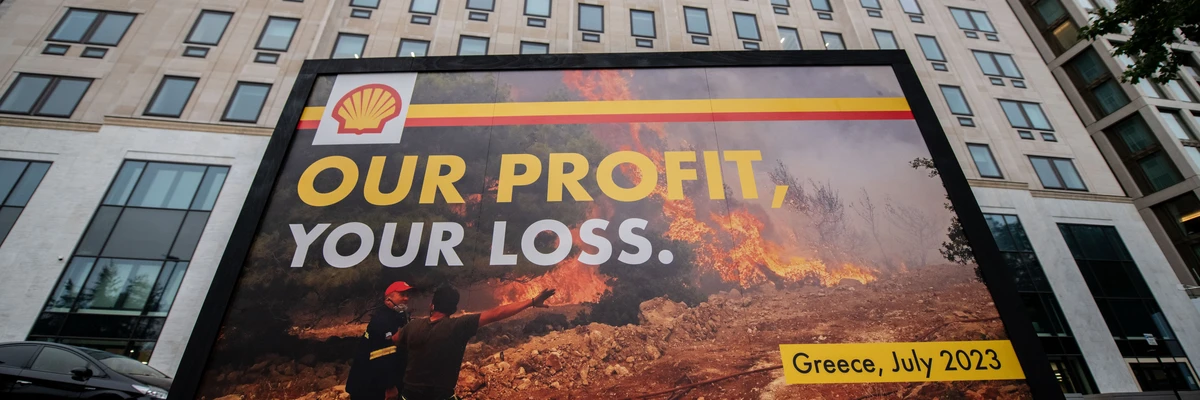
    Greenpeace activists display a billboard during a protest outside Shell headquarters on July 27, 2023 in London.
    Greenpeace activists display a billboard during a protest outside Shell headquarters on July 27, 2023 in London. (Photo: Handout/Chris J. Ratcliffe for Greenpeace via Getty Images)

    https://www.carbonbrief.org/shell-abandons-2035-emissions-target-and-weakens-2030-goal/

    Shell has abandoned a key climate target for 2035 and weakened another goal for 2030, according to its latest “energy transition strategy”.

    The oil major has “updated” its target to cut the total “net carbon intensity” of all the energy products it sells to customers – the emissions per unit of energy – by 20% between 2016 and 2030. The reduction is now set at between 15-20%.

    Within Shell’s strategy, chief executive, Wael Sawan, writes that this change reflects “a strategic shift” to focus less on selling electricity, including renewable power.

    Instead, the company says investment in oil and gas “will be needed” due to sustained demand for fossil fuels. It emphasises the importance of liquified natural gas (LNG) as “critical” for the energy transition and says it will grow its LNG business by up to 30% by 2030. 

    This amounts to a bet against the world meeting its climate goals, with the International Energy Agency (IEA) and others concluding no new oil-and-gas investment is needed on a pathway to 1.5C – and warning against the risk of “overinvestment”.

    Elsewhere in the report, Shell notes that it has “chosen to retire [its] 2035 target of a 45% reduction in net carbon intensity” due to “uncertainty in the pace of change in the energy transition”.

    Both goals were intended as stepping stones on the company’s journey towards net-zero emissions by 2050, a goal set by the previous chief executive, Ben van Beurden, in 2020.

    The weakening of climate goals from Shell, the world’s second-largest investor-owned oil-and-gas company, comes after BP scaled back its ambitions last year.

    …

    Shell boss got £8m pay package in first year

    https://www.bbc.co.uk/news/articles/c4nm8r8787ko

    Shell’s new boss received a pay package of almost £8m in his first year in the role, the energy giant has revealed.

    Detail of the pay emerged as Shell watered down one of its carbon reduction targets.

    Wael Sawan was paid a total of £7.94m, including bonuses, although that was below the £9.7m received by his predecessor, Ben van Beurden, in 2022.

    The size of the pay package came under fire from pressure groups.

    Jonathan Noronha-Gant, senior fossil fuels campaigner at Global Witness, said the amount was “a bitter pill to swallow for the millions of workers living with the high costs of energy”.

    Shell also announced that it planned to reduce the “net carbon intensity” of the energy it sells by 15-20% by 2030, compared with a previous target of 20%.

    It also dropped its plan to reduce net carbon intensity by 45% by 2035.

    …