Carbon capture: a decarbonisation pipe dream

Spread the love

Relearning lessons of the past

1 September 2022 (IEEFA): Underperforming carbon capture projects considerably outnumber successful projects globally, and by large margins, with both the technology and regulatory framework found wanting, finds a new report by the Institute for Energy Economics and Financial Analysis (IEEFA).

The report, The Carbon Capture Crux – Lessons Learned, studies 13 flagship large-scale carbon capture and storage (CCS)/carbon capture utilisation and storage (CCUS) projects in the natural gas, industrial and power sectors in terms of their history, economics and performance. These projects account for around 55% of the total current operational capacity worldwide.

Author Bruce Robertson says seven of the thirteen projects underperformed, two failed, and one was mothballed

“CCS technology has been going for 50 years and many projects have failed and continued to fail, with only a handful working.

“Many international bodies and national governments are relying on carbon capture in the fossil fuel sector to get to Net Zero, and it simply won’t work.

“Although some indication it might have a role to play in hard-to-abate sectors such as cement, fertilisers and steel, overall results indicate a financial, technical and emissions-reduction framework that continues to overstate and underperform.”

IEEFA’s study found that Shute Creek in the U.S. underperformed its carbon capture capacity by around 36% over its lifetime, Boundary Dam in Canada by about 50%, and the Gorgon project off the coast of Western Australia by about 50% over its first five-year period.

“The two most successful projects are in the gas processing sector – Sleipner and Snøhvit in Norway. This is mostly due to the country’s unique regulatory environment for oil and gas companies,” says co-author Milad Mousavian.

“Governments globally are looking for quick solutions to the current energy and ongoing climate crisis, but unwittingly latching onto CCS as a fix is problematic.”

Last week the Australian government approved two new massive offshore greenhouse gas storage areas, saying CCS “has a vital role to play to help Australia meet its net zero targets. Australia is ideally placed to become a world leader in this emerging industry”.

However, Robertson says, carbon capture technology is not new and is not a climate solution.

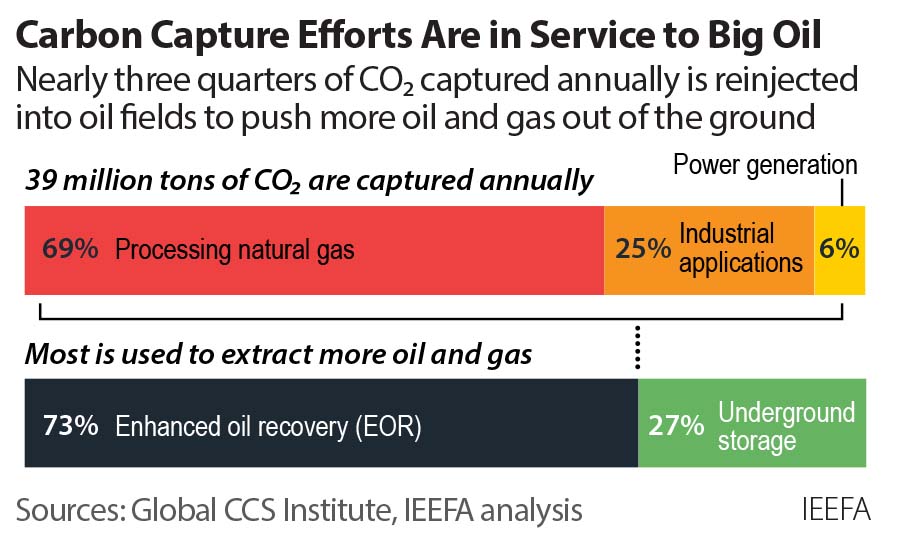
“As our report shows, CCS has been around for decades, mostly serving the oil industry through enhanced oil recovery (EOR). Around 80–90% of all captured carbon in the gas sector is used for EOR, which itself leads to more CO2 emissions.”

About three-quarters of the CO2 captured annually by multi-billion-dollar CCUS facilities, roughly 28 million tonnes (MT) out of 39MT total capture capacity globally, is reinjected and sequestered in oil fields to push more oil out of the ground.

The International Energy Agency says annual carbon capture capacity needs to increase to 1.6 billion tonnes of CO2 by 2030 to align with a net zero by 2050 pathway.

“In addition to being wildly unrealistic as a climate solution, based on historical trajectories, much of this captured carbon will be used for enhanced oil recovery,” says Robertson.

History shows CCS projects have major financial and technological risks. Close to 90% of proposed CCS capacity in the power sector has failed at implementation stage or was suspended early — including Petra Nova and the Kemper coal gasification power plant in the U.S. Further, most projects have failed to operate at their theoretically designed capturing rates. As a result, the 90% emission reduction target generally claimed by the industry has been unreachable in practice.

Finding suitable storage sites and keeping it there is also a major challenge—the trapped CO2 underground needs monitoring for centuries to ensure it does not come back to the atmosphere.

The report identifies interim considerations for CCS projects if no alternative solutions to emissions reduction are found.

  • Safe storage locations must be identified, and a long-term monitoring plan and compensation mechanism in case of failure developed.
  • The CCS project must not promote enhanced oil recovery.
  • To avoid project liability being handed over to taxpayers, as is currently the situation with Gorgon, large oil and gas companies mainly benefiting from CCS at their gas developments must be liable for any failure/leakage and monitoring costs of CCS projects, specifically if they get subsidies, grants and tax credits for capturing the carbon.
  • It must not be used by governments to greenlight or extend the life of any type of fossil fuel asset as a climate solution.

Robertson says more research could be done on CCS applications in industries where emissions are hard to abate such as, cement, as an interim partial solution to meeting net zero targets.

“As a solution to tackling catastrophic rising emissions in its current framework however, CCS is not a climate solution.”

The reportThe Carbon Capture Crux – Lessons Learned

Continue ReadingCarbon capture: a decarbonisation pipe dream

Climate scientists call on Labour to pause £1bn plans for carbon capture

Spread the love

https://www.theguardian.com/environment/2024/sep/25/climate-scientists-call-on-labour-to-pause-1bn-investment-plans-carbon-capture-blue-hydrogen

Ed Miliband, Rachel Reeves and Keir Starmer visit Teesside, the location of a proposed multibillion-pound carbon capture and storage project. Photograph: Ian Forsyth/Getty Image

Letter says technologies to produce blue hydrogen and capture COare unproven and could hinder net zero efforts

Leading climate scientists are urging the government to pause plans for a billion pound investment in “green technologies” they say are unproven and would make it harder for the UK to reach its net zero targets.

Labour has promised to invest £1bn in carbon capture, usage and storage (CCUS) to produce blue hydrogen and to capture carbon dioxide from new gas-fired power stations – with a decision on the first tranche of the funding expected imminently.

However, in the letter to the energy security and net zero secretary, Ed Miliband, the scientists argue that the process relies on unproven technology and would result in huge emissions of planet-heating CO2 and methane – gases that are driving the climate crisis.

“We strongly urge you to pause your government’s policy for CCUS-based blue hydrogen and gas power, and delay any investment decision … until all the relevant evidence concerning the whole-life emissions and safety of these technologies has been properly evaluated,” they write.

The letter, which is signed by leading climate scientists from the UK and US as well as campaigners, argues the plans would:

  • Lock the UK into fossil fuel production for generations to come.
  • Result in huge upstream emissions from methane leaks, transport and processing of liquefied natural gas (LNG) from the US.
  • Rely on carbon capture and storage (CCS) during the production of hydrogen – technology they say has been abandoned in the vast majority of similar projects around the world.
  • Pose a danger to the public if there are any leaks from pipes carrying the captured carbon. At least 45 people had to be taken to hospital after a leak in the US.

https://www.theguardian.com/environment/2024/sep/25/climate-scientists-call-on-labour-to-pause-1bn-investment-plans-carbon-capture-blue-hydrogen

Continue ReadingClimate scientists call on Labour to pause £1bn plans for carbon capture

Barclays’ $2bn coal loans expose ‘enormous loophole’ in its climate policy

Spread the love

Original article by Josephine Moulds republished from The Bureau of Investigative Journalism under a Creative Commons Attribution-NonCommercial-NoDerivs 3.0 Unported License.

Bank accused of ‘trying to have it both ways’ with coal policy that allows financing for huge polluters

Barclays helped raise nearly $2bn for companies running highly polluting coal-fired power plants in the US, exposing an “enormous loophole” in its climate policy.

As part of its strategy to reach net zero, the bank has committed to stop financing companies that make more than half their revenues from coal-fired power.

Last year, however, Barclays helped raise $1.7bn for coal-fired power companies that appear to exceed that threshold, the Bureau of Investigative Journalism and ITV News can reveal.

Among these deals were two $400m loans for Monongahela Power, which generates 95% of its electricity from burning coal at two huge plants in West Virginia. The company only sells electricity that it generates itself, suggesting that the vast majority of its revenues are from coal-fired power.

Barclays, however, said its policy only prohibits financing for companies that make more than 50% of revenues specifically from generating coal-fired power; and that TBIJ’s calculations did not account for these companies’ revenues from transmitting and distributing that power.

Barclays was Europe’s biggest lender to the coal power industry last yearAndrea Domeniconi / Alamy

Seth Feaster, an analyst at the Institute for Energy Economics and Financial Analysis (IEEFA) think tank, said: “The bank is trying to have it both ways: a public-facing coal policy that sounds like it will no longer support coal-heavy companies, but the technicality [regarding transmission and distribution revenue] has rendered that policy largely meaningless.

“The bank has created an enormous loophole that appears to allow it to largely continue doing business as usual with coal-friendly utilities.”

Natasha Landell-Mills, head of stewardship at the asset manager Sarasin & Partners, which holds Barclays debt, said the bank’s position appeared to be “somewhat disingenuous”.

“In the end, what matters is that coal-fired power falls in keeping with ensuring a safe climate. As investors, we would expect all related activities that enable coal-fired power to be captured and, if they are not, would hope to see the board urgently address this loophole.” She said this was not just a question of how Barclays is run and its reputation, but that continuing to fund high emitters was also financially risky for long-term investors.

The news comes amid a storm of protest against the bank, which was revealed in May to be Europe’s biggest funder of fossil fuels.

It is also Europe’s biggest lender to the coal power industry, taking part in $75bn worth of deals for companies active in the sector last year.

Bold pledges

Under pressure from its customers and investors, Barclays has made increasingly bold climate promises. It tightened its coal policy in 2022 and said financing the sector not only poses a threat to the planet but could represent a bad lending decision. Yet a number of companies it funded last year appear to be making most of their money from coal-fired power.

In addition to the Monongahela Power deals, Barclays helped raise $400m for Kentucky Utilities, which in 2022 generated almost three quarters of its electricity from burning coal. This suggests more than half its revenues were from coal-fired power.

Barclays also helped raise a $500m loan for Louisville Gas & Electric, which generated 83% of its power from coal in 2022. It makes some revenues from selling gas but calculations based on company and government data suggest its revenue share from coal was more than 50%.

Mill Creek power plant, a coal-fired stations owned by Louisville Gas and ElectricWilliam Alden / Creative Commons

Neither company appears to be transitioning to renewable power and their owner, PPL Corporation, said it expects they will use coal and natural gas as their predominant fuels “for the foreseeable future”.

Monongahela Power is investing millions to keep its two West Virginia plants running until 2035 and 2040, despite scientists warning that developed countries must end power generation from coal by 2030. The company aims to build 50MW of solar generation, but that represents less than 2% of its current coal-fired power capacity.

Barclays told TBIJ the deals complied with its policy “based on publicly disclosed information and our due diligence”. It said its policy does not have a loophole and that its methodology is robust. “An ambition to be net zero by 2050 does not require an immediate exit from financing coal,” the bank said. “Barclays is financing an energy sector in transition, providing finance to meet current energy needs and also financing the scaling of clean energy”.

PPL, which owns utilities in Kentucky, Rhode Island and Pennsylvania, said it had set a clear goal to achieve net-zero carbon emissions by 2050 and was transitioning to a cleaner energy mix across the group. It added that it had received approval from the authorities to retire 600MW of coal-fired power generation in Kentucky by 2027. This, however, represents less than 15% of its remaining coal capacity.

Monongahela Power did not respond to TBIJ’s request for comment.

Deadly coal plants

Coal-fired power plants are responsible for more than 40% of global CO2 emissions from energy. At Cop28 UN climate talks in Dubai last year, all countries agreed that accelerating the transition from coal to renewables was essential in order to avert catastrophic climate change.

Coal is also a major source of toxic air pollution. In the US alone, more than 3,800 people die from soot released by coal-fired power plants every year, according to a report by Sierra Club, a US NGO. While many European banks have distanced themselves from the industry, Barclays has retained strong links with US coal-fired power companies.

The boom in fracked gas and plunging cost of renewables has changed the landscape for power generation in the US. Seth Feaster at IEEFA said: “[Coal-fired power] companies are going to start struggling because they can’t sell their power in competitive environments.

“Investing in coal is very risky because most of [these coal plants] are losing money. They’re not going to be around for very long and if something breaks, they tend to shut down early because they can be very costly to repair.”

Bob Ward from the Grantham Research Institute on Climate Change said: “The coal industry in the United States is failing, it’s on its way out … there’s no excuse for propping up the American coal industry.” He described the distinction Barclays made between the generation, transmission and distribution of electricity from coal in its policy as “semantics”.

“What consumers and investors will be expecting is that Barclays are complying with the spirit of their declarations, and not just a technicality,” Ward said. “If you are generating most of your income from burning coal and then distributing the electricity results, then that’s the coal. That’s the coal industry. You’re damaging the climate. And that is what Barclays said they would stop.”

Last month, the organisers of the Wimbledon tennis championships faced calls to drop Barclays as a sponsor over its ties to fossil fuels and defence companies supplying Israel. Barclays addressed criticism of its defence funding, saying it trades in shares on behalf of clients. “Whilst we provide financial services to these companies, we are not making investments for Barclays.”

Live Nation also dropped the bank as a sponsor for various music festivals – including Download, Latitude and Isle of Wight – after protests from bands and fans.

Steff Wright, chairman of the Gusto Group, said his construction and manufacturing business is moving away from banking with Barclays. “As a company that’s working towards a green future, we need to look at our supply chain and who else is on that journey with us.

“We’d encourage all businesses to move away from them, to put pressure on them to rethink their strategy.”

Reporters: Josephine Moulds
Environment editor: Robert Soutar
Impact producer: Grace Murray
Deputy editors: Chrissie Giles and Katie Mark
Editor: Franz Wild
Production editor: Alex Hess
Fact checker: Somesh Jha

This reporting is funded by the Sunrise Project. None of our funders have any influence over our editorial decisions or output.

Original article by Josephine Moulds republished from The Bureau of Investigative Journalism under a Creative Commons Attribution-NonCommercial-NoDerivs 3.0 Unported License.

More from this project

Barclays’ billions of ‘sustainable’ finance for fossil fuel industry is greenwash, says investor

HSBC helped oil and gas industry raise $47bn despite net-zero pledge

How will new FCA greenwashing rule tackle banks’ dodgy climate claims?

Continue ReadingBarclays’ $2bn coal loans expose ‘enormous loophole’ in its climate policy

Tory Leadership Contender Robert Jenrick’s Pro-Coal and Anti-Net Zero Record

Spread the love

Original article by Adam Barnett and Sam Bright republished from DeSmog.

The Conservative candidate has changed his tune on climate action, recently attacking Labour’s net zero policies and arguing for new fossil fuel extraction.

Former Conservative minister Robert Jenrick, who has today entered the race to lead the Tory party, has a growing record of attacks on climate action.

The MP for Newark – who saw a 23.9 percent swing against him in the general election, and served as secretary of state for immigration under former prime minister Rishi Sunak – has attacked what he calls “net zero zealotry”, and has labelled the UK’s net zero target “dangerous fantasy green politics unmoored from reality”. 

This is despite Jenrick having hailed the UK’s “world-leading commitment to net zero by 2050” as recently as 2020.

Jenrick has also called for the building of “new gas power stations” and supports new fossil fuel extraction, including North Sea oil and gas, and the opening of new coal mines. 

Jenrick’s campaign manager is Conservative MP Danny Kruger, a political reactionary who is also an advisor to climate denier Jordan Peterson’s Alliance for Responsible Citizenship (ARC).

His candidacy follows the Conservative Party losing a landslide election on 4 July against a Labour Party committed to climate action, during which the Tories supported new North Sea oil and gas extraction, and the delaying of key climate reforms.

Almost half of voters (49 percent) believe renewable energy would lower household bills, while only 14 percent say the same for more fossil fuels, according to polling by More in Common. 

This week saw what climate scientists believe could be the hottest day on record thanks to climate change. The world’s leading climate science group, the UN’s Intergovernmental Panel on Climate Change (IPCC), has said that there is “a brief and rapidly closing window of opportunity to secure a liveable and sustainable future for all”.

Attacks on Labour’s Climate Agenda

In his response to the announcement of Labour’s legislative agenda in the King’s Speech last week (19 July), Jenrick used an address in the House of Commons to launch an attack on the government’s climate policies, spreading familiar misinformation. 

Jenrick said that “despite being only responsible for one percent of global emissions, we find ourselves with a government pursuing for ideological reasons a net zero policy which is going to make it harder for our own consumers to afford their bills, [and] which is further going to erode our industrial base”.

Downplaying a country’s emissions is a “widely deployed” tactic used to delay international climate action, according to academics. Contrary to Jenrick’s claims, the UK’s cost of living crisis has been made worse by its dependence on fossil fuels, according to the International Monetary Fund (IMF).

And rather than “eroding our industrial base”, net zero policies are already creating new jobs and economic development. The UK’s net zero economy grew nine percent in 2023 to £74 billion – equivalent to 3.8 percent of the total UK economy, and supported more than 765,000 jobs, according to the Energy and Climate Intelligence Unit (ECIU). 

Jenrick also attacked Labour’s green investment vehicle, Great British Energy – launched today – as a quango “which serves no apparent purpose”, warned that new solar farms would “despoil our countryside”, and claimed that “200,000 jobs in the oil and gas sector have been put in danger”, using a widely debunked figure.

The chief advisor to the National Farmers Union (NFU) has said solar farms “do not in any way present a risk to the UK’s food security”, while NFU president Tom Bradshaw has attacked the claims made by Jenrick and others as “sensationalist”. 

On 11 July, when Labour announced its decision not to defend the new proposed coal mine in Cumbria in the High Court, Jenrick posted on X: “First the oil and gas industry, now coking coal for the steel industry. Less than a week in and jobs and economic growth are already being sacrificed on the altar of Labour’s net zero zealotry.”

In 2021, Jenrick decided not to challenge the planning application for the new mine – the UK’s first deep coal mine in more than 30 years, which would extract 2.8 million tonnes of coking coal a year, emitting an estimated 220 millions tonnes of greenhouse gases over its lifetime.

Net Zero U-Turn

Jenrick’s attacks on Labour’s green policies mirror his growing criticism of climate action – despite having previously celebrated the Conservatives Party’s support for net zero.

In February, Jenrick wrote an article for The Telegraph – a newspaper that regularly publishes attacks on climate science and net zero reforms – claiming that voters are sick of the “dishonesty” from politicians about “what net zero entails”. 

He said that the UK’s 2050 net zero ambition was decided upon in the summer of 2019, “while the country was occupied by Brexit debates”, and was “nodded through the Commons with fewer than 90 minutes of debate”.

At the time, Jenrick, who was Treasury minister, welcomed the adoption of the target. In 2020, while serving as communities secretary under Boris Johnson, Jenrick praised the UK’s “world-leading commitment to net zero by 2050”. Ahead of the 2019 general election, he said that voters should support the Conservatives on the basis that the UK was the “first advanced economy in the world to pass a net zero target”.

Yet, in the February 2024 Telegraph article, Jenrick wrote that it was obvious to him “at the time” that the costs associated with net zero “were likely to be astronomical.” The article went on to claim that “reaching net zero by 2050 requires us to overhaul the material foundations of our economy in just three decades”, and that the result “is a dangerous fantasy green politics unmoored from reality and that lacks the buy-in of the public”.

Jenrick’s campaign for Tory leader is being run by fellow Conservative MP Danny Kruger.

Kruger is the chair of the New Conservatives faction in Parliament – a group that advocates for more socially conservative, right-wing ideas within the Tory party, campaigning against “woke” culture, and immigration. 

It also appears that New Conservative press officer Sam Armstrong is serving as one of Jenrick’s campaign aides, although Armstrong neither confirmed nor denied his role when approached for comment. 

As DeSmog has revealed, the New Conservatives received £50,000 in December from the Legatum Institute, a free market think tank that formerly employed Kruger as a senior fellow. 

In May of this year, Jenrick gave a speech to the Legatum Institute’s ‘Free Market Roadshow’ event at the group’s London office, where he called for new fossil fuel plants. He said: “We are smothering our ability to build new nuclear power stations, to build new gas power stations, which we’ve got to have to have the base capacity that we need as a country, in this mesh of regulation.”

The Legatum Institute’s parent company is UAE-based investment firm Legatum Group, which co-owns the right-wing broadcaster GB News. The outlet frequently spreads climate denial, both via its presenters and guests.

Kruger is also on the advisory board of another Legatum project, the Alliance for Responsible Citizenship (ARC), alongside some of the world’s most high-profile climate science deniers. 

Jenrick has pledged to win back voters who have switched from the Tories to Reform UK, the right-wing populist party led by Nigel Farage, which is bankrolled by climate deniers and polluting interests, and campaigns to “scrap all of net zero”.

Polling from the Conservative Environment Network, a green caucus backed by dozens of Tory MPs, found that only two percent of voters who planned to switch from the Conservative to Reform saw climate change as the most important issue for them in July’s election.

Original article by Adam Barnett and Sam Bright republished from DeSmog.

Continue ReadingTory Leadership Contender Robert Jenrick’s Pro-Coal and Anti-Net Zero Record

New Zealand will fail to meet 2050 net zero targets, data shows, after climate policies scrapped

Spread the love

https://www.theguardian.com/world/article/2024/jul/18/new-zealand-will-fail-to-meet-2050-net-zero-targets-data-shows-after-climate-policies-scrapped

New figures show New Zealand is on track to miss its 2050 net zero target, with scientists saying the government is too reliant on underdeveloped technologies. Photograph: Geoff Marshall/Alamy

Scientists say government’s approach to emissions cutting is ‘high risk’ and reliant on ‘immature technologies’

New Zealand’s ambitious plan to reach net zero emissions by 2050 is at risk of being derailed, as the government backslides on climate policies, new figures show.

In 2019, the Labour government passed landmark climate legislation, committing the nation to reducing its carbon emissions to net zero by 2050 and meeting its commitments under the Paris climate accords. It requires future governments to detail how New Zealand will meet its greenhouse gas targets on the way to a carbon-neutral future.

The coalition government – made up of the centre-right National party and two minor partners, the libertarian Act party and populist New Zealand First party – released its first draft emissions reduction plan on Wednesday.

Figures published alongside it show the country is on track to reach its first and second emissions budgets, covering the years 2022-2030, but will overshoot its third budget and will fail to meet its long-term 2050 goal.

https://www.theguardian.com/world/article/2024/jul/18/new-zealand-will-fail-to-meet-2050-net-zero-targets-data-shows-after-climate-policies-scrapped

Rightwing NZ government accused of ‘war on nature’ as it takes axe to climate policies

Continue ReadingNew Zealand will fail to meet 2050 net zero targets, data shows, after climate policies scrapped