Green MP, Adrian Ramsay, has responded to Ed Miliband’s speech at Labour conference, where he said that parties that deny the dangers posed by the climate crisis are a threat to national security. The foreign secretary went on to ask: “Let us therefore ask each and every party, where do you stand on tackling the climate crisis?
Adrian Ramsay said “Ed Miliband is right to highlight the threat that climate breakdown poses to our national security – though the government is still to release all the evidence UK intelligence agencies have provided on this.
“The Foreign Secretary also asked today where each and every party stands on tackling the climate crisis. Good question.
“The Green Party is unequivocal: no new drilling for oil and gas in the North Sea. No green light for a third runway at Heathrow. And we want to see massive investment in upgrading our homes, cleaning up our energy system, and improving transport to tackle the climate crisis and cut people’s bills.”
“So we ask Labour: where do you stand on these issues?”
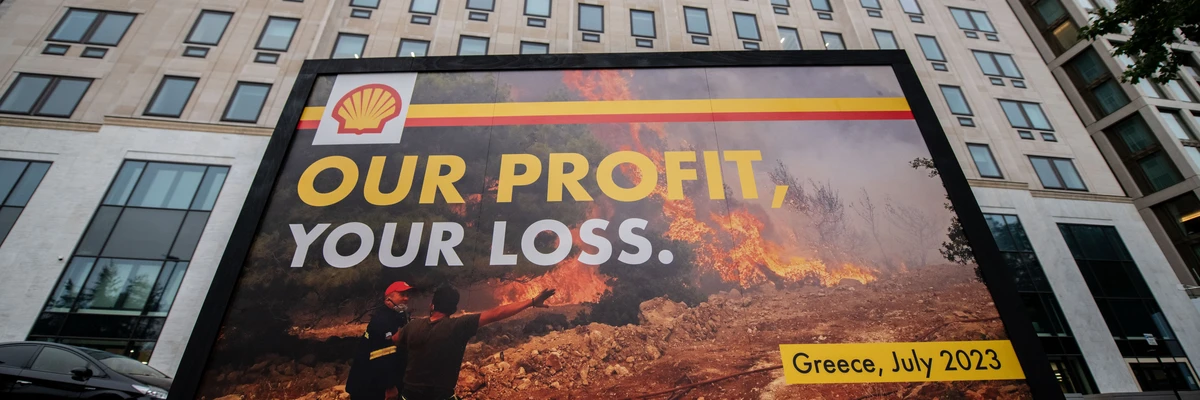
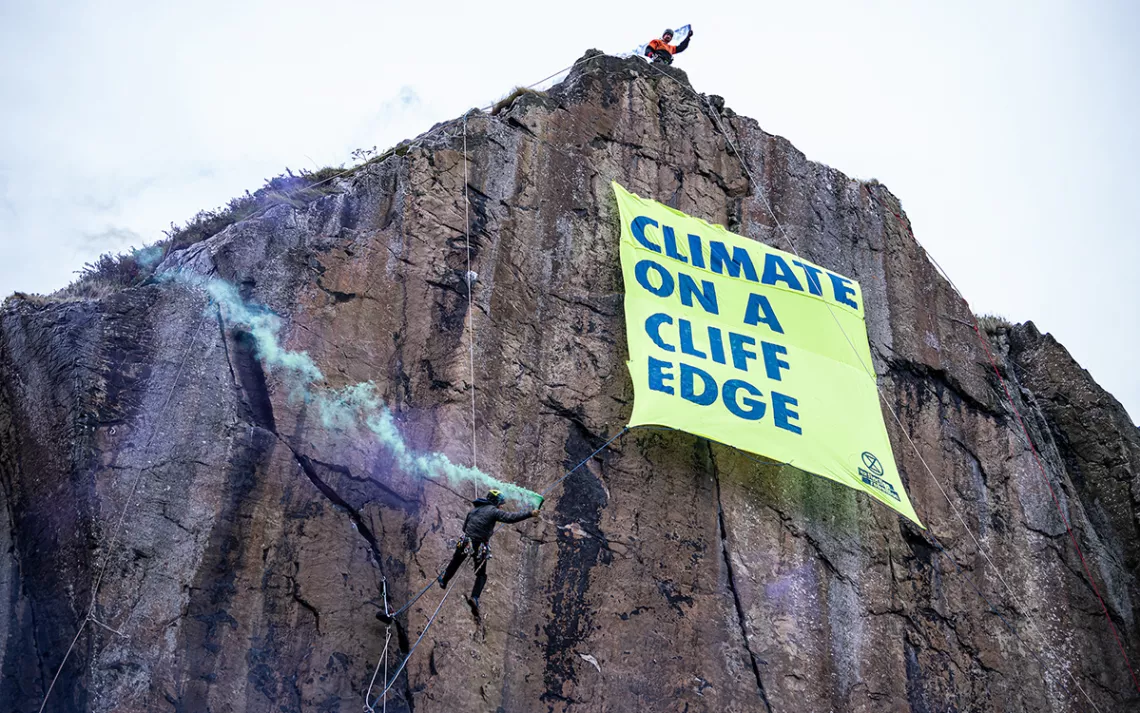
Greenpeace activists display a billboard during a protest outside Shell headquarters on July 27, 2023 in London. (Photo: Handout/Chris J. Ratcliffe for Greenpeace via Getty Images)Experienced climbers scale a rock face near the historic Dumbarton castle in Glasgow, releasing a banner that reads “Climate on a Cliff Edge.” One activist, dressed as a globe, symbolically looms near the edge, while another plays the bagpipes on the shores below. | Photo courtesy of Extinction Rebellion and Mark Richards
Leader of the Green Party Zack Polanski said: ‘Shell has spent decades making billions from fossil fuels while ordinary people around the world pay the price’
PM urged to make fossil fuel giants pay compensation for extreme weather
ANDY BURNHAM faced fresh calls today to make oil giants pay communities compensation for extreme weather as new research suggests Shell’s pollution is responsible for nearly a quarter of global heatwaves.
Analysis by campaigners suing the oil and gas giant at the High Court said that the firm’s pollution has made 24 per cent of the 213 global heatwaves reported between 2000 and 2023 at least 10,000 times more likely.
The Odette case campaign’s findings sparked calls by Green Party leader Zack Polanski, unions and fuel poverty campaigners for the Prime Minister to take a hard line on “climate vandalism” ahead of its annual conference in Liverpool.
This summer’s extreme heat caused thousands of deaths in Britain and an estimated more than £4 billion damage to the economy.
Shell, meanwhile, reported profits of over £12bn in the first six months of this year, a 70 per cent year-on-year increase, as the US-Israel war on Iran sent global oil prices soaring.
Greenpeace activists display a billboard during a protest outside Shell headquarters on July 27, 2023 in London. (Photo: Handout/Chris J. Ratcliffe for Greenpeace via Getty Images)Experienced climbers scale a rock face near the historic Dumbarton castle in Glasgow, releasing a banner that reads “Climate on a Cliff Edge.” One activist, dressed as a globe, symbolically looms near the edge, while another plays the bagpipes on the shores below. | Photo courtesy of Extinction Rebellion and Mark RichardsNigel Farage urges you to ignore facts and reality and be a climate science denier like him and his Deputy Richard Tice. He says that Reform UK has received £Millions and £Millions from the fossil fuel industry to promote climate denial and destroy the planet.
This morning the Green Party leadership, Green MPs and Green peers co-signed a letter to the Secretary of State for Energy Security and Net Zero, Miatta Fahnbulleh, to urge her not to approve the Jackdaw gas field in the North Sea, citing the fact that it will not reduce energy prices, protect jobs, or give the UK energy sovereignty.
Orcas comment on killer apes destroying the planet by continuing to burn fossil fuels.
The full text of the letter is as follows:
Dear Miatta,
Do not approve Jackdaw gas field in the North Sea.
We are writing in response to alarming reports that you intend to give the go ahead to the Jackdaw gas field as soon as next week. As Green MPs and peers we cannot sit back and watch you proceed unchallenged with this act of climate vandalism.
Approving new drilling at Jackdaw will not take a penny off energy costs nor protect jobs. As you said last month, “if you care about affordability, North Sea does not solve that problem for you”, with UK bill-payers still facing the highest energy prices in three years this winter, as a result of our continued exposure to volatile global gas markets. Further, jobs in the North Sea have been in decline for two decades. Jackdaw would only create 27 direct full-time jobs, with the platform unstaffed for most of its operating life and much of the construction already having taken place in Norway. It is completely dishonest of your government to use the legitimate concerns of job security and the cost of living to falsely justify more fossil fuel extraction.
Approving Jackdaw will not give the UK energy sovereignty. Even under the most optimistic scenarios Jackdaw is projected to contribute just 2% of UK gas demand over its lifetime (Uplift, 2026). We know that the only way to achieve energy sovereignty is to get the UK off fossil fuels as fast as possible, by significantly scaling up renewable energy and electrification.
Approving new oil and gas will add fuel to the fire of the climate emergency. Last week, the UN Environment Programme warned that “immediate and sustained cuts to greenhouse gas emissions” were crucial to avoid the worst impacts of climate breakdown. Approving more fossil fuels, at a time when the UK has just experienced record-breaking and deathly heatwaves and wildfires, is a complete dereliction of responsibility.
Approving Jackdaw will line the pockets of shareholders. The operating company, Adura, a joint venture between Shell and Equinor, has been criticised for potentially allowing Shell to write off £1.3 billion in UK tax (Global Witness, 2025). Shell has also faced criticism that it paid little or no tax in this country over several years despite huge global profits. Instead of new drilling, we need to ensure that the existing tax instruments, like the windfall tax, actually bring in the revenue that was promised, and end the subsidies that multinational oil and gas companies have received at UK taxpayers’ expense.
We are therefore urging you to be straight with the public – and instead focus on measures that would actually bring down bills and create secure jobs, like scaling up cheaper home-grown renewables, rolling out a fully-funded national home insulation programme, fully decoupling the price of electricity from gas, and ending rampant profiteering by energy companies.
Your government promised change, not continuity. Approving Jackdaw, after the hottest summer on record, isn’t doing things differently. The new Prime Minister must not repeat Keir Starmer’s mistake of treating climate and nature as second order. Change starts with ruling out all new oil and gas.
Yours sincerely,
Carla Denyer MP Dr Ellie Chowns MP Adrian Ramsay MP Hannah Spencer MP Siân Berry MP Zack Polanski, Leader of the Green Party Mothin Ali, Deputy Leader of the Green Party Rachel Millward, Deputy Leader of the Green Party Anthony Slaughter, Wales Green Party Leader Baroness Bennett of Manor Castle Baroness Jones of Moulsecoomb
Greenpeace activists display a billboard during a protest outside Shell headquarters on July 27, 2023 in London. (Photo: Handout/Chris J. Ratcliffe for Greenpeace via Getty Images)
Prime Minister Andy Burnham speaks to staff at the met office in Exeter, to discuss the UK’s ongoing response to extreme heat, wildfires and drought, August 14, 2026
Burnham urged to stand up to the fossil fuel giants and reject plans to drill Britain’s largest untapped oil fields
PRIME MINISTER Andy Burnham was urged to stand up to profiteering fossil fuel giants and reject plans to drill Britain’s largest untapped oil field as consultations on them drew to a close today.
Labour faces a key environmental test as the final decision over the future of the Rosebank oil field, which lies about 80 miles west of Shetland, is left with ministers.
Production at both Rosebank and Jackdaw had been approved by the previous Conservative government, but those decisions were quashed after a legal challenge from Greenpeace, leaving the government to decide whether or not drilling should go ahead.
The decision on the two projects comes after a summer that has seen soaring temperatures and devastating wildfires in both Britain and Europe.
Environmentalists warn that allowing the development of the Jackdaw gas field off the coast of Aberdeen, whose consultation ended last week, would produce more than 250 million tonnes of CO2 — equivalent to 70 per cent of Britain’s annual emissions.
Greenpeace campaigner Maja Darlington said: “The PM wants to be pragmatic, but there is nothing pragmatic about watching communities be battered by climate chaos while the Prime Minister flirts with expanding the very industry driving it.
“More drilling means more heatwaves, more droughts, more wildfires, and more suffering for the communities Burnham represents. The climate crisis is already hitting working people hardest — firefighters on the front line, bus drivers exposed to inhumane heat, nurses collapsing on the job.
Experienced climbers scale a rock face near the historic Dumbarton castle in Glasgow, releasing a banner that reads “Climate on a Cliff Edge.” One activist, dressed as a globe, symbolically looms near the edge, while another plays the bagpipes on the shores below. | Photo courtesy of Extinction Rebellion and Mark RichardsGreenpeace activists display a billboard during a protest outside Shell headquarters on July 27, 2023 in London. (Photo: Handout/Chris J. Ratcliffe for Greenpeace via Getty Images)Orcas comment on killer apes destroying the planet by continuing to burn fossil fuels.
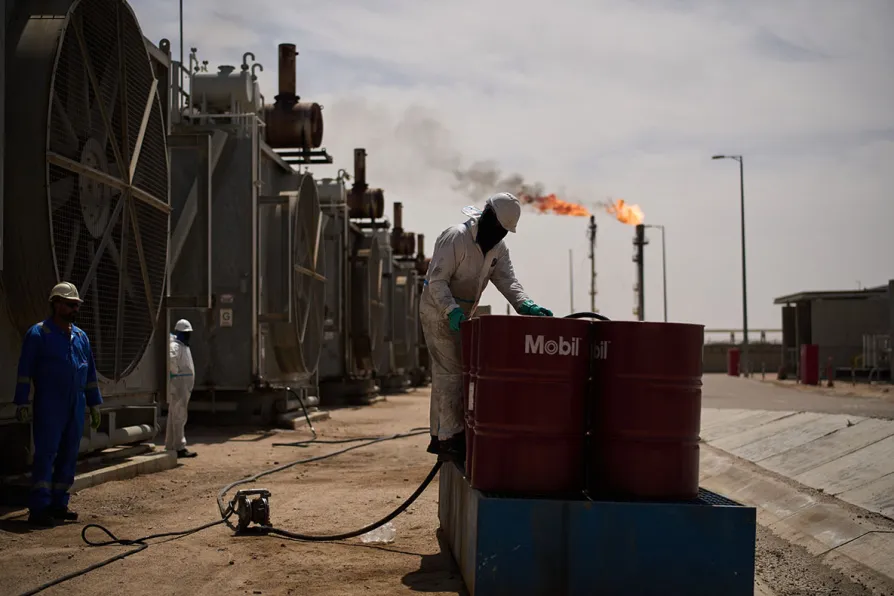
A worker collects engine oil as he works at a degassing station in Zubair oil field near Basra, Iraq
ENERGY firms raked in an excess of £6 billion in Iran war windfall profits this year, it was revealed today as households brace for yet another bill rise at the end of the month.
Campaigners said profits generated in Britain by these companies equate to over £200 for every household in the country, while a further increase in gas prices is expected in the next Ofgem price cap announcement on August 26.
Financial results posted by the world’s top energy firms revealed their British profits are only one part of their global profits, totalling £95bn in 2026.
Analysis from the End Fuel Poverty Coalition (EFPC) revealed the excess profits linked to global energy market disruptions as a result of the US war on Iran, which has increased cost pressures on households in Britain, as well as other countries.
Researchers looked at financial results posted by BP, Centrica, Chevron, Equinor, ExxonMobil, Iberdrola, Shell and Total.
EFPC co-ordinator Simon Francis said windfall profits must be considered alongside previous findings saying a third of households are “on the brink of, or are in energy debt.”
“These price shock profiteers are doing very well out of the Iran conflict, but they are doing little to solve the underlying problems,” Mr Francis said.
“As people brace for the next price cap announcement on August 26 and a third of households are on the brink of or in energy debt, the energy industry watches the profits climb.”


 Leader of the Green Party Zack Polanski said: ‘Shell has spent decades making billions from fossil fuels while ordinary people around the world pay the price’