Article by republished from Common Dreams under Creative Commons (CC BY-NC-ND 3.0).
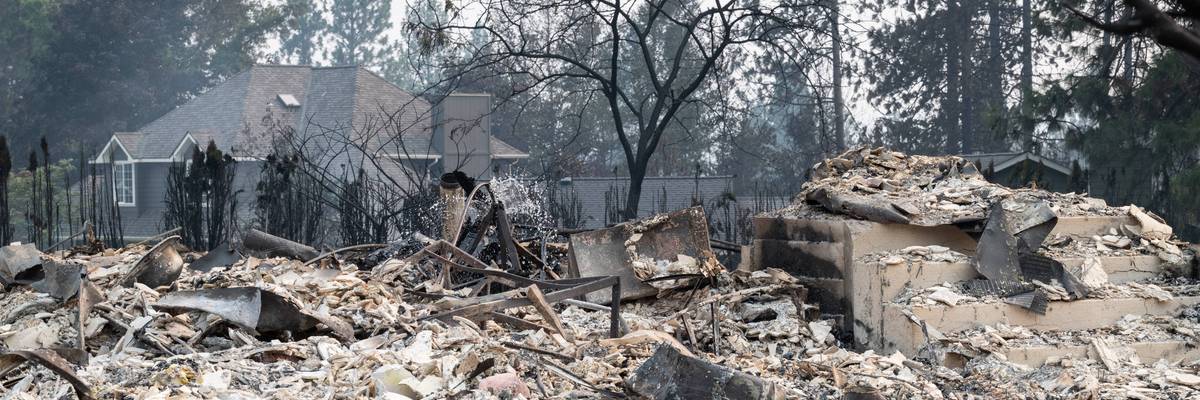
The rubble of a burned out residential home smolders in the Balboa neighborhood of Spokane, Washington, on August 2, 2026. (Photo by Erick Doxey/AFP via Getty Images)
“The fossil fuel industry may not have struck the match, but the climate crisis they drove has loaded our landscapes with tinder,” said an environmental activist.
Over 60,000 people were ordered to evacuate the Spokane area over the weekend as it was devastated by what Democratic Washington Sen. Maria Cantwell called the “top fire” in a nation currently being scorched by climate-fueled blazes.
Illustrating how the climate crisis is already impacting lives and communities across the country and the globe, three raging fires reportedly consumed over 600 structures as of Sunday, including homes and businesses, and reduced entire streets to their foundations.
At a briefing on Sunday afternoon, officials said more than 250,000 acres were burning across Washington, but reported no deaths or injuries.
Spokane Mayor Lisa Brown called it “the worst natural disaster our region has faced.”
Democratic Gov. Bob Ferguson has requested assistance from the Federal Emergency Management Agency (FEMA), which is under the Trump administration’s Department of Homeland Security (DHS).
Sen. Patty Murray (D-Wash.) wrote on social media that she had spoken with Homeland Security Secretary Markwayne Mullin and that he “made clear the federal government will do everything it can to support response and recovery,” though President Donald Trump has previously intervened to block disaster aid to Democrat-led states.
While the fires moderated over the weekend, on Monday they remained largely uncontained and continued to spread due to dry conditions from recent severe droughts in the region, exacerbated by rising global temperatures.
This is Spokane, Washington. Right now. First weekend of August.
“This is climate change playing out live in real time,” said meteorologist and Climate Central journalist Shel Winkley in a video about the Spokane fires.
Warmer temperatures, he explained, have caused a vicious cycle of “weather whiplash” in which greater winter rainfall facilitates plant growth before harsher summer heat domes suck moisture from these plants, turning them into a tinderbox.
“Northeastern Washington and central Oregon now see at least three more weeks of fire weather days each year than they did just back in the 1970s,” Winkley said. “More fire weather days means more chances for a spark, any spark, to turn into this.”
The blazes are part of a nationwide trend, with wildfires this year more severe on average than in previous years. Over the past decade, the average annual acreage burned in the US was more than double the average of the late 1980s and early 1990s, according to data from the National Interagency Fire Center.
Last week, an Oxfamanalysis of data published in the journal Nature found that emissions from just five oil companies—BP, Chevron, ExxonMobil, Shell, and TotalEnergies—were sufficient to cause around 1 in 4 heatwaves reported globally between 2000 and 2023—“heatwaves that would have been virtually impossible without human-made climate change.”
Using S&P Capital Trucost data, the group estimated that Big Oil was responsible for more than $60 billion in environmental damage last year.
But as costs fall on the public, oil companies like Chevron and ExxonMobil have reported record profits of $12.1 billion and $14.5 billion over the past quarter, in part due to global oil price spikes driven by Trump’s war with Iran.
“The fossil fuel industry may not have struck the match, but the climate crisis they drove has loaded our landscapes with tinder,” said Clémence Dubois, the campaigns director for the environmental group 350.org. “Chevron and Exxon are profiteering from a model of distraction, leaving ordinary people to pay the price with higher bills and devastating impacts such as these fires. These profits feel almost criminal.”
Jay Inslee, Washington’s former Democratic governor and a longtime advocate for policies to combat the climate crisis, said on Sunday that his friend, a legislator from Spokane, had been forced to flee his home due to the fires.
“Climate change isn’t some faraway threat,” Inslee said. “It’s happening right now, to our neighbors and friends. We have to fight for them.”
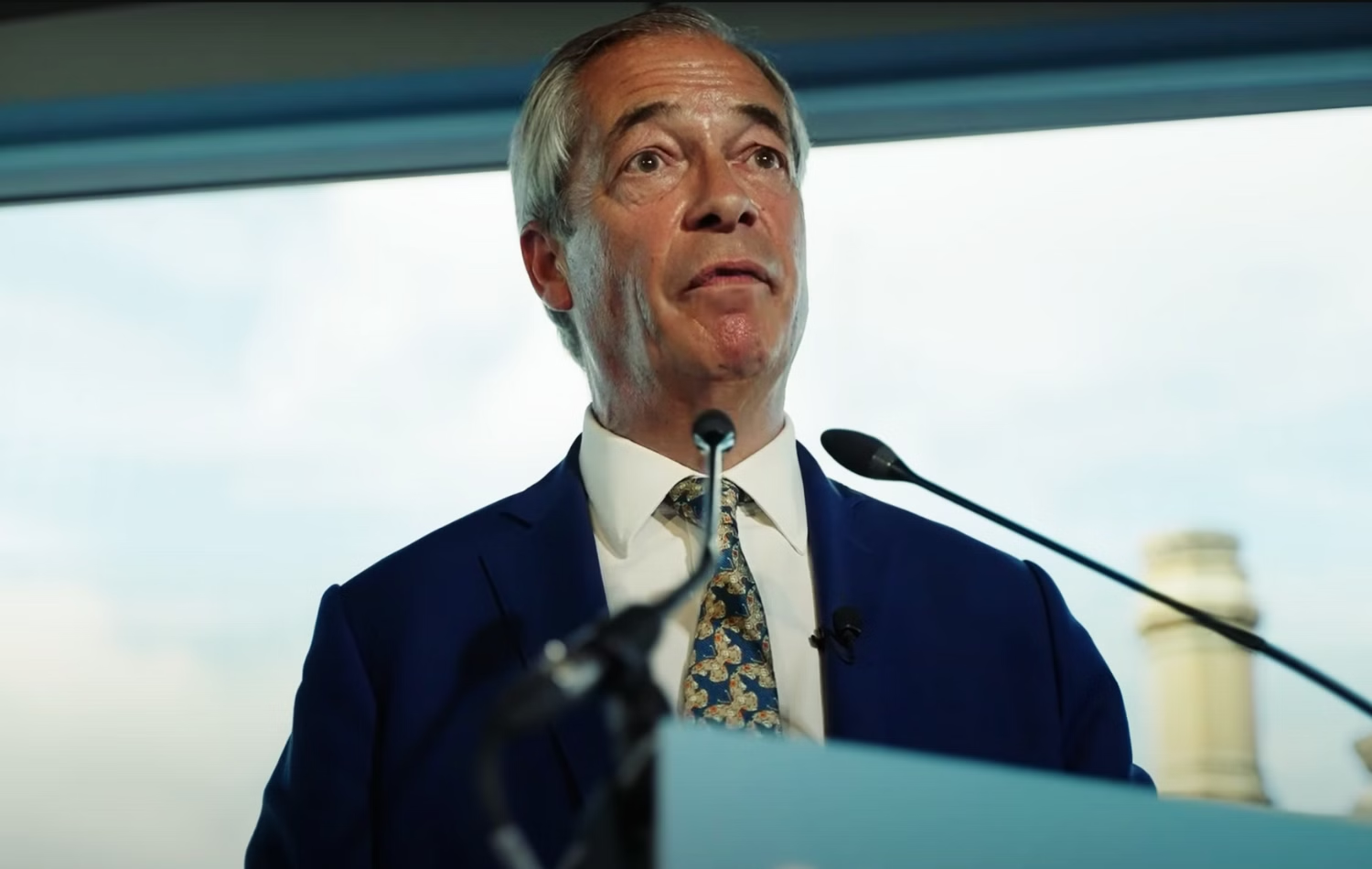
Nigel Farage urges you to ignore facts and reality and be a climate science denier like him and his Deputy Richard Tice. He says that Reform UK has received £Millions and £Millions from the fossil fuel industry to promote climate denial and destroy the planet.Donald Trump urges you to be a Climate Science denier like him. He says that he makes millions and millions for destroying the planet, Burn, Baby, Burn and Flood, Baby, Flood.Power-mad orange gasbag Donald Trump says Burn, Baby, Burn.
A view of the Chamber of the House of Lords ahead of the State Opening of Parliament at the Palace of Westminster in London, May 13, 2026
PEERS have seen their shares in oil and gas firms soar by tens of thousands since the start of the US war on Iran as the energy price cap jumped today, the Morning Star can reveal.
At least seven lords and one baroness have seen their stock holdings in companies such as Equinor, Chevron and Shell, increase since the war-driven energy shock.
New research from the End Fuel Poverty Coalition (EFPC) shared exclusively with the Star revealed the estimated gains made by peers as households “dread” the next energy bill.
EFPC co-ordinator Simon Francis slammed the lords who “may be leaping at the prospect of increased dividends and share prices” on the backs of “suffering households.”
Among the lords who saw the highest rise in their holdings was former Treasury and Cabinet Office minister Lord Agnew of Oulton.
A Tory peer and board member on GB News’ holding company, Lord Agnew saw his shares in Britain’s largest gas supplier Equinor grow by around £28,000 since the February 28 US-Israeli strikes on Iran which kicked off the war.
Former Tory Treasury minister Lord Sassoon saw shares in Chevron, ConocoPhillips, Occidental Petroleum and Shell grow by a combined value of just under £28,000.
EFPC highlighted other sitting peers holding shares in Shell, including former Hong Kong governor Lord Patten, former Tory home secretary and chancellor Lord Clarke and crossbencher Lord Rees.
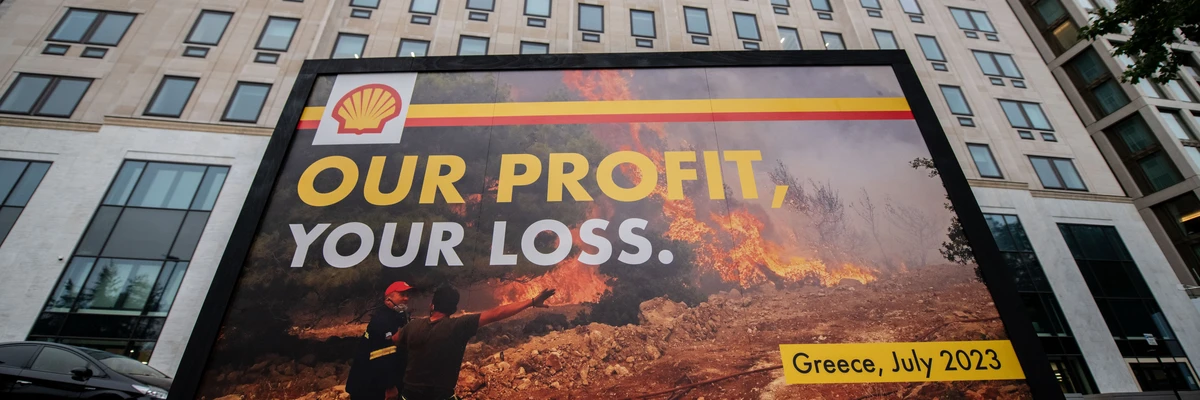
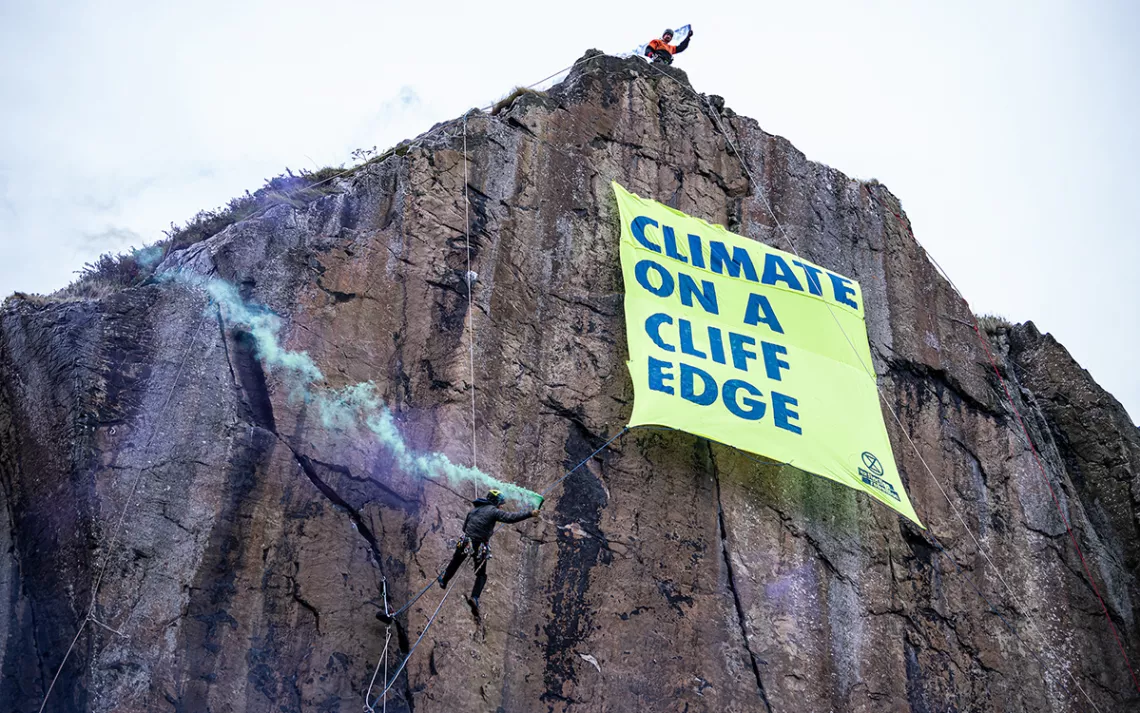
Orcas discuss Donald Trump and the killer apes’ concept of democracy. Front Orca warns that Trump is crashing his country’s economy and that everything he does he does for the fantastically wealthy.Greenpeace activists display a billboard during a protest outside Shell headquarters on July 27, 2023 in London. (Photo: Handout/Chris J. Ratcliffe for Greenpeace via Getty Images)Experienced climbers scale a rock face near the historic Dumbarton castle in Glasgow, releasing a banner that reads “Climate on a Cliff Edge.” One activist, dressed as a globe, symbolically looms near the edge, while another plays the bagpipes on the shores below. | Photo courtesy of Extinction Rebellion and Mark Richards
Peter Mandelson was Keir Starmer’s pick for US ambassador, but was forced to resign following the release of the Epstein Files (Photo by Carl Court/Getty Images)
Government failed to declare meeting with top Global Counsel clients, and says no notes were taken at several meetings
The government has no official records of meetings that top civil servants held with senior figures and clients from Peter Mandelson’s lobbying firm last year, including an undeclared meeting with oil giants and private equity firms, openDemocracy can reveal.
Global Counsel went into administration earlier this year after details of Mandelson’s close relationship with Jeffrey Epstein were revealed in the Epstein Files, including emails showing how he sought the billionaire paedophile’s advice on establishing the firm.
But before its collapse, Global Counsel’s business was booming as it and its founder established close ties to Keir Starmer’s Labour Party.
Ahead of the 2024 election, the company donated a member of staff to support Labour’s work on financial services policy development and produced promotional materials, which openDemocracy has seen, touting its significant access to the party. “Our clients’ engagement pays dividends in the long run,” it promised, adding that it was “uniquely placed” to help corporate clients “establish relationships that outlive the election and deliver policy dividends on the other side”.
By the end of that year, Starmer had appointed Mandelson as the UK’s US ambassador, and Global Counsel had seen its UK revenue surge by 75% since 2022, from £7.9m to £13.9m. The business also took on over 20 new clients in the first quarter after Labour’s win – more than in the previous five years combined – including Palantir, Shell and TikTok.
Now, openDemocracy can reveal that the most senior civil servant from the Department for Business and Trade and a senior Treasury official met with Global Counsel’s representatives several times last year, including at a roundtable the firm hosted for its clients.
No records from the discussions – including notes or minutes – exist, the government told openDemocracy in response to a Freedom of Information request.
Our investigation comes as parliament’s Intelligence and Security Committee takes the rare step of voicing “grave concerns” about the government’s failure to keep proper records from official meetings, following its review of documents set to be published relating to Mandelson’s time as US ambassador.
ISC chair Lord Beamish wrote to the government expressing a number of concerns, including over a “lack of an audit trail – in terms of agendas, minutes and records of conversations,” which he described as “unacceptable in government.”
Shadowy meetings
In January last year, Gareth Davies, then permanent secretary at the Department for Business and Trade, met Global Counsel’s most senior adviser on business and trade, Geoffrey Norris, at the exclusive Royal Horseguards Hotel in Whitehall.
The meeting was useful enough that four months later, in May 2025, the pair returned to the same hotel to chat some more.
Yet little is known about what they discussed. The department quite vaguely recorded the purpose of these meetings as “to discuss latest business updates” and “discussion on growth”, respectively.
When openDemocracy asked for more information, the government said it had none.
Davies then spoke at a Global Counsel dinner event in early June and attended a client roundtable event that the firm hosted, which Norris chaired, at its offices weeks later.
There, the senior civil servant spoke with executives from several Global Counsel clients, including oil giants Shell and Equinor, plus JP Morgan and Blackstone. But you wouldn’t know that from the government’s published transparency requests, which fail to mention that clients were present. Their attendance was revealed to openDemocracy only in documents obtained via Freedom of Information requests.
Norris was not the only Global Counsel member Davies was in touch with. In July last year, he met with Benjamin Wegg-Prosser, the company’s co-founder and CEO, “to discuss the industrial strategy”.
Both Norris and Wegg-Prosser are New Labour alumni. Norris was a top business aide in Tony Blair and Gordon Brown’s governments, and later advised Mandelson while he was business secretary, while Wegg-Prosser worked as an adviser to Mandelson before becoming Blair’s director of strategic communications.
When Labour lost power at the 2010 election, Mandelson and Wegg-Prosser established Global Counsel, which Norris joined soon afterwards, remaining at the company until its collapse in February.
Wegg-Prosser was reportedly offered a peerage and a role as Labour’s investment minister in September 2024, but declined to avoid stepping down as Global Counsel’s CEO. He eventually quit in February of this year after it was revealed that he’d had extensive contact with Jeffrey Epstein, including traveling to New York to meet Epstein in 2010, two years after Epstein was convicted for soliciting prostitution from a minor. Global Counsel went into administration weeks after Wegg-Prosser’s exit.
Davies is a long-serving civil servant who recently left DBT to become the top official at the Home Office. He began his career in government alongside Davies, Wegg Prosser and Mandelson, as a Downing Street adviser during the New Labour years.
A DBT spokesperson said: “Transparency returns are published in line with Cabinet Office guidance, and the Civil Service Code has not been broken.”
‘We need full transparency’
Global Counsel also enjoyed significant access to the Treasury under Labour – in some cases with no record of what it lobbied ministers and officials about.
A Global Counsel lobbyist specialising in financial services was seconded to the office of Labour’s first City minister, Tulip Siddiq, before she resigned in January 2025 over alleged corruption links to her aunt’s ousted government in Bangladesh. The staffer’s secondment was a registrable donation-in-kind valued at more than £35,000, and not against parliament’s rules.
In November 2024, Siddiq, who was also economic secretary to the Treasury, met with one of Global Counsel’s most senior figures, its financial services lead, Rebecca Park, to discuss “growth and competitiveness of the financial services sector”. The government declined to provide any details of what was discussed after openDemocracy submitted an FOI request last year.
Later, in July 2025, the Treasury’s director general of financial services, Gwyneth Nurse, met Global Counsel’s Benedict Brogan, a former journalist-turned banking lobbyist, at the Wolseley to “discuss the UK regulatory environment”. Again, the government told openDemocracy it held no further record of what was discussed at the meeting.
Follow-up correspondence obtained by openDemocracy shows Brogan invited Nurse to a client roundtable event in the autumn, with the suggested date of 20 October. Government transparency data shows Nurse attended a Global Counsel dinner event on 20 October, though the records do not show which of the firm’s clients were in attendance.
Financial deregulation has been a significant feature of Labour’s policy offering to the City, which has won the party rare public shows of support from some of the world’s most influential financiers, notably JP Morgan’s Jamie Dimon and Jon Gray of Blackstone. Both firms have, incidentally, worked with Global Counsel.
The lobbying firm was also reportedly contracted by other financial giants as part of an ultimately successful campaign against an increase in ‘carried interest,’ the reduced rate of tax that dealmakers pay on their profits from private equity deals, which can often save them millions.
Mick McAteer, a former regulator and the director of the Financial Inclusion and Markets Centre, said the finance sector should “serve the interests of the real economy, environment, and society”.
“But, finance sector lobbyists now exercise undue influence over finance sector policy. As a result, we are seeing a programme of deregulation and corporate welfare designed to promote finance sector growth, which could ultimately harm our interests. We need full transparency on meetings between policymakers and finance lobbyists.”
The government has previously faced significant criticism over its failure to declare a meeting in early 2025 between Starmer, Mandelson and Palantir.
Now, its failure to keep records of the meetings it has had with Global Counsel and its clients appears to breach the Civil Service Code, under which all civil servants are legally required to “keep accurate official records”.
Separate guidance on managing records in ministers’ private offices states explicitly that officials are “bound by the government’s commitment to keep records of meetings with outside interest groups”.
Duncan Hames, senior director of policy at Transparency UK, said: “When government transparency is treated as a tick-box exercise, or ignored altogether, this undermines our right to know how decisions are made and leaves room for undue influence.
“In this case, as in so many others, it is clear that the current system is not working as it should. It’s time for the UK government to follow Scotland’s lead and publish a comprehensive register of those lobbying government.”
openDemocracy contacted Ben Wegg Prosser and Benedict Brogan but neither responded.
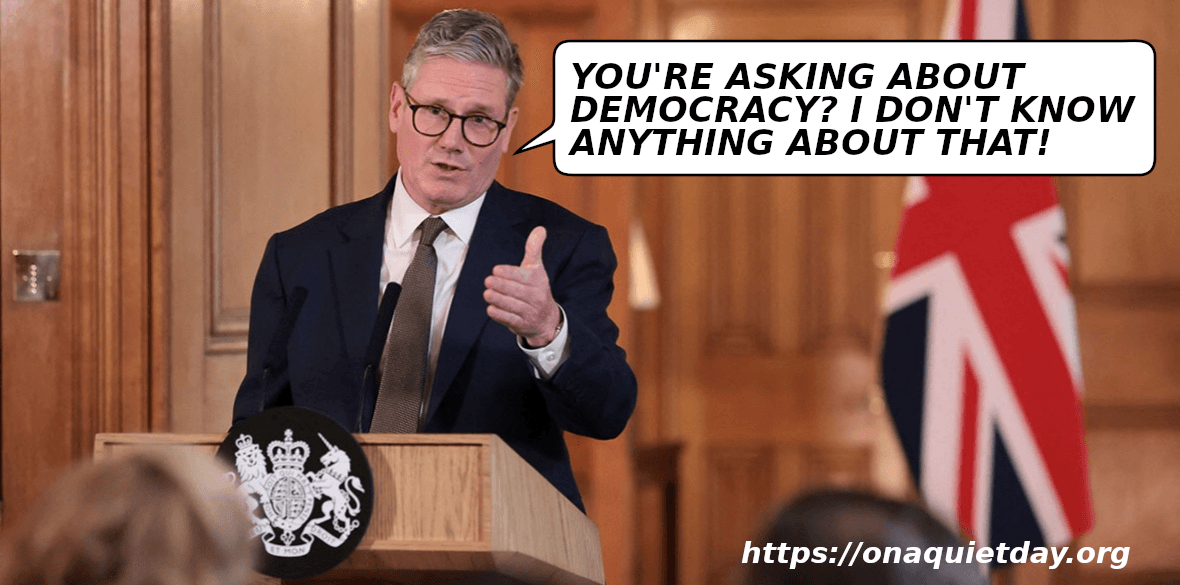
Keir Starmer says that the Labour Party under his leadership is intensely relaxed about assaulting those least able to defend themselves – the very poorest and most vulnerable.Keir Starmer confirms that he doesn’t know anything about democracy.
Reform UK leader Nigel Farage speaking in Aberdeen. Credit: Reform UK / YouTube
Nigel Farage’s party was told by Offshore Energies UK to rethink its plan to thwart clean energy.
LIVERPOOL – The UK’s largest oil and gas trade body has criticised Reform UK’s plans to “turn off the tap” on renewable energy.
Nigel Farage’s party has tried to present itself as the oil and gas industry’s closest ally, vowing to “drill, baby, drill” in the North Sea and scrap the windfall tax on excess profits, while meeting with oil executives, and courting donations from the sector.
However, on a panel at the Labour Party’s annual conference in Liverpool on Monday (29 September), a spokesperson for Offshore Energies UK (OEUK) criticised Reform’s plans to end state support for clean energy.
Natalie Coupar, communications and marketing director at OEUK – members of which include fossil fuel giants BP, Shell, ExxonMobil, TotalEnergies, and Equinor – said the group is “apolitical” but gives “hard truths to all parties”.
She said: “One of the things we’ve been saying to Reform very much is, you know, if you’re going to turn on the taps for oil and gas, there’s almost really no point if you’re just going to turn off the taps to renewables.
“That doesn’t help. We need to keep both those streams open.”
According to the Confederation of British Industry (CBI), the UK’s net zero economy grew by 10 percent in 2024, employing almost a million people in full-time jobs.
Coupar also said it was essential to “hold the consensus on tackling climate change and growing our energy future”.
A panel at 2025 Labour Party conference sponsored by Offshore Energies UK (OEUK). Credit: DeSmog
Reform’s Oil Campaign
Reform has vowed to stop all government subsidies for renewable energy, and has pledged to block solar and onshore wind farms in the local authorities it controls.
In May, the party’s deputy leader Richard Ticesaid: “Whether it’s planning blockages, whether it’s judicial reviews, whether it’s lawsuits, whether it’s health and safety notices, we will use every available legal measure to an extreme way in order to frustrate these people.”
Tice – who has said “there’s no evidence that man-made CO2 is going to change the climate” – met with senior oil executives in May and promised to approve new drilling licences “on day one” of a Reform government.
Last month, he pledged to overturn the UK’s ban on fracking for shale gas, which he calls “treasure beneath our feet”, and told the industry to “get ready”.
In April, Reform party treasurer and a billionaire property developer Nick Candy said he was trying to secure donations from oil and gas executives, claiming to have raised £100,000 from one, though this has yet to appear on Reform’s donations register.
As DeSmog has reported, 92 percent of Reform’s funding between the 2019 and 2024 general elections came from climate science deniers or those with highly polluting interests – a total of £2.3 million.
Since his election as an MP last year, Farage has spoken at a string of events in the U.S. organised by radical groups backing U.S. President Donald Trump’s pro-fossil fuel agenda. Last December, Farage launched the UK-EU branch of the Heartland Institute, a U.S. climate denial think tank.
Speaking at the Alliance for Responsible Citizenship conference in London in February, Farage claimed it was “absolutely nuts” for CO2 to be considered to a pollutant. However, he added: “I’m not a scientist. I can’t tell you whether CO2 is leading to warming or not, but there are so many other massive factors.”
Climate scientists at the UN’s Intergovernmental Panel on Climate Change (IPCC), the world’s leading climate science body, have stressed that “it is a statement of fact, we cannot be any more certain; it is unequivocal and indisputable that humans are warming the planet”.
Nigel Farage urges you to ignore facts and reality and be a climate science denier like him and his Deputy Richard Tice. He says that Reform UK has received £Millions and £Millions from the fossil fuel industry to promote climate denial and destroy the planet.Elon Musk urges you to be a Fascist like him, says that you can ignore facts and reality then.Nigel Farage reminds you that he’s the man that brought you Brexit and asks what could possibly go wrong.
Global warming linked to the world’s biggest oil and gas companies made all “major” 21st century heatwaves more intense and frequent.
This is according to new research, published in Nature, which uses “extreme event attribution” to assess the impact of climate change on all 21st-century heatwaves that were classified as “major disasters”.
The authors find one-quarter of the 213 heatwaves would have been “virtually impossible” without human-caused global warming.
They add that the effect of climate change on heatwave frequency and intensity is becoming more pronounced as the planet warms.
The study estimates the emissions stemming from the operations and production of more than 100 “carbon majors”, such as ExxonMobil, BP, Saudi Aramco and Shell.
The fossil fuels produced by these companies account for 60% of all human-caused CO2 emissions over 1850-2023, the study says.
The authors find that heatwaves recorded over 2000-23 were made, on average, 1.7C hotter due to climate change, with half of this increase due to the emissions originating from carbon majors.
This study “could be used to support future climate lawsuits and aid diplomatic negotiation”, according to a scientist not involved in the research.
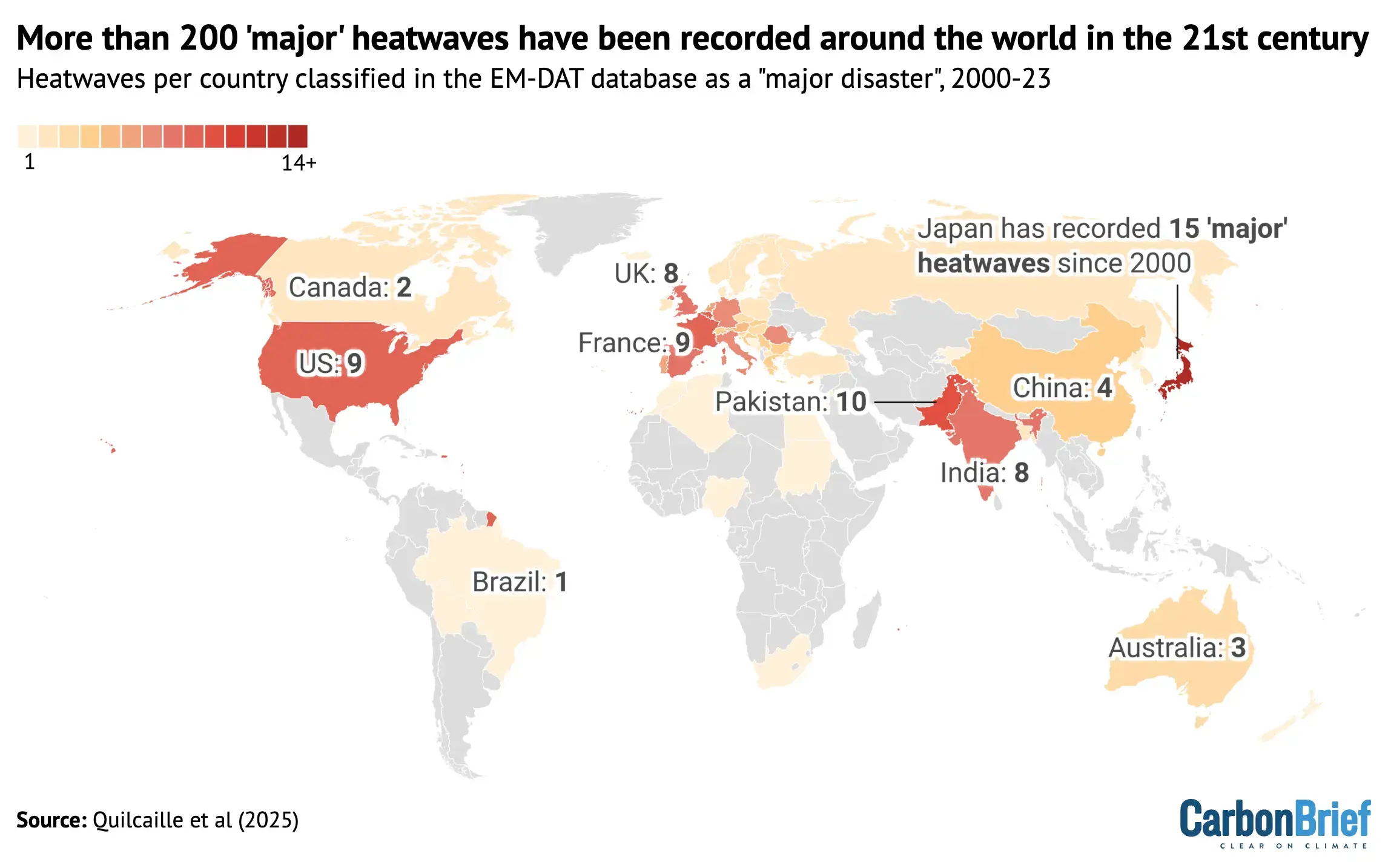
The EM-DAT database catalogues all “major disasters” that have been reported since the year 1900 – defined as events that cause at least 10 fatalities, affect at least 100 people, or result in the declaration of state of emergency or a call for international assistance.
Between 2000 and 2023, the database lists more than 200 heatwaves. These are shown on the map below, where darker pink indicates a greater number of heatwaves. Countries with no reported heatwaves are shown in grey.
The map below shows the number of heatwaves per country recorded over 2000-23 on the EM-DAT database. Data: Quilcaille et al (2025).
The study authors acknowledge that heatwave reporting is “highly uneven”, with only nine of the heatwaves reported in the database since the year 2000 in Africa, Latin America or the Caribbean. (This is largely because extreme heat events in these regions are not routinely monitored.)
They then carried an attribution analysis on each heatwave to identify whether it was made more likely or intense due to human-caused climate change.
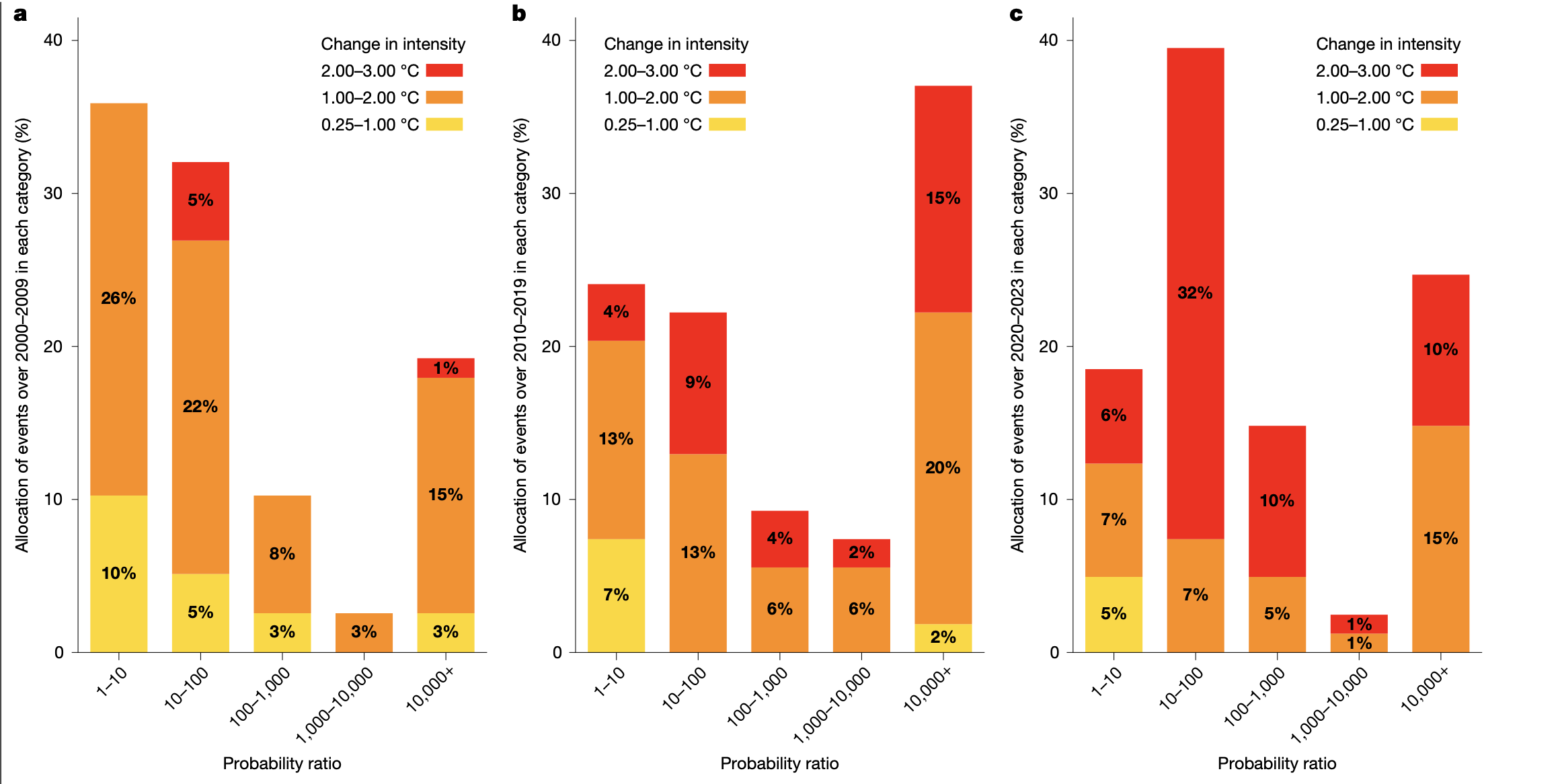
The chart below shows how climate changes increased the intensity and frequency of the 78 heatwaves assessed over 2000-09 (left), 54 heatwaves assessed over 2010-19 (middle) and 81 heatwaves assessed over 2020-23 (right).
The authors find that climate change increased the intensity and probability of all 213 heatwaves in the study. They add that the influence of climate change on heatwaves is strengthening over time.
In each panel, the bars show the percentage of heatwaves in that time period that were made 0.25-1.0C (yellow), 1.0-2.0C (orange) or 2.0-3.0C (red) hotter due to climate change.
The position of bars indicate the change in likelihood of the heatwaves. This ranges from those made 1-10 times more likely due to climate change (left-most bar in each panel) to those made more than 11,000 times more likely (right-most bar in each panel).
The extent to which climate changes increased the intensity and frequency of the 78 heatwaves assessed over 2000-09 (left), 54 heatwaves assessed over 2010-19 (middle) and 81 heatwaves assessed over 2020-23 (right). These are shown by colours and bar heights respectively. Source: Quilcaille et al (2025).
Heatwaves recorded over 2000-09 were, on average, 20 times more likely due to climate change, according to the authors. Meanwhile, those recorded over 2010-19 were about 200 times more likely.
Similarly, 2000-09 heatwaves were 1.4C hotter due to human-caused climate change on average, according to the study, while 2010-19 heatwaves were made 1.7C hotter.
The study finds that human-caused climate change made 55 heatwaves at least 10,000 times more likely. According to the authors, this is “equivalent to saying that they would have been virtually impossible” without the influence of human activity.
Carbon majors
To assess the contribution to heatwaves by oil and gas companies’ products, the authors use a database of carbon dioxide and methane emissions from 180 carbon majors over 1854-2023. This includes direct emissions from the companies, as well as the emissions released when the oil and gas they produced is used by others.
The 180 carbon majors in the database represent 60% of all human-caused CO2 emissions, including land use, over 1850-2023, according to the study. The paper adds that 14 companies, including ExxonMobil, BP, Saudi Aramco and Shell, are responsible for almost half of these emissions.
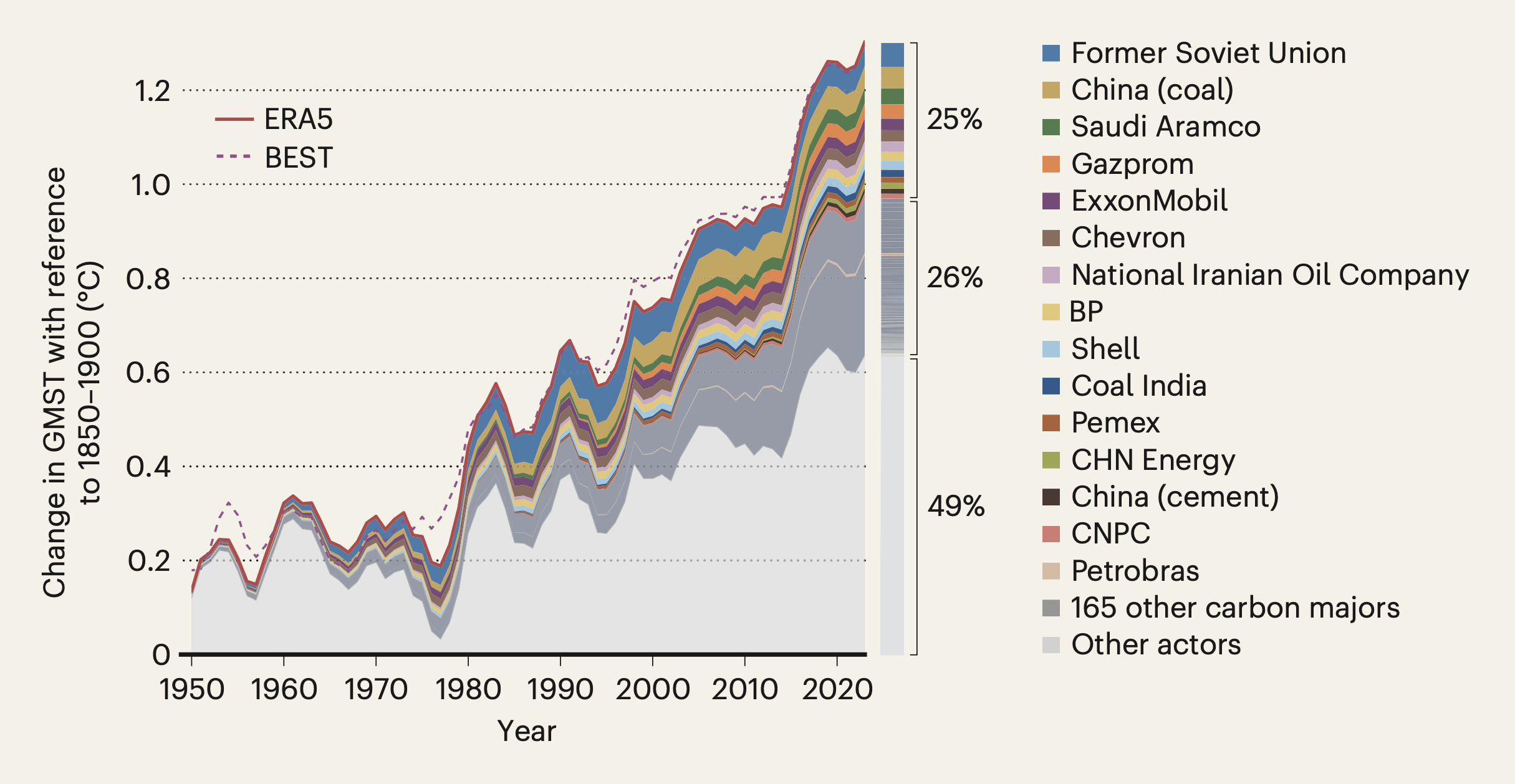
Using the Earth system model OSCAR, the authors estimate that global average surface temperatures increased by 1.3C between the 1850-1900 average and the year 2023.
They find that 0.7C of this increase was linked to the carbon majors, with 0.3C due to the emissions of the 14 largest.
The chart below, taken from an accompanying Nature “news and views” article, shows the contribution of oil and gas companies’ products to increasing global average surface temperatures over 1950-2023, compared to the 1850-1900 average.
Each colour indicates a carbon major, while grey indicates other sources of temperature increase, such as land-use change.
The contribution of oil and gas companies to increasing global average surface temperatures over 1950-2023, compared to the 1850-1900 average. Each colour indicates a company, while grey indicates other sources of temperature increase. Source: Haustein (2025).
Heatwaves recorded over 2000-23 were, on average, 1.7C hotter due to climate change, according to the study. The authors find that emissions originating from carbon majors and their products contributed about half of the increase in intensity of heatwaves seen since pre-industrial times.
The authors then break down the contribution of emissions from each carbon major on each heatwave in their analysis.
For example, they find that the emissions linked to Saudi Aramco made 51 heatwaves at least 10,000 times more likely. They add that on average, emissions tied to the company made the 213 heatwaves 0.04C hotter.
Legal action
Attribution studies already play an important role in courts by providing evidence that helps judges to determine liability.
Dr Rupert Stuart-Smith is a research associate in climate science and the law at the University of Oxford’s Sustainable Law Programme. He was not involved in the study, but has published separate work showing that the emissions linked to each of the six largest corporate emitters cause one heat-related death in Zurich alone, every summer.
Stuart-Smith tells Carbon Brief that the new paper is a “high-quality analysis and a meaningful step forward for the field of climate change attribution”. He adds:
“With more and more lawsuits aiming to hold high-emitting companies responsible for their contributions to climate change impacts or compel state and corporate actors to reduce their emissions and prevent rising climate harms, work like this provides the basis for well-informed judicial decision-making.”
Dr Yann Quilcaille is a researcher at ETH Zürich and lead author of the study. He stresses the importance of attribution research for court cases, telling Carbon Brief that he hopes his work “can be used by legal practitioners”.
However, he also says that his role as a scientist is not to assign “responsibility” for climate change, but to “provide information to governments for decision making and to courts for litigation”.
Mankin tells Carbon Brief that the new paper is “very closely” linked to his research.
Callahan says the new paper is “an important contribution to an emerging literature that illustrates how individual emitters can be linked to the change risk of extreme climate conditions and human impacts”.
He explains that “this kind of evidence will be important in courtrooms – holding emitters legally accountable requires demonstrating a causal nexus between that emitter and a particularised harm suffered by a plaintiff”.
Attribution
The cutting-edge field of extreme weather attribution seeks to establish the role that human-caused warming played in these events. Attribution studies have been carried out on hundreds of heatwaves all around the world, as shown in Carbon Brief’s interactive map.
The new paper uses one of the earliest and most commonly used methods of attribution, called “probabilistic attribution”.
The authors first chose a temperature “threshold” to define their heatwave.
They then used a global climate model to simulate two worlds – one mirroring the world as it was during the heatwave and the other using the climate of 1850-1900. This second scenario is used to represent the climate in a world without human-caused climate change.
The authors run their models thousands of times in each scenario. As the world’s climate is inherently chaotic, each model “run” – individual simulations of how the climate progresses over many years – produces a slightly different progression of temperatures. This means that some runs simulate the heatwave, while others do not.
The authors count how many times the threshold temperature was in each model run. They then compared the likelihood of crossing the threshold temperature in the world with – and a world without – climate change.
For example, they find that the 2021 Pacific north-west heatwave was made 3.1C hotter due to human caused climate change and more than 10,000 times more likely.
(A study by the WWA at the time of the heatwave found that the heatwave was made 150 times more likely. The discrepancy is due to differences in the definition of the event, as well as its “very unlikely nature” according to the study authors.)
Dr Frederieke Otto is a professor at Imperial College London and founder of the WWA initiative. She tells Carbon Brief that the new study is “very similar to some other recent studies on impacts, based on the hazard attribution method used by WWA”, but says that “this is the most high profile and wide-reaching one”.
Otto adds:
“I do hope that many more impact attribution studies will follow, based on our or other extreme event attribution studies. We need more research on this.”
Donald Trump urges you to be a Climate Science denier like him. He says that he makes millions and millions for destroying the planet, Burn, Baby, Burn and Flood, Baby, Flood.Nigel Farage urges you to ignore facts and reality and be a climate science denier like him. He says that Reform UK has received millions and millions from the fossil fuel industry to promote climate denial and destroy the planet.Greenpeace activists display a billboard during a protest outside Shell headquarters on July 27, 2023 in London. (Photo: Handout/Chris J. Ratcliffe for Greenpeace via Getty Images)Experienced climbers scale a rock face near the historic Dumbarton castle in Glasgow, releasing a banner that reads “Climate on a Cliff Edge.” One activist, dressed as a globe, symbolically looms near the edge, while another plays the bagpipes on the shores below. | Photo courtesy of Extinction Rebellion and Mark Richards


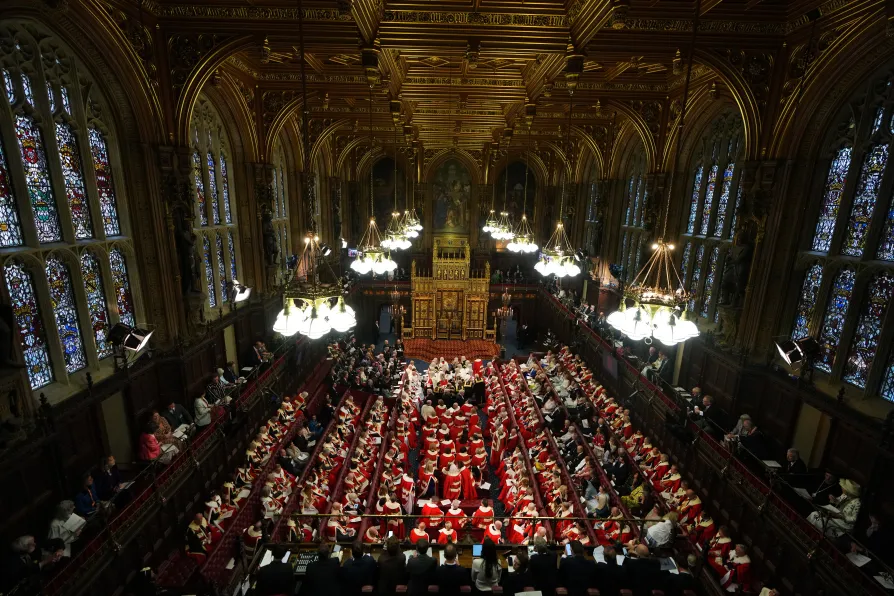
 A view of the Chamber of the House of Lords ahead of the State Opening of Parliament at the Palace of Westminster in London, May 13, 2026