Last year, when UN Secretary General António Guterres said PR firms were “acting as enablers to planetary destruction” by working for fossil fuel clients, he didn’t name WPP specifically. But they were the main company he was talking about. The advertising behemoth has more clients in the oil industry than any rival.
Guterres, being a diplomat, uses mild language. In my opinion, WPP is the world’s leading spin doctor for planetary death.
And so I was surprised when I checked in on who David Lammy had appointed to the Foreign Office supervisory board, to see WPP’s recent UK President Karen Blackett is now one of the four non-executive directors – as I revealed last week over on Democracy for Sale.
The supervisory board provides “strategic direction,” and “oversight” for the department. Adverts for the roles say they are “significant contributors to both the operational and strategic leadership of the department. Their primary objective is to bring independent advice, support and challenge… helping to shape the department’s work.”
In February, lawyers for campaign group Badvertising and others submitted a complaint about WPP to the Organisation for Economic Co-operation and Development, arguing it was breaching its international guidelines on corporate responsibility. Its work for a number of fossil fuel and pollution intensive corporations, the lawyers said, “directly increases demand for carbon intensive products and undermines global efforts to reduce greenhouse gas emissions”.
Why is that an organisation whose recently departed UK boss you’d want overseeing British foreign policy? Blackett spent 29 years working for WPP – three decades as a spin doctor at an advertising behemoth which represents some of the most destructive corporations on the planet. How can her advice possibly be independent? How can the perspectives and viewpoints of clients not have imprinted on her?
As the Badvertising website says, “for every rights-abusing, climate-wrecking corporation, there’s an advertising agency working hard to clean up their public image. And no one does this better than the world’s biggest ad firm, WPP”.
Last month, climate activists occupied WPP’s London headquarters, demanding it cut ties with clients including Shell, BP, Total, ExxonMobil, Drax and Saudi Aramco.
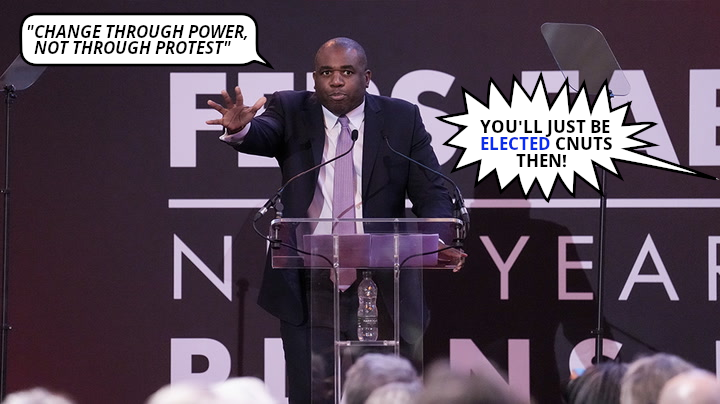
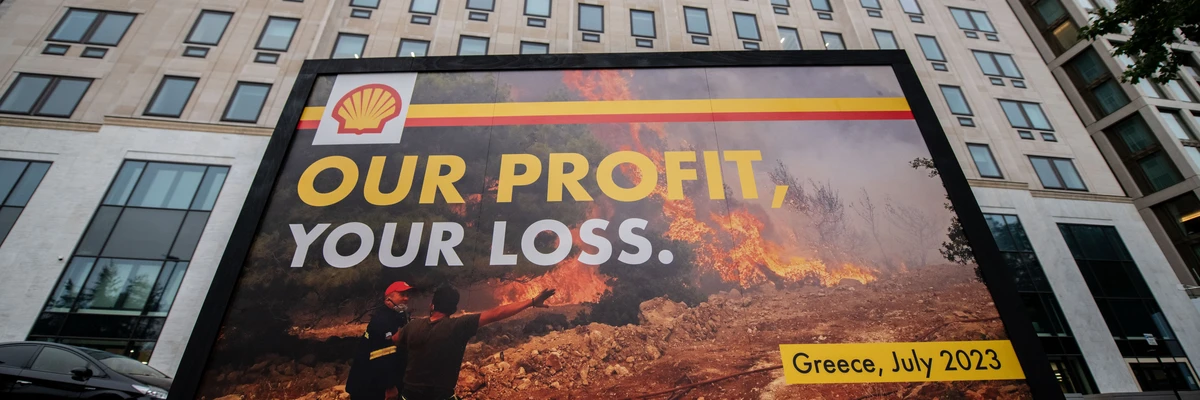
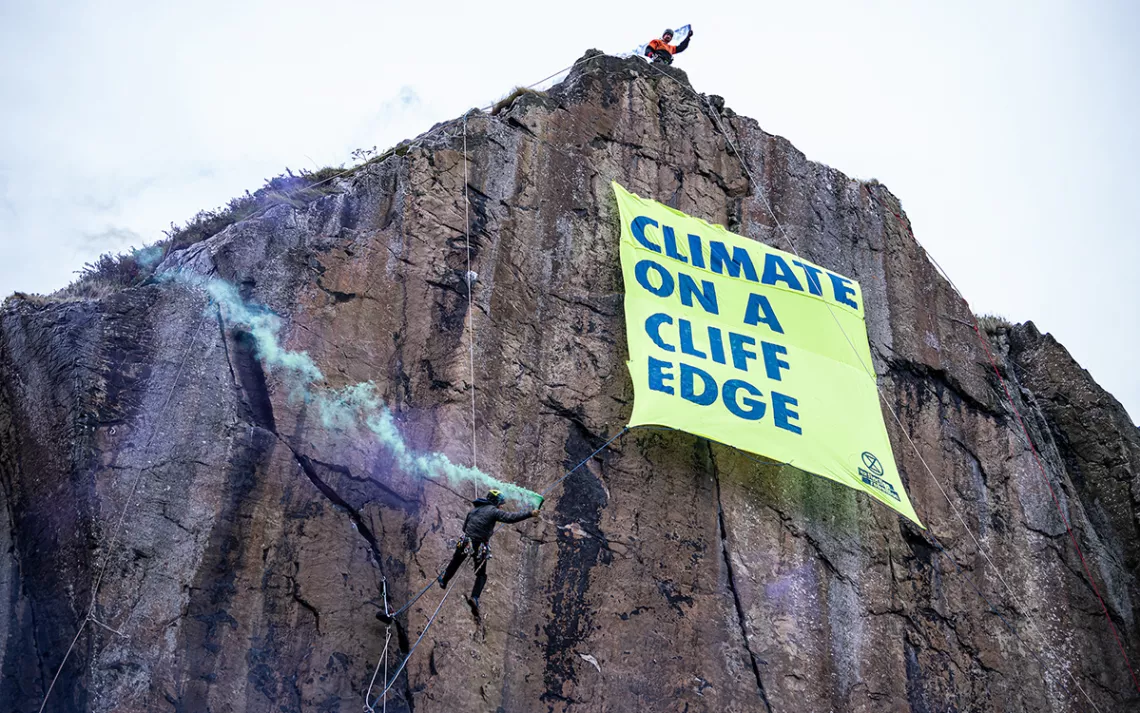
UK Labour Party Shadow Foreign Secretary repeatedly heckled at a speech to the Fabian Society over his and the Labour Party’s support for and complicity in Israel’s genocide of Gaza.Greenpeace activists display a billboard during a protest outside Shell headquarters on July 27, 2023 in London. (Photo: Handout/Chris J. Ratcliffe for Greenpeace via Getty Images)Experienced climbers scale a rock face near the historic Dumbarton castle in Glasgow, releasing a banner that reads “Climate on a Cliff Edge.” One activist, dressed as a globe, symbolically looms near the edge, while another plays the bagpipes on the shores below. | Photo courtesy of Extinction Rebellion and Mark Richards
Image of the Green Party’s Carla Denyer on BBC Question Time.
Responding to the Climate Change Committee’s latest report, co-leader Carla Denyer MP said:
“Last year fossil fuel giants Shell and BP made a total of £26 billion in profit – while ordinary people struggle every day to pay their energy bills, and the climate crisis takes its toll on communities across the UK.
“The Climate Change Committee’s latest report shows some movement in the right direction towards trying to keep us all safe, but the truth is we’re not moving nearly fast enough. Stalling progress means we all have higher bills in cold and leaky homes, while wildfires, extreme heat and flooding put lives and livelihoods at risk. The best time for action was years ago – the next best time is now.
“We need urgent action to bring down the cost of electricity more widely, to reduce household bills and keep us all safe from the growing threat from the climate crisis. Instead of handing fossil fuel giants a licence to keep profiting from climate destruction, or wasting money on slow and expensive nuclear projects, now is the time for a national push to roll out energy efficiency, heat pumps, solar panels and battery storage for our homes.
“Crucially, it’s time for the government to stop throwing money at the fossil fuel industry and instead make big polluters like Shell and BP pay up. Currently the government subsidises the fossil fuel industry to the tune of a staggering £17.5 billion per year – it’s time to pull the plug and put that money into lowering bills instead.”
Greenpeace activists display a billboard during a protest outside Shell headquarters on July 27, 2023 in London. (Photo: Handout/Chris J. Ratcliffe for Greenpeace via Getty Images)
U.S. ambassador to the UK Warren Stephens. Credit: Arkansas Inc / YouTube
Warren Stephens made the donation alongside big tech firms and oil giants.
Donald Trump’s ambassador to the UK donated $4 million to the new U.S. president’s inauguration on the same day he was nominated for the diplomatic position, DeSmog can report.
Billionaire Warren Stephens gave $4 million (just under £3 million today) to the Trump Vance Inaugural Committee on 2 December, according to the official record of donations. The committee is appointed by the president-elect to arrange the inauguration ceremony, when a U.S. president is formally sworn into office.
“It’s not so surprising that a transactional president hands out favours to people who give him money, but that doesn’t make it any less outrageous,” said Agustina Oliveri, head of campaigns and communications at the Good Law Project.
There is no direct evidence that Warren secured the position due to this donation. However, U.S. presidents have a long history of handing out diplomatic roles to major donors, while the Trump administration has bestowed his patrons with a number of senior positions. Of the 37 people who gave $1 million or more to the inauguration committee, six have either been given a role in the administration or have been nominated for a role.
Tom Brake, a former Liberal Democrat MP and the director of the transparency campaign group Unlock Democracy, urged the UK government not to follow Trump’s lead.
“Whatever approach the U.S. administration adopts towards the appointment of its ambassadors, the UK government should make it clear that when it comes to appointing UK ambassadors or high commissioners, donating substantial sums of money directly or indirectly to the party of government will block an appointment not facilitate it,” he said. “There must never be a question mark over whether UK appointments are made on merit, or driven by a donor’s deep pockets.”
As DeSmog revealed on 5 December, Warren Stephens holds significant oil and gas interests. Prior to his appointment as Trump’s UK ambassador, he ran Stephens Inc. – one of the largest privately-owned investment banks in the United States. Stephens has since stood down as CEO, but remains its chairman.
The firm’s portfolio includes a number of companies that make their money from oil and gas exploration and production — including one, Stephens Natural Resources, which “has a rich history of drilling and producing both oil and natural gas”, according to its website.
The UK’s ambassador to the U.S. Peter Mandelson also co-founded a public affairs agency with major fossil fuel clients.
Trump’s inauguration committee – which raised almost $240 million – received donations from fossil fuel giants Chevron ($2 million), ExxonMobil ($1 million), the U.S. branches of BP and Shell ($500,000 each), and Valero ($250,000).
It also accepted donations from major tech platforms including Amazon and Meta, whose founders Jeff Bezos and Mark Zuckerberg received a front row seat to the event.
Mark Zuckerberg, Jeff Bezos, Elon Musk and others at Donald Trump’s 2025 inauguration. Credit: WSJ / YouTube
The inauguration committee received a further $1 million from the Heritage Foundation, a hard-right U.S. research and lobby group which drafted the “autocratic” Project 2025 blueprint for Trump’s second term.
Trump denied knowledge of Project 2025 during the election campaign but has subsequently appointed Russell Vought, one of its advisory board members and co-authors, as director of the Office for Management and Budget (OMB), a key department within the president’s office that helps to oversee and co-ordinate policy.
Project 2025 urged Trump to “dismantle the administrative state”, slash restrictions on fossil fuel extraction, scrap state investment in renewable energy, and gut the Environmental Protection Agency.
Since his inauguration on 20 January, Trump has announced a series of policies that have mirrored these demands.
The new president, who received more than $75 million from oil and gas interests for his re-election campaign, has pledged to once again withdraw the U.S. from the flagship 2015 Paris Agreement, which set an international target for limiting global warming. He has also declared a “national energy emergency” to allow the U.S. to “drill, baby, drill” for new fossil fuels.
“When we look at the dumpster fire of U.S. government policy – from trashing the planet to attacking basic human rights – there’s no point in asking ‘What are they up to?’. The question we need to focus on is ‘Who paid for that?,’” said Oliveri.
The U.S. embassy in London referred DeSmog’s enquiry to the U.S. State Department. The Heritage Foundation was approached for comment.
Neo-Fascist Climate Science Denier Donald Trump says Burn, Baby, Burn.Elon Musk urges you to be a Fascist like him, says that you can ignore facts and reality then.Orcas discuss how Trump was re-elected and him being an insane, xenophobic Fascist.
Unite members take part in a day of action for Energy4All in Bradford, April 1, 2025Photo: Neil Terry Photography
Energy giants rake in half a trillion pounds out of people’s misery, campaigners warn
GREEDY energy giants have raked in half a trillion pounds in profits since 2020, according to new data released today.
The End Fuel Poverty Coalition examined the accounts of 20 firms that produce, supply and distribute energy, and discovered that they pocketed more than £514 billion over the last five years.
Among the top earners were oil titans Equinor and Shell, which saw their profits swell to £140bn and £91.6bn while millions of people struggled with soaring costs.
Warm This Winter spokesperson Caroline Simpson said: “It’s incomprehensible in so many ways and plain wrong that a mere 20 companies have made so much money out of people’s misery.
“The industry can spare a few of their many billions to bring down bills, pay for energy efficient homes and switch from oil and gas to save the planet.”
Households are set to be hit by even higher bills as the Ofgem price cap rises by 6.4 per cent this week.
The average bill is expected to rise by £111 to an average of £1,849 a year.
Companies and states most responsible for climate change are also those working hardest to prevent climate action, new Carbon Majors report finds.
Half of the world’s carbon dioxide emissions in 2023 came from just three dozen companies, according to a new report released today by the Carbon Majors project, with the list dominated by coal, cement, and oil producers.
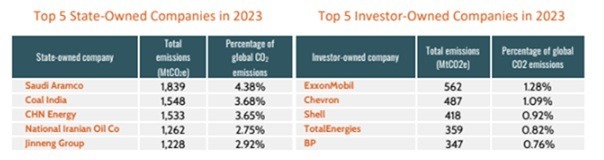
Saudi Arabia’s Saudi Aramco, the year’s worst offender, drove 4.4 percent of the world’s carbon dioxide pollution alone in 2023, the report found.
Five publicly-traded oil companies — ExxonMobil, Chevron, Shell, TotalEnergies, and BP — combined to produce an additional 4.9 percent of the year’s global carbon dioxide emissions from fossil fuels, the report adds.
The Carbon Majors database builds on the innovative work published by researcher Richard Heede of the Climate Accountability Institute (CAI) begun in 2013. For the first time, instead of attributing the build-up of industrial carbon dioxide and methane emissions to each of the world’s nations, Heede managed to trace those emissions to 90 specific “carbon major” companies. Last year, the nonprofit think tank InfluenceMap collaborated with CAI to produce major updates to the database — and today’s report marks the first annual update to that report, incorporating global data from 2023.
The year’s top carbon polluters were a mix of investor-owned and state-owned or national companies — but they have one thing in common.
“They’re some of the most obstructive actors towards climate policy,” Emmett Connaire, a senior analyst at the Carbon Majors project and one of the authors of the report, told DeSmog.
“I think it kind of kills the argument from industry that they’re not responsible for their CO2 emissions because we need fossil fuels to grow,” Connaire said, “when they’re the most obstructive and trying to keep up the demand for their products in the face of the overwhelming scientific opinion.”
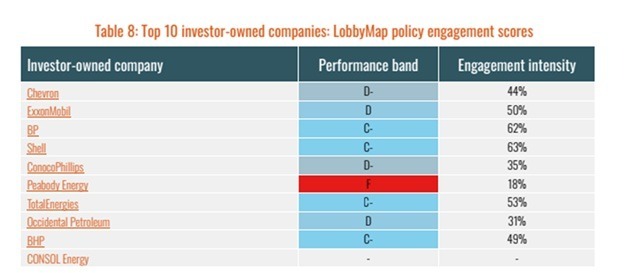
Eight of the nine public companies most responsible for carbon emissions in 2023 were “highly active or strategic” in their climate lobbying, the report notes. And their lobbying efforts took aim at regulating climate-altering pollution or sought to impede the energy transition.“ Of these 9 companies, 5 score a D or below, indicating unsupportive positions on climate policy,” the new report finds, citing data from InfluenceMap’s LobbyMap database, which grades companies based on their alignment with the Paris Agreement. “The remaining 4 score only slightly higher at C-.”
InfluenceMap gave climate policy lobbying scores to the top 10 investor-owned companies, all oil, gas, and coal firms. Credit: Carbon Majors 2025 report
None of the five top oil companies named in the report immediately responded to a request for comment from DeSmog.
Investor-owned companies aren’t the only ones actively fighting to prevent climate action, the Carbon Majors report notes.
“State-owned companies are even more oppositional to climate regulation globally according to LobbyMap research,” the report finds, listing Saudi Aramco, Russia’s Gazprom, Mexico’s Pemex, and China’s CHN Energy among the worst actors.
“The ‘Carbon Majors’ are keeping the world hooked on fossil fuels with no plans to slow production,” former United Nations climate chief and Paris Agreement architect Christiana Figueres said in a response accompanying the report. “While states drag their heels on their Paris Agreement commitments, state-owned companies are dominating global emissions — ignoring the desperate needs of their citizens.”
A sizable majority — 80 percent — of the year’s 20 worst offenders are state-owned, the report found.
State-owned fossil fuel companies dominated global climate emissions in 2023, compared to public companies, the Carbon Majors report noted. Credit: Carbon Majors report 2025
Throughout history, responsibility for driving climate change is concentrated among a strikingly small number of corporations, the report suggests.
Two-thirds of all fossil fuel and cement emissions worldwide from 1750 through 2023 can be traced to just 181 entities, the report finds, adding that one-third of emissions came from just 26 companies.
These findings may have significant legal consequences. During 2024, New York state and Vermont both enacted “Climate Superfund” laws that aim to hold fossil fuel producers and oil refiners responsible for the damage done by their climate-altering products — and the Carbon Majors database is a proposed tool to assess companies’ relative liabilities, according to InfluenceMap. Its earlier findings have been cited in civil lawsuits brought by U.S. cities and counties against fossil fuel producers and an inquiry in the Philippines (which has seen some of the strongest typhoons in recorded history) into corporate responsibility for human rights violations.
The report approaches companies’ contributions to climate change based on production data — meaning that it focuses on the companies that do the drilling and mining (which helps avoid double-counting, Connaire told DeSmog). Those production figures are self-reported by companies but are widely used by governments to assess taxes and by investors in public companies. That methodology means that, for example, natural gas pipeline companies and natural gas utilities aren’t included in the report’s rankings.
Nonetheless, natural gas producers figure among the report’s list of all-time top polluters. That includes the former Chesapeake Energy, which first rose to prominence — and some notoriety — during the shale gas fracking boom only to implode into bankruptcy in 2020. Chesapeake later emerged from bankruptcy and has since merged into the newly formed Expand Energy.
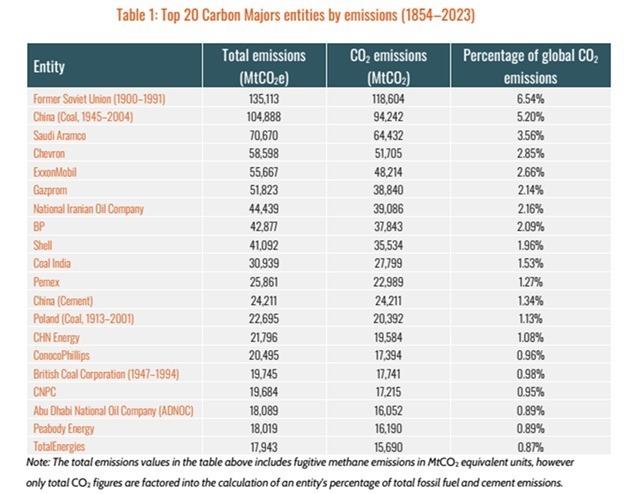
As the Carbon Majors database traces emissions throughout history, it accounts for the effects of mergers and acquisitions in the tumultuous oil industry, known for its booms and busts. “For example, the multiple smaller companies into which the Standard Oil Trust was broken up have evolved to become some of the most recognizable companies in the database today,” the report notes. “Some are direct descendants of Standard Oil, like ExxonMobil, with both Exxon and Mobil as descendants separately, and Chevron. Others have resulted from mergers with descendants of Standard Oil, such as BP and ConocoPhillips.”
The Carbon Majors database traces the historical cumulative emissions of the top individual entities, such as Chevron or the former Soviet Union, from 1854 through 2023. Credit: Carbon Majors report 2025
It also calls attention to the importance of coal pollution — not just historically, but also in 2023.
“In 2023, coal remained the largest source of emissions, contributing 41.1 percent of emissions in the database,” the new report finds, “continuing a steady increase since 2016.”
Emissions from the cement industry — also a major driver of carbon pollution — increased significantly in 2023, rising 6.5 percent year-over-year, which the Carbon Majors report noted was “the largest relative rise” found. “Four of the five companies with the greatest relative increases in emissions in 2023 were cement companies — Holcim Group, Heidelberg Materials, UltraTech Cement, and CRH — with cement emissions seeing the largest relative rise among the four commodity types.”
Cement producers aren’t the only ones, however. In fact, emissions from most of the top emitters rose in 2023, the Carbon Majors report found.
“It is truly alarming that the largest fossil fuel companies continue to increase their emissions in the face of worsening natural disasters caused by climate change, disregarding scientific evidence that these emissions are harming us all,” said Tzeporah Berman, founder of the Fossil Fuel Non-Proliferation Treaty Initiative. “It is clearer than ever that dirty private companies, driven by profits and business as usual, will never choose to self-regulate. Governments around the world must use their power to end fossil fuel expansion and transition their economies before fossil fuel companies destroy the planet.”
Greenpeace activists display a billboard during a protest outside Shell headquarters on July 27, 2023 in London. (Photo: Handout/Chris J. Ratcliffe for Greenpeace via Getty Images)Neo-Fascist Climate Science Denier Donald Trump says Burn, Baby, Burn.