Hundreds of Thousands Flood Cities Across Europe to Demand End to Genocide in Gaza

Spread the love

Original article by Julia Conley republished from Common Dreams under Creative Commons (CC BY-NC-ND 3.0).
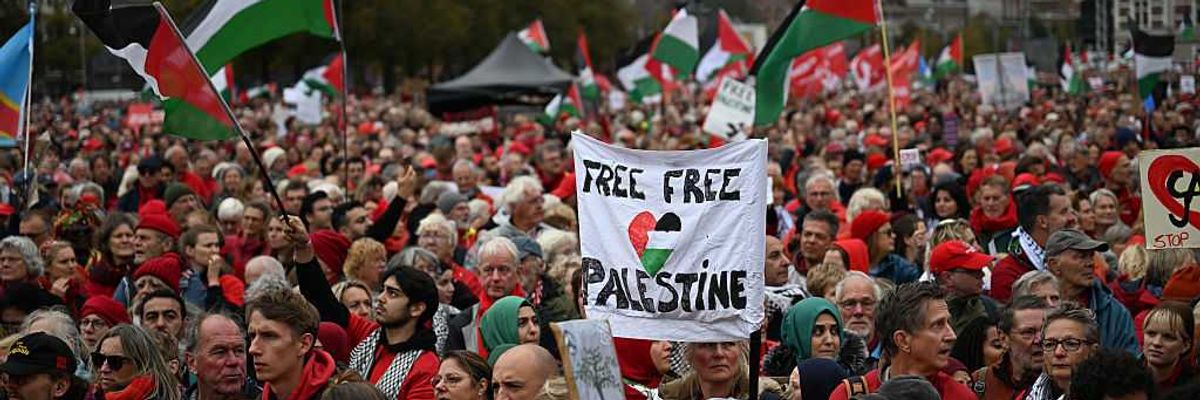
Thousands of demonstrators gather at Museumplein demanding firm government action to stop the Israeli attacks on Gaza, in Amsterdam on October 5, 2025.  (Photo by Mouneb Taim/Anadolu via Getty Images)

An estimated 250,000 people dressed in red crowded into Museum Square in Amsterdam, demanding that the Dutch government end its support for Israel.

Expressing solidarity with Palestinians in Gaza and pressuring Dutch officials to end their longtime support for Israel were the goals of a massive demonstration in Amsterdam Sunday—one of the largest pro-Palestine protests held in Europe over the weekend as the two-year anniversary of Israel’s bombardment of the exclave approached.

“The bloodshed must stop—and we unfortunately have to stand here because we have such an incredibly weak government that doesn’t dare to draw a red line. That’s why we are here, in the hope that it helps,” protester Marieke van Zijl told the Associated Press on Sunday in Museum Square in central Amsterdam, where an estimated 250,000 people gathered.

The protests in Amsterdam and across Europe came as Israel garnered global condemnation for its interception of more than 400 humanitarians from around the world who sailed toward Gaza in recent weeks with the Global Sumud Flotilla with the aim of delivering aid to the besieged territory, where a famine was declared in August due to Israel’s near-total blockade on food, water, fuel, and other necessities entering Gaza.

In Sofia, Bulgaria, citizens carried signs reading, “Gaza: Starvation Is a Weapon of War,” while in Turkey’s capital of Ankara, protesters held up placards condemning Israel’s genocide in Gaza, where more than 67,000 Palestinians have been killed since October 2023.

Scholars on genocide and the Holocaust have joined leading human rights organizations—including some in Israel—and United Nations experts in declaring that Israel’s bombardment of Gaza is a genocide. The International Court of Justice is also considering an ongoing genocide case brought by South Africa regarding the military assault and starvation policy.

In Amsterdam, most protesters wore red in solidarity with Palestine and many displayed Palestinian flags.

In the Netherlands, the government has long been a staunch supporter of Israel but in recent months has increasingly denounced its attacks on Gaza. In July it banned Israeli Prime Minister Benjamin Netanyahu and National Security Minister Itamar Ben-Gvir from entering the country because they “repeatedly incited violence against the Palestinian population.”

On Friday, Dutch Foreign Minister David van Weel said he was “unlikely” to grant an export license to send F-35 fighter jet components to Israel. The country’s Supreme Court last week ordered the government to review the currently suspended license to determine whether reinstating it would violate international law. The Netherlands is home to one of three regional warehouses for components of the US-made fighter jets.

Marjon Rozema, a spokesperson for Amnesty International, which helped organize the demonstration, called for the Dutch government to use “all economic and diplomatic means to increase pressure on Israel.”

Mass demonstrations were also held over the weekend in countries including Spain and Italy, where demonstrators demanded the release of organizers who had been aboard the Global Sumud Flotilla.

Hundreds of thousands of people marched in Rome, Madrid, and Barcelona, home of former Mayor Ada Colau, who was among those detained by Israel last week.

Organizers in Rome said 1 million people took part in Saturday’s march, which followed Friday’s one-day general strike across Italy.

“Governments, especially the Italians, are not taking action against what is happening in Gaza,” one university teacher told the BBC on Friday at a rally. “We’re here to say that it is time to intervene and solve things.”

“The Italian demonstrations for Gaza and the flotilla have been of a rather unprecedented power in recent times,” said scholar Bruno Montesano on Monday. “And they have had a global resonance that is equally surprising. And perhaps its strength derived from a sort of widespread spontaneous humanitarianism, as well as from the clashing contradictions between Western liberal-democratic chatter—certainly weakened even further due to the rise of the far right—and the racist and colonial practice of supporting Israeli fascism.”

Original article by Julia Conley republished from Common Dreams under Creative Commons (CC BY-NC-ND 3.0).

Keir Starmer objects to criticism of the IDF. He asks how could anyone object to them starving people to death, forced marches like the Nazis did, bombing Gaza's hospitals and universities, mass-murdering journalists, healthworkers and starving people queuing for food, killing and raping prisoners and murdering children. He calls for people to stop obstructing his genocide for Israel.
Keir Starmer objects to criticism of the IDF. He asks how could anyone object to them starving people to death, forced marches like the Nazis did, bombing Gaza’s hospitals and universities, mass-murdering journalists, healthworkers and starving people queuing for food, killing and raping prisoners and murdering children. He calls for people to stop obstructing his genocide for Israel.
Orcas discuss Genocide-supporting and complicit Zionists. Donald Trump, Keith Starmer, David Lammy, Rachel Reeves, Angela Rayner and Wes Streeting are acknowledged as evil genocide-complicit and supporting cnuts.
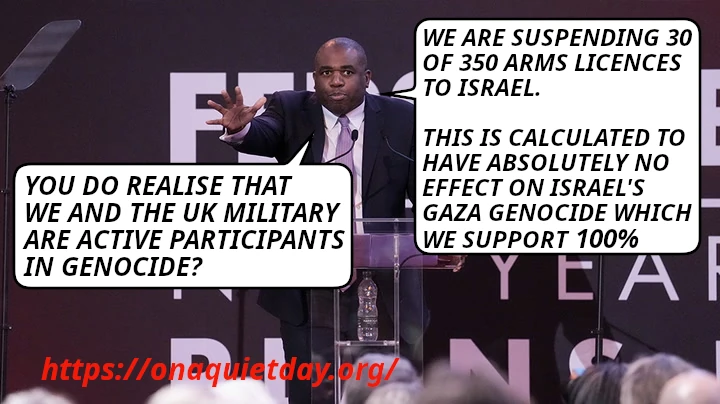
Genocide denying UK Foreign Secretary David Lammy says that UK is suspending 30 of 350 arms licences to Israel. He also confirms the UK government's support for Israel's Gaza genocide and the UK government and military's active participation in genocide.
Genocide denying UK Foreign Secretary David Lammy says that UK is suspending 30 of 350 arms licences to Israel. He also confirms the UK government’s support for Israel’s Gaza genocide and the UK government and military’s active participation in genocide.
Continue ReadingHundreds of Thousands Flood Cities Across Europe to Demand End to Genocide in Gaza

Italy’s Unions Lead General Strike for Gaza

Spread the love

Original article by Brett Wilkins republished from Common Dreams under Creative Commons (CC BY-NC-ND 3.0). 
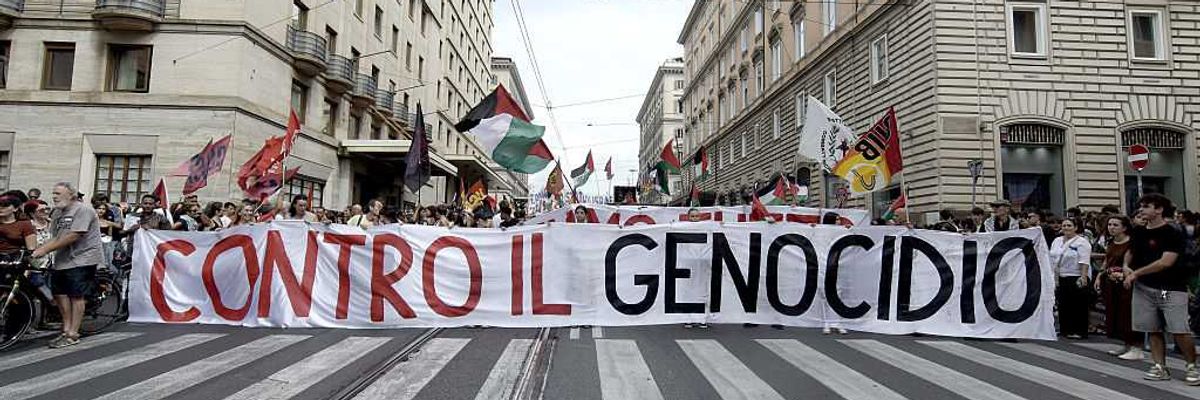
Palestine defenders rally with a banner reading, “Against the Genocide” in Rome on September 22, 2025. (Photo by Simona Granati/Corbis via Getty Images)

“Meloni should take a stand with the facts against those who have slaughtered 20,000 children, rather than limiting herself to saying ‘I do not agree,’” said one critic of Italy’s right-wing prime minister.

Italian labor unions led a massive 24-hour general strike on Monday to protest Israel’s ongoing genocide in Gaza, with estimates of hundreds of thousands of demonstrators rallying in dozens of cities across Italy.

Protesters took to squares, streets, transport hubs, ports, university campuses, and other spaces in more than 75 cities and towns, rallying under the call to “Block Everything.” Places including schools, train stations, and retail stores were shut for the day.

“The strike is called in response to the ongoing genocide in the Gaza Strip, the blockade of humanitarian aid by the Israeli army, and the threats directed against the… Global Sumud Flotilla, which has on board Italian workers and trade unionists committed to bringing food and basic necessities to the Palestinian population,” explained Unione Sindacale di Base (USB), a grassroots union confederation known for its militant stance on labor and political issues.

In Rome, tens of thousands of Palestine defenders rallied at the Termini rail station, Italy’s largest, with many of the demonstrators occupying the building.

While protest activities snarled traffic in some parts of the Italian capital, many Roman motorists showed solidarity with the demonstrators by honking their horns and raising their fists into the air.

Watch: Pro-Gaza protesters who blocked a highway near Rome were met with visible solidarity from drivers. Regional news coverage of the paralyzed Central Station showed only people expressing support for the protest.Source: Paolo Mossetti on X (@paolomossetti)

Drop Site (@dropsitenews.com) 2025-09-22T18:35:27.997Z

Milan saw an estimated 50,000 people turn out to locations including the central rail station, where some protesters damaged property and clashed with police, who said 10 people were arrested and 60 officers were injured.

“If we don’t block what Israel is doing, if we don’t block trade, the distribution of weapons and everything else with Israel, we will not ever achieve anything,” protester Walter Montagnoli, who is the Base Unitary Confederation’s (CUB) national secretary, told The Associated Press at a march in Milan.

In Bologna—home to the world’s oldest continuously operating university—students occupied lecture halls and thousands of demonstrators took to the streets, including the Tangenziale, the ring highway around the city, where police attacked them with water cannons and tear gas.

Dockworkers and other demonstrators marched and blocked ports in cities including Genoa, Trieste, and Livorno.

Thousands of protesters also blocked the main train station in Naples.

Source: Potere al Popolo via X (@potere_alpopolo)

Drop Site (@dropsitenews.com) 2025-09-22T18:06:50.797Z

In the Adriatic seaside resort of Termoli, hundreds of student-led Palestine defenders rallied in St. Anthony’s Square and, with Mayor Nicola Balice’s permission, draped a Palestinian flag from the façade of City Hall.

“Faced with such an important subject, the genocide in Palestine, we students… said this would be a nonpartisan demonstration because in the face of what is happening in the Gaza Strip—hospitals bombed, children killed every day—there can be no political ideology,” said one Termoli protester. “We must all be united.”

Some participants in Monday’s general strike pointed the finger at their own government.

“In the face of what is happening in Gaza you have to decide where you are,” Italian General Confederation of Labor leader Maurizio Landini told La Stampa. “If you don’t tell the Israeli government that you have to stop and don’t send them more weapons, but instead you keep sending them… you actually become complicit in what’s happening.”

While European nations including Ireland, Norway, Spain, Slovenia, the United Kingdom, Portugal, France, Luxembourg, and Denmark have formally recognized Palestine or announced their intent to do so since October 2023, Italy has given no indication that it will follow suit. More than 150 of 193 United Nations member states have recognized Palestine.

Although increasingly critical of Israel’s 718-day genocidal assault—which has left at least 241,000 Palestinians dead, wounded, or missing in Gaza—right-wing Italian Prime Minister Giorgia Meloni has been accused of complicity in genocide for actions including presiding over arms sales to the government of Israeli Prime Minister Benjamin Netanyahu, who is wanted by the International Criminal Court for alleged war crimes and crimes against humanity. Meloni has rejected the ICC warrants and said Netanyahu would not be arrested if he enters Italy.

“Meloni should listen to the voice of those who are peacefully protesting and asking her to act, rather than curling up to Washington to protect her friend, the war criminal Netanyahu,” Giuseppe Conte, who leads the independent progressive Five Star Movement, said Monday on social media. “Meloni should take a stand with the facts against those who have slaughtered 20,000 children, rather than limiting herself to saying, ‘I do not agree.’ And she should stop running away from the debate in Parliament.”

Original article by Brett Wilkins republished from Common Dreams under Creative Commons (CC BY-NC-ND 3.0). 

Continue ReadingItaly’s Unions Lead General Strike for Gaza

Italian left party demands answers over police infiltration scandal

Spread the love

Original article by Ana Vračar republished from peoples dispatch under a Creative Commons Attribution-ShareAlike 4.0 (CC BY-SA) license.

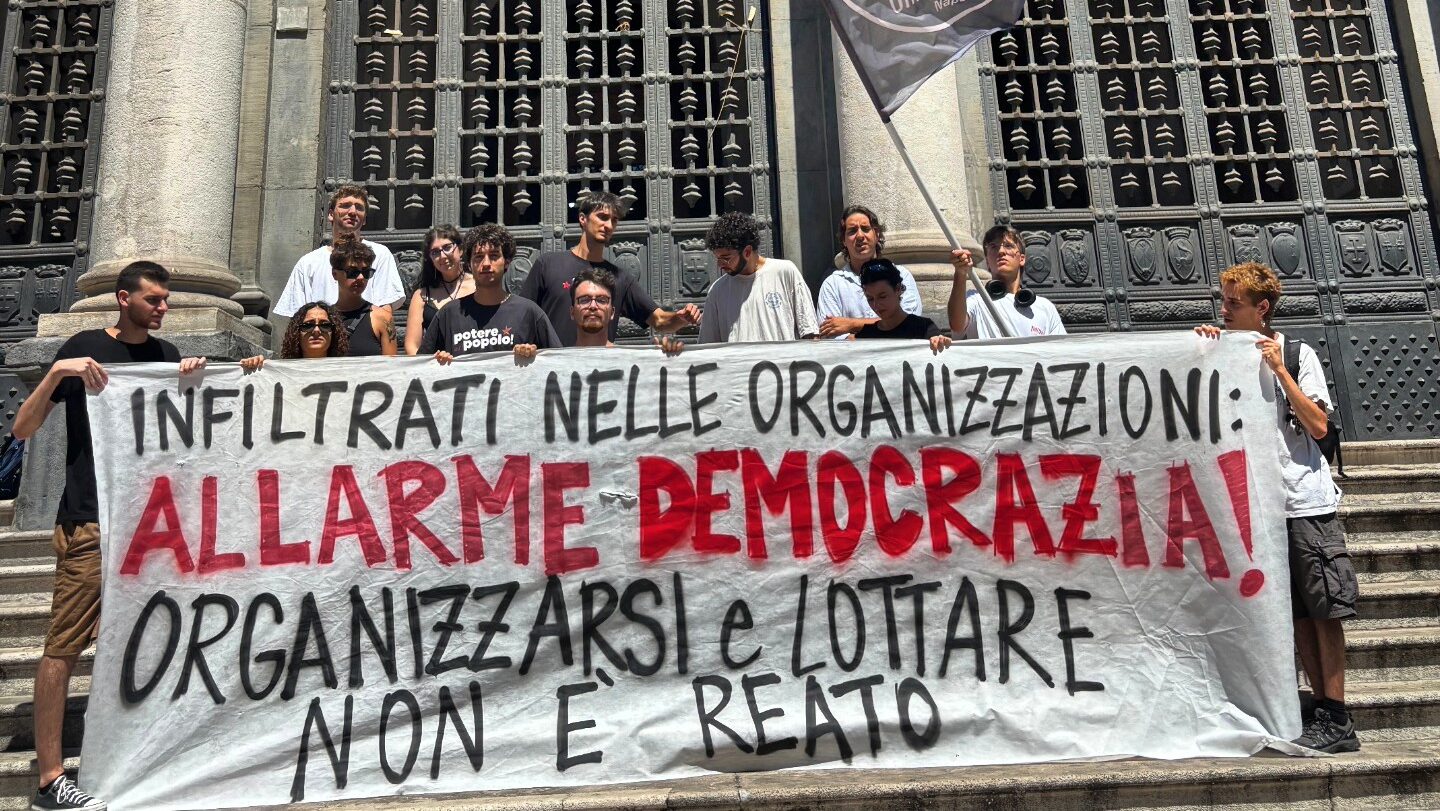
Activists protesting against police infiltrations in Italy. Source: Cambiare Rotta/Facebook

Potere al Popolo is pressing the Meloni government to explain five police infiltration attempts targeting the party’s youth organizations.

Italian left party Potere al Popolo! (Power to the People!) continues to demand full government transparency following revelations that multiple police agents infiltrated the party’s youth groups, Collettivo Autorganizzato Universitario (Self-Organized University Collectives, CAU) and Cambiare Rotta (Changing Course). For approximately eight months, undercover police officers infiltrated or attempted to infiltrate chapters in Naples, Milan, Bologna, and Rome, only to be uncovered through by the party’s internal investigation and independent media outlet Fanpage.

Speaking to Peoples Dispatch, Giuliano Granato, one of Potere al Popolo’s spokespeople, stated that the party is exploring all potential avenues for action, emphasizing that it will not wait passively in the meantime. A key priority is compelling the relevant institutions, including Prime Minister Giorgia Meloni and Interior Minister Matteo Piantedosi, to publicly explain what happened. “They owe the public some answers,” Granato says. “Who ordered this operation? Who planned it? And on what grounds?”

Read more: Italian left party uncovers more cases of police infiltration in their ranks

Meloni’s government and institutions, however, are not known for responding transparently to uncomfortable questions. This became evident again after the first case was exposed in May, when official statements ranged from evasive to outright absurd. One explanation offered, Granato recalls, was that the officer who infiltrated the youth group in Naples had done so not as part of an official assignment, but rather because he had “fallen in love with a Potere al Popolo activist.”

“Are we now supposed to believe five officers from the same training course all suddenly fell in love with five of our activists at the same time?”

Another line of defense claimed that while the infiltrations were official operations, they did not target Potere al Popolo as a political party, but only the specific youth collectives. Yet, even if one was to accept the dubious legitimacy of undercover operations in youth organizations on campuses, that explanation raises new questions. As Granato notes, there are many youth collectives across Italy active on similar issues, including Palestine solidarity and housing. “And yet, the only ones where infiltrators were discovered are the ones organically tied to Potere al Popolo.”

A state increasingly intolerant of dissent

Granato also stresses the importance of keeping public attention on the issue. Since the revelations in May, Potere al Popolo! has received solidarity from grassroots networks and trade unions, civil society organizations, and even a few opposition parties that submitted formal inquiries to the government. “In contrast to this, there has been no media uptake of the case,” Granato said. “Apart from Fanpage, only Il Fatto Quotidiano and il manifesto covered it. The rest of the mainstream media landscape? Radio silence. All the big self-declared progressive media ignored it.”

“This is a very grave thing,” he continues, “because these are the same center-left media that now and then raise concerns about Meloni’s authoritarian drift.” By choosing not to cover the infiltrations in Potere al Popolo, Granato suggests, they show that they will only raise issues when it benefits them, ignoring the public interest when it doesn’t.

The tendency is particularly worrying in the current context, Granato says, considering the infiltration of Potere al Popolo is not an isolated case but part of a broader trend. He points to connections to other recent cases, such as the surveillance of Fanpage journalists and of activists from Mediterranea Saving Humans, who have challenged the government’s deadly migration policies through their work. He also mentions the government’s so-called security decree and an ongoing campaign against the right to strike. “If we connect all these little dots, what emerges is a picture of a government and institutions that are less and less tolerant of dissent,” Granato explains.

Read more: “Disarmiamoli!” brings 30,000 to Rome against NATO and war

Yet it is not individual dissent they are afraid of. Instead, what state authorities and institutions fear is collective dissent that organizes people and gives them the tools to change the status quo, Granato says. This fear is one of the reasons why they would want to infiltrate Potere al Popolo, as they recognize it as a political force capable of posing a real threat to the structures they want to protect.

One way to resist this tendency, Granato concludes, is to remain persistent in showing solidarity, including to those who have been infiltrated by the police. “Publicly showing solidarity means publicly showing there’s still a democratic fabric that hasn’t been destroyed, both in Italy and beyond.”

Original article by Ana Vračar republished from peoples dispatch under a Creative Commons Attribution-ShareAlike 4.0 (CC BY-SA) license.

Continue ReadingItalian left party demands answers over police infiltration scandal

‘All Eyes on Rafah’ as Global Protests Against Looming IDF Assault Continue

Spread the love

Original article by BRETT WILKINS republished from Common Dreams under Creative Commons (CC BY-NC-ND 3.0).

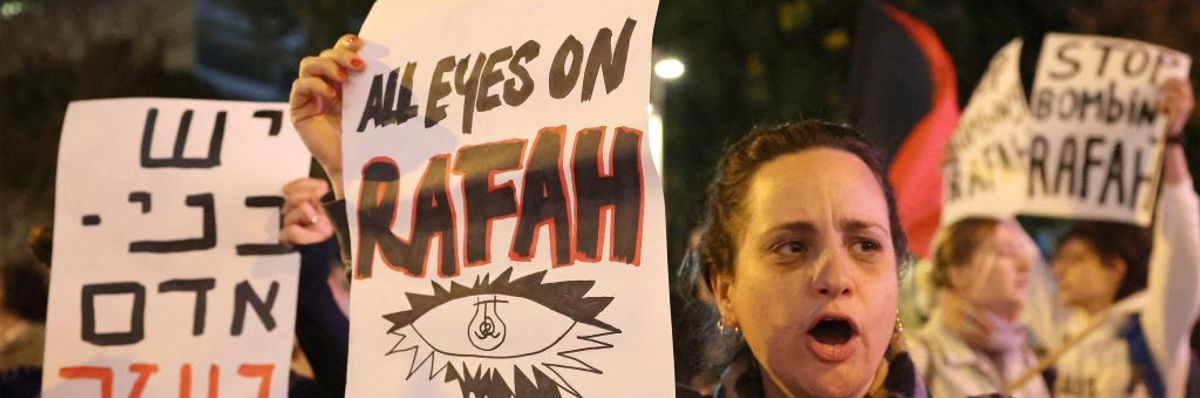
An Israeli woman holds a sign opposing Israel’s looming invasion of Rafah, Gaza during a February 13, 2024 protest outside the Defense Ministry in Tel Aviv.  (Photo: Jack Guez/AFP via Getty Images)

Demonstrators turned out from Cardiff to Tel Aviv as Palestinians in the Gaza city endured heavy Israeli bombing while bracing for an all-out ground invasion.

Global emergency protests against Israel’s expected invasion of Rafah continued Tuesday, a day after demonstrators took to the streets of cities around the world to say “hands off” the southern Gaza city whose population has swelled more than fivefold due to the influx of Palestinian war refugees.

Hundreds of protesters turned out in the cold and rain of Cardiff, Wales Tuesday afternoon, with demonstrations planned for later in the day in cities including Manchester, England and Houston, Texas.

“We do not care if it is raining—it’s raining bombs in Rafah over a million Palestinians, squeezed into an area barely the size of an airport,” protest co-organizer Black Lives Matter Cardiff & Vale said on social media.

In Tel Aviv, a crowd of left-wing Israelis protested outside the headquarters of the Ministry of Defense, holding signs with messages including “Stop Bombing Gaza” and “Stop Funding Genocide.”

Tuesday’s demonstrations followed Monday protests around the world including outside both the White House in Washington, D.C. and British Prime Minister Rishi Sunak’s residence on Downing Street in London. Rallies and marches also took place in cities including Rome, New York, Los Angeles, Toronto, Vancouver, and at U.S. President Joe Biden’s campaign headquarters in Wilmington, Delaware, where 21 Sunrise Movement climate activists were arrested.

Airstrikes on Rafah are intensifying as the Israel Defense Forces appear poised to launch a major ground invasion of the besieged city on the Egyptian border. Hundreds of Palestinians have been killed and wounded in Rafah since Israeli Prime Minister Benjamin Netanyahu’s Friday order to the IDF to create an evacuation plan for the 1.5 million people in the city, most of them refugees from other parts of Gaza.

South African officials said Tuesday that Israel’s bombing of Rafah and stated intent to invade the city are violations of the International Court of Justice’s order for Israel to “take all measures within its power” to prevent acts of genocide. The court found in a preliminary ruling that Israeli forces were “plausibly” committing genocide, as alleged in the South Africa-led case.

The looming invasion of Rafah comes amid a wider war on Gaza in which more than 100,000 Palestinians have been killed, maimed, or left missing by Israeli bombs and bullets since October 7, when Hamas led deadly attacks on southern Israel and kidnapped over 240 Israelis and others. Around 90% of Gaza’s 2.3 million people have been displaced and a majority of the besieged strip’s homes have been damaged or destroyed by Israel’s relentless onslaught.

Senior officials from Israel, the U.S., Egypt, and Qatar met in Cairo on Tuesday to resume negotiations for an extended cease-fire in Gaza in exchange for the release of the approximately 130 hostages held by Hamas.

Original article by BRETT WILKINS republished from Common Dreams under Creative Commons (CC BY-NC-ND 3.0).

Continue Reading‘All Eyes on Rafah’ as Global Protests Against Looming IDF Assault Continue

Public healthcare becomes key rallying point in Italy

Spread the love

Original article republished from peoples dispatch under a Creative Commons Attribution-ShareAlike 4.0 (CC BY-SA) license.

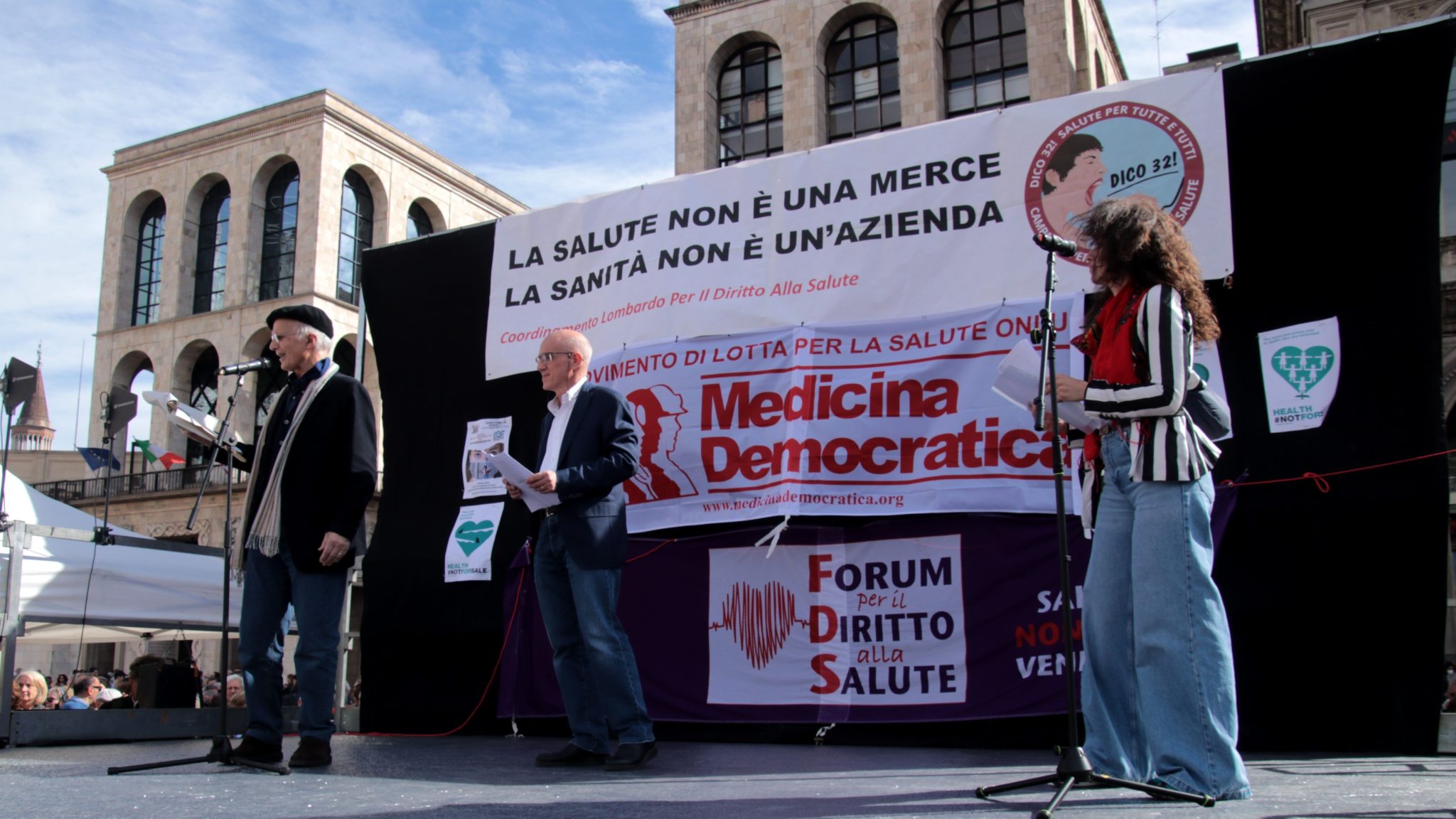
Health activists during a protest in Lombardy. (Photo: Medicina Democratica)

More and more people in Italy mobilize to protect the public health system against privatization and budget cuts promoted by far-right Giorgia Meloni’s government

The functioning and future of Italy’s National Health Service or Servizio sanitario nazionale (SSN) have become one of the most important mobilizing issues for trade unions, civil society organizations, and ordinary citizens. Just like health systems in many other European countries, the SSN has fallen prey to policies that promote the participation of the private sector in service provision, weakening the public, tax-based system, which is supposed to provide care to everyone. With the government of prime minister Giorgia Meloni pushing for a policy of administrative devolution and further cuts to health expenditure, things in the healthcare sector are poised to get even bleaker, as activists and health workers warned during a recent national rally in Rome.

Read more: Tens of thousands mobilize on the streets of Rome against far-right Meloni’s policies

After the national mobilization, the protests headed north to Lombardy, where they should culminate in a central manifestation in Milano on Saturday, 21 October. In the leadup to the local events, Vittorio Agnoletto, a physician and health activist, underlines the importance of people taking to the streets to protect the public health system. He said in a recent blog post, “The best thing for everyone to do right now is to get involved. Get involved in a campaign to defend your local hospital, get involved in a campaign to protect your community health center from falling into the hands of the private sector, get involved in any local health campaign to build its strength.”

Observing the situation of the health system in Lombardy directly, Agnoletto knows first-hand what privatization of the SSN brings. In that region, private health providers gained ground ever since the mid-1990s. During the COVID-19 pandemic, regional policies even went as far as equalizing the public and private sector. 

It seems that policy makers in Italy have lost the lessons of the pandemic, as other regions continue to pursue similar policies, undermining the SSN. In 2021, Lombardy’s private health sector received over EUR 6 billion (around USD 6.33 billion) from public sources; in Lazio, it received EUR 3.8 billion (over USD 4 billion). Overall in the same year, there were over 16,500 private health providers in Italy, with a turnover of approximately EUR 62 billion (USD 65.37 billion) in revenue, as Agnoletto warns in his reports.

Of these, EUR 25 billion (USD 26.36 billion) comes from public coffers that could be used to strengthen the SSN and help address some of its most pressing issues, including a chronic lack of health workers and long waiting lists. Wait time for some procedures in Lombardy can take up to 4 years, a fact which pushes those who can afford it toward the private sector. Those who cannot afford it often give up: millions of people in Italy decide not to pursue care because of waiting lists.

With Meloni’s government planning further reductions in health expenditure, it is difficult to imagine the waiting lists in the SSN getting shorter anytime soon. Public health expenditure in Italy, amounting to a little over 6% of GDP, is already below that of EU peers France and Germany, where it stands at 9% or more. Instead of finding ways to address that gap, the government is setting all the wrong priorities, as the left party Potere al Popolo has been warning for years.

Instead of prioritizing the education of health workers, considering the 2021 deficit of 45,000 doctors and 75,000 nurses, government plans have been focused on purchasing high-end technology and building capacities for telemedicine. Of the EUR 15.6 billion (USD 16.45 billion) allocated to health in Italy’s EUR 192 billion-worth (USD 202.45 billion) 2021-2026 recovery plan funded through the European Commission’s Recovery and Resilience Facility, 62% is allocated to technology, and only 8% is foreseen for training and retaining health workers.

Read more: Enough of creeping privatization of health care, say striking Italian doctors

The policy of administrative devolution, and thus the decentralization of healthcare, pushed for by the government, represents an additional threat to the public health system. As Margherita Cantelli from Potere al Popolo explains, some aspects of the organization of the health system have previously been decentralized from the state to the regional level. According to Cantelli, this experience is enough of a warning of what would follow if the decentralization were to be taken to another level.

“We’ve seen a clear trend of closures of local hospitals and other health units following the decentralization process, while the private structures continued to receive public funding. The shutting down of these hospitals was part of the privatization trend, and it has pushed the SSN away from the smaller towns and centers. If this kind of decentralization were to grow, there is no doubt that the problems would grow as well,” Cantelli said to People’s Health Dispatch.

According to Cantelli, the best way forward right now is to continue to protest and bring the people’s voice to the spaces where healthcare plans are shaped, thus building a shared idea of the importance of a universal public health service, free for everybody who needs it. “I believe there is a lot of space to explain the links between the problems we are seeing in the field of health and those that we are seeing in the field of labor rights, and we should use this to mobilize together,” she says.

Original article republished from peoples dispatch under a Creative Commons Attribution-ShareAlike 4.0 (CC BY-SA) license.

Continue ReadingPublic healthcare becomes key rallying point in Italy