Carbon Capture ‘Not Going to Happen,’ Top Fossil Fuel Advocate Predicts
Original article by Geoff Dembicki republished from DeSmog.
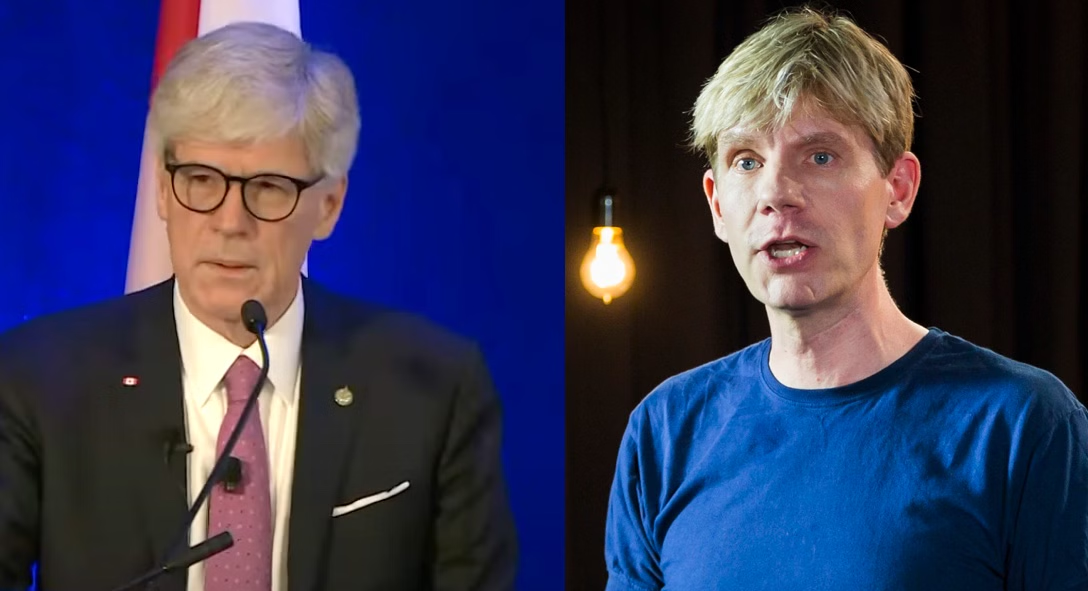
In audio obtained by DeSmog, Bjorn Lomborg told a Fraser Institute event in Vancouver that the technology is way too expensive to be viable.
Bjorn Lomborg has for years promoted the idea that fossil fuels are crucial for humankind through syndicated newspaper columns, best-selling books and appearances on TV shows including HBO’s Real Time with Bill Maher.
He’s been called a “friend” by Trump administration energy secretary and former fracking executive Chris Wright and helps advise an anti-net zero organization known as the Alliance for Responsible Citizenship (ARC) created by the Canadian conservative podcaster Jordan Peterson.
Yet the Danish political scientist — who acknowledges that climate change is real but denies that it’s a serious crisis — has a dim view of the oil and gas industry’s preferred solution to climate change: carbon capture and storage.
That technology is favored by Alberta premier Danielle Smith and Liberal energy minister Tim Hodgson, both of whom recently floated the idea of a “grand bargain” where Canada’s oil and gas industry gets approval for new pipelines in exchange for moving forward with a $16.5 billion carbon capture project.
It might seem that a prominent fossil fuel advocate like Lomborg would support technology loudly touted by major oil and gas producers and their political allies. But speaking at a private event last week in Vancouver, exclusive audio of which was obtained by DeSmog, Lomborg argued that “carbon capture will always be a net cost” to oil and gas producers and the taxpayers that subsidize it.
“In realistic terms, I don’t think it’s ever going to happen,” he added, referring to the prospect of prices for the technology coming down low enough that it can be rapidly and cost-efficiently deployed worldwide.
On that point Lomborg might actually be in agreement with climate policy experts who are also critical of carbon capture. “There’s a lot of federal money and provincial money that could be thrown at this thing,” Dave Sawyer, principal economist at the Canadian Climate Institute, recently told DeSmog. “We’ve been looking at this option for almost 20 years and it hasn’t happened.”
Speaking at the Fraser Institute
Lomborg was in the west coast Canadian city to speak at a private luncheon hosted by the Fraser Institute, a free-market organization with a long history of disputing the scientific reality of climate change that has received funding from the likes of Exxon and the charitable foundation of oil and gas billionaire Charles Koch.
It’s a leading member of Atlas Network, an influential coalition of more than 500 groups worldwide that promote free-market policies and whose partners in Canada have developed political strategies for fossil fuel expansion.
“Yes, global warming is real. It’s man-made, but it’s often also vastly exaggerated,” Lomborg claimed at the Fraser Institute luncheon, the same day that the United Nations warned that global temperatures were likely to breach the crucial warming threshold of 1.5 degrees within the next five years.
During the event he was asked for this thoughts about carbon capture, a technology that Canada’s largest oil and gas companies have for years argued is crucial for achieving “net zero” emissions in their operations.
Those companies, via an industry group called Pathways Alliance, are currently in talks with the federal and Alberta governments to build a multi-billion dollar carbon capture project in the heart of the Canadian oil sands which could be subsidized heavily by taxpayers.
“The problem is you need to store it underground,” Lomborg said, referring to the carbon dioxide captured by the technology. And to do that on a meaningful scale worldwide, he argued, “you have to build at least an infrastructure equivalent to the infrastructure that we built in the last hundred years for oil and gas. And remember back then, we did it because it was incredibly profitable. This time we would just have to pay for it.”
Current costs in Canada could be as high as $150 per tonne of CO2. Lomborg noted that for direct air capture projects — which Pathways Alliance is also proposing and involve sucking carbon emissions from the atmosphere — the costs could be as high as $600 per tonne. At those price points, widespread deployment is “not going to happen,” he said.
Growing rightwing backlash to CCS
Climate experts such as University of Pennsylvania scientist Michael Mann have for years argued that carbon capture and storage is a false solution to the climate crisis that allows oil and gas companies to suck up huge amounts of public money while continuing to pump fossil fuels. “It’s not a meaningful climate solution and it displaces meaningful climate solutions like clean energy, renewable energy,” he told a U.S. House panel in 2022.
But recently there has been growing backlash to the technology from conservatives and fossil fuel advocates, some of whom see it as an egregious government waste.
“We might as well take tax money at gunpoint and burn it,” Peterson, the conservative podcaster, wrote last year on X in response to a CCS project in Wyoming.
At Peterson’s ARC conference in London this February, the climate crisis denier Robert Bryce told DeSmog that carbon capture “will never work at scale.” He added, “Once you get that CO2 super-compressed and you’re pushing it down underground, there are very few places where you can actually sequester it. So it’s a lot of money wasted.”
That skepticism is now translating into federal U.S. policy, with Wright’s Department of Energy recently canceling $3.7 billion in decarbonization awards for carbon capture projects from Exxon and other fossil fuel producers.
Canada is still pushing ahead, however. Recently appointed Liberal energy minister Hodgson, a previous board member of oil and producer MEG Energy, said during a speech in Calgary in May that “All of us, governments and industry, need to get the Pathways [carbon capture] project done.”
During his Vancouver talk, Lomborg argued that the main reason oil and gas companies are pursuing such prohibitively expensive climate projects is so they can be generously supported by governments.
“What you can do is you can get a lot of subsidies,” he said.
Original article by Geoff Dembicki republished from DeSmog.