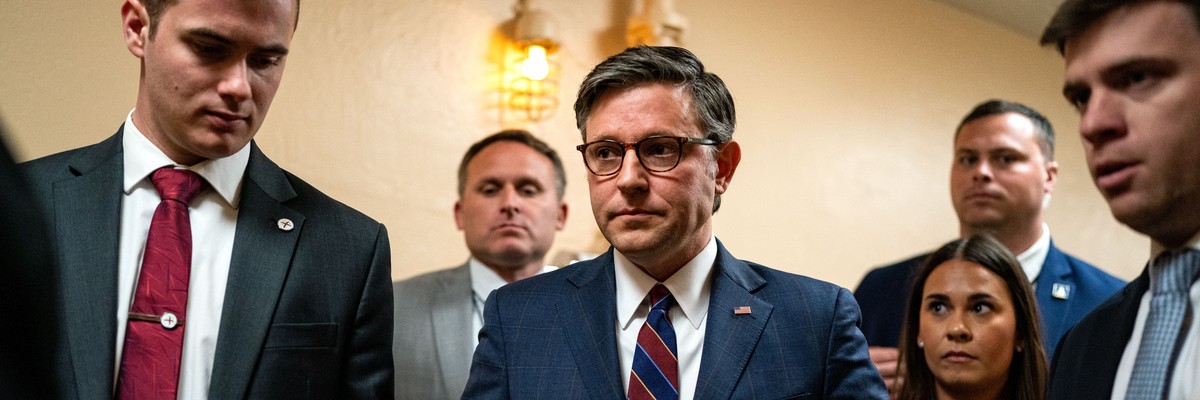
House Speaker Mike Johnson (R-La.) speaks to reporters at the U.S. Capitol on July 23, 2024 in Washington, D.C. (Photo by Kent Nishimura/Getty Images)
“Republicans would rather protect their billionaire friends at the expense of everyone else,” said the chair of the Joint Economic Committee.
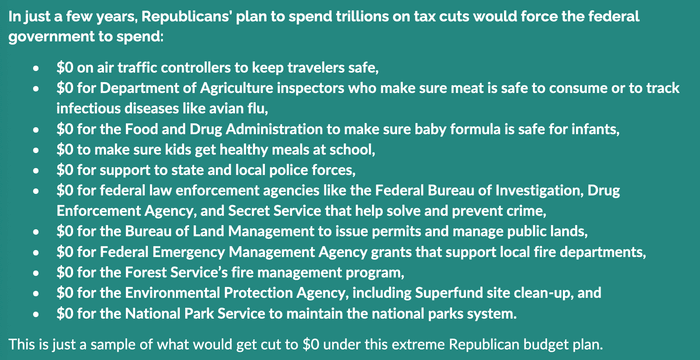
Budget proposals released by congressional Republicans in recent months lay bare the party’s desire to slash taxes for wealthy Americans and large corporations at the expense of key government programs and services, including nutrition assistance, environmental protection, and Medicaid.
That’s according to an analysis released Wednesday by Democrats on the Joint Economic Committee (JEC), which examined budget plans the GOP has released as Congress works to craft and pass government funding bills for the coming fiscal year.
The JEC specifically cites a Fiscal Year 2025 budget proposal published in March by the Republican Study Committee, a panel comprised of three-quarters of the House GOP caucus.
The plan, the JEC Democrats noted Wednesday, “claims to balance the budget by cutting Medicare spending, raising the retirement age for Social Security, capping funding for Medicaid and CHIP, and cutting the rest of non-defense discretionary spending by 31% across the board.”
“This would drive up health costs for American families by increasing premiums for [Affordable Care Act] healthcare plans and getting rid of protections for people with pre-existing conditions,” the new analysis says. “It would also prohibit Medicare from negotiating down prescription drug costs.”
A separate proposal from Republicans on the House Budget Committee claims it would finance “large tax cuts for the wealthy by both slashing key services and assuming that their tax giveaways lead to unrealistic levels of economic growth,” the Democratic report says.
“Analyzing this budget with more reasonable economic assumptions instead shows that budget would likely require the government to eliminate most federal services within a decade,” the report adds.
Sen. Martin Heinrich (D-N.M.), the chair of the JEC, said in a statement Wednesday that “Republicans’ extreme proposals are dangerous for America.”
“While Democrats are fighting to invest in families, Republicans would rather protect their billionaire friends at the expense of everyone else,” said Heinrich. “Kicking 42 million kids off of health insurance, gutting federal investments in public safety, denying veterans hospital care, and getting rid of [Supplemental Nutrition Assistance Program] benefits that help people afford groceries is unconscionable. Americans deserve better.”
Trump has called for an extension of the tax cuts he signed into law in 2017—changes that overwhelmingly benefited wealthy Americans. An extension of the tax cuts would add $4.6 trillion to the deficit of the next decade, according to the Congressional Budget Office.
The former president’s advisers have also reportedly discussed reducing the corporate tax rate from 21% to 15%, a change that would give the largest 100 U.S. companies a tax cut of $48 billion per year.
But earlier this week, UNITE HERE—a union that represents hospitality workers—endorsed Democratic nominee Kamala Harris over the Republican candidate, warning that “another Trump presidency would mean four chaotic years of defending against his attacks on unions, working people, immigrants, women, and others.”
As for Trump’s proposal to eliminate taxes on Social Security benefits, an analysis by the Tax Policy Center’s Howard Gleckman found that the move would reduce “Social Security and Medicare hospital insurance (HI) revenues by $1.5 trillion over the next decade,” harming the programs’ finances while providing “little or no benefit” to lower-income households in 2025.
“Less than 1% of the lowest-income households (those making about $33,000 or less, would get any tax cut at all,” Gleckman observed. “But about 28% of middle-income households would get a tax cut. Among the top 0.1 percent, about 20 percent of households would get a tax cut.”
Gleckman found that “in dollar terms, the biggest winners would be those in the top 0.1% of income, who make nearly $5 million or more.”
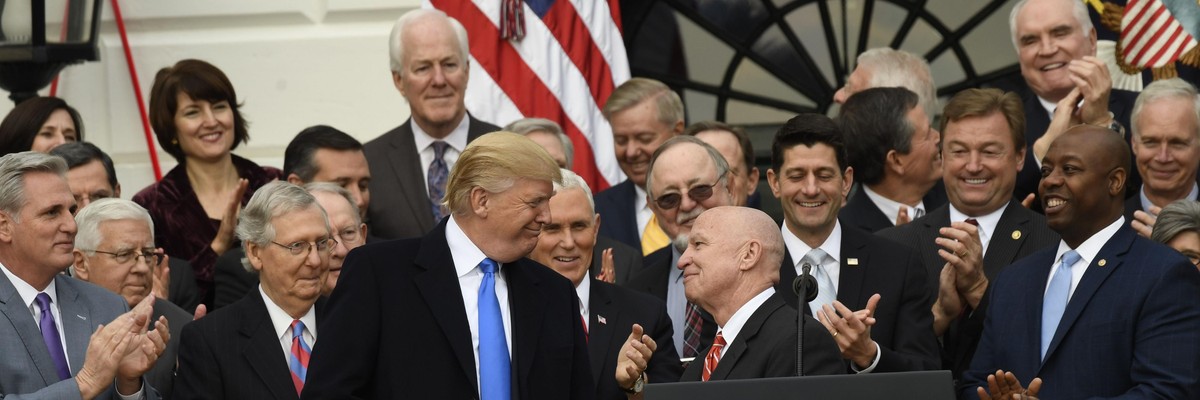
U.S. President Donald Trump smiles at House Ways and Means Committee Chairman Rep. Kevin Brady (R-Texas) after speaking about the passage of tax cut legislation at the White House in Washington, D.C. on December 20, 2017. (Photo: Saul Loeb/AFP via Getty Images)
In legislatures, the courts, and our executive offices, we have a system rigged in favor of the ultra-rich, rigged by everything from acts of Congress and judicial rulings to IRS budgets and audit policies.
By all appearances, former U.S. President Donald Trump has cut a sweet deal with a dozen or two of America’s richest billionaires: Finance his campaign and he’ll keep their federal taxes super low—or even lower them—once he’s sitting back in the White House.
How much do billionaires like this deal? This much: In April, hedge fund billionaire John Paulsen held a Palm Beach fundraiser for Trump that brought in $50.5 million. Immediately after Trump’s late May conviction on 34 felony counts in Manhattan, Timothy Mellon, the grandson of the classic plutocrat Andrew Mellon, ponied up $50 million. Miriam Adelson, the billionaire widow of Las Vegas kingpin Sheldon Adelson, appears eager to kick in as much as $100 million.
This past spring, meanwhile, billionaires Elon Musk and David Sacks reportedly held a secret dinner party for Trump, with attendees including the illustrious deep pockets Peter Thiel, Rupert Murdoch, and Michael Milken.
The rich themselves have actually become more brazen about avoiding taxes. Just try to stop us, they seem to be saying.
America’s billionaires clearly see politics as one route to ensuring they pay as little as possible at tax time. But they don’t just make their presence felt at election time. America’s rich have their thumbs firmly on the scale of all three branches of government. In legislatures, the courts, and our executive offices, we have a system rigged in favor of the ultra-rich, rigged by everything from acts of Congress and judicial rulings to IRS budgets and audit policies.
Some of this rigging we can all easily see. The dividends and long-term capital gains of the ultra-rich have for decades faced a maximum tax rate barely half the maximum rate applicable to other forms of income. And the investment income of the rich, unlike the paychecks of working people, faces no Social Security tax.
In 2017, the first year of the Trump presidency, intense lobbying efforts helped rich business owners to a special tax rate for their business income. In 2018 alone, according to ProPublica, that special rate translated into a $67 million gift to Mike Bloomberg, whose personal wealth now reportedly exceeds $100 billion.
But these glaring privileges the rich enjoy at tax time only tell part of the billionaire tax story. Other parts get precious little attention. In 2004, for instance, lawmakers in Congress enacted a penalty for the failure to disclose potentially abusive tax avoidance transactions on tax returns. The penalty on the surface looked substantial: 75% of the tax sought to be avoided. But Congress capped the penalty at $100,000, a move that turned the penalty into a minor nuisance for billionaires seeking to avoid millions of dollars in taxes.
In our current rich people-friendly tax climate, IRS staff who want to do the right thing face tough going. Recently, for example, one former IRS staffer, Michael Welu, went public with his concerns that the IRS itself has both official and unofficial policies that end up treating audited rich taxpayers much more gently than small business owners.
Welu found the upper management of the IRS division tasked with auditing the super rich—and the corporations they run—distinctly uninterested in investigating America’s richest and their “most egregious, ridiculous schemes” for avoiding taxes.
IRS officials like Michael Welu do occasionally speak out. But only tax wonks truly have any real sense of how much obscure tax code penalties and IRS audit policies favor the rich. And most of those tax wonks work for the rich.
The rich themselves have actually become more brazen about avoiding taxes. Just try to stop us, they seem to be saying.
Take the recently decided Supreme Court case, Moore v. United States. Working through an array of right-wing organizations, the conservative mover-and-shaker Leonard Leo attempted to use a challenge to an obscure one-time tax as a vehicle to preempt Congress from ever taxing the wealth or unrealized gains of the ultra-rich. Ultimately, the court decided the case without ruling on whether the rich can be taxed on their wealth or unrealized gains. But the opinions that four of the nine justices handed down made it clear that they stand prepared to do the billionaire bidding should a direct challenge to a tax on the wealth or unrealized gains of billionaires come before them.
Billionaires now have at least three Supreme Court justices firmly in their pockets. Reporting by ProPublica has revealed the massive gifts that have been flowing from Harlan Crow and other billionaires to Justice Clarence Thomas as well as the generous gifts that billionaire Paul Singer has been sending Justice Samuel Alito’s way. Justice Neil Gorsuch has had his entire career, including his appointment to the court, funded by the billionaire Philip Anschutz.
Those three justices, along with Justice Amy Coney-Barret, have now made it patently obvious they will not allow billionaires to be taxed on their unrealized gains or their wealth. Does anyone really think the billionaires won’t have the crucial, majority-making fifth vote from Justice Brett Kavanaugh when they need it?
Republican members of Congress are showing even less shame than our Supreme Court justices. Last year, these GOP lawmakers held the country hostage in negotiations to increase the country’s debt limit. Their price for agreeing to raise the debt limit, thereby avoiding a default on the country’s debt? They demanded—and won—a reduction in a scheduled IRS budget increase that would been used to increase enforcement moves against rich taxpayers.
The purported motive for this legislative hostage taking—“concern” over the federal deficit—made for an absurd justification. The proposed increase in the IRS budget would have been recovered, several times over, through increased tax collections. The IRS budget reductions the Republican lawmakers extracted will, in fact, only increase the federal deficit. But those reductions will serve a political purpose. They’ll protect the GOP’s richest patrons from tax enforcement.
The mainstream media, to no one’s surprise, did a miserable job of exposing this Republican dishonesty in the debt limit negotiations. But at one point in our recent past a courageous soul did emerge to expose the rot in our tax system. What happened? The ultra-rich and their henchmen in Congress make sure that this soul faced a punishment far more severe than any punishment ever meted out to those few rich Americans who actually get caught evading their taxes due.
That courageous soul, Charles Littlejohn, worked as an IRS contractor. He leaked tax return information related to Trump and America’s billionaires to TheNew York Times and ProPublica. ProPublica used that leaked information to write over 50 stories about billionaire tax avoidance, embarrassing and angering many of our richest in the process. Two of them even brought lawsuits, one against the IRS and the other against Littlejohn’s employer.
Ultimately, Littlejohn pled guilty to one count of unauthorized tax return information disclosure, a crime that carries a recommended sentence of four to 10 months. But 25 Republican members of Congress, undoubtedly at the behest of their billionaire patrons, wrote the judge in the case and urged the harshest possible sentence of five years. The judge obliged, stating in her sentencing remarks that Littlejohn posed a graver threat to democracy than the January 6 rioters. As tax law professor Reuven Avi-Yonah has noted, Littlejohn is now serving a sentence far harsher than any imposed on rich Americans convicted of tax evasion.
Littlejohn’s extreme sentence did not reflect the one single count of unauthorized tax return information disclosure he pled guilty to. That sentence reflects his “crime” of exposing the tax avoidance of the billionaire class.
Try this thought experiment: Imagine if Littlejohn had released the return information of 1,000 or so taxpayers with modest incomes to ProPublica. Imagine that ProPublica had then publicly detailed all the tip income that servers and bartenders among these taxpayers had failed to report and all the social meals that small business owners in the sample had claimed as business expenses. If Littlejohn had then pled to one count of unauthorized disclosure, would 25 members of Congress have intervened? Would the judge have imposed a sentence over six times the maximum recommended in federal sentencing guidelines?
Doesn’t it become dangerous to society when the punishment for a crime depends on who the victim happens to be?
We are now living that danger. Our billionaires sit firmly in control. And they will do whatever it takes to make sure they never pay tax at an appropriate level—even if that means locking a human being up for a preposterously long time just to send a message.
“The idea that rich and poor are equal before government in democratic societies is ludicrous,” writes Polychroniou. “As disparities in wealth and income grow, so do the disparities in political influence.” (Photo: flickr/Creative Commons)
Wealth taxation may sound like a good idea, but can it really address, let alone solve, the problem of inequality?
Economic inequality is the scourge of the 21st century. The rich are getting richer and faster than any other time since the onset of neoliberalism, which calls for “free-market” capitalism, regressive taxation, fiscal austerity and the rejection of the social state. They get richer not only when the economy is on an upswing but even amid crises. Billionaires more than doubled their net worth during the pandemic, according to Bloomberg Billionaires Index.
The latest analysis shows that the richest 1 percent gained $42 trillion in new wealth over the past decade, which amounts to “nearly 34 times more than the entire bottom 50 percent of the world’s population.” In the meantime, the very poor and low-income people across the globe, including the U.S., are actually getting poorer. So much for trickle-down economics which was popularized during the 1980s by the Reagan administration’s vast capital gains and income tax cuts and continues to persist to this day in spite of its major flaws. Cutting taxes on the rich not only increases economic inequality but has no effect on economic growth and unemployment.
There must be something very rotten with an economic system that allows individuals to generate obscene amounts of wealth to the point they can hijack the political system and undermine democracy.
However, inequality should not be examined purely from an economic perspective. Over the years, numerous studies have shown that economic inequality influences public attitudes toward democracy by generating political disillusion and low trust in government and other institutions, like Congress. Inequality also undermines social mobility, contributes to political polarization and fuels authoritarianism.
Finally, inequality contributes to climate change. The richest 1 percent is responsible for more carbon emissions than the poorest 66 percent, according to a 2023 report by Oxfam. Of course, while the world’s wealthiest people make a huge contribution to climate change, they are also able to insulate themselves from the worst impacts of global warming.
In sum, the super-rich can be blamed for many of the most serious ills confronting societies in the twentieth-first century. The only consequential question here is this: what can be done about it then?
One of the most frequent responses to the problem of rising inequality is a call for the implementation of a wealth tax. Wealth taxation may sound like a good idea, but can it really address, let alone solve, the problem of inequality? The answer is an unqualified “no.” At least for the world’s advanced economies. Indeed, even if it’s possible to discover all the wealth that the very rich people own (much of which is hidden in companies or put in trusts) and then proceed with an accurate asset valuation, this will have very little impact, if any, on the daily lives of people who try to survive on minimum wages. Wealth taxation alone will have no impact on workers without social protection and no bargaining power at companies. It won’t protect workers at the “gig economy” and part-time workers.
To effectively address economic inequality, we must identify the root cause of the problem, and one simple way to do this is by asking a rather simple question: How does one become superrich? Where does this immense wealth come from? Because as the renowned progressive economist James K. Boyce recently put it “nobody ‘earns’ a billion dollars.
There must be something very rotten with an economic system that allows individuals to generate obscene amounts of wealth to the point they can hijack the political system and undermine democracy. Democracy cannot exist when we have wealth concentrated in the hands of a few. The idea that rich and poor are equal before government in democratic societies is ludicrous. As disparities in wealth and income grow, so do the disparities in political influence.
Take corporations, for example, which exert enormous influence, thanks primarily to campaign donations and lobbying Their actions, which range from opposing labor laws and policies that benefit workers to restricting unionization, exacerbate inequalities at all levels of society and across the globe. Moreover, the surge in billionaire wealth and the surge in “corporate power and monopoly power” form a powerful connection. The very rich are not simply beneficiaries of the existing economic order. They are in control of the working arrangements of the global economic system. Yet despite the enormous power that corporations have on people’s lives and the communities in which they operate, there are very few policies and mechanisms at national or international level to curtail that power.
Of course, we know that billionaires and big corporations pay very little in taxes, but we need much more than wealth and corporate taxation. We need ways to curb the power of big corporations and their drive to maximize shareholder value at the expense of everything else. We should also set a cap on extreme wealth. There is no social value for having billionaires. We should abolish the superrich, perhaps an easier task, politically speaking, than finding ways to tax them. Democratic societies could hold a referendum on whether we should abolish extreme wealth.
In addition, we could create economic arrangements that provide a minimum income to ensure that everyone’s basic needs are met. This can be done either through universal basic income or guaranteed income programs.
Last, but not least, we can challenge the rule of capital by advancing democratic forms of economic governance and economic planning. Participatory economics is one such alternative that would change the economy as we know it since it entails social ownership of production and self-managed workplaces. Worker cooperatives are established is various parts of Europe, particularly in Italy and Spain. The Mondragon Corporation in the Basque region of Spain is owned by its workers and represents the biggest and most successful case of worker cooperatives. Of course, for economic transformation to occur, breaking down hierarchical structures and putting workers in charge of business activities is not enough. What needs to happen is that the values of worker cooperatives spread across the economy and that power is wrested away from the capitalist class.In today’s world, we can tackle economic inequality only by shifting the conversation to its root causes and then coming up with blends of policies that work together to put an end to the driving forces behind inequality. Spending all political capital on something like a wealth tax will only help to prolong the life of an immensely cruel and dangerous economic system. An easier and far more effective way to end plutocracy is through the power of democracy via a binding referendum that calls on citizens to decide whether or not we should abolish altogether extreme wealth.
Demonstrators demand higher taxes on the rich in Paris, France on June 23, 2024. (Photo: Laure Boyer/Hans Lucas/AFP via Getty Images)
“The richest 1% of humanity continues to fill their pockets while the rest are left to scrap for crumbs.”
The richest sliver of the global population hauled in more than $40 trillion in new wealth over the past decade as countries around the world cut taxes for those at the very top, supercharging inequality that poses a dire threat to democracy and the planet.
An Oxfam analysis released Thursday ahead of a meeting of G20 finance ministers estimated that over the past 10 years, the global 1% has accumulated $42 trillion in new wealth. That’s “nearly 34 times more than the entire bottom 50% of the world’s population,” the group observed.
“That is disgusting,” Michael Taylor, founder of the Australian Independent Media Network, wrote in response to the new figures.
The analysis comes amid a growing push by current and former world leaders for rich countries to enact a global tax on billionaire wealth that would begin to reverse the damage done by decades of regressive policy. Oxfam found in a separate analysis released earlier this year that economic and political elites’ global “war on fair taxation” has slashed taxes for the rich by 32% since 1980.
Oxfam said Thursday that global billionaires “have been paying a tax rate equivalent to less than 0.5% of their wealth.”
“Inequality has reached obscene levels, and until now governments have failed to protect people and planet from its catastrophic effects,” Max Lawson, Oxfam’s head of inequality policy, said in a statement Thursday. “The richest 1% of humanity continues to fill their pockets while the rest are left to scrap for crumbs.”
“Momentum to increase taxes on the super-rich is undeniable, and this week is the first real litmus test for G20 governments,” Lawson added. “Do they have the political will to strike a global standard that puts the needs of the many before the greed of an elite few?”
A recent report by renowned economist Gabriel Zucman of the University of California, Berkeley outlined how nations could go about implementing a 2% minimum tax on the wealth of global billionaires—a policy change that he shows would raise up to $250 billion in annual revenue that could be used to support a range of priorities, from climate investments to education and healthcare programs.
“Thanks to recent progress in international tax cooperation, a common taxation standard for billionaires has become technically possible,” said Zucman. “Implementing it is a question of political will.”
The economist’s report was commissioned by the government of Brazilian President Luiz Inácio Lula da Silva, who has championed a global billionaire tax in the face of resistance from powerful nations, including the United States—which has more billionaires than any other country. In 2018, U.S. billionaires paid a lower effective tax rate than working-class Americans.
But reporting indicates that the leaders of G20 nations—which are home to roughly 80% of the world’s billionaires—are likely to rebuff Lula’s push for billionaire wealth tax, opting instead to pursue what Bloombergdescribed as “research on taxation and inequality that could take years to deliver results.”
Reuters similarly reported Wednesday that G20 finance ministers meeting in Brazil “are preparing a joint statement for Thursday in support of progressive taxation that will stop short of endorsing the hosts’ proposal for a global ‘billionaire tax.'”
The global billionaire wealth surge comes in the context of growing misery for large swaths of the world’s population. A report released Wednesday by the United Nations’ Food and Agriculture Organization (FAO) estimated that one out of 11 people around the world—or up to 757 million people—”may have faced hunger” last year.
“The world’s poorest people are paying the highest price of hunger,” Eric Munoz, Oxfam’s food policy expert, said in response to the FAO report. “We need deeper, structural policy and social change to address all of the drivers of hunger, including economic injustice, climate change, and conflict.”
Greenpeace Netherlands and Extinction Rebellion activists block a private jet at the Schiphol Airport in Amsterdam on Saturday, November 5, 2022. (Photo: (c) Marten van Dijl/Greenpeace)
The planes tracked by a new Guardian report belong to celebrities, billionaires, CEOs, and their families, among them the Murdoch family, Taylor Swift, and the Rolling Stones.
The private jets of just 200 rich and famous individuals or groups released around 415,518 metric tons of climate-heating carbon dioxide between January 2022 and September 22, 2023, The Guardian revealed Tuesday.
That’s equal to the emissions burned by nearly 40,000 British residents in all aspects of their lives, the newspaper calculated.
The planes tracked by the outlet belong to celebrities, billionaires, CEOs, and their families, among them the Murdoch family, Taylor Swift, and the Rolling Stones. All told, the high-flyers made a total of 44,739 trips during the study period for a combined 11 years in the air.
“Pollution for wasteful luxury has to be the first to go, we need a ban on private jets.”
Notable emitters included the Blavatnik family, the Murdoch family, and Eric Schmidt, whose flights during the 21-month study period released more than 7,500 metric tons of carbon dioxide equivalent. The Sawiris family emitted around 7,500 metric tons, and Lorenzo Fertitta more than 5,000.
The Rolling Stones’ Boeing 767 wide-body aircraft released around 5,046 metric tons of carbon dioxide, which is equal to 1,763 economy flights from London to New York. The 39 jets owned by 30 Russian oligarchs released 30,701 metric tons of carbon dioxide.
Taylor Swift was the only celebrity or billionaire in the report whose team responded to a request for comment.
“Before the tour kicked off in March of 2023, Taylor bought more than double the carbon credits needed to offset all tour travel,” a spokesperson for the pop star told The Guardian.
Swift appears to have responded to public pressure to reduce private jet use. Her plane averaged 19 flights a month between January and August 2022, when she received criticism after sustainability firm Yard named her the celebrity who used her plane the most. After that point, the plane’s average monthly flights dropped to two.
The Guardian’s investigation was based on private aircraft registrations compiled by TheAirTraffic Database and flight records from OpenSky. Reporters calculated flight emissions based on model information found in the ADSBExchange Aircraft database and Planespotters.net and emissions per hour per model found in the Conklin & De Decker’s CO2 calculator and the Eurocontrol emission calculator.
The report was released the day after an Oxfam study found that the world’s richest 1% emitted the same amount as its poorest two-thirds. Given their high carbon footprint and luxury status, private jets have emerged as a rallying point for the climate justice movement.
“It’s hugely unfair that rich people can wreck the climate this way, in just one flight polluting more than driving a car 23,000 kilometers,” Greenpeace E.U. transport campaigner Thomas Gelin said in March. “Pollution for wasteful luxury has to be the first to go, we need a ban on private jets.”
In the U.S., a group of climate campaigners is mobilizing to stop the expansion of Massachusetts’ Hanscom Field, the largest private jet field in New England. An October report found that flights from that field between January 1, 2022, and July 15, 2023, released a total of 106,676 tons of carbon emissions.
“While plenty of business is no doubt discussed over golf at Aberdeen, Scotland, or at bird hunting reserves in Argentina (destinations we also documented), this is probably the least defensible form of luxury travel on a warming planet when a Zoom call would often do,” Chuck Collins, who co-authored the Hanscom report, wrote for Fortune on November 14.