U.S. Vice President JD Vance speaks at the Munich Security Conference on February 14, 2025. (Photo: Sean Gallup/Getty Images)
Rebuking the U.S. vice president, German Chancellor Olaf Scholz said that “a commitment to ‘never again’ is not reconcilable with support for the AfD.”
U.S. Vice President JD Vance faced growing backlash on Saturday after scolding the European political establishment for shunning far-right parties and subsequently meeting with the leader of the neo-Nazi Alternative for Germany, just a week ahead of the country’s general election.
While Vance did not explicitly mention Alternative for Germany, or AfD, during his remarks Friday at the Munich Security Conference, he declared that “there is no room for firewalls”—a reference to mainstream German political parties’ refusal to work with AfD or include it in governing coalitions.
The Guardianreported that “a whisper of ‘Jesus Christ’ and the squirming in chairs could be heard in an overflow room” during the U.S. vice president’s remarks, which he delivered a week after hundreds of thousands took to the streets of Munich to protest far-right extremism.
Following his speech, Vance met with AfD leader Alice Weidel, who praised the vice president’s Munich address as “excellent” in a post on X—a social media platform owned by billionaire Elon Musk, who has also expressed support for AfD as he works to dismantle agencies throughout the U.S. government.
Reutersreported that Weidel—whose grandfather was a Nazi judge appointed directly by Adolf Hitler—met with Vance at his hotel “for about 30 minutes and discussed the Ukraine war, German domestic policy, and freedom of speech.”
On Saturday, German Chancellor Olaf Scholz rebuked Vance and said that “we will not accept outsiders intervening in our democracy,” even “friends and allies.”
“Never again fascism, never again racism, never again aggressive war,” Scholz said in his speech at the Munich Security Conference. “That is why an overwhelming majority in our country opposes anyone who glorifies or justifies criminal National Socialism.”
“A commitment to ‘never again’ is not reconcilable with support for the AfD,” said Scholz.
Elon Musk urges you to be a Fascist like him, says that you can ignore facts and reality then.Climate Science Denier Donald Trump says Burn, Baby, Burn.
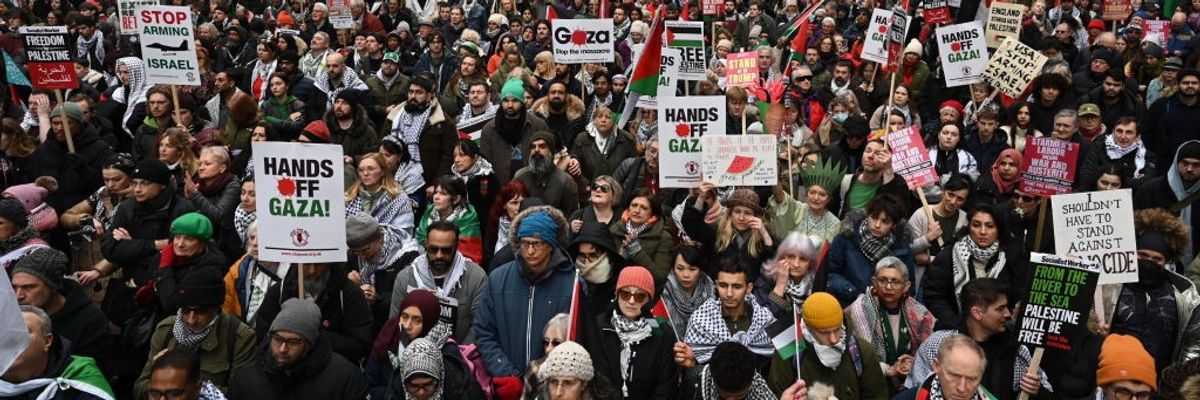
Thousands of protesters take part in a demonstration expressing support for Palestinian rights in London on February 15, 2025. (Photo: Rasid Necati Aslim/Anadolu via Getty Images)
An 87-year-old Holocaust survivor called the U.S. president’s plan to permanently force Palestinians out of Gaza “completely immoral and illegal, and also impractical and absurd.”
Thousands of people marched to the United States Embassy in London on Saturday to protest President Donald Trump’s ethnic cleansing plan for the Gaza Strip, a proposal that has been roundly condemned as unlawful and monstrous by the U.N., international human rights organizations, and Palestinians living in the enclave decimated by relentless Israeli bombing.
The march came after Trump doubled down on his proposal for the U.S. to “take over” Gaza after forcibly and permanently displacing Palestinians from the territory.
“Think of it as a big real estate site, and the United States is going to own it and we’ll slowly—very slowly, we’re in no rush—develop it,” Trump told reporters last weekend.
Marchers carried signs Sunday expressing contempt for the president’s proposal, which Amnesty Internationaldenounced as “inflammatory, outrageous, and shameful.”
Protesters march to the U.S. Embassy in London on February 15, 2025. (Photo: Wiktor Szymanowicz/Future Publishing via Getty Images)
Stephen Kapos, an 87-year-old Holocaust survivor, toldAFP on Saturday that Trump’s proposal is “completely immoral and illegal, and also impractical and absurd.”
“It’s not going to happen,” Kapos added, “but it does a lot of damage simply stating that as an endgame.”
The mass demonstration in London, organized by the Palestine Solidarity Campaign and other organizations, followed news that Hamas freed three additional Israeli hostages on Saturday in exchange for the release of more than 360 Palestinians who were held in Israeli prisons.
The exchange was part of a tenuous cease-fire deal reached in January after 15 months of incessant U.S.-backed Israeli attacks on the Gaza Strip.
The assault’s impact on Palestinians in Gaza was, and continues to be, catastrophic. According to an article published in The Lancet earlier this month, Israel’s war on the Gaza Strip “generated a life expectancy loss of more than 30 years during the first 12 months of the war, nearly halving prewar levels.”
“Actual losses are likely to be higher,” the researchers noted, stressing that their estimate was conservative and “did not account for the indirect effect of the war.”
UK Foreign Minister David Lammy confirms that UK government and military are active participants in Israel’s genocides and that the F-35 parts that they suspended from supplying to Israel are instead simply diverted via the United States. He says see https://youtu.be/QILgUHrdWREGenocide denier and Current UK Prime Minister Keir Starmer is quoted that he supports Zionism without qualification. He also confirms that UK air force support has been essential in Israel’s mass-murdering genocide. Includes URLs https://www.declassifieduk.org/keir-starmers-100-spy-flights-over-gaza-in-support-of-israel/ and https://youtu.be/O74hZCKKdpAPower-mad orange gasbag Donald Trump says Burn, Baby, Burn.
People take part at the commemoration of the February Strike of 1941 in Amsterdam, Netherlands, on 25 February 2017. The strike is remembered each year, where people lay flowers at the feet of statue depicting one of the dockworkers who led the day of action against the Nazi’s rounding up of Jews in the Dutch city and beyond. (Photo by Romy Arroyo Fernandez/NurPhoto via Getty Images)
Remembering how Amsterdam’s working class stood up against Adolf Hitler’s extermination of the Jews.
In three days, Amsterdam organized the only general strike in Europe to protest the first roundup of Jews. People poured into the streets on February 25, 1941—an estimated 300,000 of the 800,000 total who lived in the city.
The first to march were the tram and dock workers. The civil servants followed and word spread through the whole city, even to the small sewing workshop where a woman named Mientje Meijer worked. She and her husband had talked about it, and he came to the window to let her know it was really happening. She stopped her treadle, rose to her feet, and said, “Ladies, all of Amsterdam has come to a standstill because they’ve been rounding up Jews and taking them away. We’ve got to join in.”
The ladies poured out, even the boss, and joined the multitudes: teachers, metal workers, factory employees, shop clerks, people from across the political spectrum. Some were furious that their fellow citizens’ rights had been violated, some wanted to protest the Nazi occupation, and some just hated the Germans. Whatever their motives, they stopped the city in its tracks.
How did they organize so fast? A road builder and a street sweeper who belonged to the banned but well-organized Communist Party decided to call a meeting and take action. They had heard that hundreds of Jewish men had been rounded up on the square between the immense Portuguese Synagogue and the four smaller Ashkenazi ones. The communists gathered with trade union representatives and others at the Noorderkerk in the workers’ part of the city. They enlisted political and moral allies. Soon, a mimeographed leaflet urged everyone to “Strike! Strike! Strike! Shut down all of Amsterdam for a day!” And they did. The Strike even reached a few other cities before the German occupiers reacted with force.
Only limited public protest was heard the year before, at the time when Jews were fired from the civil service, including professors from the universities. Therefore, the Germans were dumbfounded in February 1941 when the Dutch, their Aryan brothers and sisters, took to the streets en masse. But the Nazis recovered fast and ordered the use of rifles and hand grenades to stop the strike.
By the time it was over a few days later, about 200 people had been arrested, nine had been killed, and 50 injured. For the rest of the war, the February Strike remained the only general strike in Europe to protest the roundups. Tragically, it was futile: about 75% of the Dutch Jewish population was mass murdered. Yet the strike remains in our memories as one of the few times ordinary people stood together against the deportation of their Jewish neighbors. It meant something to many Dutch survivors as long as they lived.
I learned about the Strike at the time of its 60th commemoration in 2001. Every year, people gather to remember, right where the first roundups took place. They stand around the statue of the Dockworker who is the symbolic figure of the Strike. Sculpted by a resistance worker who survived, the hefty figure wears a worker’s cap, looking not at us but beyond us, his hands at his sides, open but ready to form fists.
In 2001, the square was crammed with people, some old enough to have been alive at the time, others young families, others men of all ages with yarmulkes, and individuals formally dressed in black who proved to be diplomats. Everyone was quiet, even little children. The commemoration began with a few short speeches and a poem, but the main event was this: people were invited, a few at a time, to approach the Dockworker, stand for a moment, and lay flowers.
The elders approached first, those who might have been present at the Strike. Next the Jewish organizations placed their big wreaths, often laid by children. Similar offerings came from the European Trade Union Federation, from the people of Sweden and the United States, and others. But the vast majority of the flowers were small bouquets tied with ribbons, like a dozen red tulips bound by aluminum foil with a bit of wet paper inside. Some were accompanied by a personal note written in ink in a scrawly hand.
It took an hour and a half on that frigid afternoon to lay all the flowers, and they stayed there unmolested for days. The flowers remained until they were all dead and had to be carried away.
Despite international pressure to free Hiba, Jordanian authorities held her for her full sentence in a “huge setback for press freedoms.
Jordanian authorities released journalist Hiba Abu Taha on Thursday, February 13, upon completing her prison sentence.
In June, 2024, Hiba was sentenced to one year in prison for violating Jordan’s controversial Cybercrime Law by allegedly “spreading false news, slandering, insulting or defaming a governmental authority or an official body,” and “inciting discord and strife among members of society, targeting community peace, and inciting violence.”
One of those charges was reportedly imposed on Abu Taha for an article she wrote, in which she criticized Jordan’s interception of Iranian drones and rockets launched against Israel in April, 2024.
Meanwhile, she faced the other charge for writing an investigative report, exposing Jordanian companies, which were transporting goods to Israel through the Jordanian territory during Israel’s genocidal aggression on Gaza.
The imprisonment of Abu Taha and the enactment of the Cybercrime Law were widely criticized by international human rights and press freedom organizations. These organizations described Hiba’s imprisonment as a “huge setback for press freedom” in Jordan. They labelled the Cybercrime Law “draconian.”
In October 2024, an online campaign titled “We stand in solidarity with Hiba Abu Taha” was also launched by 24 media platforms, including Peoples Dispatch. However, the Jordanian authorities ignored the widespread opposition from organizations and grassroots campaigns, and continued Hiba’s incarceration until the last day of her prison sentence.
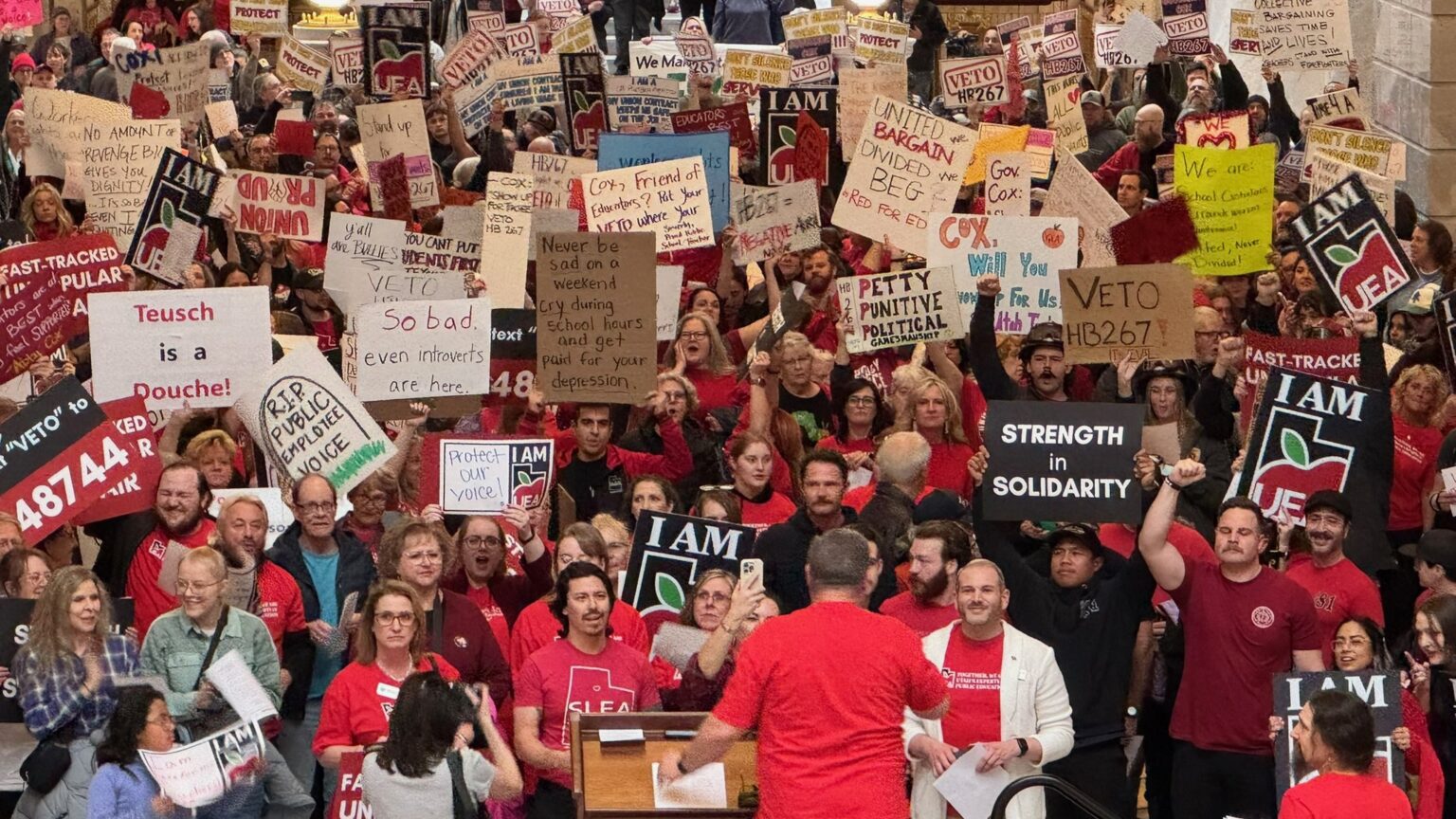
Workers pack the State Capitol building in Salt Lake City, Utah demanding Governer Cox veto HB 267. Photo: UEA
Utah’s controversial HB 267 seeks to ban collective bargaining for federal workers, drawing fierce opposition from unions and activists.
A controversial bill in the US state of Utah, HB 267, is making its way through the state legislature, sparking intense debate and widespread opposition.
If signed into law, the bill would make it illegal for any federal agency in Utah to recognize labor unions or engage in collective bargaining with their employees. This sweeping measure would impact thousands of workers, including teachers, health care workers, emergency responders, and a variety of other workers employed by federal agencies. Many federal employees rely on unions to fight for fair wages, benefits, and working conditions.
The bill has been met with fierce opposition from labor unions, federal workers, civil rights groups, and grassroots organizations. Many of whom see HB 267 as not just harmful to individual employees, but having far-reaching consequences for the broader labor movement and worker’s rights in Utah.
Despite the opposition, HB 267 passed the House floor on January 26 with a 42-32 vote and narrowly passed the Senate on February 6 with a 16-13 vote. It now awaits a decision from Utah Governor Spencer Cox, who must choose to either sign or veto the bill in the coming days.
Labor movement fights back against HB 267
The American Federation of Government Employees (AFGE), Utah AFL-CIO, and the Utah Education Association (UEA) have held several rallies at the State Capitol in protest of HB 267. Thousands of workers packed the building after the Senate passed the bill, demanding a veto from the Governor.
Workers carried signs with statements like, “Workers rights are worth the fight!” and “Bust the billionaires, not the unions!”
Michael, a pipefitter with Local 140 who is involved in the growing movement against HB 267 explained:
“I feel like it’s a power grab. I feel like they’re taking away our voice…Teachers, first responders, nurses. Those industries are under huge attacks since COVID. So therefore, you’re taking an industry that’s already been depleted and depleting it even further by taking away their voice.”
The anti-union bill, and the fight against it, reminds labor leaders of a similar anti-union bill in Wisconsin in 2011, called Act 10. That bill sparked an unprecedented worker’s movement that almost culminated into a general strike in Madison.
UEA leads resistance against legislative attacks
In response to the Utah bill passing the House floor, the UEA stated:
“We believe HB 267 represents a dangerous precedent that undermines the principles of democracy and the rights of public employees to organize and advocate for their professions. It is an attack on public educators who dedicate their lives to teaching Utah’s children, ultimately threatening the quality of public education across the state.”
The UEA is the largest teacher’s union in the state. In 2024, they led a broad coalition in a successful fight to shut down Constitutional Amendment A, which would have opened up the use of the income tax fund allocated to public education for other “needs” like private school vouchers.
“The teachers were able to fight hard and [Constitutional Amendment A] got removed from the ballot. It’s clear that the legislature is retaliating against teachers and retaliating against unions,” said Dodge Hovermale, a member of United Campus Workers of Utah Local 7765, speaking with Peoples Dispatch.