Who fears the truth? The lawfare campaign to silence Francesca Albanese

Spread the love

This work by Middle East Monitor is licensed under a Creative Commons Attribution-NonCommercial-ShareAlike 4.0 International License.

UN Special Rapporteur on Palestine Francesca Albanese holds a press conference at the lower house of the Italian Parliament, the Chamber of Deputies, to present her new report titled “Genocide in Gaza: A Collective Crime” in Rome, Italy on February 03, 2026. [Barış Seçkin – Anadolu Agency]


by Kurniawan Arif Maspul

Francesca Albanese has become one of the most polarising figures in contemporary diplomacy, not because she commands armies or signs treaties, but because she insists on describing what she sees. Since assuming her mandate as United Nations Special Rapporteur on the situation of human rights in the Palestinian territories in 2023, the Italian jurist has delivered reports that cut through diplomatic euphemism with the precision of a scalpel. 

In her October 2024 report to the General Assembly, pointedly titled Genocide as Colonial Erasure, she concluded there were ‘reasonable grounds’ to believe that Israel’s conduct in Gaza met the legal threshold of genocide and formed part of a ‘century-long project of eliminatory settler-colonialism’. Few phrases in international law carry such moral weight. Fewer still are uttered so plainly in the marble halls of New York and Geneva.

The reaction was immediate and ferocious. Israeli officials labelled her ‘one of the most antisemitic figures in modern history’. France, Germany, Italy, Austria and the Czech Republic publicly called for her removal after a February 2026 address to a Doha forum in which she condemned ‘the planning and making of a genocide’ in Gaza and decried the complicity of states that had armed and politically shielded Israel since October 2023 (a speech later distorted through a truncated clip that falsely claimed she had labelled Israel “the common enemy of humanity,” a narrative she categorically rejected). 

The edited clip of that speech ricocheted across social media, falsely suggesting she had called Israel ‘the common enemy of humanity’. She responded with weary clarity: the ‘common enemy’, she said, was the system — financial capital, algorithms and weapons — that enables atrocities, not a people or a state.

READ: France’s censorship of voices calling out international complicity with genocide

The United Nations moved swiftly to defend the independence of its mandate.

Special rapporteurs, a spokesperson reminded reporters, are not political appointees but independent experts commissioned by the Human Rights Council and protected by UN privileges and immunities.

Reuters noted there is no precedent for removing a rapporteur mid-term, and diplomats privately concede such an attempt would likely fail. Yet the calls for her resignation were not merely procedural skirmishes. 

They were signals — about who is permitted to speak, and how far the language of international law may stretch before it snaps under political strain.

What makes Albanese’s work so unsettling to some capitals is not only the gravity of her conclusions, but the breadth of her analysis. In her 2025 Human Rights Council report, she traced what she termed a shift ‘from economy of occupation to economy of genocide’, mapping the corporate and financial networks that sustain settlement expansion and military operations.

She placed Western governments within that ecosystem, arguing that political cover and arms transfers had ‘stabbed international law in the heart’. 

Amnesty International echoed this concern, warning that silencing her would distract from ‘Israel’s genocide in Gaza, its system of apartheid and unlawful occupation’.

Whether one agrees with her characterisation or not, the data underpinning the crisis are sobering. By late 2025, Gaza’s health authorities and UN agencies reported tens of thousands of Palestinians killed since October 2023, with vast swathes of housing, hospitals and water infrastructure destroyed. The World Bank estimated economic contraction in Gaza exceeding 80 per cent. UNICEF described levels of child malnutrition unseen in decades. These figures are not rhetorical flourishes; they are the raw arithmetic of devastation. 

They form the backdrop to South Africa’s genocide case before the International Court of Justice and to repeated UN General Assembly resolutions demanding a ceasefire and humanitarian access.

Across global capitals, the language of a “rules-based order” is spoken with conviction. Yet those words hollow out when rules are applied selectively. If international law binds adversaries but spares allies, it ceases to be law and becomes leverage.

The strength of the global system rests on independent scrutiny. When UN experts can be undermined through doctored clips, coordinated outrage and political pressure, the foundations of accountability begin to shake. Today it is Gaza. Tomorrow it could be Ukraine, Myanmar, Sudan, or any conflict where truth unsettles power. Disinformation does not respect borders. Precedents travel fast. If the world tolerates the silencing of inconvenient investigators, it signals that multilateralism is conditional — firm in rhetoric, fragile in practice. 

Trust erodes. Cynicism grows. The Global South watches and remembers.

READ: Trump says Board of Peace members to pledge over $5B for Gaza reconstruction on Thursday

Defending independent mandates is not an attack on any state. It is a defence of the very order governments claim to uphold. If the guardians of international law bend it when tested, the damage will not stay confined to one region. It will echo wherever justice depends on courage rather than convenience.

There is, of course, genuine sensitivity in Europe, shaped by the Holocaust and by the resurgence of antisemitism. Albanese herself has apologised for past remarks that were widely criticised. These complexities demand care. 

Yet conflating sharp legal criticism of a state’s conduct with hatred of a people risks trivialising real antisemitism and impoverishing serious debate. The joint statement of 116 human rights organisations condemning what they described as a ‘targeted smear campaign’ warned that such tactics threaten freedom of expression and the integrity of UN mechanisms.

The UN human rights office has observed an alarming rise in personal attacks and misinformation directed at independent experts.

International relations theory offers several lenses through which to view this moment. Realists see states defending allies and interests. Liberals see institutions under strain. Constructivists note how narratives of historical trauma and identity shape policy reflexes. Yet beyond theory lies a simpler question: can the international system tolerate uncomfortable truths when they implicate powerful actors?

Albanese’s language is undeniably stark. She speaks of apartheid, of settler colonialism, of genocide. For some diplomats, such words close doors. For others, they are the only vocabulary adequate to the scale of suffering. History suggests that terms once dismissed as inflammatory — apartheid in South Africa, ethnic cleansing in the Balkans — can become anchors for accountability. 

The 1963 UN Special Committee against Apartheid was once derided as politicised; it later formed part of the scaffolding that supported global sanctions and eventual transition.

The future of Gaza and Palestine will not be secured by rhetoric alone. Reconstruction will require tens of billions of dollars, credible governance reform within Palestinian institutions, security guarantees for Israel, and a political horizon that restores dignity and agency to Palestinians. A common argument is that the absence of a viable political process will simply harden cycles of violence. Sustainable development in the region hinges on accountability and inclusion; impunity breeds instability.

There is space here for Australian diplomacy — measured, principled, pragmatic. Supporting humanitarian ceasefire efforts, backing the independence of international courts, conditioning arms exports on compliance with international humanitarian law, and investing in Palestinian civil society are not radical steps. They are consistent with long-stated commitments. A middle power need not shout to be heard; it must simply be consistent.

Francesca Albanese’s tenure has illuminated an uncomfortable paradox. The United Nations is often criticised as toothless, yet when one of its independent experts speaks with legal bluntness, the reaction suggests that words still matter. Attempts to sideline her have so far failed, not because she is beyond reproach, but because the mandate she holds embodies a principle larger than any individual: that human rights scrutiny must not bend to political convenience.

For a global audience weary of endless conflict, the path to a better future for Gaza and Palestine lies not in silencing dissenting voices but in confronting evidence with honesty. The credibility of the international system — and of those states that claim to steward it — depends on that courage. 

In the end, the debate is less about one rapporteur than about whether the promise of ‘never again’ retains meaning when tested by the tragedies of the present.

OPINION: Indonesia’s 8,000: Can stabilisation proceed without normalisation?

The views expressed in this article belong to the author and do not necessarily reflect the editorial policy of Middle East Monitor.

This work by Middle East Monitor is licensed under a Creative Commons Attribution-NonCommercial-ShareAlike 4.0 International License.

Experiencing issues with this image not appearing. I suspect because it's so critical of Zionist Keir Starmer's support of and complicity in Israel's genocides.
Genocide denier and Current UK Prime Minister Keir Starmer is quoted that he supports Zionism without qualification. He also confirms that UK air force support has been essential in Israel’s mass-murdering genocide. Includes URLs https://www.declassifieduk.org/keir-starmers-100-spy-flights-over-gaza-in-support-of-israel/ and https://youtu.be/O74hZCKKdpA
Keir Starmer objects to criticism of the IDF. He asks how could anyone object to them starving people to death, forced marches like the Nazis did, bombing Gaza's hospitals and universities, mass-murdering journalists, healthworkers and starving people queuing for food, killing and raping prisoners and murdering children. He calls for people to stop obstructing his genocide for Israel.
Keir Starmer objects to criticism of the IDF. He asks how could anyone object to them starving people to death, forced marches like the Nazis did, bombing Gaza’s hospitals and universities, mass-murdering journalists, healthworkers and starving people queuing for food, killing and raping prisoners and murdering children. He calls for people to stop obstructing his genocide for Israel.
Orcas discuss Genocide-supporting and complicit Zionists. Donald Trump, Keith Starmer, David Lammy, Rachel Reeves, Angela Rayner and Wes Streeting are acknowledged as evil genocide-complicit and supporting cnuts.
Continue ReadingWho fears the truth? The lawfare campaign to silence Francesca Albanese

Britain’s relentless rain shows climate predictions playing out as expected

Spread the love
ernesto rogata / Alamy

Jess Neumann, University of Reading and Hannah Cloke, University of Reading

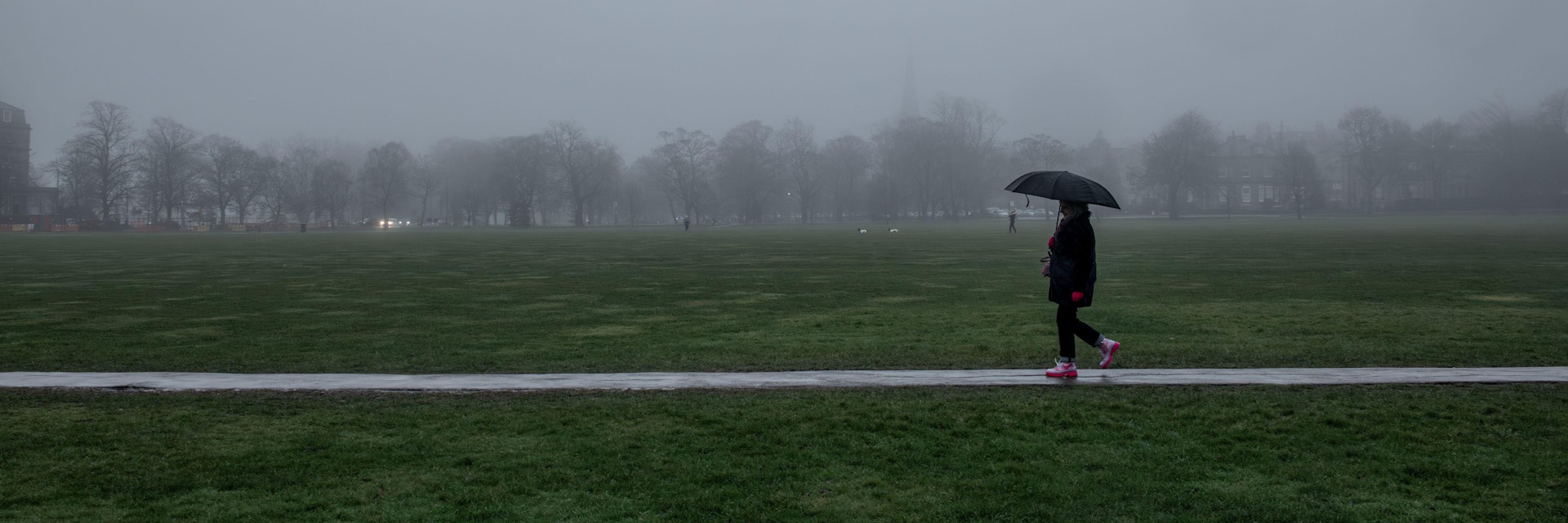
Large parts of the UK are experiencing relentless rainfall, with some places seeing rain for 41 consecutive days and counting. In Reading, in the south east of England, our university’s official rain gauge has recorded precipitation on 31 consecutive days – unprecedented in records stretching all the way back to 1908.

The pattern has not just made 2026 a bit dreary. It also reveals one way in which climate change is making the already naturally variable (some would say gloriously variable) British weather increasingly extreme.

In those 31 days, Reading has received 141mm of rain, compared to the 30-year average over that period of just 58mm – well over twice what we would expect at the time of year.

Higher than average rainfall totals are expected, well, half of the time. This is just how mean averages work. But it’s the nature of this current weather pattern that is so unusual, and is in keeping with the type of wetter winter situation for UK weather that climate scientists have been warning us to expect – even if we are still only just learning why exactly this is happening on a regional level.

Over the full breadth of a British year, the bigger picture is even more revealing. Last year, the UK was grappling with one of the hottest and driest summers on record. A succession of hot spells, combined with long periods that saw less than average rainfall, meant water supplies dwindled and widespread hosepipe bans were put in place.

As a whole, 2025 from spring onwards was exceptionally dry. Fast forward to the new year, and we’re facing the opposite – weeks of rainfall and flooding. These extremes are what we expect to see in this part of the world, as heat builds up in the global atmosphere and oceans. For British people, this is what climate change right now feels like.

More rain, more intense rain

What is causing this link between a warmer planet and wetter British winters? One fundamental link is in basic physics of the atmosphere as temperatures rise. Warmer air can hold more moisture – about 7% more for every one degree celsius of warming. This means that when it rains, on average it rains harder. Bigger, heavier downpours become more common.

Climate change is also disrupting the patterns of currents and cycles within the atmosphere and oceans that bring the UK much of its weather. As an island archipelago on the edge of three competing climate masses – the wet, mild Atlantic, the cold, dry Arctic, and the wildly variable temperatures of the Eurasian landmass – it is used to variability.

But one constant feature plays an oversized role in the type of weather we get: the jet stream – a ribbon of fast-flowing air high in the atmosphere. The position of the jet stream makes a big difference. Sometimes it flows to the north of Scotland, sometimes it is hundreds of miles further south towards Spain. This location matters, because the jet stream helps to blow whole weather systems – think of a big “bubble” of air carrying its own weather with it – from the Atlantic towards the UK.

Currently, the jet stream is positioned further south than typical for the time of year, steering consecutive wet and often windy weather systems directly towards the UK. At the same time, a high pressure system is sitting over parts of northern Europe, blocking the wet weather from moving further east.

The impact of climate change on the jet stream is complex, because this river of air circling the north pole from west to east is influenced by a lot of different factors. One thing we do know: the Arctic, at surface level, is warming faster than other parts of the planet. This means that the temperature difference between the poles and the equator, for air at lower levels at least, is not as big as it used to be. This may be influencing the jet stream to weaken and meander.

With less energy to push them along, these weather patterns can get stuck in one location, meaning that the systems of low air pressure associated with rainfall and storms can slow down or get stuck. When a system bringing rain parks itself over the UK for days on end, only to be followed by another system, and another, the result is relentless rainfall.

To complicate things further, high up in the atmosphere where the jet stream blows, climate change is actually making the temperature difference between equator and poles increase. This may be strengthening the speed and turbulence within the jet stream itself, and just adds to a complex picture of varying influence on UK rainfall.

The challenge of managing extremes

These rapid swings between drought and deluge pose serious practical challenges for everyone in the UK. Water companies must plan for both droughts and floods, even within the same year. Farmers face uncertain growing conditions, with crops rotting in the wet soil one month, and drying out in droughts a few months later. Infrastructure designed for the climate of the past may not cope with the extremes of the future.

Understanding these changes isn’t just an academic exercise. It’s essential for helping communities, businesses and governments prepare for what’s coming. As Britain experiences these climate extremes at first-hand, it is crucial to build resilience into plans for hotter and drier summers, and warmer wetter winters.

Jess Neumann, Associate Professor of Hydrology, University of Reading and Hannah Cloke, Professor of Hydrology, University of Reading

This article is republished from The Conversation under a Creative Commons license. Read the original article.

Nigel Farage urges you to ignore facts and reality and be a climate science denier like him and his Deputy Richard Tice. He says that Reform UK has received £Millions and £Millions from the fossil fuel industry to promote climate denial and destroy the planet.
Donald Trump urges you to be a Climate Science denier like him. He says that he makes millions and millions for destroying the planet, Burn, Baby, Burn and Flood, Baby, Flood.
Elon Musk urges you to be a Fascist like him, says that you can ignore facts and reality then.
Continue ReadingBritain’s relentless rain shows climate predictions playing out as expected

Coming Soon :: How to punish climate criminals

Spread the love
Nigel Farage urges you to ignore facts and reality and be a climate science denier like him. He says that Reform UK has received millions and millions from the fossil fuel industry to promote climate denial and destroy the planet.

It should be accepted that the climate criminals have destroyed the World’s – collectively our World’s – climate for profit despite being fully aware of the consequences of their actions. This has caused extreme weather events worldwide, far more extreme hurricanes, wildfires and floods while here in the UK we’ve suffered far worse flooding and almost constant raining. We are now starting to see and feel the first consequences of the climate criminals’ actions.

The climate criminals knew this, Donald Trump knows or should be treated as knowing it despite denying it. I would be so angry if I was young or even a little younger. Capitalists have destroyed younger peoples’ lives, nature and the environment for ever for short-term profit.

Their punishment doesn’t need to follow logic e.g. punish their descendents, why not? I’m thinking along the lines of dispossessing them – since they love money so much – and prevent them from all sources of income.

ed: It’s not acceptable to punish their descendents unfortunately, would breach their human rights. Can create the concept of ‘dirty money’ the proceeds from and polluted by climate destruction that should be seized from individuals. later ed: It follows that if an individual’s income has been sourced from climate destruction for some time, then it should all be seized. later later edit: This is not new of course. It is established that people should not benefit from crimes or the proceeds of crimes. What’s needed is to formally recognise climate destruction as a crime. I would expect that to no doubt happen in coming years. A different approach would be to accept the obvious consequences of climate destruction i.e. that those crimes are committed through the action of climate destruction.

I need to give this some thought and it may not be too soon …

Donald Trump urges you to be a Climate Science denier like him. He says that he makes millions and millions for destroying the planet, Burn, Baby, Burn and Flood, Baby, Flood.
Continue ReadingComing Soon :: How to punish climate criminals

Courts Have Ruled That ICE Illegally Jailed People More Than 4,400 Times in Less Than Five Months

Spread the love

Original article by Stephen Prager republished from Common Dreams under Creative Commons (CC BY-NC-ND 3.0).

Observers film US Immigration and Customs Enforcement (ICE) agents as they hold a perimeter after one of their vehicles got a flat tire on Penn Avenue on February 5, 2026 in Minneapolis, Minnesota. (Photo by Stephen Maturen/Getty Images)

In some cases, the administration has kept immigrants locked up even after a judge has ordered their release, according to an investigation by Reuters.

Judges across the country have ruled more than 4,400 times since the start of October that US Immigration and Customs Enforcement has illegally detained immigrants, according to a Reuters investigation published Saturday.

As President Donald Trump carries out his unprecedented “mass deportation” crusade, the number of people in ICE custody ballooned to 68,000 this month, up 75% from when he took office.

RECOMMENDED…

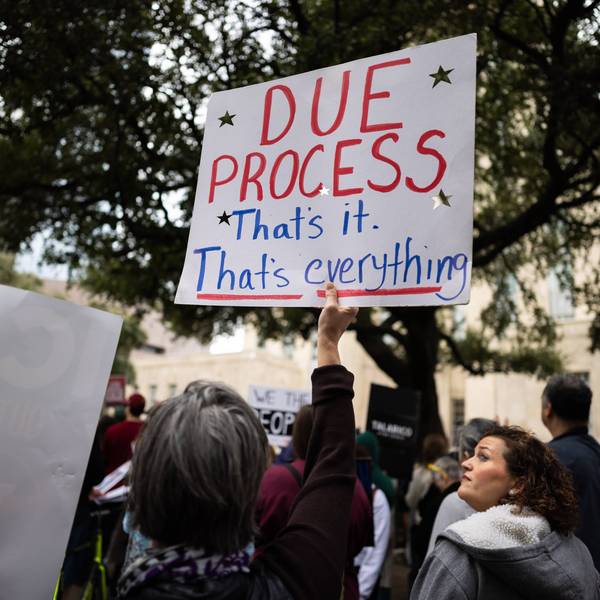
Sign reads, ''Due process: That's it. That's everything.'' during an anti-ICE demonstration at Houston City Hall

‘Fucking Insane’: Journalist Finds at Least 2,300 Illegal ICE Detentions Since July

Detainees At Krome Detention Center

‘Awful News for Due Process’ as Court Backs Trump’s Mass Immigrant Detention

Midway through 2025, the administration had begun pushing for a daily quota of 3,000 arrests per day, with the goal of reaching 1 million per year. This has led to the targeting of mostly people with no criminal records rather than the “worst of the worst,” as the administration often claims.

Reuters’ reporting suggests chasing this number has also resulted in a staggering number of arrests that judges have later found to be illegal.

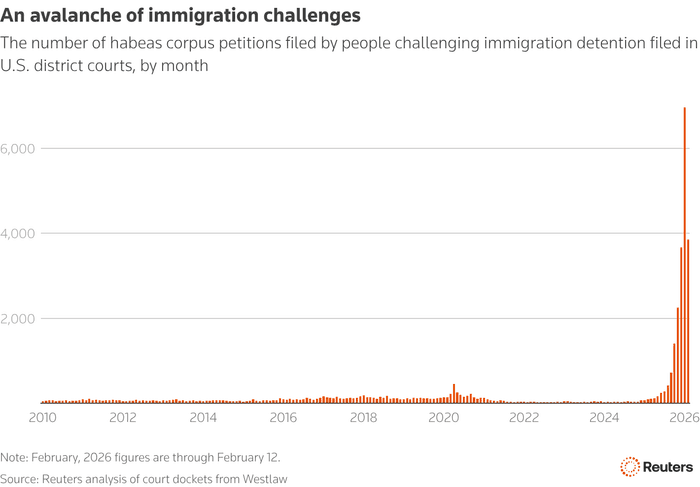
Since the beginning of Trump’s term, immigrants have filed more than 20,200 habeas corpus petitions, claiming they were held indefinitely without trial in violation of the Constitution.

In at least 4,421 cases, more than 400 federal judges have ruled that their detentions were illegal.

Last month, more than 6,000 habeas petitions were filed. Prior to the second Trump administration, no other month dating back to 2010 had seen even 500.

(Graphic by Reuters)

In part due to the sheer volume of legal challenges, the Trump administration has often failed to comply with court rulings, leaving people locked up even after judges ordered them to be released.

Reuters’ new report is the most comprehensive examination to date of the administration’s routine violation of the law with respect to immigration enforcement. But the extent to which federal immigration agencies have violated the law under Trump is hardly new information.

In a ruling last month, Chief Judge Patrick J. Schiltz of the US District Court in Minnesota—a conservative jurist appointed by former President George W. Bush—provided a list of nearly 100 court orders ICE had violated just that month while deployed as part of Trump’s Operation Metro Surge.

The report of ICE’s systemic violation of the law comes as the agency faces heightened scrutiny on Capitol Hill, with leaders of the agency called to testify and Democrats attempting to hold up funding in order to force reforms to ICE’s conduct, which resulted in a partial shutdown beginning Saturday.

Following the release of Reuters’ report, Rep. Ted Lieu (D-Calif.) directed a pointed question over social media to Kristi Noem, the secretary of the Department of Homeland Security, which oversees ICE.

“Why do your out-of-control agents keep violating federal law?” he said. “I look forward to seeing you testify under oath at the House Judiciary Committee in early March.”

Original article by Stephen Prager republished from Common Dreams under Creative Commons (CC BY-NC-ND 3.0).

Donald Fuhrump says that Amerikkka doesn't bother with crimes or charges anymore, not being 100% Amerikkkan and opposing his real estate intentions is enough.
Donald Fuhrump says that Amerikkka doesn’t bother with crimes or charges anymore, not being 100% Amerikkkan and opposing his real estate intentions is enough.
Elon Musk urges you to be a Fascist like him, says that you can ignore facts and reality then.
Orcas discuss Donald Trump and the killer apes' concept of democracy. Front Orca warns that Trump is crashing his country's economy and that everything he does he does for the fantastically wealthy.
Orcas discuss Donald Trump and the killer apes’ concept of democracy. Front Orca warns that Trump is crashing his country’s economy and that everything he does he does for the fantastically wealthy.

‘Fucking Insane’: Journalist Finds at Least 2,300 Illegal ICE Detentions Since July ›

Continue ReadingCourts Have Ruled That ICE Illegally Jailed People More Than 4,400 Times in Less Than Five Months