The UK has the worst safety net for the unemployed in north-west Europe
Viewers have taken issue with a statement by Tory MP Chris Philp who claimed that the UK’s benefits system is ‘very generous’, in an interview this morning.
Speaking to Sky News on the steep rise of shoplifting, the Policing Minister was asked if he had any sympathy for people stealing for food. He argued that there was “no excuse” because the UK’s benefits system is “very generous”.
Philp said: “We have a very generous benefits system, we’re spending well over £100 billion on working-age benefits, they went up by 10% in April this year they’ll go up by another 6 or 7%. National Minimum Wage has just gone up by around 10%. There is no excuse at all for any criminal activity, including shoplifting.”
However, people were not impressed at being told by a politician, who’s current net worth is around £3 million, that the benefits system is ‘very generous’. One X user responded: “Here is a challenge for Chris Philp – try living on ‘generous’ UK benefits for a month and then report back.”
Another wrote: “Clearly living in his own bubble. How disconnected from reality. The rental prices, bills have risen to unmanageable levels, the benefit system is completely inadequate.”
Chancellor Jeremy Hunt has threatened to cut benefits for people with disabilities and long-term illnesses who do not get a remote job | Nathan Stirk/Getty Images
The long-term effects of a dangerously mismanaged pandemic and cuts to health and social care are kicking in, with a record 2.5 million working-age people in the UK having disabilities or long-term health conditions that prevent or restrict their ability to work.
This should be the time to reform our punitive welfare system, which fewer Britons than ever believe offers enough support to those who need it. Instead, chancellor Jeremy Hunt has used his autumn statement to inflict yet more pain.
Hunt announced plans to stop people who are unemployed but not actively looking for work due to long-term sickness or disability from claiming free prescriptions and discounted bus travel, as well as to tell people they must find remote jobs or risk losing their benefits.
The news is hardly surprising – the government has long tried to paint Disabled people as ‘scroungers’. Yesterday, Laura Trott, chief secretary to the Treasury, callously told interviewers that Disabled or ill people have “a duty” to work. And just last month, Hunt promised to review benefit sanctions, telling the Conservative Party conference that “around 100,000 people are leaving the labour market every year for a life on benefits”.
What Hunt omitted, though, is that the UK already has one of the least generous welfare systems in Western Europe. Disabled people have lost an average of £1,200 a year between 2008 and 2019 due to a series of cuts and reforms, including the introduction of Employment and Support Allowance, the Work Capability Assessment, Personal Independence Payment, the bedroom tax, the benefit cap, the two-child limit, and Universal Credit.
A reduction in financial support can be difficult for anyone. But for Disabled people, it’s devastating. A household with at least one Disabled adult or child needs an additional £975 a month to have the same standard of living as non-disabled households, according to Scope disability rights charity.
The government is well aware of the mental anguish our threadbare welfare system causes. Just this week, a coroner warned work and pensions secretary Mel Stride that the system can worsen symptoms of mental illness, after a man whose “anxiety was exacerbated by his application for Universal Credit” died by suicide. The number of secret reviews into the deaths of benefit claimants carried out by the Department for Work and Pensions (DWP) has also more than doubled over the past three years.
Emma, a freelance benefits adviser in Greater London who requested that their surname not be published, knows better than most how to navigate the welfare system – they spend their working life helping others to do so.
Yet even Emma was told last year that their Hypermobile-Ehlers-Danlos Syndrome didn’t classify them for an enhanced Personal Independence Payment (PIP), which is designed to help a person with an illness, disability or mental health condition with everyday life. This money would have been a lifeline for Emma, who, despite being in work, was struggling to cover the extra costs that many Disabled people face, including, in their case, the purchase of two wheelchairs and an E-bike to help them get around.
“As a benefits adviser myself, I was able to give examples of how I met the enhanced rate mobility descriptors,” she said, referring to the criteria that must be met to be eligible for the enhanced mobility element of PIP, which is worth £71 a week. “But the caseworker [at the DWP] still refused and eventually offered me the standard rate [of £26.90 a week].”
“The whole process was incredibly stressful… He told me I had to decide there and then whether to accept his offer and that there would be no point in taking the appeal further as it would be unsuccessful.”
Pushing Disabled people towards work with threats often results in them becoming more unwell and further from the labour marketTom Pollard, head of social policy at the New Economics Foundation
Emma eventually worked with Citizens Advice to lodge a new appeal, which was successful, but it took them months to eventually receive PIP, making dealing with the additional costs associated with disability very difficult.
Having witnessed firsthand the difficulties of the current welfare system, Emma branded “current conversations” about sanctions and “getting people back to work” as “scary”.
They said: “Sanctions are an easy way [for the government] to save some money, at a time when finances are under pressure and scrutiny and they don’t know of a better way. And because they don’t understand the ramifications that sanctions will have on Disabled people”.
Emma’s sentiment was echoed by Tom Pollard, head of social policy at the New Economics Foundation. He told openDemocracy that Hunt’s threats to sanction people who do not find work will backfire and fail to achieve their stated aims.
“Any attempt to push [Disabled people] towards work by applying pressure and threats often simply results in people becoming more unwell and further from the labour market,” Pollard explained.
Labour’s position, should it take power next year, is not much better than the Tories’. In January, the then shadow work and pensions secretary, Jonathan Ashworth, announced that there would be “conditionality” – which requires people to behave a certain way to access benefits – in any welfare system the party oversees. This line appears unchanged, despite claims on the fringes of the Labour conference that the party would “co-produce” its benefits system with Disabled people.
That both of the biggest parties are resorting to threats of further sanctions or more conditionality is indicative of a system in desperate need of repair, said Geoff Fimister, policy co-chair at the Disability Benefits Consortium. “Ministers have so little confidence in what is on offer,” he explained, “that they feel they need to resort to threats to promote uptake.”
Linda Burnip from Disabled People Against Cuts, agreed, saying: “[Politicians] aren’t interested in how a good system works.” She added: “Ideologically, their only interest is in removing state aid to those who need it.”
The social security system should be an essential public service – a piece of social infrastructure that ensures we all have access to the right support when we need it. But after years of dire cuts and reforms, it has been torn apart. Hunt’s crackdown will only serve to worsen it, with disastrous consequences for those who are reliant on it.
This should be our moment for creating a system built on respect, dignity and support, that enables us to live the lives we deserve – not imprison us. We should be introducing a Guaranteed Decent Income – based on 50% of the minimum wage – and doing away with punitive sanctions, benefit caps, bedroom tax, conditionality, five-week wait for the first payment, and the two-child limit.
These are must-haves to create a system where everyone has chances and is valued and treated as equal citizens. One that pushes through the barriers of this cross-party consensus on inflicting suffering, which is completely out of line with the general public’s views.
The welfare system has taken another hit today via a ‘benefits crackdown’ in Jeremy Hunt’s autumn statement. Since the ‘welfare reform’ of 2007, disabled people have been on the receiving end of these dehumanising and punishing policies that make people out as ‘undeserving’, prioritise work over people, and make life unlivable.
But we now have evidence the Department for Work and Pensions (DPW) knows its policies kill people. It has been repeatedly warned of this fact and has even confirmed it in its own research.
It took years of campaigning by disabled people to uncover this evidence, which largely comes in the form of DWP reviews into deaths of claimants.
Now it has been brought together as part of the Deaths by Welfare project at Healing Justice London. Since 2021, journalist John Pring and I have been creating a timeline – co-produced with disabled people – showing the links between welfare policy and disabled people’s deaths.
It also shows that not only is there often a delay between the introduction of a policy and the brutal impact it has on people’s lives, but that delay tactics are central to DWP’s weaponisation of time as a strategy to avoid accountability.
To make matters worse, most families of those who have died do not even know if a review has been carried out into their loved one’s death because the DWP has always argued this is private information – an argument found by an Information Rights Tribunal to be an error in law – and can’t be shared, not even with families.
The first family to see an IPR was Philippa Day’s. Philippa, known as Pip, took her own life in 2019 after her disability benefits were stopped.
In January 2021, the coroner at the inquest into Philippa’s death found 28 separate “problems” with the administration of the Personal Independent Payment (PIP) system contributed to her death – concluding these were not individual errors by DWP and its private sector contractor Capita but systemic flaws.
Pip’s sister Imogen told us, in an interview for the Deaths by Welfare podcast, that seeing the IPR “silenced my night-time questions, right before I was going to sleep… It made it incredibly clear that we as a family had done everything that we could have done, and that it was a governmental system that had let her down”.
“I really feel for families that still don’t have answers,” she said.
And Pip is not alone. It would later come to light, after a sustained (and continuing) Freedom of Information battle, that between 2014 and 2022, the DWP carried out approximately 220 of these reviews – formerly called peer reviews, now internal process reviews (IPRs).
After finally obtaining redacted versions of some of these, we found evidence of persistent and systemic issues across welfare policy, and evidence that welfare policy is life-threatening. The reviews also contained hundreds of recommendations, which the DWP has admitted having no system for tracking.
What makes DWP reviews into what it calls the ‘death of a customer’ important is that they are (supposedly) tools through which the DWP investigates the harms of its own policies. And yet, they are designed and carried out in a way that systemically hides any state accountability. And delays in releasing the reviews is another way the department can avoid being held accountable.
What we have discovered has been learnt slowly, largely through a mixture of FOIs, parliamentary questions, queries to the DWP press office and documents released through court cases or inquests. Many of the FOIs have been submitted by Disability News Service over the last nine years.
An investigation by the National Audit Office (NAO) on the information the DWP holds on benefit claimants who ended their lives by suicide, found the DWP does not identify patterns between people’s deaths, meaning that “systemic issues which might be brought to light through these reviews could be missed”.
The NAO also found access to the reports is restricted to the team handling them and the recommendations are not tracked or monitored, meaning the DWP “does not know whether the suggested improvements are implemented”.
These recommendations include repeated warnings that policies to assess people for out-of-work disability benefits were putting the lives of “vulnerable” claimants (likely to be mostly people with mental health conditions or learning difficulties) at risk.
Yes, the DWP’s own investigations were identifying policies as potentially life-threatening. The IPRs also showed a recurring pattern of staff failure to follow DWP’s suicide guidance, which was introduced in 2009.
Tactics used to delay the release of information include claims by the DWP that the time required to collect data, due to lack of centralised record-keeping, was too costly and not in the public interest.
This was used under Thérèse Coffey to block requests about how many inquests relating to benefits claimants who died by suicide her department had submitted evidence to, as well as requests to find out how many inquests had ruled DWP policies were partly responsible for the deceased person’s state of mind. In both of these cases, the information wasn’t shared due to “disproportionate cost”.
These reviews should be publicly available by default, and the DWP should be held publicly accountable to making the changes required.
Yet it may be that the IPR process is by design unable to apprehend government accountability in people’s deaths. IPR findings and recommendations come from within the system that kills people, and therefore may never be enough for full accountability or justice. While some ascribe people’s deaths to flaws in a system that needs reform, others see them as endemic to a system that needs dismantling and creating anew, with disabled people, and the analysis developed through lived experience, at the core.
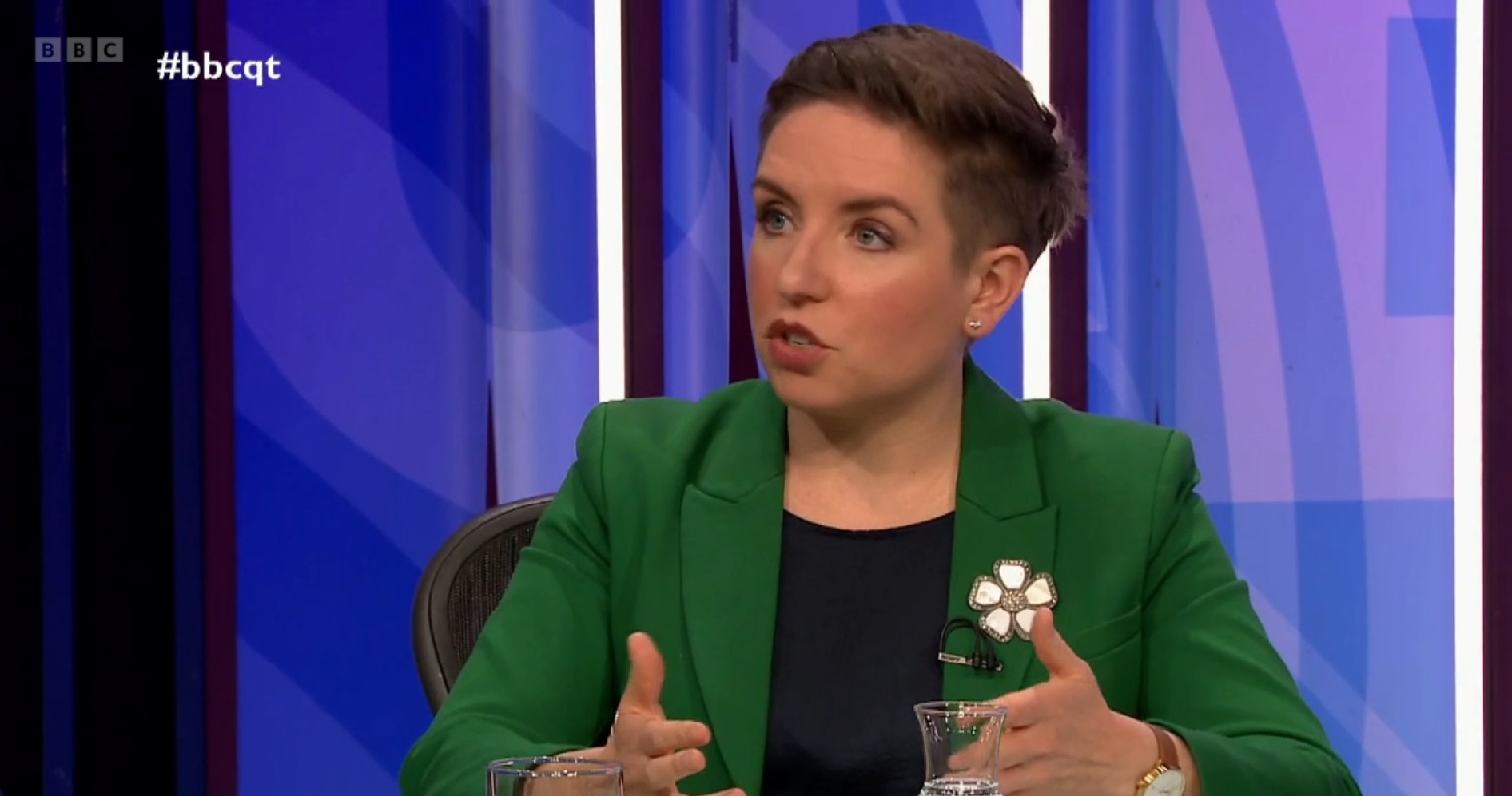
Image of the Green Party’s Carla Denyer on BBC Question Time.
Green Party co-leader Carla Denyer has outlined a 10-point plan of distinctive tax and spend policies aimed at delivering a fairer, greener country. She will dismiss the chancellor’s Autumn Statement, saying it will be “another failed opportunity to end the cost-of-living crisis, tackle the climate crisis and restore crumbling public services on which we all rely.”
Denyer said:
“Our 10-point plan identifies around £30 billion of additional funds that would be available from simply rebalancing the tax system so that the super-rich pay their fair share and both people and planet benefit.”
“The extra revenue raised would enable the government to pay NHS staff an inflation-matching pay award, increase access to NHS dentists, increase Universal Credit, abolish the two-child benefit cap, improve bus services and help small businesses take advantage of the opportunities offered by greening the economy.
“Instead, the chancellor’s Autumn Statement will be another failed opportunity to end the cost-of-living crisis, tackle the climate crisis or restore crumbling public services. It’s clear that as the Tories continue to languish in the polls, Jeremy Hunt has more interest in electoral gimmickry that he has in creating a fairer and greener country.”
The Green Party’s 10-point plan would:
Restore the public health budget by increasing spending by £1.4 billion
Immediately increase NHS spending by £8 billion, to ensure NHS staff can be paid an inflation matching pay award
Meet the Government’s current plan to increase access to NHS dentists by increasing spending 50 per cent – £1.5 billion – of the total NHS dentistry budget
End the rise in homelessness caused by the cap on Local Housing Allowances at a cost of £700 million
Increase Universal Credit by £40 per week at a cost of £9bn
Abolish the two-child benefit cap to reduce poverty for some of the most vulnerable children in the country by increasing the welfare budget by £1.3 billion
Provide the necessary powers and funding to rural local authorities to take back control of bus services so they can increase routes and service frequencies at a cost of £3bn
Turn ISAs green by linking their tax exemptions to investments in green bonds
Invest an additional £3billion in Green Transition Grants for small businesses to help them prepare for and take advantage of the opportunities offered by greening the economy
Rebalance the tax system to raise an extra £30 billion through changes to Capital Gains Tax, National Insurance and the abolition of “non dom status” which would pay for the proposed measures
Championing the Green’s alternative Autumn Statement, Carla Denyer said:
“These fairer, greener alternatives give just a flavour of what could be done if we had a Government willing to tackle the long-term crises we face. They would start to remove the fundamental injustice that means that wealthier people who own more assets often see a lower effective tax rate than less well-off people.
“Everyone deserves easy access to a dentist, improved public health, properly paid and supported doctors and nurses working with decent facilities, reduced poverty and homelessness, and accessible public transport.
“There is enough money in the economy to make our country fairer and greener. What is lacking is the political will to change priorities. And Starmer’s official opposition seems no more ready to offer this than the Government is. That is why we so desperately need more Greens in Parliament to make the case for the common-sense changes that can deliver a fairer greener country.”
Millions of people in the UK are unable to meet their most basic physical needs: to stay warm, dry, clean and fed. This is known as destitution.
Recent analysis from charity the Joseph Rowntree Foundation (JRF) estimates that around 3.8 million people in the UK experienced destitution at some point during 2022. This is a 61% increase since 2019 – and a 148% increase since 2017.
Living in destitution means severe material hardship. The JRF’s 2022 survey of crisis service users in the UK found that 61% reported going without food in the month before the survey. They often put other needs, such as accommodation or feeding their children, over feeding themselves.
About half of the people surveyed were not able to afford adequate clothing and basic necessities, such as toiletries. Many talked of living in insecure and low quality housing.
One particularly alarming aspect of these most recent statistics is the steep increase in the number of children living in destitution. In 2022, around 1 million children lived in households who experienced destitution. This is an increase of 88% since the charity’s corresponding 2019 study, and a 186% increase since the 2017 study.
Impact on children
Destitution causes immediate suffering. But for these children, this experience of hardship at a young age will have consequences that last throughout their lives. There is little doubt that both money and environment (housing quality, parental mental health and nutrition, for example) contribute to inequalities in child development. Both of these factors are affected by living in destitution.
When children reach the age of three, stark differences are already evident between those who live in poverty and those who do not. Children from more well-off families have better developed skills in both cognitive tasks, such as understanding basic concepts like colours, letters, numbers and shapes, as well as socio-emotional skills, such as self-control and resilience.
Other factors that are important in shaping children’s skills include housing quality and parental mental health.
Inequalities so early in life can compound and widen over time. These differences between the disadvantaged and the better off can be seen in educational achievement, health and criminal activity.
These types of inequalities were also exacerbated by the pandemic. While pupils everywhere missed out on education, these learning losses were not equally distributed: young people from lower socio-economic background fell further behind.
Despite large increases in funding for the early-year sectors, socio-economic inequalities in child development have not generally narrowed, particularly in recent years.
And now, the sharp increase in the share of children living in destitution does not paint a optimistic picture for the future.
Making a difference
However, many of these issues can be changed by government policy. For example, we know that being hungry at school makes it difficult to concentrate and learn. Measures that address hunger, then, can make a difference. Analysis of a trial of breakfast clubs in English schools, which offered free breakfast to disadvantaged children aged six and seven, found that the free breakfast lead to the equivalent of two months’ extra progress in reading, writing and maths across the course of one year.
Research has shown that many early interventions – such as high quality childcare and education programmes for at-risk children – can have long-lasting positive effects. From an economic perspective, acting early to lift children out of poverty and improve their home and learning environments can be a cost-effective way of helping in the long run, both for individuals as well as wider society.
Another option would be reform of the benefits system to make sure families have enough money to live. In the 2022 Joseph Rowntree Foundation survey of people who used crisis centres, 72% did receive social security benefits – but were still destitute.
This rise in children living in household experiencing destitution must be given serious attention. Successive governmentsclaim to hold upward social mobility as a important goal – that is, the ability of people to move up the economic and social ladder, regardless of their own upbringing and social background. Reducing destitution would not only benefit children right now, but would help them throughout life.