Media Faces Reckoning After Helping Trump Downplay Project 2025 on Campaign Trail

Spread the love

Original article by Stephen Prager republished from Common Dreams under Creative Commons (CC BY-NC-ND 3.0). 

The Democratic National Committee sponsors a billboard about then-Republican candidate Donald Trump and Project 2025 at 12th & Vine Streets on September 9, 2024, in Philadelphia, Pennsylvania. (Photo by Lisa Lake/Getty Images for the Democratic National Committee)

“A Trump denial is not a fact,” said one media critic.

As President Donald Trump openly embraces Project 2025, mainstream media outlets are facing criticism for their role in helping him downplay his ties to the wildly unpopular far-right governing playbook in the lead-up to his reelection last year.

After she became the Democratic nominee in July, former Vice President Kamala Harris made the Heritage Foundation’s over 900-page manifesto for “the next conservative president” central to her case against Trump during the 2024 election, often referring to it as “Trump’s Project 2025.”

She and other Democrats warned that if he retook power, he would swiftly enact many of its most extreme and unpopular proposals and dramatically expand executive power while doing it.

Among those proposals were steep cuts to social safety net programs like Medicaid and the Supplemental Nutrition Assistance Program (SNAP), the “mass deportations” of millions of immigrants, the elimination of the Department of Education, new restrictions on abortions, the gutting of climate protections, and the replacement of career civil servants with political appointees, among many others.

Democrats amplified the plan’s danger at the Democratic National Convention and in campaign ads, and Trump began to distance himself from the platform. Despite the fact that as many as 140 people who’d worked in his first administration—including Paul Dans, Heritage’s director of Project 2025—had a hand in its creation, Trump said: “I know nothing about Project 2025. I have no idea who is behind it.”

This was demonstrably untrue, even at the time. Media Matters for America dug up a clip from as far back as May 2023 of Dans stating that “President Trump’s very bought in with this,” speaking of the program.

Project 2025 was almost inconceivably unpopular. An NBC News poll from September 2024 showed that while 57% of registered voters viewed the plan negatively, just 4% viewed it positively.

But in the critical months leading up to the election, many media outlets took Trump’s denial at face value, publishing fact checks and other commentary that painted Democrats’ warnings about his connection to the plan as alarmist or misleading.

Responding to a social media post in July stating that “Trump has made his authoritarian intentions quite clear with his Project 2025 plan,” a fact check by USA Today rated the statement “false,” because, as the headline said, “Project 2025 is an effort by the Heritage Foundation, not Donald Trump.”

In September, after Harris confronted Trump about Project 2025 at the first and only debate between the two, the paper published another fact-check with the headline: “Harris repeats claim that Project 2025 is Trump’s plan. That’s still not right.”

In response to Harris’ claim during the debate that Project 2025 was “a detailed and dangerous plan… that the former president intends on implementing if he were elected,” Washington Post fact-checker Glenn Kessler, whose coverage received a fair bit of criticism during the 2024 cycle, reported in bold text that “Project 2025 is not an official campaign document.”

CNN fact check of the Harris campaign’s social media in September remarked that one account “frequently invokes Project 2025,” before caveating that “Project 2025 is not Trump’s initiative, and he has said he disagrees with some of its proposals.”

In an October interview on CBS‘s“Face the Nation,”anchor Norah O’Donnell, Harris attempted to warn about Project 2025, before O’Donnell responded: “You know that Donald Trump has disavowed Project 2025. He says that is not his campaign plan.”

After nine months back in power, the website Project 2025 Tracker estimates that Trump has already implemented approximately 48% of the objectives outlined in the policy document.

In addition to his key campaign promises many of his second administration’s policies are highly specific to Project 2025, such as his pledge to abolish the Federal Emergency Management Agency (FEMA), his efforts to privatize the National Weather Service (NWS), his reconfiguration of Title X funding to promote pregnancy, and his elimination of the Office for Civil Rights and Civil Liberties.

Trump is no longer hiding his connection to Project 2025, having brought in many of its hiring picks and authors to staff his administration almost immediately after his victory last November.

This week, he began to boast about it openly. As his Office of Management and Budget (OMB) director, Russ Vought, one of Project 2025’s architects, began using the current government shutdown to unilaterally cut off funding to infrastructure projects in blue states and cities, Trump lauded him as “he of PROJECT 2025 Fame.”

“This was always the plan,” Harris responded on social media.

While many commentators expressed outrage that Trump blatantly lied about his connections to Project 2025, others dredged up old clips of newspapers and anchors taking him at his word.

“All those 2024 media fact checks that said, ‘Donald Trump and the Trump campaign deny any connection to Project 2025’ look pretty ridiculous right now,” said MeidasTouch editor-in-chief Ron Filipkowski. “A Trump denial is not a fact. You just used his lies to ‘debunk’ a reality that was obvious to anyone paying attention.”

Mehdi Hasan, the founder of the independent media company Zeteohighlighted the CBS interview, saying Trump’s embrace of Project 2025 was “embarrassing not just for Norah O’Donnell but a whole host of leading American anchors and reporters who echoed Trump’s false denials.”

“Nothing showed the difference between mainstream and independent media better than the response to Trump’s obvious lie about not knowing anything about Project 2025,” said David Pepper, author of the book Saving Democracy: A User’s Manual. “Most mainstream media started fact-checking those who claimed a connection to be somehow false. Others ‘both sides’ed’ it. Far more in independent media called it out as a whopping lie.”

Original article by Stephen Prager republished from Common Dreams under Creative Commons (CC BY-NC-ND 3.0). 

Elon Musk urges you to be a Fascist like him, says that you can ignore facts and reality then.
Donald Fuhrump says that Amerikkka doesn't bother with crimes or charges anymore, not being 100% Amerikkkan and opposing his real estate intentions is enough.
Donald Fuhrump says that Amerikkka doesn’t bother with crimes or charges anymore, not being 100% Amerikkkan and opposing his real estate intentions is enough.
Orcas discuss how Trump was re-elected and him being an obviously insane, xenophobic Fascist.

Continue ReadingMedia Faces Reckoning After Helping Trump Downplay Project 2025 on Campaign Trail

How MAGA Lobbying is Undermining EU Climate Rules

Spread the love

Original article by Sam Bright republished from DeSmog

Series: MAGA

German Chancellor Friedrich Merz, U.S. President Donald Trump, and French President Emmanuel Macron. DeSmog collage. Credit: Faces of the World / Flickr (Macron), Steffen Prößdorf (Merz), Gage Skidmore / Flickr (Trump)

European leaders are bending to the demands of U.S. climate science deniers.

“The CSDDD is the greatest threat to America’s sovereignty since the fall of the Soviet Union,” the Heartland Institute, a pro-Trump U.S. think tank, tweeted on 31 March.

The Heartland Institute is one of the world’s leading climate science denial groups. It has helped to draft Donald Trump’s anti-climate policies, which have seen the president pledge to “drill baby drill” for more fossil fuels and once again pull the U.S. out of the flagship 2015 Paris Agreement.

Over recent months – along with a host of other Trump allies – the Heartland Institute has set its sights on a new target: the EU’s Corporate Sustainability Due Diligence Directive (CSDDD).

This vague acronym belies the potentially transformative impact of the new law. In its original form, the CSDDD sought to require large companies – and those in “high risk” sectors – trading in the EU to address human rights and environmental issues in their own operations and in their supply chains. High turnover companies would also have been forced to adopt a plan to align with the Paris Agreement, including setting emissions reduction targets.

The Heartland Institute and its anti-climate, anti-regulation peers are vocal opponents of the law – and launched an aggressive campaign to water it down, or even to see it scrapped entirely.

These groups, which are all part of the ‘Make America Great Again’ (MAGA) ecosystem, view the CSDDD as symbolic of the way in which “woke” governments are attempting to force citizens and global corporations to conform to a pro-diversity, pro-environment agenda.

Following Trump’s election in November, these MAGA groups wasted no time in formulating their plans to oppose this perceived agenda.

They focused in particular on diversity, equity and inclusion (DEI) initiatives, which attempt to create workplaces free from bias – and environmental, social and governance (ESG) schemes, which try to ensure that organisations are guided by responsible and sustainable practices, not just profit.

In December, barely a month after Trump’s victory, the Heritage Foundation – the group that wrote the key ‘Project 2025’ blueprint for the president’s second term – published a report entitled: “ESG, DEI, and What to Do About Them”.

In the report, the Heritage Foundation described ESG and DEI as “pernicious”, and called the CSDDD “a serious problem”.

Two months later, the State Financial Officers Foundation – an influential network of Republican finance officials – wrote an open letter calling on the new administration to “investigate” the CSDDD, claiming that the EU’s directives are based on “unscientific assumptions about the nature of climate change impacts” and “will force companies to incriminate themselves”.

This quickly filtered through to Trump’s Cabinet. On 12 February, Howard Lutnick, the president’s pick for commerce secretary, told a Senate committee that the CSDDD threatened to place “significant burdens” on U.S. companies, and that the Trump administration was exploring the use of “commercial tools” to mount a counter-attack against the EU’s environmental regulations.

Soon this rhetoric made its way to the White House. In March, as part of the worldwide tariffs implemented by the Trump administration, the president called the EU “one of the most hostile and abusive taxing and tariffing authorities in the world”.

But the EU hasn’t stood firm in the face of Trump’s war of words.

The EU has already announced that it will be scaling back the CSDDD and delaying its implementation. The number of companies within scope has been reduced by 80 percent. The firms in question will only be required to file due diligence reports every five years, and won’t be required to investigate the ESG operations of their indirect business partners. The implementation of the law has also been postponed until 2028.

But Trump’s MAGA hardliners are still not satisfied. In April, the Heartland Institute released an open letter signed by 31 other groups, calling for Congress and the Trump administration to “take immediate steps to counter the CSDDD’s implementation”, including “if necessary, imposing retaliatory trade policies that punish EU nations for eroding America’s sovereignty, freedoms, and prosperity.”

This backlash is now influencing European leaders. In late May, French President Emmanuel Macron and German Chancellor Friedrich Merz called for the CSDDD to be scrapped entirely. They claim it must be abandoned in order to defend the “competitiveness” of European corporations, with Macron stating that Europe must “synchronise with the U.S. and the rest of the world.”

This judgement signifies the appeasement of anti-climate pressure groups that are ideologically opposed to clean energy and climate science.

The Heartland Institute has denied that humans are driving climate change, which it has called a “delusion”, while the Heritage Foundation’s Project 2025 document urged Trump to “dismantle the administrative state”, reverse policies on climate action, slash restrictions on fossil fuel extraction, scrap state investment in renewable energy, and gut the Environmental Protection Agency.

If the EU waters down its climate policies in response to Trump’s pressure, it will have helped to send Project 2025 global.

The ‘Climate Cartel’

It’s unclear whether these MAGA groups – and the Trump administration – will ease up on the EU if the CSDDD is ditched entirely. They may simply use it as evidence that European lawmakers will buckle under enough pressure.

Indeed, MAGA’s opposition to the CSDDD is part of a multi-pronged campaign that seeks to dismantle global climate initiatives pioneered by both governments and corporations.

Much of the original groundwork for this campaign was undertaken by the U.S. House Judiciary Committee and its chair Jim Jordan, a leading Trump supporter.

Last year, Jordan’s committee produced reports – and demanded evidence from major corporations – on a supposed “climate cartel” of “left-wing activists and major financial institutions”.

The committee alleged that some of the world’s biggest asset managers – that have questionable climate commitments – are conspiring to force American companies to decarbonise against their wishes.

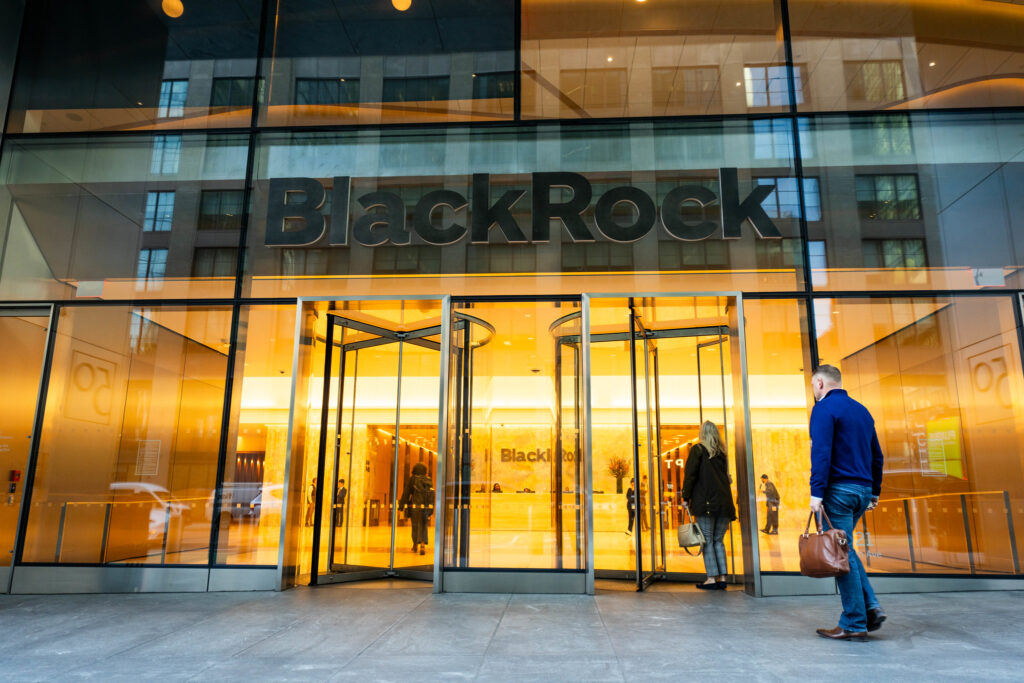
BlackRock’s New York office. Credit: Anthony Quintano / Flickr (CC BY 2.0)

As part of its “investigation”, the committee demanded information from more than 130 U.S.-based companies, retirement and pension programmes, as well as 60 U.S.-based asset managers.

In November, 11 Republican-led states sued BlackRock, Vanguard, and State Street – three of the world’s biggest asset managers – over their ESG policies. In West Virginia and Oklahoma, nearly two dozen banks have been barred from public contracts for trying to divest from fossil fuels.

These actions, along with the anti-climate rhetoric of Donald Trump, have had a chilling effect. In February last year, BlackRock, State Street, and JP Morgan Asset Management withdrew from Climate Action 100+, an investor-led initiative that works to ensure the world’s largest greenhouse gas emitters take action on climate change.

Fast forward a year, and a growing list of major U.S. corporations are either cancelling or delaying their sustainability reports – designed to show how they are meeting their climate commitments.

And a new story from the investigative outlet CORRECTIV today reports that German insurance giants and investment firms are withdrawing from climate agreements, while companies are quietly shelving their sustainability policies, amid the anti-ESG backlash orchestrated by Trump and his acolytes.

As one sustainability expert at a financial firm told CORRECTIV: “We have to be careful not to harm the cause by sticking our necks out and becoming a target in the U.S.”

This article was produced with support from the European Media and Information Fund, managed by the Calouste Gulbenkian Foundation. The sole responsibility for any content supported by the European Media and Information Fund lies with the author(s) and it may not necessarily reflect the positions of the EMIF and the Fund Partners, the Calouste Gulbenkian Foundation and the European University Institute.

Original article by Sam Bright republished from DeSmog

Continue ReadingHow MAGA Lobbying is Undermining EU Climate Rules

Farage to Share Stage with Architects of Trump’s Anti-Climate Agenda

Spread the love

Original article by Adam Barnett republished from DeSmog.

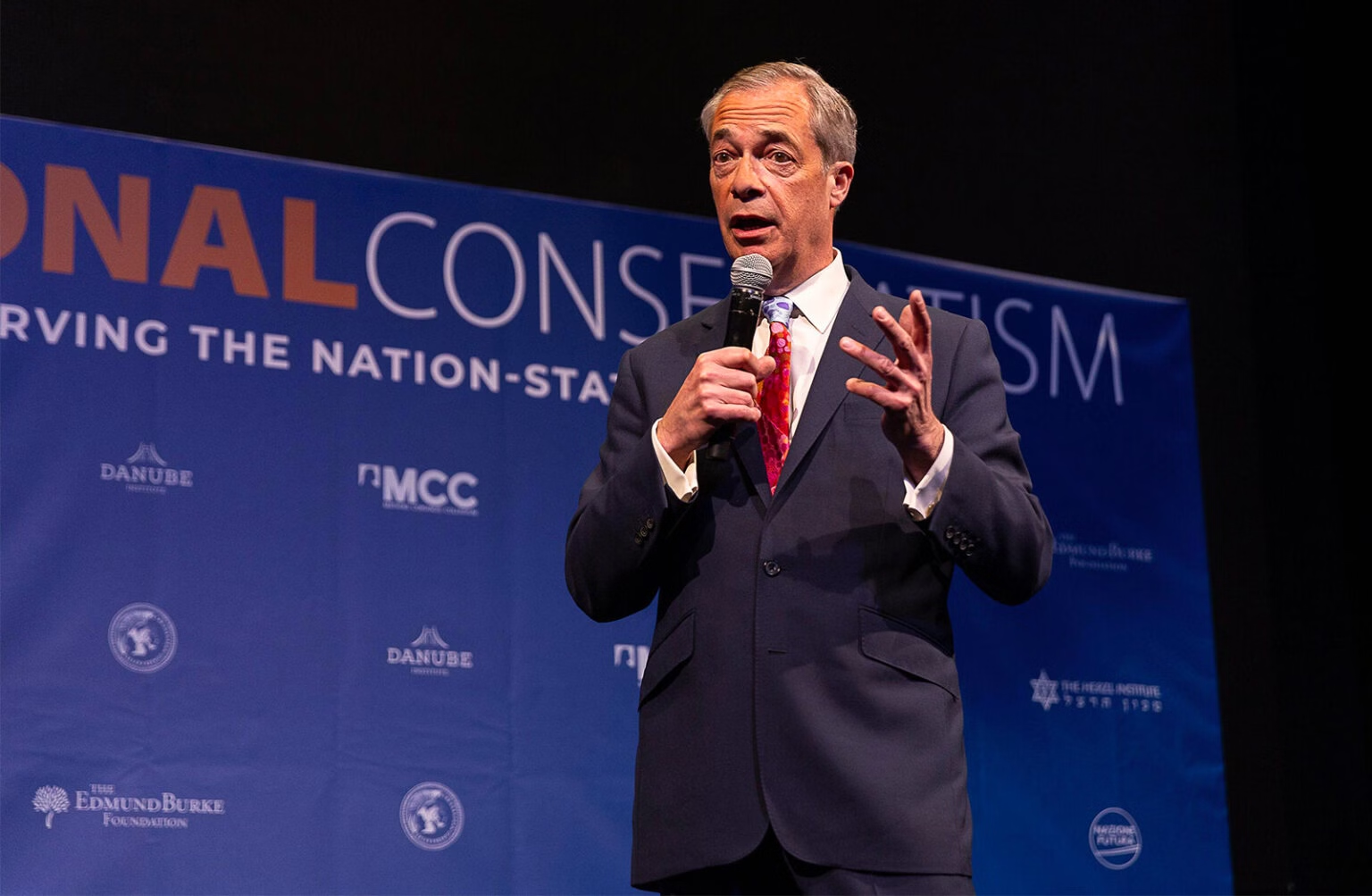
Nigel Farage at the National Conservatism conference in Brussels. Credit: Belga News Agency / Alamy

The Reform leader will be skipping Parliament again in favour of a conference in Washington DC.

Reform UK leader Nigel Farage will speak next week alongside the authors of Donald Trump’s plans to “dismantle the administrative state” and scrap climate policies. 

Farage is a featured speaker at the National Conservatism (NatCon) conference in Washington DC – at least his tenth visit to the U.S. since being elected as an MP.

As reported in The Mirror, Farage’s trip – during which he will also reportedly speak to Congress about free speech in the UK – means he will miss Parliament’s return from summer recess. 

version of this article was published by The Mirror

DeSmog’s analysis reveals that more than a fifth of the speakers at the NatCon event have roles at groups which contributed to Project 2025, the radical blueprint for Trump’s second term convened by the Heritage Foundation.

They include Russell Vought, Trump’s budget chief. Before entering office, Vought was a key author of Project 2025 and the vice president of Heritage Action, the campaign arm of the Heritage Foundation, whose president Kevin Roberts will be speaking at NatCon.

The listed speakers also include senior members of the Trump administration, including his Director of National Intelligence Tulsi Gabbard, who launched her book For Love of Country at a Heritage Foundation event with Roberts last year; and Tom Homan, Director of U.S. Immigration and Customs Enforcement (ICE), who is a former visiting fellow at the Heritage Foundation and a contributor to Project 2025.

NatCon is organised by the Edmund Burke Foundation, a conservative think tank based in Washington DC. Its UK chairman James Orr runs the pro-Reform think tank the Centre for a Better Britain, is a close friend of U.S. Vice President JD Vance, and recently told BBC Radio 4 that he admires the Heritage Foundation and Project 2025. Farage spoke at a NatCon event in Brussels last year.

The lengthy Project 2025 policy document, titled ‘The Mandate for Leadership’, proposed reversing climate policies, unleashing fossil fuel extraction, scrapping investment in clean energy, and gutting the Environmental Protection Agency (EPA) – policies imposed by the Trump administration. 

As DeSmog has reported, 70 percent of Trump’s cabinet has ties to Project 2025, which also seeks to “dismantle the administrative state”, further restrict abortion, and access to contraception.

A Liberal Democrat source told DeSmog: “Nigel Farage is far more interested in pleasing Trump and jostling for his affections than he is in turning up to Parliament on time or standing up for British values.”

Farage in DC

Farage will speak on a panel alongside Larry Arnn, who sits on the Heritage Foundation’s board of directors.

It will be the second time Farage has shared a stage with Arnn following a fundraiser in September 2024 for the Heartland Institute, which also contributed to Project 2025 and has described itself as “the world’s most prominent think tank supporting scepticism about man-made climate change”.

At the fundraiser, Farage claimed that the UK’s efforts to reduce carbon dioxide emissions don’t “make any bloody difference at all” – and reiterated Trump’s call to “drill baby drill” for fossil fuels.

Farage and Trump have both denied basic climate science. The Reform leader has claimed it’s “absolutely nuts” for CO2 to be considered a pollutant, while Trump has called climate change a “giant hoax”.

Next week’s event in Washington lists at least 22 speakers with current or recent roles at the Heritage Foundation and other Project 2025 member groups.

Other UK speakers at the event include Rupert Darwall, who has claimed there is “strong evidence for the non-existence of a climate crisis,” and former GB News presenter Calvin Robinson.

Senior members of the Conservative Party including shadow justice secretary Robert Jenrick and shadow foreign secretary Priti Patel have met with Heritage Foundation leaders or spoken at their events in recent years. 

Reform UK did not reply to DeSmog’s request for comment.


Project 2025 speakers at NatCon Washington DC

Heritage Foundation president Kevin Roberts. Credit: Gage Skidmore / Flickr (CC BY-SA 2.0)

Kevin Roberts – president of the Heritage Foundation

Russell Vought – director of the Office for Budget Management, and former vice president of Heritage Action

Tom Homan – director of Immigration, Customs and Enforcement (ICE), and a former visiting fellow at the Heritage Foundation

Christopher DeMuth – Heritage Foundation Fellow

John Backiel – visiting fellow for the Capital Markets Initiative at the Heritage Foundation

Robert Greenway – director of the Allison Center for National Security at the Heritage Foundation

Rob Bluey – executive editor of the Heritage Foundation’s Daily Signal

Victoria Coates – vice president of the Heritage Foundation’s Kathryn and Shelby Cullom Davis Institute for National Security and Foreign Policy

Tom Klingenstein – chairman of the board of directors at the Claremont Institute

Spencer Klavan – associate editor at the Claremont Review of Books

Ryan Williams – president of the Claremont Institute and publisher of the Claremont Review of Books

John Eastman – senior fellow at the Claremont Institute, and a contributor to the Heritage Guide to the Constitution

Will Thibeau – director of the American Military Project at the Claremont Institute’s Center for the American Way of Life, and previously a policy analyst in the Heritage Foundation’s Tech Policy Center

Kristen Waggoner – CEO, president, and general counsel of Alliance Defending Freedom

Gene Hamilton – president and co-founder of America First Legal

Curt Mills — executive director of the American Conservative

Mark DiPlacido — policy advisor at American Compass, and a former Heritage Action staffer

Rachel Bovard — vice president of programs at the Conservative Partnership Institute

Rupert Darwall — strategy consultant and policy analyst at the Competitive Enterprise Institute

Mark Krikorian — executive director of the Center for Immigration Studies

Alex Petkas — a senior fellow at the Center for Renewing America

Clare Morell — fellow at the Ethics and Public Policy Center

Original article by Adam Barnett republished from DeSmog.

Nigel Farage urges you to ignore facts and reality and be a climate science denier like him. He says that Reform UK has received millions and millions from the fossil fuel industry to promote climate denial and destroy the planet.
Donald Trump urges you to be a Climate Science denier like him. He says that he makes millions and millions for destroying the planet, Burn, Baby, Burn and Flood, Baby, Flood.
Elon Musk urges you to be a Fascist like him, says that you can ignore facts and reality then.
Continue ReadingFarage to Share Stage with Architects of Trump’s Anti-Climate Agenda

Global wheat yields would be ‘10%’ higher without climate change

Spread the love

Original article by Orla Dwyer republished from Carbon Brief under a CC license.

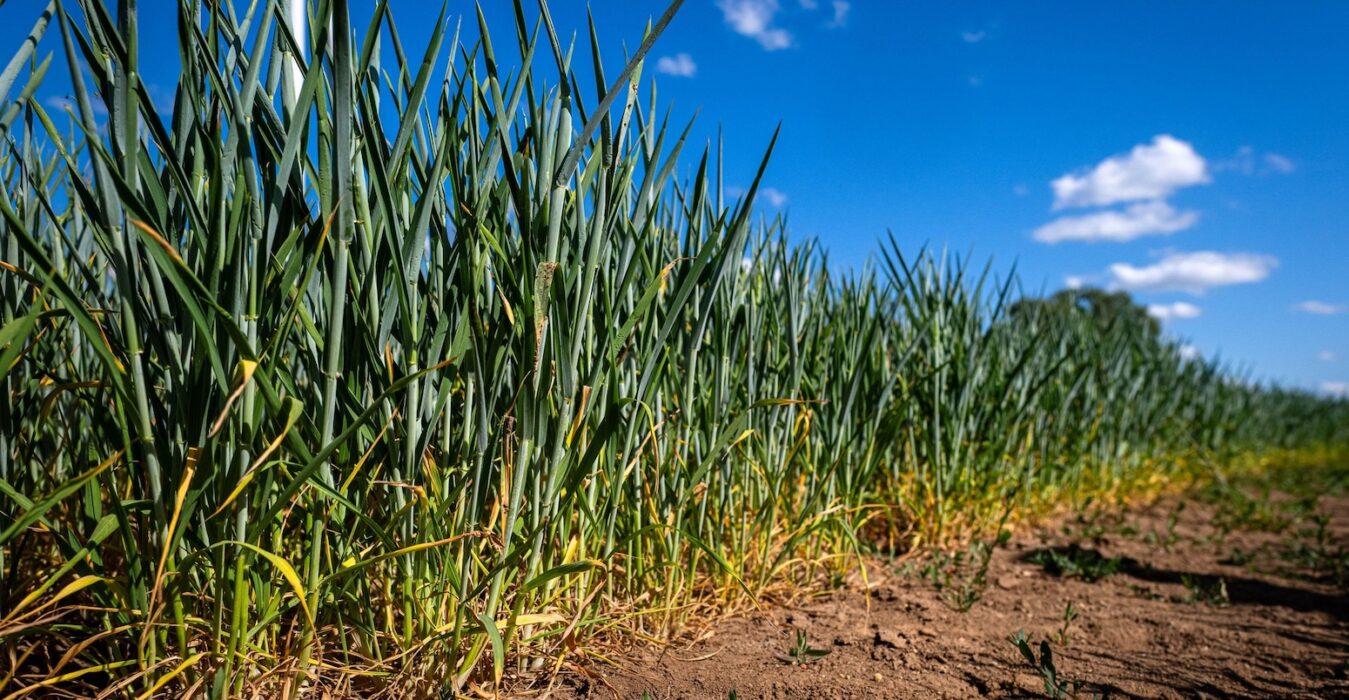
Wheat affected by drought conditions in Bremen, Germany in May 2025. Credit: dpa picture alliance / Alamy Stock Photo.

Global yields of wheat are around 10% lower now than they would have been without the influence of climate change, according to a new study. 

The research, published in the Proceedings of the National Academy of Sciences, looks at data on climate change and growing conditions for wheat and other major crops around the world over the past 50 years. 

It comes as heat and drought have this year been putting wheat supplies at risk in key grain-producing regions, including parts of Europe, China and Russia. 

The study finds that increasingly hot and dry conditions negatively impacted yields of three of the five key crops examined. 

Overall, global grain yields soared during the study period due to technological advancements, improved seeds and access to synthetic fertilisers. 

But these yield setbacks have “important ramifications for prices and food security”, the study authors write. 

Grain impacts 

Most parts of the world have experienced “significant” yield increases in staple crops since the mid-20th century. 

The new study notes that, in the past 50 years, yields increased by 69-123% for the five staple crops included in the research – wheat, maize, barley, soya beans and rice. 

But crop production is increasingly threatened by climate change and extreme weather. A 2021 study projected “major shifts” in global crop productivity due to climate change within the next two decades.

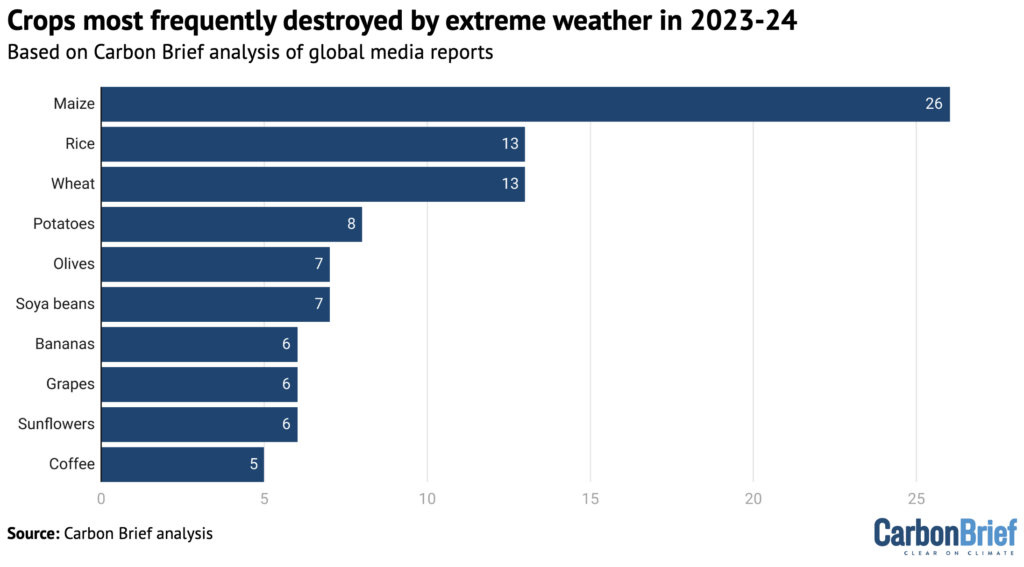
Earlier this year, Carbon Brief mapped out news stories of crops being destroyed around the world by heat, drought, floods and other weather extremes in 2023-24. Maize and wheat were the crops that appeared most frequently in these reports. 

The crops that appeared most frequently in media reports of extreme weather impacts analysed by Carbon Brief, ranked in order of most to least frequent: maize, wheat, rice, potatoes, soya beans, olives, bananas, grapes, sunflowers and coffee. Credit: Carbon Brief.

Hot and dry weather is currently threatening wheat crops in parts of China, the world’s largest wheat producer, Reuters reported this month.

In the UK, wheat crops are struggling amid the “driest start to spring in England for almost 70 years”, the Times recently reported. Farm groups say some crops are already failing, the Guardian said. 

As a result, global wheat supplies are “tight”, according to Bloomberg, with price rises possible depending on weather conditions in parts of Europe, China and Russia. 

Food security and prices

The study uses climate datasets, modelling and national crop statistics from the UN Food and Agriculture Organization to assess crop production and climate trends in key grain-producing countries over 1974-2023, including Argentina, Brazil, Canada, China, the EU, Russia and the US. 

The researchers assess climate observations and then use crop models to calculate what yields would have been with and without these climate changes. 

For example, “if it has warmed 1C over 50 years and the model says that 1C leads to 5% yield loss, we’d calculate that the warming trend caused a loss of 5%”, Prof David Lobell, the lead study author and a professor at Stanford University, tells Carbon Brief. 

The study looks at two reanalysis climate datasets that include information on temperature and rainfall over the past 50 years: TerraClimate (TC) and ERA5-Land. (Reanalysis data combines observations with a modern forecasting model.)

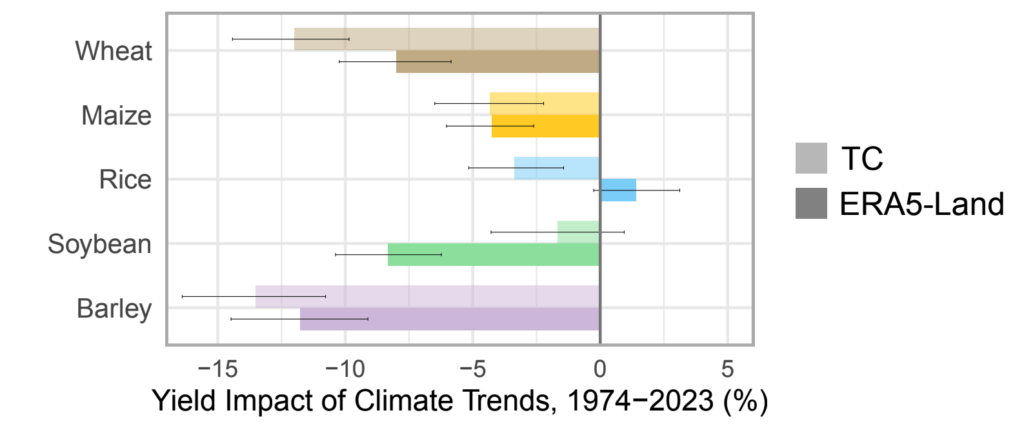
The researchers find that yields of three of the five crops are lower than they would have been without warmer temperatures and other climate impacts in the past 50 years. 

Yields were lower than they otherwise would have been by 12-14% for barley, 8-12% for wheat and 4% for maize. 

The impacts on soya beans were less clear as there were “significant differences” between data sources. But both datasets show a negative impact on yields, ranging from 2% to 8%.

The effects on rice yields were inconclusive, with one dataset showing a positive effect of around 1% while the other showed a negative effect of about 3%.   

The chart below shows the estimated yield impacts for each crop based on the calculations from the two climate datasets.

The estimated percentage impact of climate factors on yields of wheat (brown), maize (yellow), rice (blue), soya bean (green) and barley (purple) from 1974-2023, using two different historical climate datasets. Source: Lobell et al. (2025).

Given soaring overall crop yields during this time, impacts of 4-13% “may seem trivial”, the researchers write. But, they say, it can have “important ramifications for prices and food security” given growing food demand, noting: 

“The overall picture of the past half-century is that climate trends have led to a deterioration of growing conditions for many of the main grain-producing regions of the world.” 

Water stress and heat

The study also assesses the impacts that warming and vapour pressure deficit – a key driver of plant water stress – have on crop yields. 

Vapour pressure deficit is the difference between the amount of water vapour in the air and the point at which water vapour in the air becomes saturated. As air becomes warmer, it can hold more water vapour. 

A high deficit can reduce plant growth and increase water stress. The models show that these effects may be the main driver of losses in grain yield, with heat having a more “indirect effect”, as higher temperatures drive water stress. 

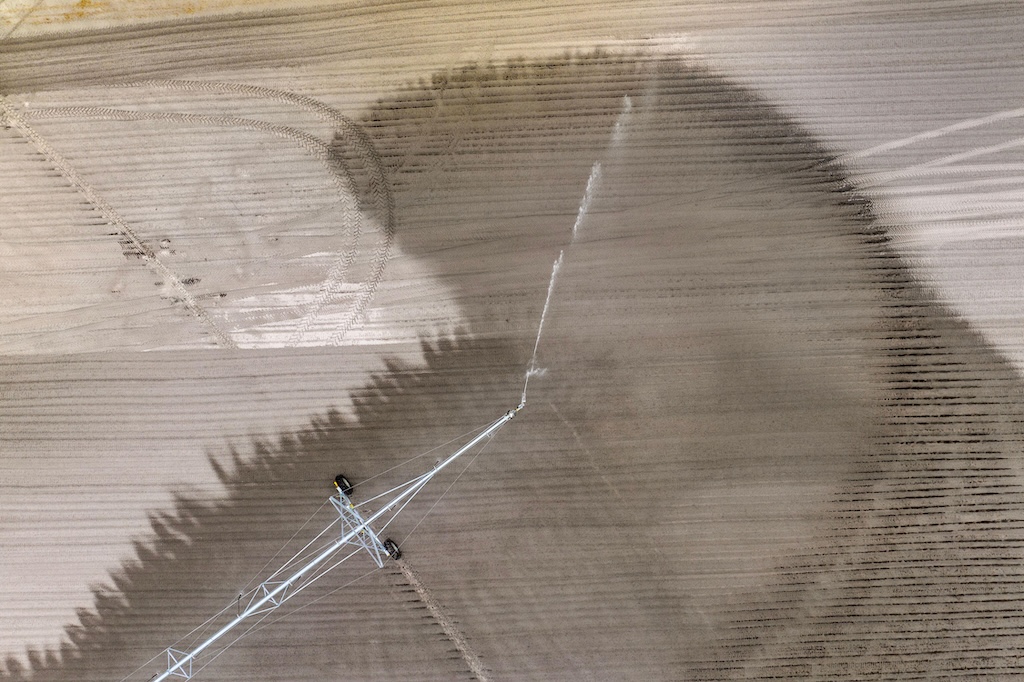
Agricultural irrigation system watering dry soil on a crop field in the US. Credit: Andrii Biletskyi / Alamy Stock Photo. Image ID: 3AKGHEX.
Agricultural irrigation system watering dry soil on a crop field in the US. Credit: Andrii Biletskyi / Alamy Stock Photo.

The study finds that vapour pressure deficit increased in most temperate regions in the past 50 years. 

The researchers compare their data to climate modelling simulations covering the past 50 years. They find largely similar results, but notice a “significant underestimation” of vapour pressure deficit increases in temperate regions in most climate models. 

Many maize-growing areas in the EU, China, Argentina and much of Africa have vapour deficit trends that “exceed even the highest trend in models”, they write. 

The researchers also find that most regions experienced “rapid warming” during the study period, with the average crop-growing season now warmer than more than 80% of growing seasons 50 years ago. 

The findings indicate that, in some areas, “even the coolest growing season in the present day is warmer than the warmest season that would have occurred 50 years ago”. 

Wheat growing in a field. Credit: Jon Freeman / Alamy Stock Photo. Image ID: EXYNXR.
Wheat growing in a field. Credit: Jon Freeman / Alamy Stock Photo.

An exception to this is in the US and Canada, they find, with most maize and soya bean crop areas in the US experiencing lower levels of warming than other parts of the world and a “slight cooling” in wheat-growing areas of the northern Great Plains and central Canada.

(The central US has experienced a cooling trend in summer daytime temperatures since the middle of the 20th century, according to the National Oceanic and Atmospheric Administration. There are many theories behind this “warming hole”, which has continued despite climate change.) 

CO2 greening 

Dr Corey Lesk, a postdoctoral researcher at Dartmouth College who studies the impacts of climate on crops, says these findings are in line with other recent estimates. He tells Carbon Brief: 

“There are some uncertainties and sensitivity to model specification here – but it’s somewhat likely climate change has already reduced crop yields in the global mean.” 

The study’s “main limitation” is that it is “behind” on including certain advances in understanding how soil moisture impacts crops, Lesk adds: 

“Moisture changes and CO2 [carbon dioxide] effects are the largest present uncertainties in past and future crop impacts of climate change. This paper is somewhat limited in advancing understanding on those aspects, but it’s illuminating to pause and take stock.”

The research looks at whether the benefits of CO2 increases during the past 50 years exceed the negative effects of higher levels of the greenhouse gas. 

Rising CO2 levels can boost plant growth in some areas in a process called “CO2 fertilisation”. However, a 2019 study found that this “global greening” could be stalled by growing water stress. 

Yield losses for wheat, maize and barley “likely exceeded” any benefits of CO2 increases in the past 50 years, the study finds. 

The opposite is true for soya beans and rice, they find, with a net-positive impact of more than 4% on yields. 

Soya beans growing in a field. Credit: Volodymyr Shtun / Alamy Stock Photo. Image ID: 3B84F7G.
Soya beans growing in a field. Credit: Volodymyr Shtun / Alamy Stock Photo.

Climate science has “done a remarkable job of anticipating global impacts on the main grains and we should continue to rely on this science to guide policy decisions”, Lobell, the lead study author, says in a press release

He adds that there may be “blind spots” on specialised crops, such as coffee, cocoa, oranges and olives, which “don’t have as much modelling” as key commodity crops, noting: 

“All these have been seeing supply challenges and price increases. These matter less for food security, but may be more eye-catching for consumers who might not otherwise care about climate change.”

 Lobell et al. (2025), A half-century of climate change in major agricultural regions: Trends, impacts, and surprises, Proceedings of the National Academy of Sciences, doi:10.1073/pnas.2502789122

Original article by Orla Dwyer republished from Carbon Brief under a CC license.

Neo-Fascist Climate Science Denier Donald Trump says Burn, Baby, Burn.
Orcas discuss Donald Trump and the killer apes' concept of democracy. Front Orca warns that Trump is crashing his country's economy and that everything he does he does for the fantastically wealthy.
Orcas discuss Donald Trump and the killer apes’ concept of democracy. Front Orca warns that Trump is crashing his country’s economy and that everything he does he does for the fantastically wealthy.
Continue ReadingGlobal wheat yields would be ‘10%’ higher without climate change

Donald Trump’s Fossil Fuel Executive UK Ambassador Donated $4 Million to President’s Inauguration Fund

Spread the love

Original article by Adam Barnett and Sam Bright republished from DeSmog.

U.S. ambassador to the UK Warren Stephens. Credit: Arkansas Inc / YouTube

Warren Stephens made the donation alongside big tech firms and oil giants.

Donald Trump’s ambassador to the UK donated $4 million to the new U.S. president’s inauguration on the same day he was nominated for the diplomatic position, DeSmog can report.

Billionaire Warren Stephens gave $4 million (just under £3 million today) to the Trump Vance Inaugural Committee on 2 December, according to the official record of donations. The committee is appointed by the president-elect to arrange the inauguration ceremony, when a U.S. president is formally sworn into office.

“It’s not so surprising that a transactional president hands out favours to people who give him money, but that doesn’t make it any less outrageous,” said Agustina Oliveri, head of campaigns and communications at the Good Law Project.

There is no direct evidence that Warren secured the position due to this donation. However, U.S. presidents have a long history of handing out diplomatic roles to major donors, while the Trump administration has bestowed his patrons with a number of senior positions. Of the 37 people who gave $1 million or more to the inauguration committee, six have either been given a role in the administration or have been nominated for a role.

Tom Brake, a former Liberal Democrat MP and the director of the transparency campaign group Unlock Democracy, urged the UK government not to follow Trump’s lead.

“Whatever approach the U.S. administration adopts towards the appointment of its ambassadors, the UK government should make it clear that when it comes to appointing UK ambassadors or high commissioners, donating substantial sums of money directly or indirectly to the party of government will block an appointment not facilitate it,” he said. “There must never be a question mark over whether UK appointments are made on merit, or driven by a donor’s deep pockets.”

As DeSmog revealed on 5 December, Warren Stephens holds significant oil and gas interests. Prior to his appointment as Trump’s UK ambassador, he ran Stephens Inc. – one of the largest privately-owned investment banks in the United States. Stephens has since stood down as CEO, but remains its chairman.

The firm’s portfolio includes a number of companies that make their money from oil and gas exploration and production — including one, Stephens Natural Resources, which “has a rich history of drilling and producing both oil and natural gas”, according to its website.

The UK’s ambassador to the U.S. Peter Mandelson also co-founded a public affairs agency with major fossil fuel clients.

Trump’s inauguration committee – which raised almost $240 million – received donations from fossil fuel giants Chevron ($2 million), ExxonMobil ($1 million), the U.S. branches of BP and Shell ($500,000 each), and Valero ($250,000).

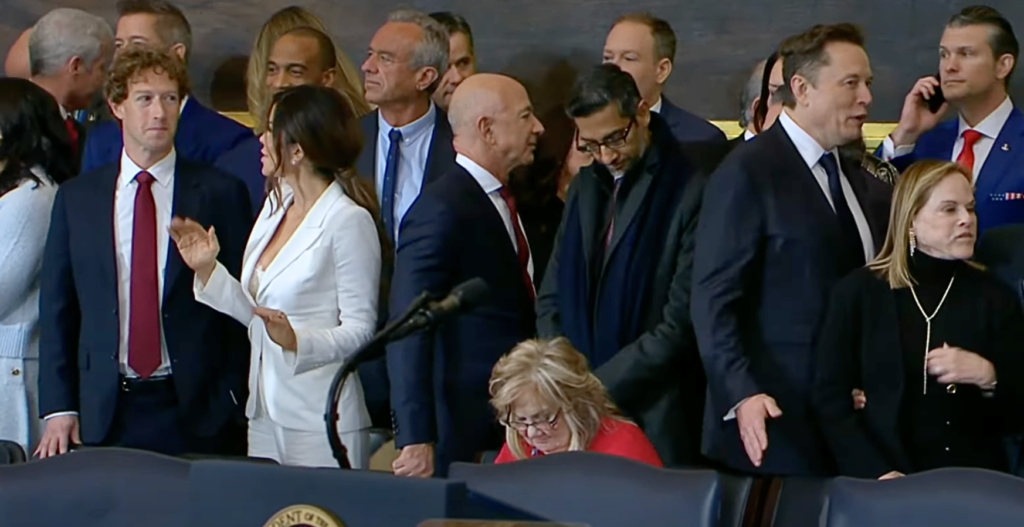
It also accepted donations from major tech platforms including Amazon and Meta, whose founders Jeff Bezos and Mark Zuckerberg received a front row seat to the event.

Mark Zuckerberg, Jeff Bezos, Elon Musk and others at Donald Trump’s 2025 inauguration. Credit: WSJ / YouTube

The inauguration committee received a further $1 million from the Heritage Foundation, a hard-right U.S. research and lobby group which drafted the “autocratic” Project 2025 blueprint for Trump’s second term.

Trump denied knowledge of Project 2025 during the election campaign but has subsequently appointed Russell Vought, one of its advisory board members and co-authors, as director of the Office for Management and Budget (OMB), a key department within the president’s office that helps to oversee and co-ordinate policy.

Project 2025 urged Trump to “dismantle the administrative state”, slash restrictions on fossil fuel extraction, scrap state investment in renewable energy, and gut the Environmental Protection Agency.

Since his inauguration on 20 January, Trump has announced a series of policies that have mirrored these demands.

The new president, who received more than $75 million from oil and gas interests for his re-election campaign, has pledged to once again withdraw the U.S. from the flagship 2015 Paris Agreement, which set an international target for limiting global warming. He has also declared a “national energy emergency” to allow the U.S. to “drill, baby, drill” for new fossil fuels.

“When we look at the dumpster fire of U.S. government policy – from trashing the planet to attacking basic human rights – there’s no point in asking ‘What are they up to?’. The question we need to focus on is ‘Who paid for that?,’” said Oliveri.

The U.S. embassy in London referred DeSmog’s enquiry to the U.S. State Department. The Heritage Foundation was approached for comment.

Original article by Adam Barnett and Sam Bright republished from DeSmog.

Neo-Fascist Climate Science Denier Donald Trump says Burn, Baby, Burn.
Elon Musk urges you to be a Fascist like him, says that you can ignore facts and reality then.
Orcas discuss how Trump was re-elected and him being an insane, xenophobic Fascist.
Continue ReadingDonald Trump’s Fossil Fuel Executive UK Ambassador Donated $4 Million to President’s Inauguration Fund