Global Sumud Flotilla ships docked in Barcelona ahead of second voyage to Gaza

Spread the love

This work by Middle East Monitor is licensed under a Creative Commons Attribution-NonCommercial-ShareAlike 4.0 International License.

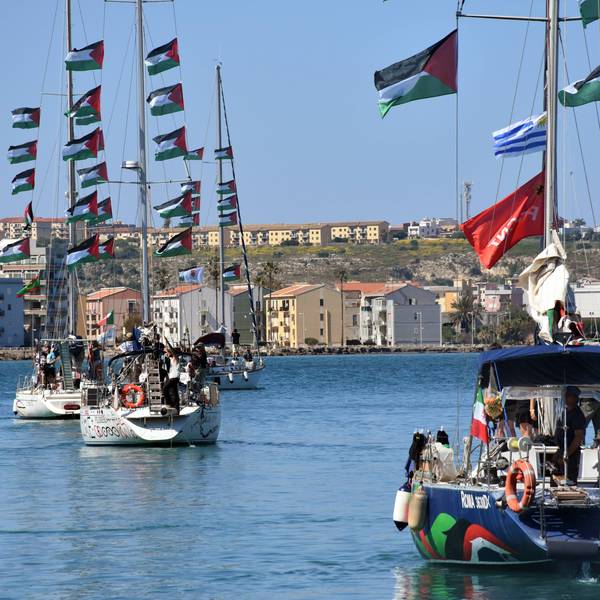
A view of a Palestinian flag as the Global Sumud Flotilla, departs once again after one year, to deliver humanitarian aid, and raise global awareness about Gaza, in Barcelona, Spain, on April 11, 2026. [Burak Akbulut – Anadolu Agency]

Global Sumud Flotilla ships were at the docks in Barcelona on Saturday, before setting off for Gaza on Sunday, Anadolu reports.

Formed to break the blockade on Gaza and deliver humanitarian aid, the flotilla will sail this time with expanded participation, with its largest participation coming from Spain.

Around 70 boats carrying up to 1,000 volunteers from 70 countries are expected to depart on April 12, nearly doubling the size of the previous mission in September 2025.

Flotilla spokesperson Pablo Castilla said the initiative aims to condemn international complicity in Israel’s actions in Gaza, demand accountability, and establish a humanitarian corridor by sea and land.

READ: London police arrest 92 at Palestine Action support rally

He said international attention on Gaza has declined due to recent regional developments, adding that Israel has intensified its blockade, restricted aid entry, expanded settlements, and accelerated land seizure. He emphasized that the mission complies with international law. Greenpeace will also participate the mission along with other NGOs.

Last September, the flotilla set sail from Spain, and eventually included 43 boats and 462 people. Before it could reach Gaza, Israeli forces boarded the vessels and took the participants into custody, including Swedish climate campaigner Greta Thunberg.

Organizers say this year’s flotilla will be the largest mission yet, including more than 1,000 participants and 100 vessels in parallel with land mobilizations.

READ: Israel kills 6 in fresh airstrike on central Gaza refugee camp

Keir Starmer explains that UK is actively supporting Israel's genocidal expansion and repeats his previous quotation that he supports Zionism "without qualification". Keir Starmer said “I said it loud and clear – and meant it – that I support Zionism without qualification.” here: https://www.jewishnews.co.uk/keir-starmer-interview-i-will-work-to-eradicate-antisemitism-from-day-one/
Keir Starmer explains that UK is actively supporting Israel’s genocidal expansion and repeats his previous quotation that he supports Zionism “without qualification”. Keir Starmer said “I said it loud and clear – and meant it – that I support Zionism without qualification.” here: https://www.jewishnews.co.uk/keir-starmer-interview-i-will-work-to-eradicate-antisemitism-from-day-one/
Keir Starmer objects to criticism of the IDF. He asks how could anyone object to them starving people to death, forced marches like the Nazis did, bombing Gaza's hospitals and universities, mass-murdering journalists, healthworkers and starving people queuing for food, killing and raping prisoners and murdering children. He calls for people to stop obstructing his genocide for Israel.
Keir Starmer objects to criticism of the IDF. He asks how could anyone object to them starving people to death, forced marches like the Nazis did, bombing Gaza’s hospitals and universities, mass-murdering journalists, healthworkers and starving people queuing for food, killing and raping prisoners and murdering children. He calls for people to stop obstructing his genocide for Israel.
Orcas discuss Genocide-supporting and complicit Zionists. Donald Trump, Keith Starmer, David Lammy, Rachel Reeves, Angela Rayner and Wes Streeting are acknowledged as evil genocide-complicit and supporting cnuts.
Continue ReadingGlobal Sumud Flotilla ships docked in Barcelona ahead of second voyage to Gaza

Israel Condemned as Sumud Flotilla Organizers Report ‘Harsh Treatment’ in Detention

Spread the love

Original article by Julia Conley republished from Common Dreams under Creative Commons (CC BY-NC-ND 3.0). 

Thousands gather for a march ahead of the second anniversary of the war in Gaza, on October 5, 2025, in Johannesburg, South Africa. (Photo by Ihsaan Haffejee/Anadolu via Getty Images)

US Rep. Ro Khanna demanded that Israel release American flotilla member David Adler, whose family has not heard from him since October 1.

US Congressman Ro Khanna on Sunday demanded the Israeli government’s release of David Adler, a US citizen who was one of the organizers intercepted by Israeli forces last week after they came close to breaking the country’s blockade on Gaza with the Global Sumud Flotilla.

As Marco Sermoneta, Israel’s consul general to the Pacific Northwest in the US, dismissed reports that humanitarians who were aboard the flotilla’s 50 boats are being deprived of food and water and mistreated in an Israeli detention center, Khanna (D-Calif.) called on the diplomat to confirm that Adler, a California resident, is a safe.

“I am most concerned about David Adler, a Californian and Jewish American, who is in the Ketziot prison,” said Khanna. “I spoke to his sister last night and their family is deeply anxious. Can you assure us he will be released and sent home safely?”

Khanna said Saturday that Adler’s family has not had contact with him since October 1, the day before a majority of the flotilla’s boats were stopped from reaching Gaza to deliver humanitarian aid.

The congressman said he plans to lead a delegation letter to Secretary of State Marco Rubio and Israeli Ambassador to the US Michael Leiter on Monday and expressed hope that “every colleague, particularly every California member, will sign.”

“Our government must stand up for an American citizen’s fair treatment and release,” said Khanna.

The Israeli Foreign Ministry said Saturday that 137 of the rights advocates who were aboard the flotilla had been deported to Turkey; they were from the United Kingdom, Italy, and the United States.

More than 400 humanitarians, lawmakers, and lawyers were aboard the vessels, including Swedish climate activist Greta Thunberg, who told Swedish officials Saturday that she has been “subjected to harsh treatment in Israeli custody” in recent days.

The Guardian obtained correspondence from Sweden’s Foreign Ministry that described Israeli authorities taking photos of the climate campaigner “holding flags,” the identity of which was not reported.

“The embassy has been able to meet with Greta,” reads an email sent by the Foreign Ministry to people close to Thunberg and viewed by The Guardian. “She informed of dehydration. She has received insufficient amounts of both water and food. She also stated that she had developed rashes which she suspects were caused by bedbugs. She spoke of harsh treatment and said she had been sitting for long periods on hard surfaces.”

Turkish activist Ersin Çelik, who also participated in the Sumud flotilla, told Anadolu that Israeli authorities “dragged little Greta by her hair before our eyes, beat her, and forced her to kiss the Israeli flag. They did everything imaginable to her, as a warning to others.”

Another humanitarian told reporters that the Sumud flotilla campaigners had been “woken up at 3 in the morning with dogs and snipers walking into our rooms” and prevented from having medicine.

“If Netanyahu’s government is treating Greta Thunberg this way, imagine how they are treating women and children in Gaza,” said Khanna on Sunday.

Talks on a peace plan between Israel and Hamas, proposed last week by US President Donald Trump, are scheduled to begin Monday in Egypt. Hamas has said it is willing to release the remaining hostages the group has been holding captive in Gaza since October 7, 2023 in exchange for the release of nearly 2,000 Palestinians detained by Israel.

On Saturday, hundreds of thousands of people across Europe marched in solidarity with the flotilla members and with Gaza, where more than 67,000 Palestinians have been killed by Israel—with the backing of the US and a number of European governments—since October 2023.

Organizers in Rome said 1 million people turned out for the demonstration that was planned after Israel’s interception of the flotilla; police said 250,000 people marched. Spanish campaigners said hundreds of thousands of people rallied in every major city in the country, while smaller protests were reported in cities including Paris, Lisbon, Athens, and London.

Families attended a rally in Barcelona—whose former mayor, Ada Colau, was among the participants in the flotilla—and held signs with messages including, “Stop the Genocide,” and “Hands off the flotilla.”

On Sunday, protests in support of the flotilla and Gaza continued in countries including South Africa and Amsterdam.

Aaron Bastani of Novara Media said it was likely not “a coincidence that David Adler remains in prison, has not been in contact with his family, and has reputedly suffered significant ill treatment.”

“The biggest problem for [Prime Minister Benjamin] Netanyahu and the Israeli right, long term,” said Bastani, “is anti-Zionist Jewish Americans.”

Original article by Julia Conley republished from Common Dreams under Creative Commons (CC BY-NC-ND 3.0). 

Keir Starmer objects to criticism of the IDF. He asks how could anyone object to them starving people to death, forced marches like the Nazis did, bombing Gaza's hospitals and universities, mass-murdering journalists, healthworkers and starving people queuing for food, killing and raping prisoners and murdering children. He calls for people to stop obstructing his genocide for Israel.
Keir Starmer objects to criticism of the IDF. He asks how could anyone object to them starving people to death, forced marches like the Nazis did, bombing Gaza’s hospitals and universities, mass-murdering journalists, healthworkers and starving people queuing for food, killing and raping prisoners and murdering children. He calls for people to stop obstructing his genocide for Israel.
Experiencing issues with this image not appearing. I suspect because it's so critical of Zionist Keir Starmer's support of and complicity in Israel's genocides.
Genocide denier and Current UK Prime Minister Keir Starmer is quoted that he supports Zionism without qualification. He also confirms that UK air force support has been essential in Israel’s mass-murdering genocide. Includes URLs https://www.declassifieduk.org/keir-starmers-100-spy-flights-over-gaza-in-support-of-israel/ and https://youtu.be/O74hZCKKdpA
Orcas discuss Genocide-supporting and complicit Zionists. Donald Trump, Keith Starmer, David Lammy, Rachel Reeves, Angela Rayner and Wes Streeting are acknowledged as evil genocide-complicit and supporting cnuts.

Continue ReadingIsrael Condemned as Sumud Flotilla Organizers Report ‘Harsh Treatment’ in Detention

Save our seabed – the bottom of the ocean needs to become a top priority, and the UN agrees

Spread the love


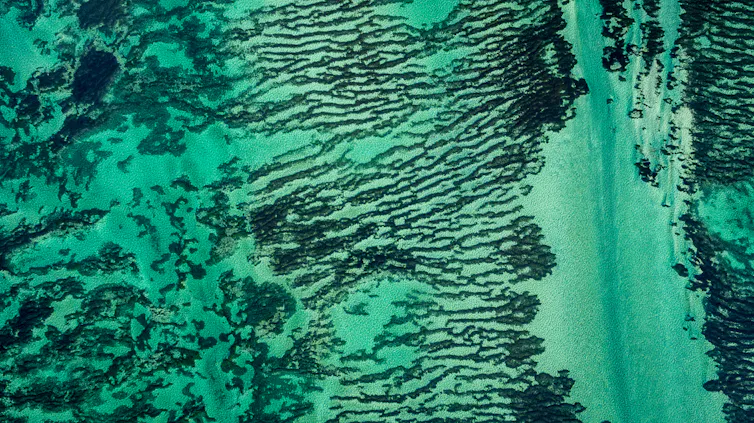
Seagrass meadows are a hugely important store of blue carbon – and so is the rest of the ocean sea floor.
Philip Schubert/Shutterstock

William Austin, University of St Andrews

“The science we need for the ocean we want” – this is the tagline for the UN Ocean Decade (2021-2030), which has just held its first conference in Barcelona, Spain. Marine scientists from around the world, including me, gathered alongside global leaders to chart the progress of this ten-year mission to improve ocean health and marine biodiversity. That includes finding ways to better protect the seabed which we still know relatively little about.

Some areas of sediment on the sea floor hold large stores of carbon. Without greater protection, disturbance from bottom-trawling fishing practices for example, could release some of that stored carbon back into the atmosphere.

I joined discussions in Barcelona that have led to the launch of a new sustainable ocean planning initiative, to be coordinated by Julian Barbière, global coordinator of the Ocean Decade. This aims to encourage commitment to sustainable management of 100% of sea area under a nation’s jurisdiction.

With this in place, there’s scope to reimagine the role of the ocean in our wider climate system and recognise that all marine natural systems sequester and store carbon in their soils and sediments.

I’m here on behalf of the global ocean decade programme for blue carbon – that’s any carbon that is stored in the ocean. This project is one of the UN’s 50 programmes aimed at delivering transformative ocean science solutions for sustainable development, connecting people and our ocean. That’s a big ask.

My work focuses on the extraordinary ability of coastal ecosystems – such as mangroves, salt marshes and seagrass – to sequester or store organic carbon in unusually high densities. Our blue carbon team of international research scientists from more than 20 countries is beginning to define emerging blue carbon ecosystems such as kelp forest and sub-tidal sediments as solutions to manage the climate and biodiversity crises.

The 360 million sq kilometres of ocean and sea floor, from coastal seagrass meadows to the sediment that slowly accumulates within the deepest trenches, are massively overlooked as a precious carbon store. Oceans hold vast stores of carbon – the top metre of the ocean holds an estimated 2.3 trillion metric tonnes.

The seafloor is not a resource to be relentlessly exploited, but a vulnerable repository of global biodiversity and carbon that needs protecting. These highly productive, yet vulnerable, ecosystems have been greatly affected by habitat loss and destructive practices such as deforestation of mangroves for shrimp aquaculture in the relentless development of the world’s coastal zones.

Blue carbon has huge potential to provide ocean-based solutions to help mitigate climate change, and thankfully, at the global scale at least, these losses have slowed in recent years.

The potential for blue carbon to reduce greenhouse gas emissions is relatively modest, but healthy, restored ecosystems have the potential to store an extra 2.96 million tonnes of carbon annually. Certain countries, such as Indonesia, offer huge potential as blue carbon hotspots where the protection and restoration of nature are an opportunity, for both the environment and local communities.

Carbon credits, the means by which additional carbon can become a source of investment income in that community, are gaining much interest. Off the coast of Kenya, the community-based Miko Pamojo project enhances direct benefits to local people from mangrove restoration.

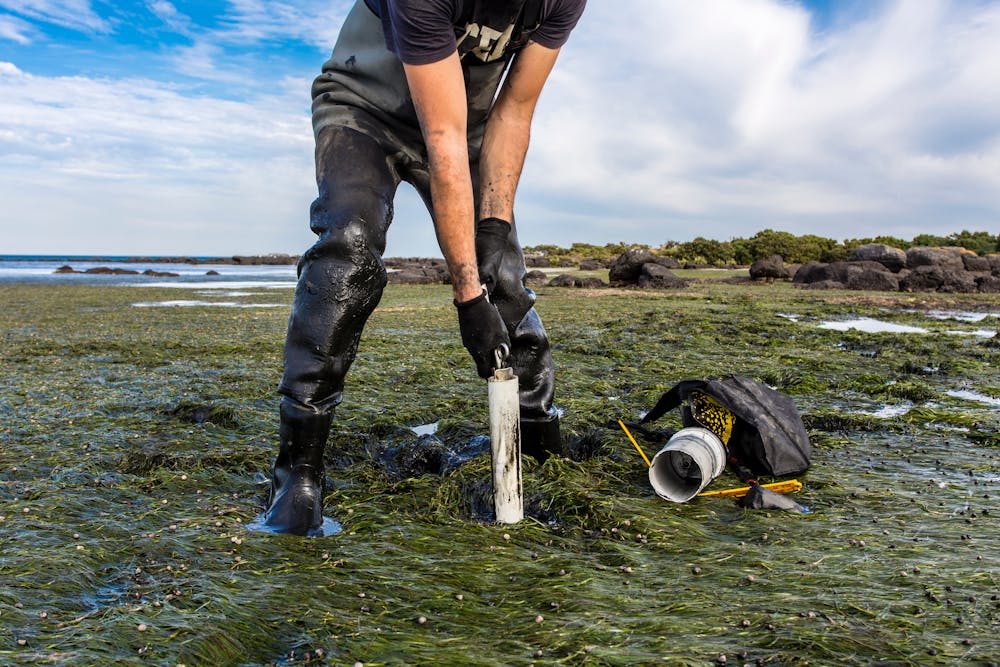
green foreshore, man in wellies with gloves placing white sampling equipment into seabed
Collecting a sediment core to assess carbon sequestration rates in the sediment of a tidal seagrass bed.
I. Noyan Yilmaz/Shutterstock

Blue carbon ecosystems can help countries meet their climate obligations and have been attracting considerable interest. However, if nations want these ecosystems to continue to provide a whole range of services our governments must protect them and, where possible, restore lost habitats.

Most governments have been stubbornly slow to prioritise ocean-based solutions high up on the agenda of global climate negotiations. At this conference, I’ve heard more people, including Unesco’s director general Audrey Azoulay, driving home the need to protect and effectively manage our ocean resources.

Members from the traditional owners of the Great Barrier Reef spoke of “country” from a perspective of a long and sustained human relationship with nature and are intimately connected to the ocean. There is a growing recognition and respect for this indigenous knowledge and our need to integrate that into a sustainable ocean future.

Reimagining the ocean’s role

It makes sense to start by protecting these natural systems that already hold vulnerable stores of carbon – this is sensible risk management.

As nations continue to exploit the marine environment for fishing, fossil fuels and even precious metals which are now being mined from the sea floor in certain places, it is time to rethink the value of these vast natural stores of ocean carbon.

Space science gets way more funding than our oceans, yet vast areas of the global deep ocean remain largely unmapped. “Life below water” is by far the least funded of the UN’s 17 Sustainable Development Goals. That needs to change through a sustained and increased investment in ocean science and greater recognition for the value of our blue economy – defined by the UN as the sustainable use of the ocean’s resources for economic growth, improved livelihoods and jobs.

Stepping back to pause and preserve what already exists in the ocean can help the planet, and us, build resilience and create a healthier and more sustainable marine environment. The seabed forms the foundation for an interconnected ocean ecosystem and acts as an important long-term global sink for carbon that involves the whole ocean and its exchanges with the atmosphere and wider Earth system.

While plans are finally moving in the right direction, there are huge challenges ahead. To paraphrase Cynthia Barzuna, director of ocean action 2030 at the World Resources Institute, “there is no wealthy ocean without a healthy ocean”. The biggest takeaway from the Barcelona conference is that a sustainable ocean future depends on a shared vision that works for all of us and marine life too.The Conversation

William Austin, Professor, University of St Andrews

This article is republished from The Conversation under a Creative Commons license. Read the original article.

Continue ReadingSave our seabed – the bottom of the ocean needs to become a top priority, and the UN agrees

Climate activists block holes on Spanish golf courses over water use

Spread the love

https://www.france24.com/en/live-news/20230702-climate-activists-block-holes-on-spanish-golf-courses-over-water-use

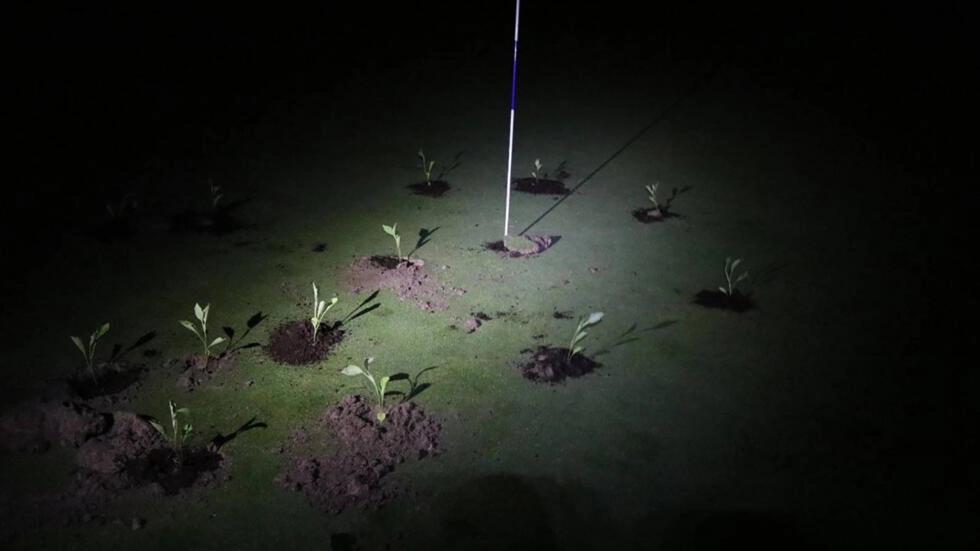
Madrid (AFP) – Climate activists said Sunday they had plugged the holes on 10 golf courses across Spain to protest at the sport’s excessive water usage as Europe lives through a severe drought.

Some activists blocked holes with cement while others filled the holes with seedlings, Extinction Rebellion said © Handout / Extinction Rebellion/AFP

Activists from Extinction Rebellion (XR) filled in the holes under cover of darkness in Barcelona, Madrid, Valencia, the Basque Country, Navarra and the Balearic Island of Ibiza to denounce “the waste of water during one of the worst droughts Europe has ever suffered”.

“Golf has no place in a world without water,” said a statement from the group, which uses direct action to underline its warnings about the dangers to the planet.

“Just one hole of a golf course consumes more than 100,000 litres of water a day to maintain the surrounding green,” XR said, citing figures from the Spanish NGO Ecologists In Action.

Experts say parts of Spain — which is the world’s biggest exporter of olive oil and a key source of Europe’s fruit and vegetables — are the driest they’ve been in a thousand years, with the prolonged drought depleting reservoirs to half their normal capacity.

Extinction Rebellion said it was part of a series of international protests “targeting the richest 1 percent of the population” through their golf courses, private jets and high-end cars to make clear that “the rich and their leisure activities that waste essential resources are a luxury we cannot afford”.

It should be clear – if you bother to engage your brain – that the climate crisis is already affecting inflation and the cost of living crisis. Less precipitation (rain) and disrupted weather [patterns] through climate change mean less crops and increased prices in the supermarket for your fruit and veg, vegetable and olive oil, all those goods made from wheat, corn, beans, etc. The Capitalists will tell you it’s all because of the war in Ukraine. Bollocks, climate change is adversely affecting crops everywhere, Ukraine is not the only place growing crops. Climate change is affecting everyone now.

It’s also noted that the rich are specifically addressed targeted.

Related: Climate change crisis: Golf courses on borrowed time as Earth’s weather patterns become wilder

Continue ReadingClimate activists block holes on Spanish golf courses over water use