Apologist for Pinochet Dictatorship Will Be Next President of Chile

Spread the love

Original article by Stephen Prager republished from Common Dreams under Creative Commons (CC BY-NC-ND 3.0).

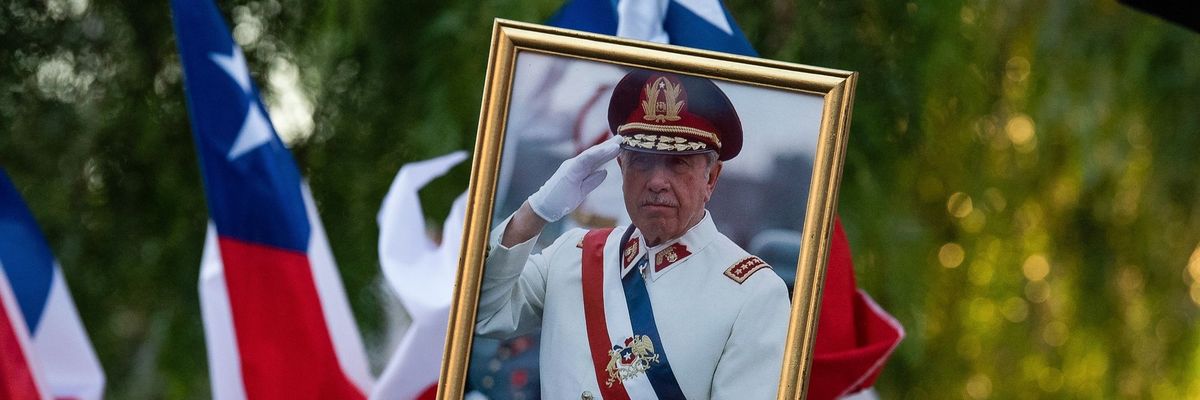
Supporters of presidential candidate José Antonio Kast of Chile’s Republican Party celebrate with an image of former Chilean President Augusto Pinochet following the 2025 presidential election on December 14, 2025, in Santiago, Chile.
(Photo by Claudio Santana/Getty Images)

José Antonio Kast has described the dictator who ended democracy for nearly two decades and presided over the persecution of tens of thousands of dissidents as someone who brought “order” to Chile.

José Antonio Kast, a far-right former lawmaker, won over 58% of the vote in Chile’s runoff elections on Sunday over Jeannette Jara, the labor minister under outgoing left-wing President Gabriel Boric, to become the nation’s next president.

The win came despite Kast’s open admiration for General Augusto Pinochet, who ended civilian rule in Chile after taking power through a coup d’etat in 1973, overthrowing its democratically elected socialist leader in a US Central Intelligence Agency-backed plot and implementing a radical program of economic austerity.

RECOMMENDED…

Nobel Peace Prize Ceremony 2025

Protest in Oslo Denounces Nobel Peace Prize for Right-Wing Machado

HONDURAS-ELECTION-PROPAGANDA

US Progressives Warn Trump Against Interference in Honduras Election

Until he was ousted by a democratic referendum in 1990, Pinochet governed Chile as a military dictatorship rife with human rights abuses, resulting in his indictment by a Spanish court in 1996 for crimes against humanity. His regime assassinated or “disappeared” nearly 3,200 people, while tens of thousands were tortured and more forced into exile.

Human rights groups have accused Kast and his family—the patriarch of which was a member of the Nazi Party who fled to Chile in 1950—of collaboration with the Pinochet regime’s detention of opponents. The president-elect’s brother was a minister for Pinochet during the dictatorship.

Kast will be the first president of Chile since its return to democracy to have campaigned for and voted “Yes” in the 1988 plebiscite for the dictator to stay in power for another eight years despite his reign of terror.

But rather than distance himself from Pinochet’s legacy, Kast has described himself as his spiritual successor.

In 2017, during his first of three presidential campaigns, Kast told a local newspaper that “if he were alive,” Pinochet “would vote for me.” Kast later described Pinochet as someone who brought “order” to Chile, comments that the Buenos Aires Times wrote in 2021, “railed many who are still scarred by this dark period in the country’s history.”

But Kast’s nostalgia for that period of repression was not enough to hobble him this time around. At a time when the right is making gains across Latin America, Kast’s policy agenda sits at the nexus point between the free market fundamentalism of Argentina’s Javier Milei and the police state ambitions of El Salvador’s Nayib Bukele.

He has pledged an economic program in the same vein as Pinochet’s and, later, Milei’s “shock therapy,” proposing an unprecedented cut of $21 billion in public spending over his term, paired with a reduction in taxes on the wealthy.

Kast has pledged that these cuts would only affect “waste” and “political” spending, but not impact social programs that benefit Chileans. But economic analysts, including Javiera Toro, Chile’s social development minister, have argued that a cut of that size would inevitably cut into the social safety net, including its popular state pension program and others related to health, housing, and education.

Kast successfully martialed fear of high crime (even though it actually fell under Boric’s tenure) into outrage toward the nation’s undocumented migrants—mainly from Venezuela—whom he has pledged to deport en masse. As in the US, where President Donald Trump is also spearheading a mass deportation operation, immigrants in Chile commit crimes at lower rates than those born in the country.

Last year, Kast visited the sprawling prison complex where Bukele has used emergency powers to detain tens of thousands of people as part of his sweeping war on gangs, often in punishing conditions where they’ve faced torture. Amnesty International described it as a “state policy of massive and arbitrary deprivation of liberty.” Kast said he’d like to implement a similar policy in Chile.

Kast immediately raised fears for the future of Chile’s democracy in his victory speech, vowing to form an “emergency government” when he takes power in 2026. However, he will not command a majority in Chile’s legislature, which may make the delivery of his agenda more challenging.

Jenny Pribble, professor of political science and global studies at the University of Richmond, told Al Jazeera: “It remains to be seen if Kast could or would pursue such an approach, but if Chile follows the Salvadoran model, it would constitute significant democratic backsliding.”

Original article by Stephen Prager republished from Common Dreams under Creative Commons (CC BY-NC-ND 3.0).

Continue ReadingApologist for Pinochet Dictatorship Will Be Next President of Chile

Twenty years after “No to the FTAA”, Latin American movements reaffirm their anti-imperialist commitment

Spread the love

Original article by Pablo Meriguet republished from peoples dispatch under a Creative Commons Attribution-ShareAlike 4.0 (CC BY-SA) license.

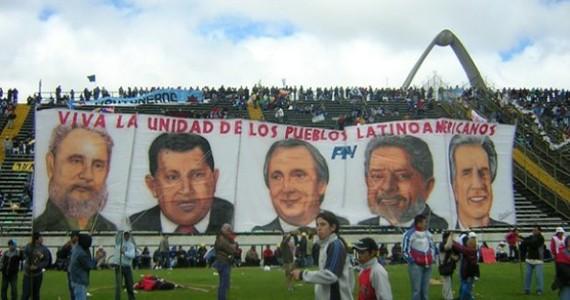
In 2005, in the city of Mar del Plata, the presidents of the brother countries of the Americas, Lula da Silva, Hugo Chávez, Evo Morales, and Néstor Kirchner stood firm against the United States. Photo: X

The meeting in Mar del Plata paid tribute to the moment when several Latin American presidents defeated the US attempt to establish a regional free trade agreement.

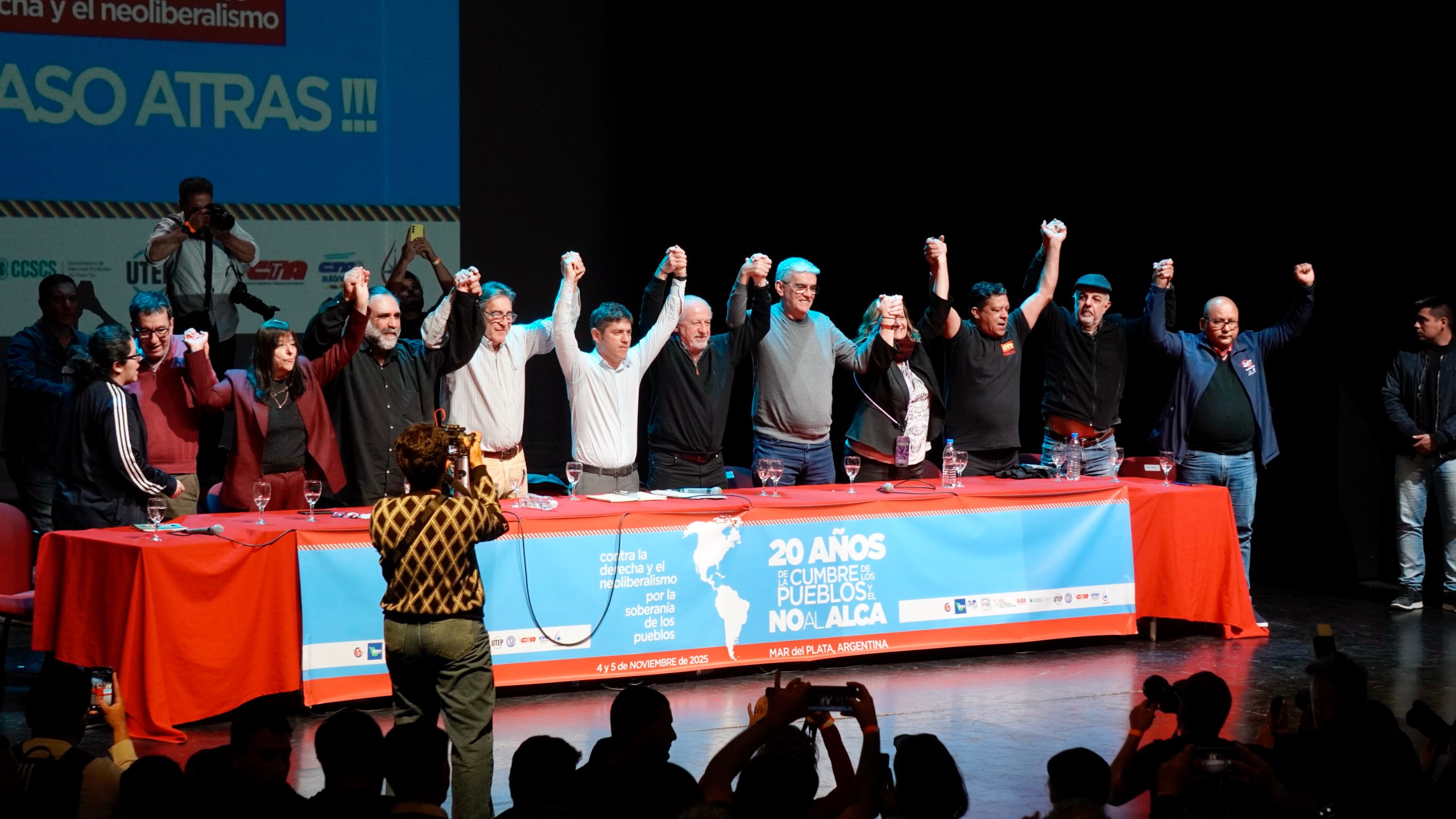
In the same place where the regional free trade project was “buried” two decades ago, 150 delegates from various social movements in Brazil, Uruguay, Bolivia, Cuba, Mexico, Portugal, Haiti, Palestine, Chile, Nicaragua, Peru, and Paraguay gathered to reaffirm the anti-imperialist spirit that led to the regional rejection of the FTAA project, they say.

“The world faces greater levels of inequality, injustice, and authoritarianism, with a growing concentration of financial and technological power that deepens poverty and limits the autonomy of countries in the Global South,” the delegates said in the event’s final declaration.

The meeting was also attended by the governor of Buenos Aires, Axel Kicillof, who stated that the rejection of the FTAA in 2005 was a “new declaration of independence” for Latin American countries. “The rejection of the FTAA was a victory for Latin American sovereignty, voiced by a group of presidents with enormous courage, represented in our country by Néstor Kirchner. Twenty years after that historic milestone, we have a responsibility to continue building unity, because there is no possibility of development for our countries outside the framework of regional integration. We cannot afford not to have a project on behalf of our people, because Argentina and the countries of Latin America are not anyone’s backyard,” Kicillof wrote in X.

Peoples Summit No al ALCA
Delegates from dozens of Latin American countries reaffirm the anti-imperialist spirit of the “No to the FTAA” summit in 2005.

For his part, the Secretary of Foreign Affairs of the Argentine Workers’ Central Union (CTA), Adolfo Aguirre, stated: “In this very place, in front of the President of the United States, George W. Bush, and before the eyes of the whole world, our peoples, workers, together with leaders such as Néstor Kirchner, Hugo Chávez, and Luiz Inácio Lula da Silva, marked a turning point. We said no to surrender, no to dependence, no to the model that wanted to turn our America into the backyard of economic power.”

Twenty years ago, the anti-imperialist slogan was born

Twenty years ago in Argentina, several political leaders from the Latin American left gathered at a People’s Summit, whose fundamental slogan was the rejection of the Free Trade Area of the Americas (FTAA), an initiative promoted, among others, by the George W. Bush administration. The FTAA sought to significantly reduce customs barriers between American countries.

According to popular and left-wing forces in Latin America and the Caribbean, the agreement would have promoted a regional market in which the United States would have had an enormous advantage over other countries and which, in the long run, would have led to the destruction of the still immature regional industry to benefit the interests of large US companies.

However, the economic and geopolitical project did not prosper due to fierce and coordinated opposition from several Latin American presidents, including Néstor Kirchner (Argentina), Hugo Chávez (Venezuela), and Luiz Inácio Lula da Silva (Brazil), among others. The political maneuver took place in Mar del Plata, during the Summit of the Americas, where Bush and his entourage suffered a severe setback. Thus, the proposal that had been in the works and planned since 1994 in Miami and was definitively defeated.

The Summit of the Americas is considered by several experts to be a turning point in the geopolitical relations of the American continent. New progressive and pro-sovereignty processes joined those of Argentina, Brazil, and Venezuela, giving rise to an attempt at regional integration that to this day is pushed by progressivism and boycotted by Washington’s neoliberal allies.

While the summit was taking place, thousands of people from left-wing and progressive movements and political parties gathered at a parallel conference with the slogan “No to the FTAA,” which was eventually attended by several political leaders. Among them, Hugo Chávez made a statement in his speech that would go down in history: “ALCA (FTAA in Spanish), al carajo! (FTAA, go to hell!)”.

A historic event

The region has undoubtedly changed its political composition. The seemingly unstoppable rise of progressive governments is now fragmented due to the emergence of new right-wing and neoliberal projects, such as those of Javier Milei in Argentina and Daniel Noboa in Ecuador, and the recent victory of the Bolivian right after more than 20 years of left-wing governments, among others.

However, in several countries, progressivism managed to regain government, as in the case of Lula da Silva himself, or managed to remain in power, as in the case of the United Socialist Party of Venezuela. Also, in other countries such as Colombia with Gustavo Petro and Mexico with Andrés Manuel López Obrador and Claudia Sheinbaum, progressive governments took office for the first time in their recent history.

In this sense, the dispute over governments in Latin America remains open, and much of the structure of that dispute can be found in what happened in Mar del Plata 20 years ago, where one regional project was buried and another was established, for almost a decade, as the model for regional integration around a position that, although it had its clear limits, always declared itself sovereign and independent.

Original article by Pablo Meriguet republished from peoples dispatch under a Creative Commons Attribution-ShareAlike 4.0 (CC BY-SA) license.

Continue ReadingTwenty years after “No to the FTAA”, Latin American movements reaffirm their anti-imperialist commitment

12 countries commit to arms embargo on Israel to stop its attacks on Gaza

Spread the love

Original article by Pablo Meriguet republished from peoples dispatch under a Creative Commons Attribution-ShareAlike 4.0 (CC BY-SA) license.

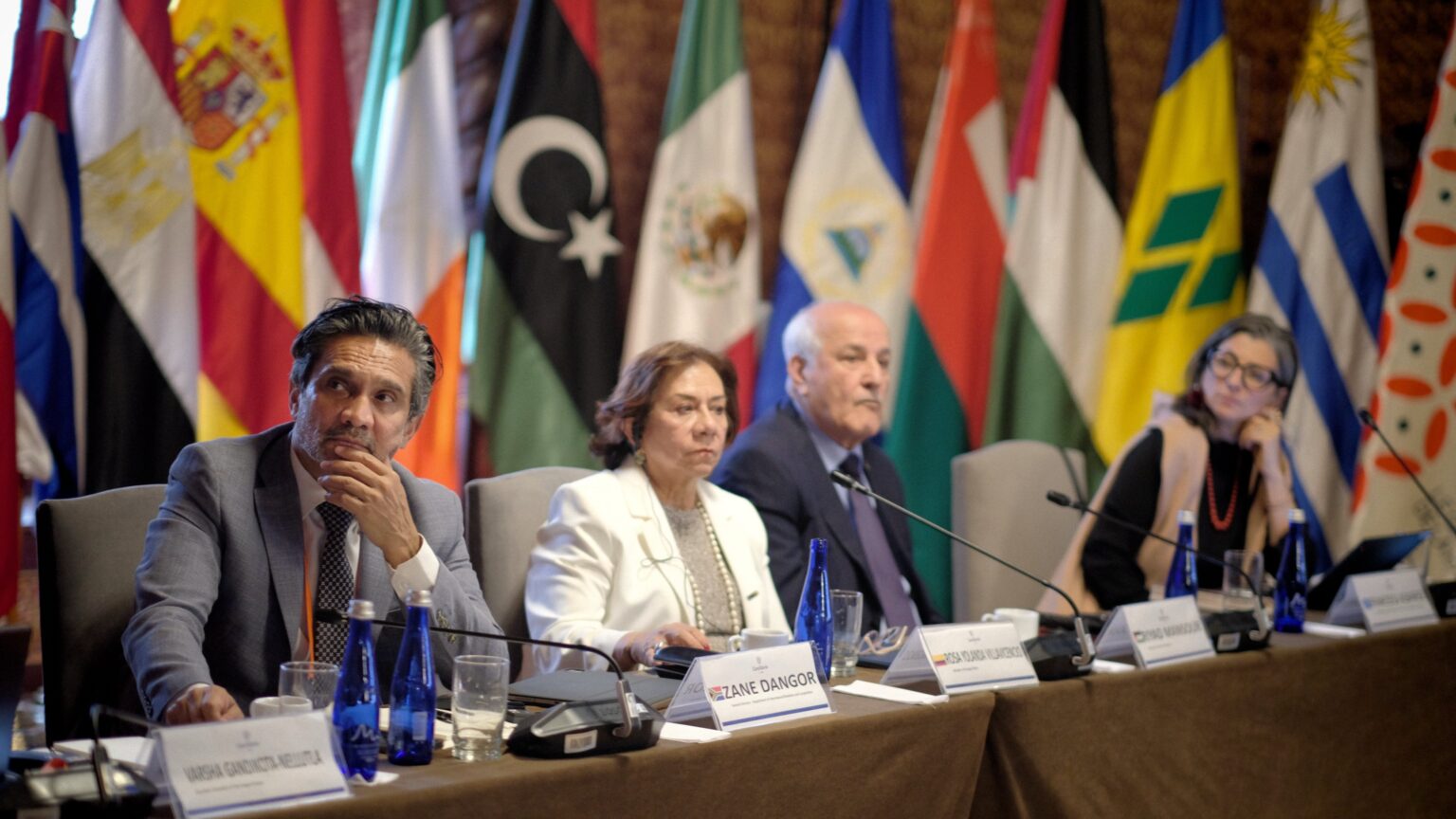
Hague Group Summit in Bogotá, Colombia. Photo: Abby Martin

In the final document, the signatory countries commit, among other things, to cease arms trade with Israel, review public contracts with that country, and seek accountability for war crimes.

Countries of the Global South have expressed their solidarity with the Palestinian people at the Emergency Ministerial Conference on Palestine organized by The Hague Group, which took place on July 15 and 16 in Bogotá, Colombia. The multilateral meeting was attended by representatives from Algeria, Bangladesh, Botswana, Brazil, Chile, China, Djibouti, Egypt, Slovenia, Spain, Honduras, Indonesia, Iraq, Ireland, Lebanon, Libya, Malaysia, Mexico, Namibia, Nicaragua, Norway, Oman, Pakistan, Palestine, Qatar, Saint Vincent and the Grenadines, South Africa, Turkey, Uruguay, and Venezuela.

Regarding the meeting, Colombia’s deputy secretary of state, Mauricio Jaramillo, said: “This conference is being convened by the Hague Group, but it is not an exclusive meeting of this group. Given the urgency of what is happening in the occupied territories, especially in Gaza, where today, for example, we have passed the threshold of 58,000 fatalities, we must commit ourselves to action.”

The conference, which was organized by the governments of Colombia and South Africa and attended by 30 countries, agreed that: “The era of impunity must end – and that international law must be enforced without fear or favor through immediate domestic policies and legislation – along with a unified call for an immediate ceasefire.”

The agreements

According to an official press release, the meeting laid out several measures to stop the genocide in Gaza:

  1. Prevent the provision or transfer of arms, munitions, military fuel, related military equipment, and dual-use items to Israel.
  2. Prevent the transit, docking, and servicing of vessels at any port … in all cases where there is a clear risk of the vessel being used to carry arms, munitions, military fuel, related military equipment, and dual-use items to Israel.
  3. Prevent the carriage of arms, munitions, military fuel, related military equipment, and dual-use items to Israel on vessels bearing our flag … and ensure full accountability, including de-flagging, for non-compliance with this prohibition.
  4. Commence an urgent review of all public contracts to prevent public institutions and funds from supporting Israel’s illegal occupation of the Palestinian Territory and entrenching its unlawful presence.
  5. Comply with obligations to ensure accountability for the most serious crimes under international law, through robust, impartial, and independent investigations and prosecutions at national or international levels, to ensure justice for all victims and the prevention of future crimes.
  6. Support universal jurisdiction mandates, as and where applicable in national legal frameworks and judiciaries, to ensure justice for victims of international crimes committed in the Occupied Palestinian Territory.

Although 30 countries attended the meeting, only 12 countries committed to immediately complying with the agreements outlined in the final declaration: Bolivia, Cuba, Colombia, Indonesia, Iraq, Libya, Malaysia, Namibia, Nicaragua, Oman, Saint Vincent and the Grenadines, and South Africa. The others expected to join them by September 20, 2025 – the date of the 80th UN General Assembly. The group will also be consulting various other states on an ongoing basis for participation in the measures against Israel.

Colombia’s President Gustavo Petro stated: “We came to Bogotá to make history — and we did … Together, we have begun the work of ending the era of impunity. These measures show that we will no longer allow international law to be treated as optional, or Palestinian life as disposable.”

“What we have achieved here is a collective affirmation that no state is above the law … The Hague Group was born to advance international law in an era of impunity. The measures adopted in Bogotá show that we are serious — and that coordinated state action is possible,” said South African Secretary of State Ronald Lamola.

The final agreement is historic as it is the first multilateral agreement that seeks to influence the Israeli government’s actions in its offensive against Gaza. In this sense, it is the first time that several countries have challenged the apparent immunity of the Israeli state in its actions in Gaza, which could have unpredictable diplomatic repercussions. It could also become the starting point for other countries to demand an end to the violence in Palestine jointly.

Original article by Pablo Meriguet republished from peoples dispatch under a Creative Commons Attribution-ShareAlike 4.0 (CC BY-SA) license.

Continue Reading12 countries commit to arms embargo on Israel to stop its attacks on Gaza

Outrage After Israeli Occupation Forces Shoot Live Rounds at Foreign Diplomats in West Bank

Spread the love

Original article by Brett Wilkins republished from Common Dreams under Creative Commons (CC BY-NC-ND 3.0).

Members of an international diplomatic delegation scramble for cover after coming under Israeli fire during a May 21, 2025 visit to the besieged Jenin refugee camp in the illegally occupied West Bank of Palestine. (Photo: Mohammad Ateeq/AFPTV/AFP via Getty Images)

Among those shot at were representatives of three nations that threatened “concrete actions” if Israel doesn’t end its assault and siege on Gaza and others that support a genocide case against the country.

Israeli occupation forces fired what they called “warning shots” at a large delegation of international diplomats visiting the besieged Jenin refugee camp in the West Bank on Wednesday, an incident many critics said was an attempt to intimidate countries that just two days earlier issued an ultimatum to stop annihilating Gaza and others that have joined a genocide case against Israel.

Palestinian officials were briefing a group of more than 20 diplomats about the crisis in the illegally occupied West Bank—where Israeli soldiers and settlers have killed and wounded thousands of Palestinians including hundreds of children since October 2023 while pushing ahead with massive land theft and colonization—when they came under fire.

According to the Israeli Foreign Ministry, the delegation “deviated” from the route approved by Israeli occupation authorities “and entered an area where they were not authorized to be,” prompting Israel Defense Forces (IDF) soldiers to fire “warning shots to distance them away.”

“The IDF regrets the inconvenience caused,” the ministry added.

Israeli soldiers intentionally fired at a delegation of about 30 Arab & EU diplomats, ambassadors and consuls, visiting Jenin refugee camp, in the West Bank. Israel claims “it was an accident” and that they fired “warning shots” because they “felt in danger”. Israel was trying to intimidate them.

[image or embed]
— Anonymous ( @youranoncentral.bsky.socialMay 21, 2025 at 6:06 AM

Israeli media reported IDF troops fired shots in the air. However, video footage of the incident appears to show soldiers aiming their guns and firing straight ahead in the direction of the diplomats as they scrambled for cover. Israeli officials have often been caught lying about the actions of IDF troops in Palestine.

The delegation included diplomats from the European Union and countries including Austria, Brazil, Bulgaria, Canada, Chile, China, Egypt, France, India, Japan, Jordan, Lithuania, Mexico, Morocco, Poland, Portugal, Romania, Russia, Spain, Sri Lanka, Turkey, and the United Kingdom.

On Monday, three of those countries—France, the United Kingdom, and Canada—issued a rare joint statement condemning Operation Gideon’s Chariots, the ongoing Israeli campaign to conquer and indefinitely occupy all of Gaza and ethnically cleanse much of its population.

On Tuesday, the U.K. announced it is suspending negotiations with Israel on a free trade agreement, explaining that “it is not possible to advance discussions on a new, upgraded FTA” with a government “that is pursuing egregious policies in the West Bank and Gaza.”

Israeli Prime Minister Benjamin Netanyahu and Yoav Gallant, his former defense minister, are wanted by the International Criminal Court for alleged war crimes and crimes against humanity in Gaza including extermination and forced starvation.

The U.K. additionally sanctioned three far-right Israeli extremists, including settler leader Daniella Weiss, as well as three illegal settlement outposts and two groups “that have supported, incited, and promoted violence against Palestinian communities in the West Bank.”

Also on Tuesday, European Commission Vice President Kaja Kallas—who is the E.U.’s foreign policy chief—said the 27-nation bloc would review its political and economic agreement with Israel in light of the “catastrophic” situation in Gaza.

Brazil, Chile, China, Egypt, Jordan, Mexico, Spain, and Turkey have either joined or expressed support for the South Africa-led genocide case against Israel currently before the International Court of Justice—which last year found that Israel’s 58-year occupation of the West Bank, including East Jerusalem, and Gaza is an illegal form of apartheid that must be ended as soon as possible.

Israel’s 592-day assault and siege on Gaza has left more than 189,000 Palestinians dead, maimed, or missing and over 2 million others forcibly displaced, starved, or sickened, according to the Gaza Health Ministry.

The Palestinian Authority Ministry of Foreign Affairs condemned what it called Wednesday’s “heinous crime” against the diplomats.

“The delegation was undertaking an official mission to observe and assess the humanitarian situation and document the ongoing violations perpetrated by the occupying forces against the Palestinian people,” the ministry said. “This deliberate and unlawful act constitutes a blatant and grave breach of international law and of the fundamental principles of diplomatic relations as enshrined in the 1961 Vienna Convention on Diplomatic Relations.”

Kallas said Wednesday that “any threats on diplomats’ lives are unacceptable.”

“Israel is also a signatory to the Vienna Convention, I mean the obligation to guarantee the security of all foreign diplomats,” Kallas noted. “We definitely call on Israel to investigate this incident and also hold accountable [those] who are responsible for this.”

The governments of other countries whose diplomats were targeted on Wednesday condemned the incident, with some, including France and Italy, summoning their Israeli ambassadors.

Original article by Brett Wilkins republished from Common Dreams under Creative Commons (CC BY-NC-ND 3.0).
Experiencing issues with this image not appearing. I suspect because it's so critical of Zionist Keir Starmer's support of and complicity in Israel's genocides.
Genocide denier and Current UK Prime Minister Keir Starmer is quoted that he supports Zionism without qualification. He also confirms that UK air force support has been essential in Israel’s mass-murdering genocide. Includes URLs https://www.declassifieduk.org/keir-starmers-100-spy-flights-over-gaza-in-support-of-israel/ and https://youtu.be/O74hZCKKdpA
UK Labour Party government ministers Keir Starmer, Angela Rayner and Rachel Reeves explain that they are partners complicit in Israel's Gaza genocide. The UK has provided Israel with arms, military and air force support. They explain that they don't do gas chambers but do do forced marches, starvation, destroy hospitals, mass-murders of journalists and healthcare workers.
UK Labour Party government ministers Keir Starmer, Angela Rayner and Rachel Reeves explain that they are partners complicit in Israel’s Gaza genocide. The UK has provided Israel with arms, military and air force support. They explain that they don’t do gas chambers but do do forced marches, starvation, destroy hospitals, mass-murders of journalists and healthcare workers.
Continue ReadingOutrage After Israeli Occupation Forces Shoot Live Rounds at Foreign Diplomats in West Bank

93 Countries Back ICC Probe Into Israeli War Crimes in Gaza

Spread the love

Original article by JON QUEALLY republished from Common Dreams under Creative Commons (CC BY-NC-ND 3.0). 
Palestinian child, injured in the Israeli attack on Abu Aisha family house is taken to Al-Aqsa Martyrs Hospital in Deir al-Balah, Gaza on June 14, 2024.
 (Photo by Ashraf Amra/Anadolu via Getty Images)

A joint statement calls on “all States to ensure full co-operation with the Court for it to carry out its important mandate of ensuring equal justice for all victims of genocide, war crimes, [and] crimes against humanity.”

Ninety-three nations on Friday, all them state parties to the Rome Statute that created the International Criminal Court, reiterated their support for the ICC as it assesses an application for arrest warrants of high level Israeli government officials accused of perpetrating war crimes in Gaza.

The 93 countries—including Canada, Bangladesh, Belgium, Ireland, Afghanistan, Costa Rica, Chile, Germany, France, Mongolia, Mexico, New Zealand, and scores of other—cited separate ICC statements defending its mandate for independence and upheld in their joint statement “that the Court, its officials and staff shall carry out their professional duties as international civil servants without intimidation.”

Though neither nation is named in the joint statement, both the United States and Israel have publicly condemned ICC chief prosecutor Karim Khan for his May 20 arrest warrant applications for Israeli Prime Minister Benjamin Netanyahu and Defense Minister Yoav Gallant over alleged “war crimes” and “crimes against humanity” in the Gaza Strip.

Khan also submitted arrest warrants for Hamas leaders Yahya Sinwar, Mohammed Diab Ibrahim Al-Masri, and Ismail Haniyeh for their alleged roles in the October 7 attack on southern Israel. Following Khan’s announcement in May, U.S. President Joe Biden said, “Whatever this prosecutor might imply, there is no equivalence—none—between Israel and Hamas. We will always stand with Israel against threats to its security.”

In April it was reported that the U.S. government was working behind the scenes to block the ICC from issuing any arrest warrants targeting Israel officials. Neither Israel nor the U.S. is party to the Rome Statute, though the United Nations has recognized the ICC’s jurisdiction over the Occupied Palestinian Territories (OPT), where the alleged war crimes by the occupying power, Israel, took place.

After Khan made his application for warrants, White House spokesperson Karine Jean-Pierre said, “We’ve been really clear about the ICC investigation. We do not support it.” On June 4, Republicans in the U.S. House of Representatives, along with 42 Democrats, passed a measure that would sanction ICC officials if the arrest warrants for any Israeli officials were approved or carried out.

Balakrishnan Rajagopal, the United Nations Special Rapporteur on the right to adequate housing, was among those who applauded Friday’s public statement.

Rajagapol thanked the signatory nations “for defending the ICC and standing up against the bullies, including the relics from the U.S. Senate whose idea of engaging with the world is to use threats,” a possible reference to Sen. Lindsay Graham (R-S.C.) who denounced Khan’s applications as “outrageous,” applauded the House approval of sanctions, and vowed further punishment for the ICC.

Such punitive measures and high-profile threats directed at the ICC appeared to be the exact kind of intimidation Friday’s joint pledge of support is responding to.

“The ICC, as the world’s first and only permanent international criminal court, is an essential component of the international peace and security architecture,” the statement reads. “We therefore call on all States to ensure full co-operation with the Court for it to carry out its important mandate of ensuring equal justice for all victims of genocide, war crimes, crimes against humanity and the crime of aggression, grave crimes that threaten the peace, security and well-being of the world.”

With their show of unified support for the ICC and its mandate, the countries said they aim to “contribute to ending impunity for such crimes and preventing their recurrence while defending the progress we have made together to guarantee lasting respect for international humanitarian law, human rights, the of law and the enforcement of international criminal justice.”

Original article by JON QUEALLY republished from Common Dreams under Creative Commons (CC BY-NC-ND 3.0). 
America Crawls Further Into Global Isolation by Backing Gaza Genocide

Why the Senate Must Reject the Dangerous Antisemitism Awareness Act

Despite Mainstream Headlines, Israel’s Tents Massacre Was Not a ‘Tragic Mistake’

The Nuseirat Massacre Shows How Israel and the West Devalue Palestinian Lives

Continue Reading93 Countries Back ICC Probe Into Israeli War Crimes in Gaza