‘We Need Urgent Global Action’: Study Warns Humanity on Path to Trigger 16 Climate Tipping Points

Spread the love

Original article by Jessica Corbett republished from Common Dreams under Creative Commons (CC BY-NC-ND 3.0).

A church spire of the submerged village of Graun protrudes from the nearly completely drained Reschensee Lake during construction work on May 23, 2024, near Resia, Italy. Climate change is thawing the permafrost that stabilizes alpine rocks, endangering numerous mountain passes across the European Alps. (Photo: Manuel Romano/NurPhoto via Getty Images)

“It is clear that we are currently on a dangerous trajectory,” said one University of Exeter professor.

Scientists on Wednesday released yet another study warning that humankind is at risk of triggering various climate “tipping points” absent urgent action to dramatically reduce planet-heating emissions from fossil fuels.

The new peer-reviewed paper, published Wednesday in the journal Earth System Dynamics, comes from a trio of experts at the United Kingdom’s University of Exeter and the University of Hamburg in Germany.

Climate scholars use the term “tipping point” to describe a critical threshold which, when crossed, “leads to significant and long-term changes of the system,” the paper notes. Debate over it “has intensified over the past two decades,” prompting several studies of specific risks.

“Climate tipping points could have devastating consequences for humanity,” said co-author Tim Lenton in a statement. “It is clear that we are currently on a dangerous trajectory—with tipping points likely to be triggered unless we change course rapidly.”

“We need urgent global action—including the triggering of ‘positive tipping points’ in our societies and economies—to reach a safe and sustainable future,” added the Exeter professor and Global Systems Institute director.

Lenton’s team calculated the probabilities of triggering 16 tipping points. They looked at the risks of serious damage to key glaciers, ice sheets, sea ice, and permafrost; the dieback of forests such as the Amazon; the die-off of low-latitute coral reefs; and the collapse of the Atlantic Meridional Overturning Circulation (AMOC), which is part of a crucial “global conveyor belt” of ocean currents.
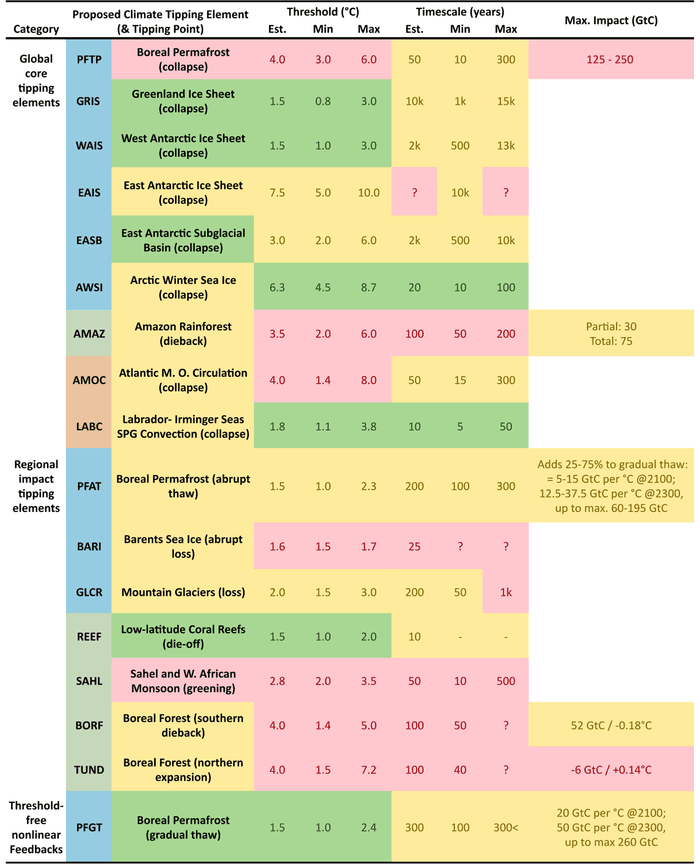
To assess the risk of current policies triggering climate tipping points, the researchers focused on a scenario in which median warming of 2.8°C takes place by the end of the century.

On that pathway, the study says, “our most conservative estimate of triggering probabilities averaged over all tipping points is 62%… and nine tipping points have a more than 50% probability of getting triggered.”

Under scenarios with lower temperature rise, “the risk of triggering climate tipping points is reduced significantly,” the study continues. “However, it also remains less constrained since the behaviour of climate tipping points in the case of a temperature overshoot is still highly uncertain.”

The paper concludes that “rapid action is needed to reduce greenhouse gas emissions, since climate tipping points are already close, and it will be decided within the coming decades if they will be crossed or not.”

Lead author Jakob Deutloff shared that takeaway a bit more optimistically, saying that “the good news from our study is that the power to prevent climate tipping points is still in our hands.”

“By moving towards a more sustainable future with lower emissions, the risk of triggering these tipping points is significantly reduced,” he added. “And it appears that breaching tipping points within the Amazon and the permafrost region should not necessarily trigger others.”

▶️New paper from Jakob Deutloff, Hermann Held and Tim Lenton highlights the need for action to prevent triggering climate tipping points. More on this at The Global Tipping Points conference @exeter.ac.uk Register now! global-tipping-points.org/conference-2…esd.copernicus.org/articles/16/…

Global Systems Institute (@gsiexeter.bsky.social) 2025-04-23T08:45:40.637Z

The paper was published during Covering Climate Now’s joint week of media coverage drawing attention to the 89% of people worldwide who want their governments to do more to address the global crisis; ahead of a Global Systems Institute conference on tipping points this summer; and just over six months away from the next United Nations climate summit, COP30, in Brazil.

While some governments are trying to prevent the worst-case scenario by taking action to cut emissions, U.S. President Donald Trump has made clear since returning to office in January that he aims to deliver on his pro-fossil fuel campaign pledge to “drill, baby, drill.”

On the heels of the hottest year in human history, Trump is working to gut key agencies, ditched the Paris climate agreement, and has taken executive action to boost planet-wrecking coal, gas, and oil, including declaring a national energy emergency.

Original article by Jessica Corbett republished from Common Dreams under Creative Commons (CC BY-NC-ND 3.0).

Neo-Fascist Climate Science Denier Donald Trump says Burn, Baby, Burn.
Elon Musk urges you to be a Fascist like him, says that you can ignore facts and reality then.
Continue Reading‘We Need Urgent Global Action’: Study Warns Humanity on Path to Trigger 16 Climate Tipping Points

Critics Warn Media Outlets Failing to Explain Climate Cause Behind Los Angeles Fires

Spread the love

Original article by Eloise Goldsmith republished from Common Dreams under Creative Commons (CC BY-NC-ND 3.0).
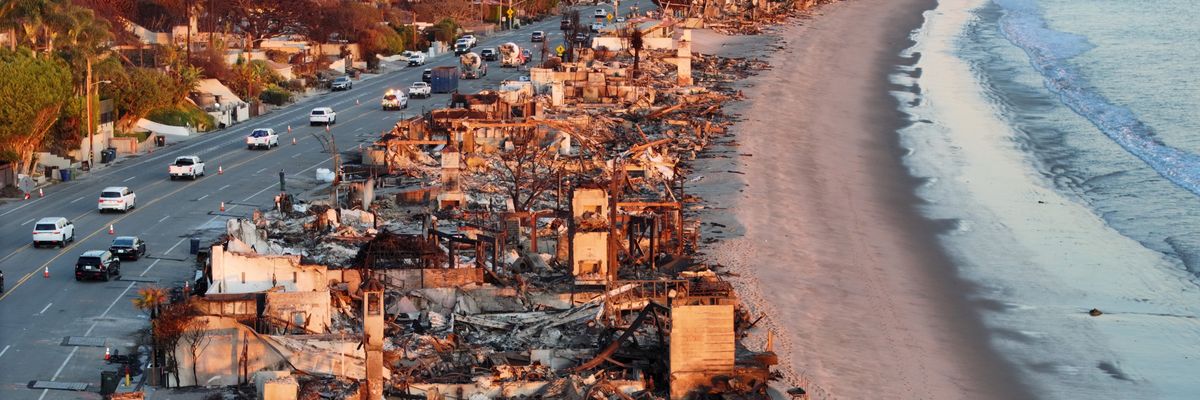
An aerial view of repair vehicles at sunset passing near beachfront homes that burned in the Palisades Fire on January 15, 2025 in Malibu, California. (Photo: Mario Tama/Getty Images)

“Too much of the coverage has simply ignored the climate crisis altogether, an inexcusable failure when the scientific link between such megafires and a hotter, dryer planet is unequivocal,” wrote the founders of Covering Climate Now.

Covering the who, what, when, where, and why is journalism 101. So why are too few media outlets explaining the role that the climate crisis plays in the “why” behind the fires ravaging the Los Angeles region?

That’s the central question posed in an opinion piece published in The Guardian and elsewhere on Thursday authored by Mark Hertsgaard and Kyle Pope, the founders of Covering Climate Now, a global collaboration of over 500 news outlets aimed at improving climate coverage, of which Common Dreams is a part.

Hertsgaard and Pope wrote that “too much of the coverage has simply ignored the climate crisis altogether, an inexcusable failure when the scientific link between such megafires and a hotter, dryer planet is unequivocal.”

They added: “Too many stories have framed the fires as a political spat between U.S. President-elect Donald Trump and California elected officials instead of a horrifying preview of what lies ahead if humans don’t rapidly phase out fossil fuels. Too often, bad-faith disinformation has been repeated instead of debunked.”

Misinformation, in many instances stemming from right-leaning sources, have proliferated since the blazes broke out last week. Trump in a social media post appeared to point the finger at California’s statewide water management plans for fire hydrants running dry as firefighters fought the blazes last week. Southern California does have plenty water stored, but the city’s infrastructure was not designed to respond to a fire as the large as the ones that broke out, experts told PBS. Another user on the platform X falsely claimed that California turned away fire trucks from Oregon because of their emission levels, according to KQED.

Hertsgaard and Pope also called for outlets to name names. “Rarely have stories named the ultimate authors of this disaster: ExxonMobil, Chevron, and other fossil fuel companies that have made gargantuan amounts of money even as they knowingly lied about their products dangerously overheating the planet,” they wrote.

While the fires are still burning, researchers are already drawing the links between climate change and the blazes. In a thread on Bluesky, the climate scientist Daniel Swain explained the concept of climate “hydroclimate whiplash”—which southern California experienced in 2024—and how this can create ideal conditions for fires to spread.

The authors of the opinion piece noted that there have been bright spots when it comes to covering the fires with an eye toward the climate emergency and debunking false and misleading claims about the fires. The duo highlight a Time story that is titled “The LA fires show the reality of living in a world with 1.5C of warming” and a column written by the Los Angeles Times’ Sammy Roth, which began: “Los Angeles is burning. Fossil fuel companies laid the kindling.”

Hertsgaard and Pope wrote, “When a house is on fire, by all means let journalism show us the flames.”

“But tell us why the house is burning, too,” they added.

Original article by Eloise Goldsmith republished from Common Dreams under Creative Commons (CC BY-NC-ND 3.0).

Orcas comment on killer apes destroying the planet by continuing to burn fossil fuels.
Continue ReadingCritics Warn Media Outlets Failing to Explain Climate Cause Behind Los Angeles Fires