Italy holds third general strike in three months, against war budget and for Palestine

Spread the love

Original article by Ana Vračar republished from peoples dispatch under a Creative Commons Attribution-ShareAlike 4.0 (CC BY-SA) license.

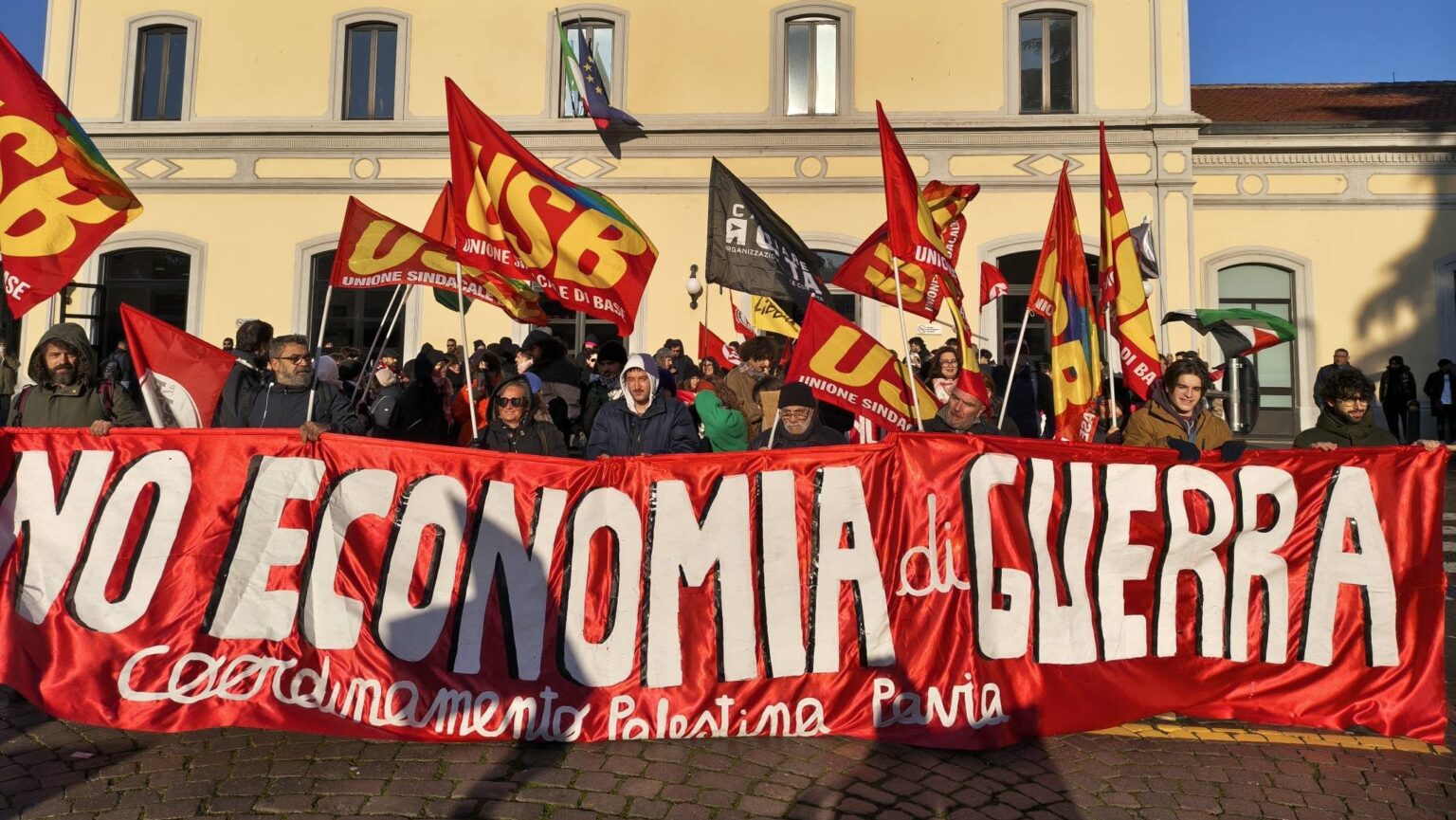
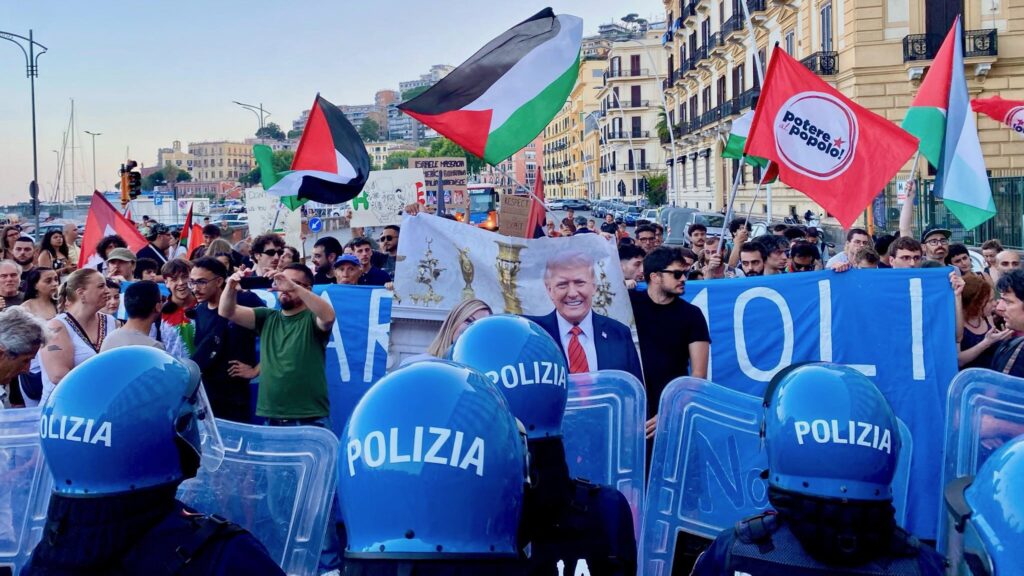
Strikers and activists holding banner reading “No to the war economy” during November 28 general strike in Italy. Source: Potere al popolo Pavia/Facebook

Workers in Italy have launched their third general strike in under three months, demanding an end to Meloni’s war agenda and budget.

Italy is on general strike for the third time in less than three months, following a call by the grassroots union Unione Sindacale di Base (USB). Pickets, industrial actions, and demonstrations were organized in over 40 cities, with massive rallies demanding an end to rearmament plans and the war budget shaped by Giorgia Meloni’s government.

On Friday, workers stressed that their mobilization is tied both to worsening material conditions at home and to international events, specifically the struggle of the Palestinian people – whose fate, they insist, is inseparable from Europe’s expanding war economy. As a result, those striking today reiterated their commitment to join the national march for Palestine in Rome, taking place on Saturday, November 29.

“The Meloni government’s rearmament budget is in line with the warmongering policies pursued in recent years, but it also represents a further leap in quality, with public services being sacrificed on the altar of the war economy, all while inflation continues to rise and wages have been stagnant for decades,” USB and the dockworkers’ collective CALP wrote in one of the strike calls.

“We want at least €2,000 in base pay, retirement no later than 62, an end to subcontracting, reduced working hours with no loss of pay, guaranteed housing rights, new public-sector hiring, and free, universal public health care,” USB added. “These are urgent needs in an exhausted country, needs that are incompatible with the government’s warmongering.”

Italy’s social situation is “a political choice,” workers say

Like other European governments, Meloni’s administration has aligned itself with the European Union’s armament agenda. According to trade unions, this will mean billions for the military and related industries while essential public services fall apart. CALP described the new budget as one that freezes wages, ignores inflation, and prioritizes banks and capital gains. “While prices keep rising, salaries stay stagnant and pensions are cut every year,” the collective stated. “We work more, earn less, and live worse. This isn’t a crisis: it’s a political choice, and workers are the ones paying for it.”

Read more: Belgian workers reject Arizona’s austerity in three-day strike wave

Calls for the government’s dismissal could be heard across today’s actions, together with refusals to accept the shift toward militarization and military enrollment. Groups including left party Potere al Popolo and student collectives CAU and Cambiare Rotta marched with striking workers, blocking roads and picketing companies set to profit from military budgets while healthcare and education are left underfunded.

Messages of support arrived from abroad as well. UN Special Rapporteur Francesca Albanese and Freedom Flotilla participants Greta Thunberg and Thiago Ávila announced they would join the 28-29 November mobilizations in person. Artists including Roger Waters, as well as international trade unions and Palestine solidarity coalitions, expressed solidarity with the strike. “USB’s strikes have shed a bright light on the shameful complicity of the Italian government and Italian corporations in enabling Israel’s genocide, illegal occupation and apartheid against Palestinians,” the BDS National Committee wrote. “They have shown the power of the people and inspired many across the globe.”

In a letter to USB, the Galician Unions Confederacy (CIG) emphasized the strike’s relevance in the context of the EU’s ReArm Europe strategy and the rise of the far right. “We reject the policies promoted by the EU and its member states, which fuel a warmongering escalation and commit to increasing military budgets at the expense of public services and social support,” CIG stated. “And we are concerned about the fascist drift toward which Europe is heading, of which the Meloni government is a clear example.”

Read more: Is fascism back in Europe? A conversation with the Zetkin Forum

Unlike the general strike in October, in which the confederation CGIL joined USB’s call in a rare moment of unity, the call for today’s action came from grassroots unions alone, with CGIL planning its own strike in mid-December. This, however, did not diminish USB’s determination. “Calling the third general strike in just over two months is not a decision to be taken lightly or symbolically,” they wrote.

Instead, they reiterated that today’s strike was intended to table concrete demands and alternatives. The strike, USB added, should not be perceived as a one-off protest but as “an event that represents not only a stage of mobilization, but also a decisive political step to give a voice to those who can’t make ends meet, those working for starvation wages, and those watching their futures crushed by wars, inequality, and the choices of a government hostile to workers.”

Original article by Ana Vračar republished from peoples dispatch under a Creative Commons Attribution-ShareAlike 4.0 (CC BY-SA) license.
Continue ReadingItaly holds third general strike in three months, against war budget and for Palestine

European leaders praise Gaza ceasefire deal, back neocolonial agenda

Spread the love

Original article by Ana Vračar republished from peoples dispatch under a Creative Commons Attribution-ShareAlike 4.0 (CC BY-SA) license.
Source: EU – European Parliament/Denis Lomme

Reactions to the Gaza ceasefire deal signal that European leaders are more interested in advancing neocolonial projects than seeing peace in Palestine.

European government leaders were quick to comment on the recently announced ceasefire deal for Gaza – but their enthusiasm seemed directed less toward a possible respite for the people of Palestine after two years of genocide, and more toward a new opportunity to ingratiate themselves with US President Donald Trump. Early statements overflowed with compliments for the US administration, accompanied by brief acknowledgments of other participants in the negotiations, before moving to promises of what Europe intends to do next.

Read more: Israel-Hamas ceasefire deal met with cautious optimism

“The European Union will continue to support the swift and safe delivery of humanitarian aid into Gaza,” European Commission President Ursula von der Leyen wrote on social media. “And when the time comes, we will be ready to help with recovery and reconstruction.” In her remarks, von der Leyen made no mention of the fact that the EU had failed to take decisive action to ensure the delivery of food and medicine to Gaza throughout Israel’s genocide, or that EU member states continued to ship weapons to the occupation power, thus directly contributing to the destruction she now presumably wants to help Gaza recover from.

Similar statements could be found across communication channels of French, British, and other European officials. Some of the most remarkable reactions, however, came from Italy, whose government representatives had previously described President Trump’s plan for Gaza as the only achievable one and poured praise on his diplomatic skills. The same officials had criticized Italian activists who joined the Global Sumud Flotilla to break the sea blockade of the Strip and deliver essential supplies, failing to protect them from an Israeli terrorist attack and kidnapping in international waters.

Prime Minister Giorgia Meloni announced that Italy “is ready to contribute to the stabilization, reconstruction, and development of Gaza,” while Foreign Minister Antonio Tajani posted videos showing Gazans waving Italian flags alongside Palestinian ones, apparently mistaking their recognition of Italian workers and students – who organized two general strikes and mass demonstrations in solidarity with Palestine, bringing inspiration to the whole region – for gratitude toward the Meloni administration itself.

In reality, Italy’s far-right government has continuously backed Israel throughout the genocide and shipped substantial quantities of weapons to the occupation forces. For this reason, Meloni, Tajani, and Defense Minister Guido Crosetto, along with arms manufacturer Leonardo’s CEO Roberto Cingolani, were recently reported to the International Criminal Court for suspicion of complicity in crimes against humanity.

Read more: Workers shut down Italy again in solidarity with Palestine

Reactions from the left were more skeptical of what lies ahead. Jean-Luc Mélenchon of France Unbowed (La France Insoumise) commented: “After so many deaths and months of genocide, a ceasefire could take place in Gaza. How could one not rejoice at this? […] But once again, the Palestinians will have to endure a new foreign political order. And can one really believe Trump? From our continent, let us lend lucid and vigilant support to the ceasefire while remaining attentive and mobilized.”

Progressive politicians in Europe also criticized the EU’s enthusiasm to define Gaza’s political future. Marc Botenga, MEP for the Workers’ Party of Belgium (PTB-PVDA), warned: “The EU needs to pressure Israel to respect the ceasefire, lift the humanitarian blockade, withdraw from the Gaza Strip and other occupied Palestinian territory.” Reacting to EU High Representative for Foreign Affairs Kaja Kallas, who suggested that the bloc should have a seat at the table while the management of Gaza is discussed, Botenga added: “Europe should stand for Palestinian self-determination instead of fighting to be part of a neocolonial administration.”

Original article by Ana Vračar republished from peoples dispatch under a Creative Commons Attribution-ShareAlike 4.0 (CC BY-SA) license.

Experiencing issues with this image not appearing. I suspect because it's so critical of Zionist Keir Starmer's support of and complicity in Israel's genocides.
Genocide denier and Current UK Prime Minister Keir Starmer is quoted that he supports Zionism without qualification. He also confirms that UK air force support has been essential in Israel’s mass-murdering genocide. Includes URLs https://www.declassifieduk.org/keir-starmers-100-spy-flights-over-gaza-in-support-of-israel/ and https://youtu.be/O74hZCKKdpA

Continue ReadingEuropean leaders praise Gaza ceasefire deal, back neocolonial agenda

Italian left party demands answers over police infiltration scandal

Spread the love

Original article by Ana Vračar republished from peoples dispatch under a Creative Commons Attribution-ShareAlike 4.0 (CC BY-SA) license.
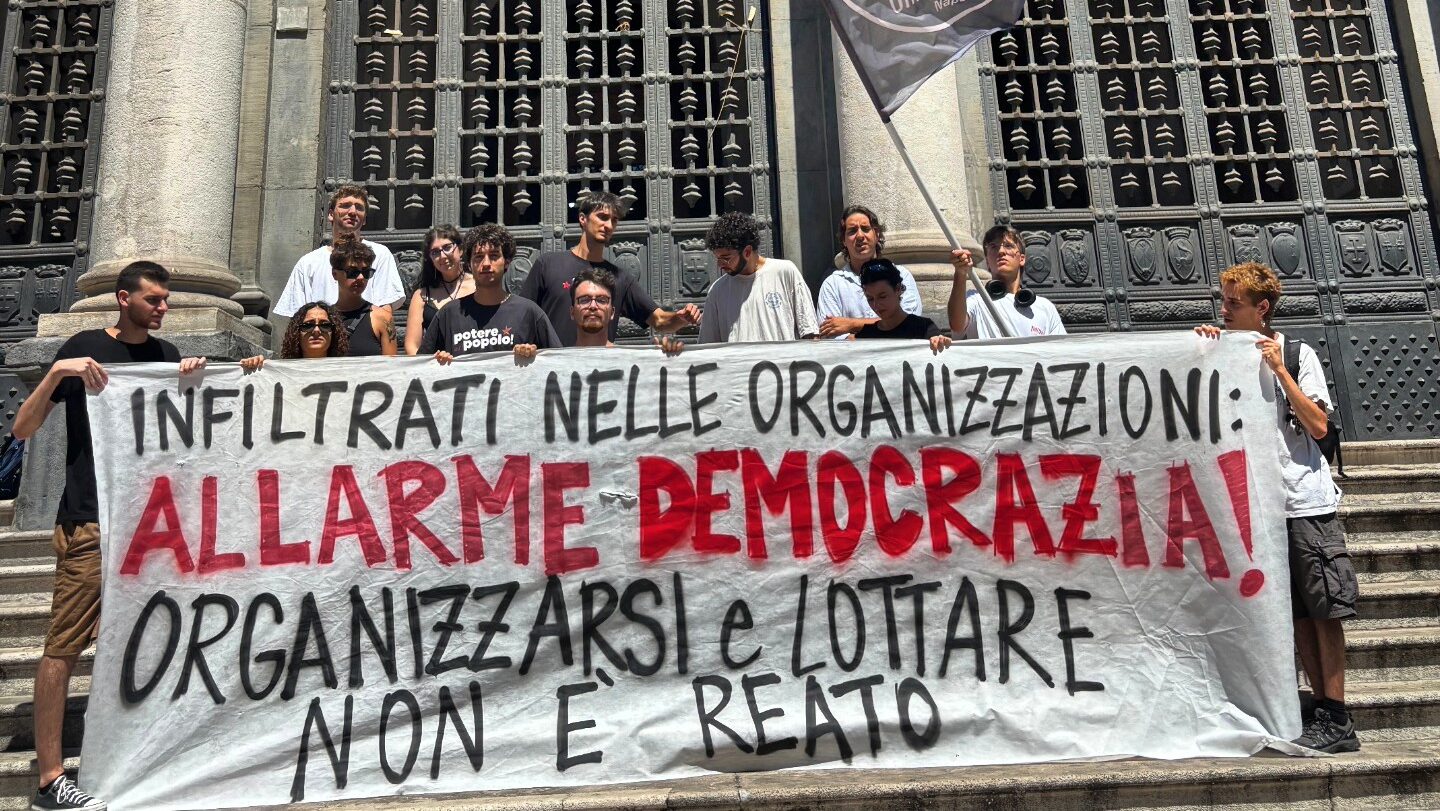
Activists protesting against police infiltrations in Italy. Source: Cambiare Rotta/Facebook

Potere al Popolo is pressing the Meloni government to explain five police infiltration attempts targeting the party’s youth organizations.

Italian left party Potere al Popolo! (Power to the People!) continues to demand full government transparency following revelations that multiple police agents infiltrated the party’s youth groups, Collettivo Autorganizzato Universitario (Self-Organized University Collectives, CAU) and Cambiare Rotta (Changing Course). For approximately eight months, undercover police officers infiltrated or attempted to infiltrate chapters in Naples, Milan, Bologna, and Rome, only to be uncovered through by the party’s internal investigation and independent media outlet Fanpage.

Speaking to Peoples Dispatch, Giuliano Granato, one of Potere al Popolo’s spokespeople, stated that the party is exploring all potential avenues for action, emphasizing that it will not wait passively in the meantime. A key priority is compelling the relevant institutions, including Prime Minister Giorgia Meloni and Interior Minister Matteo Piantedosi, to publicly explain what happened. “They owe the public some answers,” Granato says. “Who ordered this operation? Who planned it? And on what grounds?”

Read more: Italian left party uncovers more cases of police infiltration in their ranks

Meloni’s government and institutions, however, are not known for responding transparently to uncomfortable questions. This became evident again after the first case was exposed in May, when official statements ranged from evasive to outright absurd. One explanation offered, Granato recalls, was that the officer who infiltrated the youth group in Naples had done so not as part of an official assignment, but rather because he had “fallen in love with a Potere al Popolo activist.”

“Are we now supposed to believe five officers from the same training course all suddenly fell in love with five of our activists at the same time?”

Another line of defense claimed that while the infiltrations were official operations, they did not target Potere al Popolo as a political party, but only the specific youth collectives. Yet, even if one was to accept the dubious legitimacy of undercover operations in youth organizations on campuses, that explanation raises new questions. As Granato notes, there are many youth collectives across Italy active on similar issues, including Palestine solidarity and housing. “And yet, the only ones where infiltrators were discovered are the ones organically tied to Potere al Popolo.”

A state increasingly intolerant of dissent

Granato also stresses the importance of keeping public attention on the issue. Since the revelations in May, Potere al Popolo! has received solidarity from grassroots networks and trade unions, civil society organizations, and even a few opposition parties that submitted formal inquiries to the government. “In contrast to this, there has been no media uptake of the case,” Granato said. “Apart from Fanpage, only Il Fatto Quotidiano and il manifesto covered it. The rest of the mainstream media landscape? Radio silence. All the big self-declared progressive media ignored it.”

“This is a very grave thing,” he continues, “because these are the same center-left media that now and then raise concerns about Meloni’s authoritarian drift.” By choosing not to cover the infiltrations in Potere al Popolo, Granato suggests, they show that they will only raise issues when it benefits them, ignoring the public interest when it doesn’t.

The tendency is particularly worrying in the current context, Granato says, considering the infiltration of Potere al Popolo is not an isolated case but part of a broader trend. He points to connections to other recent cases, such as the surveillance of Fanpage journalists and of activists from Mediterranea Saving Humans, who have challenged the government’s deadly migration policies through their work. He also mentions the government’s so-called security decree and an ongoing campaign against the right to strike. “If we connect all these little dots, what emerges is a picture of a government and institutions that are less and less tolerant of dissent,” Granato explains.

Read more: “Disarmiamoli!” brings 30,000 to Rome against NATO and war

Yet it is not individual dissent they are afraid of. Instead, what state authorities and institutions fear is collective dissent that organizes people and gives them the tools to change the status quo, Granato says. This fear is one of the reasons why they would want to infiltrate Potere al Popolo, as they recognize it as a political force capable of posing a real threat to the structures they want to protect.

One way to resist this tendency, Granato concludes, is to remain persistent in showing solidarity, including to those who have been infiltrated by the police. “Publicly showing solidarity means publicly showing there’s still a democratic fabric that hasn’t been destroyed, both in Italy and beyond.”

Original article by Ana Vračar republished from peoples dispatch under a Creative Commons Attribution-ShareAlike 4.0 (CC BY-SA) license.
Continue ReadingItalian left party demands answers over police infiltration scandal

Italian left party uncovers more cases of police infiltration in their ranks

Spread the love

Original article by Ana Vračar republished from peoples dispatch under a Creative Commons Attribution-ShareAlike 4.0 (CC BY-SA) license.
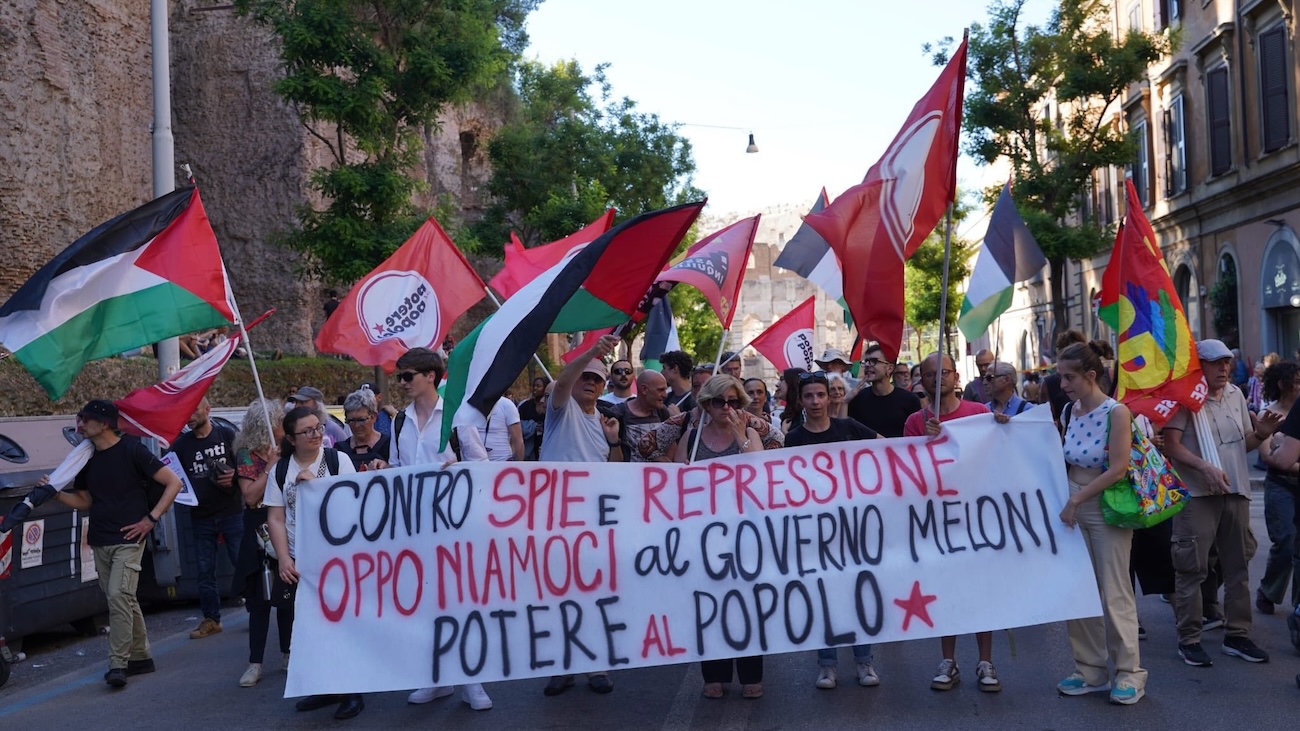
Potere al Popolo activists with banner reading: “Against spies and repression. Let’s stand up to the Meloni government”. Photo: Potere al Popolo

Following the exposure of an undercover operation in its Naples chapter, Potere al Popolo has reported additional cases of police spying in other Italian cities.

After discovering that a young police officer had infiltrated Potere al Popolo (Power to the People) in Naples at the end of May, the party, together with media outlet Fanpage, uncovered four similar cases in Milan, Bologna, and Rome. The officers approached the organization primarily through one of its youth collectives, Cambiare Rotta (Changing Course), between October and November 2024, shortly after graduating from the same police course and just before being assigned to the Central Police Directorate for Crime Prevention, an agency dedicated to investigating terrorism.

Read more: Police targets Potere al Popolo in undercover operation

During this period, the officers actively participated in demonstrations against the cost of living crisis, in solidarity with Palestine, and in anti-militarization actions. They often presented themselves as out-of-town students with few connections at local universities. Their involvement went deep: some supported election campaigns for official student bodies. At the same time, other activists noticed inconsistencies – none of the identified officers engaged in activities beyond political work, for example, an unusual pattern in youth organizing.

While the infiltration operations in Naples, Milan, and Bologna lasted about eight months, the effort in Rome was short-lived. Activists there quickly grew suspicious of the officer’s background story and the way he tried to approach the organization.

Italian left party uncovers more cases of police infiltration in their ranks
Protestors take the streets to demonstrate against rearmament and NATO. Photo: Potere al Popolo

By late June, all those identified had ceased contact with Potere al Popolo, but one officer was present at a demonstration in Bologna when news of the Naples infiltration broke publicly last month. “The moment there was a public denunciation in that demonstration in Bologna, about the Naples episode, this person disappeared from one day to the next,” said Giuliano Granato of Potere al Popolo. “We haven’t heard from him since.”

A threat to democratic rights and structures

Back in May, the party had denounced the Naples case as a disturbing sign of the government’s authoritarian drift, undermining the democratic character of Italian society and constitutional values. That warning has since prompted several parliamentary parties to demand explanations from Prime Minister Giorgia Meloni’s government – none of which have been provided. With these new revelations, alongside confirmed instances of journalists being spied on, concerns are mounting over the administration’s trajectory.

“It shows us the path of repression this government is taking through, and I quote Giorgia Meloni’s own words, ‘regime methods’,” said Anita Palermo of Potere al Popolo Rome. “We appeal to social and democratic forces, associations, and citizens to mobilize so that political activity in this country can take place in a democratic way, without fear of police infiltration.”

During a press conference on June 27, Granato added that the infiltration and surveillance of political parties, humanitarian organizations working with migrants, and journalists were indicative of the government’s own fear. The fact that they are prepared to launch such operations shows that the government is terrified of dissent, he said.

“But dissent is the salt of democracy,” Granato added, insisting that the experience of Potere al Popolo has far broader relevance. “If the state can plant an undercover officer inside a political party, it can do the same to a union or a newsroom.”

Read more: “Disarmiamoli!” brings 30,000 to Rome against NATO and war

Trade unions and social collectives have condemned the police operations as a clear attack on political and civil rights. Many interpret it as part of the Meloni government’s increasingly repressive stance toward political opposition. This comes at a moment when Potere al Popolo, alongside grassroots unions, is leading a national campaign against war, NATO, and the European Union’s rearmament agenda.

According to the Unione Sindacale di Base (USB), the attack on Potere al Popolo and its affiliated groups is emblematic of the broader political climate. “It’s a snapshot of the cultural and political values of a class that has openly aligned itself with war and rearmament,” the union said.

“And in a climate of war, the first targets are those who oppose it clearly and unequivocally, voices that must be preemptively silenced even when they act with full transparency,” the USB warned. “The ‘war system’ and all its economic and social ramifications … allows no dissent because it demands we all silently enlist in its cause. And that cause crushes democracy, packing away our freedoms in the attic.”

Original article by Ana Vračar republished from peoples dispatch under a Creative Commons Attribution-ShareAlike 4.0 (CC BY-SA) license.

Continue ReadingItalian left party uncovers more cases of police infiltration in their ranks

Italy marks 80 years since liberation with calls against genocide and militarism

Spread the love

Original article by Ana Vračar republished from peoples dispatch under a Creative Commons Attribution-ShareAlike 4.0 (CC BY-SA) license.

Source: Potere al Popolo Bologna e provincia/Facebook

On the 80th anniversary of liberation from Nazi-fascism, left forces in Italy mobilize against genocide, armament, and the Meloni government

In the coming weeks, many European countries will mark the 80th anniversary of liberation from Nazi-fascist occupation. Italy is among the first, with dozens of events organized for April 25 – Liberation Day – despite ongoing attempts by the Meloni government and right-wing forces to rewrite or erase the memory of the Resistance. For most grassroots groups, this year’s events aim to locate the values that inspired partisan fighters in the 1940s into today’s context, marked by an aggressive rearmament agenda, support for Israel’s genocide in Gaza, and domestic repression of civil rights.

“Eighty years ago, our grandparents freed us from the grip of fascism. But remembering the past is not enough, especially not in the stale, institutional way the Democratic Party and center-left do,” Giuliano Granato of Potere al Popolo said during the demonstration in Naples. Along similar lines, the Unione Sindacale di Base (USB) stated that April 25 should not be reduced to a mere ritual or commemoration. “It should actualize the values and ideals of the partisan Resistance, which freed, perhaps not once and for all, this country from the barbarity of war and Nazi-fascism and provided an inescapable push toward better democratic, working, and living conditions for the people of this country,” the trade union declared in its call to action.

Against Israeli genocide

These values, according to USB, Potere al Popolo, and other left groups, must necessarily include opposition to genocide. In many cities, protesters have insisted that Italy’s ongoing ties with the Israeli occupation are unacceptable. These ties, they argue, are evidence that the political establishment has failed to grasp the true meaning and importance of the Resistance. Ahead of Liberation Day, the Genoa chapter of Potere al Popolo organized an action addressing President Sergio Mattarella, criticizing him for formally honoring the Resistance while remaining silent on the genocidal war against Palestinians and on the breakdown of democratic rights under the current government.

Potere al Popolo Genoa with banner reading: “Mattarella, antifascists don’t finance wars and genocide.” Source: Potere al Popolo Genoa/Facebook

“To do so [speak of the Resistance] after cozying up to the president of the criminal state of Israel, effectively supporting the ongoing genocide of the Palestinians, is an insult to those who, since the days of the partisan struggle, have fought against all genocide,” Potere al Popolo Genoa stated. “To honor the Resistance while equating the Soviet communists who liberated much of Europe from Nazism with the Third Reich is an insult to history and memory.”

Against armament

Equally prominent as the call to stop the genocide and sever ties with Israel is the demand to reject Europe’s new armament agenda, which will come at the cost of public services, education, healthcare, and climate justice. Giorgia Meloni’s administration and mainstream opposition parties alike have supported this agenda in different ways, endorsing increased spending on so-called defense and entertaining proposals for a joint European army. These priorities stand in stark contrast with the interests of Italy’s working class and the vision of a more just society that accompanied the antifascist Resistance.

Read more: Movement against increased military spending grows in Italy

“The rearmament plan launched by the EU represents the latest folly of a continental political class disinterested in building a present and future of peace and prosperity for the peoples of Europe,” warned USB. Similarly, Potere al Popolo called on people to rally around an alternative set of priorities: “We don’t need more money to enrich the arms industry. We need money for wages, for health care and services, for envisioning an ecological revolution and addressing the real challenge of our time, which is the climate crisis.”

Against new iterations of fascism

Meanwhile, Giorgia Meloni and her ministers are pursuing a different kind of battle, one aimed at minimizing the role of the antifascist struggle, led largely by communists, in shaping modern Italy. While the mainstream opposition tends to fixate on this behavior by the right wing, Granato warns that doing so risks missing important pieces of the puzzle.

“For us, Giorgia Meloni is simply following the path she’s always been on, one clearly tied to the rise of neo-fascism. After the defeat of Nazism, the slogan of the Italian Social Movement [neo-fascist party] was ‘neither renounce nor restore’ – and that’s exactly what Meloni is doing today. She doesn’t outright deny their fascist roots, but she also doesn’t walk around openly glorifying Benito Mussolini,” Granato told Peoples Dispatch.

The most recent attempt of the right to undermine the legacy of the Resistance came in the wake of the death of Pope Francis, when the government declared a record five days of mourning and called for “sobriety” at all public events. Many understood this to be an attempt to minimize April 25 events. Liberal and right-wing local administrations seized the opportunity to scale down and cancel rallies, while far-right media ran headlines such as April 25: Day of mourning. “Sure, they can claim they were referring to the death of the pope, but the truth is, they’ve been waiting 80 years for an excuse to print something like that, because for them, April 25 has always been a defeat,” says Granato.

Progressive forces, however, resisted, criticizing the government for using the death of a pope who – unlike the administration, called for peace and solidarity – to advance its agenda. They also refused to limit the day’s activities to commemorations, echoing the partisans’ revolutionary vision of a radically different society. “We don’t stop at the official ceremonies, not just because they’re cold and formulaic, but because we believe the fight for liberation and resistance isn’t over,” Granato explains. “Just like many partisans understood back then that toppling fascism wasn’t enough, we believe that defeating the Meloni government wouldn’t be enough either.”

A group of protesters after the central demonstration in Naples, April 25, 2025. Source: Ex-OPG Je so’ pazzo/Facebook

Instead, Granato calls on the people to work together to free themselves from contemporary forms of danger and oppression: first and foremost genocide and militarization. “We worked to make today a day of liberation from militarism and genocide and to link it to the mobilization we are building, including a national assembly in Rome on May 24, and a mass demonstration on June 21, just days before the NATO summit in The Hague,” he adds.

“We believe militarism has always been a tool of fascism. The militarization of Europe today goes hand-in-hand with growing authoritarianism at home and worsens conditions for the working class across the continent.”

Original article by Ana Vračar republished from peoples dispatch under a Creative Commons Attribution-ShareAlike 4.0 (CC BY-SA) license.

Continue ReadingItaly marks 80 years since liberation with calls against genocide and militarism