US President Donald Trump speaks to House Republican lawmakers during their annual policy retreat, January 6, 2026, in Washington
Campaigners call on public to join protests across the country demanding Starmer stands up to the far-right US president
PEACE campaigners have warned Sir Keir Starmer to break with US President Donald Trump now before Britain is embroiled in a “full-scale conflict” over “oil and empire” as Britons join protests around the country on Saturday.
The Prime Minister’s tepid reaction to the US attack on Venezuela and its abduction of President Nicolas Maduro and his wife Cilia Flores has already driven thousands out onto the streets this week.
Even more are expected this weekend at demonstrations in urban centres across the country on Saturday, including outside Downing Street at 1pm on and the US consulate in Edinburgh at 11am.
Campaigners called on the public to join them in keeping pressure on the government after the Labour leader this week said siding with Europe over the US would be a mistake in the wake of further US military threats on Greenland.
His reactions prompted further fury from activists, as the former human rights barrister also refused to say whether the US operations in Venezuela broke international law at PMQs.
Stop the War Coalition (StWC) convener Lindsey German told the Morning Star: “The British government should break with Trump and his far-right racist warmongering policies now before the world is embroiled in a full scale conflict for oil and empire.
Elon Musk urges you to be a Fascist like him, says that you can ignore facts and reality then.Donald Fuhrump says that Amerikkka doesn’t bother with crimes or charges anymore, not being 100% Amerikkkan and opposing his real estate intentions is enough.Orcas discuss how Trump was re-elected and him being an obviously insane, xenophobic Fascist.
In 2018, a colleague and I, together with a team of Greenlandic research assistants, conducted one of the most comprehensive surveys to date on public opinion in Greenland. We travelled to 13 randomly selected towns and settlements across the island nation, conducting in-person interviews with a representative sample of adult residents.
The survey explored a wide range of topics. We asked for views on climate change, economic matters – and the prospect of independence from Denmark. Until recently, this was the latest poll on what the people of Greenland thought about this issue.
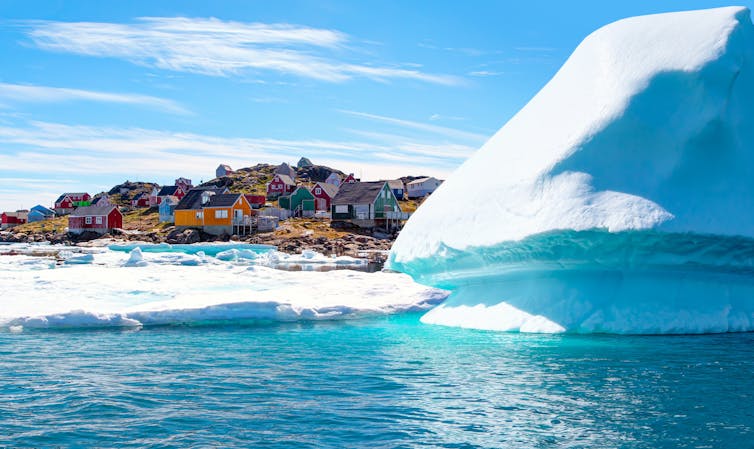
Greenland, a former Danish colony, is currently an autonomous territory within the Kingdom of Denmark. This political arrangement grants Greenland extensive self-rule, including control over most domestic affairs, as well as its own prime minister and parliament. However, Denmark retains authority over foreign policy, defence and monetary policy.
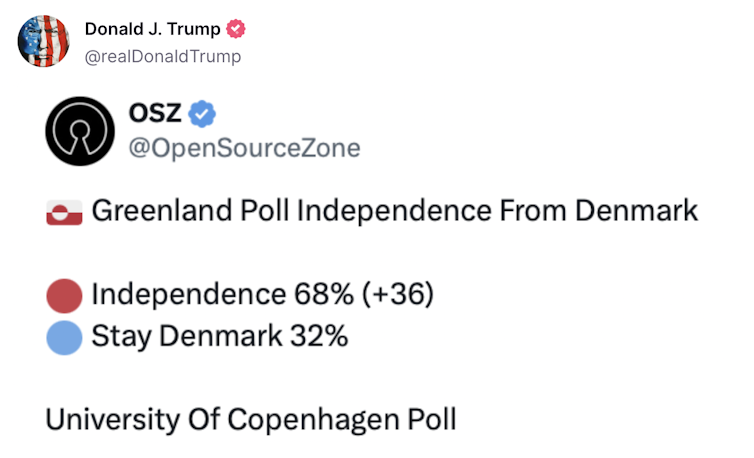
While our survey results were covered in Greenlandic and Danish media upon their release, they received scant international attention. This changed abruptly on January 15, when newly re-elected US president Donald Trump reposted an old news article about our results. The headline stated that two-thirds of Greenlandic citizens support independence.
Trump did not add a comment in the post but the insinuation was clear given his recent statements about annexing Greenland from Denmark: Greenlandic residents want independence from Denmark, and therefore, they might be open to other political or economic arrangements with the US.
“I think we’re going to have it,” Trump recently said after a phone call with the Danish prime minister, Mette Frederiksen, who told him the land was “not for sale”. Trump has in the past spoken of somehow “purchasing” Greenland but has since moved on towards speaking in more assertive terms about taking control of the territory.
Back in 2018, when we conducted the survey, Trump had not yet revealed any plans to annex the island nation. It was a scenario we could hardly even have imagined and therefore did not ask our participants about. As such, regardless of how Trump framed them, the survey results in no way indicated that the population harboured a desire to join the US.
In fact, a recent survey conducted by Sermitsiaq (a Greenlandic newspaper) and Berlingske (a Danish newspaper) directly addressed this question and found that only 6% of respondents wanted Greenland to leave Denmark and instead become part of the US.
In the study I published based on the 2018 data collection, I reported that a majority of the Greenlandic population aspired to independence. Two-thirds of the participants thought that “Greenland should become an independent country at some point in the future”.
Opinions were more divergent regarding the timing of independence. When asked how they would vote in an independence referendum if it were held today, respondents who stated a preference were evenly split between “yes” and “no” to independence.
The Act on Greenland Self-Government, passed in 2009, grants the Greenlandic government the legal authority to unilaterally call a referendum on separating from the political union with Denmark. According to the law, “the decision regarding Greenland’s independence shall be taken by the people of Greenland”.
During the 15 years since its passage, the option to call a referendum has not been exercised. This is likely due to the potential economic consequences of leaving the union with Denmark.
Each year, Denmark sends a block grant that covers approximately half of Greenland’s budget. This supports a welfare system that is more extensive than what is available to most Americans. In addition, Denmark administers many costly including national defence.
This backdrop presents a dilemma for many Greenlanders who aspire to independence, as they weigh welfare concerns against political sovereignty. This was also evident from my study, which revealed that economic considerations influence independence preferences.
For many Greenlanders, the island nation’s rich natural resources present a potential bridge between economic self-sufficiency and full sovereignty. Foreign investments and the associated tax revenues from resource extraction are seen as key to reducing economic dependence on Denmark. Presumably, these natural resources, which include rare earths and other strategic minerals, also help explain Trump’s interest in Greenland.
As Greenland’s future is likely to remain at the centre of a geopolitical power struggle for some time, it is crucial to remember that only Greenlanders have the right to determine their own path. What scarce information is available on their views suggests that while many aspire to independence, it is not driven by a desire to join the US.
Greenland’s concentration of natural resource wealth is tied to its hugely varied geological history over the past 4 billion years. Jane Rix/Shutterstock
Greenland, the largest island on Earth, possesses some of the richest stores of natural resources anywhere in the world.
These include critical raw materials – resources such as lithium and rare earth elements (REEs) that are essential for green technologies, but whose production and sustainability are highly sensitive – plus other valuable minerals and metals, and a huge volume of hydrocarbons including oil and gas.
The scale of Greenland’s hydrocarbon potential and mineral wealth has stimulated extensive research by Denmark and the US into the commercial and environmental viability of new activities like mining. The US Geological Survey estimates that onshore northeast Greenland (including ice-covered areas) contains around 31 billion barrels of oil-equivalent in hydrocarbons – similar to the US’s entire volume of proven crude oil reserves.
But Greenland’s ice-free area, which is nearly double the size of the UK, forms less than a fifth of the island’s total surface area – raising the possibility that huge stores of unexplored natural resources are present beneath the ice.
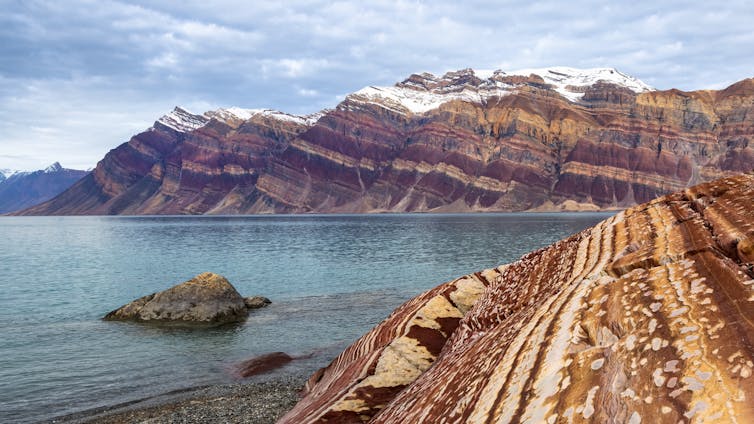
Greenland’s concentration of natural resource wealth is tied to its hugely varied geological history over the past 4 billion years. Some of the oldest rocks on Earth can be found here, as well as truck-sized lumps of native (not meteorite-derived) iron. Diamond-bearing kimberlite “pipes” were discovered in the 1970s but have yet to be exploited, largely due to the logistical challenges of mining them.
Geologically speaking, it is highly unusual (and exciting for geologists like me) for one area to have experienced all three key ways that natural resources – from oil and gas to REEs and gems – are generated. These processes relate to episodes of mountain building, rifting (crustal relaxation and extension), and volcanic activity.
Greenland was shaped by many prolonged periods of mountain building. These compressive forces broke up its crust, allowing gold, gems such as rubies, and graphite to be deposited in the faults and fractures. Graphite is crucial for the production of lithium batteries but remains “underexplored”, according to the Geological Survey of Denmark and Greenland, relative to major producers such as China and South Korea.
But the greatest proportion of Greenland’s natural resources originates from its periods of rifting – including, most recently, the formation of the Atlantic Ocean from the beginning of the Jurassic Period just over 200 million years ago.
Greenland’s onshore sedimentary basins such as the Jameson Land Basin appear to hold the greatest potential of oil and gas reserves, analogous to Norway’s hydrocarbon-rich continental shelf. However, prohibitively high costs have limited commercial exploration. There is also a growing body of research suggesting potentially extensive petroleum systems ringing the entirety of offshore Greenland.
Metals such as lead, copper, iron and zinc are also present in the onshore (mostly ice-free) sedimentary basins, and have been worked locally, on a small scale, since 1780.
Difficult-to-source rare earth elements
While not as intimately related to volcanic activity as nearby Iceland – which, uniquely, sits at the intersection of a mid-ocean ridge and a mantle plume – many of Greenland’s critical raw materials owe their existence to its volcanic history.
REEs such as niobium, tantalum and ytterbium have been discovered in igneous rock layers – similar to the discovery (and subsequent mining) of silver and zinc reserves in south-west England, which were deposited by warm hydrothermal waters circulating at the tip of large volcanic intrusions.
Critically among REEs, Greenland is also predicted to hold sufficient sub-ice reserves of dysprosium and neodymium to satisfy more than a quarter of predicted future global demand – a combined total of nearly 40 million tonnes.
These elements are increasingly seen as the most economically important yet difficult to source REEs because of their indispensable role in wind power, electric motors for clean road transport, and magnets in high-temperature settings like nuclear reactors.
The development of known deposits such as Kvanefield in southern Greenland – not to mention those not yet discovered in the island’s central rocky core – could easily affect the global REE market, owing to their relative global scarcity.
An unfortunate dilemma
The global energy transition came about due to increasing public recognition of the manifold threats of burning fossil fuels. But climate change has major implications for the availability of many of Greenland’s natural resources that are currently blanketed by kilometres of ice – and which are a key part of that energy transition.
An area the size of Albania has melted since 1995, and this trend is likely to accelerate unless global carbon emissions fall sharply in the near future.
Recent advances in survey techniques, such as the use of ground-penetrating radar, allow us to peer with increasing certainty beneath the ice. We are now able to obtain an accurate picture of bedrock topography below up to 2 km of ice cover, providing clues as to the potential mineral resources in Greenland’s subsurface.
However, progress is slow in prospecting under the ice – and sustainable extraction is likely to prove even harder.
Soon, an unfortunate dilemma may need to be addressed. Should Greenland’s increasingly available resource wealth be extracted with gusto, in order to sustain and enhance the energy transition? But doing so will add to the effects of climate change on Greenland and beyond, including despoiling much of its pristine landscape and contributing to rising sea levels that could swamp its coastal settlements.
Currently, all mining and resource extraction activities are heavily regulated by the government of Greenland through comprehensive legal frameworks dating from the 1970s. However, pressures to loosen these controls, and to grant new licences for exploration and exploitation, may increase amid the US’s strong interest in Greenland’s future.
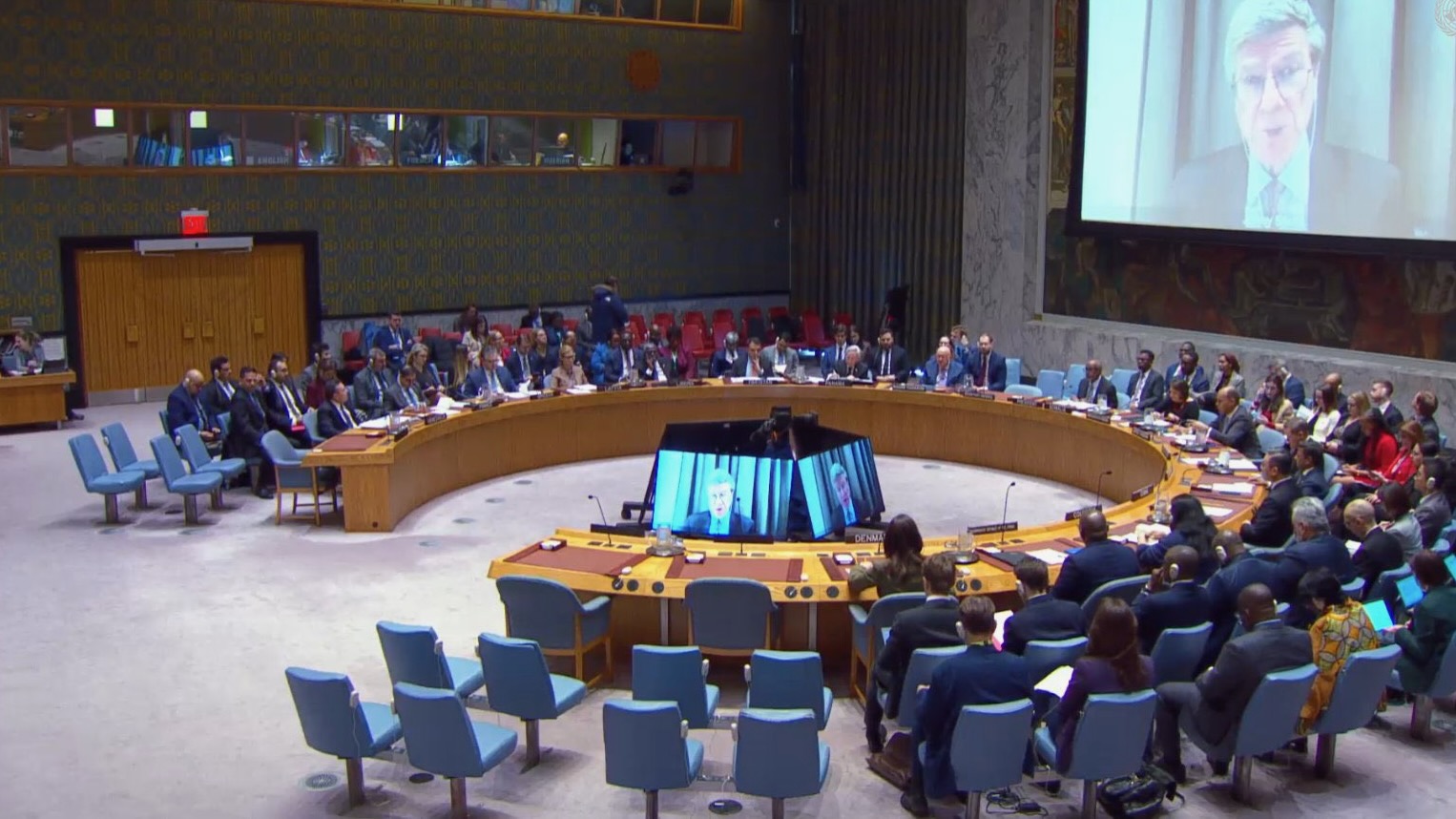
The high-level diplomatic meeting was marked by two clearly distinguishable positions: those who supported Washington’s actions and those who rejected them, claiming they violated international law and the South American country’s national sovereignty.
Rosemary DiCarlo, representative of the Secretary-General, said that the actions could generate greater instability in the nation: “We meet at a grave time following the January 3 United States military action in the Bolivarian Republic of Venezuela.” In addition, DiCarlo, following the statements of Secretary-General Antonio Guterres, emphasized that the attack constituted a military aggression that violates the UN Charter.
Future of the UN Charter at stake
Renowned scholar Jeffrey D. Sachs, president of the UN Sustainable Development Solutions Network, also addressed the session and highlighted that beyond the immediate violation of Venezuela’s sovereignty, the US actions constitute an existential threat to the entire UN system. “The issue before the Council today is not the character of the government of Venezuela. The issue is whether any Member State—by force, coercion, or economic strangulation—has the right to determine Venezuela’s political future or to exercise control over its affairs. This question goes directly to Article 2(4) of the United Nations Charter, which prohibits the threat or use of force against the territorial integrity or political independence of any state.”
Sachs implored the UNSC to take action and call on the US to end its military threats and attacks against Venezuela, end its naval blockade, and withdraw its military forces from the Caribbean which have been amassing since August.
Sachs affirmed that, “Peace and the survival of humanity depend on whether the United Nations Charter remains a living instrument of international law or is allowed to wither into irrelevance.”
Neocolonialism, illegalityand imperialism: condemnation of the attack
Samuel Moncada, Venezuela’s representative to the Security Council, strongly condemned the US military actions against his country. He stated that what happened on January 3 constituted an “illegitimate armed attack” that lacked legal justification and violated the UN Charter, the Geneva Convention, and the principles of sovereignty. The situation also calls into question the “credibility of international law,” as it seems that “the law is optional” when it is one country and not another that “kidnaps a head of state”.
China
Along the same lines, Fu Cong, representative of China, said: “[China] strongly condemns the unilateral, illegal, and bullying acts against Venezuela.” “[The United States] wantonly tramples upon Venezuela’s sovereignty, security, and legitimate rights and interests,” he said. He also called on the United States to return to dialogue to reach a peaceful solution.
Cuba
Cuba, for its part, categorically rejected the “imperialist and fascist aggressions” of the United States and warned of “criminal and hegemonic plans” that Washington is carrying out. In addition, the Cuban representative stated that the United States commits acts of economic suffocation and maritime terrorism against the governments it seeks to overthrow, which is in flagrant contradiction with the UN Charter and international law. He asserted that the objective behind the “kidnapping” of Maduro and his wife, Cilia Flores, is to gain “control over Venezuela’s land and natural resources.”
Russia
Likewise, the representative of the Russian Federation, Vassily Nebenzia, condemned the “armed aggression” against Venezuela for violating international law and demanded the immediate release of the “legitimately-elected president”, Nicolás Maduro. He also called for an end to fear and hypocrisy in the face of US actions that seek to justify “such an egregious act of aggression [out of fear of the] American global gendarme.” Finally, he stated that the actions of the United States constitute new examples of “neocolonialism and imperialism”.
Colombia
For her part, Leonor Zalabata said that her country, Colombia, strongly condemns the actions of January 3, and affirmed that the use of force, according to the UN Charter, can only be used in exceptional situations, such as self-defense, but never to take political control of another state, as Trump said he would do with Venezuela. The attacks, she added, could lead to a large-scale migration that would require significant budget allocations to care for the migrants. Colombia shares thousands of kilometers of border with Venezuela, and Trump has directly threatened Colombian President Gustavo Petro with carrying out a similar attack on Colombian territory.
Mexico
Mexico also strongly criticized the military attack and stated that such actions “should not be allowed” because they jeopardize multilateralism and international law. It called on members to abandon double standards and “act decisively” in respect for the national sovereignty of the peoples of each country, who are the only ones authorized to decide “their destiny”.
Brazil
Brazil also joined in the criticism. Representative Sérgio França stated that “South America is a zone of peace,” and therefore his country rejects military intervention in Venezuela, which “crossed an unacceptable line”, and violates the UN Charter and international law.
The violation of international law: moderate criticism of the United States
Several members of the Security Council also criticized Washington’s actions, albeit indirectly or less forcefully.
United Kingdom
Among them was the United Kingdom, whose representative, James Kariuki, stated that his country reaffirms its commitment to international law and the principles of the United Nations. However, he also criticized the actions of the Maduro government for allegedly increasing poverty, repressing the opposition, and the illegitimacy of his government.
Panama
Along the same lines, Panama’s representative, Eloy Alfaro de Alba, condemned the US attack. He stated that US military actions could have very serious consequences for peace in the Latin American region. He also stressed that his country, which suffered a US invasion between 1989 and 1990, reaffirms its respect for the sovereignty of nations. However, he also took the time to criticize what he called Maduro’s illegitimate and authoritarian government, which he said had eroded the democratic system after the 2024 elections.
Chile
Chile was another country that criticized the US military actions “unilaterally in Venezuela,” according to the South American country’s representative, Paula Narváez. “Chile does not recognize the Maduro regime, but serious human rights violations… cannot be resolved militarily and can only be addressed through peaceful, gradual, and incisive processes.”
“There is no war”: in defense of the US attack
For his part, US representative Michael Waltz defended his government’s actions and stated that “there is no war against Venezuela or its people”. On the contrary, Waltz argued that the attack was “a surgical law enforcement operation to apprehend two indicted fugitives, [the] narco-terrorist Nicolás Maduro and Celia Flores.”
Argentina
Another country that openly supported the attack was Argentina. Its representative, Francisco Tropepi, welcomed Trump’s “decisive action” and stated that it was justified by Maduro’s alleged involvement in drug trafficking. However, he called for the situation to be normalized and for institutional order to be restored as soon as possible.
Latvia
Along the same lines, Latvia’s representative, Sanita Pavļuta-Deslandes, indirectly justified the radical measure taken by the United States when she told the Security Council that Maduro’s government had violated human rights and encouraged drug trafficking and corruption.
The international community and international law are under threat
However, despite some direct and indirect support, the United States’ actions have not been well received by the majority of the United Nations Security Council. Several of its members understand that if such actions are not strongly condemned, they could pave the way for similar military actions in other parts of the world.
Asian and African countries fear a new wave of colonialism in their lands, and Europeans, many of whom do not support Maduro, see expansionist arguments looming over Greenland, which have not been heard in Europe for centuries.
Thus, the international community and international law (both structured after the defeat of the Axis in 1945) face an immense challenge following the attack on Venezuela. Whether they will emerge stronger or weakened will become clear in the coming months.
Original article by Pablo Meriguet republished from peoples dispatch under Creative Commons Attribution-ShareAlike 4.0 (CC BY-SA) license.
Elon Musk urges you to be a Fascist like him, says that you can ignore facts and reality then.Donald Fuhrump says that Amerikkka doesn’t bother with crimes or charges anymore, not being 100% Amerikkkan and opposing his real estate intentions is enough.Orcas discuss how Trump was re-elected and him being an obviously insane, xenophobic Fascist.
This work by Middle East Monitor is licensed under a Creative Commons Attribution-NonCommercial-ShareAlike 4.0 International License.
Spanish Prime Minister Pedro Sanchez holds a press conference following the European Union (EU) Leaders’ Summit in Brussels, Belgium, on October 23, 2025. [Dursun Aydemir – Anadolu Agency]
Spanish Prime Minister Pedro Sanchez said on Monday that the territorial unity of Ukraine, the Gaza Strip and Venezuela is not open to negotiation.
In a post on the X platform, Sanchez said that “respect for the sovereignty of all states and their territorial integrity is a non-negotiable principle, from Ukraine to Gaza, including Venezuela”.
Commenting on remarks by US President Donald Trump, who described Greenland as having a strong strategic position and said the United States needs it for national security reasons, Sanchez expressed his rejection of those statements.
He added that Spain “will always remain actively committed to the United Nations and will be in full solidarity with Denmark and the people of Greenland”.
On Sunday, Spain, Brazil, Colombia, Mexico, Uruguay and Chile said in a joint statement that they “reject unilateral US military operations” in Venezuelan territory.
The statement, distributed by the Spanish authorities, said: “We express our deep concern about what is happening in Venezuela and our rejection of unilateral military actions carried out on Venezuelan territory.” Such actions had violated the “basic principles of international law, in particular the prohibition of the use of force and respect for territorial sovereignty established in the United Nations Charter.”
This work by Middle East Monitor is licensed under a Creative Commons Attribution-NonCommercial-ShareAlike 4.0 International License.
Elon Musk urges you to be a Fascist like him, says that you can ignore facts and reality then.Donald Fuhrump says that Amerikkka doesn’t bother with crimes or charges anymore, not being 100% Amerikkkan and opposing his real estate intentions is enough.Orcas discuss how Trump was re-elected and him being an obviously insane, xenophobic Fascist.

 US President Donald Trump speaks to House Republican lawmakers during their annual policy retreat, January 6, 2026, in Washington