‘No Legal Basis,’ Says Harvard After Trump Declares Tax-Exempt Status Will Be Taken Away

Spread the love

Original article by Eloise Goldsmith republished from Common Dreams under Creative Commons (CC BY-NC-ND 3.0).
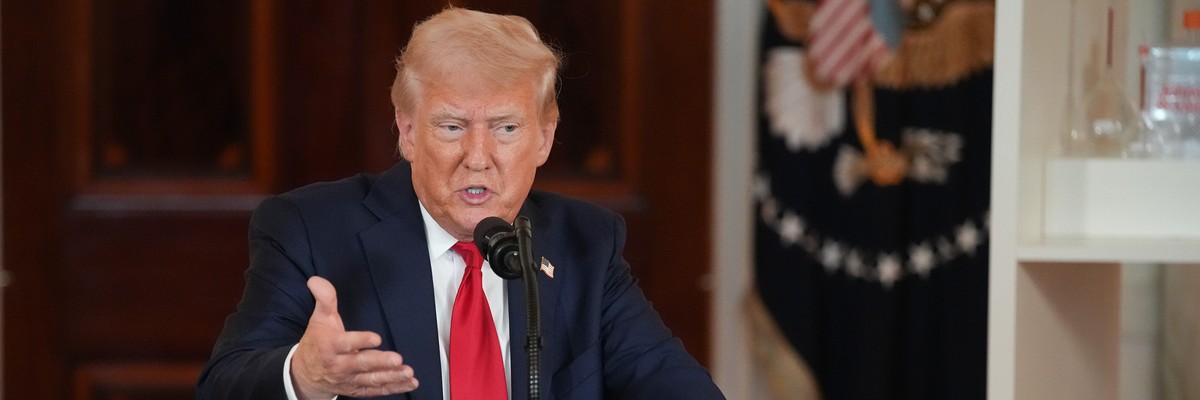
U.S. President Donald Trump speaks in the Cross Hall of the White House during an event on “Investing in America” on April 30, 2025 in Washington, D.C. (Photo: Andrew Harnik/Getty Images)

“Such an unprecedented action would endanger our ability to carry out our educational mission,” said a spokesperson for the Ivy League school.

Harvard University pushed back forcefully Friday after President Donald Trump declared in a social media post that “we are going to be taking away Harvard Tax Exempt Status,” adding that is “what they deserve.”

Trump’s comment came just hours after Democratic senators sent a letter demanding a probe into whether the administration is acting illegally by trying to compel the U.S. Internal Revenue Service to yank the university’s tax exemption.

Trump’s post did not specify whether the IRS, the entity that has the power to remove an organization’s tax-exempt status, is opting to remove Harvard’s designation. Multiple outlets noted they got no immediate response from the IRS when they asked the agency for comment.

“There is no legal basis to rescind Harvard’s tax-exempt status,” a university spokesperson said in a statement, according toPolitico. “Such an unprecedented action would endanger our ability to carry out our educational mission.”

It is illegal for the president, vice president, or other top officials to request, indirectly or directly, that the IRS audit a particular taxpayer.

Senate Minority Leader Chuck Schumer (D-N.Y.) and multiple other Democratic senators on Friday asked the Acting Treasury Inspector General for Tax Administration (TIGTA) to probe whether the IRS has received illegal pressure from the administration when it comes to Harvard, and to provide information about whether the agency is looking into other entities at the direction of the president or other top officials.

“It is both illegal and unconstitutional for the IRS to take direction from the president to target schools, hospitals, churches, or any other tax-exempt entities as retribution for using their free speech rights,” the senators wrote in a letter dated Friday to the Acting TIGTA Heather Hill.

“It is further unconscionable that the IRS would become a weapon of the Trump administration to extort its perceived enemies, but the actions of the president and his operatives have now made this fear a reality. We request that you review whether the president or his allies have taken any step to direct or pressure the IRS to take politically-motivated actions regarding the tax-exempt status of the president’s political targets,” they continued.

Loss of tax-exempt status, something that would only typically occur after an audit process that allows the university opportunity to defend itself and appeal, would be extremely significant for the university. Tax-exempt status means the school does not pay federal income tax on charitable contributions to the school and other income. It also means that donations to the school are tax-exempt for those who make them.

Trump mused publicly on April 16 that Harvard should lose its tax-exempt status, after the university’s president said the institution would not comply with a list of policy demands from the president, that included, according to the Harvard Crimson, derecognizing pro-Palestine student groups and auditing academic programs for viewpoint diversity. The pushback from Harvard prompted the administration to freeze over $2 billion in federal funding for the school.

That same week, it was reported that the IRS was making plans to revoke Harvard’s tax-exempt status.

In response to Trump’s bullying tactics, Harvard sued the administration, calling the freeze on funding unlawful and asking the court to restore it.

The tangling between Harvard and the Trump administration is part of a broader wave of scrutiny by the White House on higher education.

Original article by Eloise Goldsmith republished from Common Dreams under Creative Commons (CC BY-NC-ND 3.0).

Orcas discuss Donald Trump and the killer apes' concept of democracy. Front Orca warns that Trump is crashing his country's economy and that everything he does he does for the fantastically wealthy.
Orcas discuss Donald Trump and the killer apes’ concept of democracy. Front Orca warns that Trump is crashing his country’s economy and that everything he does he does for the fantastically wealthy.
Neo-Fascist Climate Science Denier Donald Trump says Burn, Baby, Burn.
Elon Musk urges you to be a Fascist like him, says that you can ignore facts and reality then.
Continue Reading‘No Legal Basis,’ Says Harvard After Trump Declares Tax-Exempt Status Will Be Taken Away

Harvard Suit: Trump Admin Punishing University for ‘Protecting Its Constitutional Rights’

Spread the love

Original article by Jessica Corbett republished from Common Dreams under Creative Commons (CC BY-NC-ND 3.0). 

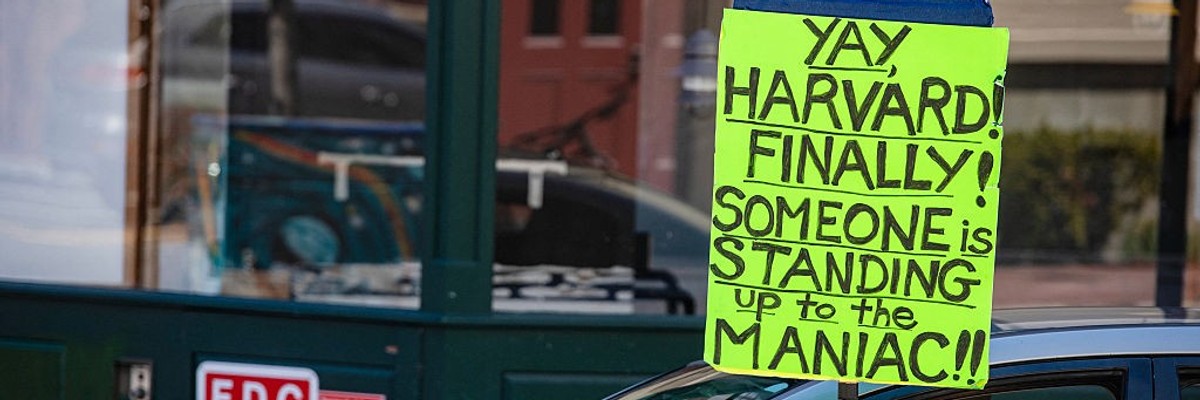
A demonstrator holds a sign after a rally against U.S. President Donald Trump’s attacks on Harvard University in Cambridge, Massachusetts on April 17, 2025.  (Photo: Joseph Prezioso/AFP via Getty Images)

“Indiscriminately slashing medical, scientific, and technological research undermines the nation’s ability to save American lives, foster American success, and maintain America’s position as a global leader in innovation.”

Harvard University sued multiple federal agencies and members of U.S. President Donald Trump’s Cabinet on Monday over a $2.2 billion funding “freeze” and reported plans to cut off another $1 billion, implemented in response to the nation’s oldest higher education institution rejecting the administration’s escalating demands.

In addition to the funding cuts, the Trump administration has “initiated numerous investigations of Harvard’s operations, threatened the education of international students, and announced that it is considering a revocation of Harvard’s 501(c)(3) tax-exempt status,” said Alan Garber, the university’s president, in a statement. “These actions have stark real-life consequences for patients, students, faculty, staff, researchers, and the standing of American higher education in the world.”

“Research that the government has put in jeopardy includes efforts to improve the prospects of children who survive cancer.”

“The consequences of the government’s overreach will be severe and long-lasting,” Garber explained. “Research that the government has put in jeopardy includes efforts to improve the prospects of children who survive cancer, to understand at the molecular level how cancer spreads throughout the body, to predict the spread of infectious disease outbreaks, and to ease the pain of soldiers wounded on the battlefield.”

“As opportunities to reduce the risk of multiple sclerosis, Alzheimer’s disease, and Parkinson’s disease are on the horizon, the government is slamming on the brakes,” he continued. “The victims will be future patients and their loved ones who will suffer the heartbreak of illnesses that might have been prevented or treated more effectively. Indiscriminately slashing medical, scientific, and technological research undermines the nation’s ability to save American lives, foster American success, and maintain America’s position as a global leader in innovation.”

Noting the Trump administration’s attempt to justify funding cuts by citing Harvard’s response to discrimiation against Jewish people, Garber said that “as a Jew and as an American, I know very well that there are valid concerns about rising antisemitism,” and pledged to “fight hate with the urgency it demands as we fully comply with our obligations under the law.” He also promised to soon release task force reports about combating antisemitism and Islamophobia on campus.

The university president’s lengthy message included a link to the 51-page complaint, filed in a federal court in Boston, Massachusetts. The defendants are the General Services Administration, National Aeronautics and Space Administration, National Institutes of Health, National Science Foundation, and the departments of Defense, Education, Energy, Health and Human Services, and Justice, along with the leaders of those agencies.

Like Garber’s statement, the complaint highlights the sweeping impacts of “the government’s efforts to use the withholding of federal funding as leverage to gain control of academic decision-making at Harvard” and other higher education institutions.

“Defendants’ actions threaten Harvard’s academic independence and place at risk critical lifesaving and pathbreaking research that occurs on its campus,” the filing states. “And they are part of a broader effort by the government to punish Harvard for protecting its constitutional rights.”

“The government’s actions flout not just the First Amendment, but also federal laws and regulations,” the complaint argues, asking the court “to enjoin defendants from exceeding the bounds of their legal authority and to protect Harvard’s constitutional rights.”

The Harvard Crimson, the campus newspaper, noted that the university “will be represented by Robert K. Hur ’95 and William A. Burck, both lawyers with deep ties to President Donald Trump. Hur was appointed to the United States Department of Justice by Trump in his first term, and Burck has served as counsel for the Trump Organization. Lawyers affiliated with law firms Ropes & Gray and Lehtosky Keller Cohn will also represent Harvard, according to the lawsuit.”

The Ivy League university’s suit was filed the same day that a coalition of 75 groups, led by the Leadership Conference on Civil and Human Rights, responded to Trump’s attacks on nonprofits by launching “The Pact: A Civil Rights Coalition Unity Commitment.”

“We have witnessed outrageous attacks on our work,” the coalition’s pact states, citing investigations of nonprofits, terminated grants, law firms fearing retribution, threats to revoke tax-exempt status, and the weaponization of civil rights laws. “We will not be divided. We will not be intimidated into silence or abandoning our communities.”

Original article by Jessica Corbett republished from Common Dreams under Creative Commons (CC BY-NC-ND 3.0). 
Orcas discuss how Trump was re-elected and him being an insane, xenophobic Fascist.
Elon Musk urges you to be a Fascist like him, says that you can ignore facts and reality then.
Neo-Fascist Climate Science Denier Donald Trump says Burn, Baby, Burn.
Continue ReadingHarvard Suit: Trump Admin Punishing University for ‘Protecting Its Constitutional Rights’

Harvard set up worthless carbon offsetting scheme that sold millions of junk credits

Spread the love

Original article by Fin Johnston republished from TBIJ under a Creative Commons Attribution-NonCommercial-NoDerivs 3.0 Unported License.

Project has sold credits to EasyJet, British American Tobacco and Ernst & Young

A carbon offsetting project set up by Harvard University’s endowment fund has sold millions of junk credits to major international companies, the Bureau of Investigative Journalism (TBIJ) can reveal.

After establishing the scheme in 2012 on land it has bought in Uruguay, Harvard ended its involvement when it sold the land across two deals in 2017 and 2019 worth a combined $450m. But the project is still active today and has sold enough credits to have supposedly offset over 5 million tonnes of CO2 emissions – roughly equivalent to what a million cars would produce in a year.

EasyJet, British American Tobacco and Ernst & Young are all among the biggest buyers of credits from the project.

The current owner of the project told TBIJ it had received no revenues from sales of carbon credits to these companies. A spokesperson for the Harvard fund said it does not comment on individual investments.

The project was given the green light to sell carbon credits in 2012 by Verra, the carbon credit standards body. But in 2022 it was given a rating of zero by an agency that assesses the effectiveness of carbon offsetting schemes.

More from this investigation Tobacco giant’s ‘carbon neutral vape’ was offset with junk credits

The rating means that the credits, which should each represent one tonne of emissions avoided or removed from the atmosphere, represent no change. In other words, the project has had no effect on the environment at all.

The Guanaré Forest Plantations Project, a vast reforesting scheme, was set up following the 2006 purchase of an area of land in eastern Uruguay about the size of Washington DC. It was ultimately paid for by the university’s endowment fund, Harvard Management Company (HMC), a $50bn vehicle which invests to support research and student bursaries.

Though the land was bought through two companies set up by HMC, and the running of the project was outsourced to a Uruguayan forestry company, all the money made from sales of carbon credits went to the Harvard fund.

[section omitted: What is carbon offsetting?]

Carbon offsets allow companies to make up for the carbon emissions they create by paying to avoid or remove emissions elsewhere. Each carbon credit represents a ton of carbon dioxide either removed from the atmosphere or prevented from entering it in the first place.

Offsetting has been the subject of much debate. Some argue it is necessary and provides much-needed incentives for investors to channel their money into green initiatives. Others have said it offers polluting companies a way to avoid reducing their own greenhouse gas emissions.

The $2bn global market for carbon offsets has been hit by a number of recent scandals – with reports claiming that many credits do not represent genuine carbon reductions.

On day one of this year’s Cop climate talks in Baku, an early agreement was reached over rules around the creation of a global carbon market, in theory paving the way for rich countries to pay for cheap climate action abroad.

Among the project’s customers was British American Tobacco, which purchased 130,000 credits to offset emissions from its flagship product Vuse, marketed by the company as “the world’s first carbon neutral vape brand”.

The coffee company Lavazza also bought credits from the project to offset the emissions of a supposedly “carbon neutral” coffee capsule it launched in 2022.

Renoster, the agency that gave the project a zero rating, raised three criticisms of the scheme. The first hinged on a factor known as “additionality”, which exists to prevent companies from going about their normal business – for example running a commercial timber project – and selling carbon credits on top. If a project could run without carbon finance, then it cannot be considered additional.

Documents submitted to Verra state that the project’s objective is to create “high value” timber products. Renoster ruled that carbon finance had ultimately made no difference. “We believe that these trees were going to be planted regardless of the project,” it said.

The second criticism was that the scheme’s “baseline assumptions” were wrong. A baseline number is something given to every carbon offsetting project, against which its removals are measured. The project had a baseline of 0, meaning no emissions whatsoever would have been removed from the atmosphere if the scheme did not exist.

Renoster said that baseline was “not a reasonable assumption for the region” because large portions of nearby land were already being converted from pasture to eucalyptus plantations.

Renoster’s third criticism was that the project was unlikely to run its full course, which was projected to be 100 years.

“We do not believe that Guanaré’s carbon credits represent true emissions reductions,” Renoster’s chief science officer, Elias Ayrey, told TBIJ. “We would not consider carbon neutrality claims based on these particular credits to be legitimate.”

The current owners of the project said: “Carbon credits have been critical for achieving the rates of return that investors required when the project started.” They said this cash means they can let the trees grow for longer before they are harvested.

A second agency, BeZero Carbon, also assessed the project and raised similar concerns around additionality and baseline assumptions. It found that the project had a “low” likelihood of achieving the purported emissions avoidance or removal.

The project has also been criticised by World Rainforest Movement, an organisation that monitors the Uruguayan forestry industry, which said: “Industrial tree plantations in Uruguay have led to land concentration by a small group of corporations and investment funds. They replace an extremely important ecosystem – grasslands – to plant tree monocultures, destroying biodiversity and watersheds.”

A BAT spokesperson told TBIJ that its carbon neutrality claim was independently validated in 2021. Lavazza said it had removed the claims from its products and is dedicated to transparency in all its sustainability initiatives.

An EasyJet spokesperson told TBIJ that it transitioned away from offsetting in 2022 but until then “had robust due diligence processes in place”.

Ernst & Young said it selects offsetting projects which have been certified against internationally recognised standards and continues to work on its due diligence procedures. It said it retired all remaining credits in this project in 2023.

This story was updated on 20 November 2024 to clarify the response given to TBIJ by the Harvard fund.

Reporter: Fin Johnston
Global health editor: Fiona Walker
Deputy editor: Chrissie Giles
Editor: Franz Wild
Impact producer: Paul Eccles
Production editor: Alex Hess
Fact checker: Somesh Jha

TBIJ has a number of funders, a full list of which can be found here. None of our funders have any influence over editorial decisions or output.

Original article by Fin Johnston republished from TBIJ under a Creative Commons Attribution-NonCommercial-NoDerivs 3.0 Unported License.

Continue ReadingHarvard set up worthless carbon offsetting scheme that sold millions of junk credits