This work by Middle East Monitor is licensed under a Creative Commons Attribution-NonCommercial-ShareAlike 4.0 International License.
The former High Representative of the European Union for Foreign Affairs and Security Policy and Vice-President of the European Commission, Josep Borrell, takes part in a debate at Casa Arabe on June 19, 2025, in Madrid, Spain. [Photo By Ricardo Rubio/Europa Press via Getty Images]
Former European Union foreign policy chief Josep Borrell Friday accused EU leaders of being complicit in Israel’s alleged crimes in Gaza by failing to impose sanctions, urging immediate action to uphold international law and human rights, Anadolu reports.
In an opinion piece for The Guardian, Borrell said Israel’s attacks on Gaza amount to genocide, citing the widespread killing and starvation of civilians as well as the destruction of infrastructure. He also pointed to daily violations of international law by Israeli forces and settlers in the West Bank and East Jerusalem.
“But for all those who have ears to hear and eyes to see, there can be little doubt that the Israeli government is committing genocide in Gaza, slaughtering and starving civilians after systematically destroying all the infrastructure in the territory,” he wrote.
Borrell argued that the EU’s continued inaction despite its legal obligations under the EU-Israel Association Agreement renders it complicit in the crisis.
“The EU has many levers it could pull to exert significant influence on the Israeli government,” he said, noting that the bloc is Israel’s largest trading partner and participates in several joint funding and exchange programs, including the Horizon and Erasmus programs.
He underlined that Article 2 of the agreement makes cooperation conditional on respect for human rights, meaning that EU leaders have a legal obligation to suspend the deal, warning: “Failure to do so would also be a serious violation of the association agreement with Israel.”
Borrell, who served as the EU’s high representative for foreign affairs and security policy until 2024, said he had pushed for stronger measures during his tenure but received little support from member states.
“This inaction has already seriously damaged its geopolitical standing, not only in the Muslim world but across the globe,” he said.
“The leaders of the EU and its member states will probably be called to account in the future for their complicity in the crimes against humanity committed by Netanyahu’s government,” he wrote.
“The EU must finally decide to sanction Israel without further delay,” he concluded.
This work by Middle East Monitor is licensed under a Creative Commons Attribution-NonCommercial-ShareAlike 4.0 International License.
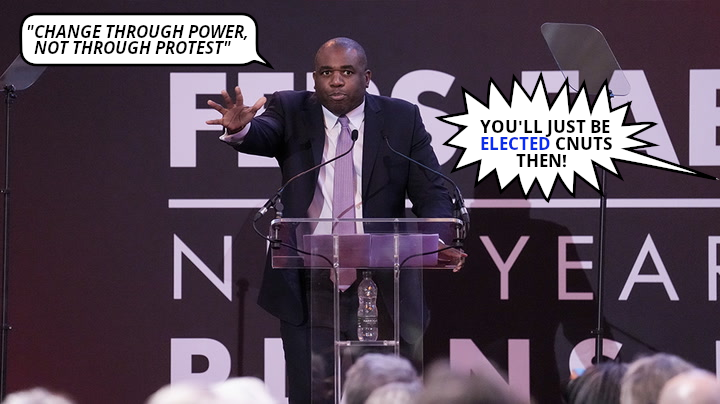
Genocide denier and Current UK Prime Minister Keir Starmer is quoted that he supports Zionism without qualification. He also confirms that UK air force support has been essential in Israel’s mass-murdering genocide. Includes URLs https://www.declassifieduk.org/keir-starmers-100-spy-flights-over-gaza-in-support-of-israel/ and https://youtu.be/O74hZCKKdpAUK Labour Party Shadow Foreign Secretary repeatedly heckled at a speech to the Fabian Society over his and the Labour Party’s support for and complicity in Israel’s genocide of Gaza.UK Labour Party government ministers Keir Starmer, Angela Rayner and Rachel Reeves explain that they are partners complicit in Israel’s Gaza genocide. The UK has provided Israel with arms, military and air force support. They explain that they don’t do gas chambers but do do forced marches, starvation, destroy hospitals, mass-murders of journalists and healthcare workers.
Palestine Action joke that appeared in the UK satirical publication ‘Private Eye’.
Sharing a Private Eye cartoon led to the arrest of a retired head teacher under the Terrorism Act
Full legal review set for September
High Court cites ‘recipe for chaos’ if legality of order isn’t reviewed as soon as possible
Dilemma sharpens for Met Chief ahead of mass protest on 9 August
“Recipe for chaos”
Today, 30 July, the High Court granted permission to Huda Ammori, co-founder of Palestine Action, to bring a full judicial review against the order of the Home Secretary, Yvette Cooper, proscribing the group as a ‘terrorist organisation’.
The ruling comes as a blow to Cooper, whose lawyers argued vigorously that the application should be refused, on the basis that the Terrorism Act contains a statutory process to apply for de-proscription.
Such a process can take years, however, whereas the judicial review is now due to be heard in September.
Mr Justice Martin Chamberlain rejected the Home Secretary’s position stating that:
“[T]he proscription order is likely to give rise to a substantial interference with rights guaranteed by the common law and by Articles 10 and 11 ECHR …
If the legality of the proscription order can properly be raised by way of defence to criminal proceedings, that would open up the spectre of different and possibly conflicting decisions on that issue in Magistrates Courts across England & Wales or before different judges or juries in the Crown Court. That would be a recipe for chaos. To avoid it there is a strong public interest in allowing the order to be determined authoritatively as soon as possible.”
He granted Huda Ammori leave to bring a full judicial review on the basis that it is arguable that:
1. The order is a disproportionate interference with Articles 10 and 11 of European Convention on Human Rights [the rights to freedom of expression and peaceful assembly]; and that
2. The Home Secretary should have consulted PA before making it and, by failing to do so, acted in breach of natural justice and/or contrary to Article 6 ECHR [the right to a fair hearing].
Dilemma for Met Commissioner ahead of mass protest on 9 August
It sharpens the dilemma for Sir Mark Rowley, the Met Commissioner, ahead of what is expected to be a mass protest of more than 500 people planned for 9 August [1A]. It would already be a huge and costly operation for the Met to arrest so many people for holding cardboard signs, people who are motivated by horror at the genocide in Gaza and a desire to uphold democratic freedoms. The prospect of the order being ruled unlawful opens up the further possibility that all those arrested and detained will later be awarded compensation payments for unlawful arrest.
As some of his colleagues have shown around the country, police have discretion as to whether to conduct arrests or not. Police in Totnes, Derry and Kendall for example have chosen to leave peaceful protestors be. On 9 August, Sir Mark will face a stark choice – to risk his own reputation with an absurd and costly operation to arrest 500 peaceful protestors for terrorism offences, or to undermine the Home Secretary’s position by applying common sense and allowing peaceful protestors to exercise their democratic rights.
A spokesperson for Defend Our Juries, the groups organising the protests, said:
“Yvette Cooper has no-one to blame for this crisis but herself. She was warned by her advisers that the ban would be “novel and unprecedented”, which is Whitehall mandarin-speak for ‘mad’.
If it wasn’t the police or the intelligence agencies pushing for the ban, who was it?
One of the grounds for the High Court’s ruling today was the Home Secretary’s failure to consult appropriately. While she consulted with the Israeli government and Elbit Systems on the merits of the order (and no prizes for guessing their position) she failed to consult with those adversely affected, such as Palestine Action and civil liberties organisations.
If you only consult with those who stand to benefit from your proposal, those who are committing and supporting genocide, but not those who will be adversely affected, not those who are acting to prevent genocide, your bias is already exposed.
We are confident the High Court will soon strike down this absurd and repugnant order, made at the bidding of the perpetrators of genocide.”
Chorus of criticism, mockery and defiance
The ruling comes amid a crisis of credibility for the order, which has been lambasted by lawyers, politicians and the UN alike, and openly mocked and defied across the country, on the streets, in print and online, already resulting in over 200 arrests for Terrorism Act offences.
In the House of Lords last week, former Secretary of State for Northern Ireland Lord Hain asked: “How have we got to the point where peacefully holding up a placard about the carnage in Gaza is equated with terrorism by Al Qaeda on 9/11 or Islamic State on countless occasions. And shouldn’t the police be concentrating on real terrorism and real crime, not targeting peaceful protesters?” [1]
Derry City and Strabane District Council ignored legal advice to pass a motion calling for the immediate overturning of the proscription, with Councillors openly wearing “We Are All Palestine Action” shirts.[1B].
Speaking to Al Jazeera, the former chief political commentator of The Daily Telegraph, Peter Oborne, warned that Yvette Cooper’s controversial ban of Palestine Action could lead to her resignation: “If the general populace comes to the conclusion that this is a stunt by the Starmer government … this legislation won’t take, people will regard it as ridiculous … you’ll end up having thousands of people coming out in support of Palestine Action, thousands of people declared terrorists. The law will suddenly look an ass, this government will lose a great deal of political credibility and in due course the Home Secretary might have to resign.” [2]
Tayab Ali, a leading lawyer at Bindmans, said:
“I would be extraordinarily surprised if the British Courts don’t strike [the ban] down. This is such an overreach.” [3]
After Private Eye satirised the ban with a cartoon, a retired head-teacher was arrested for displaying a copy of the cartoon, despite it being available in newsagents across the UK [4]. The comedian, Rosie Holt, has mocked “The new face of terrorism. It’s old, it’s wrinkly, it’s elderly and it’s dangerous.” [5]
On Friday, the UN Human Rights Chief, Volker Türk issued a press release stating:
“[The ban] appears to constitute an impermissible restriction on rights [to freedom of expression, peaceful assembly and association] that is at odds with the UK’s obligations under international human rights law.” [5A]
Previously, five UN Special Rapporteurs had written to the UK Government counselling against the use of Terrorism Act powers against Palestine Action [5B]. Amnesty International has spoken out against the ban, saying:
“Government embarrassment at security breaches is no proper basis for excessive and disproportionate interferences with human rights. It is precisely this kind of unlawful government action that critics of the UK’s terrorism laws warned would come one day.” [5C]
Shortly before the proscription, more than 23 organisations, led by the European Association of Lawyers for Democracy & World Human Rights, criticised the use of Terrorism Act powers against the Filton 18, members of Palestine Action, in a paper headed, “United Kingdom: The “Filton 18” case is a warning sign of democracy and rule of law decline” [5D], citing evidence political interference in the legal process by the Israeli government:
“Judicial independence and impartiality is a fundamental aspect of the right to a fair trial and the protection of human rights, and a prerequisite to the rule of law …
Documents obtained on 29 April 2025 through a Freedom of Information request have revealed that the UK government has shared contact details of counter-terrorism police and prosecuting authorities with the Israeli embassy in September 2024, during the investigation into the Filton 18 action and shortly after the Attorney General’s Office met with the Israeli ambassador to the UK. The documents disclosed were almost entirely redacted. However, documents disclosed in August 2023 evidence that the Israeli authorities have previously attempted to pressure the UK government to intervene in judicial proceedings relating to UK protests.
These communications, and the lack of transparency concerning their contents and whether these relate to the proceedings against Palestine Action members, raise serious questions around the independence and impartiality of prosecuting authorities in the Filton 18 case. These concerns are strengthened by the UN experts’ opinion that the use of anti-terrorism laws against the Filton 18 lacked a credible basis and may have pursued an ulterior purpose.”
On Saturday, police in Shenstone arrested a man in a wheel-chair, for wearing a T-shirt in support of Palestine Action. [6]
Home Office insinuations against Palestine Action contradicted by their own evidence
As part of the legal process, the Home Office was required to disclose the evidence available to the Home Secretary in support of proscription. It emerged that Home Office insinuations that Palestine Action is violent and funded by Iran were directly contradicted by the assessments provided to her.
The government’s Proscription Review Group (PRG) advised in March 2025 that a ban on Palestine Action would be “novel and unprecedented”, because “there was no known precedent of an organisation being proscribed… mainly due to its use or threat of action involving serious damage to property”. [7]
The Joint Terrorism Analysis Centre (JTAC) assessment noted: “PA media channels highly likely will only share footage, or encourage, instances of property damage. PA branded media will highly unlikely explicitly advocate for violence against persons”. [7]
On 23 June, the day of Cooper’s statement to parliament, the Times published a report saying “Iran could be funding Palestine Action, Home Office officials claimed”. This went on to be widely reported. Yet the JTAC assessment of Palestine Action’s sources of funding makes no mention of Iran, stating that Palestine Action “is primarily funded by donations, which can be made directly through their website or via crowdfunding. Other forms of revenue include the sale of merchandise”. [7]
Writing for Declassified, John McEvoy, the historian, film-maker and reporter, said:
“The discrepancy between the Home Office press briefings and the official intelligence reports raises the prospect that a state-linked disinformation campaign was waged against Palestine Action in order to manufacture public consent for proscription.” [7]
Yvette Cooper defied warnings from advisers to push through the ban
Strikingly, the Home Secretary was warned by her own advisers that proscription risked substantiating claims of pro-Israeli bias. A Community Impact Assessment produced by the Ministry of Housing, RICU (Research, Information and Communications Unit), and NPCC (National Police Chiefs’ Council), stated:
“Other reports documented Israeli embassy officials purportedly attempting to get the attorney general’s office to intervene in court cases. In the context of such reports, proscription could provide fertile ground for actors attempting to substantiate a pattern of bias”. [7]
The report goes on to say that a ban “could be seen as the partial realisation of Lord Walney’s efforts, which dissenting actors could argue were coloured by pro-Israel bias”. [7]
In May last year, Lord Walney, published a report calling for Palestine Action and Just Stop Oil to be banned. Successive governments falsely presented Lord Walney to the public as an ‘independent’ adviser on political violence and disruption. [8]
Lord Walney in fact has close ties to the Israeli government and is a paid lobbyist for the arms industry. [9] On 14 February this year, following a Defend Our Juries campaign to sack him, his role was removed, although the Home Office stated, his work would “continue to inform our approach”. [10]
The right to social security is enshrined in several international agreements on human rights. But the UK’s system – even before the disability benefits cuts announced earlier this year – falls way below these standards.
For a new report published today, Amnesty International asked my colleague Lyle Barker and me to review the evidence about the state of the UK’s social security in relation to international human rights law.
The UK has signed and ratified a number of international agreements on human rights. One of these is the 1966 International Covenant on Economic, Social and Cultural Rights (ICESCR), which lays out the right to social security. An accompanying document defines the three key principles of this right as:
Availability A social security system established in law, administered publicly, and materially reachable by those who need it.
Adequacy Benefits must be suitable, both in amount and in duration, to realise essential socioeconomic rights.
Accessibility Everyone should be covered by the social security system, paying particular attention to disadvantaged and marginalised individuals and groups.
The conclusion of our study for Amnesty International is crystal clear: even disregarding the cuts announced in March, the UK’s social security system does not meet these standards.
Availability
Our review of the literature shows a widespread underclaiming of benefits. It has been estimated that in 2024, £22.7 billion in income-related benefits went unclaimed, a £4 billion increase from the previous year.
Gaps in official data hinder a clear understanding of why many people are missing out on the support they are entitled to. But qualitative evidence suggests this is largely due to fear, stigma, bureaucratic and digital hurdles, and eligibility cliff edges for means-tested benefits.
In recent years, the UK government has adopted a contentious and punitive stance toward benefit recipients. Media and political rhetoric have portrayed those who claim benefits as idle or undeserving scroungers.
This stigma harms the mental health and self-esteem of people experiencing poverty. It can result in shame and secrecy, and create barriers to people accessing support they are entitled to.
Our research for Amnesty International concludes that UK claimants do not get enough information and support about their rights to benefits. Combined with the stigma of claiming, the UK is falling far short of making benefits “available” in line with international standards.
Adequacy
Since the austerity policies of the 2010s, the UK’s social security system has become significantly less adequate in supporting vulnerable people and families. The basic rate of universal credit (the main benefit for working-age people on a low income) is at 40-year low in real terms amid a cost of living crisis.
Restrictive policies, such as the benefit cap (introduced in 2013 to set a maximum limit to the total benefits received by a household) and the two-child limit have curtailed access to essential benefits. Although inflation adjustments in the last two years provided some relief, many benefits still fail to keep up with rising living costs.
The two-child limit is the cruellest expression of the inadequacy of the UK’s social security system. Introduced by the Conservative government in 2017, the two-child limit restricts financial support through universal credit to two children. It is likely to be the most significant single cause of child poverty in the UK, including in families where adults work but do not earn enough to make ends meet.
When Labour returned to power, there was much speculation about whether they would reverse the two-child limit. But despite pleas from experts and people with direct experience, the government has persisted in retaining it.
Accessibility
Our study lays out the many barriers to accessibility in the UK’s system. For example, the bureaucratic hurdles in the assessment process, and the disproportionate impact of punitive sanctions on lone mothers and on minority ethnic claimants.
The UK operates a benefits sanction regime, which imposes penalties on claimants who fail to meet certain conditions. These include attending jobcentre appointments or accepting job offers. In general, sanctions and the fear of sanctions erode the trust between benefit claimants and the social security system.
Benefits sanctions are just one of the barriers to accessing social security. 1000words/Shutterstock
As it did in its previous review in 2016, in February the UN Committee on Economic, Social and Cultural Rights recommended that the UK review the use of benefit sanctions to ensure they are used proportionately and are subject to prompt and independent dispute resolution mechanisms.
Another accessibility concern is the shift to a digital-by-default system in the 2010s. While intended to make accessing benefits more efficient, it has become an administrative barrier.
Many people, particularly the elderly and others who are less digitally literate, struggle to navigate the benefits system. It excludes people without reliable internet access, underscoring a digital divide that prevents meaningful access to social security.
Meeting standards
Given the evidence, it is no surprise that earlier this year, the UN Committee on Economic, Social and Cultural Rights urged the UK government to assess the cumulative effects of the austerity measures introduced in the 2010s.
In particular, the committee recommended reversing the two-child limit, the benefit cap and the five-week delay for the first universal credit payment, and increasing the budget allocated to social security. These recommendations were made before the changes announced in the spring statement.
To live up to the internationally recognised right to social security, the UK should recognise in law, policy and practice that social security is a human right. And, that it is essential to the fulfilment of other human rights.
Amnesty International recommends the government set up a commission with statutory powers, to produce a strategy for “wholesale reform” of the social security system. The UK must establish a minimum support level and an essentials guarantee, to ensure beneficiaries can consistently meet their basic needs. A good way to start would be abolishing the two-child limit once and for all.
Keir Starmer says that the Labour Party under his leadership all feel a small part of Scunthorpe.Keir Starmer, Angela Rayner and Rachel Reeves wear the uniform of the rich and powerful. They have all had clothes bought for them by multi-millionaire Labour donor Lord Alli. CORRECTION: It appears that Rachel Reeves clothing was provided by Juliet Rosenfeld.
Pope Francis greeting people in St. Peter’s Square in Vatican City in 2014. (Photo: Alfredo Borba/Creative Commons)
Again and again, Pope Francis railed against our collective indifference to widespread suffering and urged humanity, especially world leaders, to do better. It’s not too late to heed his call.
Like millions of other people, I was deeply saddened to hear of the passing of Pope Francis, one of the most vocal and humble advocates for sharing the world’s resources.
But at the heart of his advocacy was a focus on ending inequality both globally and on a national basis, repeatedly calling upon governments to redistribute wealth and benefits to the poor in a new spirit of generosity.
I first recall being struck by Pope Francis’ headline-grabbing speech in 2014, when he urged the United Nations to promote a ‘worldwide ethical mobilization’ of solidarity with the poor to help curb an ‘economy of exclusion’ that is taking hold everywhere today.
A year later in 2015, the papal encyclical Laudato Si’—subtitled ‘On care for our common home’—made bigger headlines around the world with its powerful critique of laissez-faire ideology and its destructive effects on the environment. The trenchant letter expounded on the responsibility of rich countries to address their ‘ecological debt’ to less developed countries, with an acknowledgement of ‘differentiated responsibilities’ in addressing climate change. It was a radical entreaty for resource transfers between the Global North and South, and significant reductions in the consumption of non-renewable energy within developed countries.
The eloquent discourse of Laudato Si’ also reflected the core understanding of many environmental activists—that the climate and inequality crises are inextricably interconnected. Again and again, Pope Francis railed against our collective indifference to widespread human suffering. He persistently argued that the welfare of nations is interrelated, so the massive poverty and hunger experienced in the fragile economies of developing nations is, in turn, reflected in the destruction of the natural environment. Hence the urgency of remediating the enormous discrepancies in living standards throughout the world, which calls for a sense of global solidarity and interdependency that is tragically lacking in human affairs.
During the coronavirus pandemic, Francis also set out the challenge for rich nations to cooperate and distribute the vaccine freely to the world, rather than hoarding resources and treating one’s own nation first. The 2020 encyclical titled Fratelli tutti—‘Brother’s all’—made clear that Covid-19 was exposing existing inequalities, and fraternity on a state level requires richer countries to help poorer ones if we are to give meaning to the equality of human rights. Clearly, the world failed to heed Pope Francis’ plea to ensure recovery from the crisis tackled poverty, inequality and the climate emergency by ‘sharing resources in a just and respectable manner’.
Another theme that Francis constantly returned to was the need for cancelling the debts of countries unable to repay them. In his final papal bull for the Jubilee Year 2025, titled Spes non confundit—‘Hope does not disappoint’—he described debt forgiveness as a matter of justice more than generosity, and again decried the true ecological debt that exists between the Global North and South.
Francis was rightly known as the ‘Pope of the peripheries,’ standing up for the most vulnerable and marginalized peoples. He made clear his opposition to Western government policies of battening down the hatches and draconian responses to international migrants. Soon after taking office, Francis visited the Italian island of Lampedusa where he condemned European ‘indifference’ to the drowning of migrants crossing the Mediterranean in small boats. He later visited numerous camps for excluded migrants and refugees living ‘ghost lives in limbo,’ calling upon us to see Christ in the stranger and outsider. This was a sharp rebuke to reactionary politicians like Trump, Meloni, and Orbán, instead emphasizing the need for ‘universal fraternity’ as influenced by St. Francis of Assisi, after whom the Pope took his name.
It was a fitting testament to Francis’ advocacy for the poor and forgotten that he died hours after calling for a ceasefire in Gaza. In his annual Urbi et Orbi —‘To the City and World’—message on Easter Sunday, the day before he died, Francis repeated his appeal to the warring parties to “come to the aid of a starving people that aspires to a future of peace.” Few politicians, it seems, have followed the Pope’s counsel throughout his 12-year-long pontificate. Which now leaves it up to us, the ordinary people of goodwill, to uphold Francis’ tireless advocacy and hope for a better world.
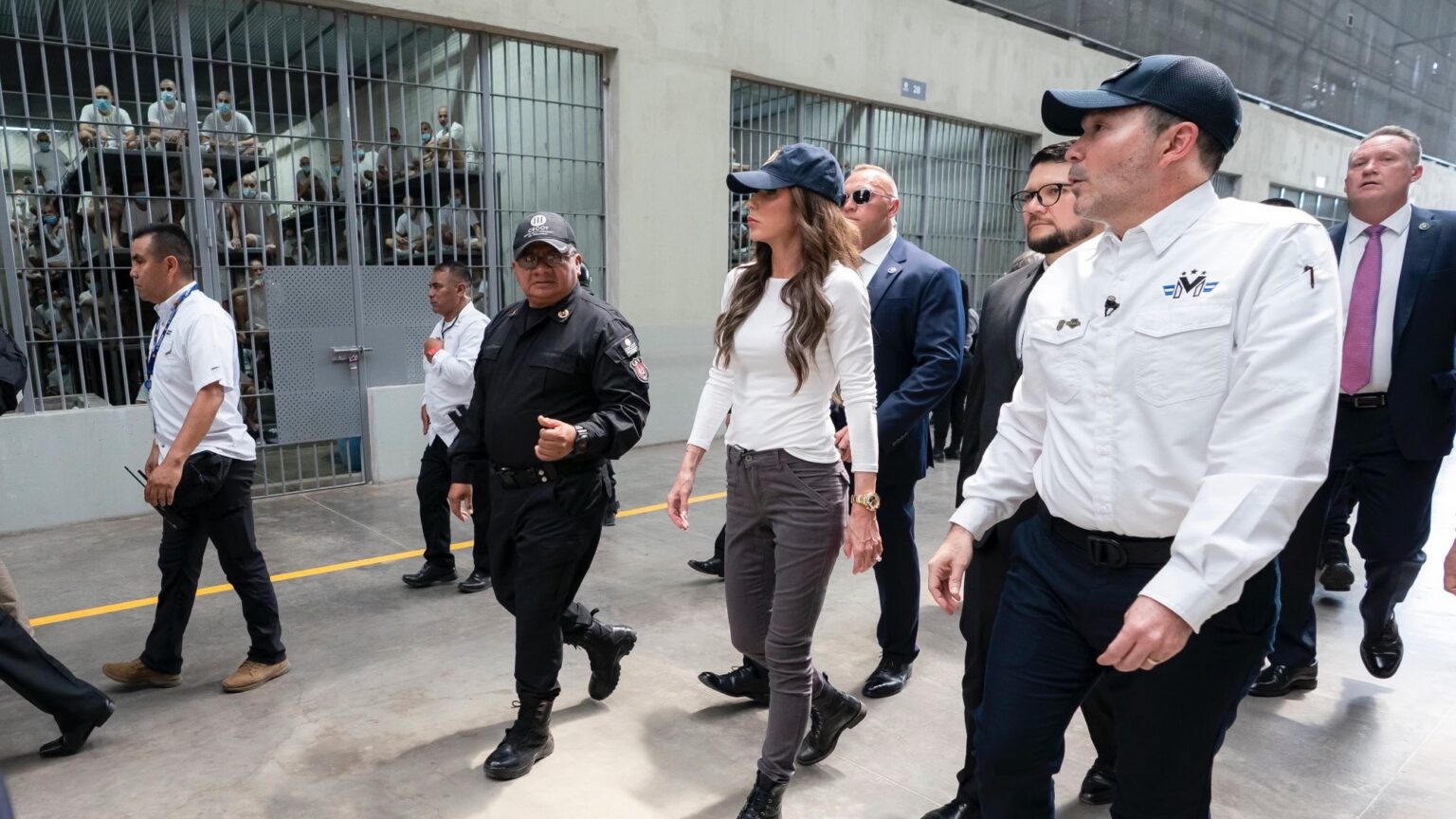
On X, the US Embassy in El Salvador explained that during her visit, “Secretary Noem will address cooperation between the two countries in the fight against illegal migration, reinforcing joint efforts to strengthen border security and ensure a safer region.”
Noem strengthens US-El Salvador alliance on mass deportations
In a clear gesture of support for the Bukele administration, Noem met with the Salvadoran President to strengthen the crackdown on immigration that the Trump administration has initiated since he took office on January 20, 2025. According to the US Embassy in El Salvador, the meeting formalized “bilateral cooperation on security and migration. During the meeting, Secretary Noem thanked the President for El Salvador’s commitment to the fight against illegal migration.”
For his part, El Salvador’s Secretary of Security, Gustavo Villatoro explained that during Noem’s visit, “We toured CECOT, the largest maximum-security prison in the Americas. In addition, we signed a Memorandum of Cooperation to update the Security Alliance for Fugitive Enforcement (SAFE) between our countries. With this agreement, we will have a more streamlined exchange of information and criminal records on fugitives, so that these criminals are not inadvertently released or remain unnoticed in the communities. This will undoubtedly be an enriching experience to share our security achievements and strengthen our strategies to combat transnational organized crime and terrorism.”
Noem’s prison video sparks controversy over US policy and human rights
One of the most controversial moments of the visit was disseminated by Secretary Noem herself, who recorded a video inside the CECOT mega-prison, in front of a cell holding dozens of shirtless inmates posing in silence.
“I want to thank El Salvador and their President for the partnership with the US to bring the terrorists here, and to incarcerate them and to have consequences for the violence they have perpetuated in our communities.” But most seriously, she warned in a threatening tone, that if anyone dared to enter the United States illegally, “this is one of the consequences you can face… [CECOT] is one of the facilities that we will use if you commit crimes against the American people”.
Despite Noem repeating that the detained men are “terrorists” and “criminals”, none of the 238 migrants who were irregularly deported from the US to El Salvador were granted a trial – a constitutional right – meaning they have not been proven guilty of anything. In fact, family members of many of those deported have shared that their relatives’ only crime was being a poor migrant with tattoos.
The agreement to receive deported migrants and lock them up was signed between the President of El Salvador, Nayib Bukele, and the Secretary of State, Marco Rubio.
Venezuela continues to demand the immediate and safe return of its citizens from El Salvador, and has received several deportation flights this past week.
Trump doubles down on deportations and detainment
For now, Trump shows no signs of abandoning his immigration policy, including the deportation of migrants to El Salvador. Despite the objections of several human rights organizations and the Venezuelan government, Trump has ordered a blackout on information regarding deportation operations to the Central American country. Everything related to the flights of Venezuelans to El Salvador has been declared a “State Secret” by the US president.
Meanwhile, hundreds of Venezuelan families, along with the Maduro government, continue to demand the release and repatriation of their compatriots to Venezuela.
Neo-Fascist Climate Science Denier Donald Trump says Burn, Baby, Burn.Elon Musk urges you to be a Fascist like him, says that you can ignore facts and reality then.