Members of the California national guard and other law enforcement at a protest in Los Angeles on Sunday. Photograph: Daniel Powell/ZUMA Press Wire/Shutterstock
Lawsuit claims administration ‘trampled’ on states sovereignty by bypassing Governor Gavin Newsom
The state of California will file a lawsuit against the Trump administration for “unlawfully” federalizing the state’s national guard and deploying its troops to quell immigration protests, the attorney general Rob Bonta said on Monday.
Previewing the lawsuit, Bonta claimed the Trump administration “trampled” on the states sovereignty by bypassing the governor Gavin Newsom – a move he said was “by definition, illegal” and escalated what began on Friday as scattered protests and erupted into unrest.
“This was not inevitable,” Bonta said of the demonstrations that built over the weekend following immigration raids across Los Angeles, adding: “There was no risk of rebellion, no threat of foreign invasion. No, inability for the federal government to enforce federal laws.”
Elon Musk urges you to be a Fascist like him, says that you can ignore facts and reality then.Neo-Fascist Climate Science Denier Donald Trump says Burn, Baby, Burn.
A Palestinian medic carries an injured child from an ambulance as the wounded being transported to Al-Ahli Baptist Hospital for treatment following an Israeli attack on the Shuja’iyya neighborhood in Gaza City, Gaza on January 01, 2025. (Photo by Dawoud Abo Alkas/Anadolu via Getty Images)
Organizing together under the name Taxpayers Against Genocide, constituents served notice that no amount of rhetoric could make funding of genocide anything other than repugnant.
On the last day of 2024, the deputy general counsel for the House of Representatives formally accepted delivery of a civil summons for two congressmembers from Northern California. More than 600 constituents of Jared Huffman and Mike Thompson have signed on as plaintiffs in a class action accusing them of helping to arm the Israeli military in violation of “international and federal law that prohibits complicity in genocide.”
Whatever the outcome of the lawsuit, it conveys widespread anger and anguish about the ongoing civilian carnage in Gaza that taxpayers have continued to bankroll.
By a wide margin, most Americans favor an arms embargo on Israel while the Gaza war persists. But Huffman and Thompson voted to approve $26.38 billion in military aid for Israel last April, long after the nonstop horrors for civilians in Gaza were evident.
Back in February — two months before passage of the enormous military aid package — both Human Rights Watch and Amnesty International found that, in the words of the lawsuit, “the Israeli government was systematically starving the people of Gaza through cutting off aid, water, and electricity, by bombing and military occupation, all underwritten by the provision of U.S. military aid and weapons.”
When the known death toll passed 40,000 last summer, the UN’s high commissioner for human rights said: “Most of the dead are women and children. This unimaginable situation is overwhelmingly due to recurring failures by the Israeli Defense Forces to comply with the rules of war.” He described as “deeply shocking” the “scale of the Israeli military’s destruction of homes, hospitals, schools and places of worship.”
No one should put any trust in the court system to stop the U.S. government from using tax dollars for war. But suing congressmembers who are complicit in genocide is a good step.
On Dec. 4, Amnesty International released a 296-page report concluding that Israel has been committing genocide “brazenly, continuously and with total impunity” — with the “specific intent to destroy Palestinians,” engaging in “prohibited acts under the Genocide Convention.”
Two weeks later, on the same day the lawsuit was filed in federal district court in San Francisco, Human Rights Watch released new findings that “Israeli authorities are responsible for the crime against humanity of extermination and for acts of genocide.”
Responding to the lawsuit, a spokesperson for Thompson said that “achieving peace and securing the safety of civilians won’t be accomplished by filing a lawsuit.” But for well over a year, to no avail, the plaintiffs and many other constituents have been urging him and Huffman to help protect civilians by ending their support for the U.S. pipeline of weapons and ammunition to Israel.
Enabled by that pipeline, the slaughter has continued in Gaza while the appropriators on Capitol Hill work in a kind of bubble. Letters, emails, phone calls, office visits, protests and more have not pierced that bubble. The lawsuit is an effort to break through the routine of indifference.
Like many other congressional Democrats, Huffman and Thompson have prided themselves on standing up against the contempt for facts that Donald Trump and his cohorts flaunt. Yet refusal to acknowledge the facts of civilian decimation in Gaza, with a direct U.S. role, is an extreme form of denial.
“Over the last 14 months I have watched elected officials remain completely unresponsive despite the public’s demands to end the genocide,” said Laurel Krause, a Mendocino County resident who is one of the lawsuit plaintiffs.
Another plaintiff, Leslie Angeline, a Marin County resident who ended a 31-day hunger strike when the lawsuit was filed, said: “I wake each morning worrying about the genocide that is happening in Gaza, knowing that if it wasn’t for my government’s partnership with the Israeli government, this couldn’t continue.”
Such passionate outlooks are a far cry from the words offered by members of Congress who routinely appear to take pride in seeming calm as they discuss government policies. But if their own children’s lives were at stake rather than the lives of Palestinian children in Gaza, they would hardly be so calm. A huge empathy gap is glaring.
In the words of plaintiff Judy Talaugon, a Native American activist in Sonoma County, “Palestinian children are all our children, deserving of our advocacy and support. And their liberation is the catalyst for systemic change for the betterment of us all.”
As a plaintiff, I certainly don’t expect the courts to halt the U.S. policies that have been enabling the horrors in Gaza to go on. But our lawsuit makes a clear case for the moral revulsion that so many Americans feel about the culpability of the U.S. government.
To hardboiled political pros, the heartfelt goal of putting a stop to the arming of the Israeli military for genocide is apt to seem quixotic and dreamy. But it’s easy for politicians to underestimate feelings of moral outrage. As James Baldwin wrote, “Though we do not wholly believe it yet, the interior life is a real life, and the intangible dreams of people have a tangible effect on the world.”
Organizing together under the name Taxpayers Against Genocide, constituents served notice that no amount of rhetoric could make funding of genocide anything other than repugnant. Jared Huffman and Mike Thompson are the first members of Congress to face such a lawsuit. They won’t be the last.
In recent days, people from many parts of the United States have contacted Taxpayers Against Genocide (via classactionagainstgenocide@proton.me) to see the full lawsuit and learn about how they can file one against their own member of Congress.
No one should put any trust in the court system to stop the U.S. government from using tax dollars for war. But suing congress members who are complicit in genocide is a good step for exposing — and organizing against — the power of the warfare state.
U.S. Secretary of State Antony Blinken. meets with Israeli Prime Minister Benjamin Netanyahu in Tel Aviv on October 12, 2023. (Photo: Eyepress Media Limited/Reuters via Getty Images)
“This lawsuit demands one thing and one thing only: for the State Department to obey the law requiring a ban on assistance to abusive Israeli security forces,” said one advocate.
Palestinians and Palestinian Americans on Tuesday filed a lawsuit accusing the U.S. State Department of creating a “loophole” allowing Israel to skirt federal legislation barring American military aid to foreign militaries that violate human rights law.
The lawsuit, which was filed by five individuals and supported by the group Democracy for the Arab World Now (DAWN), accuses the State Department and Secretary of State Antony Blinken of violating the Leahy Law, legislation passed in two parts in the late 1990s that built on the Foreign Assistance Act of 1961‘s proscription of U.S. military aid to foreign security forces that commit gross human rights violations.
According to DAWN, the suit “documents how the State Department has created unique, insurmountable processes to evade the Leahy Law requirement to sanction abusive Israeli units, despite overwhelming evidence of their human rights violations” including “torture, prolonged detention without charge, forced disappearance, and flagrant denials of the right to life, liberty, and security, such as genocide, indiscriminate and deliberate killings, and deprivation of items essential to survival, including food, water, fuel, and medicine.”
Case plaintiff Ahmed Moor, a Palestinian American from the southern Gazan city of Rafah who has lost numerous relatives in Israeli attacks, toldZeteo‘s Prem Thakker, “I’m hoping, through this action, through this lawsuit, that we can just call out the federal government to begin to enforce American laws.”
The State Department has sparked international outrage by repeatedly finding that Israel is using U.S.-supplied arms in compliance with domestic human rights law, citing the key ally’s right to defend itself and the October 7, 2023 Hamas-led attack. However, Israel’s 438-day retaliation has left more than 162,000 Palestinians dead, wounded, or missing in Gaza and millions more forcibly displaced, starved, or sickened. Thousands more have been killed or maimed in the West Bank.
South Africa is leading a genocide case against Israel at the International Court of Justice. Last month, the International Criminal Court (ICC) issued arrest warrants for Israeli Prime Minister Benjamin Netanyahu and Yoav Gallant, his former defense minister, for alleged war crimes and crimes against humanity.
Both men have been warmly welcomed in Washington, D.C.. Congress and the Biden administration have approved tens of billions of dollars in arms transfers to Israel. U.S.-supplied bombs have been used in some of Israel’s most notorious airstrikes. The U.S. has also vetoed numerous United Nations Security Council resolutions demanding a Gaza cease-fire.
Today, the White House welcomed Yoav Gallant, charged by the ICC with the war crimes of starvation as a method of warfare and intentionally directing an attack against the civilian population, as well as the crimes against humanity of murder, persecution, and other inhumane acts. What a disgrace.
“This lawsuit demands one thing and one thing only: for the State Department to obey the law requiring a ban on assistance to abusive Israeli security forces,” DAWN executive director Sarah Leah Whitson said in a statement on Tuesday. “For too long, the State Department has acted as if there’s an ‘Israel exemption’ from the Leahy Law, despite the fact that Congress required it to apply the law to every country in the world. As a result, millions of Palestinians have suffered unimaginable, horrific abuses by Israeli forces using U.S. weapons.”
Stephen Rickard, a former U.S. official who helped pass the landmark legislation, said that “long-standing concerns that the State Department was not cutting off aid to specific Israel units as required by the Leahy Law… have been given dramatic urgency by the tragic ongoing crisis in Gaza.”
“If the State Department will not comply with the law, then it is time for the courts to vindicate the rule of law and order it to do so,” Rickard added.
The new lawsuit came a day after relatives of Ayşenur Ezgi Eygi—the Turkish American woman who, according to witnesses, was deliberately shot in the head while peacefully protesting the expansion of Israel’s illegal settlements in the occupied West Bank in September—met with Blinken in search of justice and accountability for the activist’s killing.
Referring to another American activist killed by Israeli forces while defending Palestinian homes, Hamid Ali, Eygi’s widower, said that Blinken “was attentive in listening to us, but unfortunately repeated a lot of the same things that we’ve been hearing for the past 20 years, particularly since Rachel Corrie’s killing.”
Ali called Blinken “very deferential to the Israelis,” adding that “it felt like he was saying his hands were tied and they weren’t able to really do much.”
A journalist asked State Department spokesperson Matthew Miller during a Tuesday press conference why the U.S. has not suspended arms transfers to Israel by invoking the Leahy Law and citing the cases of victims like Eygi or Shireen Abu Akleh—the Palestinian American Al Jazeera correspondent who, according to witnesses and several independent probes, was deliberately shot dead by an Israeli sniper in the West Bank in May 2022.
“We have taken those cases extremely seriously,” Miller claimed. Referring to Eygi, he added that he made it clear to Israel that “her death was unacceptable, that it should have been avoided, it should have never happened in the first place, that we want to see the results of their investigation, and we want to see them change their rules of engagement.”
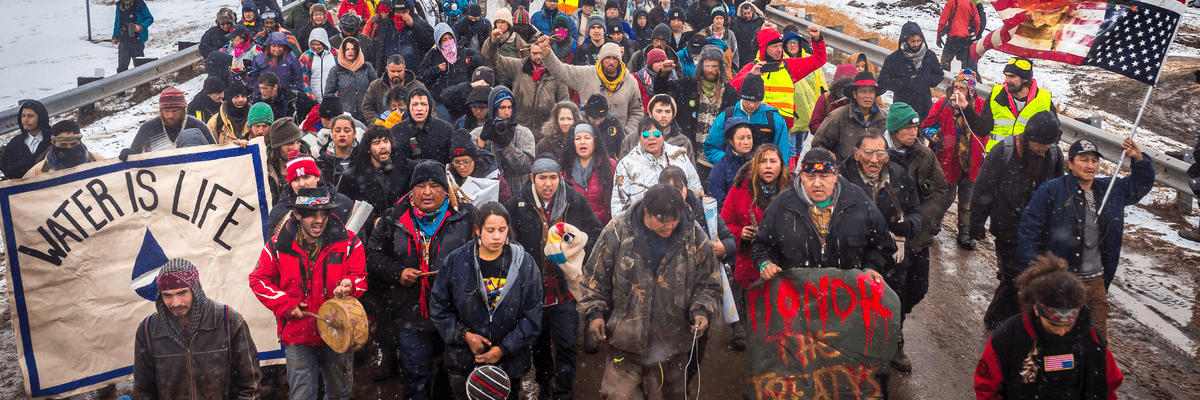
Dakota Access Pipeline protesters rally at Standing Rock Indian Reservation on February 22, 2017. (Photo: Michael Nigro/Pacific Press/LightRocket via Getty Images)
“No matter who you are, no matter what your politics are, this is one of the most important issues in America right now,” one Greenpeace spokesperson said.
Nearly 300 organizations and tens of thousands of individuals have signed an open letter supporting Greenpeace USA against a $300 million lawsuit brought against the environmental group by Energy Transfer—a company with a majority stake in the Dakota Access pipeline.
The corporation is falsely accusing Greenpeace of being the driving force behind Indigenous-led protests against the Dakota Access pipeline (DAPL) in 2016 and 2017.
Greenpeace USA announced its supporters on Thursday as it launched a campaign to raise awareness about the lawsuit—which it said could “functionally bankrupt” the organization, threatening its “existence.” However, Greenpeace said that the dangers posed by strategic lawsuits against public participation (SLAPPs), like the one it faces, extend far beyond one organization.
“No matter who you are, no matter what your politics are, this is one of the most important issues in America right now,” Greenpeace USA spokesperson Rolf Skar said in a statement. “Energy Transfer built the Dakota Access pipeline. But they’re suing anyway in order to send a message: If you dare to oppose us, we will financially ruin you.”
We’re being sued by Big Oil @EnergyTransfer for $300 million. It’s an abusive lawsuit designed to end Greenpeace’s 50-year legacy of environmental activism. But it’s not just a threat to our existence. Learn more: pic.twitter.com/YrtObvuVKm
The Dakota Access pipeline drew massive protests from the Standing Rock Sioux Tribe, more than 300 other tribal nations, and non-Indigenous allies. While former U.S. President Donald Trump forced the pipeline through shortly after taking office in early 2017, the protests rattled the fossil fuel industry and their allies in government. After 2016, 18 states passed anti-protest laws that shielded around 60% of U.S. oil and gas production and related infrastructure from peaceful protests. The industry also turned to “judicial harassment.”
Energy Transfer (ET) initially brought suits against Standing Rock Tribal Chairman Dave Archambault and other Water Protectors, as well as a federal suit against Greenpeace in 2017.
At the time, ET CEO Kelcy Warren told a reporter: “Could we get some monetary damages out of this thing, and probably will we? Yeah, sure. Is that my primary objective? Absolutely not. It’s to send a message—you can’t do this, this is unlawful, and it’s not going to be tolerated in the United States.”
“Everyone who says they care about freedom—of whatever political stripe—should join together to support the Greenpeace campaign to protect people’s right to speak out against corporate abuses.”
While the 2017 cases were all dismissed, ET immediately filed a similar case against Greenpeace in North Dakota state court in 2019. The new case, which is scheduled to go to trial in February 2025, makes what Greenpeace called a “deeply racist” case that Greenpeace, and not Indigenous leaders, coordinated the Dakota Access protests.
“The lawsuit against Greenpeace is also an attack on the Indigenous movement in our fight for self-determination to protect Mother Earth, our waters, sacred and cultural sites, and our youth and future generations,” Morgan Brings Plenty of the Standing Rock Youth Council said in a statement. “These colonialist lawsuits are trying to send a warning to anyone who might consider speaking out and to be quiet—any of you could be next.”
ET also makes several claims that would set a dangerous precedent if upheld, including denouncing legitimate speech as defamatory and making anyone who is present at a protest liable for things that occurred at the same protest.
“The whole point of this type of lawsuit is to limit freedom of expression, so even if you don’t care about climate change, or you don’t care about Greenpeace, you should pay attention,” Skar said. “What’s at stake isn’t just Greenpeace or environmentalism, but the fundamental American rights to freedom of peaceful expression and advocacy for all of us.”
Greenpeace has circulated a letter to ET that has so far been signed by more than 290 organizations—including 350.org, Public Citizen, ACLU North Dakota, SEIU, Indigenous Environmental Network, and Amnesty International USA—and tens of thousands of individuals, including prominent celebrities and activists like Jane Fonda, Susan Sarandon, Billie Eilish, and Adam McKay.
“This is corporate overreach that is part of a disturbing trend of attacks on advocacy and speech around the world,” the letter reads. “We will not allow lawsuits like this one to stop us from advocating for a just, green, and peaceful future. On the contrary, we will ensure they have the opposite effect, increasing the support for organizations like Greenpeace and strengthening the broader movement for justice.”
“This legal attack on Greenpeace is an attack on us all,” the letter continues. “We will not stand idly by. We will not be bullied. We will not be divided and we will not be silenced.”
Organizations also issued individual statements of support.
“Everyone who says they care about freedom—of whatever political stripe—should join together to support the Greenpeace campaign to protect people’s right to speak out against corporate abuses,” said Robert Weissman, co-president of Public Citizen. “As Greenpeace knows from its own experience, too often corporations use their political, economic, and legal power not just to run PR campaigns justifying their wrongdoing, but to threaten public interest advocates with bad-faith lawsuits (SLAPPs) and other intimidation tactics.”
Brian Hauss, a senior staff attorney for the ACLU, said: “Protesters and advocacy groups should never have to fear the weight of groups like ETP as a condition for expressing their First Amendment rights. The court should see this lawsuit for what it is and toss it.”
Progressives are also calling for a national legislative solution to the problem of SLAPP suits. While most states do have laws on the books against them, North Dakota is one of the 18 that do not.
“The case against Greenpeace illustrates how mega-corporations can use lawsuits to silence, intimidate, and ruin their critics,” Raskin said. “America must demand, and Congress must pass, bipartisan legislation to protect First Amendment rights against ruinous litigation practices.”
As more communities sue oil majors following climate disasters, a collection of evidence reveals the industry’s efforts to deny the link between extreme weather and climate change.
Illustration by Tess Abbot
This story was originally published by ExxonKnews.
When Bucks County, Pennsylvania, filed a lawsuit last week against major oil and gas companies for climate damages, Commissioner Chair Diane Ellis-Marseglia pointed to “unprecedented weather events here in Bucks County that have repeatedly put residents and first responders in harm’s way, damaged public and private property and placed undue strain on our infrastructure.” The county argues oil companies’ “campaigns to deceive and mislead the public about the damaging nature of their fossil fuel products” delayed climate action for decades, robbing communities of precious time to mitigate the climate-driven disasters they now face.
One of those disasters occurred last year, when a rainstorm in Bucks County caused deadly flash flooding that swallowed vehicles and killed 7 people, including two children. Scientists said the deluge and its aftermath — not the county’s first “100-year flood” in recent years — are a harbinger of the intense and dangerous rainstorms that a warming climate is making more likely.
As the science connecting climate change to more frequent and severe weather events becomes clearer, there is mounting evidence that members of the fossil fuel industry coordinated to downplay that link — evidence that could be valuable to lawsuits seeking accountability.
Bucks County is just one in a growing list of communities taking legal action against fossil fuel companies in the wake of deadly extreme weather events. Multnomah County, Oregon sued oil, gas, and coal majors after a 2021 heat dome that killed nearly 70 people. On the 10 year anniversary of Superstorm Sandy, New Jersey’s attorney general took Exxon, Chevron, and other oil giants to court, citing the billions of dollars in damage and deaths the hurricane caused in the state. In the first-ever racketeering lawsuit against Big Oil companies, Puerto Rico municipalities are seeking to recover costs incurred by Hurricane Maria.
Fossil fuel majors, these cases argue, should help communities pay for the costs of adapting to and recovering from climate disasters given the industry’s early research into — and subsequent denial of — their products’ harm. “We’re already seeing the human and financial tolls of climate change beginning to mount,” said Commissioner Ellis Marseglia. “If the oil companies’ own data is to be believed, the trend will continue.”
It’s a trend that the fossil fuel industry worked to obscure for decades.A collection of evidence just published to ClimateFiles.com reveals the extent to which oil companies and their trade associations sought to deny and downplay the relationship between climate change and extreme weather.
Nicky Sundt, a climate expert and former communications director for the U.S. Global Change Research Program during the George W. Bush administration, said she tried to publicly communicate the science behind that link, but was “stymied over and over again” by industry interests inside and outside the White House — an experience she has discussed with The Guardian andPBS Frontline.
“By interfering with the communications of climate science to the public, [the fossil fuel industry] knew that the public was less likely to become agitated and do something about it,” Sundt said. “The consequence was to slow efforts to reduce our emissions, and to leave us more unprepared for the impacts of climate change. The longer you wait, the more expensive it is to deal with all of these issues, and they’ve eaten up incredibly important time we needed.”
“A new norm”
In 1997, fossil fuel interests successfully convinced prominent United States officials to oppose U.S. ratification of the Kyoto Protocol — an international climate agreement that would have limited greenhouse gas emissions decades ago.
A year later, the American Petroleum Institute (API) — the largest oil and gas trade association in the U.S. — bluntly outlined a plan to keep drumming up opposition to the Kyoto Protocol as negotiations continued. According to a newly uncovered February 1998 internal strategy proposal reviewed by ExxonKnews, API would “develop and implement a campaign-style ‘rapid response’ team… to respond to op-eds that make exaggerated claims about climate science… and to media events staged by government officials and/or environmental organizations seeking to tie extreme weather events to possible human impacts on global climate.”
Long before that campaign began, internal industry memos and promotional materials show, major oil companies knew about the role that climate change would play in intensifying hurricanes, floods, droughts, heatwaves, precipitation patterns, and other extreme weather events.
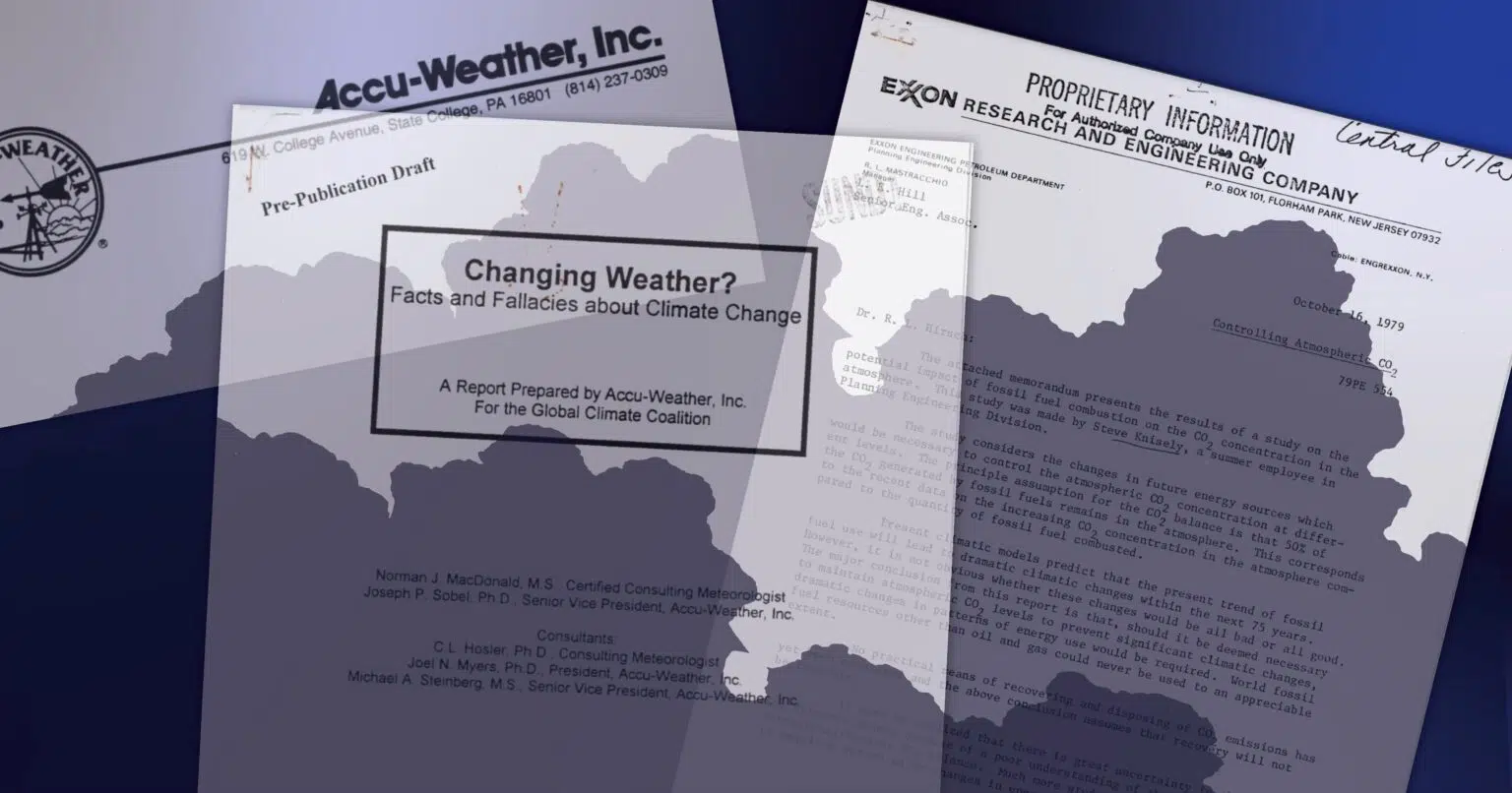
One 1979 memo distributed to Exxon management, about a report conducted by Steve Knisley of Exxon’s Research and Engineering Department, accurately predicted the growth of atmospheric carbon dioxide concentrations by 2010 and referenced the “ecological consequences of increased CO2 levels.” Those consequences were listed in detail, including global temperature increases, water shortages in the U.S. southwest, increased rainfall, and “violent storms.”
In a 1991 film production by Shell, called “Climate of Concern,” a narrator warns that “if the weather machine were to be wound up to such new levels of energy, no country would remain unaffected,” and that “what is now considered abnormal weather could become a new norm.”
Another film produced that year by BP, called “This Earth – What Makes Weather?”, alludes to the ways climate change would increase the frequency and damage caused by extreme weather events like storms, flooding, and drought. “From warmer seas, more water would evaporate — making storms and the havoc they cause more frequent,” the narrator predicts. “Catastrophic floods could become commonplace and low-lying countries like Bangladesh would be defenseless against them.”
But around the same time, the industry began to worry about how public understanding of those phenomena could affect their core business. A 1989 presentation by Duane LeVine, a senior executive at Exxon, expressed concern that an extreme heat and drought event the year before had “drawn much attention to the potential problems and we’re starting to hear the inevitable call for action. Exactly what happens now is not clear… but this critical event has energized the greenhouse effort and raised public concern over PEG [potential enhanced greenhouse].”
Under the cover of trade associations and front groups, through PR campaigns and funded academic research, the industry developed a strategy to undermine the link between climate change and weather-related disasters — and discredit those who sought to communicate that science to the public.
A Campaign to Turn the Tide
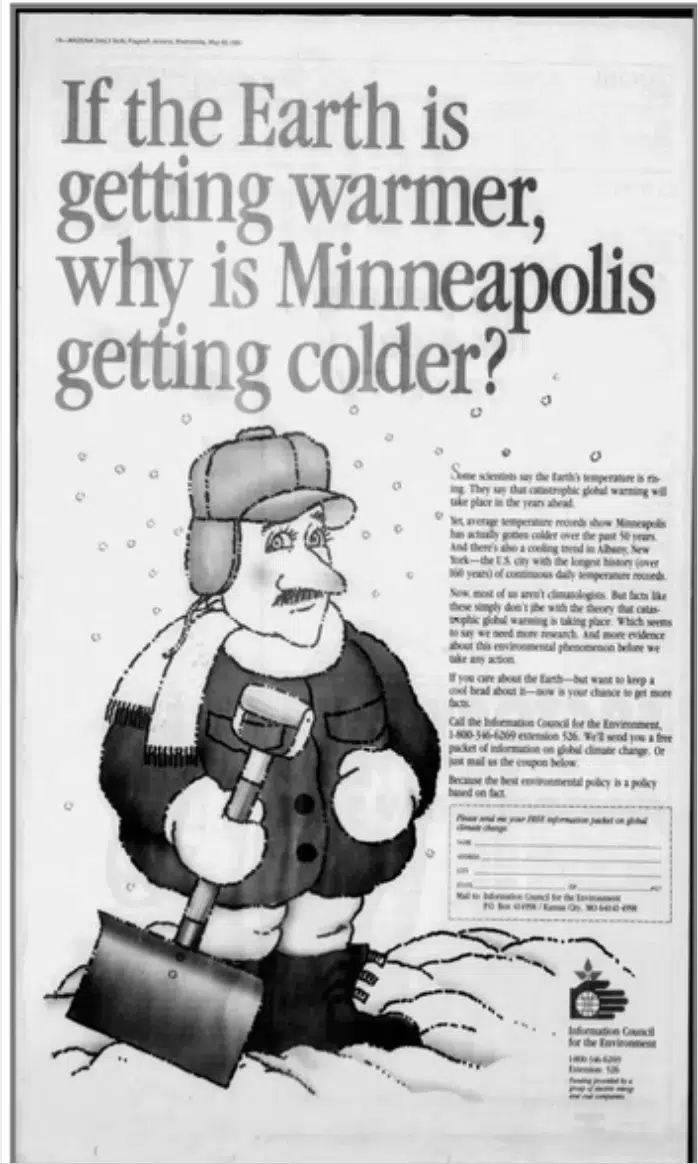
One ad from a PR campaign by the “Information Council on the Environment,” funded by fossil fuel and electric utility interests. Minnesota is now suing ExxonMobil, Koch Industries, and the American Petroleum Institute for climate fraud.
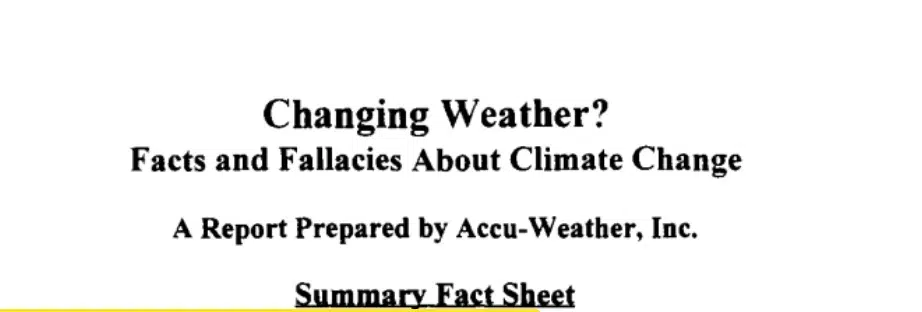
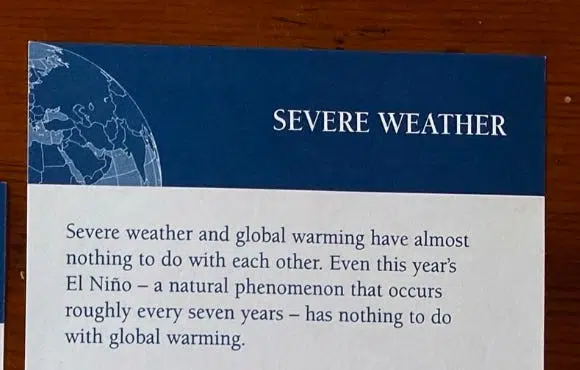
One key player was the Global Climate Coalition (GCC) — an international industry lobbying group that was instrumental in early efforts to deny climate change and generate opposition to policy action to reduce emissions. In 1994, the GCC hired weather forecasting service AccuWeather Inc. to produce a report minimizing the impact of global warming on extreme weather, which the GCC would cite in a pamphlet distributed at the United Nations climate convention the following year.
“No convincing, observational evidence exists that hurricanes, tornadoes and other extreme temperature and precipitation events are on the rise because of the recent slight increase in the Earth’s surface temperature,” the report states.
A report that AccuWeather produced minimizing the impact of global warming on extreme weather in 1994.
In response to ExxonKnews’ requests for comment on the report, a spokesperson for AccuWeather said that “AccuWeather and the other leading consulting meteorologists involved had been engaged to produce an analysis based upon the available data at that time. There was much debate and uncertainty in the scientific community over the causes and effects of global warming during that time period, and a new generation of computer modeling studies was just beginning to emerge that would create an important shift in scientific judgment.”
“As an organization rooted in science, AccuWeather’s view on global warming and extreme weather has evolved over the past three decades, as has the view of many other scientific organizations,” they said, noting that data now shows a “marked increase in billion-dollar disasters due to extreme weather events.” Today, the spokesperson added, AccuWeather has signed the “Global Climate Science-Media Action Pledge”, and is committed to communicating the impacts of climate change on extreme weather to the public.
The GCC also hired academics to further their cause. Internal meeting notes from July 1997 show that the GCC commissioned a research paper from Robert E. Davis, a University of Virginia climatologist, explicitly denying the climate and extreme weather connection.
Excerpt from Global Climate Coalition meeting notes in 1997.
“A belief commonly held is that global warming will produce more extreme weather,” the published paper read. “While this thinking serves as convenient fuel for sensationalist headlines linking what only a decade ago would have been viewed as the normal vagaries of weather to some approaching climatic apocalypse, it is not based on sound science.”
From a folder handed out by the GCC at the UN climate negotiations in 1999.
In 1999, in the wake of Hurricane Floyd, Frank Maisano, then a spokesman for the GCC, faxed a memo to “Communicators Interested in Global Climate Issues.” “As millions of people flee Hurricane Floyd, many climate activists have again suggested — despite the facts — that hurricanes and global warming are connected,” the memo stated.
In response to questions about the memo and the GCC’s positions, Maisano told ExxonKnews that “Any fair review of the debate over any link between climate and severe weather has always been the subject of significant discussion between the experts themselves, especially with regard to hurricanes.”
“Importantly,” Maisano said, “GCC’s main focus at the time was on the economic impacts, sovereignty and effectiveness of any policy proposed to address climate change.”
Maisano now runs a strategic communications practice for Bracewell LLP, whose separate law practice provides services for oil and gas companies including Eni (currently being sued for climate deception in Italy) and Phillips 66 (which is a defendant in many U.S. climate lawsuits, including those filed by Bucks County and the state of New Jersey). Since 2005, the group has also advocated for renewables, Maisano said.
The industry’s campaign stretched on for years. In 2006, shortly after Hurricane Katrina, the DCI Group — a lobbying and campaign contractor with ties to Exxon — produced and sent VHS tapes of videos designed to look like a national news broadcast to Gulf of Mexico area news stations. The tape featured Dr. William Gray, a (now deceased) hurricane scientist at Colorado State University and climate change denier, stating that in the past 20 years, scientists had seen “no significant change in the frequency and intensity of major hurricanes around the globe…. This is the way nature sometimes works.” (Scientists have since concluded that climate-driven warming contributed to the increased rainfall and severity of storm surge during Hurricane Katrina, which killed nearly 2,000 people.)
According to Sundt, after Hurricane Katrina hit, the communications arm of the U.S. Global Change Research department proposed hosting a session on the implications for preparing for climate change on the Gulf Coast. “We had a well developed proposal, and it was just killed [by the White House] without explanation,” she said.
“A more resilient world”
Today, the steady growth of attribution science — or research investigating the role of climate change in altering or intensifying extreme weather events — has put a dent in Big Oil’s designs. The field of study has developed to even be able to tie the emissions of specific corporate actors to climate-worsened disasters — opening up more possibilities for those companies to be held liable for climate damages in court.
One such study, from researchers from the Union of Concerned Scientists and the University of California, Merced, found that nearly 40% of all forests burned in the Western U.S. and Canada since 1986 can be tied to emissions from just 88 of the world’s largest fossil fuel and cement manufacturers. That research was cited in Multnomah County’s lawsuit against oil and gas majors for climate damages last year.
Delta Merner, lead scientist for the Union of Concerned Scientists’ climate litigation hub and a co-author of the study, pointed out that many of the same companies that fought regulation of climate-warming emissions adapted their own fossil fuel infrastructure to account for rising seas, warming temperatures, and worsening storms decades ago.
“As you look through the oil industry’s own reactions to their knowledge about climate change, they were able to build better infrastructure to be resilient,” Merner said. “We would have a more resilient world, we would not be facing the realities of climate change that we’re seeing today if it wasn’t for the lies the industry propped up for so long.”
At least one oil major anticipated legal action decades ago. In a planning scenario from 1998, Shell made an eerie prediction: “In 2010, a series of violent storms causes extensive damage to the eastern coast of the U.S. … Following the storms, a coalition of environmental NGOs brings a class-action suit against the US government and fossil-fuel companies on the grounds of neglecting what scientists (including their own) have been saying for years: that something must be done.”
Shell was ahead of its time. Between the increased frequency, severity, and costs of extreme weather events, the advancing science connecting them to polluters, and mounting legal theories, Merner said she expects more communities to file suit. Even as she sees the industry’s deception evolving in content and sophistication — like companies trying to shift the blame for emissions onto consumers to avoid responsibility — Merner believes attribution research is evolving faster.
“It’s a testament to the power of science that climate litigation has been able to withstand an additional onslaught of disinformation from the fossil fuel industry and is now a key part in the fight for climate justice,” she said.
Note: Additional individuals mentioned here were asked to provide comment. The piece will be updated if they respond.
CLARIFICATION 4/3/24:This story has been updated to clarify the difference between Bracewell LLP’s strategic communication practice and its law practice.