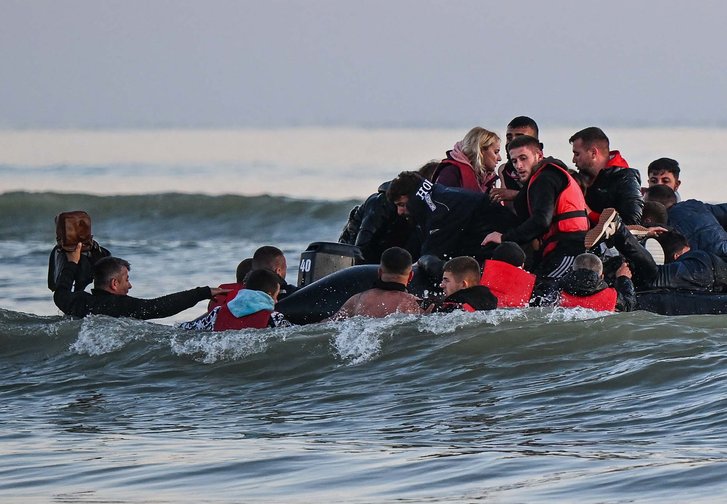
Starmer’s counter-terror plan for migration woefully misses the mark

Spread the love

Original article by Ruben Andersson republished from Open Democracy under a Creative Commons Attribution-NonCommercial 4.0 International licence

Italian Prime Minister Giorgia Meloni and British Prime Minister Keir Starmer take a walk after meeting to discuss migration in Rome | Filippo Monteforte/AFP/Getty Images. All rights reserved

There’s no smuggling ‘kingpin’ to take down. Instead, Labour’s security rhetoric risks putting more people in danger

Labour lost no time burying the Conservatives’ tawdry Rwanda plan in favour of something a little more, well, Churchillian. In July, as he welcomed European leaders to Winston’s birthplace of Blenheim Palace, Keir Starmer framed border security not as some nationalist vote-fishing expedition but rather as a pragmatic British undertaking “at the heart of the Government’s reset with Europe”.

It would also involve fighting them on the beaches. Gangs would be suitably smashed, he told his guests, by a new Border Security Command armed with “counter terrorism-style powers”. Elsewhere Starmer has also enthused over Giorgia Meloni’s ‘upstream’ fight against irregular migration — including offshoring asylum processing to Albania and outsourcing crackdowns to Tunisia.

So far, so familiar. If there’s anything European political leaders of different stripes and nationalities have united around since the 1990s, it’s more border security. But what will a counterterror-style crackdown actually achieve this time around?

Is Labour offering anything new on migration?

For some of those relieved to see Rishi Sunak exit stage right, his meaningless “stop the boats” sign tucked under his arm, there are grounds for optimism. The counterterror rhetoric, they say, hides humane openings elsewhere, especially when it comes to breaking the massive backlog of asylum cases. Respecting the European Court of Human Rights also looks like a welcome return to normality – and legality.

Starmer has further promised that his approach will be more cost-efficient. That’s easy enough to believe, as it’s hard to imagine anything more wasteful than spending “£700m to persuade four volunteers to go to Rwanda,” as Starmer himself described it. Supporters will add that smuggling is a rapacious business. Going after its economics is key, as is respectful collaboration with partner states rather than grandstanding. Reinstating EU returns (lost after Brexit), cracking down on smugglers, and expediting asylum cases will work where ‘invasion’ rhetoric failed.

In this take, Starmer offers strategic “competence with compassion” that also helps placate the tabloids. It’s a method that, if it works out, means everybody wins except the cold-hearted smugglers.

Not so fast. A brief look at the past decades’ border dynamics suggests that Starmer’s initiatives may well end up being as gimmicky as those they replace. If politicians genuinely want to stop profiteering as people drown in the English Channel or the Mediterranean Sea, they must first understand the drivers of migration and the smuggling business. Otherwise they will simply fail again – with more lives lost, and even harder rhetoric to come from the hard right.

Smuggling 101: supply and demand

It’s peculiar how difficult it is for mainstream politicians, who are otherwise so keen on market economics, to learn that human smuggling is a market driven by demand. It responds to incentives, and its strongest incentive by far is the disappearance of legal routes. The market is further buoyed by crackdowns of the kind seen around the Channel Tunnel in recent years. The displacement of routes has predictably increased danger and desperation – and thus reliance on professional smugglers. The border security system perversely feeds on the very problem it ostensibly combats.

True, deterrence-signalling measures may put a damper on the market – for a while. Cue Starmer’s nod towards Italy, where Meloni and her authoritarian Tunisian partner claim credit for bringing down maritime migration this past year. But sooner or later, the market will re-emerge unless the underlying dynamics and drivers are addressed.

Ever-tougher approaches targeting the supposed ‘kingpins’ have merely shifted the modus operandi

Reproducing new versions of the same threat and then combating them again is bad enough. But Starmer’s reference to counterterrorism — now accompanied by a doubling of the funding for the new Border Security Command — raises additional red flags.

Consider the US Homeland Security behemoth spawned by the George W. Bush administration after 9/11. Rather than changing dynamics at the US-Mexico border – the stage of spectacular enforcement all through the 1990s – it worsened it.

The cartels started playing an unpaid role in ‘prevention through deterrence’. At the same time, border crackdowns and technology imported from the war on terror pushed migrants away from smaller smuggling operations and into the hands of larger, more predatory players with the necessary economic margins.

Yet that inconvenient reality was never really acknowledged. As I heard some years ago, Customs and Border Protection bureaucrats repeatedly magicked up models showing their method ‘works’ by denting the revenue of smugglers and ramping up deterrence. It didn’t. Instead it reproduced a deadly dynamic and spawned fresh political crises.

Or consider Italy itself. Rome has deployed anti-mafia methods against smugglers, but it has little to show for these efforts except perverse results such as jailing a presumed “Al Capone of the desert”, who was later released in a case of mistaken identity. As the man’s lawyer said, “After three years, finally the judge confirmed what we have been saying: we had a farmer in jail and a smuggler at large.” The prosecutors kept insisting they had the right man, waging a war less on smugglers than on reality.

Fighting an elusive enemy

For years, ever-tougher approaches targeting the supposed ‘kingpins’ have merely shifted the modus operandi, in Libya and elsewhere. Instead of piloting a boat, the smugglers make passengers steer it. The latter then bear the legal — or lethal — consequences when it is seized or sinks.

People on the move, of course, also adapt their behaviour to crackdowns. As one Senegalese man explained to me 15 years ago, before his wooden fishing boat approached the Canary Islands, he threw “food, GPS and the compass into the sea”. The shift in tactics in response to enforcement has hugely increased the risk, pushing responsibility of the vessels onto migrants who cannot navigate or do not want to be seen doing so.

It is possible that Labour’s smuggling crackdown will not get stuck either in the bureaucratic swamp of ‘Homeland Security’, or get distracted by the catch-the-small-fry fracas. But its own alarmist rhetoric, combined with tabloid and Tory pressure, feed bureaucratic incentives to produce ‘results’ – and these are the easiest ways of showing such results. So beware the hyperbole: it makes meaningful ‘results’ more difficult to achieve.

Underneath all the tactics and rhetoric, however, a more fundamental analytical problem is lurking. Unless the threat has been correctly diagnosed, there’s little chance the remedy will work.

Starmer’s approach is based on the idea that smuggling is in the hands of very well-organised, transnational crime. That there is, somewhere, a kingpin to take down. But while it is true that human smuggling has become more predatory, profitable and professional as the market has grown with each short-sighted crackdown, that model is, at absolute best, extraordinarily incomplete.

The outsourcing of draconian migration controls has benefited repressive state and para-statal actors, while increasing the very dangers that drive people to move

Precision is needed, not alarmism. On the Spanish borders, for instance, politicians, police and reporters for years talked of ‘mafias’, even while small operators and migrants themselves kept organising crossings.

‘Upstream’, in North Africa and the Sahel, the authorities themselves are involved. They benefit from the security largesse provided by their European ‘partners’ in fighting irregular migration, and from the ever-increasing bribes needed to evade their own controls. Rather than a straightforward ‘battle’ between clear adversaries, we see here more of a symbiosis between the border security and smuggling businesses.

The outsourcing of draconian migration controls has benefited repressive state and para-statal actors, such as Libya’s militias, while increasing the very dangers that are driving people to move with the aid of smugglers. If we account for this political dynamic, Meloni’s ‘success’ looks fragile indeed. It is based on a drop of arrivals in 2024 from the previous year. Yet the chaos in Italian ports in 2023 was, to no small extent, the result of Tunisia’s president using African migrants as a bargaining chip with Europe.

Kelly Greenhill has called it “weapons of mass migration”. It’s something the EU says it wants to combat. Instead, European leaders seem to be rewarding it.

The smuggler factory

A ‘counterterror’ approach to smuggling, combined with further reliance on non-European buffer states, risks further skewing the border-crossing market from smaller players to more organised and rapacious ones while shifting the risks from smugglers to their increasingly desperate passengers. This, in turn, risks fuelling the trend towards captive markets that we see today from Libya to northern Mexico.

It’s been said many times that a ‘war on smugglers’ swiftly turns into a war on migrants. As David Keen and I show in our book Wreckonomics, politicians have kept learning the wrong lessons from their various short-sighted ‘wars’ against smuggling, terror, crime and drugs.

They keep choosing to go in hard with the security theatre and target the symptoms not the causes, hoping to reap short-term electoral rewards. They keep producing figures showing that the ‘fight’ is succeeding – and numbers may even really go down for a bit. But they don’t create sustained change. Look at the long term and we see above all a displacement of routes and methods – whether in the Channel, the Mediterranean or across the Rio Grande – with a corresponding boost for the smuggling market.

Starmer may still play smart and prioritise reinstating European returns, speeding up processing, and going after the big players and the money. The UK does not have Italy’s Mediterranean border, after all, and its main ‘outsourcing’ partner is France not Libya.

But in this context, it’s all the more worrying that we hear the language of counterterror and ‘upstream’ controls dominate the messaging. If the measures don’t match the problem, and if the relevant actors themselves remain poorly understood, the problem will simply keep being reproduced — as indicated by the past two decades of Labour and Tory enforcement efforts around the Channel.

For a more visionary political figure there is surely a chance here to offer a different kind of security

To Starmer’s supporters — eyeing tabloids and Faragists on the warpath — the gambit may still look appealing, or at least like some kind of lesser evil. Yet here awaits one further fallacy. For if there’s one other group besides smugglers that has predictably and consistently gained from ‘securitisation’ over the past decades, it is the far right.

Offering a lighter version of hard-right securitisation simply increases voter appetite for the full-fat version. The political appeal of repeatedly announcing an ‘emergency’ or ‘invasion’ is not based on numbers. Channel crossings, we know, are vanishingly small relative to overall immigration into the UK. But if the big politics of ‘small boats’ is not driven by numbers, the corollary is that even if Starmer were to get numbers down temporarily, the appetite for more border security would remain.

Starmer’s problem today is that of the left in general, which increasingly finds itself trapped in security logics — something we’ve equally seen in the recent US elections. This is unfortunate, since for a more visionary political figure there is surely a chance here to offer a different kind of security.

Instead of dismissing legal pathways, for instance, these could be reframed as bringing humanity, control and predictability to migration policy — while fundamentally creating a disincentive to use smugglers, as border guards themselves often insist.

Instead of trumpeting ‘counterterror’, there is scope for a sophisticated overarching strategy against organised crime and exploitative actors that targets the regulations and loopholes that these actors feed upon. This means working inland, where the exploitation of migrant labour, for instance, is a huge and neglected problem. Waiting in the wings is also a much wider conversation about how politicians’ economic choices and foreign policy fuel migration and displacement.

But all this involves open democratic debate and oversight. Counterterror approaches have tended to do the opposite: fuel a fear-based politics, increase secrecy, sidestep audits, benefit the big criminal players and corrupt partner authorities. They also unfailingly feed the very crises forcing people to leave countries such as Afghanistan in the first place.

A Churchillian rhetoric of unity-through-security is tempting. So is the language of counterterror. But to end with a warning from the failed war on terror, let’s perhaps listen to Richard C. Holbrooke, the US special representative to Afghanistan and Pakistan, who said: “We may be fighting the wrong enemy in the wrong country.”

Starmer may at least be in the right country. But if he insists on misunderstanding the problem he will confront the wrong enemy yet again.


Explore the rest of the series

This series looks at how the UK, EU and bordering countries are increasingly treating migration as a criminal offence, and targeting migrants and solidarity actors in the name of ‘anti-smuggling’ and ‘border control’.

Original article by Ruben Andersson republished from Open Democracy under a Creative Commons Attribution-NonCommercial 4.0 International licence

Continue ReadingStarmer’s counter-terror plan for migration woefully misses the mark

EU migration strategy: treat migrants like the mafia

Spread the love

Original article by Lorenzo D’Agostino republished from Open Democracy under a Creative Commons Attribution-NonCommercial 4.0 International licence

Police wait for migrants to disembark in the port of Catania, Italy, 2023 | Fabrizio Villa/Getty Images. All rights reserved

Deploying ‘anti-mafia’ tactics against migrants and those standing in solidarity with them is solving nothing

In November 2023, Italy’s prime minister, Giorgia Meloni, gathered the country’s top prosecutors at the headquarters of the powerful anti-mafia and anti-terrorism directorate, the DNAA. The far-right leader flattered them, boasting about the Italian judiciary’s global prestige.

“Italy used to export mafia,” she said. “Now it exports anti-mafia.”

She was trying to smooth over tensions around her government’s plans to limit the powers of organised crime investigators. Yet there was more to Meloni’s statement than she perhaps realised.

Over the past decade, the DNAA shifted focus from fighting Italy’s mafia to tackling undocumented migration. The directorate became central to Europe’s response – a hub for national police forces and European agencies like Frontex and Europol to exchange and refine anti-migration tactics.

The DNAA’s success lay in its apparent ability to throw investigative findings behind an idea that politicians were keen to believe: that undocumented migration is essentially a matter of organised crime and should be dealt with as such. A prosecutor in Palermo branded this approach “the Italian job” – but Italy wasn’t alone in this effort.

In recent years, many European border countries have seen an explosion of court cases against people thought to facilitate migration in some way. Driving a dinghy, providing shelter or medical assistance, even receiving a distress call from a sinking boat is now enough to make someone vulnerable to prosecution.

Migrants, as always, have been the main targets. But prosecutors have also set their sights on European activists and aid workers in what can be described as a campaign to criminalise solidarity.

Since 2013 this judicial policy has been turbocharged with unprecedented funding, but its roots stretch back over two decades. The technical and legal groundwork was laid after the fall of the Soviet Union and reinforced following the 11 September 2001 attacks in the United States – an inflection point that saw migration become ever more intertwined with security concerns.

The policy has run long enough to be assessed. And, at least at the practical level, it has been a complete failure.

Searching for a mafia to take down

Critical smuggling scholars agree that large, hierarchical smuggling rings are rare. Their contribution to migration flows is insignificant. The vast majority of migration facilitation instead comes from loose chains of actors who do not share a common employer. A migrant finds somebody who can help with a step or two, and then finds someone new to help with the next step, building out this ‘chain’ as they go along.

That said, smuggling facilitators of all kinds are more likely to be active wherever borders are particularly restrictive.

European prosecutors ignore these inconvenient truths about migration, but that doesn’t change the result. Smuggling ‘kingpins’ are not ending up in the dock, and the people who do are rarely worth the judge’s time.

Substantial academic and journalistic research shows that European smuggling cases predominantly target innocent asylum seekers. And legal actions against European activists – whether in Italy, Greece, Spain, or France – have almost all collapsed in court, though not without first causing significant harm to those involved.

European governments used to conceal these deals, with investigative journalists scrambling to dig them up. But they are now official policy

The failure of this policy is not lost on its proponents. They are well aware of the reports that confirm these findings. So when it comes to reducing the number of undocumented arrivals, politicians resort to much cruder methods than the formalities of court procedures, such as so-called ‘border externalisation’ policies.

These are bilateral agreements between European states and various foreign entities in what Europe labels transit countries – governments, militias, autocratic rulers, law enforcement bodies, and security services. They typically include provisions for military equipment, technology, training, political support, and fat contracts for European and local companies and aid agencies.

In return, beneficiaries commit to intercepting, incarcerating, or taking back undesired migrants. European governments used to conceal these deals, with investigative journalists scrambling to dig them up. But they are now official policy, having shown some effectiveness in curbing migration flows, at least along specific routes and long enough to scrape through an election year.

So if the campaign against migration and solidarity offers, at best, a short-term dip in movement in some places but no real long term results, why is it pursued with such fervour? Authorities claim it’s about justice: smugglers exploit migrants in distress for profit and migrants infringe on a country’s sovereignty by entering without permission, both of which are morally unacceptable. They can’t just let that slide.

Campaigners take a different view: criminalisation, they argue, serves as a political tool to deflect blame from the real culprits of migrants’ suffering. “Tens of thousands have died at Europe’s borders over the last two decades,” says Sara Traylor, an activist in Palermo. “Policymakers push the false narrative that punishing facilitators of border crossings will solve this crisis. But these deaths stem directly from Europe’s closed doors and neo-colonial policies.”

Making a smuggler

Traylor co-authors “From Sea to Prison,” a report tracking the arrests of individuals accused of being “crew” on small dinghies arriving in Italy. Her group in Palermo is part of the broader European Captain Support network, a coalition of grassroots organisations providing information and legal support to those accused of maritime smuggling.

“Since 2013, nearly 3,000 people have been arrested in Italy alone,” she said. “Thousands more have faced similar fates in Greece and Spain. The UK and France have also stepped up prosecutions for those attempting to cross the Channel.”

The Captain Support network often highlights blatant miscarriages of justice. Their “Free the footballers” campaign seeks to exonerate eight asylum seekers from Libya, Tunisia, Syria and Morocco serving 30-year sentences in Italy. Included among them are professional football players. Arrested in 2015 and accused by the DNAA branch in Catania of steering a dinghy where 49 people suffocated, they were identified by witnesses who received residence permits for their cooperation. Initial testimonies had denied the presence of smugglers.

In court, it emerged that suspects were pre-selected based on their appearance on a military rescue boat. Frontex officers found them “suspicious” due to their clothes, and they had stood out to the Italian police on board “because of their lighter skin”. Witness statements collected by the police were nearly identical, with entire sections copied and pasted, and were largely retracted in court. Interpreters often didn’t speak the right languages.

Yet despite evidence that at least five were paying passengers, their sentences were upheld. A final ruling this April said only a presidential pardon could address the “disparity” between the sentence “and the moral dimension of their actual culpability”.

A volunteer rests as migrants disembark in Salerno, Italy in July 2023 | Ivan Romano/Getty Images. All rights reserved

According to Traylor, this case is not extreme: police interrogations after traumatic crossings, manipulated witness statements, lack of interpreters, inadequate legal defence, and the use of intimidation or inappropriate incentives to secure cooperation are recurrent in smuggling cases.

Traylor doesn’t claim that everyone helped by the Captain Support Network is innocent in a legal sense; a few may have acted for profit, but avoiding profit motives doesn’t prevent convictions. “Criminalised individuals come from diverse backgrounds and motivations,” she said. “The only common factor is that they’re accused of helping someone to cross a border.”

“The term ‘Captains’ restores agency to those on the move, who often don’t see smugglers as morally reprehensible,” she said. “Sometimes, boat drivers are even celebrated as heroes.”

The views Traylor holds today are considered fringe. They were once mainstream.

Shifting perceptions

In 1980, the highest criminal court in Germany heard a peculiar smuggling case. The smuggler was the plaintiff, and was referred to as an “escape helper”. He had sued a refugee for unpaid fees after a failed attempt to transport him from East to West Germany.

The court ruled the fees must be paid with interest, stating the refugee had made “use of his fundamental right to freedom of movement” and that helping someone exercise this right, even for profit, “does not in principle act contrary to morality.”

The court backed the Berlin Senate’s view that smuggling becomes criminal only when “capitalising on the personal distress of others” turns into “a permanent source of considerable income”.

Since then, the notion of what warrants criminal punishment has stretched to absurd extremes. It now includes everything from walking up to a border unaided to being related to someone crossing illegally, or even posting on social media about wanting to cross.

Refugees, once seen as freedom-seekers, have become ‘undesirable’ economic threats

In June 2022, 23 migrants were killed in clashes with Spanish and Moroccan security forces while trying to enter the Spanish enclave of Melilla. Though the victims had reached the border on foot, Pedro Sanchez, the Spanish prime minister, blamed “human trafficking mafias” for the tragedy.

Later that year, Tunisian mothers protesting the mass drowning of migrants were met with a shocking response: Vincent Cochetel, a special envoy for the UN’s refugee agency (UNHCR), suggested “symbolically prosecuting parents for putting at risk their children.”

Just weeks ago, the Moroccan government, eager to appease Spain in externalisation talks, arrested 60 teenagers for social media posts about swimming to Ceuta, a Spanish town on the North African coast. They even placed barriers to prevent access to the sea in towns near the enclave.

This massive shift in perceptions is often traced to the post-Soviet era: refugees from the Eastern Bloc pouring into Western Europe, once seen as freedom-seekers, transformed into ‘undesirable’ economic threats. In this period European countries tightened asylum and visa laws, forcing refugees into illegal routes.

By the late 1990s, an influx of mostly Kurdish refugees from Iraq raised alarm in Germany, where politicians started to speak of “illegal immigration organised by criminal gangs” and pressured coastal states like Italy and Greece for tougher action against smugglers. Around the same time, Italy began prosecuting Kurds arriving by boat. And in the UK, a report from the late 1990s found that courts in coastal towns were seeing “two or three trials for facilitating illegal entry every week”, with sentences ranging from one to three years.

This process accelerated dramatically after the 11 September 2001 attacks. In Western political discourse, migrants became increasingly associated with security threats and terrorism. But political rhetoric alone doesn’t explain these changes.

In his seminal study of the subject, The Politics of Insecurity: Fear, Migration and Asylum in the EU, French sociologist Jef Huysmans argued that security agencies played a pivotal role in constructing migration as a criminal threat. Political visions, he noted, rely on “evoking fears and emergencies” while offering “credible methods” to control these insecurities. Security agencies then step in, using their expertise to provide competing solutions to the problems politicians present.

Italy’s DNAA proved to be a master in this game.

Power grab

On 3 October 2013, over 360 people, mostly from Eritrea and Somalia, drowned off the coast of Lampedusa. Authorities ignored their overloaded boat for hours, until a passenger lit a makeshift torch that sparked a fire, capsizing the vessel.

Days later, in an official resolution, EU leaders declared that the tragedy “had shocked all Europeans”. To avoid more deaths, they pledged to “step up the fight against trafficking and smuggling.”

DNAA prosecutors were already at work to make that happen. The previous day they had met in Rome for the first in a series of “coordination meetings to fight maritime illegal immigration”. These meetings came to be attended by Frontex, Europol and Eurojust representatives alongside Italian law enforcement. The DNAA leveraged the credibility it had gained from decimating Cosa Nostra to assert its ability to tackle this new security threat.

That anti-mafia prosecutors could claim jurisdiction over undocumented migration, though, wasn’t a given. Before 2013, the DNAA’s remit was limited to trafficking, where people are forced across borders for exploitation, often through organised networks. Smuggling, however, involves voluntary crossings and is an offence against border laws, not people.

The Lampedusa disaster blurred this line: the journey was so deadly it seemed no one would take it willingly. With the public still emotional and desperate for solutions, the DNAA made the most of this confusion.

Handbooks said investigators should exploit the emotionally charged moments after a rescue, targeting the “weakest subjects” for statements against boat drivers

After the first meeting, the agency published guidelines expanding Italy’s jurisdiction into international waters for anti-smuggling operations. By invoking laws ranging from the slave trade era to the American war on drugs, they framed migration as part of a broader criminal continuum.

These guidelines referenced provisions of the 1958 Geneva Convention allowing high-seas police operations against the slave trade and piracy; the 2002 EU Facilitators Package that criminalises aiding undocumented entry and stay; and even the Reagan-era Maritime Drug Law Enforcement Act.

Subsequent governments codified the DNAA’s expanded role. After the 2015 Paris attacks, the agency was granted the anti-terrorism mandate (“thanks to the work we did from 2013 on,” said Franco Roberti, then DNAA chief). Two years later it was assigned migrant smuggling.

With the jurisdictional groundwork in place, the DNAA moved on to securing arrests. Working with police and European navies, they formalised the investigative methods at work in the case of the Libyan football players.

Law enforcement handbooks advised identifying smugglers based on details like clothing and attitude toward the police. They also said investigators should exploit the emotionally charged moments after a rescue, targeting the “weakest subjects” for information and witness statements against boat drivers. Because civil rescue ships operated by NGOs interfered with this activity, in a 2017 coordination meeting attended by EU law enforcement the DNAA top brass discussed charging them with aiding and abetting smuggling.

The arrests made through these methods led to outlandish stories eagerly reported by the media: smugglers branding migrants’ heads with knives, boat drivers tossing a toddler overboard to hinder rescue efforts of their own sinking boat, and human rights activists making under-the-table deals with traffickers. Though debunked in court, these accounts made lasting impressions on the public. And because they targeted people arriving in Italy on dinghies, those arrested weren’t even smugglers or traffickers.

The only high-profile target of the DNAA was the alleged trafficking kingpin Medhanie Yedhego Mered, an Eritrean accused of organising numerous sea journeys from Libya. The investigation, a collaboration between the DNAA and the UK’s National Crime Agency, culminated in a dramatic press conference announcing Mered’s arrest in Sudan.

However, it soon emerged that the man flown to Palermo from Khartoum on a military jet was actually Medhanie Tesfamariam Berhe, a carpenter from Asmara. Prosecutors held him in prison for three years before partly admitting the mistake.

Calogero Ferrara, the DNAA prosecutor behind the case and the proponent of the “Italian job” approach, responded by wiretapping Guardian journalist Lorenzo Tondo, who exposed the error, and later sued him for libel. He recently called to strengthen international legislation against migrant smuggling.

In a 2022 interview, even Franco Roberti, the former DNAA boss, recognised that the anti-migration strategy put in place after the Lampedusa shipwreck was a failure. But, he attributed it to a lack of cooperation from foreign police rather than any conceptual shortcoming. Lessons were not learnt.

Doubling down

After yet another shipwreck killed at least 94 people 150 metres from the Italian shore in February last year, Giorgia Meloni’s government doubled down once again. This time it established unprecedentedly high prison terms for those convicted of smuggling. Last January, she asked the DNAA to start investigating regular migration flows for potential document fraud as well.

Keir Starmer, the UK prime minister, recently visited Italy to learn more about the Italian model of combating irregular migration. At a joint press conference, Meloni said that she and “Starmer agree that the first thing to do is to step up the fight against the trafficking in human beings”. She emphasised that Italy’s strategy was inspired by Giovanni Falcone, the judge murdered by the Sicilian mafia in 1992 shortly after founding the DNAA, and called for a stronger role for Interpol and Europol in anti-smuggling efforts.

Starmer concurred, spelling out the goal of his Italy trip: “to share intelligence, share tactics, shut down smuggler routes, and smash the gangs”.

And around we go.


Explore the rest of the series

This series looks at how the UK, EU and bordering countries are increasingly treating migration as a criminal offence, and targeting migrants and solidarity actors in the name of ‘anti-smuggling’ and ‘border control’.

Original article by Lorenzo D’Agostino republished from Open Democracy under a Creative Commons Attribution-NonCommercial 4.0 International licence

Continue ReadingEU migration strategy: treat migrants like the mafia

Children prosecuted as adult ‘smugglers’ in UK, Italy, Greece

Spread the love

Original article by Frey Lindsay republished from Open Democracy under a Creative Commons Attribution-NonCommercial 4.0 International licence

Protestors hold a banner outside Canterbury Crown Court to demonstrate against the conviction and sentencing of teenager Ibrahim Bah in February 2024
 | Andrew Aitchison/In pictures/Getty Images. All rights reserved

Governments are locking teenagers up in a bid to catch smugglers – and failing vulnerable kids in the process

In December 2022, an inflatable dingy carrying dozens of people across the English Channel capsized. At least four people died. Ibrahima Bah, a teenager from Senegal, was identified by authorities as steering the dinghy and was arrested.

One of the people who died was Ibrahima’s friend. Neither of the friends had money, so Ibrahima initially agreed to steer the boat in exchange for their passage. He tried to back out when he saw the condition of the boat, but the adults organising the passage forced him to continue.

In February 2024, Bah was sentenced to almost ten years in prison for manslaughter by four counts of gross negligence, and for violating immigration rules. Despite Bah saving other passengers’ lives on the journey, mainstream headlines slammed him as a guilty ‘boat pilot’ and described him, wrongly, as an adult man.

Bah is one of dozens of children who have been charged for immigration offences across the UK and Europe. Most of those children are Black teenage boys travelling alone. Most of them were seeking safety and protection.

Accused children and their lawyers have spoken to openDemocracy from Greece, Italy and the UK about these huge miscarriages of justice.

They tell a story of racist and outdated age assessments, a lack of access to legal support and translators, bureaucratic mistakes, biased prosecutors and a fundamental lack of support.

“A dark place”

When he arrived in the UK, Bah didn’t know exactly how old he was. He was given an age assessment and declared to be over 18. Only later did a birth certificate emerge, showing that he was a minor. The courts rejected it and relied on the age assessment instead.

“I think Ibrahima struggles to understand, as do we, how he can possibly be held accountable for those people’s deaths,” says Maddie Harris of Humans for Rights Network, an organisation supporting people subjected to hostile border regimes.

Since June 2022, Humans for Rights Network has identified at least 23 minors prosecuted as adults for immigration offences. All of them are Black Africans, the majority Sudanese or South Sudanese.

“The reality of the child’s experience versus what they are accused of – they’re just not the same thing at all,” said Harris.

Most if not all children travelling irregularly go through a lot on their way to the UK. For more and more children, part of their transit now also includes getting coerced into steering the boats by those arranging the passage, often through violence, threats, or because they cannot afford the fare. Once they’re in the UK, they struggle to understand how the legal system can then paint them as criminals.

“They told me, ‘you are under arrest because you arrived in the UK without a visa,’” said Ameen (a pseudonym), one of those prosecuted children. “A couple of minutes later, they said, ‘you have to go to prison for a couple of days, and then you will go to court.’”

The next three days in the police station were the “darkest days” of his life, Ameen said. “One room, with nothing. A dark place. Nobody talks to you, nobody answers you. Stress. Words are not enough to explain those days. They were bad days, the worst that I have ever had in my life.”

Ameen went on to spend six months in an adult prison.

UK age assessments are “highly subjective”

Child asylum seekers get caught up in this system because of the way authorities determine their ages.

“When people arrive, they have the opportunity to state their age, usually by putting their finger on a number on a piece of paper,” said Vicky Taylor, a researcher at Oxford University and lead author of the 2024 report No Such Thing as Justice Here.

If a child is recognised as under 18, they are put in the care of the local authority. If they say they are a minor but are suspected of being older, they are subjected to further assessment.

“These initial inquiries have been shown to be unreliable,” said Taylor. “People are often in a confused state, having just landed in the UK after a long, dangerous and traumatic journey. They are not offered legal advice, interpreting or support.”

Age assessments tend to have three stages, according to Taylor. First, the young person is asked to recount their own personal timeline – when they left their home country, for instance, or the last birthday they can remember.

“Obviously it can be difficult [to assess] when people are from cultures in which birthdays are not celebrated or marked in the same way,” said Taylor. “Trauma also greatly affects young people’s ability to tell their story in a way that is legible to authorities.”

The second check is physical appearance. Assessors look at the potential child to see if they have beard lines, or to check how hairy their hands are, or how far back their hair line is. These are racialised markers, said Taylor.

Third, a person’s demeanour is assessed – how they engage with officials, react to questioning, and how they carry themselves.

All these checks “are highly subjective,” said Taylor, “and very difficult to ascertain within a ten-to-40-minute assessment.” Children travelling alone, as well as those who have been through difficult and traumatic experiences, are also less likely to present in ways that are obviously child-like.

It’s estimated that over 1,300 children were wrongly assessed as adults by the Home Office from January 2022 to June 2023

Many children who went through this process say they did not understand what they were asked. And for those who came away with a new age assigned to them, the number was often arbitrary.

Age assessments have been widely criticised by rights groups and researchers. An inquiry by the Independent Chief Inspector of Borders and Immigration between 2021 and 2022 described age assessments as “perfunctory” and noted that concerns had been raised at various times about the process.

“[Children’s] experiences include not being provided with the correct interpreter, being called liars and facing inappropriate comments about their physical appearance,” said Labour MP Andrew Western in the House of Commons. “This is unacceptable, and the reason it is so worrying is that the stakes are so high.”

Earlier this year, Refugee Council, Humans for Rights Network and the Helen Bamber Foundation reported that over 1,300 children had been wrongly assessed as adults by the Home Office from January 2022 to June 2023. The charities reported that children as young as 14 were forced to share rooms with unrelated adults, with no safeguards in place, and that children felt “unsafe, scared, and traumatised” by their experiences.

According to Harris, these figures are likely to be an undercount, since not all local authorities responded to requests for information, and some children continue to be prosecuted as adults.

“It’s a sort of conveyor belt,” said Harris. “They continue to prosecute children without adequately resolving their ages.”

Children branded as ‘traffickers’ in Italy

This is not just a problem in the UK. Italy is also taking child migrants to court, said Cinzia Pecoraro, a lawyer in Sicily. Similarly to Britain, outdated and racialised age markers are partly to blame.

Some of the methods Italian authorities use to measure people’s ages date back to the 1950s. One method uses X-rays to examine bone structure, based on samples of an Anglo-Saxon population. Its margin of error is between six months and two years, according to Pecoraro.

The moment I was arrested as a trafficker I was worried, because they accused me of something I didn’t do

Pecoraro represented one child from West Africa who was identified as steering the dinghy he arrived in.

“The moment I was arrested as a trafficker I was worried, because they accused me of something I didn’t do,” said Ola (a pseudonym) over text message.

Ola was originally identified as underage, but the Italian authorities intervened and subjected him to a flawed age assessment. He was moved to adult prison as a result.

“I felt sick, because they gave me an age that is not my age,” Ola said. “I felt it was racism.”

Ola spent a year in adult prison until Pecoraro was assigned to his case. “I realised that this was a child,” she said. “It was obvious.” She eventually got hold of a birth certificate, and after multiple delays his case was sent back to a minors’ court.

Ola is an adult now and the case is still pending. Despite being tried as a minor, he still faces serious consequences for allegedly steering the dinghy. “It’s been nine years,” Ola said. “Let’s hope to finish it soon so I can feel calm, because every moment I think about it.”

Pecoraro is confident Ola will be acquitted, but said he is lucky she was assigned to his case. She has a lot of experience defending minors in his position. “You need a proper defence,” she said. “Without it, they get convicted.”

These convictions are not happening in a political vacuum. The government of Georgia Meloni – who rose to power on the back of anti-immigrant rhetoric – has aggressively sought to reduce numbers of people arriving in Italy.

More and more people have been criminalised for the crime of ‘facilitation’ across the EU, allowed under the soon-to-be-expanded Facilitation Directive. And in Italy, Pecoraro says prosecutors seemed determined to continue.

“It’s common knowledge these journeys do not have a formal crew or driver. They are only passengers, forced to steer the boat,” she said. “This is [well] known, but prosecutors don’t want to surrender.”

Kids caught up in Greece’s hostile system

Thousands of people are likewise in prison in Greece for the crime of ‘facilitation’, with at least one or two people arrested per dinghy arriving. As a result, racialised people serving time for ‘smuggling’ related offences comprise the second largest prison population in the whole of Greece.

Sometimes just being seen by authorities at the rear of a boat is enough for a person to be identified as ‘driving’. Kani (a pseudonym), a young person from an African country, was 19 when he arrived in Greece. He was arrested after being falsely identified for driving the dinghy.

M. E., now 16, is awaiting trial and faces a possible 4,670-year sentence for ‘smuggling’

“I didn’t touch the steering wheel, and I have no idea about driving or anything else,” wrote Kani in a text message. “They took me to prison after that. I had no idea why they took me in the first place. I didn’t even realise that the matter was this serious. I didn’t understand anything. I said to myself, ‘what is happening’? I was literally terrified.”

In 2023, H. E.*, an Egyptian fisherman, was sentenced to 280 years in prison for piloting a dinghy from Libya to Crete. Unable to pay for himself and his teenage son, he had agreed to steer. His son, M. E.*, now 16, is awaiting his own trial and faces a possible 4,670-year sentence for ‘smuggling’.

In reality, M. E. won’t serve a sentence of this length – even if he could live that long. Maria Flouraki, the teenager’s lawyer, said he’ll likely be released before a decade is up. While Greek courts regularly hand out decades or even centuries-long sentences for smuggling cases, sentences are generally capped at 20-25 years, with options for early release.

The crime of ‘facilitation’ – legalese for smuggling – comes from the 2002 EU Facilitation Directive, and is interpreted very widely by Greek authorities. In this case, the child providing his father support while he steered the boat – helping pass out food and water, for instance – was enough to make him legally complicit.

Flouraki said M. E. could not understand why he was accused of being a smuggler. “He was just a kid following his father. He had no other option.”

She is hopeful he will be acquitted once in front of a judge, as is generally the case for minors. Flouraki’s client is not being prosecuted as an adult, but children are sometimes identified and charged as adults.

Dimitris Choulis is a lawyer on the Greek island of Samos. Many of the minors he works with have spent months in adult prison before being released. “To be honest, it’s always been like this,” said Choulis.

One of Choulis’s clients is a child currently locked up in an adult prison. Choulis says he has the birth certificate, and hopes it will help him to get his client out of adult prison and into the minors’ system soon.

Choulis does not believe Greece is deliberately trying to criminalise children. Rather, he thinks that children are getting caught up in a system beset with structural failures. But, he said, such problems could be avoided if the system gave children more time and support.

“They don’t give them the opportunity, and these [children] don’t know what they have to say,” said Choulis. “They are [hearing] a strange language, in a strange country, and they’re in handcuffs. They don’t know what to say, and they haven’t seen a lawyer.”

Whether children are locked up because of embedded racism in age assessments, overzealous prosecutors or bureaucratic errors, the result is the same.

Children are paying the price because the UK and EU governments are more intent on securing their borders than safeguarding the rights of people seeking asylum, said Vicky Taylor. “States are willing to override their obligations to children because they’re preoccupied with the performance of security.”

*Full names have been withheld to protect their identities

Original article by Frey Lindsay republished from Open Democracy under a Creative Commons Attribution-NonCommercial 4.0 International licence

Continue ReadingChildren prosecuted as adult ‘smugglers’ in UK, Italy, Greece

Caught in the net: how migration became a criminal offence

Spread the love

Original article by Vicky Taylor Melissa Pawson republished from Open Democracy under a Creative Commons Attribution-NonCommercial 4.0 International licence

People board an inflatable dinghy in an attempt to cross the Channel from France to the UK in July 2022
 | Denis Charlet/AFP/Getty Images. All rights reserved

New series: UK and EU governments are targeting people crossing borders in the name of ‘counter-smuggling’

On 1 June 2019, Samyar Bani boarded a small dinghy with five other people. Looking out at the expanse of the English Channel, he said he felt afraid, but knew he had to continue. Just a few miles more and he would be in the UK. At that point, he never expected to still be journeying, still seeking safety, two years after fleeing persecution in his hometown of Shiraz, Iran.

Bani and his companions had purchased the dinghy together to avoid smugglers’ fees. He hoped the boat would keep them safe as they crossed the water, because he didn’t know how to swim. It was a dangerous last step, he knew that. But, given the limits of the UK’s resettlement routes and the tightness of its visa regimes, he saw this as his best chance for reaching sanctuary.

Bani hoped he’d be welcomed on the other side of the Channel, and that his request for asylum would be accepted. He had no idea that placing his hand on the tiller of the boat would land him in prison, cause him to plead his case before a jury at trial, and tie him up in an appeal process for two and a half years.

He never expected to lose contact with his wife and daughter, or for them to spend three years mourning the death of their husband and father. He never expected to have his picture put online, or to be branded as a ‘dangerous people smuggler’.

All of this happened to Bani because he helped to buy a boat, and helped to steer it to safety.

A new normal has crept in. Over the last few decades, crossing borders without permission – sometimes called ‘irregular migration’ – has become a criminal offence in many countries. Among those prosecuted are people in search of asylum, fleeing war and persecution.

These migrants and refugees, as well as solidarity actors like rescue workers, are also increasingly at risk of being labelled as ‘smugglers’ for the purposes of prosecution.

Governments are widening the nets of who they consider criminal as they respond to calls from the far-right to crack down on immigration. In doing so, states justify measures which racially profile, control and contain people on the move. These measures have been shown to make no tangible difference to immigration numbers, and instead cause immense harm to the very people they purport to protect.

In this new series, 12 authors do a deep dive into the criminalisation of migration and solidarity in the UK and Europe. Some of the contributors to this series have been accused of espionage, people smuggling, and facilitating ‘illegal entry/ arrival’. Some were crossing borders, and others were acting in solidarity with those crossing borders. Contributors also include policy experts and journalists working to expose those injustices.

Over the next two weeks, we’ll examine the hidden corners of global anti-migration structures set up in the name of ‘anti-smuggling’. We’ll be looking at: the detention of rescue workers in Italy; the imprisonment of children under ‘smuggling’ charges in the UK; the repeal of EU-enforced smuggling laws in Niger; how the EU is putting pressure on migrants’ rights groups in North Africa; the lucrative policing contracts in the ‘digital fight’ against smuggling; and the far-reaching influence of anti-mafia and counter-terror policies on counter-smuggling.

Widening the definition of ‘smuggling’

People fleeing wars, occupations or persecution often have no choice but to travel without documents or visas. Many must leave quickly and under dangerous circumstances, and in any case most countries of destination don’t make any practical legal routes available to them.

In recognition of these circumstances, refugees are protected from “penalties on account of their illegal entry or presence” by the 1951 Refugee Convention, which the UK and all EU countries are party to. But their protected status has, in recent years, been eroded by anti-immigration and counter-smuggling policies. What used to be considered ‘irregular’ movement for asylum has increasingly been redefined as ‘illegal’.

Many countries, for example, now target the people steering the boats carrying people on the move – people like Samyar Bani – regardless of whether they were involved further in ‘smuggling’ activities or not. Organisations and researchers have documented this practice in GreeceItalySpainIndonesia, and, most recently, in the UK.

Soon after people started arriving in the UK in ‘small boats’ in greater numbers in late 2018, the Conservative government began to arrest, charge, and convict those identified as steering the dinghies. These arrests were accompanied by media briefings labelling the people arrested as ‘smugglers’ responsible for crossings.

Yet even those tasked with identifying the ‘smugglers’ questioned the logic. Border Force officers told inspectors, “there were no organised crime group members onboard the boats, although one of the migrants might have agreed with the facilitators to act as a ‘chaperone’ for a reduced fee.”

A series of successful appeals in 2021 overturned these early convictions. Lawyers argued that people intending to arrive at ports and claim asylum are not guilty of the offence of ‘illegal entry’, since they are simply arriving irregularly, and then entering as an ‘asylum seeker’.

The legislation effectively made all irregular arrival, even for the purposes of claiming asylum, a criminal offence in the UK

In response, the UK government used the 2022 Nationality and Borders Act to expand the criminal offences that can be applied against people crossing borders irregularly. This legislation introduced a new offence of ‘illegal arrival’ and increased the maximum sentence to four years imprisonment. For the crime of ‘facilitation’ – in other words, assisting arrival or ‘smuggling’ – the maximum sentence was increased to life in prison.

This legislation effectively made all irregular arrival, even for the purposes of claiming asylum, a criminal offence in the UK.

Across Europe, states are also working on expanding the definition of ‘smuggling’ to increase the number of prosecutions. Member states can currently charge people for offences relating to crossing borders, or for defending the rights of those crossing borders through the EU’s 2002 Facilitation Directive.

Just like in the UK, the directive has allowed states to prosecute people for steering boats even if no other evidence of ‘smuggling’ activities is presented. In 2021, a Greek court sentenced M. Hanad Abdi to 142 years in prison for “transporting” 33 people to the country. The decision was made despite Abdi having been forced “at gunpoint” to helm the boat, and despite him saving 31 of his co-passengers’ lives on the way.

His lawyers appealed the sentence, and it was reduced to eight years in 2023. Responding to the decision, Abdi’s lawyer, Alexandros Georgoulis wrote: “The law is completely obsolete. We now know that smugglers no longer approach the Greek coast to avoid arrest, and let the migrants guide the boats on their own.”

And yet, the European Commission is seeking to strengthen its powers even further through a new, expanded facilitation directive. This is despite migrants’ rights groups and the UN Special Rapporteur on Human Rights Defenders raising concerns about the implications this will have.

The new EU directive is likely to “dramatically increase” the criminalisation of migration and solidarity in Europe, according to migrants’ rights organisation PICUM. It will introduce longer prison sentences, broaden provisions for criminalising NGO workers, and continue to allow smuggling charges to be brought against people simply for crossing borders with their children.

Hundreds already serving sentences

As the UK and EU expand the legislation which allows them to criminalise those crossing borders or those standing in solidarity with them, hundreds are already caught in the web of the system.

According to PICUM, 117 people were subject to criminal proceedings for their solidarity work with people crossing borders in Europe, and 76 people were charged for crossing borders in 2023. Most of them faced charges of migrant smuggling or facilitation of entry, transit or stay, allowed under the 2002 EU directive. These numbers are most likely an undercount, since charges across the entire bloc are hard to track.

In the UK, 189 people were arrested for their ‘illegal arrival’ in dinghies in 2022, 109 of them for their role in steering the boats. In 2023, 244 people were charged for ‘illegal arrival’, 86 of whom were alleged to have steered the boat. The latest data obtained from the Home Office indicated that 38 people were charged with ‘illegal arrival’ for steering dinghies in the first six months of 2024.

Those branded as ‘smugglers’ are made convenient scapegoats for the real, unaddressed failures of UK and EU governments

The vast majority of these people were crossing borders to seek sanctuary and a better life. Some were victims of trafficking and torture. And at least 22 of those charged in the UK are age disputed, meaning that they were charged as an adult despite stating their age as under 18.

In courts across Europe and the UK, those arrested often explain how they drove the boats under duress, or because they could not otherwise afford the passage. Individuals – some of them teenagers like Ibrahima Bah or the El Hiblu 3 – explain how they were only seeking a place of safety.

Yet they have been declared ‘smugglers’ and labelled as solely responsible for any harms that occurred at sea. This placement of blame entirely obscures the structural responsibility of states who close alternative routes to safety while continuing to invest in border security infrastructure.

And Europe isn’t only criminalising people on its own shores. Years of policies to offshore its border control, for example to countries on the other side of the Mediterranean, have resulted in people being targeted for migrating or for solidarity work before they even reach European soil.

EU countries have handed billions to Turkey, Libya, Tunisia, Egypt, Mauritania and Morocco in deals to control and curb migration. Many of those deals hand funds to authoritarian regimes – and, in Libya’s case, facilitate human rights abuses on and off its shores.

Erosion of rights for everyone

Criminalisation policies cause immense harm to people. NGO workers are targeted for supporting people on the move and are forced to uproot their work and their lives. People migrating are forced to take even more dangerous routes to evade arrests, through deserts and in unseaworthy boats – and if they do make it to safety, they face spending years or decades in prison.

All the while, those branded as ‘smugglers’ are made convenient scapegoats for the real, unaddressed failures of UK and EU governments: soaring poverty and homelessness, declining public services, a rising cost of living and crises in the healthcare systems.

Experts have long called for safe routes to be made available to people seeking sanctuary. But governments seem intent to plough on with harmful criminalisation policies instead, all the while increasing the risks people are forced to take at borders.

Since being released from prison, Samyar Bani has been granted leave to remain in the UK. The scars of his experiences are far from healed: he still suffers flashbacks from his time in prison, is still struggling to get a job due to his criminal record, and has had his application to bring his wife and daughter to the UK rejected.

But he’s not giving up on building a life in safety. He’s working on his English so he can go back to work, and he’s appealing the decision on his family reunification application. “Humans need life,” said Bani at the end of our interview together. “My country wasn’t safe for me, so I came to the UK.”

He paused. “Police understand who a smuggler is, and they don’t sit in the boat. They just do this so they can close the border to refugees.”

Original article by Vicky Taylor Melissa Pawson republished from Open Democracy under a Creative Commons Attribution-NonCommercial 4.0 International licence

Continue ReadingCaught in the net: how migration became a criminal offence

Starmer apes Tory rhetoric by claiming migration is security threat equivalent to terrorism

Spread the love

https://morningstaronline.co.uk/article/starmer-apes-tory-rhetoric-by-claiming-migration-is-security-threat-equivalent-to-terrorism

Prime Minister Sir Keir Starmer giving a speech during the Interpol General Assembly, at the Scottish Event Campus (SEC) in Glasgow, November 4, 2024

ILLEGAL migration is a security threat equivalent to terrorism, the Prime Minister said today as he aped Tory rhetoric.

Pouring cash and hardline language at the problem, Sir Keir Starmer announced an extra £75 million to police Britain’s borders.

Speaking at the global policing organisation Interpol’s conference in Glasgow, Sir Keir said that “people smuggling should be viewed as a global security threat similar to terrorism.”

The new Border Security Command Labour is establishing would “treat people smugglers like terrorists,” he pledged.

Government presentation of the question appeared inflammatory, as the Downing Street press release for the Prime Minister’s speech headlined “national security threat.”

Public and Commercial Services (PCS) union general secretary Fran Heathcote said: “While we welcome the government’s commitment to tackle people smugglers, the best way to deal with deaths in the Channel is to adopt our Safe Passage policy that would create a safe and legal route for refugees to come to the UK and here begin their asylum claim.”

Small boat crossings are presently on the rise, with more than 27,500 people having made the dangerous passage across the Channel so far this year, more than in the same period in 2023.

https://morningstaronline.co.uk/article/starmer-apes-tory-rhetoric-by-claiming-migration-is-security-threat-equivalent-to-terrorism

Continue ReadingStarmer apes Tory rhetoric by claiming migration is security threat equivalent to terrorism