‘Financing the Arsonists’: Scientists Arrested During Citigroup Climate Protest

Spread the love

Original article by EDWARD CARVER republished from Common Dreams under Creative Commons (CC BY-NC-ND 3.0).
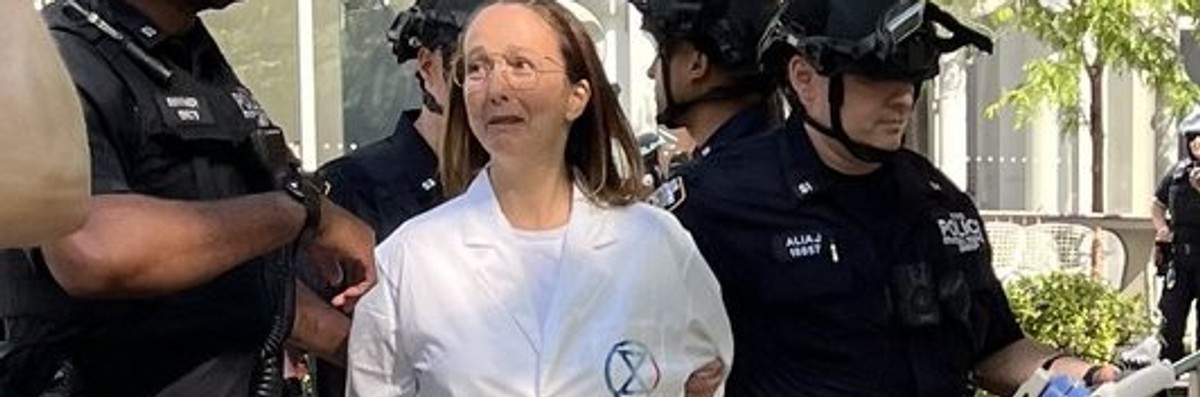
Police arrest a climate protester at Citigroup’s headquarters in New York City on June 12, 2024. (Photo: Bank On Our Future/X)

“I invite you to join us, at any level of risk tolerance,” said one participant in the New York demonstration. “It feels deeply meaningful—even joyful—to be a part of this movement and to stand on the right side of history.”

Police arrested 28 people, including several scientists, protesting outside Citigroup’s headquarters in New York City on Wednesday as climate campaigners continued a series of actions targeting the bank for financing oil and gas projects.

Dozens of scientists and allies, some wearing white lab coats, marched to the bank’s entrances holding signs and banners with messages like “The Science Is Clear,” as they condemned Citigroup for financing nearly $400 billion in fossil fuel extraction in the eight years after the 2015 Paris agreement was signed.

Several scientists gave speeches before or as they were being arrested.

“I have studied climate change since 1982,” Sandra Steingraber, a biologist and retired scholar in residence at Ithaca College, said in a speech outside the Wall Street giant’s entrances. “I’ve testified. I’ve sent letters to the White House. I’ve met with the science advisor. I went to the Paris Climate talks. But carbon dioxide levels just reached a new high, and Citi here is financing the arsonists.”

Police arrested Steingraber, who, as she was being taken away in handcuffs, declared: “I’m not interested in writing eulogies for the species that I study!”

The scientists’ protest was part of a series of climate actions undertaken as part of the Summer of Heat, a program organized by Climate Defenders, Climate Organizing Hub, New York Communities for Change, Planet Over Profit, and Stop The Money Pipeline (STMP).

A total of 28 people were arrested Wednesday, including several scientists, Alec Connon, STMP co-director, told Common Dreams. Dozens of campaigners were also arrested at Citigroup’s headquarters on both Monday, in a highly-attended kickoff to the summer activism series, and Tuesday, in an orca-themed follow-up.d

During Wednesday’s protest, the scientists delivered a joint letter, published Monday by the Union of Concerned Scientists and addressed to Citigroup’s leadership, urging the bank to stop financing fossil fuel projects scientists delivered a letter addressed to Citigroup’s leadership urging the bank to stop financing fossil fuel projects.

Activist pressure on major banks has risen in recent years following revelations—notably in the annual Banking on Climate Chaos report, published by nonprofit groups—about the key role they’ve played in funding oil, gas, and coal projects. The most recent report found that the world’s 60 largest banks had provided $6.9 trillion in funding to the fossil fuel industry in the eight years after the Paris Agreement.

The pressure has had an effect on some banks: HSBC and, more recently, Barclays have declared that they would stop financing new oil and gas projects. However, the Bureau of Investigative Journalism has reported that HSBC remains involved in fossil fuel deals.

Bank loans to fossil fuel companies are used not just to continue extraction at existing sites but also to explore and develop new reserves, even though the International Energy Agency has said there can be no more such development if climate goals are to be met. Citigroup has funded more new extraction than any bank in the world, the Banking on Climate Chaos report found.

Yet in response to Monday’s action, Citigroup claimed it was part of the transition to a green economy.

“Citi respects the advocacy of climate activists, and we are supporting the transition to a low-carbon economy through our net zero commitments and our $1 trillion sustainable finance goal,” a bank spokesperson said a statement, according to media outlets. “Our approach reflects the need to transition while also continuing to meet global energy needs.”

The statement did not win over climate activists. “This is the sort of bald-faced corporate lie that could cost us our planet,” Peter Kalmus, a NASA climate scientist, wrote in a Newsweek op-ed published Wednesday.

Kalmus attended Wednesday’s protest. Standing outside Citigroup’s headquarters, he said, “We’ve written thousands and thousands of papers and they have not listened to us. They’re fools. They’re stupid. They’re being unwise. They have to start listening to scientists.”

Summer of Heat organizers have events planned throughout the summer. In the op-ed, Kalmus reached out to readers to join the effort.

“I invite you to join us, at any level of risk tolerance,” he wrote. “In my experience, and in the experience of many other climate activists I know, civil disobedience has been a very effective way to create social change. And a big change is happening: A transition from a profit-above-life, colonial-extractivist, genocidal mindset, to a loving, sharing, interconnected mindset. It feels deeply meaningful—even joyful—to be a part of this movement and to stand on the right side of history.”

Original article by EDWARD CARVER republished from Common Dreams under Creative Commons (CC BY-NC-ND 3.0).
Continue Reading‘Financing the Arsonists’: Scientists Arrested During Citigroup Climate Protest

‘Disappointing and surprising’: Why isn’t this a climate election in the UK?

Spread the love
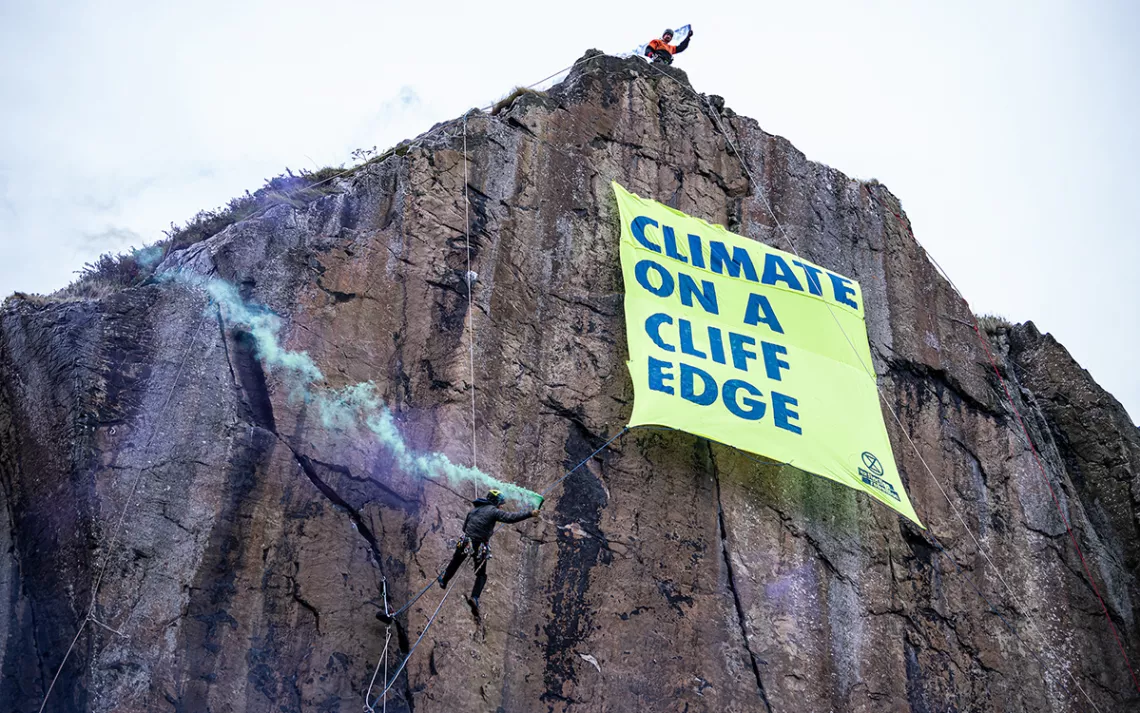
Experienced climbers scale a rock face near the historic Dumbarton castle in Glasgow, releasing a banner that reads “Climate on a Cliff Edge.” One activist, dressed as a globe, symbolically looms near the edge, while another plays the bagpipes on the shores below. | Photo courtesy of Extinction Rebellion and Mark Richards

https://www.theguardian.com/politics/article/2024/jun/10/disappointing-and-surprising-why-isnt-this-a-climate-election-in-the-uk

More than 400 scientists write to political parties urging ambitious action or risk making Britain and the world ‘more dangerous and insecure’

After five years of record heat and record floods, one might assume British politicians would also pay record attention to the climate issue in the current election campaign.

But with the manifestos due this week, concerns are growing that the response of the two main parties will range from tepid progress to a great leap backwards, despite the certainty of further climate chaos during the next parliament.

In a sign of how worried the experts are, more than 400 scientists have signed a public letter to party leaders, urging them to adopt ambitious policies to prepare the country for the coming turmoil and to honour the UK’s international obligation to address the primary causes – the burning of gas, oil, coal and vegetation.

“It is very clear that a failure to tackle climate change with sufficient urgency and scale is making the UK and the rest of the world more dangerous and insecure,” notes the letter, whose signatories include former UK chief scientist Sir David King, former president of the Royal Meteorological Society Prof Joanna Haigh, and the creator of the “climate stripes” graphic, Prof Ed Hawkins.

The 408 scientists urge parties to promise five measures: a credible strategy to reach net zero by 2050, faster action to adapt the UK to now unavoidable climate impacts, leading by example internationally on “transitioning away from fossil fuels”, increasing climate funding for developing countries and respecting Climate Change Committee advice on North Sea oil and gas fields.

“Without such a pledge, we do not believe that your party deserves support in the forthcoming general election,” they write.

The case for action is now indisputable. More than 99% of climate scientists are sure that human burning of gas, oil, coal and trees is heating the planet. This is no longer a geographically or temporally distant threat to the UK. It is here and now.

Last year, the northern hemisphere sweltered through its hottest summer in 2,000 years, causing tens of thousands of deaths and billions of dollars worth of economic damage. That should have been a wake-up call for humanity to transition away from fossil fuels. In fact, the reverse has happened. Carbon dioxide is accumulating in the atmosphere faster than ever, the US National Oceanic and Atmospheric Administration announced last week.

The past two years have been the hottest the British Isles have ever seen. For the first time, the UK has experienced temperatures of more than 40C. By the government’s reckoning, extreme heat killed 2,295 people in 2023, and another 4,500 the year before that. By 2050, the toll is expected to rise to 10,000 each year, according to the British Medical Journal.

https://www.theguardian.com/politics/article/2024/jun/10/disappointing-and-surprising-why-isnt-this-a-climate-election-in-the-uk

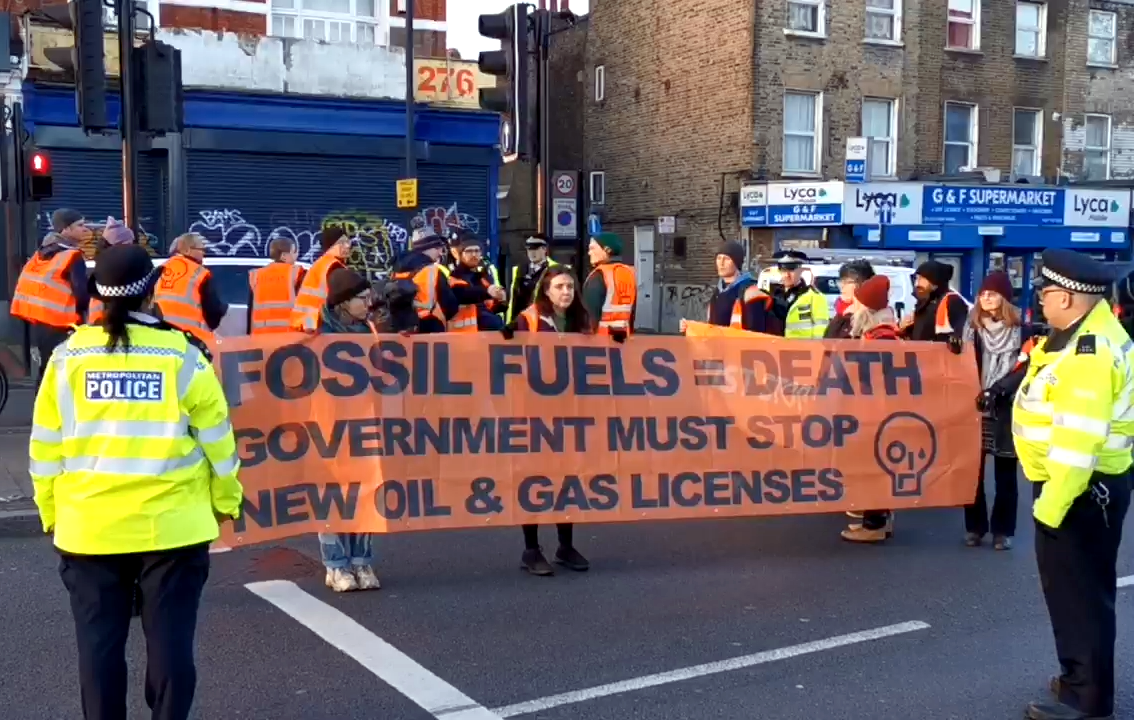
Just Stop Oil protesting in London 6 December 2022.
Continue Reading‘Disappointing and surprising’: Why isn’t this a climate election in the UK?

Conservation slowing biodiversity loss, scientists say

Spread the love

https://www.bbc.co.uk/news/science-environment-68897433

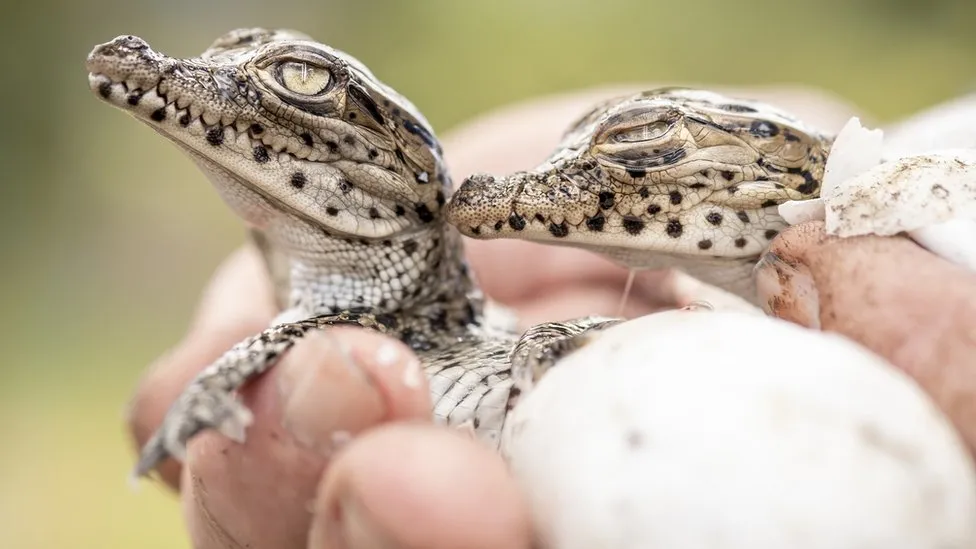
Cuban crocodiles at a breeding sanctuary – one of a number of conservation actions studied

Conservation actions are effective at reducing global biodiversity loss, according to a major study.

International researchers spent 10 years looking at measures, from hatching Chinook salmon to eradication of invasive algae.

The authors said their findings offered a “ray of light” for those working to protect threatened animals and plants.

One out of every three species monitored is currently endangered because of human activities.

In the first study of its kind, published in the journal Science, scientists from dozens of research institutes reviewed 665 trials of conservation measures, some from as far back as 1890, in different countries and oceans and across species types, and found they had had a positive effect in two out of every three cases.

https://www.bbc.co.uk/news/science-environment-68897433

Continue ReadingConservation slowing biodiversity loss, scientists say

‘In Even the Best Coverage There Is No Accountability for the Fossil Fuel Industry’

Spread the love

Original article by JANINE JACKSON republished from FAIR under a Creative Commons Attribution-NonCommercial-NoDerivs 3.0 Unported License.

CounterSpin interview with Evlondo Cooper on climate coverage

Janine Jackson interviewed Media Matters’ Evlondo Cooper about climate coverage for the March 22, 2024, episode of CounterSpin. This is a lightly edited transcript.

Audio Player

00:00

00:00

Use Up/Down Arrow keys to increase or decrease volume. [Available at the original article]

Media Matters (3/14/24)

Janine Jackson: Climate disruption is, of course, one of the most disastrous phenomena of today’s life, affecting every corner of the globe. It’s also one of the most addressable. We know what causes it, we know what meaningful intervention would entail. So it’s a human-made tragedy unfolding in real time before our eyes.

To understate wildly, we need to be talking about it, learning about it, hearing about it urgently, which is why the results of our next guest’s research are so alarming. I’ll just spoil it: Broadcast news coverage of the climate crisis is going down.

Evlondo Cooper is a senior writer with the Climate and Energy Program at Media Matters for America. He joins us now by phone from Washington state. Welcome to CounterSpin, Evlondo Cooper.

Evlondo Cooper: Thank you for having me. I’m excited about our conversation today.

JJ: We’re talking about the latest of Media Matters’ annual studies of climate crisis coverage. First of all, just tell us briefly what media you are looking at in these studies.

EC: So we’re looking at corporate broadcast network coverage. That’s ABC, CBS and NBC. And for the Sunday morning shows, we also include Fox BroadcastingFox News Sunday.

JJ: All right. And then, for context, this decline in coverage that you found in the most recent study, that’s down from very little to even less.

Media Matters (3/14/24)

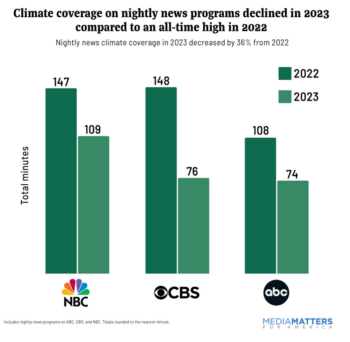
EC: Yeah, so a little context: 2021 and 2022 were both record years for climate coverage, and that coverage was a little bit more than 1%. This year, we saw a 25% decrease from 2022, which brought coverage to a little bit less than 1%. We want to encourage more coverage, but even in the years where they were doing phenomenal, it was only about 1% of total coverage. And so this retrenchment by approximately 25% in 2023 is not a welcome sign, especially in a year where we saw record catastrophic extreme weather events, and scientists are predicting that 2024 might be even worse than ’23.

JJ: Let’s break out some of the things that you found. We’re talking about such small numbers—when you say 1%, that’s 1% of all of the broadcast coverage; of their stories, 1% were devoted to the climate crisis. But we’ve seen, there’s little things within it. For example, we are hearing more from actual climate scientists?

EC: That was a very encouraging sign, where this year we saw 41 climate scientists appeared, which was 10% of the featured guests in 2023, and that’s up from 4% in 2022. So in terms of quality of coverage, I think we’re seeing improvements. We’re seeing a lot of the work being done by dedicated climate correspondents, and meteorologists who are including climate coverage as part of their weather reports and their own correspondents’ segments, a bigger part of their reporting.

So there are some encouraging signs. I think what concerns us is that these improvements, while important and necessary and appreciated, are not keeping up with the escalating scale of climate change.

Media Matters (3/14/24)

JJ: It’s just not appropriate to the seriousness of the topic. And then another thing is, you could say the dominance of white men in the conversation, which I know is another finding, that’s just kind of par for the elite media course; when folks are talked to, they are overwhelmingly white men. But it might bear some relation to what you’re seeing as an underrepresentation of climate-impacted populations, looking at folks at the sharp end of climate disruption. That’s something you also consider.

EC: Yeah, we look at coverage of, broadly, climate justice. I think a lot of people believe it’s representation for representation’s sake, but I think when people most impacted by climate change—and we’re talking about communities of color, we’re talking about low-income communities, we’re talking about low-wealth rural communities—when these folks are left out of the conversation, you’re missing important context about how climate change is impacting them, in many cases, first and worse. And you’re missing important context about the solutions that these communities are trying to employ to deal with it. And I think you’re missing an opportunity to humanize and broaden support for climate solutions at the public policy level.

So these aren’t communities where these random acts of God are occurring; these are policy decisions, or indecisions, that have created an environment where these communities are being most harmed, but least talked about, and they’re receiving the least redress to their challenges. And so those voices are necessary to tell those stories to a broad audience on the corporate broadcast networks.

JJ: Yes, absolutely.

CBS (7/17/23)

Another finding that I thought was very interesting was that extreme weather seemed to be the biggest driver of climate coverage, and that, to me, suggests that the way corporate broadcast media are coming at climate disruption is reactive: “Look at what happened.”

EC: Totally.

JJ:  And even when they say, “Look at what’s happening,” and you know what, folks pretty much agree that this is due to climate disruption, these houses sliding into the river, it’s still not saying, “While you look at this disaster, know that this is preventable, and here is who is keeping us from acting on it and why.”

EC: Yeah, that is so insightful, because that’s a core critique of even the best coverage we see, that there is no accountability for the fossil fuel industry and other industries that are driving the crisis. And then there’s no real—solutions are mentioned in about 20% of climate segments this year. But the solutions are siloed, like there are solution “segments.”

But to your point, when we’re talking about extreme weather, when you have the most eyeballs hearing about climate change, to me, it would be very impactful to connect what’s happening in that moment—these wildfires, these droughts, these heat waves, these hurricanes and storms and flooding—to connect that to a key driver, fossil fuel industry, and talk about some potential solutions to mitigate these impacts while people are actually paying the most attention.

CNN (3/3/23)

JJ: And then take it to your next story about Congress, or your next story about funding, and connect those dots.

EC: Exactly. I mean, climate is too often siloed. So you could see a really great segment, for instance, on the Willow Project, at the top of the hour—and this is on cable, but the example remains—and then later in the hour, you saw a story about an extreme weather event. But those things aren’t connected, they’re siloed.

And so a key to improving coverage in an immediate way would be to understand that the climate crisis is the background for a range of issues, socioeconomic, political. Begin incorporating climate coverage in a much broader swath of stories that, whether you know it or not, indirectly or directly, are being impacted by global warming.

JJ: It’s almost as though corporate media have decided that another horrible disaster due to climate change, while it’s a story, it’s basically now like a dog-bites-man story. And if they aren’t going to explore these other angles, well, then there really isn’t anything to report until the next drought or the next mudslide. And that’s just a world away from what appropriate, fearless, future-believing journalism would be doing right now.

Evlondo Cooper: “It doesn’t have to be about just showing the destruction and carnage. There are ways that you can empower people to take action.”

EC: It’s out of step, right? Pull up the poll showing bipartisan support for government climate action, because, whether people know it or not, as far as the science, —and there’s some deniers out there, but anecdotally, people know something is happening, something is changing in their lives. We’re seeing record-breaking things that no one’s ever experienced, and they want the government to do something about it.

And so it’s important to cover extreme weather and to cover these catastrophes. And I know there’s a range of thought out there that says if you’re just focusing on devastating impacts, it could dampen public action. But to me, to your point, report on it and connect it to solutions, empower people to call their congressperson, their representative, their senator, to vote in ways that have local impacts to deal with the local climate impacts.

It doesn’t have to be about just showing the destruction and carnage. There are ways that you can empower people to take action in their own lives, and to galvanize public support.

And the public wants it. The public is asking for this. So I think just being responsive to what these polls are showing would be a way to immediately improve the way that they cover climate change right now.

JJ: All right, then. We’ve been speaking with Evlondo Cooper of Media Matters for America. You can find this work and much else at MediaMatters.org. Evlondo Cooper, thank you so much for joining us this week on CounterSpin.

EC: Thank you for having me.

Original article by JANINE JACKSON republished from FAIR under a Creative Commons Attribution-NonCommercial-NoDerivs 3.0 Unported License.

Continue Reading‘In Even the Best Coverage There Is No Accountability for the Fossil Fuel Industry’

Scientists Condemn Last Minute Push to Overturn EU Nature Law

Spread the love

Original article by Clare Carlile republished from DeSmog.

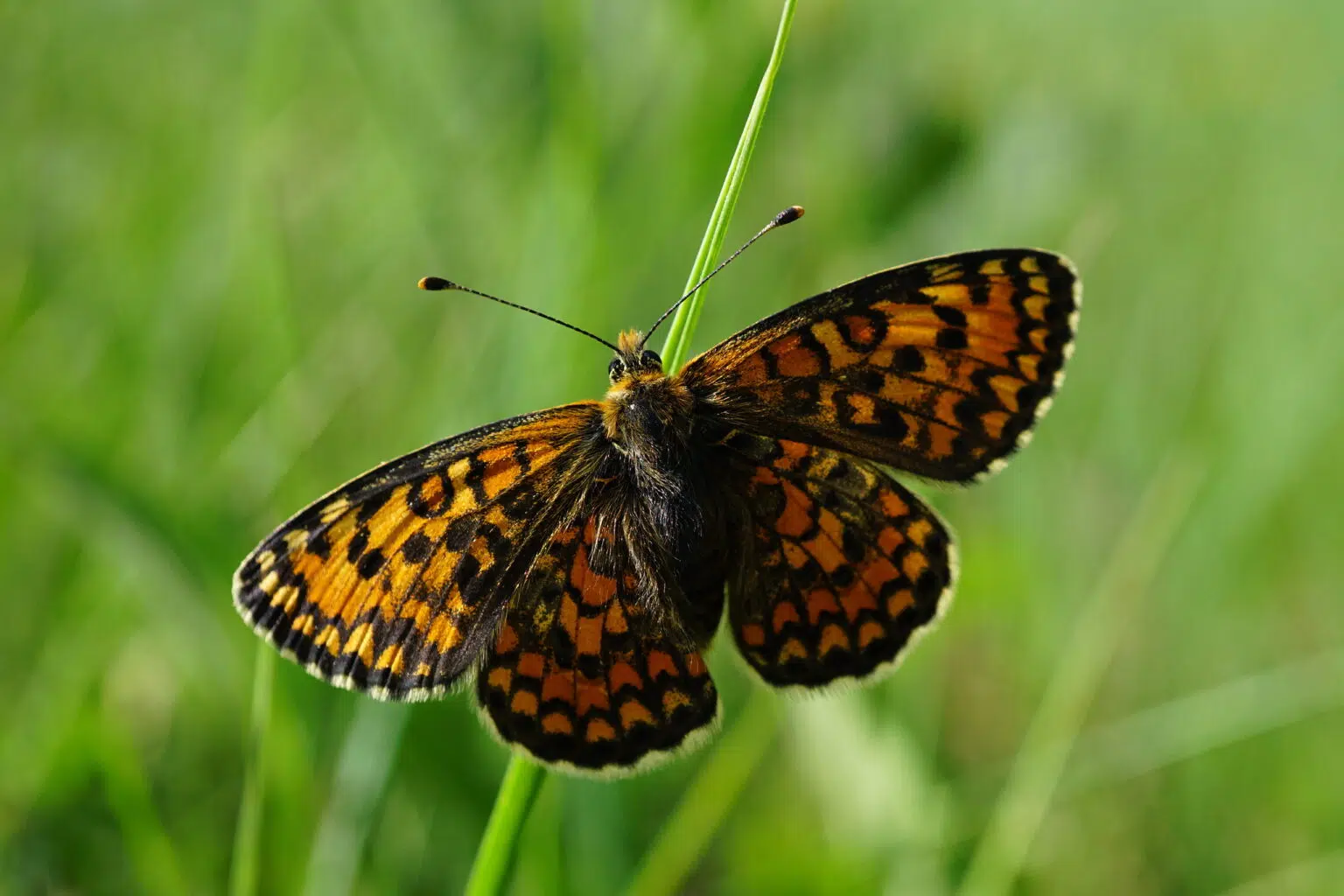
The Melitaea trivia butterfly, one of many endangered species in the EU. The nature restoration law offers a lifeline for natural habitats in the bloc where one in three bees, butterflies and hoverflies are disappearing.

At the eleventh hour, right-wing politicians have launched a bid to block the passing of the EU’s flagship nature protection law, which scientists have described as a “cornerstone of food security and human health”. 

The pro-nature plan, which could see as much as 90 percent of damaged ecosystems repaired across the bloc, is due for final sign off in Parliament on Tuesday (27 February).

Usually a formality, the vote follows six months of intense – and at times bitter – negotiation of the law between the European Commission, Parliament and EU member states that saw an agreement reached in November last year.

But on Wednesday the right-wing European Conservatives and Reformists (ECR) party filed amendments calling for Members of the European Parliament (MEPs) to reject outright the so-called Nature Restoration Law – an extremely rare move so late in the decision-making process.

Scientists have condemned the call, as well as six other amendments that could see the law delayed or weakened. They say the proposed policy offers a lifeline for natural habitats in the bloc where one in three bees, butterflies and hoverflies are disappearing.

“In Europe we are in a critical biodiversity situation, which climate change is accelerating,” Daniel Hering, professor of aquatic ecology at the University of Duisburg-Essen, told DeSmog. “Without such an ambitious legislation, it will not be possible to bend the curve of declining biodiversity.”  

A number of proposed green laws have been rolled back or delayed over the last 12 months, as opposition mounts to the EU’s Green Deal – a flagship plan to reach net zero by 2030.

The eurosceptic ECR party has justified its last-minute attempt to block the law citing “great social unrest”, in apparent reference to farmer protests that have spread across the continent in recent weeks, with tractors blocking roads and motorways in the majority of EU countries.

But scientists told DeSmog that derailing the law could come at significant cost to farmers, who are facing increasingly uncertain conditions due to climate breakdown and biodiversity loss.

The former EU climate chief Frans Timmerman has stated that “already half of crops in the EU that depend on pollination face a deficit.”

If any of the ECR’s amendments – such as deleting a target to restore 30 percent of Europe’s damaged ecosystems by 2030 – are accepted, a final decision on the law would be delayed until after the EU elections in June when right-wing parties are expected to make major gains.

It is so far unclear whether the proposals will succeed in gaining a majority in the vote next week. But the choice made by the centre-right European Peoples’ Party (EPP) – the largest in the EU parliament – will be a deciding factor. 

The EPP’s Christine Schnieder, chief negotiator on the nature law, told DeSmog that her party had “serious concerns” and would “determine its voting behaviour for the vote on Tuesday at the Group meeting on Monday evening”.

Misinformation’

The law has long been portrayed as a burden to the farming industry. The EPP has repeatedly attempted to block the legislation following intense lobbying by farm union Copa-Cogeca, which represents producers and agribusinesses across the bloc. It succeeded in deleting the most ambitious agriculture clauses from the law, including targets to re-wild 10 percent of farmland.

However, scientists told DeSmog that jettisoning the legislation would cause major harms to the industry – a stance backed up by some small scale producers who are calling for more environmental support. 

“Our food systems are at extreme risk. Looking outside and seeing the current temperatures, we can see that the coming summer will be even worse than the last one,” said Guy Pe’er, an ecologist at the German Centre for Integrative Biodiversity Research and the Helmholtz Centre for Environmental Research. “Farmers will soon need help maintaining production under very difficult conditions. The Nature Restoration law is a crucial part of this package.”

Pe’er also told DeSmog he was concerned Tuesday’s outcome could be “based on misinformation”. He was one of more than 6,000 scientists to sign an open letter in July, warning of a “lack of scientific evidence” for arguments opposing the law, including suggestions that it would harm EU food security and take away farming jobs across the continent.

Christine Schneider of the EPP told DeSmog that the EPP remained concerned that the law would lead to onerous regulations in member states with “far-reaching monitoring and reporting obligations for agriculture and forestry”. 

‘Election Strategy’

If parliament supports any amendments on 27 February, negotiations on the Nature Restoration Law will extend beyond EU elections, which are due to take place between 6-9 June later this year.

Polls are currently suggesting a major ballot swing towards right-wing parties, which have  pledged to use election success to fight the Green Deal. 

In France, Marine Le Pen’s far-right party National Rally is expected to claim more than 30 percent of the country’s vote. It said in January it planned to form a “blocking majority” with other parties that target environmental laws. 

The EPP, which is likely to retain the largest number of seats in the EU parliament, has likewise opposed multiple environmental regulations in the run-up to the elections in recent months, including overturning plans to halve pesticide use.

The ECR is so far not expected to gain many seats in the coming election. 

Environmental activist Chloé Miko told DeSmog that if the law was voted down on Tuesday it would be “the final nail in the coffin for the Green Deal” – which has been seen as the lead policy package for the current Commission. 

She added that the ECR was deploying a cynical “election strategy”, by linking its opposition to the law to farmer protests across the continent. 

“It is not a sign of goodwill towards farmers,” she said. “The far-right, sometimes with the help of the Conservatives, have been on a journey to weaken, delay or even kill every remaining part of the Green deal. It is part of this process.”

Jutta Paulus, the Greens’ negotiator on the law in Parliament, told DeSmog: “The ECR’s attempt to stop the legislative procedure is typical for this euro-sceptic group,” adding that the EPP’s concerns about the law had already been addressed during trialogue negotiations between parliament, the commission and the council over recent months. 

“I expect the constructive, pro-European parties to take a firm position and vote in favour of the trilogue agreement,” she said.

ECR did not respond to Desmog’s request for comment.

Original article by Clare Carlile republished from DeSmog.

Continue ReadingScientists Condemn Last Minute Push to Overturn EU Nature Law