… MPs from different parties lined up to quiz the minister on how the government will tackle the crisis gripping the water sector. Among those to question Pow was Green MP Caroline Lucas.
She said: “Water companies had no debt when they were privatised. Since [then], they have borrowed £53 billion, and much of that has been used to help pay the £72 billion in dividends. Meanwhile, we have this appalling sewage scandal – particularly in the South East of England. We have a failing water company – the Southern Water company – that my constituents have no choice but to rely on and it’s considering raising bills by £279 per year by 2030, largely to pay for the investment that they should have been making in the previous years.
“Doesn’t that just show that the privatisation of water was a serious mistake and it needs to be permanently rectified?”
In an unbelievable response, Pow came back: “What I would say is that privatisation has enabled clean and plentiful water to come out of our taps.”
…
Minister says water privatisation has enabled "clean & plentiful water". What?? Since privatised, water firms have borrowed a staggering £53bn, much of that to help pay £72bn shareholder dividends – while sewage pours into rivers & seas. Privatisation has utterly failed @We_OwnItpic.twitter.com/g3dLpeDdfs
Six major US retirement funds would be worth a combined $21 billion more today if they had divested a decade ago, University of Waterloo researchers find.
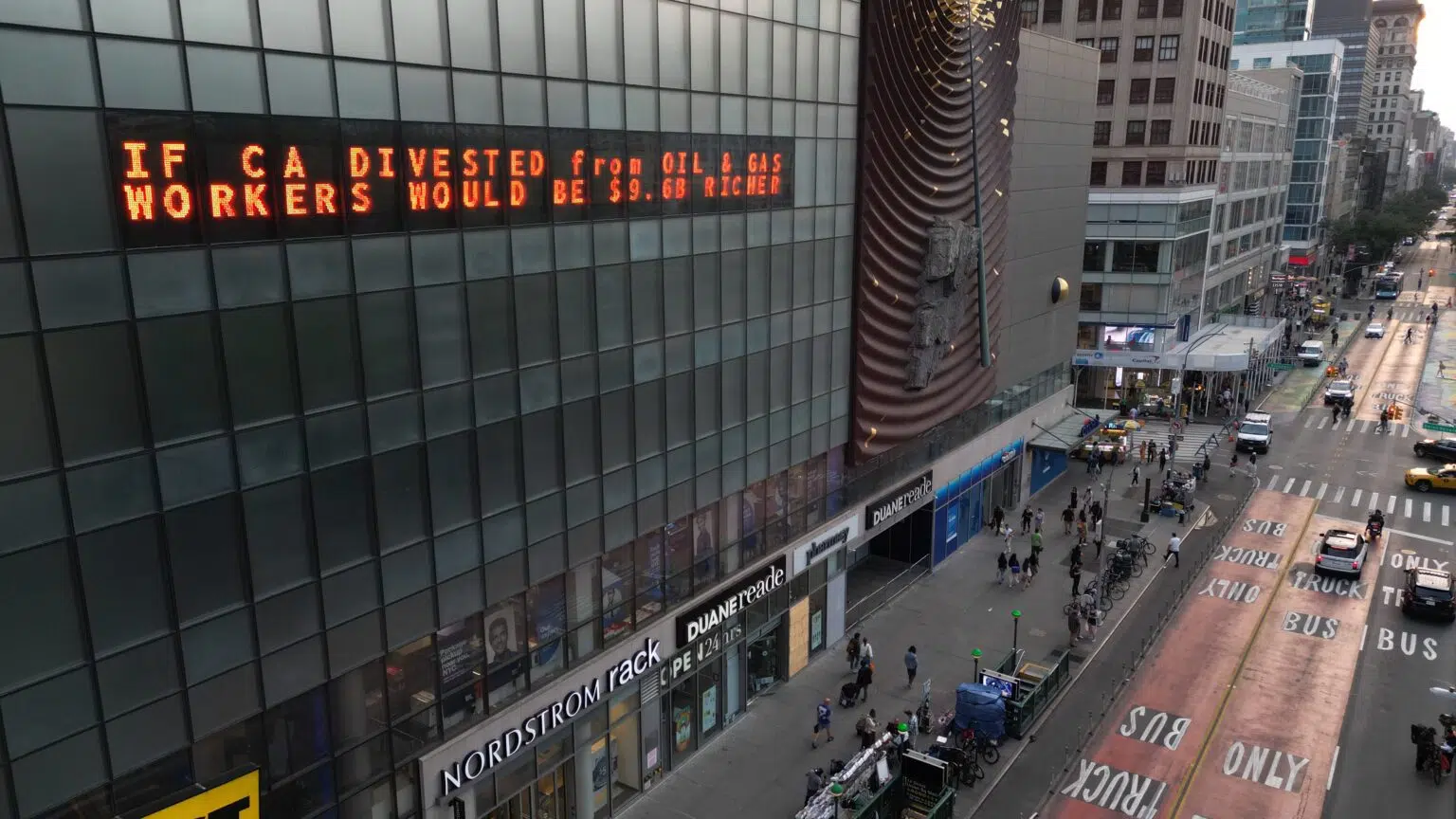
US public pension funds would be worth billions more if they divested from fossil fuels, researchers have found. Credit: Climate Clock
For U.S. public pension funds, divesting from oil, coal, and gas would result in overall higher financial value.
That is the key takeaway from a new study examining the past decade’s portfolio performance for several of the largest public pension funds in the country. The analysis by researchers at the University of Waterloo, published today in partnership with the organization Stand.earth, has found that the total cumulative value of six major U.S. public pension funds would have been about 13 percent higher had they divested from fossil fuel holdings ten years ago – equivalent to around $21 million in earnings.
Using Bloomberg Terminal data, the researchers looked at the actual portfolio performance between December 31, 2012 and December 31, 2022 of six funds: the Alaska Permanent Fund Corporation, California Public Employees’ Retirement System, California State Teachers’ Retirement System, New York State Teachers’ Retirement System, Oregon Public Employees’ Retirement Fund, and the State of Wisconsin Investment Board.
Then they analyzed how the funds would have done over the same time period if the fossil fuel investments had been divested, and their value spread evenly among the remaining holdings.
The analysis found that while the total actual value of the six funds was $402.8 billion at the end of 2022, they would have been worth $424.6 without the fossil fuel holdings.
“Financially it doesn’t make sense to stay invested [in fossil fuels],” Olaf Weber, a University of Waterloo sustainable finance professor and co-author of the study, told DeSmog.
He said the findings are consistent with other similar studies, such as a 2019 analysis which found that California and Colorado’s public pension funds would have been a combined $19 billion richer had they divested from fossil fuel holdings in 2009.
Although major fossil fuel companies have reported record profits over the past year, this growing body of research suggests that it has not significantly boosted the value of pension funds that remain invested in these companies.
Experts have pointed out that in addition to the great volatility of the fossil fuel industry’s value, the sector appears to be bound for long-term, perhaps even permanent, decline.
“Today the oil and gas sector is in a pitched battle for last place in the stock market,” said Tom Sanzillo, director of financial analysis at the Institute for Energy Economics and Financial Analysis, during an April webinar timed to the release of a report calling for major hospital systems to divest from the industry.
While the fossil fuel sector commanded about 28 percent of the stock market in 1980, it now accounts for about 5 percent or less of the market, Sanzillo said during the event.
Oil and gas sector profits “are unsustainable,” he said, “and their future is on shaky ground.”
Fossil Fuel Divestment ‘a Win-Win Situation’
One often-used argument for staying invested in fossil fuels is that it allows investors to try influencing companies through shareholder engagement. The problem with this argument is that shareholder engagement has not been very effective at compelling big polluters to take serious climate action.
“The results show there is not really an effect of engagement because if [investors] put pressure on the fossil fuel companies to reduce production, it will have a negative impact on the share price as well,” Weber said. “So that’s kind of a conflict.”
Weber and his colleagues also looked at the greenhouse gas emissions associated with the public equity investments of eight U.S. pension funds: the same six plus the Colorado Public Employees’ Retirement Association and the Alaska Retirement Management Board. They found that if the funds had divested from fossil fuel holdings ten years ago, their cumulative carbon spew would have been about 16.6 percent or nearly 280 million tons lower – the equivalent of the annual energy use of 35 million homes.
“[Fossil fuel] divestments are able to create a win-win situation with higher financial returns and lower carbon footprints,” the researchers concluded.
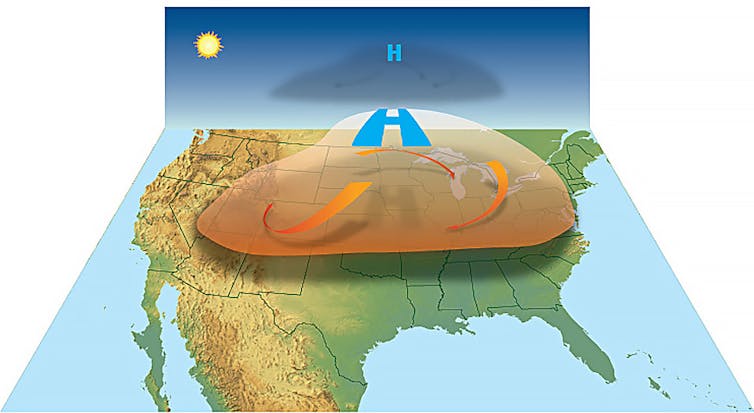
A heat dome occurs when a persistent region of high pressure traps heat over an area. The heat dome can stretch over several states and linger for days to weeks, leaving the people, crops and animals below to suffer through stagnant, hot air that can feel like an oven.
Typically, heat domes are tied to the behavior of the jet stream, a band of fast winds high in the atmosphere that generally runs west to east.
Normally, the jet stream has a wavelike pattern, meandering north and then south and then north again. When these meanders in the jet stream become bigger, they move slower and can become stationary. That’s when heat domes can occur.
Heat domes involve high-pressure areas that trap and heat up the air below. NOAA
When the jet stream swings far to the north, air piles up and sinks. The air warms as it sinks, and the sinking air also keeps skies clear since it lowers humidity. That allows the sun to create hotter and hotter conditions near the ground.
If the air near the ground passes over mountains and descends, it can warm even more. This downslope warming played a large role in the extremely hot temperatures in the Pacific Northwest during a heat dome event in 2021, when Washington set a state record with 120 degrees Fahrenheit (49 Celsius), and temperatures reached 121 F in British Columbia in Canada, surpassing the previous Canadian record by 8 degrees F (4 C).
The human impact
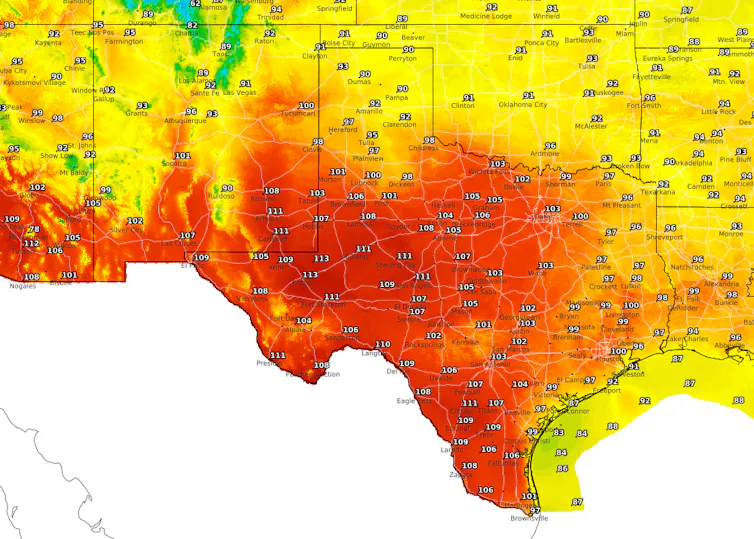
Heat domes normally persist for several days in any one location, but they can last longer. They can also move, influencing neighboring areas over a week or two. The heat dome involved in the June 2023 heat wave in Texas and Mexico was forecast to expand deeper into the Southwest and South Central U.S.
On rare occasions, the heat dome can be more persistent. That happened in the southern Plains in 1980, when as many as 10,000 people died during weeks of high summer heat. It also happened over much of the United States during the Dust Bowl years of the 1930s.
A heat dome can have serious impacts on people, because the stagnant weather pattern that allows it to exist usually results in weak winds and an increase in humidity. Both factors make the heat feel worse – and become more dangerous – because the human body is not cooled as much by sweating.
The heat index, a combination of heat and humidity, is often used to convey this danger by indicating what the temperature will feel like to most people. The high humidity also reduces the amount of cooling at night. Warm nights can leave people without air conditioners unable to cool off, which increases the risk of heat illnesses and deaths. With global warming, temperatures are already higher, too.
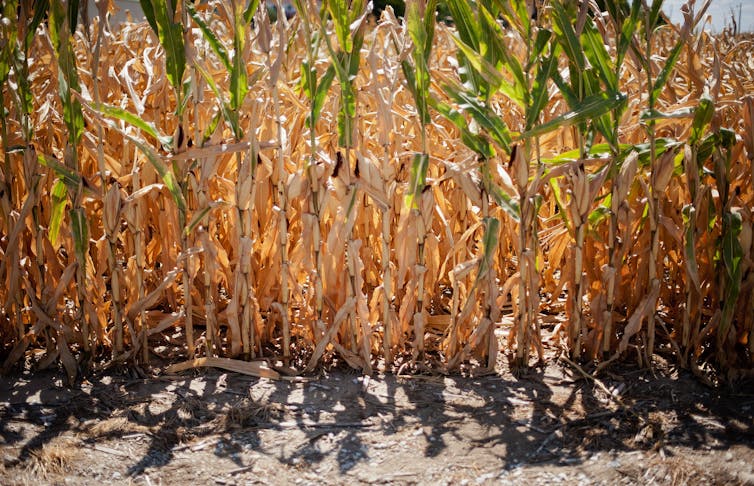
Many people are familiar with flash floods – torrents that develop quickly after heavy rainfall. But there’s also such a thing as a flash drought, and these sudden, extreme dry spells are becoming a big concern for farmers and water utilities.
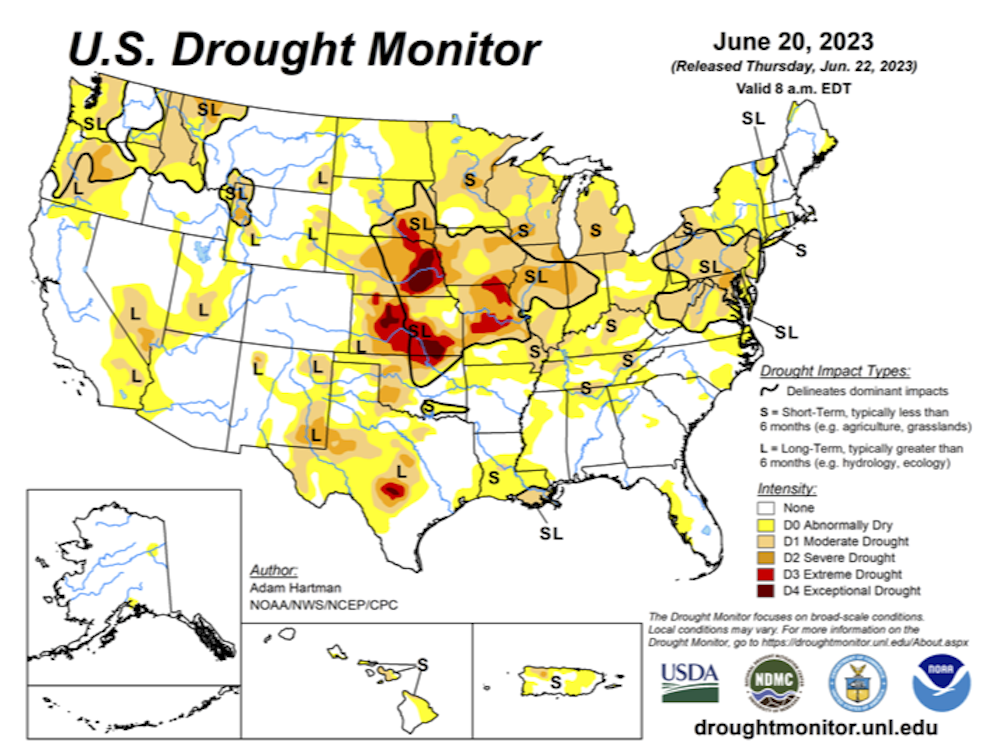
Flash droughts start and intensify quickly, over periods of weeks to months, compared to years or decades for conventional droughts. Still, they can cause substantial economic damage, since communities have less time to prepare for the impacts of a rapidly evolving drought. In 2017, a flash drought in Montana and the Dakotas damaged crops and grasses that served as forage for cattle, causing US$2.6 billion in agricultural losses.
A developing flash drought in the central U.S. covered 64% of corn territory and 57% of soybean territory in late June 2023. Areas marked S are under short-term drought. U.S. Drought Monitor via USDA
Less rain, warmer air
Flash droughts typically result from a combination of lower-then-normal precipitation and higher temperatures. Together, these factors reduce overall land surface moisture.
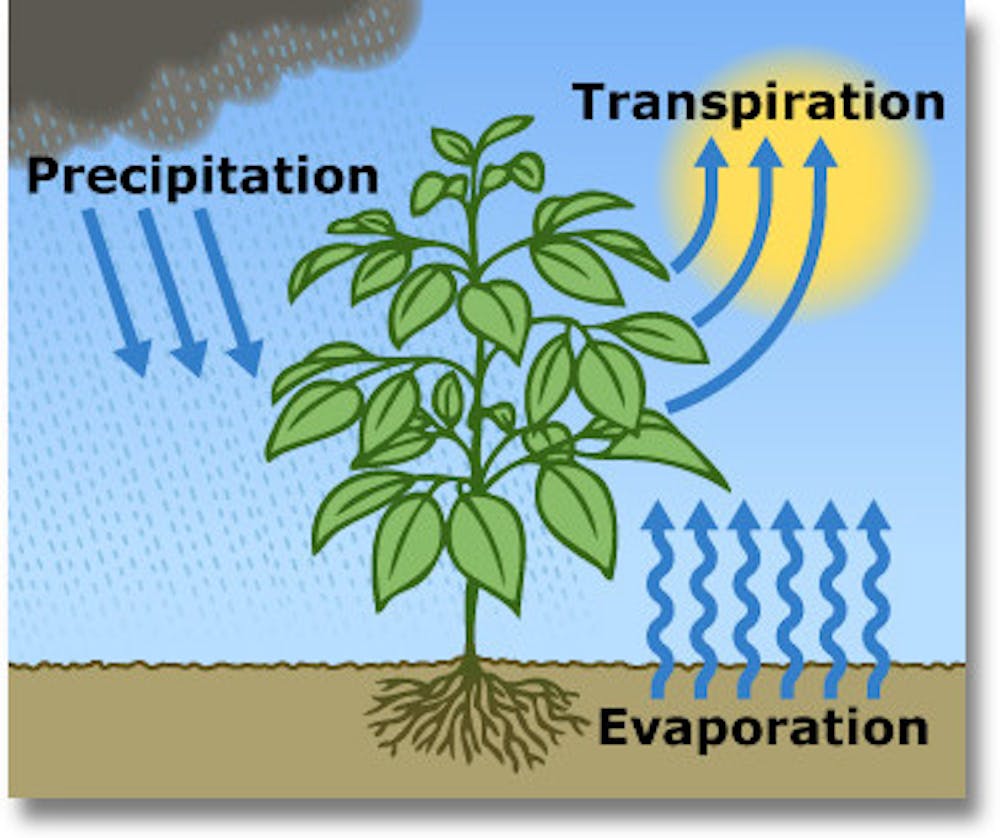
Water constantly cycles between land and the atmosphere. Under normal conditions, moisture from rainfall or snowfall accumulates in the soil during wet seasons. Plants draw water up through their roots and release water vapor into the air through their leaves, a process called transpiration. Some moisture also evaporates directly from the soil into the air.
Water constantly circulates between soil and the atmosphere – sometimes directly, sometimes via plants. USGS
Scientists refer to the amount of water that could be transferred from the land to the atmosphere as evaporative demand – a measure of how “thirsty” the atmosphere is. Higher temperatures increase evaporative demand, which makes water evaporate faster. When soil contains enough moisture, it can meet this demand.
But if soil moisture is depleted – for example, if precipitation drops below normal levels for months – then evaporation from the land surface can’t provide all the moisture that a thirsty atmosphere demands. Reduced moisture at the surface increases surface air temperatures, drying out the soil further. These processes amplify each other, making the area increasingly hot and dry.
Moist regions can have flash droughts
Flash droughts started receiving more attention in the U.S. after notable events in 2012, 2016 and 2017 that reduced crop yields and increased wildfire risks. In 2012, areas in the Midwest that had had near-normal precipitation conditions through May fell into severe drought conditions in June and July, causing more than $30 billion in damages.
Conventional droughts, like the Dust Bowl of the 1930s or the current 22-year drought across the southwestern U.S., develop over periods of years. Scientists rely on monitoring and prediction tools, such as measurements of temperature and rainfall, as well as models, to forecast their evolution.
Predicting flash drought events that occur on monthly to weekly time scales is much harder with current data and tools, largely due to the chaotic nature of weather and limitations in weather models. That’s why weather forecasters don’t typically make projections beyond 10 days – there is a lot of variation in what can happen over longer time spans.
And climate patterns can shift from year to year, adding to the challenge. For example, Boston had a very wet summer in 2021 before its very dry summer in 2022.
Scientists expect climate change to make precipitation even more variable, especially in wetter regions like the U.S. Northeast. This will make it more difficult to forecast and prepare for flash droughts well in advance.
But new monitoring tools that measure evaporative demand can provide early warnings for regions experiencing abnormal conditions. Information from these systems can give farmers and utilities sufficient lead time to adjust their operations and minimize their risks.