Business secretary privately met media mogul in apparent breach of ministerial code of conduct
Kemi Badenoch failed to declare a meeting that she held with Rupert Murdoch days after she was appointed to the cabinet – in a breach of transparency rules.
The business and trade secretary reacted angrily on Monday on social media after it was revealed that she had privately met the media mogul and other executives from his News Corp company in New York in September 2022.
Murdoch was reported by Politico to have questioned Badenoch for 20 minutes in an atmosphere that was said to have been described as akin to a job interview by one of those present.
A government spokesperson described the fact that the meeting with Murdoch was not made public as “an oversight”.
Nevertheless, the failure to declare the meeting appears to have contravened the ministerial code of conduct, which states: “Meetings with newspaper and other media proprietors, editors and senior executives will be published on a quarterly basis, regardless of the purpose of the meeting.”
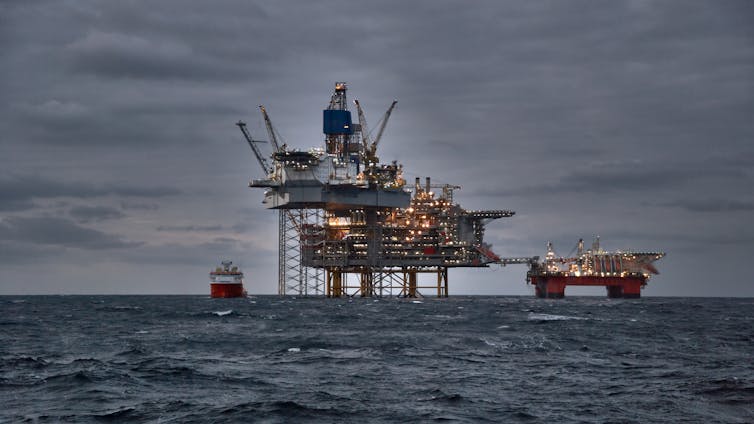
In a four-line statement announcing the approval of the new Rosebank oil field 80 miles west of Shetland, the UK’s offshore oil and gas regulator showed its mission no longer serves the public good.
The announcement by the North Sea Transition Authority (NSTA), which regulates oil and gas extraction in the waters off the British coast, asserted that net zero considerations had been taken into account – a technical definition that makes it appear long-term oil production is compatible with climate goals. This has outraged and dismayed climate scientists, campaigners, and the many other people concerned about the UK’s faltering climate leadership.
The approval greenlights a process that is expected to produce first oil by 2026, and around 300 million barrels of oil (and a smaller amount of gas) over the next two decades. The project’s developers are Equinor, an oil company owned for the most part by the Norwegian state, and Ithaca Energy, owned by the Delek Group listed on the Tel Aviv stock exchange.
The decision is out of step with demands for rapid action on climate change coming from a range of quarters. This includes shareholder activists demanding corporations accelerate decarbonisation, direct action groups such as Just Stop Oil, and financiers concerned about the risks of “asset stranding” as renewables become cheaper than fossil fuels.
Public protests and legal challenges to the NSTA spotlight the irrationality and recklessness in the government’s expressed support for issuing new licenses. Activists are not alone in making this point.
A welter of scientific studies and reports by international agencies confirm that new fossil fuel extraction is incompatible with keeping global temperature increases well below 2℃.
Rosebank has been a major focus for climate activism in the past couple of years, as science, international policy and campaigners turn their attention to stopping new extraction, rather than solely focusing on reducing emissions. Calls to end new licensing for oil and gas are in line with climate science.
But a climate politics focused on new licensing alone misses the point. The thing is, like other North Sea oil fields yet to be approved, Rosebank was licensed for oil and gas extraction years ago.
The NSTA approval process follows licensing, sometimes after considerable time has passed. And it is this approval process that locks the UK into hydrocarbon production for years to come.
End ‘maximising economic recovery’
The core objective of the NSTA is to maximise the economic recovery of UK petroleum – a principle shorthanded as MER – as set out in the 1998 Petroleum Act. In practice, this means the regulator’s primary mission is to facilitate the extraction of oil and gas.
A revised strategy in 2021 paired MER with an obligation to support the UK’s net zero commitments. And the former Oil and Gas Authority changed its name to include an explicit reference to the “transition” in 2022, underpinned by ambitions for emissions reduction and decarbonisation.
NSTA sees its job as effecting the industry’s alignment with these goals. It is now also in charge of licensing for carbon capture and storage and offshore hydrogen storage.
Rosebank’s approval therefore reveals a deeper truth: the regulator’s guiding objective fails the public good test. Regulation aims to avoid economic, environmental and social harms, and ensure the public good through delivering collective benefits and upholding socially-desirable ideals. The Rosebank decision arguably breaches this principle.
Supporters of Rosebank argue it will contribute to the UK’s energy security and deploy decarbonisation technologies that reduce CO₂ emissions overall. These arguments do not stand scrutiny, however: oil from Rosebank, like around 80% of North Sea oil production, will be sold directly into international markets and will not materially affect the price of petrol or diesel for UK motorists.
Much of the value of that oil will flow into the portfolios of Equinor and Ithaca. That value could be harnessed to speed up transition to renewables or ensure its benefits are widely distributed, but that’s largely down to Equinor and Ithaca – not the UK government.
A decade ago, a decision by NSTA would not have raised much attention. Now it highlights a significant problem in need of reform. Piecemeal adaptation has left MER and other core regulatory principles untouched, which is at odds with the climate emergency.
Existing licensed fields escape the weak scrutiny embodied in instruments such as the climate compatibility checkpoint, a series of tests to be applied in decisions about future licensing rounds. What’s more, as a litmus test for approval, Rosebank indicates other licensed projects may get the go-ahead, like Cambo.
Removing NSTA’s central objective to maximise economic recovery requires nothing less than a rewrite of the Petroleum Act. This would be an opportunity to fundamentally revise what the North Sea is for, and whether or how to exploit its resources in the future. A start would be to consider a reversal of direction – a “minimising” of economic recovery, for example – which redefines the “economic” in terms of what is socially necessary.
Such a move will inevitably entail reviewing licences already in place, and will likely generate challenges from the sector and other powerful incumbents. Rosebank exposes, however, how the new mission of the offshore regulator has to be about securing a new public good. This needs wider social debate, and should ultimately be decided through parliament.
Don’t have time to read about climate change as much as you’d like?
“One week ago, 75,000 people inundated New York City streets to demand the president end fossil fuels,” said one campaigner. “Now, climate-fueled rains are submerging those same streets.”
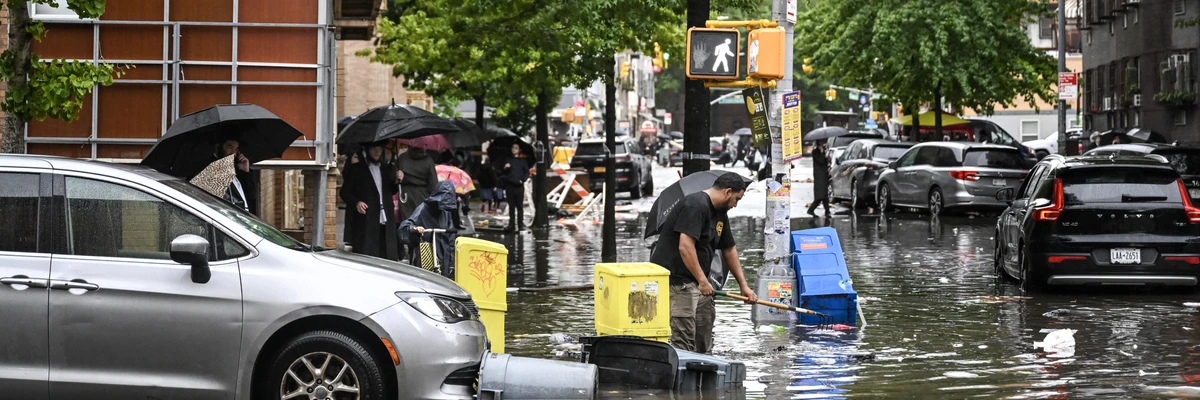
“This is the climate crisis,” said youth-led grassroots organization Sunrise Movement on Friday as photos and videos of flooded streets and subway stations in the largest city in the United States went viral across social media.
The group shared a video of cars struggling to drive through water that was up to pedestrians’ knees in Brooklyn, saying the image starkly illustrated the need to both prepare U.S. cities and infrastructure for fossil-fueled extreme weather events and to rapidly draw down planet-heating greenhouse gas emissions that have been linked to stronger hurricanes, rising sea levels, and other destructive changes.
“We need an all-out mobilization of our government and society to stop [the climate crisis] right now,” said the group.
New York is underwater.
THIS is the climate crisis. We need an all-out mobilization of our government and society to stop it right now. https://t.co/An3yS7UYh4
New York Gov. Kathy Hochul called the rainstorm that caused the flash flooding a “life-threatening rainfall event” and noted that there have been reports of some school buildings flooding, prompting administrators to move children to higher floors or close the buildings.
“No children are in danger as far as we know,” said Hochul, adding that many New York City children use public transportation to get home from school. “We want to make sure we get the subways, the trains, our communication system, our transportation system working.”
According to Richard Davis, president of Local 100 of the Transport Workers Union, some bus passengers on Friday were forced to stand on their seats as drivers navigated through high flood waters that seeped into buses.
Maintenance workers were using pumps to remove water from subway stations, and the Metropolitan Transportation Authority announced “extremely limited subway service,” with many lines suspended or rerouted.
Right now: NYC is essentially shut down because of heavy rainfall flooding the subways. https://t.co/PkD6D4kXCb
New York City Councilmember Chi Ossé criticized Mayor Eric Adams for failing to address the public until the crisis was well underway and said the flooding shows the city is “severely underprepared for the climate crisis.”
This was @NYCMayor’s statement 3 months before he took office.
What is this administration’s climate resiliency plan for North and Central Brooklyn?
I know he doesn’t control the weather, but what safety measures/ investments have been put into Brooklyn to prepare for this? https://t.co/7tM2ZRBMxo
Earlier this month Adams announced a new initiative aimed at mobilizing business owners to comply with Local Law 97, which will take effect in 2024 and would reduce carbon emissions from buildings.
According toGothamist, “environmental experts say the new plan will weaken the law’s enforcement powers by giving qualified building owners an extra three years to meet carbon reduction deadlines.”
The climate crisis: heavier storms and major flooding b/c hotter air holds more moisture. It tends to pour harder.
Pols like Eric Adams talk like they care, but he’s attacking NYC’s landmark climate/jobs law right now. Making the crisis worse. https://t.co/Jw1LWoo2Vt
Jean Su, energy justice director at the Center for Biological Diversity, took aim at the offshore drilling plan proposed by President Joe Biden on Friday over the objections of scientists and climate advocates. The five-year plan includes three new offshore gas leases in the Gulf of Mexico despite Biden’s campaign promise to end offshore gas and oil drilling.
“We are in the climate emergency,” said Su. “Yet the president is continuing to drill for oil and gas. He has to stop to give us a chance at a livable planet.”
One week ago, 75,000 ppl inundated NYC streets to demand @POTUS#EndFossilFuels. Now, climate-fueled rains are submerging those same streets.
Earlier this month, noted Su, some of the same streets that were inundated with rainwater on Friday had been filled with tens of thousands of people demanding that Biden declare a climate emergency and take decisive action to speed the transition toward renewable energy.
“A week ago, we were hitting the streets of New York for Climate Week NYC,” said grassroots group Rising Tide North America. “We shut down Citibank’s headquarters and blockaded the New York Federal Reserve.”
“[The New York Police Department] arrested lots of our friends,” the group added. “Maybe they should have been arresting those bankers and bureaucrats who are responsible for this disaster.”
Storm Daniel landed on the Libyan coastal town of Toukrah in the early hours of September 10 and started moving east. Soon the wind was rising and heavy rain falling, forcing people to stay indoors. By afternoon the rain was clearly out of the ordinary.
Albaydah city on the coast would receive 80% of its annual rain before midnight, according to records from a local weather station that we have accessed. In less than 24 hours, thousands of people were dead, hundreds of thousands were missing, and towns and villages across Jebel Akhdar (the Green Mountain) in north-eastern Libya resembled a Hollywood disaster movie.
Storm Daniel was a Mediterranean cyclone or hurricane (a so-called medicane) which struck Greece, Bulgaria, Libya, Egypt and Turkey over the course of a week. Medicanes are not rare. Such large storms happen in this part of the world every few years. But Daniel has proved to be the deadliest.
At the time of writing, the World Health Organization estimates that at least 3,958 people have died across Libya as a result of the floods, with more than 9,000 people still missing.
Daniel was not an exceptionally big storm though. The medicane with the highest wind speeds was medicane Ianos in September 2020, which killed around four people and caused more than €224 million (£193 million) of damage. So what made Storm Daniel different?
Less frequent, but stronger
Like tropical cyclones, medicanes form in hot conditions at the end of summer. Most medicanes form to the west of the islands of Corsica and Sardinia. As they tend to strike the same regions each time, the people living in the western Mediterranean, southern Italy and western Greece, have built structures to deal with these storms and the occasional downpours they bring.
Daniel formed relatively far to the east and struck north-eastern Libya, which is rare. Dozens of people were killed in communities across Cyrenaica, the eastern portion of the country.
In the mountain gorge above the city of Derna, two dams failed in the middle of the night. Thousands of people, most of whom were asleep, are thought to have perished when the wave of water and debris swept down to the coast, destroying a quarter of the city.
Derna, a city in eastern Libya, before and after Storm Daniel. Google Earth/Holly Squire, CC BY
Since medicanes are formed in part by excess heat, events like this are highly sensitive to climate change. A rapid attribution study suggested greenhouse gas emissions made Daniel 50 times more likely.
Despite this, the sixth assessment report from the UN Intergovernmental Panel on Climate Change (IPCC) concluded that medicanes are becoming less frequent but larger. Storm Daniel suggests where medicanes form and make landfall might be more important than their frequency and size.
So does Libya need to brace itself for more of these events in the future than it has in the past, even if they affect the western Mediterranean less often?
Clues from the past
An important clue might lie deep underground, inside caves within north-eastern Libya. Although the caves are often dry today, they contain stalagmites which formed when rain passed through the soil, into the rock and dripped into the cave below thousands of years ago.
These rock formations attest to times in the past when this region was considerably wetter. The caves in Libya – and in Tunisia and Egypt too – form these stalagmites when the global climate is warm.
These bygone warm periods are not quite the same as the warm periods IPCC forecasts suggest modern climate change will usher in. But the way a hot world, a relatively ice-free Europe and North America and a wet northern Africa have regularly coincided in the past is striking. Striking and difficult to understand.
Stalagmites formed in the distant past contain clues about the ancient climate. InFocus.ee/Shutterstock
That’s because the experiments that suggest medicanes will become less frequent as the climate warms belong to a pattern described by IPCC climate assessments, in which wet parts of the world are expected to get wetter and dry parts drier. So it is hard to understand why stalagmites tell us warmer periods in the past involved wetter conditions across the northern margin of the Sahara – one of the driest regions on Earth.
Fortunately, scientists can learn more from the way stalagmites sometimes grow imperfectly, leaving tiny blobs of water trapped between the crystals.
The stalagmite we recovered from Susah Cave on the outskirts of Libya’s Susah city, which was severely damaged in the storm, had quite a lot of water in it from wet periods dating to 70,000 to 30,000 years ago. The oxygen and hydrogen isotopes in this water are suggestive of rain drawn from the Mediterranean. This could indicate more medicanes were hitting the Libyan coast then.
Our finding that more rain was falling above Susah Cave during warm periods suggests we should get more storms hitting eastern Libya as the climate warms. This is not quite what the IPCC forecasts, with their prediction of fewer but larger storms, show.
But storm strength is measured in wind speed, not rainfall. The caves could well be recording an important detail of past storminess which we’re not yet able to forecast.
Are stalagmites warning us that North Africa must prepare for future medicanes shifting further east? Our ongoing research aims to answer that question.
The pattern of ancient desert margins receiving more rain during warm periods despite the “dry gets drier” pattern of global climate models is not unique to northern Africa but found around the world. Over millions of years, globally warm periods almost always correspond with smaller deserts in Africa, Arabia, Asia and Australia.
This “dryland climate paradox” is important to unravel. Understanding the differences between climate models and studies of ancient rain will be key to navigating the future as safely as possible.
Don’t have time to read about climate change as much as you’d like?
The UK is considered one of the most nature-depleted countries in the world. This is not surprising given its history of early industrialisation and agricultural intensification.
These islands have lost species and unique habitats have shrunk to tiny remnants. Nearly every landscape and view has transformed.
What is more surprising is that over the last 50 years or so, from when scientists started to collect information about biodiversity systematically, there has been no let-up in that downward slide.
More than 750 assessed species have declined by 19% on average since monitoring began in 1970. The losses continue despite the heroic efforts of many passionate people and organisations. Today, out of over 10,000 species assessed, 16% (1,500, or one in six) are threatened with extinction.
That is the sobering conclusion of the latest state of nature report, compiled by experts from over 60 of the top research and conservation organisations in the UK, using the latest and most accurate information about biodiversity on land, in freshwater, around the coast and in the ocean.
The evidence that species and habitats are being lost is clear. And yet, as the report shows, there has never been a better understanding of the state of nature and, importantly, what is needed to fix it.
Nature continues to decline
Everyone depends on nature for the things it provides for free: so-called ecosystem services like healthy food, materials, clean air and water. You could add human wellbeing, physical and mental health – and for many, inspiration, solace and joy.
There is cause to protect nature because it aligns with our values, from the moral responsibility we feel to future generations to the intrinsic worth we know nature has. These are all good reasons, but self-preservation is compelling.
The new report presents evidence on how and why nature is changing in the UK and in its four constituent countries. To do this, the authors analysed three measures: species abundance (the number of individuals), species distribution (the proportion of sites occupied) and national extinction risk.
These measures have been assessed for hundreds – and in some cases thousands – of species native to the UK. Our new findings are in line with previous reports (2013, 2016, 2019) in pointing to a pattern of continued biodiversity loss.
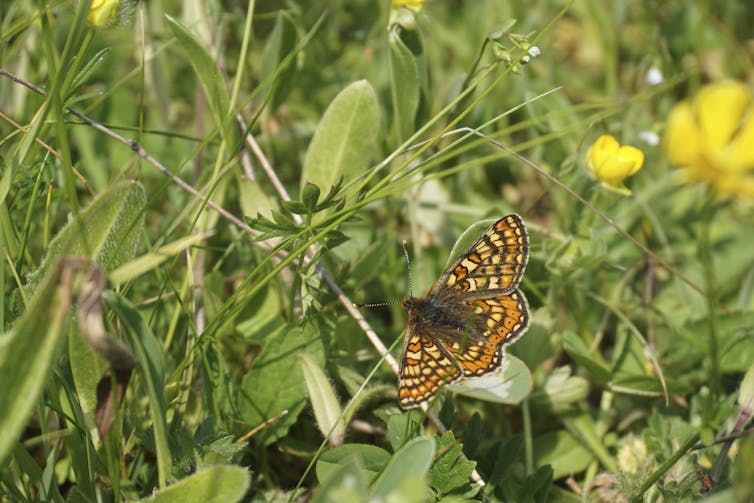
The threatened marsh fritillary butterfly. Patrick Cashman/RSPB
The new report’s key findings include:
The distributions of almost 5,000 invertebrate species have on average shrunk by 13% since 1970. Strong declines were seen in insect groups that perform key ecosystem functions, including pollinators (18% decrease) and pest controllers (34% decrease).
The distributions of 54% of flowering plant species and 59% of bryophytes (mosses and liverworts) have decreased across Britain since 1970. By comparison, only 15% and 26% of these groups have increased respectively.
The abundance of 13 species of seabird has fallen by an average of 24% in the UK since 1986. But these results pre-date an ongoing outbreak of Highly Pathogenic Avian Influenza, which has killed thousands of seabirds, some belonging to populations constituting the bulk of an entire species.
The report shows that climate change – which is predominantly caused by burning fossil fuels – is among the biggest threats to wildlife in all ecosystems. The intensive way in which land is managed for farming (with the loss of hedgerows, farm ponds and scruffy margins and the increasing use of pesticides and fertilisers, as well as changes in crops and cropping patterns) is also a major driver of biodiversity loss, and contributes to climate change.
At sea, unsustainable fishing practices are a major factor. Added to these pressures on wildlife are invasive species, pollution and for some, such as birds of prey, persecution.
Solving all of these problems will involve several actions that can be joined up to support each other. This must be swift and extensive to be effective.
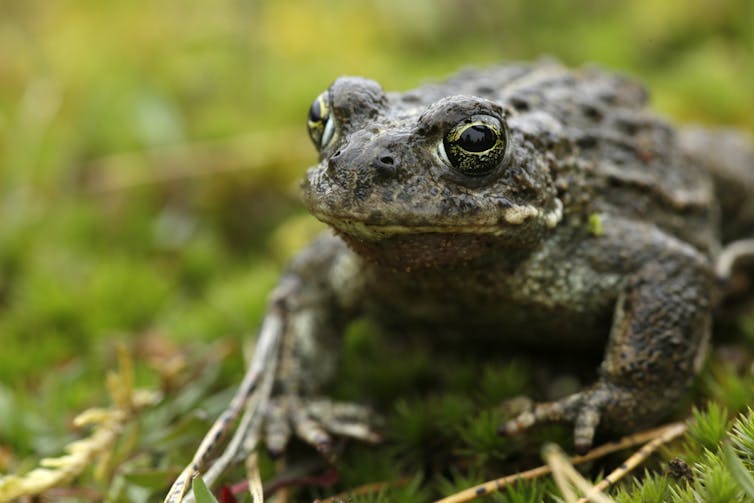
The report establishes what is known about the success or failure of conservation efforts. Fortunately, there are many success stories. Species like natterjack toads, Duke of Burgundy butterflies, bitterns, and large marsh grasshoppers have all benefited from bespoke conservation projects and are bouncing back.
Natterjack toads cling on in a handful of shallow coastal pools. Andy Hay/RSPB
Cairngorms Connect is the UK’s largest habitat restoration project, covering 60,000 hectares in the Scottish national park. It aims to restore native woodland, peatlands and rivers over the next 200 years. This is the scale at which conservationists need to operate in order to reverse nature’s decline.
Recovery by 2050?
It is only through the collective efforts of thousands of people, most of them volunteers, that we can report on the state of nature with such clarity and breadth. Without their enthusiasm, commitment and skill, we’d only have a sketchy understanding of how the environment is changing, and whether conservation efforts are making a difference.
The 2023 state of nature report is timely given the recent adoption of global targets to recover nature. The Convention on Biological Diversity’s new global framework, signed by nearly 200 countries in December 2022, aims to maintain, enhance, restore and expand ecosystems, reduce the number of species threatened with extinction and increase the abundance of native species by 2030, putting nature on a path to recovery by 2050.
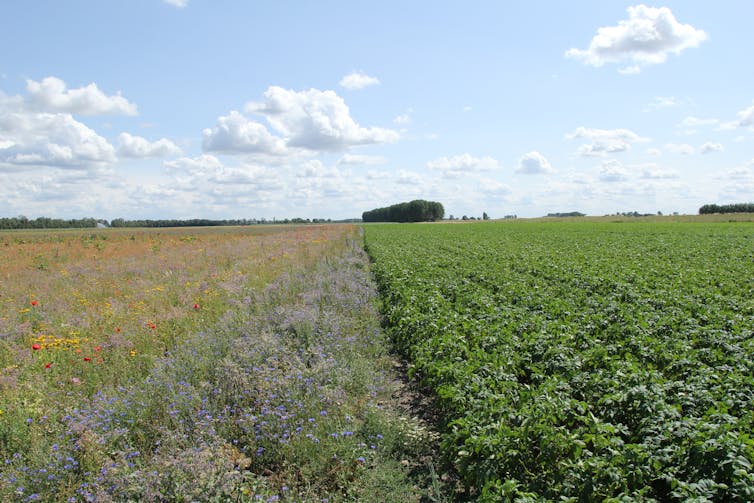
Restoring meadows on farmland could benefit pollinating insects. Angel217/Shutterstock
To halt and reverse biodiversity loss in the UK, efforts to conserve and restore species and habitats must ramp up. But the underlying drivers of this loss must be addressed too, especially those attached to our food system.
That means making food production more sustainable and nature-friendly on land and at sea, and adjusting our diets to cut demand for products that drive the loss of nature, such as meat.
Nature-based solutions to climate change, such as restoring and protecting carbon-absorbing forests and wetlands in river catchments, or restoring coastal habitats, can also boost biodiversity if well designed (think saving two birds with one tree).
We have never had a better understanding of the state of nature and what is needed to fix it. Now we need action.
Don’t have time to read about climate change as much as you’d like?