Climate Obstructionism Runs Deep in the UK — Watch Out for It at the Election

Spread the love

Original article by Freddie Daley and Peter Newell republished from DeSmog.

Credit: Lindsay Grime.

Regardless of who wins next month, fossil fuel interests have multiple levers for influencing policy.

The UK is heading to the polls on July 4. Although it doesn’t get enough attention, the two major parties — the Conservatives and Labour — have chosen climate change and, in particular, fossil fuel production in the North Sea as a clear political dividing line for the electorate. 

As polling day draws closer, and election fervour takes hold, we will see the forces of British climate obstruction in full effect. Influential individuals, organisations and media outlets that seek to block, dilute, delay, or even reverse climate policies will attempt to widen that political dividing line with a mixture of claims to be defending individual freedoms, putting growth first, being ‘climate realists’, or by displacing concerns about the UK’s responsibility to act on climate change through ‘whataboutism’.

The Conservative government, under Prime Minister Rishi Sunak, has pushed ahead with issuing hundreds of new oil and gas licences in the North Sea. The government was due to further reform the licensing regime so permits are handed out on an annual basis, all under the auspices of ‘energy security’, but the election has halted the bill’s progress through Parliament. Future licences are expected to yield just three weeks’ worth of gas per year

Sir Keir Starmer’s Labour Party, however, announced that it will end new licensing for oil and gas in the North Sea, with the very large caveat of honouring those already approved. But even this announcement ignited fierce resistance from the media, trade unions, Labour’s political opponents and some figures it deemed allies. The plan was labelled as “Thatcher on steroids”“naive”, and risked “creating a cliff-edge” for industry and investment in and around the North Sea. In response to the vitriol, Starmer conceded that fossil fuels will continue to be used in the UK “for many, many years”.  

This episode provides a useful insight into how climate obstructionism operates in the UK. In a new publication for the Climate Social Science Network (CSSN) based at Brown University, alongside Dr Ruth McKie and Dr James Painter, we identified three major channels through which obstructionism operates in Britain and the network of organisations that sustain it. 

Financial Power

The first is the material. This speaks to the financial and structural power of the fossil fuel industry that allows it to use threats of capital flight and job losses to curry favourable policy conditions and fend off tax hikes that would dent profitability. It also speaks to party donations, where fossil fuel firms, or those that benefit from their expansion, provide funds to individual politicians or the wider party for access and a say over policy. 

Since 2019, the Conservatives have received £8.4 million in donations from big polluters and those with direct links to fossil fuel production. The current Energy Security and Net Zero Secretary, Claire Coutinho, accepted a £2,000 donation in January 2024 from Lord Michael Hintze, a funder of the UK’s leading climate science denial group, the Global Warming Policy Foundation. Labour too have taken money from big polluters, most notably Drax, whose North Yorkshire power plant is the UK’s single largest source of emissions.

Alongside the material sits the institutional. The policy making process in the UK provides a multitude of opportunities for actors to shape policy, all within the bounds of proper procedure and due process. All Party Parliamentary Groups (APPGs), informal groups of politicians organised around key themes or policy issues, have provided an effective fora for obstructionist actors to garner access and shape policy. The rules governing APPGs often inhibit public scrutiny. Trade associations, and the companies they represent, can be omitted from official parliamentary transparency logs as only benefits in kind above £1,500 a year must be declared — a threshold many industry bodies claim not to meet. 

Revolving doors between industry and government are another institutional means through which fossil fuel interests can determine policy. An investigation by The Ferret found that since 2011, 127 former oil and gas employees have gone into top government roles and been appointed to ministerial advisory boards. At least a dozen of these individuals were given roles in the North Sea Transition Authority, the organisation tasked with governing oil and gas production, as well as within departments responsible for writing energy and climate policy. Shutting this revolving door, or even just slowing it down through ‘cool-off’ periods, would go some way in curtailing obstructionism. 

Climate Delay

The final, and perhaps most pronounced, thread of climate obstructionism in the UK is discursive, primarily promoted through the media. The right-leaning media in the UK, such as the Daily Telegraph and Daily Mail, have persistently opposed climate policy and action. This opposition used to be grounded in outright denial, where the integrity of climate science was disputed and denigrated. Now, though, a more pernicious form of discursive obstructionism is prevalent; that of climate delay. 

Countless op-eds and articles have been published that acknowledge climate change but dispute the necessity of addressing it, the cost of implementing climate policy (both economically and in terms of national security), and the efficacy of green technologies such as wind turbines, electric vehicles (EVs) and heat pumps. These interventions, which are sometimes made by individuals with direct links to sceptic organisations or else use their framing, often push blatant untruths to the public, such as renewable energy pushing up household energy bills or solar panels  jeopardising British farming. The media continues to both demonise climate activists and undermine public support for key climate policies. 

In this election, watch out for climate obstructionism. While institutional channels may be curtailed due to purdah, others will pick up the slack. With all parties now firmly on an election footing, donations will become a crucial resource for knocking doors and getting out the vote in marginal seats. The sources of these donations, and the interests behind them, will bear the thumbprint of the fossil fuel industry. The media will increase its scrutiny of manifesto pledges and publish a litany of analyses. It is highly likely that Labour’s climate policy will be painted as a threat to national security, an insurmountable cost to the public purse, and reflecting the demands of both Vladimir Putin and Just Stop Oil simultaneously. The foundation of this framing has already been set. 

What is less clear, though, is what comes after July 4. With a change of government comes a reconfiguration of interests and, for the winners, concessions will be made to those actors and constituencies that helped get them past the post. For the losing party, most likely to be the Conservatives, there may be an ideological reorientation that ends the cross-party consensus on tackling climate breakdown, making them the party of climate obstructionism that challenges the necessity of net zero and fights for more oil and gas. 

This election might be the one that ends 14 years of Conservative rule, but it’s not likely to be the one to end climate obstructionism in the UK.  

Freddie Daley is a Research Associate at the Centre for Global Political Economy at the University of Sussex.

Peter Newell is a Professor of International Relations at the University of Sussex.

They are the authors of a chapter in Climate Obstructionism across Europe, a new collection of essays analysing the organisations, politicians, think tanks and media outlets seeking to delay, derail and denigrate climate policy, produced by the Climate Social Science Network.

Original article by Freddie Daley and Peter Newell republished from DeSmog.

dizzy: I don’t agree that there is “cross-party consensus on tackling climate breakdown.” I suggest that instead the Conservative and Labour parties are indistinguishable in their support of plutocracy, sucking up to the rich and powerful. The Conservatives under Sunak have made no pretence of their intention to forge ahead with exploiting North Sea fossil fuels all they can and Labour do not intend to stop the Rosebank North Sea oil and gas field. Starmer has abandoned so many pledges that he should be recognised as as much a liar as Tony Blair or Boris Johnson.

The title of “… the party of climate obstructionism that challenges the necessity of net zero and fights for more oil and gas. ” is currently shared by the Conservatives and climate denier Nigel Farage’s Reform UK.

Rishi Sunak on stopping Rosebank says that any chancellor can stop his huge 91% subsidy to build Rosebank, that Keir Starmer is as bad as him for sucking up to Murdoch and other plutocrats and that we (the plebs) need to get organised to elect MPs that will stop Rosebank.

Continue ReadingClimate Obstructionism Runs Deep in the UK — Watch Out for It at the Election

‘We will not vote for those who normalise massacres’

Spread the love

https://morningstaronline.co.uk/article/we-will-not-vote-those-who-normalise-massacres

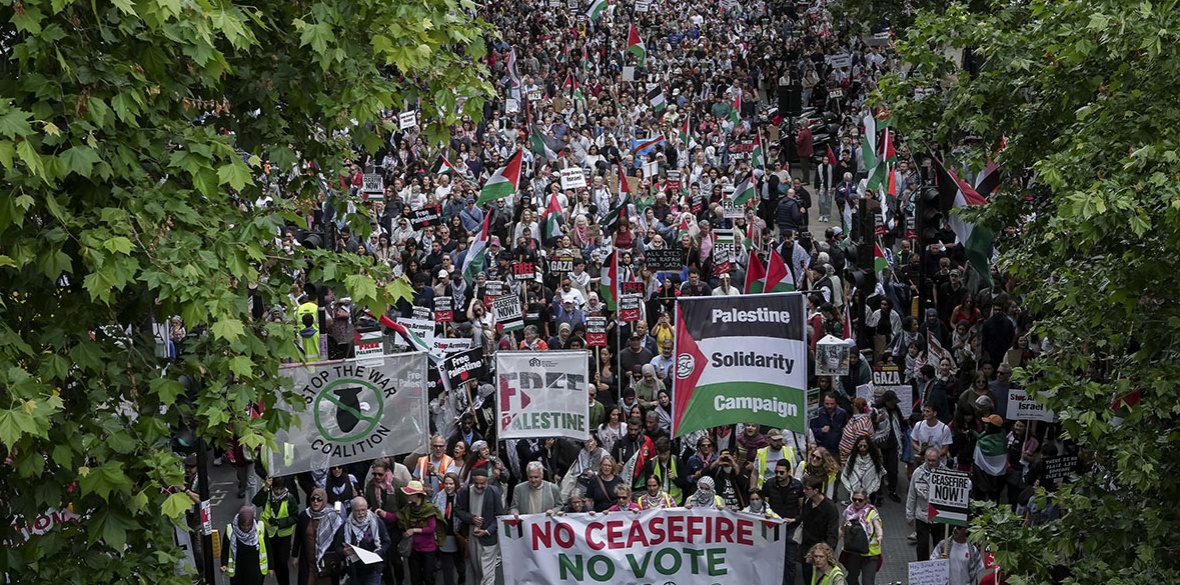
People take part in a national demonstration for Gaza from Russell Square to Whitehall in London, June 8, 2024

Hundreds of thousands protest across Britain demanding end to Gaza bloodshed

OVER the weekend, hundreds of thousands of people flooded Britain’s streets, calling for a permanent ceasefire in Gaza and warning political parties to stop arming Israel if they expect support in the upcoming election.

On Saturday, over 150,000 gathered in London for the 15th national march for Palestine.

The march took place as Israel carried out a murderous assault on Nuseirat refugee camp in Gaza.

Israeli forces killed at least 274 Palestinians and injured 698 more, according to Gaza’s Health Ministry.

Four Israeli captives were freed during the raid.

Prime Minister Rishi Sunak ignored the horrific death toll, instead describing the release of the captives as a “huge relief.”

Two days before, an Israeli air strike hit a UN school, murdering 33 people, including nine children.

Speaking at the rally, Palestine Solidarity Campaign director Ben Jamal accused political leaders of having “normalised massacres.”

He said: “Now our political leaders are coming before you asking for your vote. Your answer needs to be clear.

“We will not vote for those who normalise massacres.

“We will not vote for those who greenlight genocide.

“We will not vote for those who collaborate with systems of apartheid.”

He emphasised that justice for Palestinians needs to be forced onto the election agenda like never before.

Lindsey German from Stop the War said the massive demonstration, which stretched along Whitehall, sent “the loudest possible message to our politicians that the public support an immediate and unconditional ceasefire in Gaza.”

Article continues at https://morningstaronline.co.uk/article/we-will-not-vote-those-who-normalise-massacres

Continue Reading‘We will not vote for those who normalise massacres’

‘Disappointing and surprising’: Why isn’t this a climate election in the UK?

Spread the love
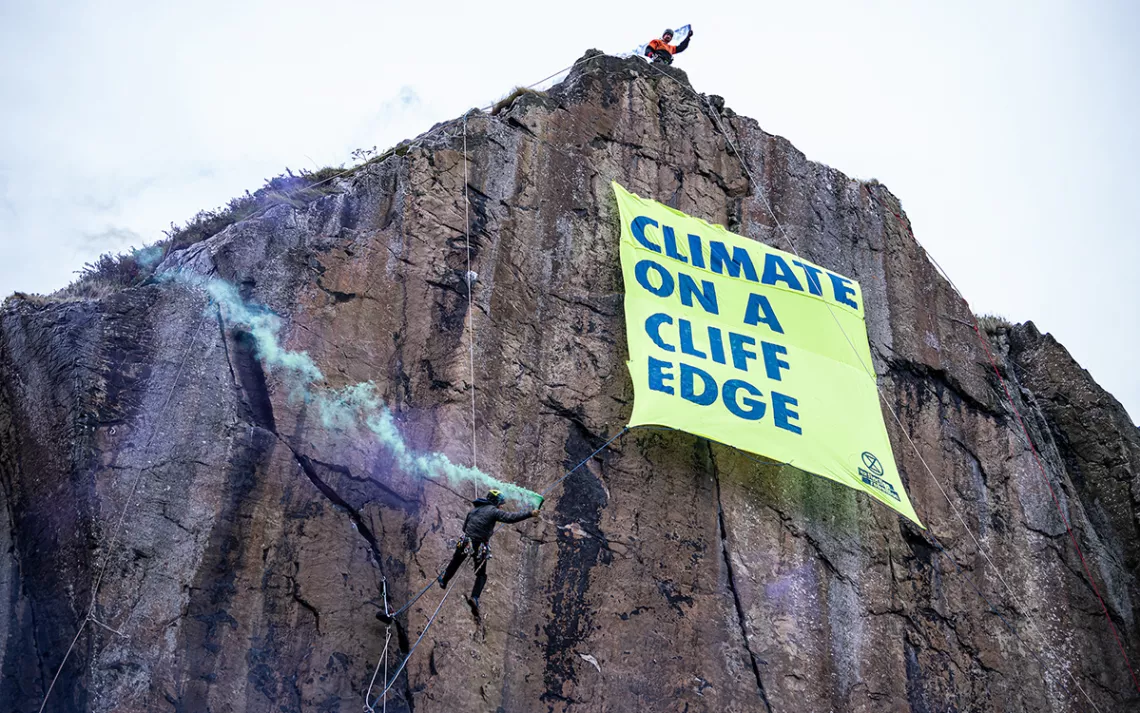
Experienced climbers scale a rock face near the historic Dumbarton castle in Glasgow, releasing a banner that reads “Climate on a Cliff Edge.” One activist, dressed as a globe, symbolically looms near the edge, while another plays the bagpipes on the shores below. | Photo courtesy of Extinction Rebellion and Mark Richards

https://www.theguardian.com/politics/article/2024/jun/10/disappointing-and-surprising-why-isnt-this-a-climate-election-in-the-uk

More than 400 scientists write to political parties urging ambitious action or risk making Britain and the world ‘more dangerous and insecure’

After five years of record heat and record floods, one might assume British politicians would also pay record attention to the climate issue in the current election campaign.

But with the manifestos due this week, concerns are growing that the response of the two main parties will range from tepid progress to a great leap backwards, despite the certainty of further climate chaos during the next parliament.

In a sign of how worried the experts are, more than 400 scientists have signed a public letter to party leaders, urging them to adopt ambitious policies to prepare the country for the coming turmoil and to honour the UK’s international obligation to address the primary causes – the burning of gas, oil, coal and vegetation.

“It is very clear that a failure to tackle climate change with sufficient urgency and scale is making the UK and the rest of the world more dangerous and insecure,” notes the letter, whose signatories include former UK chief scientist Sir David King, former president of the Royal Meteorological Society Prof Joanna Haigh, and the creator of the “climate stripes” graphic, Prof Ed Hawkins.

The 408 scientists urge parties to promise five measures: a credible strategy to reach net zero by 2050, faster action to adapt the UK to now unavoidable climate impacts, leading by example internationally on “transitioning away from fossil fuels”, increasing climate funding for developing countries and respecting Climate Change Committee advice on North Sea oil and gas fields.

“Without such a pledge, we do not believe that your party deserves support in the forthcoming general election,” they write.

The case for action is now indisputable. More than 99% of climate scientists are sure that human burning of gas, oil, coal and trees is heating the planet. This is no longer a geographically or temporally distant threat to the UK. It is here and now.

Last year, the northern hemisphere sweltered through its hottest summer in 2,000 years, causing tens of thousands of deaths and billions of dollars worth of economic damage. That should have been a wake-up call for humanity to transition away from fossil fuels. In fact, the reverse has happened. Carbon dioxide is accumulating in the atmosphere faster than ever, the US National Oceanic and Atmospheric Administration announced last week.

The past two years have been the hottest the British Isles have ever seen. For the first time, the UK has experienced temperatures of more than 40C. By the government’s reckoning, extreme heat killed 2,295 people in 2023, and another 4,500 the year before that. By 2050, the toll is expected to rise to 10,000 each year, according to the British Medical Journal.

https://www.theguardian.com/politics/article/2024/jun/10/disappointing-and-surprising-why-isnt-this-a-climate-election-in-the-uk

Just Stop Oil protesting in London 6 December 2022.
Continue Reading‘Disappointing and surprising’: Why isn’t this a climate election in the UK?

Who are the wealthy climate sceptics funding rightwing UK politics?

Spread the love
Image of Nigel Farage

https://www.theguardian.com/politics/article/2024/jun/07/who-are-the-wealthy-climate-sceptics-funding-rightwing-uk-politics

A number of wealthy climate sceptics are giving funding to Nigel Farage’s Reform UK, rightwing Conservatives, and the climate science-denying thinktank the Global Warming Policy Foundation. But who are they and how are they linked?

The biggest donor to the Reform party this year is the shipping magnate Terence Mordaunt, the head of First Corporate Shipping. His personal company, Corporate Consultants Ltd, has given £200,000 to Reform over the past 12 months. He was previously chair of the Global Warming Policy Foundation (GWPF) and is now a trustee.

Reform was formerly known as the Brexit party and is the third highest polling political party, aiming to win over rightwing voters who are disenchanted with the Tories. It states on its website: “Net zero means reducing man made CO2 emissions to stop climate change. It can’t. Climate change has happened for millions of years, before man made CO2 emissions, and will always change. We are better to adapt to warming, rather than pretend we can stop it. Up to 10 times more people die of cold than warmth.” The party advocates for scrapping net zero targets and increasing fracking and new nuclear power.

The GWPF is the thinktank set up by the former Conservative chancellor Nigel Lawson in 2009. Since then, it has released reports claiming rising carbon dioxide levels are good for humanity, and opposed climate action. Though Mordaunt has not made many public proclamations on climate science, he said when joining the GWPF in 2017: “I am delighted to continue my support for the GWPF which has brought much needed rigour into the climate debate.” His donations could shed some light on his views; his company also donated £100k to Vote Leave in 2016.

Mordaunt is also, according to DeSmog, a significant donor to the Conservative party, having donated £34,600between 2003 and 2009, according to electoral register data. His companies have also donated at least £135,000 to the party since 2008, including a £25,000 donation in 2017.

Articles continues identifying more rich climate denying donors at https://www.theguardian.com/politics/article/2024/jun/07/who-are-the-wealthy-climate-sceptics-funding-rightwing-uk-politics

Continue ReadingWho are the wealthy climate sceptics funding rightwing UK politics?

Climate crisis made May heatwaves 1.5C hotter in India, study says

Spread the love
Experienced climbers scale a rock face near the historic Dumbarton castle in Glasgow, releasing a banner that reads “Climate on a Cliff Edge.” One activist, dressed as a globe, symbolically looms near the edge, while another plays the bagpipes on the shores below. | Photo courtesy of Extinction Rebellion and Mark Richards

https://www.independent.co.uk/climate-change/news/india-heatwaves-climate-change-delhi-50c-b2558588.html

Hundreds of deaths have been attributed to heatwave that saw temperatures approaching 50C in Delhi

The unprecedented heatwaves that scorched northern and central India in May were made 1.5 degrees Celsius hotter by the climate crisis, a new scientific assessment has found.

In the last week of May, India experienced a spell of severe heatwaves, with 37 cities recording temperatures above 45C, prompting warnings of heatstroke. The capital Delhi saw a record temperature of 49.1C.

The heatwaves led to hundreds of deaths, including one voter and several workers conducting the mammoth national election, which ended after six weeks on 1 June.

The heatwaves were nearly 1.5C warmer than the hottest heatwaves the country had seen previously despite occurring later in the typical summer season, according to a report published by ClimaMeter, a research project funded by the European Union and the French National Centre for Scientific Research, or CNRS.

The study found that the heatwaves were “a largely unique event whose characteristics can mostly be ascribed to human driven climate change”.

This May was the hottest ever on record globally, completing an entire year of record-breaking extreme heat for the planet.

Article continues https://www.independent.co.uk/climate-change/news/india-heatwaves-climate-change-delhi-50c-b2558588.html

Continue ReadingClimate crisis made May heatwaves 1.5C hotter in India, study says