Rocket attack kills 12 children in Golan Heights – who are the Druze who live there?
Spread the love
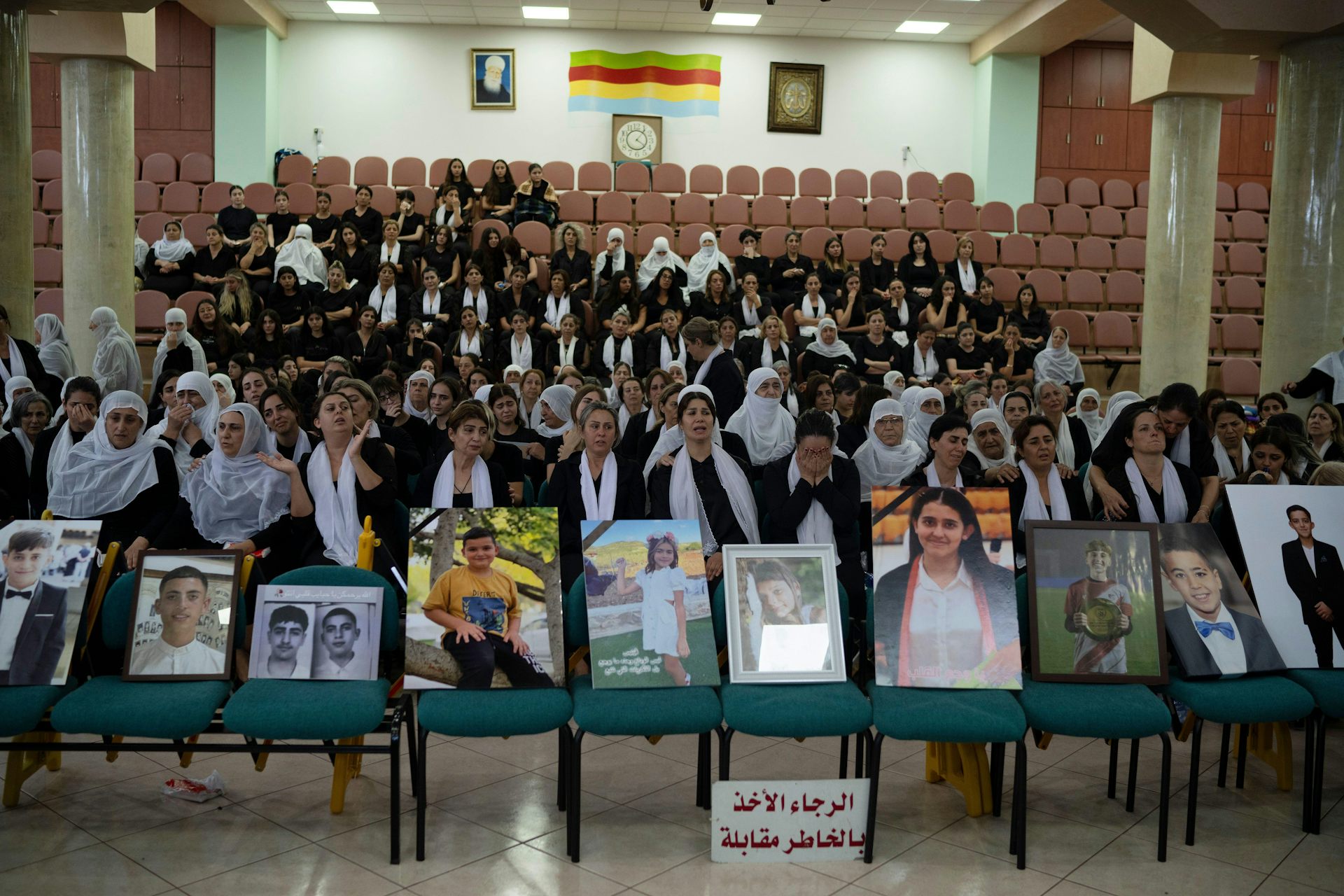
Killed while playing football: a memorial service for the 12 dead children of Majdal Shams. AP Photo/Leo Correa

Erika Jiménez, Queen’s University Belfast

Israel’s prime minister, Benjamin Netanyahu, has threatened a harsh response to a rocket attack that on July 27 struck the Israeli-occupied Syrian Golan Heights, killing 12 children and injuring about 30 more.

Visiting the small town of Majdal Shams, where the children had been playing football when the strike occurred, Netanyahu blamed Hezbollah for the attack and said it would pay a “hefty price”. He said: “Our response will come, and it will be harsh.”

While Israel is claiming the attack targeted their citizens, all the victims of the strike were members of the Druze religious minority group located across Israel, Lebanon and Syria. Hezbollah has denied responsibility for the attack, but without an independent investigation, it remains unclear who fired the rocket.

The Golan Heights, a rocky 1,000 square kilometre region south-west of Damascus, was occupied by Israel after the 1967 Arab-Israeli war in a move that, half a century on, is often referred to as the “forgotten occupation”.

After defeating Egypt, Jordan, and Syria in the short conflict, Israel occupied the West Bank, Gaza and East Jerusalem as well as the Sinai desert and two-thirds of the Syrian Golan. Around 127,000 indigenous Syrians (95% of the population) – including Christians, Muslims and Druze – fled or were forcibly displaced. Depopulated villages were razed to the ground.

Later in 1981, Israel illegally annexed the territory, passing the Golan Heights Law. The UN security council immediately condemned this as illegal and passed resolution 497 (1981) calling on Israel to rescind its action, which would have “serious consequences for peace and security in the Middle East”.

Israel’s annexation of the Golan Heights was not recognised internationally until 2019 when the then US president Donald Trump released a “Proclamation on Recognizing the Golan Heights as Part of the State of Israel”.

Israel views its control over the Golan Heights as crucial to its security, as the region shares a border with Israel, Jordan and Lebanon. There is a buffer zone between the Israeli-occupied area of the Golan Heights and Syria, which is administered by the United Nations Disengagement Observer Force (Undof). The Golan gives whoever controls the land a vantage point overlooking Syria, which has never given up on its claim over the land.

Forgotten people

But what of the indigenous people of the Golan? Roughly 20,000 Druze people now remain, members of an Arab sect which is an offshoot of Islam that allows no intermarriage or joining from outside the religion. There are about 150,000 Druze in Israel and about 1 million across the Middle East. Druze men with Israeli citizenship are subject to military service.

Historically, Golanis have resisted the occupation via non-violent means, drawing on Druze religious beliefs, secular political ideas and the continuing assertion of their Syrian identity. The main industry in the region is agriculture and the area is known for its production of apples, cherries and olive oil.

Golanis in Majdal Shams participating in peaceful demonstration in solidarity with Palestinians. Al-Marsad

Resistance

In the years before annexation of the Golan, Israel attempted to introduce Israeli identity cards for the population. But this was rejected by Syrian communities in the Golan, who issued a wathiqa wataniya (Syrian national document), which asserted their Syrian-Arab national identity and connection to the land and opposed the annexation of the Golan.

The annexation also triggered what became known as the aldrab alkabir (great strike) that began in the February of 1982 and lasted almost six months. All segments of Golani society took part in demonstrations, discarded their Israeli ID cards and refused to pay taxes or participate in Israeli land surveys. The aim was to resist the imposition of Israeli citizenship and assert their Syrian identity.

Israel responded by placing curfews on the Druze villages, setting up blockades and restricting goods from entering, including milk and baby food. Some residents were arrested, including women who played a central role in the strike.

The Golani community responded to these restrictions by sharing resources and offering free services to one another. Palestinians also mobilised in support of Golanis by taking part in demonstrations and solidarity visits to the Golan.

This non-violent action was successful in achieving its primary aim and to this day around 80% of Golani Druze have rejected citizenship. They identify as Syrian and, unlike the Druze living in Israel, do not serve in the Israeli military.

This does mean that they are “stateless” (though not landless like many stateless people) and instead of passports they hold “laissez passer” travel documents that state their nationality is “undefined”. Without Israeli citizenship they are not allowed to vote, though they can attend Israeli educational institutions.

Meanwhile there are also an estimated 25,000 Jewish-Israelis living in the Golan Heights, across more than 30 settlements, considered illegal under international law. They are supported by the Israeli military and now together control 95% of the Golan, including much of its agriculture and industries.

Fear of escalation

There are now fears in the region that an Israeli retaliation against Hezbollah could significantly escalate the conflict. I’ve been working with local partners in the Golan Heights on a research project about Golani youth and human rights.

I spoke with a colleague in Majdal Shams this week. She told me that the people of the Golan “don’t want any other mother to scream and cry”. She said: “The Golani people are and have always been a peaceful people. Our message would be, ‘Stop the killing.’”

The 12 children were killed while playing football. Let that sink in. Then remember that it should not take their deaths to bring this forgotten occupation and these people who are forced to live under a foreign power to the world’s attention.

Erika Jiménez, Leverhulme Early Career Fellow at the School of Law, Queen’s University Belfast

This article is republished from The Conversation under a Creative Commons license. Read the original article.

Continue ReadingRocket attack kills 12 children in Golan Heights – who are the Druze who live there?

Common Dreams: Israel human rights abuses, Venezuela coup attempts, Trump & Sen. J.D. Vance

Spread the love

Far-Right Israelis Mob Bases After Soldiers Arrested for Allegedly Raping Palestinian

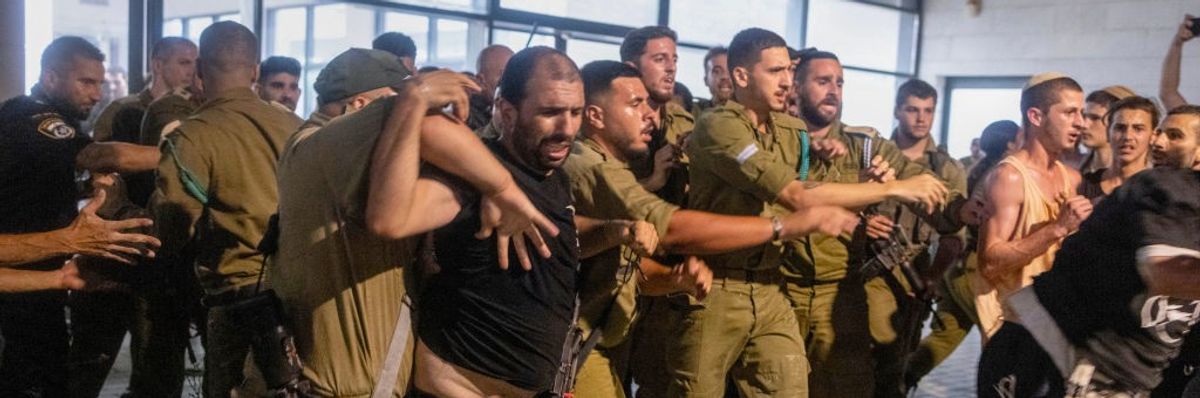
Israeli soldiers and police clash with a far-right mob that invaded the Beit Lid army base in Kfar Yona on July 29, 2024.  (Photo: Oren Ziv/AFP via Getty Images)

Several Israeli lawmakers and one minister took part in the attempt to free the nine reservists, who were hailed as heroes by multiple Cabinet members.

Far-right Israelis including government officials stormed two military bases late on Monday, sparking clashes with troops and police over the arrest of Israel Defense Forces reservists who allegedly gang-raped a Palestinian prisoner.

Hundreds of protesters broke into the notorious Sde Teiman base in the Negev Desert in an attempt to stop the detention of nine reserve troops accused of sodomizing a Palestinian jailed there. According to the Israeli newspaper Haaretz, the victim is hospitalized with severe injuries and is unable to walk.

The nine suspects were then taken to the Beit Lid army base, which was also mobbed by at least dozens of demonstrators.

UN Experts Say Israel ‘Must Stop Acting as If Uniquely Above the Law’

Maduro Victory Shows Democratic Bolivarian Socialism Continues in Venezuela

Supporters of president-elect Nicolas Maduro celebrate his proclamation as president-elect in the vicinity of the CNE headquarters during the ceremony to deliver the majority of the vote Certificate at CNE Headquarters on July 29, 2024 in Caracas, Venezuela. (Photo by Jesus Vargas/Getty Images)

Shortly before midnight on 28 July, Venezuela’s National Electoral Council (CNE) announced that — with 80 percent of the over 20 million votes counted — the trend was irreversible: Nicolás Maduro had been re-elected president of Venezuela.

According to the CNE, Maduro received 51.2 percent of the vote, while his primary opponent, the little-known Edmundo Gonzales, received 44.02 percent. With that result, it was clear that the Venezuelan majority chose to continue the project of Bolivarian socialism introduced by Hugo Chavez at the end of the nineties. Recognizing the economic turn-around of the last two years and proud of their achievements in building 5.1 million housing units, securing food sovereignty, and deepening communal democracy, Venezuelans re-elected Maduro for a third six-year term.

A former ambassador to Argentina, the opposition candidate Gonzales replaced far-right leader Maria Corina Machado as the candidate of the Unity Platform after Machado was disqualified from running. Machado has long been an outspoken critic of Chavismo, supporting US sanctions and advocating foreign intervention in the country. In 2018, she asked Benjamin Netanyahu for military assistance in dismantling the Maduro government. Machado has close ties in the United States. In 2009, she was a Yale World Fellow. On June 23, 2024 she spoke at a National Endowment for Democracy awards ceremony in Washington, DC. She has been nicknamed the new “iron lady” after her idol Margaret Thatcher. In contrast, Maduro supports the Palestinian liberation struggle, linking it to the struggle of the indigenous peoples of Venezuela against colonial genocide.

Maduro Slams Attempted ‘Coup Against Venezuela’ as Far-Right Cries Fraud

Venezuela’s far-right opposition is doubling down on its refusal to accept defeat in the country’s presidential election amid simmering unrest and violence in the streets of Caracas, sparking warnings of another coup attempt in a nation that has long faced interference from the United States and other Western powers.

Led by María Corina Machado, who was disqualified from running in Sunday’s election, Venezuela’s opposition claimed that its candidate—ex-diplomat Edmundo González—defeated President Nicolás Maduro with over 70% of the vote, contradicting the official results announced by the Consejo Nacional Electoral (CNE).

Machado, who once urged Israeli Prime Minister Benjamin Netanyahu to back an effort to topple Maduro’s elected government, pointed Venezuelans to a website the opposition is using to assemble its own vote counts.

“So far, she hasn’t presented any evidence [of fraud],” Caracas-based reporter Andreína Chávez Alava said in an appearance on Democracy Now! Tuesday morning. “In past elections they have also said they have evidence that they won and they never actually showed any proof.”

Trump and Vance Are the Enemy of Working People

Republican vice presidential nominee U.S. Sen. J.D. Vance (R-OH) arrives to speak during a rally with running mate U.S. Republican Presidential nominee former President Donald Trump at Herb Brooks National Hockey Center on July 27, 2024 in St Cloud, Minnesota. (Photo by Stephen Maturen/Getty Images)

The former Republican president, despite all his allegedly populist rhetoric, has a deeply anti-worker record from his first term. Vance’s record is no different and he’s no better.

Trump’s Repeated Efforts to Disavow Project 2025 ‘Not Fooling Anyone’

“These attempts to create the appearance of distance between Trump and Project 2025 are happening because Americans are starting to learn about this extreme takeover plan,” said one Democratic congressman.

The 2025 Presidential Transition Project, as it is formally called, is a policy agendapersonnel recruitmenttraining, and a 180-day playbook for the next right-wing president, spearheaded by the Heritage Foundation and backed by over 100 other organizations. Critics have described it as a “far-right playbook for American authoritarianism.”

At least 140 people who worked in the Trump administration—including six former Cabinet secretaries—have been involved with Project 2025, according to a CNN analysis published earlier this month. Among them is the outgoing director, Paul Dans.

“Dans served in the Trump administration as chief of staff at the U.S. Office of Personnel Management where he managed the federal agency in charge of human resources policy for the more than 2 million federal workers,” according to his profile on the Heritage website.


Continue ReadingCommon Dreams: Israel human rights abuses, Venezuela coup attempts, Trump & Sen. J.D. Vance

BP Condemned Over ‘Mammoth Profits’ as Fossil Fuels Wreak Havoc on the Planet

Spread the love
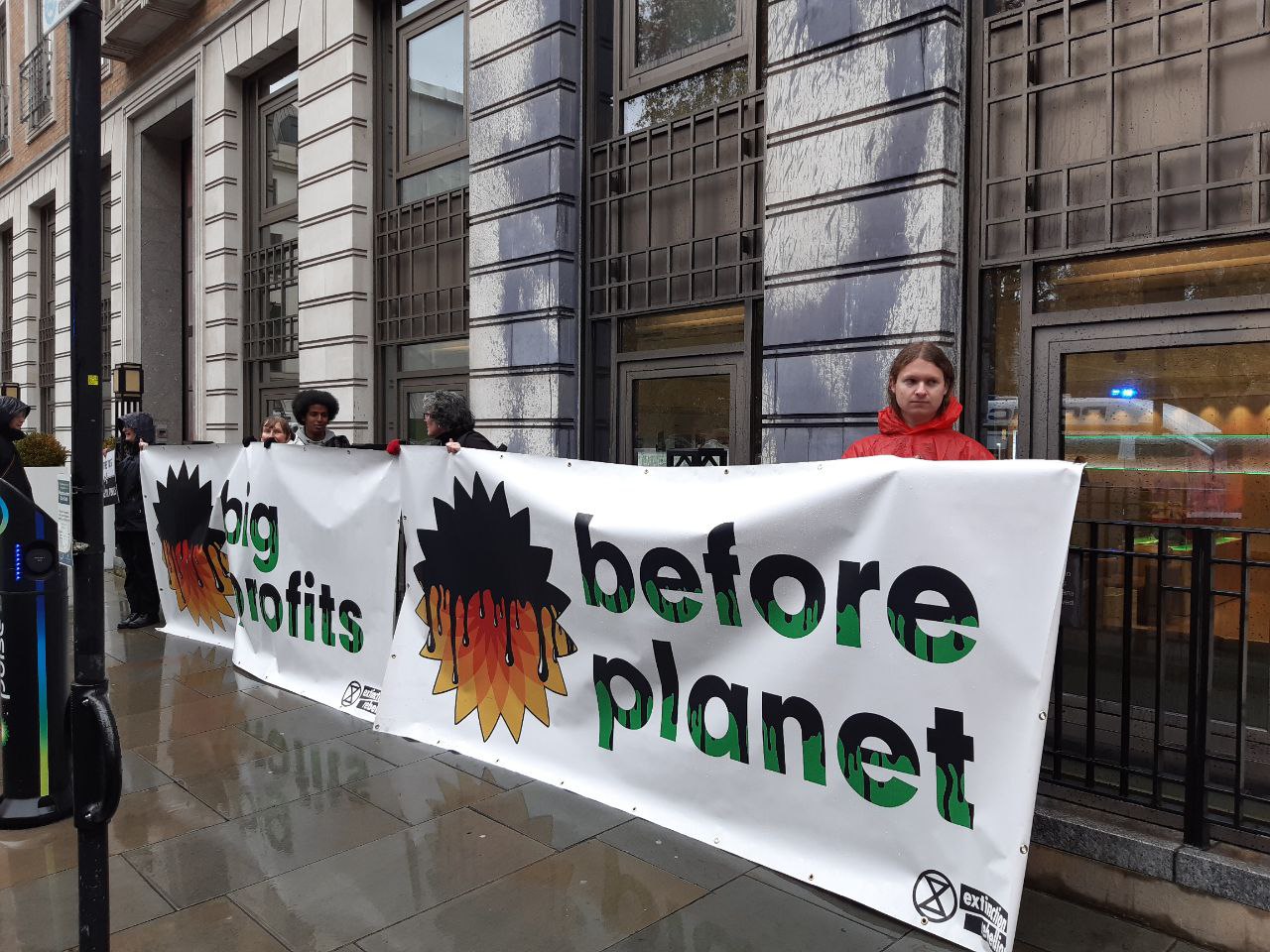
Extinction Rebellion protests at BP
Extinction Rebellion protests at BP London. Banner reads big profits before planet

“The world can no longer afford fossil fuel companies putting short-term profits above people and planet.”

The London-based oil giant BP announced Tuesday that it hauled in $2.8 billion in profit during the second quarter of the year as the world faced the consequences of the fossil fuel industry’s business model in the form of record-shattering heat, devastating wildfires, and other weather extremes.

The company’s second-quarter profit surpassed analysts’ expectations and brought its total profit for the first half of 2024 to $5.5 billion. BP on Tuesday also announced a 10% dividend increase, an expansion of its stock buyback program, and a green light for a new drilling platform in the Gulf of Mexico, even as international scientists say any new fossil fuel production is incompatible with critical warming targets set out by the Paris climate accord.

BP said that once completed, the new floating platform would have the capacity to produce 80,000 barrels of crude oil daily.

Chiara Liguori, Oxfam Great Britain’s senior climate justice policy adviser, said in a statement that “the world can no longer afford fossil fuel companies putting short-term profits above people and planet.”

“It is inexcusable that BP, one of the world’s most polluting and profitable fossil fuel companies, continues to rake in billions of pounds while low-income countries are in urgent need of funds to tackle the devastating impacts of the climate crisis despite doing the least to cause it,” said Liguori. “The costs of inaction are already here with deadly heat waves, wildfires, flooding, and drought, but it is people living in poverty who are left paying the highest price.”

BP’s profit report came weeks after the company, now under the leadership of CEO Murray Auchincloss, announced it would pause new offshore wind projects and put fresh “emphasis on oil and gas amid investor discontent over its energy transition strategy,” as Reuters reported last month. The move came over a year after the company rolled back its plan to curtail oil and gas production.

Extreme weather driven by the burning of fossil fuels, meanwhile, continued to wreak havoc across the globe.

“As global temperatures spiked to their highest levels in recorded history [last Monday], ambulances were screaming through the streets of Tokyo, carrying scores of people who had collapsed amid an unrelenting heat wave,” wrote The Washington Post‘s Sarah Kaplan over the weekend. “A monster typhoon was emerging from the scorching waters of the Pacific Ocean, which were several degrees warmer than normal. Thousands of vacationers fled the idyllic mountain town of Jasper, Canada ahead of a fast-moving wall of wildfire flames.”

“By the end of the week—which saw the four hottest days ever observed by scientists—dozens had been killed in the raging floodwaters and massive mudslides triggered by Typhoon Gaemi,” Kaplan continued. “Half of Jasper was reduced to ash. And about 3.6 billion people around the planet had endured temperatures that would have been exceedingly rare in a world without burning fossil fuels and other human activities, according to an analysis by scientists at the group Climate Central.”

Izzie McIntosh, a climate campaigner at the United Kingdom-based advocacy group Global Justice Now, said Tuesday that BP’s “mammoth profits” come “at the expense of our climate, communities, and the Global South facing the most brutal impacts of a climate crisis they did not cause.”

“Labour has made some promising signals about a move toward green energy—it now needs to throw its weight behind tackling the rampant profiteering of oil and gas companies,” McIntosh said of the newly elected U.K. government. “It can do this by introducing a windfall tax and other measures to fund the U.K.’s contribution to a globally just fossil fuel phaseout that works for workers and communities in the U.K. and around the world.”

Original article by JAKE JOHNSON republished from Common Dreams under Creative Commons (CC BY-NC-ND 3.0). 

Original article by JAKE JOHNSON republished from Common Dreams under Creative Commons (CC BY-NC-ND 3.0). 

‘Twisted’: BP And Shell CEOs See Pay Double As Workers Struggle To Heat Homes ›

Continue ReadingBP Condemned Over ‘Mammoth Profits’ as Fossil Fuels Wreak Havoc on the Planet

For decades, governments have subsidised fossil fuels. But why?

Spread the love
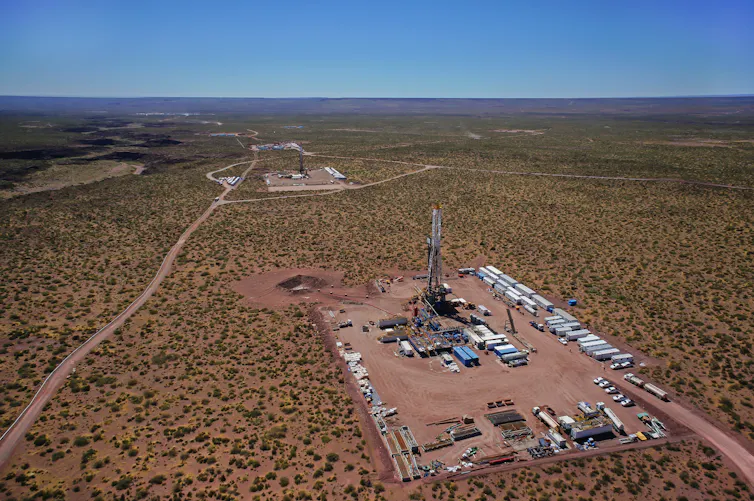
Sobrevolando Patagonia/Shutterstock

Bernard Njindan Iyke, La Trobe University

Even now, decades after we first began trying to avert the worst of global warming, more than 80% of the world’s total energy comes from fossil fuels.

You might think this would make fossil fuel production extremely profitable. But it’s not always the case. Much of the most accessible oil has already been extracted and burned. Many countries want to shore up domestic sources of fossil fuels to boost energy security. Energy price fluctuations and competition from new energy sources such as solar, wind and fossil gas have made it harder for some fossil fuel companies to make money, especially in coal.

This is where fossil fuel subsidies come in. Australia gave A$14.5 billion in subsidies to major fossil fuel producers and consumers in 2023–24 alone.

You might have wondered – why would some of the largest companies on Earth need subsidies? Here’s why.

LNG tanker
Australia’s surging liquefied natural gas industry has been boosted by government funding. KDS Photographics/Shutterstock

Private companies, public money

Globally, private companies dominate fossil fuel production, though fossil fuel-rich nations often have state-owned companies, such as Saudi Arabia’s Aramco and Russia’s Rosneft.

Why would governments give fossil fuel companies money? Many reasons. But the most important is that wealthy countries have historically needed huge volumes of fossil fuels for manufacturing, transport and power. Many countries have some sources of fossil fuels inside their borders, but only a few are self-sufficient. This has enabled fossil fuel giants such as Saudi Arabia to become wealthy beyond belief.

Many governments have used subsidies to boost their energy security and encourage local producers to seek out new sources of coal, gas and oil. These subsidies can make all the difference in making fossil fuel companies competitive internationally. For instance, Canada spent billions on subsidies to boost its oil sands and fracking projects.

Subsidies were essential in the United States’ fracking revolution. Novel approaches to extracting fossil gas and oil – boosted by major tax incentives – turned the US from a major importer of oil and gas into a net exporter by 2019.

You can see why the US did this. At a stroke, it went from being dependent on energy provided by foreign nations to being independent.

Once subsidies are in place, they become very hard to remove. Indonesia’s lavish fuel subsidies now account for 2% of the nation’s GDP. When the national government tried to walk these back, there were riots.

And there’s another reason, too. Fossil fuels are still playing an important role in boosting the economy in most nations. Subsidising them has long been seen as a way to maintain economic growth and stability.

Globally, these subsidies are estimated at a staggering $10.5 trillion each year.

This figure has grown sharply in recent years, after Russia’s invasion of Ukraine. As European nations tried to wean themselves off Russia’s gas, energy prices surged worldwide. In response, some countries introduced new subsidies to support businesses and consumers.

The top-line figure of $10.5 trillion includes two types of subsidy – explicit (meaning real dollars change hands) and implicit (for example, governments building roads and railways to encourage crude oil transport).

Explicit subsidies

Explicit fossil fuel subsidies are direct financial incentives from governments to fossil fuel producers and consumers. These incentives come in different forms, such as tax breaks, direct payments, grants and price controls. All of them aim to reduce the financial burden associated with fossil fuel production and use.

In Australia, explicit subsidies include fuel tax credits and exploration tax reductions. Fossil fuel companies can get subsidies to offset the losses they make during the years it takes to find and begin extracting new fossil fuels.

In the US, oil and gas companies benefit from the oil depletion allowance, which permits them to deduct a percentage of their gross income from oil and gas sales as an expense. They can also claim tax deductions for intangible drilling costs, such as the wages of workers and material needed to find new sources of oil and gas.

China, too, uses direct subsidies, discounted land-use fees, and preferential loans as explicit subsidies to boost coal production and consumption. The national government also supports fossil fuel consumption through direct payments to consumers.

coal miners China
China has used subsidies to encourage exploitation of its large coal resources. zhaoliang70/Shutterstock

Implicit subsidies

Implicit subsidies are often described as “imaginary”. That doesn’t mean they don’t exist, just that they’re not a direct transfer to directly paid to fossil fuel producers.

For instance, the cost of burning fossil fuels is borne by the global community and the natural world, in the form of climate change, damage to human health and other harms. Most fossil fuel companies don’t have to pay a cent for the pollution their products cause – so in effect, they are being granted an indirect subsidy.

Implicit incentives also include government investment in facilities such as transport networks, pipelines, oil refineries and port infrastructure, which will accelerate fossil fuel production and delivery. Think of the Middle Arm development in Darwin, funded by both the federal and territory government.

Why are these subsidies still being paid?

As the world grapples with a worsening climate crisis, fossil fuel subsidies are under great scrutiny.

It’s politically difficult to withdraw subsidies once given. This is why governments around the world have instead begun to give subsidies and tax incentives to green energy developers, including the enormous $500 billion Inflation Reduction Act in the US, the European Union’s Green Deal, and China’s massive subsidies of green technologies such as electric vehicles and solar panels.

The goal here is to make renewable energy and electrified transport steadily more affordable and competitive – just as fossil fuel subsidies did for oil, gas and coal.

Bernard Njindan Iyke, Lecturer in Finance, La Trobe University

This article is republished from The Conversation under a Creative Commons license. Read the original article.

Continue ReadingFor decades, governments have subsidised fossil fuels. But why?