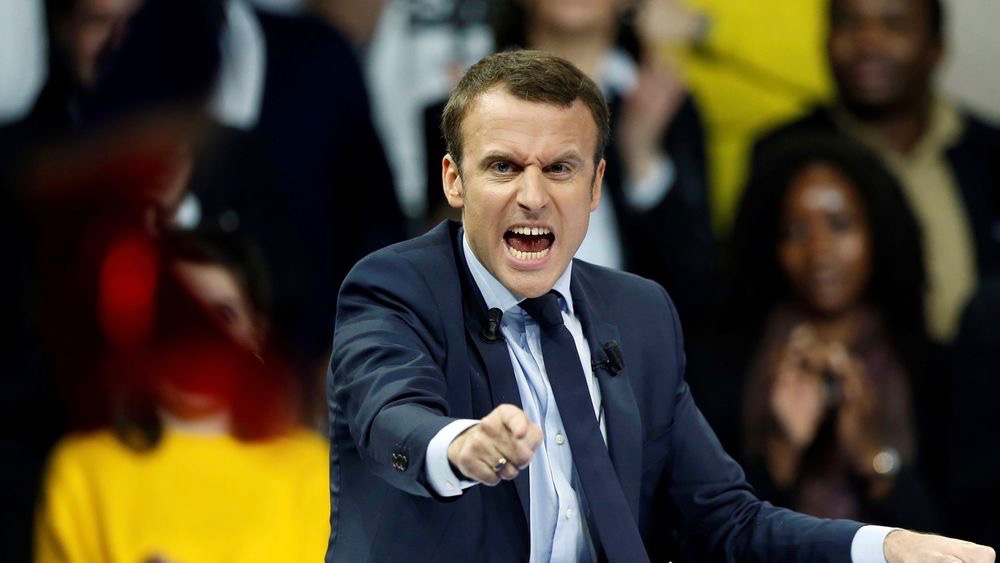
Emmanuel Macron continues to stall the post-election process in France, ignoring the New Popular Front’s calls to nominate their prime ministerial candidate
Nearly a month after the snap election in France, President Emmanuel Macron continues to delay recognizing the electoral victory of the left-progressive alliance New Popular Front (NFP). Following extensive consultations, the NFP recently named Lucie Castets as their prime ministerial candidate, urging Macron to formally nominate her. Instead, Macron has called for a “political pause” until mid-August, apparently to allow the nation to focus on the Olympic Games.
Castets, a 37-year-old expert in tax evasion and fraud intelligence, expressed her determination to see the nomination through. Even more than her economic expertise, her dedication to public services and opposition to privatization make her a logical choice for the NFP. Reacting to the NFP nomination, she stated that she would fully implement the coalition’s program of rupture, ending cuts imposed by Macron over the years.
As a member of the collective Our Public Services, Castets analyzed parties’ programs during the last election. Reflecting on the materials collected throughout this process, she vocally criticized the far-right National Assembly, debunking claims that their program would benefit the working class. On the contrary, the collective’s report indicated that the course would remain largely unchanged by what was set by Macron’s liberals. This would lead to further reductions in access to essential services and cuts targeting migrants in particular.
Castets also said she aims to repeal Macron’s controversial pension reform. NFP parliamentarians have already submitted a bill to reverse the rising retirement age, in line with announcements made during the election campaign.
Despite having the largest number of representatives in the National Assembly, the NFP faces challenges to consolidate their power as President Macron continues to exercise his executive power to block them. The president has not only avoided recognizing the left’s victory and kept former PM Gabriel Attal in a caretaker role while calling for the “political pause,” but Macron’s liberals also collaborated with the right-wing Republicans to re-elect Yaël Braun-Pivet as president of the National Assembly, a move criticized by progressive circles. However, most new parliamentary functionaries are from the NFP, giving the coalition significant leverage for future discussions.
France Unbowed criticized Macron for “confiscating” democracy. “The theft of democracy we are witnessing risks putting into power a hard-right coalition aligned with the Macronists, paving the way for the National Rally and resulting in deeply antisocial policies that are hostile to workers and trade unions,” the party wrote following Macron’s refusal to nominate Castets.
Closing campaign rally of Nicolás Maduro in Caracas. Photo: Zoe Alexandra
Numerous international media outlets have stepped up attacks against Nicolás Maduro in a seemingly scripted manner with key messages that they seek to establish as the truth
On Sunday, the people of Venezuela will head to the polls to elect their next president. The 21 million eligible voters in Venezuela have the opportunity to pick between 10 candidates from a broad range of political parties and currents. The two projected front runners however, are from completely opposite ends of the spectrum: incumbent President Nicolás Maduro and candidate for the right-wing Unitary Democratic Platform, Edmundo González.
As election day comes closer, and international mainstream media pays more attention to what is happening in the Caribbean country, several dominant patterns have emerged in the discourse and messages of these outlets.
First of all, several media outlets have carried profiles of the leading candidates, and presented a very stark dichotomy. Maduro is authoritarian, González is democratic. Maduro is oppressive, González is free. In these profiles, when talking about Maduro, they will talk about the alleged amount of money and properties that he owns, but when profiling González, no such questions are asked.
When speaking of González, another type of framing is used, namely, that of the chosen one who was able to bring about the unity of an opposition that has historically had enormous difficulties in reaching minimum agreements. In this way, they want to present a worn out, questioned and “possibly” corrupt candidate (Maduro), while on the other hand, they want to show a peaceful, conciliatory, and ethically pristine candidate (Gónzález). This framing also erases the other eight opposition candidates who are running in these elections who also represent important political sectors. This has a very clear political intention, although not explicitly stated.
It goes without saying that there is almost no mention of the ferocious hybrid war which Venezuela has been subjected to for the last decade and how the Maduro government has endured coup attempts, assassination attempts, a near complete blockade on the country’s economy and oil production, and attempted invasions by paramilitary groups. In this situation of an almost constant political and economic siege, Maduro and his party United Socialist Party of Venezuela (PSUV) have not only been able to initiate remarkable economic recovery, but also have forged unity amongst the diverse political progressive tendencies which are under the broad umbrella of Chavismo. During the last several months, the socialist candidate has traveled to dozens of cities and towns across the country to meet with the people, listen to them, and hear their demands of the government and the Bolivarian process. These multitudinous rallies and meetings have received almost no media attention.
Qué impresionante fue ver a mi gente de Valencia y La Victoria en la calles, donde cantamos, bailamos y entregamos obras para el Pueblo. El 28 de julio vamos a triunfar y colocaremos la canción profunda: Viva #Venezuela, mi Patria Querida. ¡Viva la #patria! ¡Viva Carabobo y… pic.twitter.com/6NicWbDrah
Another type of premise that hegemonic media outlets have tried to establish is that of an almost certain electoral fraud if the candidate of the PSUV wins. At the same time they state that if the opposition wins, Maduro will not recognize the results (even though the government has repeatedly publicly stated that it will respect the results, whatever they may be).
That is to say, the media perspective acquires the structure of an informal fallacy called “false dilemma”, in which, according to the hegemonic narrative, either the opposition wins and Maduro ignores the results, or Maduro wins but only through electoral fraud.
For almost a month, these media outlets have also sought to express that the so-called opinion polls (carried out by corporate, right-wing pollsters) give such a wide advantage to González that Maduro will be unable to subtract such difference, implicitly stating that, for almost a month, the election has already been decided. This fatalism also relies on the false premise that election results are absolute and defined several weeks before voting day – completely undermining the people’s will and sovereignty to decide their future.
Furthermore, it is intentionally not said that other polls have put Maduro ahead in terms of voting intentions, thus reinforcing their message that either González wins overwhelmingly or that Maduro carries out electoral fraud. Hence, it is justified, in a somewhat bizarre way, when far-right opposition leaders like María Corina Machado that are backing the candidacy of González, say that the only result they will accept is the victory of their candidate. These figures continue to denounce that Chavismo would only accept a victory of its own. Ironically, only the PSUV has affirmed that it would accept the result, whatever it may be.
This type of Manichean media attitude provokes an evident polarization and increases the tension in a country that already suffered right-wing political violence and tensions after electoral processes.
With all eyes on Venezuela this Sunday, these predetermined media narratives are important to identify and debunk. It will not be the mainstream media outlets like the New York Times, CNN, InfoBae, Voz de América and others that will determine Venezuela’s future, it will be the Venezuelan people.
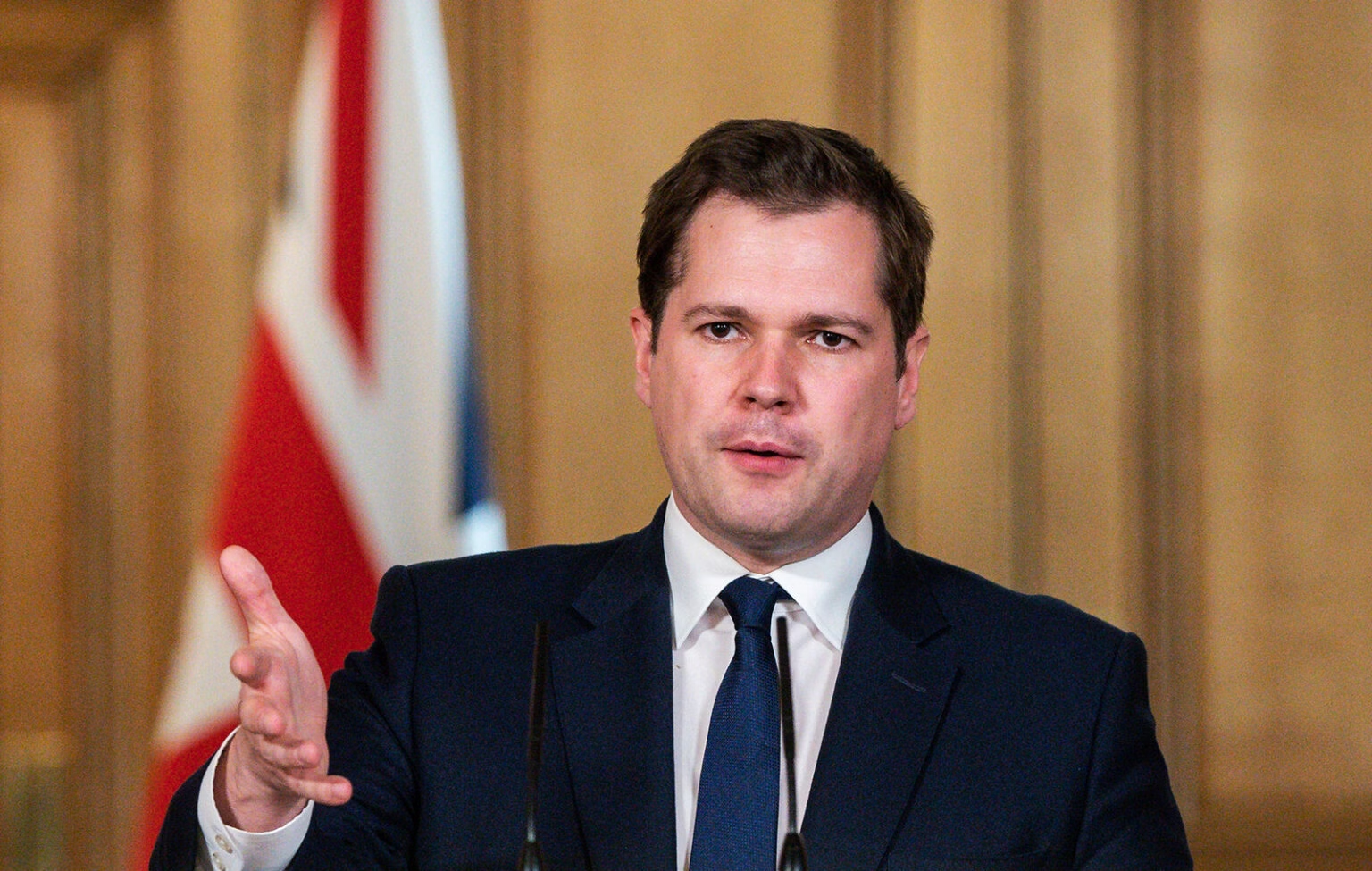
The Conservative candidate has changed his tune on climate action, recently attacking Labour’s net zero policies and arguing for new fossil fuel extraction.
Former Conservative minister Robert Jenrick, who has today entered the race to lead the Tory party, has a growing record of attacks on climate action.
The MP for Newark – who saw a 23.9 percent swing against him in the general election, and served as secretary of state for immigration under former prime minister Rishi Sunak – has attacked what he calls “net zero zealotry”, and has labelled the UK’s net zero target “dangerous fantasy green politics unmoored from reality”.
This is despite Jenrick having hailed the UK’s “world-leading commitment to net zero by 2050” as recently as 2020.
Jenrick has also called for the building of “new gas power stations” and supports new fossil fuel extraction, including North Sea oil and gas, and the opening of new coal mines.
His candidacy follows the Conservative Party losing a landslide election on 4 July against a Labour Party committed to climate action, during which the Tories supported new North Sea oil and gas extraction, and the delaying of key climate reforms.
Almost half of voters (49 percent) believe renewable energy would lower household bills, while only 14 percent say the same for more fossil fuels, according to polling by More in Common.
This week saw what climate scientists believe could be the hottest day on record thanks to climate change. The world’s leading climate science group, the UN’s Intergovernmental Panel on Climate Change (IPCC), has said that there is “a brief and rapidly closing window of opportunity to secure a liveable and sustainable future for all”.
Attacks on Labour’s Climate Agenda
In his response to the announcement of Labour’s legislative agenda in the King’s Speech last week (19 July), Jenrick used an address in the House of Commons to launch an attack on the government’s climate policies, spreading familiar misinformation.
Jenrick said that “despite being only responsible for one percent of global emissions, we find ourselves with a government pursuing for ideological reasons a net zero policy which is going to make it harder for our own consumers to afford their bills, [and] which is further going to erode our industrial base”.
Downplaying a country’s emissions is a “widely deployed” tactic used to delay international climate action, according to academics. Contrary to Jenrick’s claims, the UK’s cost of living crisis has been made worse by its dependence on fossil fuels, according to the International Monetary Fund (IMF).
And rather than “eroding our industrial base”, net zero policies are already creating new jobs and economic development. The UK’s net zero economy grew nine percent in 2023 to £74 billion – equivalent to 3.8 percent of the total UK economy, and supported more than 765,000 jobs, according to the Energy and Climate Intelligence Unit (ECIU).
Jenrick also attacked Labour’s green investment vehicle, Great British Energy – launched today – as a quango “which serves no apparent purpose”, warned that new solar farms would “despoil our countryside”, and claimed that “200,000 jobs in the oil and gas sector have been put in danger”, using a widely debunked figure.
The chief advisor to the National Farmers Union (NFU) has said solar farms “do not in any way present a risk to the UK’s food security”, while NFU president Tom Bradshaw has attacked the claims made by Jenrick and others as “sensationalist”.
On 11 July, when Labour announced its decision not to defend the new proposed coal mine in Cumbria in the High Court, Jenrick posted on X: “First the oil and gas industry, now coking coal for the steel industry. Less than a week in and jobs and economic growth are already being sacrificed on the altar of Labour’s net zero zealotry.”
In 2021, Jenrick decided not to challenge the planning application for the new mine – the UK’s first deep coal mine in more than 30 years, which would extract 2.8 million tonnes of coking coal a year, emitting an estimated 220 millions tonnes of greenhouse gases over its lifetime.
Net Zero U-Turn
Jenrick’s attacks on Labour’s green policies mirror his growing criticism of climate action – despite having previously celebrated the Conservatives Party’s support for net zero.
In February, Jenrick wrote an article for The Telegraph – a newspaper that regularly publishes attacks on climate science and net zero reforms – claiming that voters are sick of the “dishonesty” from politicians about “what net zero entails”.
He said that the UK’s 2050 net zero ambition was decided upon in the summer of 2019, “while the country was occupied by Brexit debates”, and was “nodded through the Commons with fewer than 90 minutes of debate”.
At the time, Jenrick, who was Treasury minister, welcomed the adoption of the target. In 2020, while serving as communities secretary under Boris Johnson, Jenrick praised the UK’s “world-leading commitment to net zero by 2050”. Ahead of the 2019 general election, he said that voters should support the Conservatives on the basis that the UK was the “first advanced economy in the world to pass a net zero target”.
Yet, in the February 2024 Telegraph article, Jenrick wrote that it was obvious to him “at the time” that the costs associated with net zero “were likely to be astronomical.” The article went on to claim that “reaching net zero by 2050 requires us to overhaul the material foundations of our economy in just three decades”, and that the result “is a dangerous fantasy green politics unmoored from reality and that lacks the buy-in of the public”.
Climate Denial Links
Jenrick’s campaign for Tory leader is being run by fellow Conservative MP Danny Kruger.
Kruger is the chair of the New Conservatives faction in Parliament – a group that advocates for more socially conservative, right-wing ideas within the Tory party, campaigning against “woke” culture, and immigration.
It also appears that New Conservative press officer Sam Armstrong is serving as one of Jenrick’s campaign aides, although Armstrong neither confirmed nor denied his role when approached for comment.
As DeSmog has revealed, the New Conservatives received £50,000 in December from the Legatum Institute, a free market think tank that formerly employed Kruger as a senior fellow.
In May of this year, Jenrick gave a speech to the Legatum Institute’s ‘Free Market Roadshow’ event at the group’s London office, where he called for new fossil fuel plants. He said: “We are smothering our ability to build new nuclear power stations, to build new gas power stations, which we’ve got to have to have the base capacity that we need as a country, in this mesh of regulation.”
The Legatum Institute’s parent company is UAE-based investment firm Legatum Group, which co-owns the right-wing broadcaster GB News. The outlet frequently spreads climate denial, both via its presenters and guests.
Kruger is also on the advisory board of another Legatum project, the Alliance for Responsible Citizenship (ARC), alongside some of the world’s most high-profile climate science deniers.
Jenrick has pledged to win back voters who have switched from the Tories to Reform UK, the right-wing populist party led by Nigel Farage, which is bankrolled by climate deniers and polluting interests, and campaigns to “scrap all of net zero”.
Polling from the Conservative Environment Network, a green caucus backed by dozens of Tory MPs, found that only two percent of voters who planned to switch from the Conservative to Reform saw climate change as the most important issue for them in July’s election.
A wanted war criminal addressing US Congress proved to be a pitched battle between the state and tens of thousands of anti-genocide protesters
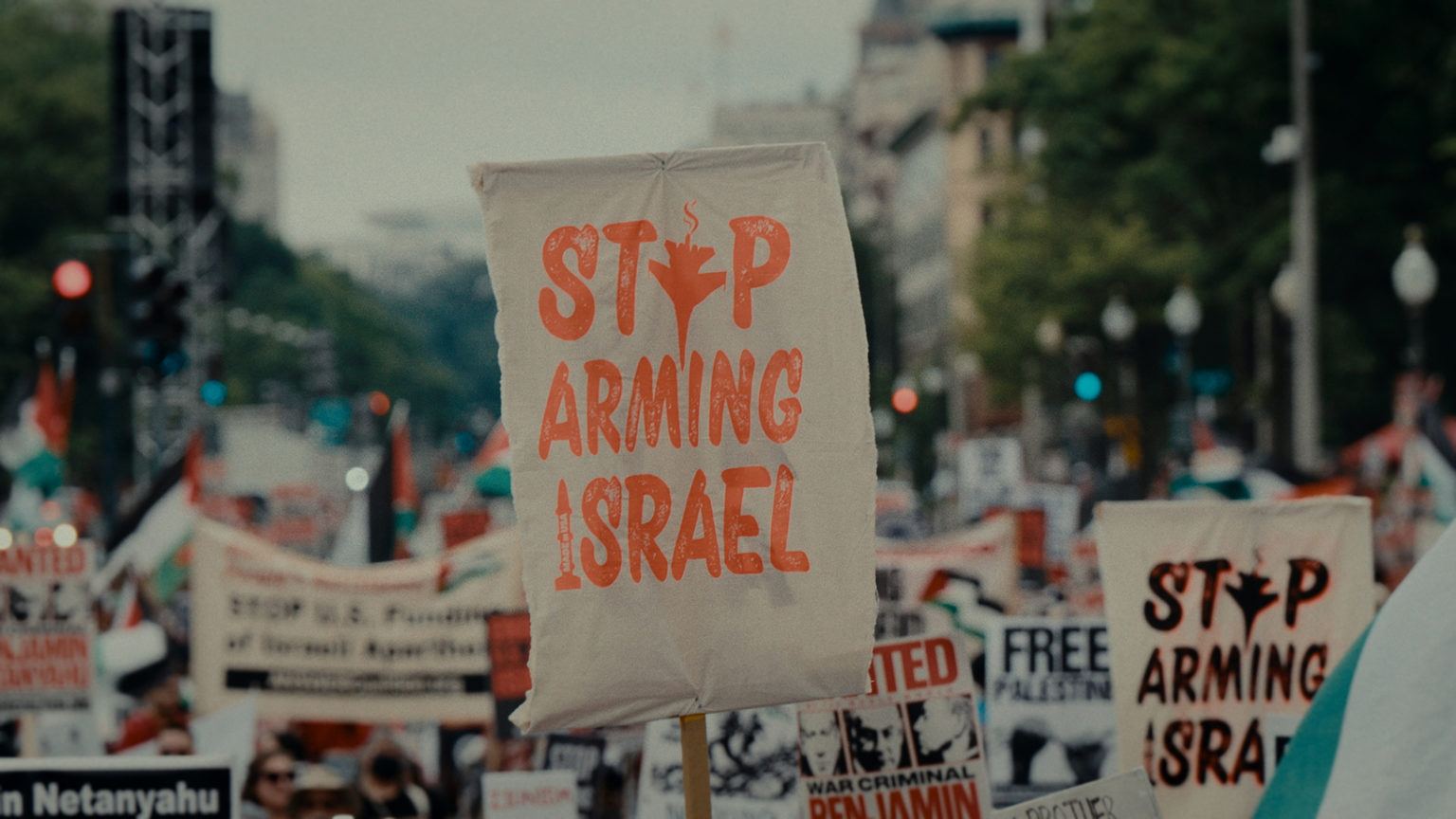
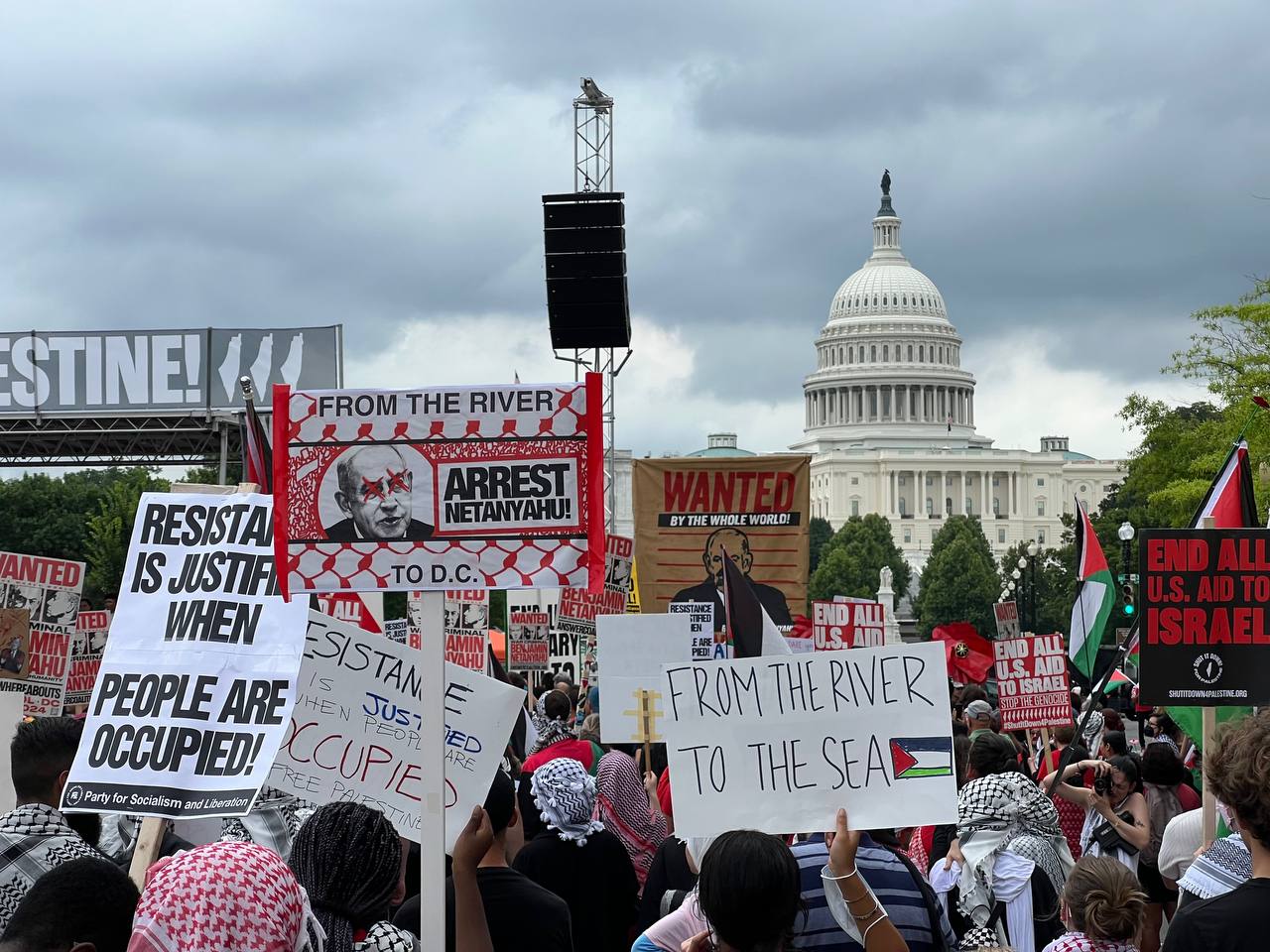
Tens of thousands of people demonstrated in Washington, DC yesterday in opposition to Benjamin Netanyahu’s joint address to Congress. While war criminal Netanyahu received a standing ovation from both chambers of Congress and both major establishment parties, thousands took to the streets directly outside the US Capitol building to register their disgust with the US’s support for and complicity in the genocide of 186,000 Palestinians.
Protesters rally in front of Capitol (Photo: Addison Clapp)
Police forces launched pepper spray at demonstrators and made several arrests, but demonstrators, who came as individuals or part of organizations of the working class such as student groups, labor unions, and tenant organizations, overcame intense police repression in order to assert their right to protest. In doing so, these protesters registered the mass discontent among the people of the United States regarding the US’s bankrolling of Israeli genocide. Recently polling has shown that as many as 61% of people in the US are against sending aid to Israel. Among people under 30, that number jumps to 77%.
The state made drastic preparations to protect Netanyahu’s speech to Congress from demonstrations. Over 200 New York Police Department officers were deployed ahead of protests. The layers of barricades and protections around the Capitol building far exceeded those on January 6, 2021 when far-right demonstrators were able to go as far as scaling the building and entering the offices of the highest-ranking politicians. “Look around the area, there are snow plows, police barricades, eight-foot high fencing,” said Brian Becker, Executive Director of the ANSWER Coalition, one of the key organizers of the demonstration, during the rally preceding the march through Washington. “This US Capitol, which says to itself, we are the people’s house, it should be renamed, it should be called Fort Netanyahu.”
Mass march experiences heavy repression
Police deploy pepper spray (Photo: Jason Bixon)
Following the rally of tens of thousands which convened in front of the Capitol, demonstrators prepared to march. Shortly after the march began, protesters were blocked by a line of police officers from multiple agencies, including DC police, Capitol police, and NYPD. After it became clear that the police intended to stop the march in its tracks, Becker addressed the crowd from the frontline, “The police have decided to block the people of the United States from exercising their constitutional right to go to the point of the protest. We say no. We have the right to go on Constitution Avenue, there’s no rule against it. The permit is called the First Amendment of the Constitution.”
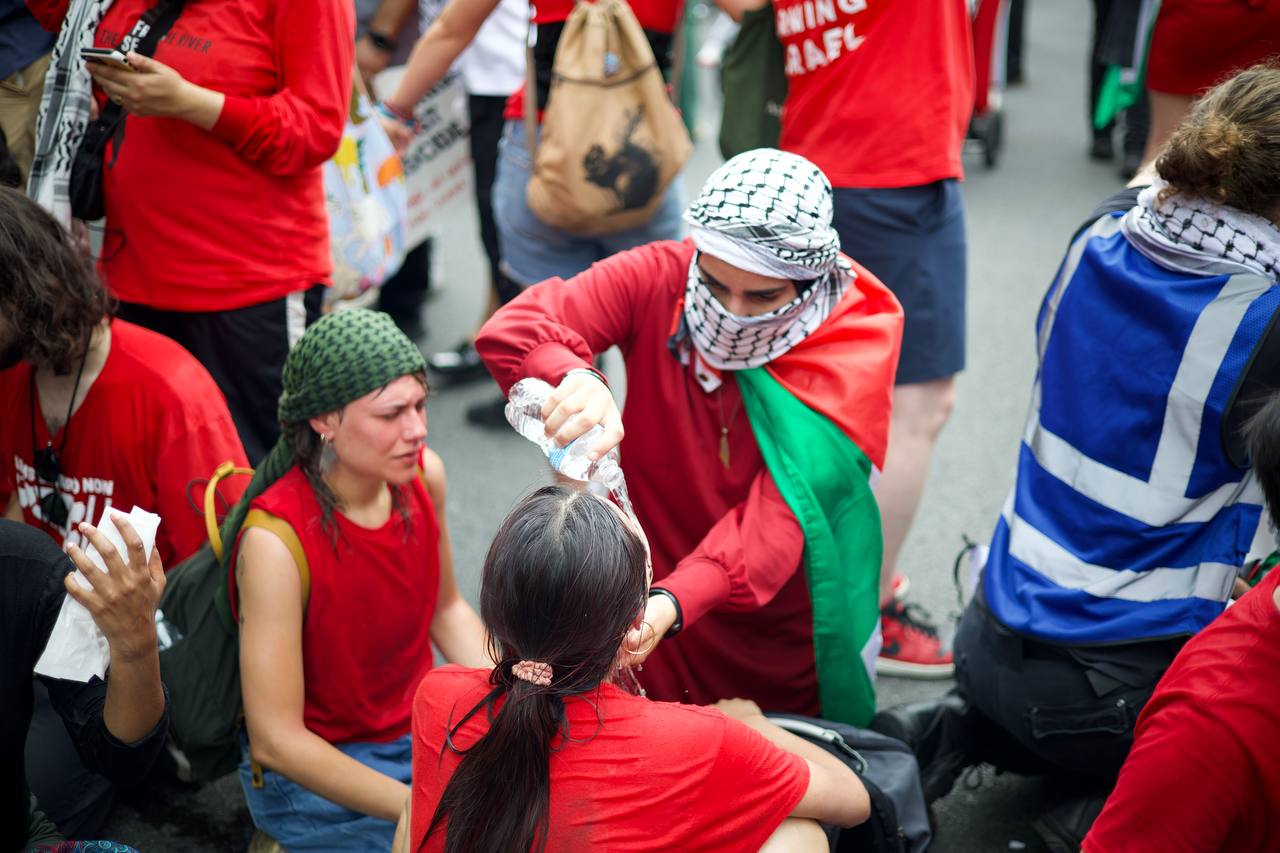
Protesters provide treatment to one another following pepper spray (Photo: Kaleigh O’Keefe)
With that, the crowd decided to press forward, after which, police deployed pepper spray liberally amongst the crowd, injuring several protesters.
“This proves to us that our police forces are training with the IDF, they’re learning tactics from the IDF,” Ibtihal Malley, an organizer with the Palestinian Youth Movement, told Peoples Dispatch directly after police pepper sprayed the crowd. “They are afraid of the people, and they’re afraid of the mass movement for Palestine, so they resort to violence to brutalize our people, just as they brutalize us in Gaza.”
“We are here in DC marching with tens of thousands of people that are asserting their right to march and to protest, and we were blockaded by tens of police,” said Lameess M., also a lead organizer in the Palestinian Youth Movement, in an interview with Peoples Dispatch following police repression. “[Police are] here to protect a war criminal and use our tax dollars to protect that war criminal, while pepper spraying the people that they claim to represent.”
The incident of state repression only made the crowd more defiant. The march quickly diverted to another street, where they continued to evade police lines for several blocks throughout Washington, DC, before rallying once again in front of Union Station. Inspired demonstrators took it upon themselves to take down three massive US flags in front of the station, replacing them with Palestinian flags, and burning the US flags along with a puppet effigy of Netanyahu.
This expression of popular anger at genocide has been seized upon by mainstream media as well as the highest-ranking politicians in the country to denounce the protests. Vice President Kamala Harris, the Democratic Party favorite for the 2024 presidential elections, released a statement making no mention of the reason that tens of thousands had gathered in Washington, DC to protest the celebration of a war criminal. Instead, she condemned “the burning of the American flag.”
“That flag is a symbol of our highest ideals as a nation and represents the promise of America. It should never be desecrated in that way,” Harris stated. “I condemn any individuals associating with the brutal terrorist organization Hamas, which has vowed to annihilate the State of Israel and kill Jews. Pro-Hamas graffiti and rhetoric is abhorrent and we must not tolerate it in our nation.”
The ANSWER Coalition released a statement following the demonstrations. “To try and misdirect people’s attention, some parts of the corporate media and the White House itself are now trying to minimize the significance of these actions,” the anti-war organization stated. “They are attempting to demonize the protests, and focus on one individual sign or some individual’s burning of the American flag. This is designed to distract the public from the actual police violence yesterday, and the true mass violence that has claimed over 40,000 Palestinian lives and millions more in U.S.-led wars across the world. But the rising of the Palestinian flag on multiple flagpoles in front of Union Station and in the shadow of the US Capitol grounds is a clear indication that the tide has turned. Public opinion has been transformed so dramatically that no attempt at deflection can turn it back.”
Organizations of the working class denounce genocide
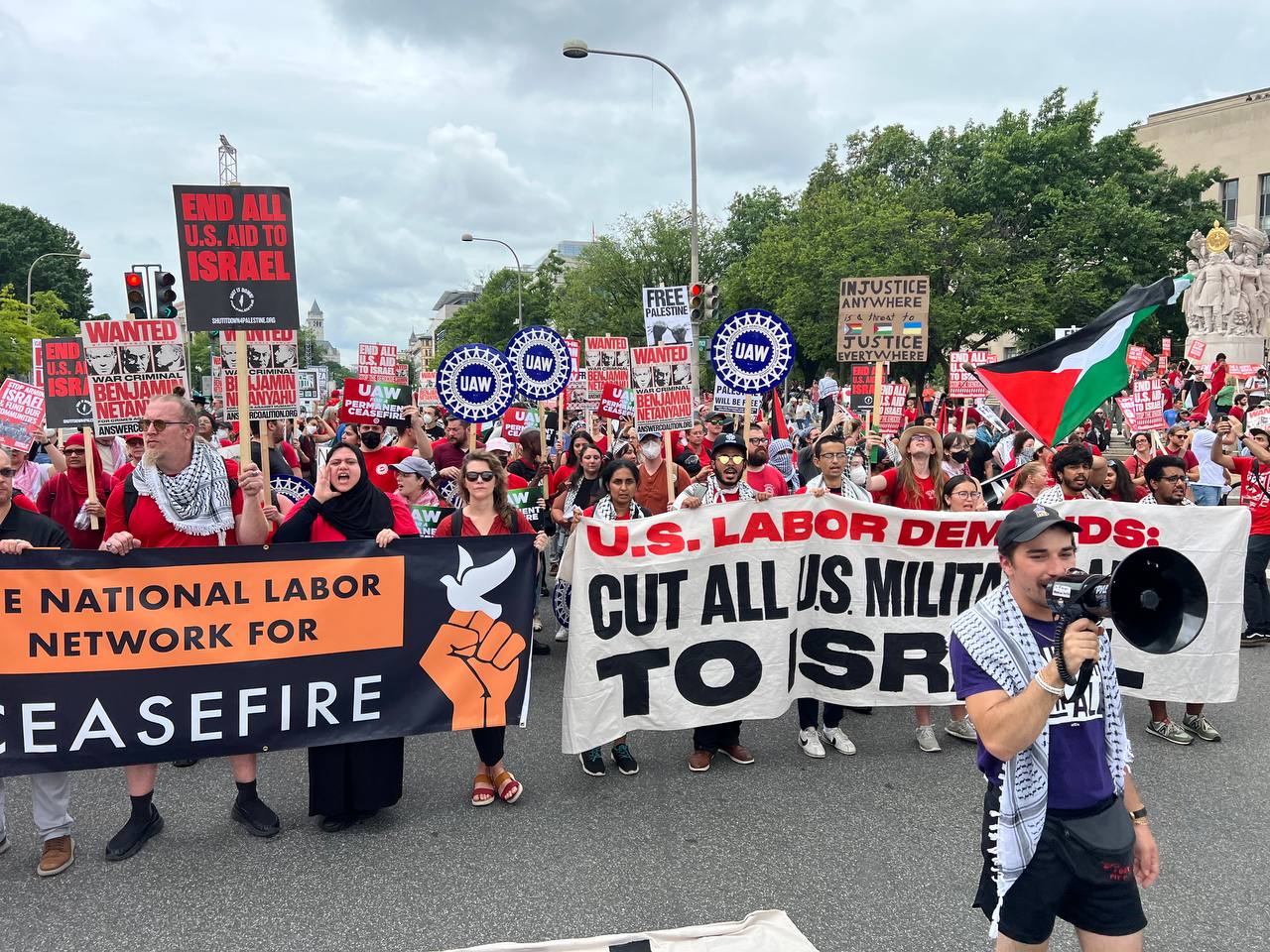
Despite heavy repression, organizations of the working class used the platform of the demonstration to denounce the US’s unconditional support for Israel. The day before the demonstration, seven major unions, representing almost half of all unionized workers in the United States, penned an open letter calling for an end to all US military aid to Israel and a ceasefire in Gaza. Leaders from some of these major unions addressed demonstrators in front of the Capitol.
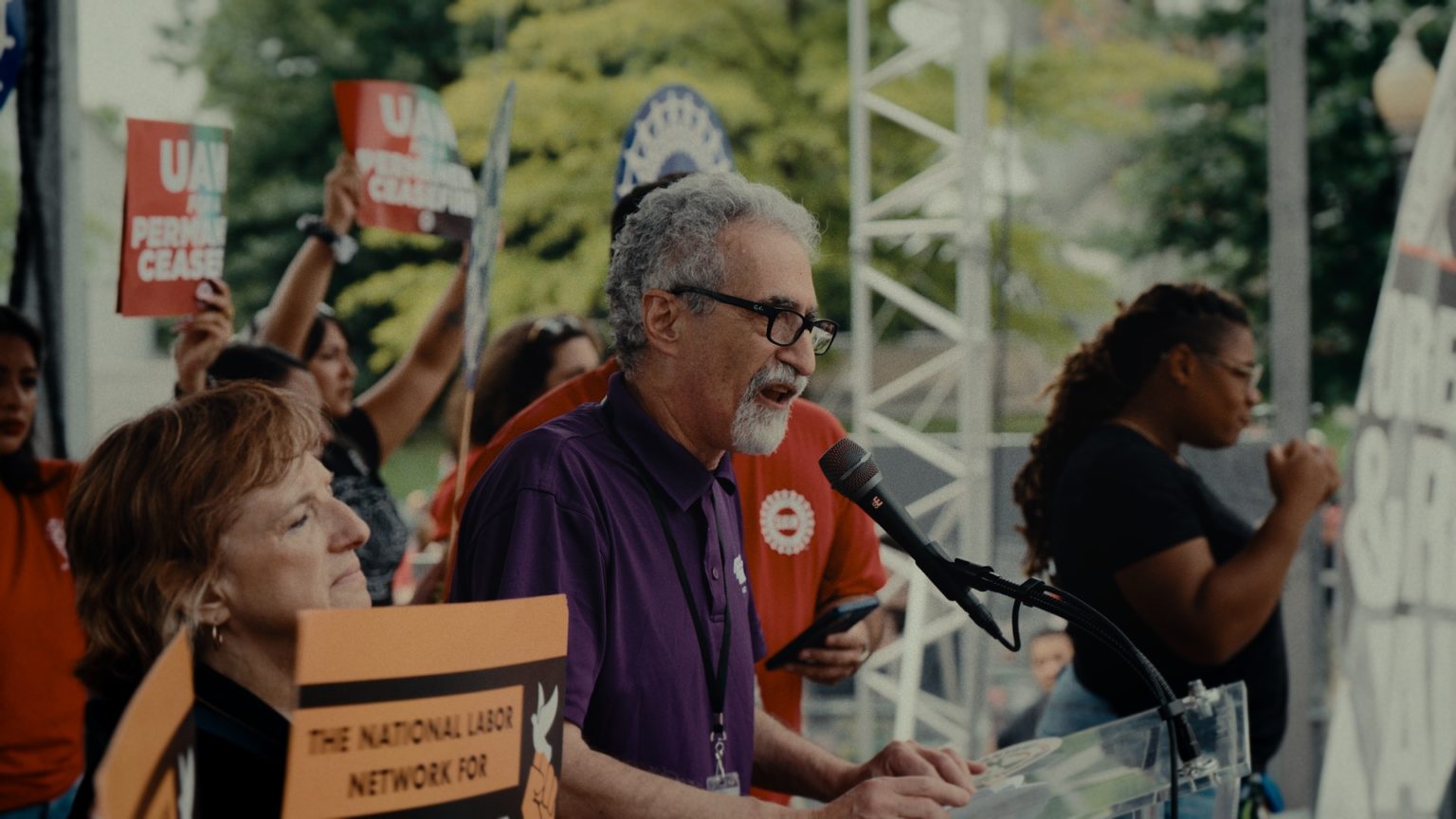
These leaders include Mark Dimondstein, President of the American Postal Workers Union. “In the spirit of working class solidarity and justice, the American Postal Workers Union… stands with humanity and the suffering people, workers and unions in Gaza, in calling for a long overdue ceasefire and massive humanitarian aid to the 2.3 million people of Gaza,” he addressed the rallying crowd. “While they are displaced, homeless, bombed, killed, injured, diseased, and starving behind the war crimes of the Netanyahu-Israeli government, fully backed by US military aid.”
Mark Dimondstein, President of the American Postal Workers Union, addresses demonstrators in Washington, DC (Photo: Craig Birchfield)
Dimondstein’s denunciation of US government policy is not only reflective of his personal opinion, but that of the workers the APWU represents. “Just last week in our convention we voted,” calling on the US government to halt military aid to the US government, “and to stop using our tax dollars for more war,” he said.
“It’s a labor issue. We believe in social justice, we believe in international solidarity,” Dimondstein told Peoples Dispatch in an interview. “Workers pay taxes, and the last thing our taxes should be used for is to kill, maim, and starve innocent men, women, and children of another country.”
“The workers are deeply affected in Palestine and the unions are deeply affected in Palestine,” he continued. “And it’s also a working class issue because there’s real danger of a wider war. And who has to fight, kill, and be killed in these unjust wars if it’s not the working class?”
“US taxpayers are basically funding a genocide,” said Arrion Brown, the director of the Support Services Division within the APWU, in an interview with Peoples Dispatch. Brown has been a postal worker for 24 years. “Those same tax dollars would do so much better in the US, helping actual working people.”
“Working people hold the power of the country, of the world. So it’s important for working class people to express our thoughts, to let the powers that be, the establishment know that they’re not going in the direction we want. Ultimately, we are the political power, we are the working power, and we are the power of the world.”
Brandon Mancilla, a leader in the international board of the United Auto Workers, also addressed the crowd on behalf of the over 400,000 workers of diverse sectors represented by the UAW. In his speech, Mancilla credited rank and file workers with pushing the leadership to call for a ceasefire in Gaza, a step the union took back in December. “Autoworkers in Dearborn, Michigan, have been personally affected by this issue, and have demanded that their union and their government stop funding a genocide. Because academic workers all across the country in countless campuses in almost every state of this country have been protesting for their literal right of free speech, to call on their universities to divest and be held accountable,” he mentioned. The UAW notably represents not only auto workers but a large portion of organized academic workers across the country. Following the brutal crackdown against the Gaza solidarity encampment at the University of California – Los Angeles (UCLA), UAW Local 4811, which represents academic workers within the University of California system, went on strike for the right to protest for Palestine, representing the first strike in US history in relation to the Palestine solidarity movement.
For Mancilla, the letter that seven unions signed onto on July 23 represents an “escalation.”
“A ceasefire has not been realized, it has not been actualized, and in order to actually make that happen, not only do we have to keep negotiations going, and agree to the framework, we have to also materially intervene, which means ending arms shipments to Israel,” Mancilla told Peoples Dispatch.
Labor unions march with demonstrators (Photo: Addison Clapp)
Unions were not the only organizations of the working class out in full force that day—Peoples Dispatch also spoke to tenants organized with CAAAV (Committee Against Anti-Asian Violence), an organization that united Asian-American communities in New York City against gentrification, among other issues. Bingjie, a young member of CAAAV from the NYC neighborhood of Chinatown, told Peoples Dispatch that it’s unjust that tax dollars are being used to fund genocide “when tenants don’t even have enough in New York.”
“The fight for Palestine is not just a fight for Palestine itself, but for liberation for the whole entire world,” she said.
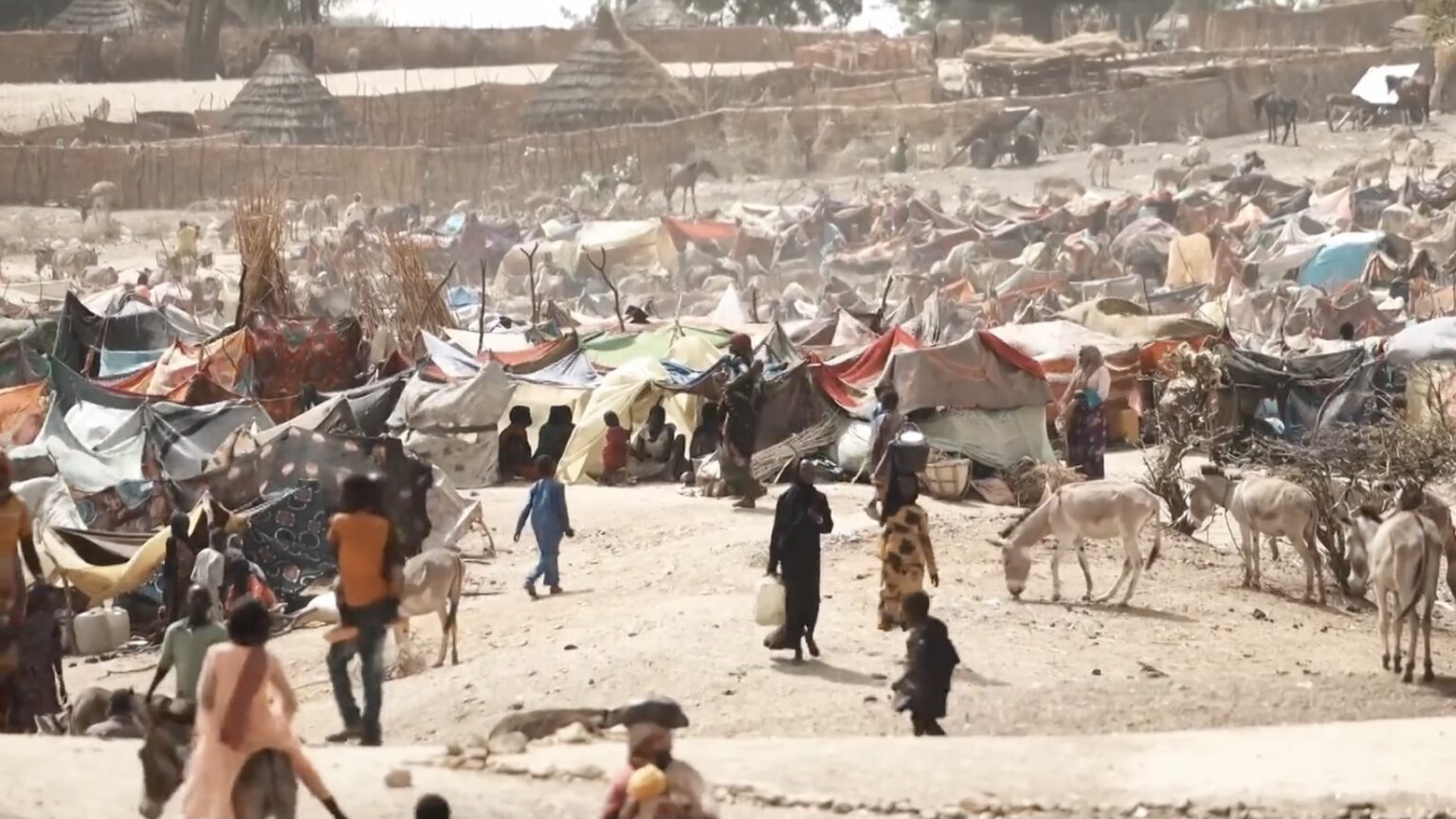
Sudanese refugees in Chad. Over 10 million people have been forcibly displaced in over a year of war in Sudan. Photo: Wikimedia commons
Famine looms in Sudan, forcing people to flee to neighboring countries, while talks between warring parties and a UN envoy are still under way in Geneva
The governments of 15 Arab and African countries issued a statement on Tuesday, July 16, expressing their deep concerns regarding the escalating food security crisis in war-torn Sudan. The countries included the United Arab Emirates, Jordan, Morocco, Mauritania, Chad, Comoros, Guinea-Bissau, Benin, Seychelles, Senegal, Kenya, Sierra Leone, Uganda, Mozambique and Nigeria.
The statement came as a reaction to the Integrated Food Security Phase Classification (IPC) report, which was published on June 27, 2024. “Fourteen months into the conflict, Sudan is facing the worst levels of acute food insecurity ever recorded by the IPC in the country,” the report said, pointing out that more than half of the population in Sudan have experienced severe hunger, which makes Sudan the world’s largest hunger crisis.
The number of starving people is estimated at 25.6 million people, with 14 areas at the risk of famine including greater Darfur, Greater Kordofan, Al Jazirah and some hotspots in Sudan’s capital Khartoum. Many starving Sudanese people have been reportedly fleeing Sudan to seek asylum in neighboring countries due to hunger and looming famine.
The countries who issued the statement expressed their concern about what was set out in the IPC report as a “stark and rapid deterioration” in food security, and its dire impact on the safety and well-being of civilians, including thousands of children, who have suffered from severe acute malnutrition.
According to a Save the Children report published on July 7, due to the war in Sudan 30% of children are acutely malnourished and 20% of the overall population is facing extreme food shortages.
Since the conflict between the Sudanese Armed Forces (SAF) and the Rapid Support Forces (RSF) began in April 2023, the destruction caused by the fighting resulted in a sharp decrease in the agricultural production, and therefore a hike in food prices and food scarcity. The hunger crisis in Sudan has been further deepened by the severe restriction on the movement of food and aid convoys due to the ongoing conflict.
Reiterating the United Nations Security Council’s call from June of 2023, the countries urged all the parties to the conflict to ensure immediate, safe, and unrestricted access to civilian humanitarian aid. They also called on the conflicting parties to adhere to international humanitarian law and to comply with all relevant Security Council resolutions.
The statement also addressed foreign actors requesting them to stop providing armed or material support to the parties involved in the conflict and to refrain from any action which may ignite the conflict. Furthermore, it called on the international community for immediate and coordinated international response to tackle the urgent needs of the affected Sudanese population. The countries encouraged the international community to scale up the humanitarian assistance it provides, and to support the IPC recommendations for increasing nutrition interventions, restoring productive systems and improving data collection.
While the humanitarian situation in Sudan is constantly deteriorating, talks between a United Nations envoy and delegations from both conflicting parties continue in Geneva this week. The talks started last Thursday, focusing on humanitarian aid and the protection of civilians.
There were a few “promising signs” emerging from Monday’s talks in Geneva, the Representative of the World Health Organization (WHO) in Sudan, Shible Sahbani commented. “Let’s wait for the coming hours and days, and we hope that if we don’t get a ceasefire, at least we can get the protection of civilians and the opening of humanitarian corridors,” he added.