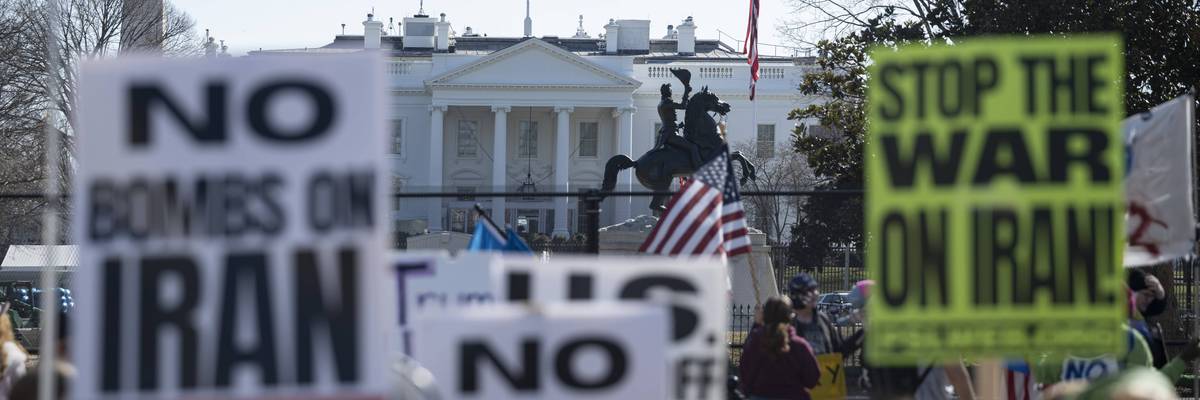
Demonstrators gathered outside the White House in Washington DC on February 28, 2026 to protest US and Israeli strikes on Iran. (Photo by Celal Gunes/Anadolu via Getty Images)
“If this goes on… this is going to become a political disaster,” said one foreign policy expert.
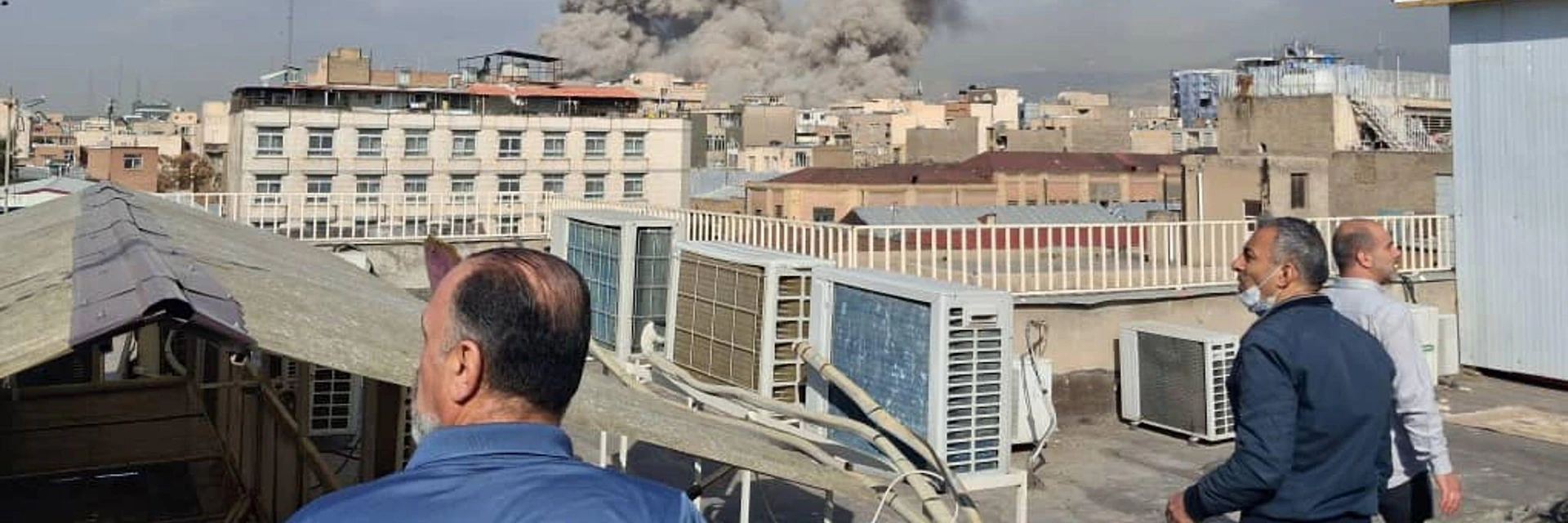
President Donald Trump’s war in Iran is extraordinarily unpopular, according to a poll conducted shortly after the US and Israel carried out massive strikes on the country Saturday.
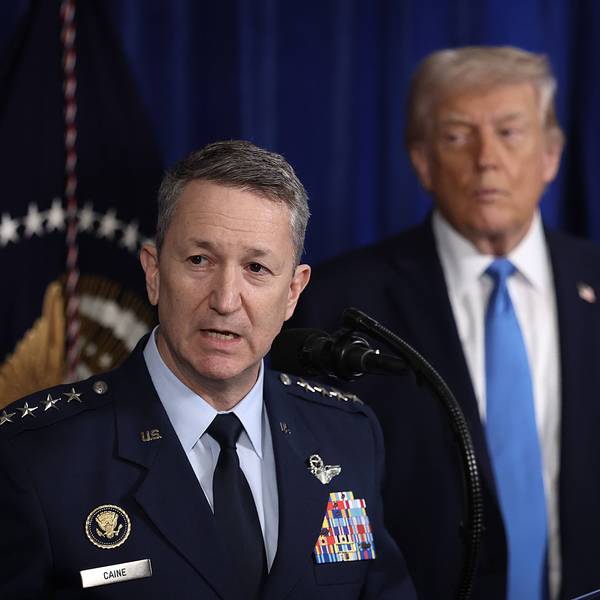
The survey, conducted by Reuters/Ipsos, found that just 27% of voters approved of the strikes, which have killed at least 555 Iranians as of Monday morning and resulted in retaliation from Iran that has killed at least four US service members, with more casualties expected according to a spokesperson for the US Joint Chiefs of Staff.
Meanwhile, 43% of respondents disapproved of the military action, while 29% said they were not sure.
A majority of Republicans said they approved of the strikes, with 55% expressing support. Still, 13% disapproved, and a noteworthy 31% said they were unsure.
Only 27 percent of Americans approve of Trump's Iran strikes, per new Reuters poll. Any Dems who are still skittish about the war powers vote should get over it already. pic.twitter.com/aPPWCBcJn0
Approval is dismal with nearly everyone else. Only 19% of independents expressed support compared to 44% who disapproved. And though Democratic leaders in Congress have done little to stand in the way of the strikes, their voters are overwhelmingly against them: 74% said they disapproved, while just 7% approved.
The poll reflects a wider skepticism of US military intervention, with 56% of respondents saying the president was too quick to deploy military force in recent months, including in Venezuela, Syria, and Nigeria.
Compared with previous US military interventions in the Middle East, such as the invasions of Iraq and Afghanistan, which—at least at their outset—enjoyed broad support from the American public following intense government efforts to drum up support, there has been little effort by the Trump administration to define the purpose of war with Iran.
Trump’s justification for launching the war has shifted wildly since he began amassing troops in the region. Trump has most recently said the strikes were intended to stop an “imminent threat” from Iran; meanwhile, the Pentagon has told Congress there was no sign Iran was planning an attack unless the US did so first.
The president previously said his push for war was to prevent Iran from developing a nuclear weapon, an assertion at odds with his claim that his strikes in June “obliterated” the country’s nuclear capabilities.
Told @AJEnglish that Trump's messaging on why he started the war with Iran signalled desperation.
He is desperately trying to come up with a justification that will be convincing to his base for a war that only one out of five Americans sees as justified… pic.twitter.com/pteQ6Ey2zx
Trita Parsi, executive vice president of the Quincy Institute for Responsible Statecraft, toldAl Jazeera that Trump’s shifting explanations reek of “desperation.”
“It’s very clear that Trump has a tremendous difficulty finding a justification for this war of choice that he’s embarked on,” he said. “The reality is that if this goes on for another week or two, this is going to become a political disaster.”
“So now he’s suddenly, desperately, using all kinds of justifications: Liberating the Iranian people, Iran is fighting against civilization,” Parsi said. “If he actually had a case, he would have stuck to that point and made it clearly. But he doesn’t have one.”
Donald Fuhrump says that Amerikkka doesn’t bother with crimes or charges anymore, not being 100% Amerikkkan and opposing his real estate intentions is enough.Elon Musk urges you to be a Fascist like him, says that you can ignore facts and reality then.Orcas discuss rotting brain. Front Orca says “Wish someone would lock him up”.
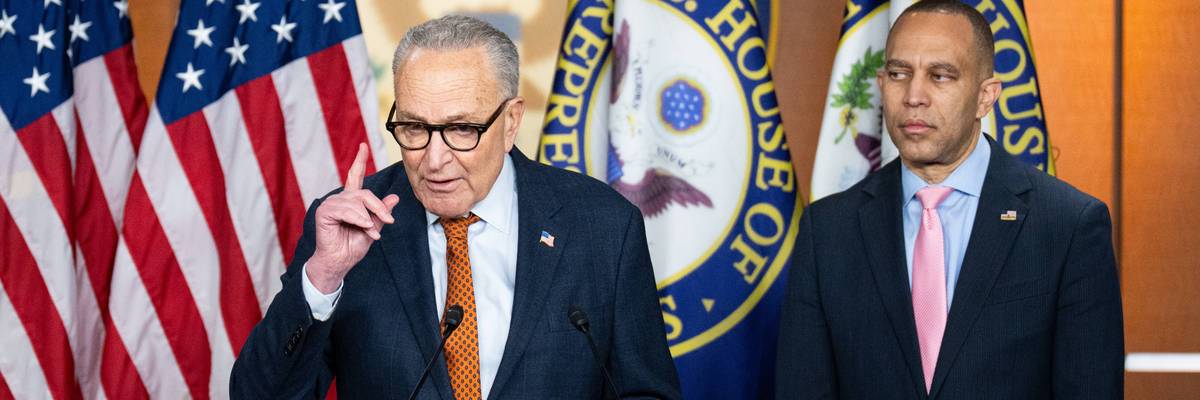
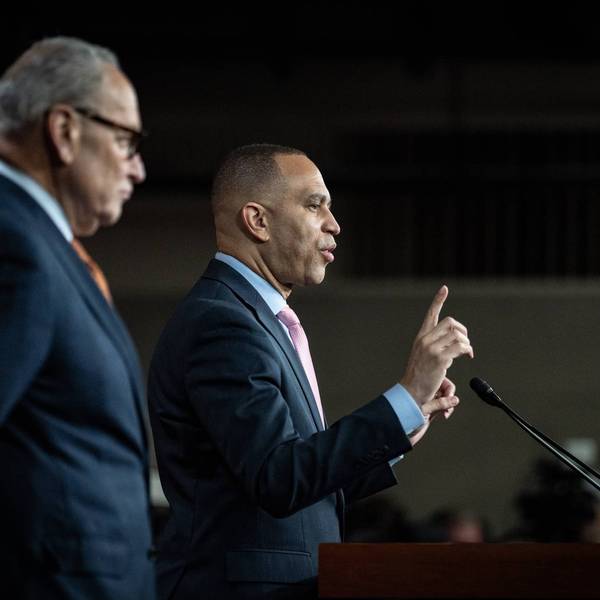
Senate Minority Leader Chuck Schumer (D-NY) and House Minority Leader Hakeem Jeffries (D-NY) held a joint news conference on January 8, 2026. (Photo by Bill Clark/CQ-Roll Call, Inc. via Getty Images)
“As we plunge headlong into another catastrophic war, Sen. Schumer and Rep. Jeffries’ throat-clearing and process critique only serves Trump and the war machine.”
The top Democrats in the US Congress, Senate Minority Leader Chuck Schumer and House Minority Leader Hakeem Jeffries, faced backlash on Saturday over what critics described as tepid, equivocal responses to President Donald Trump’s illegal assault on Iran—and for slowwalking efforts to prevent the war before the bombing began.
While both Democratic leaders chided Trump for failing to seek congressional authorization and not adequately briefing lawmakers on the details of Saturday’s attacks, neither offered a full-throated condemnation of a military assault that has killed hundreds so far, including dozens of children, and hurled the Middle East into chaos.
Schumer (D-NY)—who infamously worked to defeat the 2015 nuclear deal that Trump later abandoned during his first White House term, setting the stage for the current crisis—said he “implored” US Secretary of State Marco Rubio to “be straight with Congress and the American people about the objectives of these strikes and what comes next.”
“Iran must never be allowed to attain a nuclear weapon,” he added, “but the American people do not want another endless and costly war in the Middle East when there are so many problems at home.”
Jeffries (D-NY), a beneficiary of AIPAC campaign cash, said in his response to the massive US-Israeli assault that “Iran is a bad actor and must be aggressively confronted for its human rights violations, nuclear ambitions, support of terrorism, and the threat it poses to our allies like Israel and Jordan in the region.”
“The Trump administration must explain itself to the American people and Congress immediately, provide an ironclad justification for this act of war, clearly define the national security objective, and articulate a plan to avoid another costly, prolonged military quagmire in the Middle East,” said Jeffries.
The Democratic leaders’ responses bolstered the view that their objections to Trump’s attack on Iran are based on procedure, not opposition to war.
This is a disgusting and cowardly statement handwringing about process and the need for a briefing.
No you idiot. This war is a horror and a disaster and must be directly opposed. Any Democrat who can’t say that needs to resign and ESPECIALLY the ones in leadership. https://t.co/CdZoEyNkOy
Claire Valdez, a New York state assemblymember who is running for Congress, said that “as we plunge headlong into another catastrophic war, Sen. Schumer and Rep. Jeffries’ throat-clearing and process critique only serves Trump and the war machine.”
“Democrats should speak clearly and with one voice: no war,” Valdez added.
Schumer and Jeffries both committed to swiftly forcing votes on War Powers resolutions in their respective chambers. But reporting last week by Aída Chávez of Capital & Empire indicated that top Democrats worked behind the scenes to slow momentum behind the resolutions, helping ensure they did not come to a vote before Trump launched the war.
“The preferred outcome of many AIPAC-aligned Senate Democrats, according to a senior foreign policy aide to Senate Democratic Leader Chuck Schumer, is that Trump acts unilaterally, weakening Iran while absorbing the domestic backlash ahead of the midterms,” Chávez wrote.
The top Democrats’ responses to Saturday’s US-Israeli attacks on Iran, which Trump said would continue “uninterrupted” even after the killing of the nation’s supreme leader, contrasted sharply with statements of rank-and-file congressional Democrats—and even some members of leadership—who condemned the president for shredding the Constitution and driving the US into another deadly war that the American public opposes.
Rep. Alexandria Ocasio-Cortez (D-NY), who has been floated as a possible 2028 challenger to Schumer, said Saturday that “the American people are once again dragged into a war they did not want by a president who does not care about the long-term consequences of his actions.”
“This war is unlawful. It is unnecessary. And it will be catastrophic,” said Ocasio-Cortez. “This is a deliberate choice of aggression when diplomacy and security were within reach. Stop lying to the American people. Violence begets violence. We learned this lesson in Iraq. We learned this lesson in Afghanistan. And we are about to learn it again in Iran. Bombs have yet to create enduring democracies in the region, and this will be no different.”
Rep. Rashida Tlaib (D-Mich.), a vice chair of the Congressional Progressive Caucus, was more blunt.
“Congress must stop the bloodshed by immediately reconvening to exert its war powers and stop this deranged president,” she said. “But let’s be clear: Warmongering politicians from both parties support this illegal war, and it will take a mass anti-war movement to stop it.”
Donald Fuhrump says that Amerikkka doesn’t bother with crimes or charges anymore, not being 100% Amerikkkan and opposing his real estate intentions is enough.Elon Musk urges you to be a Fascist like him, says that you can ignore facts and reality then.Orcas discuss rotting brain. Front Orca says “Wish someone would lock him up”.
The US president has repeatedly said that Iran can’t be allowed to develop a nuclear weapon. The United Nations nuclear watchdog has reported that, because Iran has denied access to key sites hit during last year’s conflict, it cannot verify whether Iran has suspended all uranium enrichment or determine the current size and composition of its enriched uranium stockpile. However, Iran’s foreign minister, Abbas Araghchi, said after the latest round of talks that “good progress” was being made on a deal to limit Iran’s nuclear programme in return for sanctions relief.
Now, from everything that the US president is saying, the goalposts have shifted from a nuclear deal to an attempt to force regime change.
So bombs are falling on various cities in Iran, family members are hiding, tragedies will inevitably happen and the innocent will suffer. This is the endpoint of a longstanding campaign by the US and Israeli right-wing to reshape the Middle East and the wider Muslim world at the barrel of a gun. This is yet another intervention in a long history of disastrous foreign moves that have destabilised the country since Britain and the Soviet Union deposed Reza Shah Pahlavi in 1941 and the CIA and MI6 orchestrated a coup to depose Iran’s democratically elected prime minister, Mohammad Mossadegh, in 1953.
The consequences of this attack are likely to be dire for the region and the world. Already, Iran has retaliated by targeting US bases in Kuwait, Qatar, the United Arab Emirates and Bahrain and the first reports of casualties are emerging. Iran is unlikely to hold back. It’s clear that the Islamic Republic is viewing this as an existential threat.
Tehran will call on its allies in the region, the Houthis in Yemen, the Popular Mobilisation Forces in Iraq and Hezbollah in Lebanon which – despite being weakened over two years of attacks by Israel aided and abetted by the United States – have the capacity to expand the conflict throughout the region.
Iran has already indicated in recent drills with the Russian Navy that it may be capable of closing off the strait of Hormuz, through which around one-quarter of the world’s oil and one-third of its liquefied natural gas travel. As a consequence, oil prices will explode and the world economy will suffer.
Clash of civilisations
There is a cultural component to this war, too. Israel and the US are conducting this war during the month of Ramadan. Muslims all over the world are fasting. For billions of them, this is the month of spirituality, peace and solidarity. Images of Iranian Muslims being killed by Israeli and US bombs threaten to further a clash of civilisations narrative which pits the Judeo-Christian world against Islam.
Iran has threatened retaliation across the Middle East. EPA/Abedin Taherkenareh
Muslims in European capitals, together with anti-war activists, will see this war as a clear aggression on the part of the US and Israel. Global public opinion will not be easily swayed into the direction Trump and Netanyahu would like.
And it must be asked, what will the leaders in Moscow and Beijing be thinking as they watch this illegal war and what might this mean for Ukraine and Taiwan? Vladimir Putin and Xi Jinping are close to the government of Iran and will condemn this war. At the same time, they must feel emboldened to pursue their own agendas with military might.
So Trump and Netanyahu’s attack on Iran has the potential to plunge the world into deep crisis. Expect more refugees, more economic turmoil, more trauma, death and destruction. The only hope now is that cooler heads among world leaders can prevail to contain this conflict and to limit the actions of Trump and Netanyahu.
Diplomacy has to be prioritised. Attempting to force regime change by launching an illegal war is foolhardy. If Iran is further destabilised, the entire Middle East and beyond will be plunged into utter turmoil. From there the outcome for the whole world is dangerously uncertain.
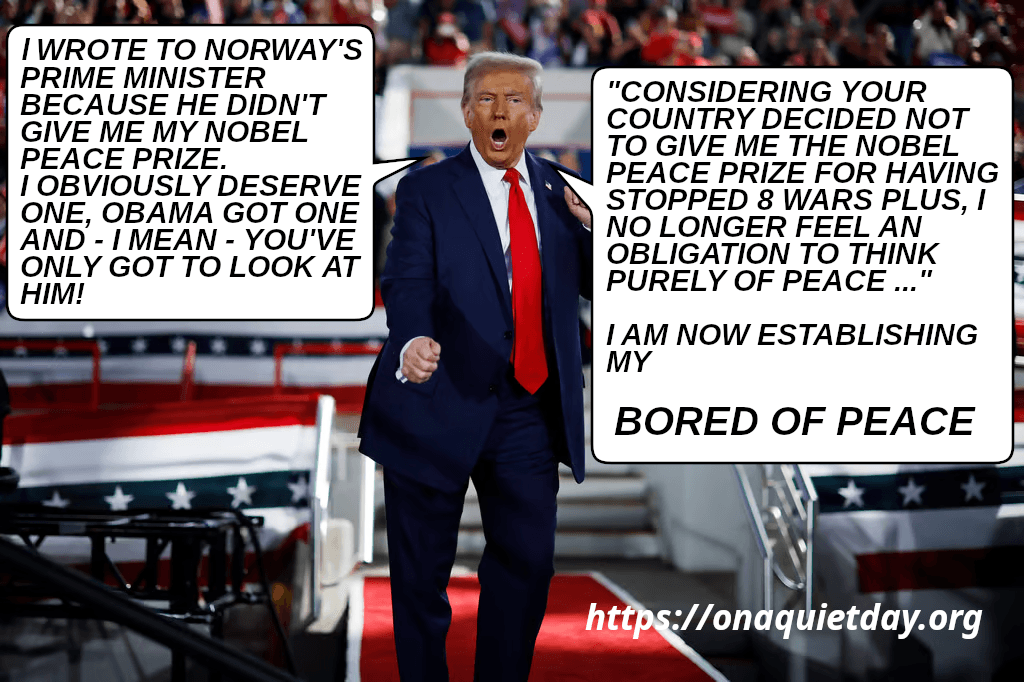
Donald Trump explains why he established his Bored of PeaceDonald Fuhrump says that Amerikkka doesn’t bother with crimes or charges anymore, not being 100% Amerikkkan and opposing his real estate intentions is enough.Orcas discuss rotting brain. Front Orca says “Wish someone would lock him up”.
US and Iranian negotiators met in Geneva earlier this week in what mediators described as the most serious and constructive talks in years. Oman’s foreign minister, Badr Albusaidi, spoke publicly of “unprecedented openness,” signalling that both sides were exploring creative formulations rather than repeating entrenched positions. Discussions showed flexibility on nuclear limits and sanctions relief, and mediators indicated that a principles agreement could have been reached within days, with detailed verification mechanisms to follow within months.
These were not hollow gestures. Real diplomatic capital was being spent. Iranian officials floated proposals designed to meet US political realities – including potential access to energy sectors and economic cooperation. These were gestures calibrated to allow Donald Trump to present any deal as tougher and more advantageous than the 2015 agreement he withdrew the US from in May 2018. Tehran appeared to understand the optics Washington required, even if contentious issues such as ballistic missiles and regional proxy networks remained outside the immediate framework. Then, in the middle of these talks, the bridge was shattered.
Sensing how close the negotiations were — and how imminent military escalation had become — Oman’s foreign minister, Badr Albusaidi, made an emergency dash to Washington in a last-ditch effort to preserve the diplomatic track.
In an unusually public move for a mediator, he appeared on CBS to outline just how far the talks had progressed. He described a deal that would eliminate Iranian stockpiles of highly enriched uranium, down-blend existing material inside Iran, and allow full verification by the International Atomic Energy Agency (IAEA) — with the possibility of US inspectors participating alongside them. Iran, he suggested, would enrich only for civilian purposes. A principles agreement, he indicated, could be signed within days. It was a remarkable disclosure — effectively revealing the contours of a near-breakthrough in an attempt to prevent imminent war.
But rather than allowing diplomacy to conclude, the US and Israel have launched coordinated strikes across Iran. Explosions were reported in Tehran and other cities. Trump announced “major combat operations,”, framing them as necessary to eliminate nuclear and missile threats while urging Iranians to seize the moment and overthrow their leadership. Iran responded with missile and drone attacks targeting US bases and allied states across the region.
What is most striking is not merely that diplomacy failed, but that it failed amid visible progress. Mediators were openly discussing a viable framework; both sides had demonstrated flexibility – a pathway to constrain nuclear escalation appeared tangible. Choosing military escalation at that moment undermines the premise that negotiation is a genuine alternative to war. It signals that even active diplomacy offers no guarantee of restraint. Peace was not naïve. It was plausible.
Iran’s approach in Geneva was strategic, not submissive. Proposals involving economic incentives – including energy cooperation – were not unilateral concessions but calculated compromises designed to structure a politically survivable agreement in Washington. The core objective was clear: constrain Iran’s nuclear programme through enforceable limits and intrusive verification, thereby addressing the very proliferation risks that sanctions and threats of force were meant to prevent.
Talks had moved beyond rhetorical posturing toward concrete proposals. For the first time in years, there was credible movement toward stabilising the nuclear issue. By attacking during that negotiation window, Washington and its allies have not only derailed a diplomatic opening but have cast doubt on the durability of American commitments to negotiated solutions. The message to Tehran – and to other adversaries weighing diplomacy – is stark: even when talks appear to work, they can be overtaken by force.
Iran is not Iraq or Libya
Advocates of escalation often invoke Iraq in 2003 or Libya in 2011 as precedents for rapid regime collapse under pressure. Those analogies are misleading. Iraq and Libya were highly personalised systems, overly dependent on narrow patronage networks and individual rulers. Remove the centre, and the structure imploded.
Iran is structurally different. It is not a dynastic dictatorship but an ideologically entrenched state with layered institutions, doctrinal legitimacy and a deeply embedded security apparatus, including the Islamic Revolutionary Guard Corps. Its authority is intertwined with religious, political and strategic narratives cultivated over decades. It has endured sanctions, regional isolation and sustained external pressure without fracturing.
Even a previous US-Israeli campaign in 2025 that lasted 12 days failed to eliminate Tehran’s retaliatory capacity. Far from collapsing, the state absorbed pressure and responded. Hitting such a system with maximum force does not guarantee implosion; it may instead consolidate internal cohesion and reinforce narratives of external aggression that the leadership has long leveraged.
The mirage of regime change
Rhetoric surrounding the strikes has already shifted from tactical objectives to the language of regime change. US and Israeli leaders framed military action not solely as neutralising missile or nuclear capabilities, but as an opportunity for Iranians to overthrow their government. That calculus – regime change by force – is historically fraught with risk.
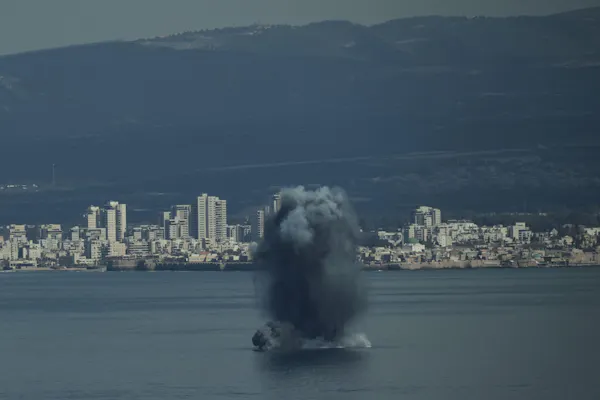
An incoming missile crashes into the sea off the port of Haifa in Israel as Iran retaliates. AP Photo/Leo Correa
The Iraq invasion should be a cautionary tale. The US spent more than a decade cultivating multiple Iraqi opposition groups – yet dismantling the centralised state apparatus still produced chaos, insurgency and fragmentation. The vacuum gave rise to extremist organisations such as IS, drawing the US into years of renewed conflict.
Approaching Iran with similar assumptions ignores both its institutional resilience and the complexity of regional geopolitics. Sectarian divisions, entrenched alliances and proxy networks mean that destabilisation in Tehran would not remain contained. It could rapidly spill across borders and harden into prolonged confrontation.
A region wired for escalation
Iran has invested heavily in asymmetric capabilities precisely to deter and complicate external intervention. Its missile, drone and naval systems are embedded along the strait of Hormuz — a chokepoint for global energy — and linked into a network of regional allies and militias.
In the current escalation, Tehran has already launched retaliatory missile and drone strikes against US military bases and allied territories in the Gulf, hitting locations in Iraq, Bahrain, the United Arab Emirates (including Abu Dhabi), Kuwait and Qatar in direct response to US and Israeli strikes on Iran’s cities, including Tehran, Qom and Isfahan. Explosions have been reported in Bahrain and the UAE, with at least one confirmed fatality in Abu Dhabi, and several bases housing US personnel have been struck or targeted, underscoring how the conflict has already spread beyond Iran’s borders
A full-scale regional war is now more likely than it was a week ago. Miscalculation could draw multiple states into conflict, inflame sectarian fault lines and disrupt global energy markets. What might have remained a contained nuclear dispute now risks expanding into a wider geopolitical confrontation.
What about Trump’s promise of no more forever wars?
Trump built his political brand opposing “endless wars” and criticising the Iraq invasion. “America First” promised strategic restraint, hard bargaining and an aversion to open-ended intervention. Escalating militarily at the very moment diplomacy was advancing sits uneasily with that doctrine and revives questions about the true objectives of US strategy in the Middle East.
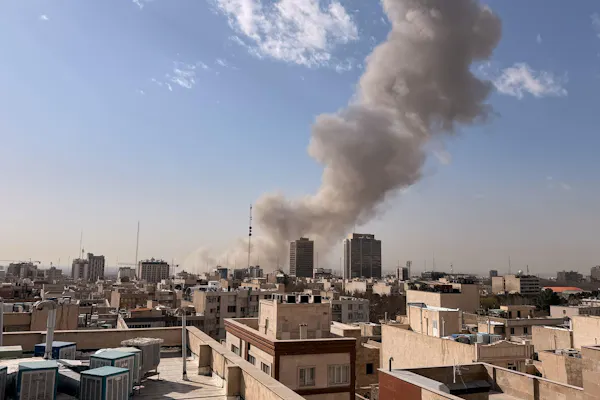
Tehran and other Iranian cities have come under heavy bombardment from Israel and the US. AP Photo
If a workable nuclear framework was genuinely emerging, abandoning it in favour of escalation invites a deeper question: does sustained tension serve certain strategic preferences more comfortably than durable peace?
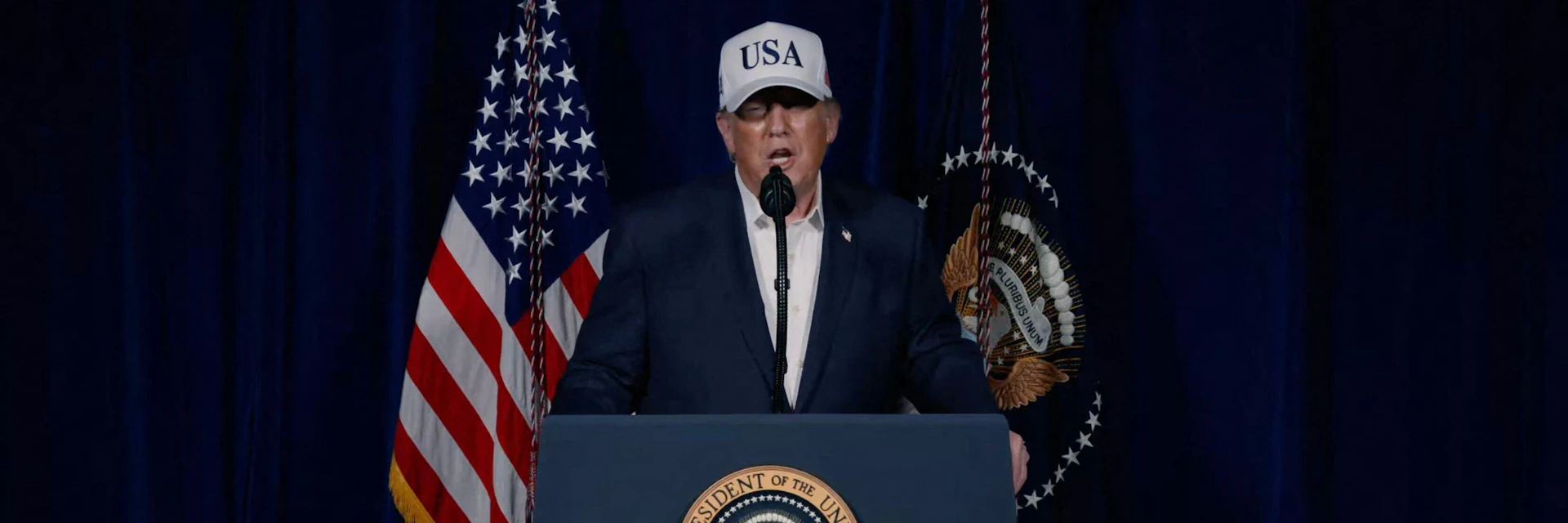
Trump’s Mar-a-Lago address announcing the strikes carried unmistakable echoes of George W. Bush before the 2003 invasion of Iraq. Military action was framed as reluctant yet necessary – a pre-emptive move to eliminate gathering threats and secure peace through strength. The rhetoric of patience exhausted and danger confronted before it fully materialises closely mirrors the language Bush used to justify the march into Baghdad.
The parallel extends beyond tone. Bush cast the Iraq war as liberation as well as disarmament, promising Iraqis freedom from dictatorship. Trump similarly urged Iranians to reclaim their country, implicitly linking force to regime change. In Iraq, that fusion of shock and salvation produced not swift democratic renewal but prolonged instability. The assumption that military force can reorder political systems from the outside has already been tested – and its costs remain visible.
The central challenge now facing the US is not simply Iran’s military capability. It is credibility. Abandoning negotiations mid-course signals that diplomacy can be overridden by force even when progress is visible. That perception will resonate far beyond Tehran.
Peace was never guaranteed. It was limited and imperfect, focused primarily on nuclear constraints rather than human rights or regional proxy networks. But it was plausible – and closer than many assumed. Breaking the bridge while building it does more than halt a single agreement – it risks convincing both sides that negotiation itself is futile.
In that world, trust erodes, deterrence hardens and aggression – not agreement – becomes the default language of international power. What we are witnessing is yet another clear indication that the rules-based order has been consigned to the history books.
This work by Middle East Monitor is licensed under a Creative Commons Attribution-NonCommercial-ShareAlike 4.0 International License.
Israeli authorities prevent Palestinians from entering Jerusalem from the West Bank to perform the first Friday prayers of Ramadan at Al-Aqsa Mosque in East Jerusalem, on February 20, 2026. [Issam Rimawi – Anadolu Agency]
Israeli forces on Sunday evening forced worshippers out of a mosque in the Old City of occupied East Jerusalem and prevented them from performing the Isha and Taraweeh prayers.
Local sources said troops entered Sheikh Lulu Mosque shortly before the call to the Isha prayer and forced worshipers to leave the place, and prevented prayers, including Tarawih prayers, in what was described as part of ongoing restrictions on places of worship.
The incident came as Al-Aqsa Mosque remained closed for a second consecutive day under what authorities described as a state of emergency. Strict closures were also imposed on the Old City and its entrances.
Since Saturday evening, Israeli authorities have completely shut Al-Aqsa Mosque and forced worshippers to leave immediately, citing the declaration of a state of emergency following Israel’s attack on Iran. The measures have further tightened restrictions on freedom of worship and movement in the city.
Genocide denier and Current UK Prime Minister Keir Starmer is quoted that he supports Zionism without qualification. He also confirms that UK air force support has been essential in Israel’s mass-murdering genocide. Includes URLs https://www.declassifieduk.org/keir-starmers-100-spy-flights-over-gaza-in-support-of-israel/ and https://youtu.be/O74hZCKKdpAKeir Starmer objects to criticism of the IDF. He asks how could anyone object to them starving people to death, forced marches like the Nazis did, bombing Gaza’s hospitals and universities, mass-murdering journalists, healthworkers and starving people queuing for food, killing and raping prisoners and murdering children. He calls for people to stop obstructing his genocide for Israel.Orcas discuss Genocide-supporting and complicit Zionists. Donald Trump, Keith Starmer, David Lammy, Rachel Reeves, Angela Rayner and Wes Streeting are acknowledged as evil genocide-complicit and supporting cnuts.