‘We’ve got to have clean, homegrown power that we control’

Spread the love

https://morningstaronline.co.uk/article/weve-got-have-clean-homegrown-power-we-control

People dispense fuel at the pump at Costco Petrol Station in West Thurrock, Essex. The conflict in Iran has caused a surge in oil and gas prices, March 5, 2026

Campaigners warn soaring oil and gas prices are pushing households into another cost-of-living crisis

TEN straight days of high oil and gas prices are pushing households into another cost-of-living crisis, campaigners warned today, as costs suffered from the US-Israel attack on Iran.

The warning came as Chancellor Rachel Reeves said she had asked the competition watchdog to “crack down” on “rip-off” fuel prices ahead of a meeting with energy bosses to warn against war profiteering.

Ms Reeves insisted she “will not tolerate” firms exploiting uncertainty in the Middle East for excess financial gain.

The government has promised to intervene if companies engage in “unfair” practices that would hit customers facing a rise in the price of home heating oil, which is not covered by Ofgem’s energy price cap.

Rural communities which rely on oil to heat their homes are already being hit hard, according to charity Rural Action Derbyshire (RAD), which runs an oil-buying scheme.

The heating oil market is closely connected to the daily market for jet fuel, meaning price rises are typically passed directly to customers.

RAD said homes in Derbyshire saw the cost of 500 litres jump from around £300 to £700-800 in the week after the conflict.

For an average household, 500 litres lasts two to three months.

Article continues at https://morningstaronline.co.uk/article/weve-got-have-clean-homegrown-power-we-control

Continue Reading‘We’ve got to have clean, homegrown power that we control’

Israel-US and Iran War: A geostrategic transformation

Spread the love

This work by Middle East Monitor is licensed under a Creative Commons Attribution-NonCommercial-ShareAlike 4.0 International License

U.S. Navy warplane takes off from the aircraft carrier USS Abraham Lincoln during Operation Epic Fury targeting Iran in the Gulf of Oman, on March 01, 2026. [U.S. Navy / Handout – Anadolu Agency]

by Dr Zakir Hussain

After the 12-day war in May last year, it was clear that both sides would be face-to-face soon. They restarted on 28th February 2026. Israel-US adopted the same pattern of targeting the top brass, including the Grand Leader, Ayatollah Ali Khamenei, on the very first day, thinking that in the absence of these officials, the Iranian administration would be like a rudderless ship. This would create confusion and provide an easy opportunity for regime change.

Thirteen days have passed, yet there are no visible signs of either the fall of the regime or a pause or ceasefire. Despite US-Israel’s anguish, Iran selected Mojtaba Khamenei as the new supreme leader – an act of defiance.

Both sides continue to bombard each other’s vital infrastructure, including civilian and military targets. Energy installations such as oil depots and refineries have become primary targets. Under a tit-for-tat policy, Iran has also declared that financial centers, banks, and offices of major technology companies such as Google, YouTube, and Microsoft could be the next targets. Already 26 US bases have been targeted. Following the assassination of Ayatollah Ali Khamenei, the conflict rapidly expanded from a limited confrontation into a regional war, and with the blockade of the Strait of Hormuz, its effects are now visible in the global economy and in the daily lives of ordinary people. Approximately 130 oil ships are anchored, stopping 20% oil which passes through the narrow strait of 33 km. Already four ships were targeted which tried to bypass the warning.

Among the GCC countries, the UAE faced the highest number of attacks.

Iran’s aggressive response and selection of Mojtaba, a hardliner, as Ayatollah, appear to indicate that Iran is prepared for a prolonged conflict, whereas the United States and Israel seem eager to conclude the war quickly. Meanwhile, President Trump’s plan to send Kurdish Peshmerga into Iran via Iraq seems like another disaster.

READ: Trump says US ‘ahead of schedule’ in Iran war, claims most missiles destroyed

Tehran had been closely and patiently observing military buildups in the Indian Ocean, the Gulf of Oman, and the Mediterranean Sea for several weeks. The United States mobilized a substantial part of its defence capabilities, including naval armadas and two aircraft carriers, Abraham Lincoln and Gerald Ford. Hundreds of fifth-generation stealth fighter jets were deployed along with advanced air-defence systems such as THAAD and large stockpiles of interceptors.

In addition, the United States strengthened its military presence across several bases in the Gulf region, including Qatar, Bahrain, Oman, the United Arab Emirates, Kuwait, Saudi Arabia, Jordan, and Iraq.

Israel also appeared determined to launch what it described as a “fight-to-the-finish” war with the Islamic Republic. Prime Minister Benjamin Netanyahu repeatedly stated that he had been waiting for such a war for nearly forty years. Iran, on the other hand, has long maintained that it began preparing for such a scenario after the 2003 US-led invasion of Iraq and the fall of Saddam Hussein.

The earlier conflict in May had already revealed the strengths and weaknesses of both sides. However, the current course of the war suggests that the US–Israel alliance underestimated Iran’s military capabilities, particularly its missile and drone systems, careful planning, and effective use of its military resources.

Compared with the US–Israel alliance, Tehran appears to possess a clearer understanding of its adversaries’ strengths, limitations, and operational constraints.

Iran was also aware of its own limitations. Its air force cannot match the capabilities of US and Israeli fighter jets, and its airspace remains vulnerable to aerial attacks. As the conflict expanded, these vulnerabilities became evident. At the same time, the United States and Israel appeared to have an incomplete assessment of Iran’s capabilities. Although they possessed precise intelligence about the locations of Iranian leaders and senior officials—they killed several commanders and Ayatollah Ali Khamenei-they appeared to lack detailed knowledge of Iran’s missile infrastructure, drone networks, and underground silos developed over several decades.

It also appears that the US–Israel side underestimated the possibility of indirect assistance from Russia and China, relying heavily instead on air superiority and defensive shield systems.

Iran’s war strategy

A detailed military assessment would require expert analysis, but developments in the conflict suggest that Iran followed a three-stage strategy.

First, Iran responded to the US-Israel attacks by deploying large numbers of drones, many reportedly stored since 2011 and 2013. These drones forced US–Israel defence systems to respond with expensive interceptors. In financial terms, this created an asymmetric dynamic: Iranian drones costing between $20,000 and $50,000 were intercepted by missiles costing between $1 million and $2 million. As the wave of drone attacks continued, interceptor stocks began to decline, gradually exposing the airspace of US bases and Israel to greater risk.

Second, once defensive systems were strained, Iran launched more advanced missiles targeting radar installations, communication centres, satellites, and data facilities. Reports indicate damage to communication and data infrastructure at the Al Udeid Air Base in Qatar and at military installations in Bahrain. Such attacks disrupted surveillance and communication systems that coordinate missile defence networks such as THAAD, David’s Sling, Arrow, and Iron Dome. Command and monitoring centres that once gathered and transmitted military data across thousands of kilometres became severely limited in their operations.

Third,

Iran escalated its attacks using hypersonic missiles while adopting a tit-for-tat strategy. These strikes targeted refineries, military bases, and strategic infrastructure in Israel. Some reports suggest the use of the Khorramshahr-1 missile equipped with submunitions capable of dispersing dozens of warheads over a wide area, complicating interception efforts.

Meanwhile, attacks on naval assets reportedly forced aircraft carriers operating in the Gulf of Oman to reposition farther from the Iranian coastline.

READ: Two weeks in, Iran strikes inflict nearly $4B in US military losses

Hormuz blockade and its impact

After weakening regional defence systems, Iran announced a blockade of the Strait of Hormuz. This strait is one of the world’s most critical energy corridors, through which roughly 20 percent of global crude oil and a similar share of liquefied natural gas passes.

At present, around 130 oil tankers are reportedly anchored in the strait. Iran claims effective control over the Hormuz chokepoint.

It has targeted four vessels, including one linked to India, that attempted to pass through. Iran has reportedly deployed underwater tunnels and small, agile boats to intercept or attack ships that violate the blockade.

At the same time, attacks on energy facilities in Saudi Arabia and the temporary closure of Qatar’s Ras Laffan gas facilities disrupted global energy supplies. As a result, gas prices in Europe rose sharply while crude oil prices increased from about $62 per barrel to more than $100. Some analysts warn that if the conflict continues, oil prices could rise further, potentially reaching $200 per barrel. Such developments could trigger inflation, supply-chain disruptions, and rising unemployment worldwide.

Future of the War

Iran appears determined to pursue its objectives and may not halt operations even if a ceasefire is proposed by the United States or Israel. The selection of Mojtaba Khamenei as the new supreme authority signals continuity of leadership, consolidation of political control, and a claim of legitimacy within the existing system.

Large public gatherings during funeral processions and demonstrations suggest that, at least during wartime, sections of the population have rallied around the leadership.

Reports have also mentioned proposals to deploy Kurdish Peshmerga forces into Iran through Iraq. However, the region’s history suggests that such operations would face significant geographical and logistical difficulties. During the Iran–Iraq War, Saddam Hussein also attempted to advance through the mountainous terrain of the Zagros region but faced serious constraints.

Some Iranian sources have claimed the capture of US special forces personnel and the killing of several Israeli officials during the conflict, although many of these claims remain difficult to verify independently.

Chances of a Ceasefire

Iranian authorities have reportedly outlined three conditions for a ceasefire. First, all military attacks by the United States and Israel must stop immediately. Second, Tehran seeks assurances that such attacks will not be repeated in the future. Third, Iran demands recognition of its sovereignty and compensation for damages caused during the conflict. These conditions are not easy. Who will ensure that the U.S. and Israel would not attack in the future? Second, who will pay the reconstruction cost, etc.? It is true that regional problems can be resolved only when the issue of Palestine is resolved in a fair and just manner. Lebanon and Yemen, Syria also need attention.

Future Trajectory-Palestine solution is the only solution

Even if the present war stops, regional stability will remain uncertain. Long-standing political and security disputes remain unresolved. Israel is unlikely to abandon its strategic objectives, Greater Israel, while tensions involving Hezbollah and Hamas are likely to persist. The United States may also increase pressure on Gulf states to revise their security arrangements so that regional partners become more directly involved in future conflicts.

Implications for India

For India, energy security remains a major concern. Disruptions in the Strait of Hormuz could affect oil supplies and trade routes. Approximately 50% oil passes through the route, while Houthis are there to choke off the Red Sea navigation. 

India must also prepare contingency plans for the evacuation of its 9 million workers from the region and strengthen logistical arrangements to safeguard trade and shipping routes in the event of prolonged instability. Chemical fertilizers are another major concern for India. The region provides the bulk of fertilizers and ensures food security. Disruption in supply line has significantly affected the supply of fresh vegetables, perishable items including agriproducts , poultry and meat products 

In the long term, India is to sign a long term energy agreement with the US. At the same time, India needs a more coherent West Asia policy and must avoid being drawn into the region’s strategic conflicts. The region is sensitive as well as vital to India’s economy and geostrategy. India needs a careful policy.

OPINION: Iran is not Venezuela: Gen-Z would fail to defeat diehard ayatollahs

The views expressed in this article belong to the author and do not necessarily reflect the editorial policy of Middle East Monitor.

This work by Middle East Monitor is licensed under a Creative Commons Attribution-NonCommercial-ShareAlike 4.0 International License

Climate science denier Donald Trump says that more liquid gold is being secured according to his policy of global privateering
Donald Trump explains why he established his Bored of Peace
Donald Trump warns against following the https://onaquietday.org blog, says that it's easy atm, she only needs to report war crimes supporting Israel's genocidal expansion.
Donald Trump warns against following the https://onaquietday.org blog, says that it’s easy atm, she only needs to report war crimes supporting Israel’s genocidal expansion.
Continue ReadingIsrael-US and Iran War: A geostrategic transformation

The economics behind wars

Spread the love

This work by Middle East Monitor is licensed under a Creative Commons Attribution-NonCommercial-ShareAlike 4.0 International License

People take part in a protest and march gathering at Times Square on Al-Quds Day, to oppose the joint U.S.–Israel war on Iran in New York City, United States on March 13, 2026. [Mostafa Bassim – Anadolu Agency]

by Muhammad Bilal Malik

War is not a violation of the international order. For a select few, it is the international order working exactly as intended; a machine that converts human suffering into corporate profit, political advantage, and generational wealth. The bombs that fall are not random. They are a calculated strategy, and behind every calculation sits a balance sheet.

In 2024, the world’s top 100 arms manufacturers generated a combined $679 billion in revenue; the highest figure ever recorded in human history. American firms alone accounted for $334 billion of that total. That wealth was not created in a vacuum. It was built, contract by contract, on the rubble of Ukraine, Gaza, Lebanon, and now Iran.

When Russia invaded Ukraine in February 2022, geopolitical tensions surged and a war of survival began on both sides. Ukraine rushed westward, particularly toward the United States, for aid and military hardware. What followed was framed publicly as an act of solidarity. What it actually triggered was one of the most profitable procurement cycles in modern American history.

Raytheon’s CEO Gregory Hayes stood before investors shortly after the invasion and declared the conflict would be “very, very good” for the company’s bottom line. He was not speculating. He was reading the market. Raytheon reported a record $180 billion order backlog in the months that followed. Lockheed Martin posted net earnings of $6.9 billion in 2023; a 21 per cent increase over the previous year, while sitting on $160.6 billion worth of unfulfilled weapons contracts. The US arms export figure hit $200.8 billion in fiscal year 2024, up sharply from $157.5 billion the year before.

These are not incidental numbers. They are the architecture of a system; one that political philosopher Max Weber identified more than a century ago. In The Protestant Ethic and the Spirit of Capitalism, Weber argued that Protestant; particularly Calvinist theology provided capitalism with its moral foundation. Wealth, in this tradition, was not greed. It was divine confirmation. Accumulation was virtue. Profit was blessing.

That theological inheritance echoes loudly in the American defence industry today. A $6.9 billion profit is not merely a financial result. Within the cultural logic that shaped Western commerce, it is evidence of righteousness. And every missile fired is not a tragedy to these corporations. It is an invoice, one paid in human blood, invoiced to the taxpayer, and deposited into shareholder accounts.

READ: “Where are we supposed to go?” The road out of Dahiyeh and Lebanon’s forced evacuations

The mechanism that sustains this system is not secret. It operates in full public view, protected by its own normalisation. It is called the revolving door; the seamless rotation of senior personnel between the Pentagon, the US Congress, and the private defence industry.

A 2021 report by the Government Accountability Office found that 1,700 senior US government officials had moved into arms industry positions over just five years. Over 80 per cent of retired four-star generals and admirals went directly onto defence company boards or into lobbying roles, men who spent their careers making war decisions, now paid to ensure those decisions keep coming.

In 2023, Lockheed Martin deployed 65 lobbyists in Washington. 48 of them were former government insiders. The company spent $14 million on lobbying that year alone. Since 2001, the weapons industry has collectively spent more than $2.5 billion lobbying the US Congress; roughly 700 lobbyists per year whispering into the ears of the men who decide where American bombs fall next.

The men who vote for war and the men who profit from war are, with remarkable frequency, the same men. Or they were last year. Or they will be next year.

President Dwight D. Eisenhower understood this danger intimately. In his farewell address of January 1961, he warned the American public of what he called the military-industrial complex, an alliance between the defence industry and the military establishment that, left unchecked, would corrupt democratic governance and manufacture the conditions for permanent war. He was right. The warning went unheeded. The complex grew.

Now observe what is happening in real time because theory without evidence is merely opinion, and the evidence today is overwhelming.

In the final days of February and the opening days of March 2026, the United States and Israel launched nearly 900 strikes against Iran within a single 12-hour operational window. The US military is burning through an estimated $890 million to $1 billion per day in expenditure. Iran has retaliated with hundreds of ballistic missiles and over 2,000 drones targeting US bases and Israeli territory. More than 1,700 people have been killed in eleven days of exchanges.

Israel-US and Iran War: A geostrategic transformation

The economic consequences have rippled immediately across the globe. Oil prices crossed $100 per barrel for the first time since the Russia-Ukraine war. The Strait of Hormuz: the narrow chokepoint through which 20 per cent of the world’s oil supply passes is under direct threat of closure. LNG prices in Asia more than doubled in a single week after Qatar Energy declared force majeure at the world’s largest liquefaction facility. The Dow Jones Industrial Average lost over 1,000 points in a single session. Global food prices are climbing again, driven by supply chain disruption and fuel cost surges.

Civilians across Iran, Israel, Lebanon, and the Gulf are paying with their lives and livelihoods. And somewhere in Bethesda, Arlington, and the corridors of Capitol Hill, the shareholders are watching the numbers go up.

This is the economics of war in its most brutal form. One conflict. One superpower and its defence industry. One shared outcome, an entrenched elite that profits from permanent conflict, sustained by institutions too compromised, too invested, and too structurally captured to stop it.

The revolving door keeps spinning. The lobbying budgets keep growing. The order backlogs keep lengthening. And with every new conflict, every new theatre of war, every new headline about missiles and drones and civilian casualties, another procurement cycle begins.

The missiles point outward. The money flows inward, upward, always upward, toward the architects of the machine. And the machine, as long as it keeps paying, will never stop.

The views expressed in this article belong to the author and do not necessarily reflect the editorial policy of Middle East Monitor.

This work by Middle East Monitor is licensed under a Creative Commons Attribution-NonCommercial-ShareAlike 4.0 International License

Climate science denier Donald Trump says that more liquid gold is being secured according to his policy of global privateering
Donald Trump explains why he established his Bored of Peace
Donald Trump warns against following the https://onaquietday.org blog, says that it's easy atm, she only needs to report war crimes supporting Israel's genocidal expansion.
Donald Trump warns against following the https://onaquietday.org blog, says that it’s easy atm, she only needs to report war crimes supporting Israel’s genocidal expansion.
Continue ReadingThe economics behind wars

From Lebanon to Iran, Says Sanders, US Must End Complicity in ‘Netanyahu’s Wars’

Spread the love

Original article by republished from Common Dreams under Creative Commons (CC BY-NC-ND 3.0).

Smoke rises over Dahieh, a suburb of Beirut, Lebanon, following Israeli airstrikes on March 11, 2026. (Photo by Adri Salido/Getty Images)

“In less than two weeks, Israel has killed 570 people and displaced 750,000—over 10% of the entire country,” the senator said of Lebanon. “Residential buildings are being bombed with no warning.”

Just a day after tearing into US President Donald Trump and Israeli Prime Minister Benjamin Netanyahu for “unraveling international law, the Geneva Conventions, and the legitimacy of the United Nations” with their illegal war on Iran, Sen. Bernie Sanders stressed that “it’s not just Iran.”

“It’s Lebanon,” Sanders (I-Vt.) said on social media Wednesday. Since Trump and Netanyahu began bombing Iran a dozen days ago, Israel has also ramped up attacks against its northern neighbor—claiming to target the Lebanese political and paramilitary group Hezbollah—despite a November 2024 ceasefire deal.

RECOMMENDED…

Bernie Sanders Holds Town Hall On AI In Stanford

Sanders Rips Trump-Netanyahu for ‘Unraveling International Law’ With War on Iran

War on Iran ticker

‘The Behavior of Rogue States’: Global Revulsion as US and Israel Launch War on Iran

That agreement to protect the Lebanese people was struck just over a year into Israel’s retaliation for the October 2023 Hamas-led attack, which has also left the Gaza Strip in ruins. Despite the Lebanon truce, and another for Gaza reached this past October, Israeli forces have continued to slaughter civilians in both places.

In Lebanon, Sanders noted Wednesday, “in less than two weeks, Israel has killed 570 people and displaced 750,000—over 10% of the entire country. Residential buildings are being bombed with no warning.”

“The US cannot continue to be complicit in Netanyahu’s wars,” declared the senator. His comments came after the White House tried to walk back Secretary of State Marco Rubio’s suggestion last week that Trump followed the Israeli prime minister’s lead on Iran.

Sanders has also criticized and even attempted to curb US complicity in Netanyahu’s genocidal assault on Palestinians in Gaza—under the Biden and Trump administrations—by forcing unsuccessful votes to cut off some weapons to Israel.

The Israeli government has used the operation against Iran—which experts argue violates the US Constitution and UN Charter—to again cut off necessary humanitarian aid to Gaza, claiming last week that “the existing stock is expected to suffice for an extended period.”

Philippe Lazzarini, commissioner-general of the United Nations Relief and Works Agency for Palestine Refugees in the Near East, called the move “a new chokehold on Gaza,” adding that “after more than two years of unspeakable suffering and a spreading man-made famine, people still lack the most basic supplies, despite increases in aid since the ceasefire.

As for Lebanon, Axios reported Monday that “the Lebanese government proposed direct negotiations with Israel—through the Trump administration—aimed at ending the war and reaching a peace agreement.”

However, the Financial Times reported Tuesday that “Israel has rejected diplomatic overtures by Lebanon,” with one unnamed source saying that the Lebanese “are ready to talk to Israel, but under the condition of a cessation of fire. Not a ceasefire, but a cessation… so talks can get going in Cyprus.”

“Israel has so far refused and says it will only negotiate ‘under fire,’” according to that unnamed source.

Trump’s ambassador to the United Nations, Mike Waltz, made US support for Israel’s bombing of Lebanon clear in his Wednesday remarks to the UN Security Council.

“The United States condemns the attacks that Hezbollah, a long-time proxy of the Iranian regime, has launched against Israel. Hezbollah has yet again made it clear that it does not represent nor does it defend the people of Lebanon. It defends the interests of the Iranian regime,” Waltz said, stressing Israel’s “right to defend itself.”

Waltz also welcomed the Lebanese Council of Ministers’ recent decision “to immediately prohibit Hezbollah’s military and security activities,” and declared that “now is the time for the government of Lebanon to take back control of the entirety of its country.”

Meanwhile, Tom Fletcher, United Nations under-secretary-general for humanitarian affairs and emergency relief coordinator, noted to the Security Council that UN Secretary-General António Guterres “has insisted… we need the protection of civilians, de-escalation, an immediate cessation of hostilities, and genuine dialogue and negotiations towards a peaceful settlement, in line with the charter.”

Fletcher concluded his comments at the briefing on Lebanon with calls for the protection of “all civilians throughout the region,” “generous funding for a principled, scaled-up humanitarian response,” and “a revival of strategic, calm, rational, hopeful diplomacy.”

“Lebanon is exhausted by other people’s wars,” he said. “It is not asking for help, but for oxygen. Its people can defy the history, the geography, even the politics. They can be stronger than the forces pulling them apart. But they can only do that if Iran and Israel stop fighting their war in Lebanon.”

Original article by republished from Common Dreams under Creative Commons (CC BY-NC-ND 3.0).

Keir Starmer explains that UK is participating defensively in Trump and Israel's criminal war for Israel's genocidal expansion in Iran and states that he supports Zionism "without qualification".
Keir Starmer explains that UK is participating defensively in Trump and Israel’s criminal war for Israel’s genocidal expansion in Iran and states that he supports Zionism “without qualification”. Starmer said it here:  https://www.jewishnews.co.uk/keir-starmer-interview-i-will-work-to-eradicate-antisemitism-from-day-one/
Keir Starmer objects to criticism of the IDF. He asks how could anyone object to them starving people to death, forced marches like the Nazis did, bombing Gaza's hospitals and universities, mass-murdering journalists, healthworkers and starving people queuing for food, killing and raping prisoners and murdering children. He calls for people to stop obstructing his genocide for Israel.
Keir Starmer objects to criticism of the IDF. He asks how could anyone object to them starving people to death, forced marches like the Nazis did, bombing Gaza’s hospitals and universities, mass-murdering journalists, healthworkers and starving people queuing for food, killing and raping prisoners and murdering children. He calls for people to stop obstructing his genocide for Israel.
Orcas discuss Genocide-supporting and complicit Zionists. Donald Trump, Keith Starmer, David Lammy, Rachel Reeves, Angela Rayner and Wes Streeting are acknowledged as evil genocide-complicit and supporting cnuts.

Continue ReadingFrom Lebanon to Iran, Says Sanders, US Must End Complicity in ‘Netanyahu’s Wars’

Sanders Rips Trump-Netanyahu for ‘Unraveling International Law’ With War on Iran

Spread the love

Original article by Jessica Corbett republished from Common Dreams under Creative Commons (CC BY-NC-ND 3.0). 

Sen. Bernie Sanders (I-Vt.) speaks at a town hall event on February 20, 2026 in Stanford, California. (Photo by Benjamin Fanjoy/Getty Images)

As evidence of US war crimes mounts, critics around the world argue that “Trump and Hegseth should be sent straight to The Hague to face prosecution.”

As President Donald Trump on Tuesday made what one critic called “the most blasé admission of a war crime by a US president in history,” claiming the Navy sunk an Iranian ship and killed over 100 sailors because it was “more fun” than capturing both, Sen. Bernie Sanders tore into him and Israeli Prime Minister Benjamin Netanyahu over their illegal war on Iran.

“The attacks on Iran by the United States and Israel are unraveling international law, the Geneva Conventions, and the legitimacy of the United Nations. This is extremely dangerous for the future of the planet and humanity,” Sanders (I-Vt.) said in a statement.

RECOMMENDED…

President Donald Trump oversees Iran assault

Experts Pillory Trump Case for War on Iran: ‘Flimsiest Excuse for Initiating a Major Attack’ in Decades

War on Iran ticker

‘The Behavior of Rogue States’: Global Revulsion as US and Israel Launch War on Iran

While both the Republican-controlled Senate and House of Representatives have refused to pass a war powers resolution to stop the assault, experts worldwide have argued the assault violates the US Constitution, which gives Congress the authority to declare war, and UN Charter, which prohibits the use of force against another state unless it is a “necessary and proportionate” act of self-defense or is authorized by the Security Council.

“If the United States and Israel have the right to launch a unilateral attack against Iran, what is the moral or legal argument against China invading Taiwan, Russia attacking Poland, or North Korea launching missiles into South Korea? There is none,” warned Sanders, who has supported war powers resolutions on Iran, Venezuela, and the president’s boat bombing campaign. “In Trump’s world, any nation has the ‘right’ to go to war against any other nation for any reason.”

“After the horrors of World War II, the international community came together to establish international law—a system of rules designed to prevent aggressive wars and hold nations accountable for violating basic human rights,” said the senator, whose father lost relatives in the Holocaust. “Trump and Netanyahu are destroying that effort and are pushing the global community back into international anarchy—a world that produced 10 million dead in World War I and 50 million dead in World War II.”

Sanders argued that “we cannot go back to a world where might makes right—where any nation can invade, bomb, or destabilize another country for any reason they choose. That mentality leaves all of us, and future generations, increasingly unsafe.”

In addition to opposing Trump’s violence at home and abroad, the senator has railed against US complicity in Netanyahu’s genocidal assault on the Gaza Strip, where the death toll continues to rise despite an October ceasefire deal. He even forced multiple unsuccessful Senate votes to cut off some US weapons to Israel over the bloodshed in the Palestinian territory.

Netanyahu not only bombed and starved the Palestinians of Gaza after the Hamas-led October 2023 attack on Israel, he also bombarded Lebanon, claiming to target Hezbollah. While a ceasefire agreement to protect the Lebanese people was reached in November 2024, Israel has returned to attacking the country since launching the assault on Iran last month.

More than 1,300 Iranians are now dead, including multiple political leaders as well as around 175 people, mostly children, killed in what increasingly appears to have been a US strike on a girls’ elementary school in Minab. US Defense Secretary Pete Hegseth told reporters that Tuesday would “be yet again our most intense day of strikes inside Iran.”

Meanwhile, Jostein Hauge, an assistant professor at the UK’s University of Cambridge, noted on social media Tuesday that “the Minab school massacre in Iran—carried out by the US government—is one of the deadliest school massacres in modern history.”

He put the US president and Pentagon chief in a class with not only Netanyahu but also former Israeli Defense Minister Yoav Gallant, Russian President Vladimir Putin, and former Sudanese President Omar al-Bashir, who are all wanted by the Hague-based International Criminal Court.

“Trump and Hegseth should be sent straight to The Hague to face prosecution for war crimes, alongside Netanyahu, Gallant, Putin, and al-Bashir,” Hauge said.

While the American public is already enduring some economic fallout of Trump’s war on Iran, at least seven US troops have paid with their lives. Eight more “remain listed as severely injured,” according to chief Pentagon spokesperson Sean Parnell. “Since the start of Operation Epic Fury, approximately 140 US service members have been wounded over 10 days of sustained attacks.”

Democratic Sens. Tammy Baldwin (Wis.), Cory Booker (NJ), Tammy Duckworth (Ill.), Tim Kaine (Va.), Chris Murphy (Conn.), and Adam Schiff (Calif.)—with whom Sanders caucuses—have launched a renewed effort to force new votes on war powers resolutions if Senate Majority Leader John Thune (R-SD) refuses to hold committee hearings on Iran.

“Now is the time for Democrats to use all the leverage we have to try to stop this unnecessary war,” they said Monday in a joint statement to Semafor. The senators added that Hegseth and Secretary of State Marco Rubio “must immediately come before Congress for a public hearing and explain why we’re in this war, how it will end, and why they are prioritizing billions of dollars on an open-ended war instead of lowering costs for American families.”

Original article by Jessica Corbett republished from Common Dreams under Creative Commons (CC BY-NC-ND 3.0). 

Keir Starmer explains that UK is participating defensively in Trump and Israel's criminal war for Israel's genocidal expansion in Iran and states that he supports Zionism "without qualification".
Keir Starmer explains that UK is participating defensively in Trump and Israel’s criminal war for Israel’s genocidal expansion in Iran and states that he supports Zionism “without qualification”. Starmer said it here:  https://www.jewishnews.co.uk/keir-starmer-interview-i-will-work-to-eradicate-antisemitism-from-day-one/
Donald Trump explains why he established his Bored of Peace
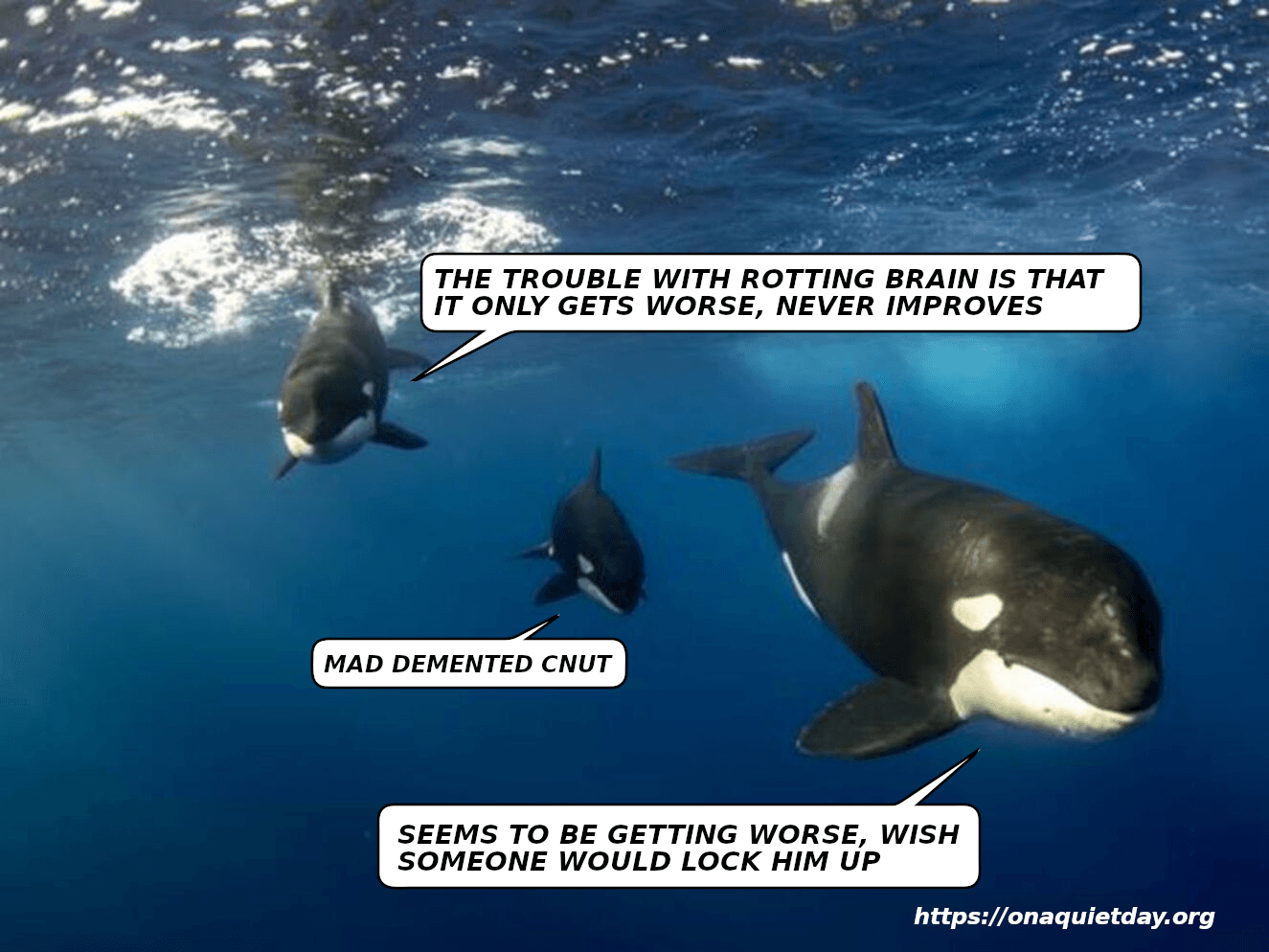
Orcas discuss rotting brain. Front Orca says "Wish someone would lock him up".
Orcas discuss rotting brain. Front Orca says “Wish someone would lock him up”.

From Your Site Articles

Continue ReadingSanders Rips Trump-Netanyahu for ‘Unraveling International Law’ With War on Iran