There are far better ways to tackle climate breakdown, but successive governments have chosen to listen to the fossil fuel companies instead
The new prime minister will be looking for money? Well, here’s £21.7bn lying on the ground. The government could cancel its deranged, disastrous carbon capture and storage (CCS) programme at no cost to public welfare: in fact, it would greatly reduce the harm we will suffer.
[N]ew CCS plants will mean massively more gas use than the UK would otherwise have required. Ultimately, that means more imports of liquefied natural gas (LNG). We now know that, thanks to methane leakage along the production and transport chain, LNG has higher emissions than coal. Two-thirds of its greenhouse impact occurs before the gas arrives in this country. So that’s all right then – it doesn’t count towards our national figures.
If the real aim were to cut emissions, we would push fossil fuel use in the electricity sector down to zero, and scale up renewables and battery storage instead. The net effect? Much lower climate impacts and much lower bills. Instead, the programme will greatly ramp up both. Why?
Well, the whole thing has been built the wrong way round. It appears likely to be the result of massive lobbying by fossil fuel companies. In 2023 alone, as the key decision on deployment loomed, the oil companies Equinor, BP and ExxonMobil attended 24 meetings with Conservative ministers to discuss CCS. Why? Because they know it’s the only way they will be permitted to keep burning gas. Governments have sought to find a way of meeting their demands while adhering to the climate budgets, so lo, a £264bn white elephant is born. As the Climate Change Committee admits, “gas with CCS accounts for around half of the remaining demand for fossil fuels in 2050” in the UK. In other words, this is their lifeline.
Neo-Fascist Climate Science Denier Donald Trump says Burn, Baby, Burn.Nigel Farage urges you to ignore facts and reality and be a climate science denier like him and his Deputy Richard Tice. He says that Reform UK has received £Millions and £Millions from the fossil fuel industry to promote climate denial and destroy the planet.Elon Musk urges you to be a Fascist like him, says that you can ignore facts and reality then.
dizzy: Carbon Capture and Storage (CCS) should be regarded as a fossil fuel subsidy.
The government has been accused of making a “secret exchange deal” with fossil fuel firms to compensate for the tax hike.
Chancellor Rachel Reeves told a fossil fuel giant that the industry would receive a “quid pro quo” in return for higher taxes on its windfall profits, DeSmog can reveal.
In a meeting with the Norwegian state energy company Equinor on 27 August last year, Reeves suggested that the government’s carbon capture, utilisation and storage (CCUS) subsidies were a payoff for oil firms being hit with a higher tax rate.
Minutes of the meeting obtained by DeSmog state that Equinor CEO Anders Opedal raised concerns over the Energy Profits Levy – also known as the “windfall tax” – and “its impact on the value” of Equinor’s UK portfolio.
In response, Reeves said that raising the windfall tax from 35 percent to 38 percent was a “manifesto commitment”, but stated that “Equinor should recognise the quid pro quo – the funds raised enable government investment in CCUS etc.”.
CCUS is the controversial practice of trapping the emissions produced by fossil fuel plants before they enter the atmosphere.
The technology is accused of being a favourite climate “solution” of the fossil fuel industry since it allows for the continued extraction of oil and gas. Experts have also suggested that the technology is not economically viable at scale.
The Labour government announced in October that it would provide £22 billion in subsidies to CCUS projects over 25 years following a surge in lobbying by the fossil fuel industry, as revealed by DeSmog.
Green Party co-leader Carla Denyer MP claimed that Reeves and the Labour government had been “caught out making promises in a secret exchange deal which goes against the interests of the British people”.
Denyer added: “In public they claim to be taxing fossil fuel giants more fairly by raising the windfall tax, but behind closed doors they are giving back with dodgy deals to allow the fossil fuel corporates to continue with business as usual under the guise of CCUS – an expensive distraction and largely unproven technology.”
An Equinor spokesperson said: “Government regularly meets with companies like Equinor. This is standard and necessary practice. As with any official meeting, minutes were taken of the conversation between the chancellor and Equinor CEO as a public record of what was said and readily available via a Freedom of Information request.”
Equinor is one of the principal firms investing in the UK’s CCUS sector. In December, the government signed deals with Equinor, BP, and TotalEnergies to develop carbon capture facilities in Teesside. This will involve the development of the Net Zero Teesside Power plant, which will be 25 percent owned by Equinor and aims to be the world’s first gas-fired power station featuring CCUS.
Earlier this year, following a DeSmog investigation, Equinor retracted the claim that it stores 1 million tonnes of carbon dioxide annually at its flagship carbon capture project in the North Sea. Equinor has not captured 1 million tonnes of CO2 per year at the site since 2001, and only captured a tenth of that figure in 2023.
The firm made an $28.7 billion (£21.2 billion) post-tax profit in 2022 after Russia’s invasion of Ukraine triggered higher oil and gas prices – a figure that stood at $8.8 billion (£6.6 billion) in 2024.
Tessa Khan, executive director of the campaign group Uplift, said: “Oil companies, like Equinor, have held sway over successive UK governments, for years shaping policies to benefit their bottom line and slowing down climate action. This Labour government must stand up to them and put our needs – for affordable clean energy and a safe climate that we can pass on to our children – ahead of their insatiable need to profit.”
The House of Commons’ Public Accounts Committee (PAC) – which scrutinises government spending decisions – released a report in February describing the UK’s CCUS subsidies as “risky”.
The report noted that the government has downgraded its ambitions for CCUS storage, scrapping its previous commitment of storing 20 to 30 million tonnes annually by 2030. It also highlighted that the UK’s new CCUS projects don’t allow the government to share any potential profits or for local consumers to benefit from lower energy bills.
The committee also reported that producing liquid natural gas, which will be used in the UK’s CCUS projects, leaks more greenhouse gases into the atmosphere than previously thought.
“This could undermine the rationale for pursuing certain schemes,” the report said.
After being sued by environmental consultant Andrew Boswell over the Net Zero Teesside scheme, the previous Conservative government admitted that it had not taken into account the plant’s full potential emissions, which Boswell estimated could reach more than 20.3 million tonnes during its lifetime.
In summer 2024, a judge rejected Boswell’s case, which argued that officials did not fully explore the environmental impacts of the scheme before approving it. The government also won the appeal in May.
Boswell, who leads the Scrap Carbon Capture campaign, called Reeves’ Equinor meeting “an outrageous spectacle”.
“She begs Norway’s oil colossus to tax its huge profits, and then gifts it with far more in return – many billions over decades for climate-wrecking CCUS.”
Equinor and Shell have formed a joint venture to become the UK’s largest North Sea fossil fuel producer. In November, the government admitted that it had unlawfully approved the development of the country’s largest untapped oilfield, Rosebank, which is operated by Equinor, by not taking into account the climate effects of burning the oil and gas extracted from the field. Equinor intends to re-apply for approval to develop the project.
The Labour government has been steadfast in its support for the UK achieving net zero emissions by 2050, with Prime Minister Keir Starmer stating that “home grown clean energy” is “in the DNA” of his administration.
The Climate Change Committee stated in its 2025 appraisal of the government’s net zero policies that the UK needs to scale up its CCUS capacity to 73 million tonnes a-year by 2050 to help meet its climate commitments.
“Investment in carbon capture and storage is a gamble on unproven technology,” said Lily-Rose Ellis, campaigner at Greenpeace UK. “All it does is give oil and gas giants carte blanche to continue causing planet destroying emissions in the hopes that one day they might be able to capture the carbon and store it for all of eternity. Public money should be spent on renewables which guarantee to lower emissions, bring bills down, and boost the economy with new jobs.”
“Equinor has been a reliable energy partner to the UK for over 40 years,” a company spokesperson said, “providing a stable supply of oil and gas, developing the UK’s offshore wind industry, and pioneering solutions to decarbonise the UK economy, including carbon capture and storage.
“Using our experience of decarbonising energy production in Norway, including safely storing carbon emissions under the North Sea for over 25 years, we are supporting the UK to develop its own home grown energy transition.”
A government spokesperson said: “We are delivering first of a kind carbon capture projects in the UK, supporting thousands of jobs across the country, reigniting industrial heartlands and tackling the climate crisis.
“Money raised from changes to the Energy Profits Levy made at the Autumn Budget last year support the transition to clean energy, enhance energy security and independence, provide sustainable jobs for the future, and help protect electricity bills against future price shocks”.
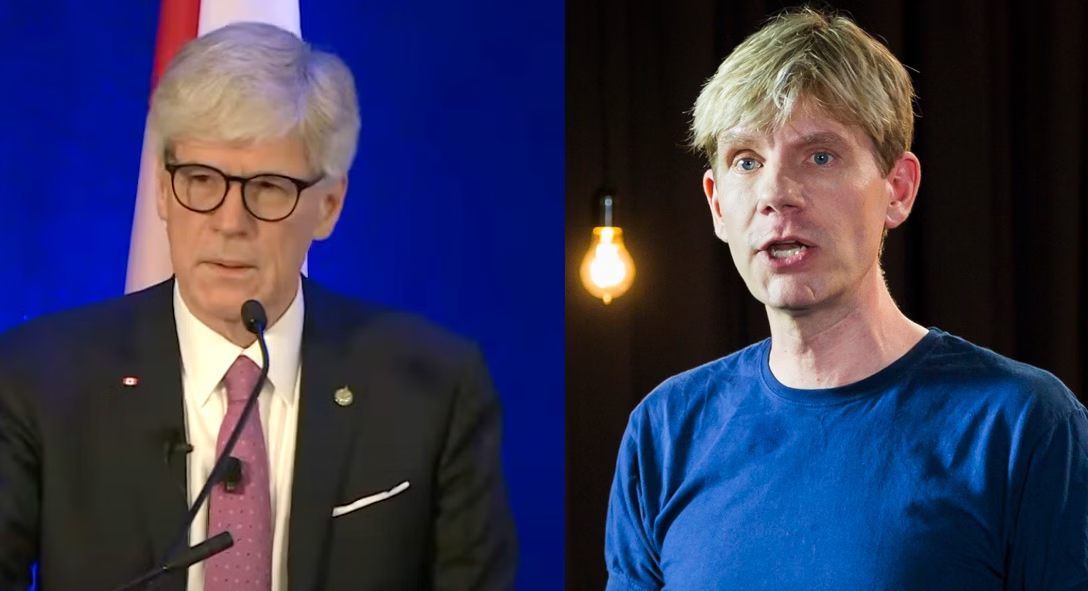
Canada Energy Minister Tim Hodgson (left) and climate crisis denier Bjorn Lomborg (right). Credit: Dan Lofton (CC BY-NC 2.0) and CPAC / YouTube
In audio obtained by DeSmog, Bjorn Lomborg told a Fraser Institute event in Vancouver that the technology is way too expensive to be viable.
Bjorn Lomborg has for years promoted the idea that fossil fuels are crucial for humankind through syndicated newspaper columns, best-selling books and appearances on TV shows including HBO’s Real Time with Bill Maher.
Yet the Danish political scientist — who acknowledges that climate change is real but denies that it’s a serious crisis — has a dim view of the oil and gas industry’s preferred solution to climate change: carbon capture and storage.
That technology is favored by Alberta premier Danielle Smith and Liberal energy minister Tim Hodgson, both of whom recently floated the idea of a “grand bargain” where Canada’s oil and gas industry gets approval for new pipelines in exchange for moving forward with a $16.5 billion carbon capture project.
It might seem that a prominent fossil fuel advocate like Lomborg would support technology loudly touted by major oil and gas producers and their political allies. But speaking at a private event last week in Vancouver, exclusive audio of which was obtained by DeSmog, Lomborg argued that “carbon capture will always be a net cost” to oil and gas producers and the taxpayers that subsidize it.
“In realistic terms, I don’t think it’s ever going to happen,” he added, referring to the prospect of prices for the technology coming down low enough that it can be rapidly and cost-efficiently deployed worldwide.
On that point Lomborg might actually be in agreement with climate policy experts who are also critical of carbon capture. “There’s a lot of federal money and provincial money that could be thrown at this thing,” Dave Sawyer, principal economist at the Canadian Climate Institute, recently told DeSmog. “We’ve been looking at this option for almost 20 years and it hasn’t happened.”
Speaking at the Fraser Institute
Lomborg was in the west coast Canadian city to speak at a private luncheon hosted by the Fraser Institute, a free-market organization with a long history of disputing the scientific reality of climate change that has received funding from the likes of Exxon and the charitable foundation of oil and gas billionaire Charles Koch.
It’s a leading member of Atlas Network, an influential coalition of more than 500 groups worldwide that promote free-market policies and whose partners in Canada have developed political strategies for fossil fuel expansion.
“Yes, global warming is real. It’s man-made, but it’s often also vastly exaggerated,” Lomborg claimed at the Fraser Institute luncheon, the same day that the United Nations warned that global temperatures were likely to breach the crucial warming threshold of 1.5 degrees within the next five years.
During the event he was asked for this thoughts about carbon capture, a technology that Canada’s largest oil and gas companies have for years argued is crucial for achieving “net zero” emissions in their operations.
Those companies, via an industry group called Pathways Alliance, are currently in talks with the federal and Alberta governments to build a multi-billion dollar carbon capture project in the heart of the Canadian oil sands which could be subsidized heavily by taxpayers.
“The problem is you need to store it underground,” Lomborg said, referring to the carbon dioxide captured by the technology. And to do that on a meaningful scale worldwide, he argued, “you have to build at least an infrastructure equivalent to the infrastructure that we built in the last hundred years for oil and gas. And remember back then, we did it because it was incredibly profitable. This time we would just have to pay for it.”
Current costs in Canada could be as high as $150 per tonne of CO2. Lomborg noted that for direct air capture projects — which Pathways Alliance is also proposing and involve sucking carbon emissions from the atmosphere — the costs could be as high as $600 per tonne. At those price points, widespread deployment is “not going to happen,” he said.
Growing rightwing backlash to CCS
Climate experts such as University of Pennsylvania scientist Michael Mann have for years argued that carbon capture and storage is a false solution to the climate crisis that allows oil and gas companies to suck up huge amounts of public money while continuing to pump fossil fuels. “It’s not a meaningful climate solution and it displaces meaningful climate solutions like clean energy, renewable energy,” he told a U.S. House panel in 2022.
But recently there has been growing backlash to the technology from conservatives and fossil fuel advocates, some of whom see it as an egregious government waste.
“We might as well take tax money at gunpoint and burn it,” Peterson, the conservative podcaster, wrote last year on X in response to a CCS project in Wyoming.
At Peterson’s ARC conference in London this February, the climate crisis denier Robert Bryce told DeSmog that carbon capture “will never work at scale.” He added, “Once you get that CO2 super-compressed and you’re pushing it down underground, there are very few places where you can actually sequester it. So it’s a lot of money wasted.”
That skepticism is now translating into federal U.S. policy, with Wright’s Department of Energy recently canceling $3.7 billion in decarbonization awards for carbon capture projects from Exxon and other fossil fuel producers.
Canada is still pushing ahead, however. Recently appointed Liberal energy minister Hodgson, a previous board member of oil and producer MEG Energy, said during a speech in Calgary in May that “All of us, governments and industry, need to get the Pathways [carbon capture] project done.”
During his Vancouver talk, Lomborg argued that the main reason oil and gas companies are pursuing such prohibitively expensive climate projects is so they can be generously supported by governments.
“What you can do is you can get a lot of subsidies,” he said.
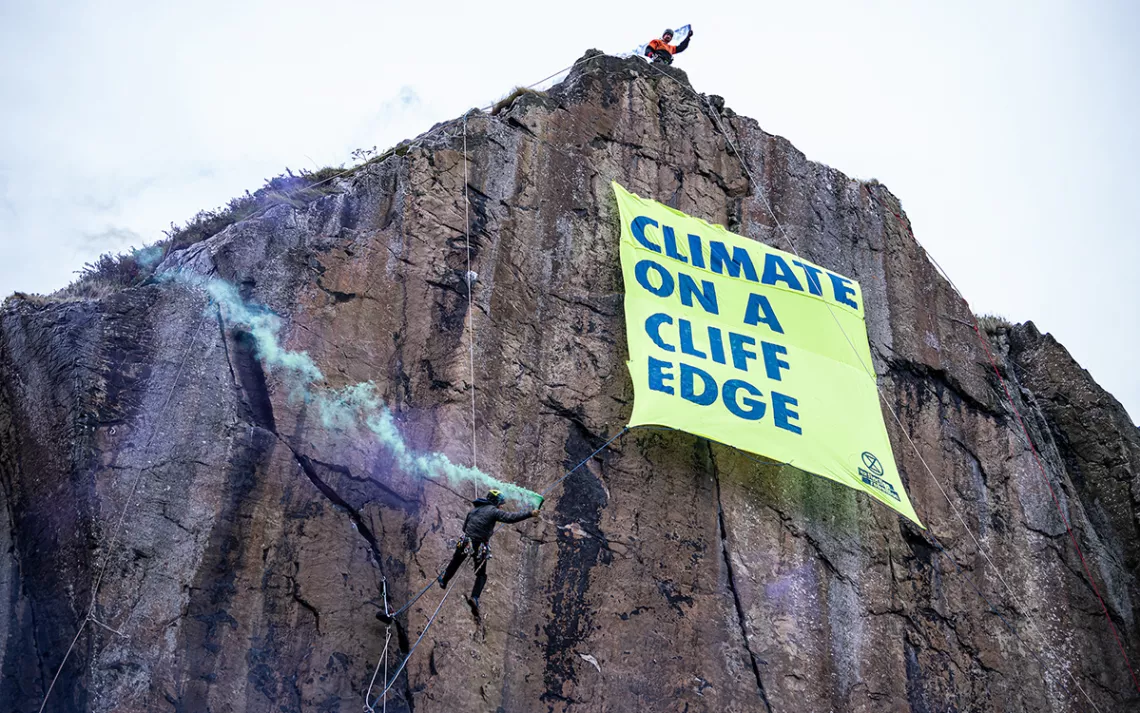
Experienced climbers scale a rock face near the historic Dumbarton castle in Glasgow, releasing a banner that reads “Climate on a Cliff Edge.” One activist, dressed as a globe, symbolically looms near the edge, while another plays the bagpipes on the shores below. | Photo courtesy of Extinction Rebellion and Mark RichardsOrcas comment on killer apes destroying the planet by continuing to burn fossil fuels.
UK newspapers have already launched more editorials attacking Ed Miliband in the first four months of 2025 than they did during the whole of 2024, Carbon Brief analysis reveals.
In the year to date, predominantly right-leaning publications have published 65 editorials – articles seen as the newspaper’s formal “voice” – criticising the UK energy secretary, compared with only 61 across the full year of 2024.
Nearly four sucheditorials have been published every week so far in 2025, roughly three times the rate of the previous year.
This is a significant escalation from a period that had already seen an unprecedented torrent of attacks levelled at the energy secretary.
The articles, which primarily appear in the Sun, the Daily Mail and the Daily Telegraph, frequently seek to label Miliband as a “net-zero zealot” with a “messianic” devotion to climate action.
They have also tried to blame him for the potential closure of the UK’s remaining steel plant and – most recently – misrepresented the words of former prime minister Sir Tony Blair to falsely present them as a personal rebuke to Miliband.
Many of the articles urge prime minister Keir Starmer to “sack” Miliband due to his supposedly “radical” policy ideas, referring to him as a “liability” for the Labour government.
Despite this near-obsessive stream of criticism and constantspeculation about the energy secretary’s job security, the prime minister has said unequivocally that the net-zero agenda is “in my government’s DNA” and that Miliband is “doing a great job”.
Record criticism
The UK’s Labour government won an election last summer, with a large majority, on the back of a manifesto that focused heavily on climate action.
As laid out at the time, one of the government’s “five missions” was to:
“Make Britain a clean-energy superpower to cut bills, create jobs and deliver security with cheaper, zero-carbon electricity by 2030.”
Miliband, the energy security and net-zero secretary, is the minister overseeing this brief and the public face of much of the government’s net-zero strategy.
This position has resulted in a relentless stream of criticism and personal attacks from right-leaning commentators and media organisations, against a backdrop of rising political and press opposition to net-zero.
Carbon Brief analysis in January revealed the scale of the personal attacks levelled at Miliband in newspaper editorials during 2024, both in the lead up to the general election and in the months that followed.
However, the new analysis shows that the 61 critical editorials published last year have already been eclipsed in 2025 after barely four months of intense focus on Miliband.
As of 2 May, predominantly right-leaning newspapers have already published 65 editorials taking aim at the energy secretary this year. The chart below, which shows the cumulative number of such editorials, highlights this rapid escalation.
Cumulative number of UK newspaper editorials criticising energy secretary Ed Miliband in 2024 (blue) and 2025 so far (red). Source: Carbon Brief analysis.
Specific events, often only vaguely related to the energy secretary, have inflated the criticism of Miliband in the media.
One example was the imminent closure of the UK’s last remaining steel blast furnaces in Scunthorpe, in early April. Right-leaning newspapers blamed Miliband, among other things, for “banning new coal mines” in the UK, which they argued could have provided coking coal to the facility.
(The Scunthorpe site’s owners prior to government control, British Steel, had said that the coal from a planned mine in Cumbria would not have been suitable for their needs.)
More recently, right-leaning newspapers have used the furore around a report published by the Tony Blair Institute for Global Change (TBI) as a further opportunity to criticise Miliband.
Many publications misleadingly interpreted comments by Blair as a criticism of the Starmer government’s net-zero policies and, by association, Miliband himself. They described the energy secretary as an “eco-loon” compared to the “uncontroversial” advice from Blair.
Miliband the ‘fanatic’
The majority of the criticism of Miliband in newspaper editorials in 2025 has come from the Daily Mail, the Sun and the Daily Telegraph.
The Sun remains the most consistent critic of Miliband, with 26 editorials published in 2025 so far. There have only been 18 weeks in 2025 to date. As the chart below shows, this spate of 26 editorials from the Sun is already approaching last year’s record of 29.
UK newspaper editorials criticising Ed Miliband, broken down by publication, in 2024 and 2025. Source: Carbon Brief analysis.
The attacks levelled at Miliband by right-leaning newspapers are often both highly personal and somewhat melodramatic.
They frequently imply that his focus on net-zero policies is a sign of mental instability or quasi-religious devotion, rather than being part of his job title – or acknowledging that reaching net-zero emissions is the only way scientists say climate change can be prevented from getting worse.
The Sun has referred to Miliband’s “uncontrolled fanaticism”. The Sun on Sunday has described the “madness of Ed Miliband’s green crusade” and called him the “fanatical prophet of net-zero”.
Another editorial from the Sun stated that “Miliband is so blinded by eco-ideology that he’s lost touch with reality”, referring to his “eco insanity”.
In an editorial lamenting the state of the UK’s oil-and-gas industry, which shed 10s of 1,000s of jobs under the previous Conservative government, the Daily Mail mentioned:
“Energy secretary Ed Miliband’s messianic desire to sacrifice a multi-billion pound industry on the altar of net-zero.”
The newspapers also suggest that Miliband is unwilling to listen to any criticism. “Miliband has shown himself unprepared to countenance any suggestion that his efforts to decarbonise the grid within five years might be reckless,” the Daily Telegraph claimed.
There have also been frequent calls from newspaper editorials for Starmer to sack the energy secretary. In an article titled “Miliband’s madness”, published at the end of April, the Daily Mail asked:
“Isn’t it time Sir Keir Starmer accepted his colleague’s ideological net-zero fervour is damaging the government – and sacked him?”
Beyond the editorial pages, there has also been a constant stream of comment pieces, many by climate sceptics, which often go even further in their attacks on the energy secretary. “Miliband belongs in a padded cell,” Daily Mail columnist Richard Littlejohn wrote at the start of May.
This has come amid much media speculation from commentators on both the left and right that Starmer is considering firing Miliband.
However, Starmer has not given any indication of doing this.
On the contrary, at the recent energy security conference the UK government hosted in London, Starmer stated that he was fully committed to his government’s net-zero ambitions. “That is in the DNA of my government,” he stated in a widely covered speech.
dizzy: Miliband has been vilified by the same right-wing climate science deniers in a similar way to Just Stop Oil and others labelled zealots. I object to his and thereby the current Labour government’s policy of supporting Carbon Capture and Nuclear for different reasons. Both are false solutions needing huge government subsidies, carbon capture and storage is an unproved, false solution proposed by the fossil fuel industry to enable them to continue destroying the planet, nuclear supports producing nuclear weapons and [ed: is] hugely capital intensive producing radioactive waste that needs to be managed for thousands to millions of years. A far better response is rapid decarbonisation including conversion to renewables and to travel far less, prevent the rich from causing so much damage.
Rapidly phasing out fossil fuels and limiting energy consumption to tackle climate change is “a strategy doomed to fail” according to former UK prime minister Tony Blair.
In the foreword of a new report, Blair urges governments to rethink their approach to reaching net zero emissions.
Instead of policies that are seen by people as involving “financial sacrifices”, he says world leaders should deploy carbon capture and storage, including technological and nature-based approaches, to meet the rising demand for fossil fuels.
But speak to many academic experts on climate change and they will tell a very different story: that there is no strategy for addressing climate change that does not involve ending, or at least massively reducing, fossil fuel combustion.
“There is a wealth of scientific evidence demonstrating that a fossil fuel phase-out will be essential for reining in the greenhouse gas emissions driving climate change,” says Steve Pye, an associate professor of energy at UCL.
“I know because I have published some of it.”
Ed Hawkins, a climate scientist at the University of Reading, agrees.
“Rapidly reducing our reliance on fossil fuels, and not issuing new licenses to extract oil and gas, is the most effective way of minimising future climate-related disruptions,” he says.
“The sooner those with the power to shape our future recognise this, the better.”
Fossil fuels are responsible for 90% of the carbon dioxide heating the climate. The amount burned annually is still rising, and so is the rate at which the world is getting hotter. Scientists now fear we are approaching irreversible tipping points in the climate system, hence their support for an urgent replacement of fossil fuels with renewable energy.
Blair is confident that an emergency response on this scale can be avoided by absorbing CO₂ immediately after burning fossil fuels, from the smokestacks where the greenhouse gas is concentrated.
Not all of the emissions responsible for climate change would be prevented. UCL earth system scientist Mark Maslin says that natural gas, which would linger as an energy source thanks to carbon capture, still leaks from pipelines and storage vessels upstream of power plants.
Commercial applications of the technology also have a poor track record. Just two large-scale coal-fired power plants are operating with CCS worldwide – one in the US and one in Canada.
“Both have experienced consistent underperformance, recurring technical issues and ballooning costs,” Maslin says.
Blair might baulk at what he perceives to be the expense of ditching fossil fuels. But economic modelling led by Oxford University’s Andrea Bacilieri suggests his concern is misplaced. A rapid phase-out of fossil fuels could save US$30 trillion (US$1 trillion a year) by 2050 she concludes, compared with allowing power plants and factories to keep burning them with CCS.
Developing CCS will be necessary to help manage an orderly transition from fossil fuels according to Myles Allen, a professor of geosystem science at Oxford University. But it is not a substitute for undergoing that transition, he says.
“Above all, we need to make sure the availability of CCS does not encourage yet more CO₂ production.”
Keeping the public on board
Is Blair right to fret about a public backlash to lower energy use? Academics suggest multiple reasons to think otherwise if the alternative is prolonging the use of fossil fuels.
Replacing a gas boiler with a heat pump that runs on electricity, for example, can lower a household’s energy consumption without a deliberate effort. That’s because renewable appliances convert power to heat more efficiently (how much depends on how well insulated the home is).
In fact, it’s dependence on fossil fuel that is preventing many households from making this switch. The high wholesale price of gas determines the cost of electricity for UK consumers.
“Crucially, the public wants and needs the government to show clear and consistent leadership on climate change,” they say.
Meanwhile, what can corrode public acceptance of sacrifices is the high-consuming behaviour of a minority (think pop stars in rockets, as Westlake recently argued). And, arguably, the statements of powerful people like Blair.
New research even suggests the politics that Blair and many others like him favour might also play a role here. Felix Schulz (Lund University) and Christian Bretter (The University of Queensland) are social scientists who study how ideology affects personal views on climate policy.
They identified respondents in six countries (the UK, US, Germany, Brazil, South Africa and China) who shared Blair’s neoliberal worldview, which the pair define as a belief that individuals are primarily responsible for their own fortune, and need to take care of themselves – as well as an abiding faith in the free market.
“We observed a strong link between a neoliberal worldview and lack of support for the climate policies in our study,” they say.
Schulz and Bretter urge us to consider how someone’s ideology ultimately shapes their understanding of the problem and its solutions as well.