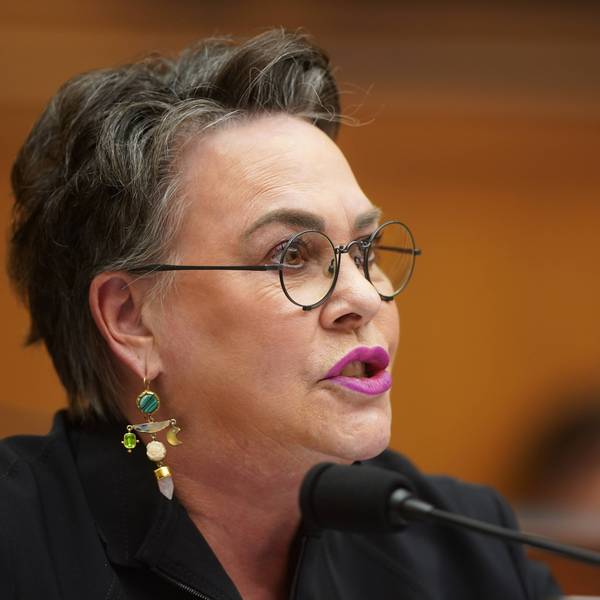
Fossil Free London activists dressed as suffragettes protest outside the National Gallery in London against Labour’s anti-protest laws ahead of International Women’s Day, march 6, 2026 [Photo: Andrea Domeniconi]
CLIMATE campaigners dressed as suffragettes outside the National Gallery today against anti-protest laws ahead of International Women’s Day.
The Fossil Free London group’s action took place ahead of International Women’s Day on Sunday, drawing attention to the tightening of anti-protest laws.
They held placards highlighting comparisons between the jail terms received by climate protesters and those handed to militant suffragettes in the early 20th century.
Just Stop Oil activists Phoebe Plummer and Anna Holland were sentenced to a combined 44 months in prison for throwing soup in the National Gallery in 2022.
They caused minor damage to the frame of Van Gogh’s Sunflowers painting.
Their action recalled the famous National Gallery protest by militant suffragette Mary Richardson, arrested for slashing Velazquez’s Rokeby Venus.
She was sentenced to a considerably shorter time of six months in prison.
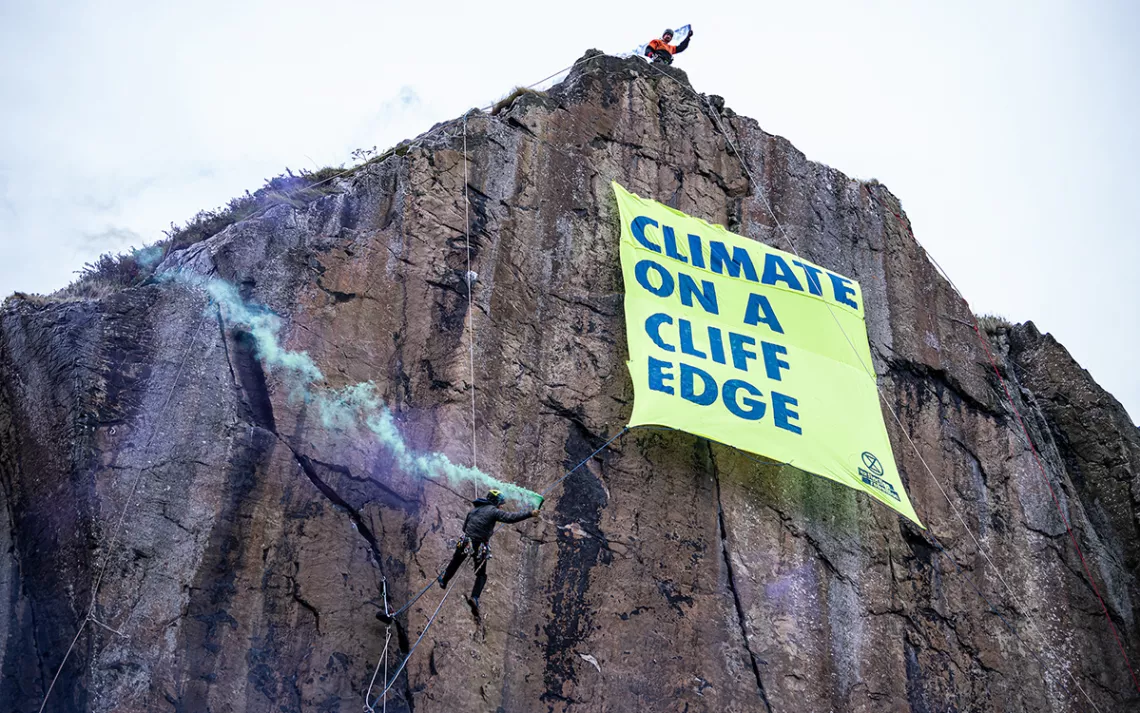
Experienced climbers scale a rock face near the historic Dumbarton castle in Glasgow, releasing a banner that reads “Climate on a Cliff Edge.” One activist, dressed as a globe, symbolically looms near the edge, while another plays the bagpipes on the shores below. | Photo courtesy of Extinction Rebellion and Mark RichardsDonald Trump urges you to be a Climate Science denier like him. He says that he makes millions and millions for destroying the planet, Burn, Baby, Burn and Flood, Baby, Flood.Nigel Farage urges you to ignore facts and reality and be a climate science denier like him and his Deputy Richard Tice. He says that Reform UK has received £Millions and £Millions from the fossil fuel industry to promote climate denial and destroy the planet.
Top polling party’s moves to ‘undeclare’ the climate emergency and scrap net zero targets could be a sign of things to come
Reform UK’s disregard of the climate crisis is already taking effect across the country. Since gaining control of 10 councils last May, the party has scrapped vital environmental goals. It has courted support from fossil fuel investors with a promise to “drill, baby, drill”. And its councillors have hijacked public debates with outright climate denialism.
Seven of the councils now controlled by Reform have abandoned important green measures. This includes ditching ambitious net zero targets and withdrawing the declaration of a climate emergency – which could threaten green investment and undermine action taken locally to deal with the crisis.
With Reform leading the polls and more local elections to come this year, what we’ve seen so far could be the tip of the iceberg.
For Lord Adair Turner, co-chair of the Energy Transitions Commission, the return of climate denial to public debate is “undoubtedly bad news” and presents a major setback for tackling the crisis. “We’ve got to work out how to convince people that there is a real, massive climate problem and that we do have the solutions now, which are available at relatively low cost,” he said.
We’ve been looking at how Reform has treated climate issues at a local level to gauge what might happen if it wins more councils this year – and if it comes to power in 2029.
The ‘global warming hoax’
One of Reform UK’s key campaigning pledges is the scrapping of net zero in order to cut energy bills. West Northamptonshire’s council leader Mark Arnull said: “Every resident who voted Reform UK voted for that and they must be heard.”
Of the 10 new Reform-controlled councils, seven promptly abandoned their climate promises. Of the remaining three, Lincolnshire did not have any significant climate pledges to scrap but Reform leaders there say they have “declared war” on green energy projects; Derbyshire confirmed its commitment to cutting emissions but ditched the objective to “work to address the causes, and adapt to the impacts, of climate change”; and Doncaster – which has a Reform majority but a Labour mayor and cabinet – has maintained its climate pledges.
The Reform councils’ position contrasts sharply with those controlled by other parties. Climate Emergency UK – a campaign organisation for council climate action – says it is not aware of any other local authorities that have scrapped their climate pledges. Across the UK, more than 300 councils have declared a “climate emergency” and many of those are backed up with ambitious net zero targets.
Polling suggests almost three quarters of people in the UK believe climate change is caused by human activity; a study of more than 88,000 climate-related studies found that 99.9% of peer-reviewed scientific papers agree.
Yet in public debates, some Reform councillors have put forward the opposite view. In Nottinghamshire, councillor Bert Bingham said: “I’ve been involved in sustainability projects for 25 years and I’ve never seen such nonsense as the anthropogenic global warming hoax.”
In Kent, Councillor Chris Hespe said: “It is often stated that anthropogenic climate change is ‘settled science’ and that the whole scientific community believes it. However, this is far from the case.”
Outright climate denial has permeated local debate. After Rachael Hatchett, a Green councillor in Derbyshire, spoke up in a debate about solar farms last year, she was heckled by another councillor shouting: “There is no climate change!”
Reform’s claim that scrapping net zero will cut energy bills is also misleading, according to energy experts. Dhara Vyas, chief executive of industry body Energy UK, told Carbon Brief it is “crystal clear what has driven electricity bills up in the UK … it’s the wholesale costs, driven by the price of gas”.
Liberal Democrat councillor Alex Ricketts said Reform’s climate denial would have real-world impacts for Kent’s constituents. Parts of the county are recognised to be at risk of flooding and local authorities have received funding from the Environment Agency to shore up sea walls and maintain other defences.
Ricketts said this money was allocated based on the science and policymaking that Reform criticises: “There are very real effects on the people of Kent by trying to debunk these things.”
In Durham, Reform proposed retracting the climate emergency and instead declaring a “care emergency” with a focus on special educational needs. Independent councillor Chris Lines said: “Politically, the rhetoric from Reform was that if you voted against it, you were labelled as someone who didn’t care about young people. Conflating the two issues was frankly appalling.”
Lines is concerned about the impact of these declarations on the economy, pointing to research showing that the low-carbon industry was worth £1.7bn to County Durham in 2021/22. “If I was a business in that growing sector looking to invest in an area, would I really want to come here, given the direction this council is going?”
Not all the debates on net zero have involved outright climate denial. In West Northamptonshire, councillors questioned how feasible climate policies were and raised concerns about their cost – an approach that academics have labelled “climate delay”, which can hinder action on climate change.
Alan Graves, the Reform UK leader in Derbyshire, said: “We do not deny that the climate is changing… The council continues to support practical, affordable measures that cut waste, improve efficiency, and reduce costs for residents.”
Responding to whether climate denial had spread in local councils, he said he could only speak for Derbyshire but that they weren’t focusing on “culture-war labels”.
Graves added: “We do not remove policies for ideological reasons. Where we have amended plans, it is because they were vague, unfunded, sometimes unfounded or undeliverable. Our responsibility is to be honest with the public about what can realistically be achieved within local government budgets.” Reform UK and the other councils mentioned did not respond to requests for comment.
A familiar playbook
Reform UK has proudly borrowed slogans from Donald Trump’s campaigns in the US. At a recent council meeting in Durham, Reform councillor Kyle Genner painted a vivid picture of the county’s “dilapidated and deprived estates … the joblessness … the lack of dignity and hope”. He urged his fellow councillors to support the reindustrialisation of the county – including the extraction of coal, oil and gas – to “make Durham great again”.
“I’m clearly not Donald Trump,” he said. “But I do like the idea of ‘drill, baby, drill’. I do like the idea of ‘jobs, baby, jobs’.”
Reform are in the climate denial camp and the Conservatives have moved into – not climate denial, but saying they want to get away from net zero
Lord Turner
The Reform leader of the council, Andrew Husband, said this local debate held a national significance. “It’s telling the North Sea oil and gas producers, ‘Don’t give up just yet’. We’re preparing County Durham for a Reform government in 2029 so we can hit the ground running. Simple as that.”
Back in Kent, former Reform councillor Fothergill said it was “ridiculous” the county was not exploiting its abundance of gas, coal and mineral resources.
In further echoes of the Trump administration, Reform councils across the country are erasing the words climate and environment from cabinet roles, committee names and planning documents.
Where Trump set up the Department of Government Efficiency spearheaded by Elon Musk, Kent county council introduced its own Department of Local Government Efficiency, or DOLGE.
Andrew Husband speaks during the Reform UK County Durham Conference last FebruaryIan Forsyth / Getty Images
Kent’s first head of DOLGE, Matthew Fraser Moat, highlighted what he said were “several, maybe tens of millions of pounds” wasted on the county’s declaration of a climate emergency. In September last year, he said this spending should be stopped, “given that there is no discernible benefit to the world’s climate from all of [Kent county council’s] efforts over the last seven years”.
Weeks later, Kent’s council leader said Reform had saved the county £32m over four years by “undeclaring the climate emergency”, and a further £7.5m by scrapping the county council’s transition to electric vehicles.
Fraser Moat, however, told the Financial Times this month that the Reform council “had not actually made any cuts”. The DOLGE team reportedly expected to find vast amounts of waste but didn’t. Fraser Moat has since stepped down from the council’s cabinet, saying his comments were the result of a “lapse of judgement” and that his words had been twisted.
Blocking the bulldozers
Across the country, Reform-controlled councils have opposed solar projects. In Durham, the party has abandoned a plan to install solar panels on council buildings, which aimed to save the council money on energy bills.
In Lincolnshire, Reform councillor Sean Matthews told the BBC about a new solar farm development: “I’m going to do whatever I can to stop it, and that does include laying in front of those bulldozers.”
While it may not always stray into the outright climate denial Hatchett faced in Derbyshire, Ricketts said Reform’s opposition to solar is largely political. “They know that resonates with one part of their base that don’t want solar farms built on fields, but also with the other part that are anti-climate change measures.”
Time and again, the environmental issues raised in local councils came back to party politics. Independent councillor Ian McCord welcomed West Northamptonshire’s move to scrap net zero targets. “Those that are crying into their tofu and quinoa forget that they lost the May election,” he said.
This has shifted the debate on net zero across the political spectrum. Lord Turner said: “Reform, obviously, are in the climate denial camp but the Conservatives have moved into, not climate denial, but saying they want to get away from net zero.
“It’s a bit ironic that, in the face of catastrophic weather events around the world, we are losing [the cross-party] consensus. I’m under no illusion that we’re facing a more tricky situation than we were five or 10 years ago.”
This story was updated on Wednesday 25 February 2026 to reflect the fact that Nottinghamshire county council has not rescinded its climate emergency declaration.
Reporters: Josephine Moulds and Grace Murray Environment editor: Rob Soutar Deputy editor: Chrissie Giles Editor: Franz Wild Fact checker: Ero Partsakoulaki Production editor: Alex Hess
TBIJ has a number of funders, a full list of which can be found here. None of our funders have any influence over editorial decisions or output.
Nigel Farage urges you to ignore facts and reality and be a climate science denier like him and his Deputy Richard Tice. He says that Reform UK has received £Millions and £Millions from the fossil fuel industry to promote climate denial and destroy the planet.Nigel Farage explains the politics of Reform UK: Racism, Fake anti-establishmentism, Deregulation, Corporatism, Climate Change Denial, Mysogyny and Transphobia.Neo-Fascist Climate Science Denier Donald Trump says Burn, Baby, Burn.
Rising temperatures across France since the mid-1970s are putting Tour de France competitors at “high risk”, according to new research.
The study, published in Scientific Reports, uses 50 years of climate data to calculate the potential heat stress that athletes have been exposed to across a dozen different locations during the world-famous cycling race.
The researchers find that both the severity and frequency of high-heat-stress events have increased across France over recent decades.
But, despite record-setting heatwaves in France, the heat-stress threshold for safe competition has rarely been breached in any particular city on the day the Tour passed through.
However, the researchers add it is “only a question of time” until this occurs as average temperatures in France continue to rise.
The lead author of the study tells Carbon Brief that, while the race organisers have been fortunate to avoid major heat stress on race days so far, it will be “harder and harder to be lucky” as extreme heat becomes more common.
‘Iconic’
The Tour de France is one of the world’s most storied cycling races and the oldest of Europe’s three major multi-week cycling competitions, or Grand Tours.
Riders cover around 3,500 kilometres (km) of distance and gain up to nearly 55km of altitude over 21 stages, with only two or three rest days throughout the gruelling race.
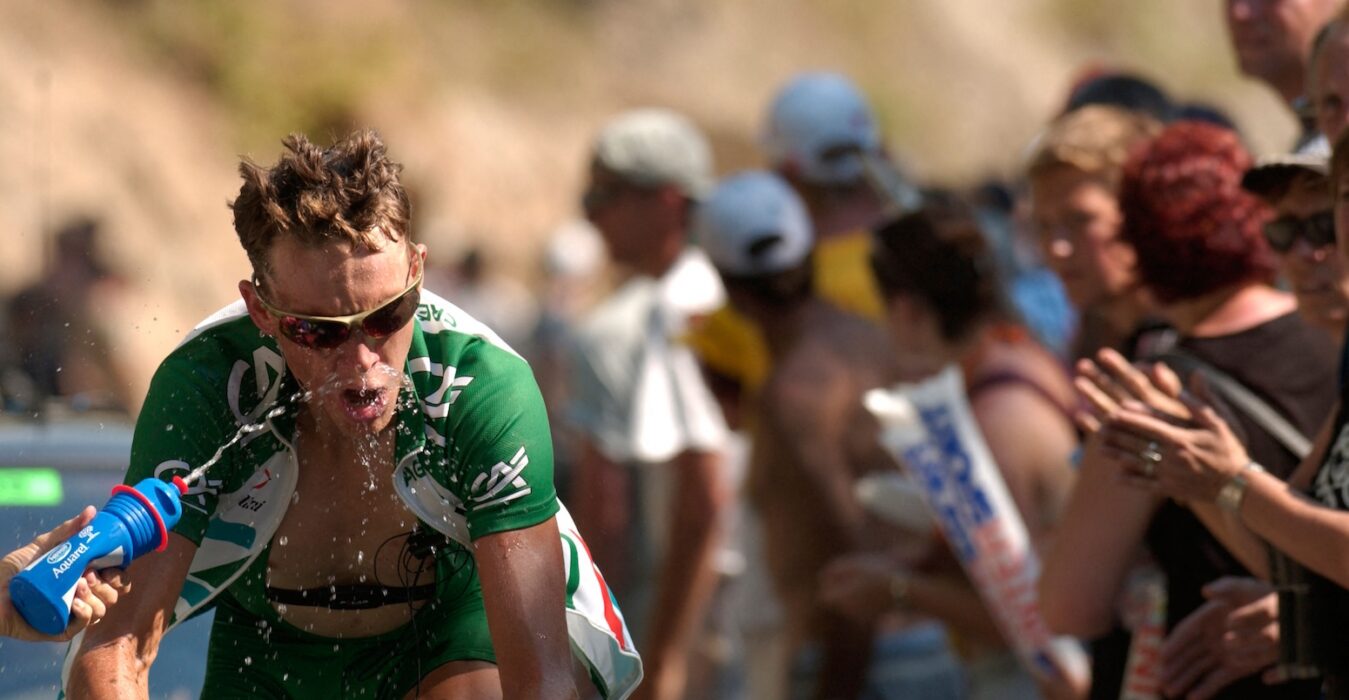
Heat has become a growing problem for the competition in recent years.
In 2022, Alexis Vuillermoz, a French competitor, collapsed at the finish line of the Tour’s ninth stage, leaving in an ambulance and subsequently pulling out of the race entirely.
Two years later, British cyclist Sir Mark Cavendish vomited on his bike during the first stage of the race after struggling with the 36C heat.
The Tour also makes a good case study because it is almost entirely held during the month of July and, while the route itself changes, there are many cities and stages that are repeated from year to year, Cvijanovic adds.
‘Have to be lucky’
The study focuses on the 50-year span between 1974 and 2023.
The researchers select six locations across the country that have commonly hosted the Tour, from the mountain pass of Col du Tourmalet, in the French Pyrenees, to the city of Paris – where the race finishes, along the Champs-Élysées.
These sites represent a broad range of climatic zones: Alpe d’ Huez, Bourdeaux, Col du Tourmalet, Nîmes, Paris and Toulouse.
For each location, they use meteorological reanalysis data from ERA5 and radiant temperature data from ERA5-HEAT to calculate the “wet-bulb globe temperature” (WBGT) for multiple times of day across the month of July each year.
WBGT is a heat-stress index that takes into account temperature, humidity, wind speed and direct sunlight.
Although there is “no exact scientific consensus” on the best heat-stress index to use, WBGT is “one of the rare indicators that has been originally developed based on the actual human response to heat”, Cvijanovic explains.
It is also the one that the International Cycling Union (UCI) – the world governing body for sport cycling – uses to assess risk. A WBGT of 28C or higher is classified as “high risk” by the group.
Murfree, who was not involved in the new study, adds that the researchers are “doing the right things by conducting their science in alignment with the business practices that are already happening”.
The researchers find that across the 50-year time period, WBGT has been increasing across the entire country – albeit, at different rates. In the north-west of the country, WBGT has increased at an average rate of 0.1C per decade, while in the southern and eastern parts of the country, it has increased by more than 0.5C per decade.
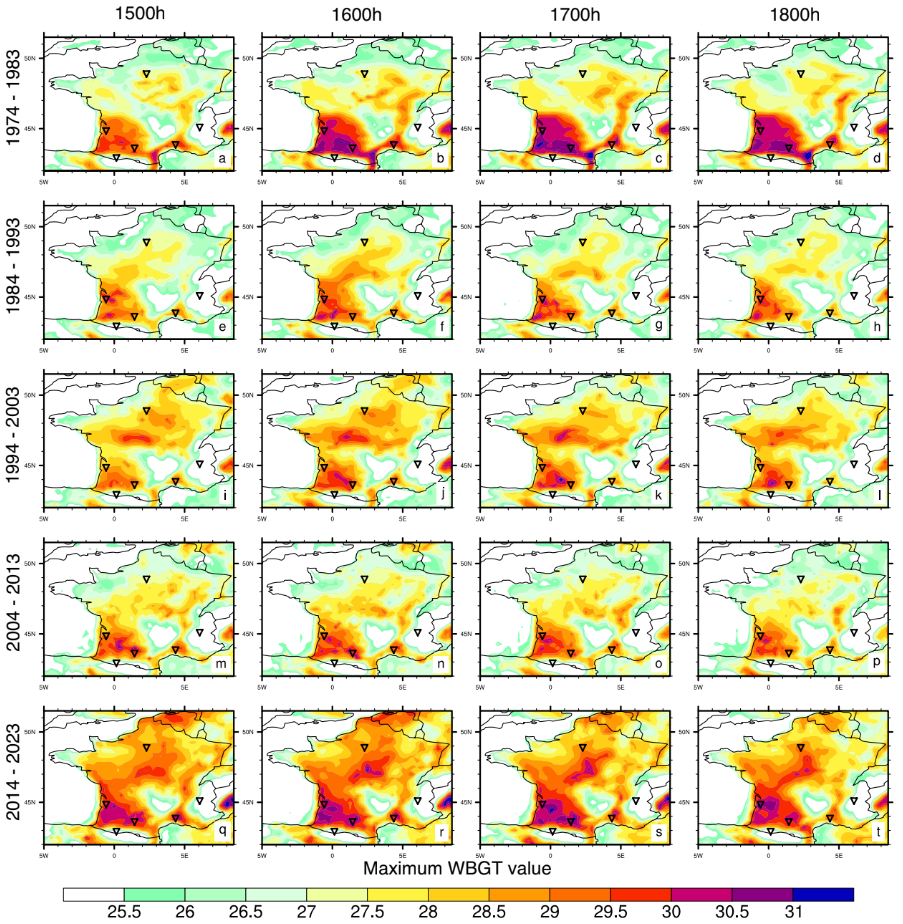
The maps below show the maximum July WBGT for each decade of the analysis (rows) and for hourly increments of the late afternoon (columns). Lower temperatures are shown in lighter greens and yellows, while higher temperatures are shown in darker reds and purples.
Six Tour de France locations analysed in the study are shown as triangles on the maps (clockwise from top): Paris, Alpe d’ Huez, Nîmes, Toulouse, Col du Tourmalet and Bordeaux.
The maps show that the maximum WBGT temperature in the afternoon has surpassed 28C over almost the entire country in the last decade. The notable exceptions to this are the mountainous regions of the Alps and the Pyrenees.
Maximum WBGT across France for the month of July from 1974-2023. Rows show the values for each decade and columns show the hourly values for 3:00pm, 4:00pm, 5:00pm and 6:00pm. Lower temperatures are shown in lighter greens and yellows, while higher temperatures are shown in darker reds and purples. Triangles indicate the six Tour de France locations analysed in the study. Source: Cvijanovic et al. (2026)
The researchers also find that most of the country has crossed the 28C WBGT threshold – which they describe as “dangerous heat levels” – on at least one July day over the past decade. However, by looking at the WBGT on the day the Tour passed through any of these six locations, they find that the threshold has rarely been breached during the race itself.
For example, the research notes that, since 1974, Paris has seen a WBGT of 28C five times at 3pm in July – but that these events have “so far” not coincided with the cycling race.
The study states that it is “fortunate” that the Tour has so far avoided the worst of the heat-stress.
Cvijanovic says the organisers and competitors have been “lucky” to date. She adds:
“It has worked really well for them so far. But as the frequency of these [extreme heat] events is increasing, it will be harder and harder to be lucky.”
Dr Madeleine Orr, an assistant professor of sport ecology at the University of Toronto who was not involved in the study, tells Carbon Brief that the paper was “really well done”, noting that its “methods are good [and its] approach was sound”. She adds:
“[The Tour has] had athletes complain about [the heat]. They’ve had athletes collapse – and still those aren’t the worst conditions. I think that that says a lot about what we consider safe. They’ve still been lucky to not see what unsafe looks like, despite [the heat] having already had impacts.”
Heat safety protocols
In 2024, the UCI set out its first-ever high temperature protocol – a set of guidelines for race organisers to assess athletes’ risk of heat stress.
The assessment places the potential risk into one of five categories based on the WBGT, ranging from very low to high risk.
The protocol then sets out suggested actions to take in the event of extreme heat, ranging from having athletes complete their warm-ups using ice vests and cold towels to increasing the number of support vehicles providing water and ice.
If the WBGT climbs above the 28C mark, the protocol suggests that organisers modify the start time of the stage, adapt the course to remove particularly hazardous sections – or even cancel the race entirely.
However, Orr notes that many other parts of the race, such as spectator comfort and equipment functioning, may have lower temperatures thresholds that are not accounted for in the protocol, but should also be considered.
Murfree points out that the study’s findings – and the heat protocol itself – are “really focused on adaptation, rather than mitigation”. While this is “to be expected”, she tells Carbon Brief:
“Moving to earlier start times or adjusting the route specifically to avoid these locations that score higher in heat stress doesn’t stop the heat stress. These aren’t climate preventative measures. That, I think, would be a much more difficult conversation to have in the research because of the Tour de France’s intimate relationship with fossil-fuel companies.”
Neo-Fascist Climate Science Denier Donald Trump says Burn, Baby, Burn.Nigel Farage urges you to ignore facts and reality and be a climate science denier like him and his Deputy Richard Tice. He says that Reform UK has received £Millions and £Millions from the fossil fuel industry to promote climate denial and destroy the planet.Donald Trump urges you to be a Climate Science denier like him. He says that he makes millions and millions for destroying the planet, Burn, Baby, Burn and Flood, Baby, Flood.
As reported by the New York Times, the court has agreed to hear arguments related to a petition filed by ExxonMobil and Canadian energy firm Suncor related to a 2018 lawsuit by the city of Boulder, Colorado that seeks financial damages from the companies for their role in causing global climate change.
The Times report noted that dozens of similar lawsuits have been filed by states and municipalities over the last decade, and they generally seek money from energy firms to help mitigate or repair damage done by extreme weather exacerbated by the climate crisis.
According to the Associated Press, attorneys for the energy companies are petitioning to have the case moved from state courts to federal courts that have in the past dismissed similar complaints.
“The use of state law to address global climate change represents a serious threat to one of our nation’s most critical sectors,” the attorneys claimed.
The Supreme Court’s decision to hear the case comes months after the Colorado Supreme Court ruled that Boulder’s lawsuit could initiate the discovery process and move toward a trial.
In an interview with the Colorado Sun, Boulder County Commissioner Ashley Stolzmann said that the city wasn’t backing down from its efforts make the fossil fuel industry pay for the damage it’s done.
“The oil companies have tried every avenue to delay our climate accountability case or move it to an out-of-state court system,” said Stolzmann. “As everyone continues to face rising costs that put budgets under pressure, we must hold oil companies accountable for the significant harm they’ve caused our communities.”
Richard Wiles, president of the Center for Climate Integrity, said that the merits of the Boulder lawsuit are clear, regardless of the Supreme Court’s intervention.
“Big Oil’s climate lies are the most consequential and harmful corporate deception campaign in history,” Wiles said, “and the communities paying the price for that deception deserve to put these companies on trial. Exxon’s desperation to escape accountability does not change the evidence of their wrongdoing or the law that lower courts agree is on Boulder’s side.”
Alyssa Johl, vice president of legal and general counsel at the Center for Climate Integrity, said the Supreme Court should simply affirm lower court rulings stating that “communities like Boulder have the right to seek accountability in their state courts when corporations have knowingly caused local harms.”
Donald Fuhrump says that Amerikkka doesn’t bother with crimes or charges anymore, not being 100% Amerikkkan and opposing his real estate intentions is enough.Orcas discuss Donald Trump and the killer apes’ concept of democracy. Front Orca warns that Trump is crashing his country’s economy and that everything he does he does for the fantastically wealthy.Elon Musk urges you to be a Fascist like him, says that you can ignore facts and reality then.
In 1976, the film Network premiered, featuring one of the most iconic scenes in film history. Howard Beale, played by Peter Finch, unleashes a rant that would be right at home in the present day:
“We know things are bad—worse than bad. They’re crazy. It’s like everything everywhere is going crazy, so we don’t go out anymore. We sit in the house, and slowly the world we are living in is getting smaller, and all we say is, ‘Please, at least leave us alone in our living rooms.’”
He was right, then and now. And while Beale was raving against the media’s pursuit of sensationalism over journalistic integrity, we see the same thing happening today. Things are indeed bad, to put it mildly, and we do not have the luxury of hiding away in our living rooms.
In early January of this year, a New York Times headline read, “The EPA will stop considering lives saved when setting pollution limits and instead calculate only the cost to businesses.” The EPA (Environmental Protection Agency) is openly letting the American people know that it does not care about us. Dead people are just the cost of doing business, and boy, business is booming.
In yet another glaring example of the business owners and the ruling class placing profits over people, the EPA under the current Republican administration is shifting its policy from environmental protection to the economic costs of regulations. The EPA will no longer track the health impacts of air pollution or quantify the financial impacts of health improvements; instead, it will focus on the financial impact of regulations on businesses. The return of the days when smog was a staple in large metro areas is looking to make a comeback, and it’s only a matter of time before the Cuyahoga River catches fire again.
The shift at the EPA is at odds with the Make America Healthy Again movement, but then again, so is nearly everything else in this administration. While the MAHA movement continues to wage a war against vaccines, thereby ensuring a victory for preventable diseases, the American people will soon be dealing with a rise in air pollution. Clean air and water, once considered a human right, are an impediment to big business shareholders, and the Trump administration sided with big business.
At the same time, the EPA under the Trump administration revoked all scientific findings that greenhouse gases endanger public health. This revocation comes on the heels of the past three years being the hottest years on record. While states and cities grapple with the escalating costs of dealing with extreme weather, the federal government has not only effectively abandoned them but also removed years of climate research and findings.
President Donald Trump departs with Environmental Protection Agency director Lee Zeldin and Office of Management and Budget director Russell Vought, right after announcing the EPA will no longer regulate greenhouse gases, in the Roosevelt Room of the White House, Thursday, Feb. 12, 2026, in Washington.| Evan Vucci/AP
“President Trump will be taking the most significant deregulatory actions in history to further unleash American energy dominance and drive down costs,” said White House spokesperson Karoline Leavitt. Lower costs are not only a plus, but they will also be necessary, as we will need more money to offset the rising healthcare costs associated with polluted air.
Michelle Roos, executive director of the Environmental Protection Network, a group of former EPA employees, said, “Communities across the country will bear the brunt of this decision–through dirtier air, higher health costs, and increased climate harm. The Trump EPA is surrendering its responsibility, turning its back on families and communities already facing the highest pollution and health risks, and dismantling decades of science and progress.”
It comes as no surprise, then, that Big Oil spent almost half a billion dollars on the last election. Oil company CEOs and shareholders need allies in powerful places, and it doesn’t get any higher than Congress and the President. And no one spends that much money without expecting large dividends.
A panel of the National Academies of Sciences, Engineering, and Medicine (NASEM) recently released a statement reading, in part, “The evidence for current and future harm to human health and welfare created by human-caused greenhouse gases is beyond scientific dispute.” The current argument against this is “nuh uh,” often used by the dumbest people you went to high school with, making it very difficult to know who to believe.
The most recent National Climate Assessment, released in 2023, reported that temperatures in the contiguous U.S. have increased by 1.4 °C since 1970. The frequency of annual heat waves has tripled since the 1960s, while storms are producing heavier rainfall, and wildfires have become more severe. Since the Earth is on track to reach 2-3 °C, we are rapidly approaching the point of no return, where climate scientists say that no matter what we do to mitigate climate change, it will be too little, too late.
Recent scientific findings point to tipping points that, in turn, lead to feedback loops. The destruction of the Amazon rainforest releases carbon into the air that would otherwise not have been released, thereby amplifying global warming. Capitalists are actively killing the planet in the name of profit, and since money is all they care about, there is no incentive for them to stop. It also doesn’t help that most of them are sociopaths. And because there is a lack of class consciousness in the U.S., this Steinbeck quote is all the more relevant: “I guess the trouble was that we didn’t have any self-admitted proletarians. Everyone was a temporarily embarrassed capitalist.”
The ruling class loves to place the blame on the working class, insisting that we carpool and recycle our cardboard boxes and plastic bottles. And while we should do these things, that alone will not solve our problem, and it ignores the fact that over 70% of emissions come from 100 corporations. They want us to carpool so they don’t have to pay for public transportation, and they want us to recycle our cardboard so we feel like we’re saving the planet from the comfort of our living room. We do not have that luxury, which means Howard Beale was right.
As with all news-analysis and op-ed articles published by People’s World, the views reflected here are those of the author.
We hope you appreciated this article. At People’s World, we believe news and information should be free and accessible to all, but we need your help. Our journalism is free of corporate influence and paywalls because we are totally reader-supported. Only you, our readers and supporters, make this possible. If you enjoy reading People’s World and the stories we bring you, please support our work by donating or becoming a monthly sustainer today. Thank you!
Donald Trump urges you to be a Climate Science denier like him. He says that he makes millions and millions for destroying the planet, Burn, Baby, Burn and Flood, Baby, Flood.Nigel Farage urges you to ignore facts and reality and be a climate science denier like him and his Deputy Richard Tice. He says that Reform UK has received £Millions and £Millions from the fossil fuel industry to promote climate denial and destroy the planet.Elon Musk urges you to be a Fascist like him, says that you can ignore facts and reality then.

 Fossil Free London activists dressed as suffragettes protest outside the National Gallery in London against Labour’s anti-protest laws ahead of International Women’s Day, march 6, 2026 [Photo: Andrea Domeniconi]