People attending the People’s Assembly Against Austerity protest in central London, June 7, 2025
BRITAIN’S Communists meet tomorrow in Yorkshire for their 58th Congress. They will debate the urgent challenges faced by the left across the nations of Britain and more widely across the world.
Reactionary nationalism and racism, accelerated militarism and the abandonment of commitments on global warming all demand a new level of unity, a united front, not just as a slogan, but as a unifying solidarity across our communities and the organised labour movement.
How to secure that unity is a question that both unites but also sometimes divides the wider left. It is certainly not one that will be currently resolved by thinking purely in terms of political parties.
Keir Starmer says that the Labour Party under his leadership is intensely relaxed about assaulting those least able to defend themselves – the very poorest and most vulnerable.Nigel Farage urges you to ignore facts and reality and be a climate science denier like him and his Deputy Richard Tice. He says that Reform UK has received £Millions and £Millions from the fossil fuel industry to promote climate denial and destroy the planet.Nigel Farage explains the politics of Reform UK: Racism, Fake anti-establishmentism, Deregulation, Corporatism, Climate Change Denial, Mysogyny and Transphobia.
WARNING FROM HISTORY: Communists Robert Thompson and Benjamin Davis leave the Federal Courthouse in New York City during the 1949 ‘Foley Square Trial’ / Pic: CM Stieglitz/World Telegram & Sun/Library of Congress/CC
After Zohran Mamdani’s electoral win, BHABANI SHANKAR NAYAK points to the forgotten role of US communists in New York’s radical politics
AS THE dust of the recently concluded mayoral election settles in New York’s political consciousness, a new dawn begins.
Red babies are once again in the streets of Harlem, and it is now confirmed that 34-year-old Zohran Kwame Mamdani is the mayor-elect of New York City. Mamdani, a self-confessed socialist, is a member of both the Democratic Party and the Democratic Socialists of America.
His victory demonstrates that market-led bourgeois politics can be challenged and defeated by working people united around a clear, progressive political agenda.
New York is one of the richest cities in the world, yet one in four of its residents lives in poverty. The costs of housing, rent, childcare, transport, food and other essentials have become unaffordable for a dignified, basic life.
In this wealthy city, more than 500,000 children go to bed hungry each night. In response to such acute crisis, Mamdani offers politics of hope in the hopeless world of racialised capitalism in US.
Mamdani’s campaign promised to freeze rents, reduce the cost of childcare, double the minimum wage, provide free public transport and increase corporate tax rates. He also pledged to establish city-owned grocery stores, expand mental health services and promote community safety across New York.
These progressive policies are not radical enough for a total transformation but the policies are a necessary response to the times and essential for the survival and dignity of working people in New York.
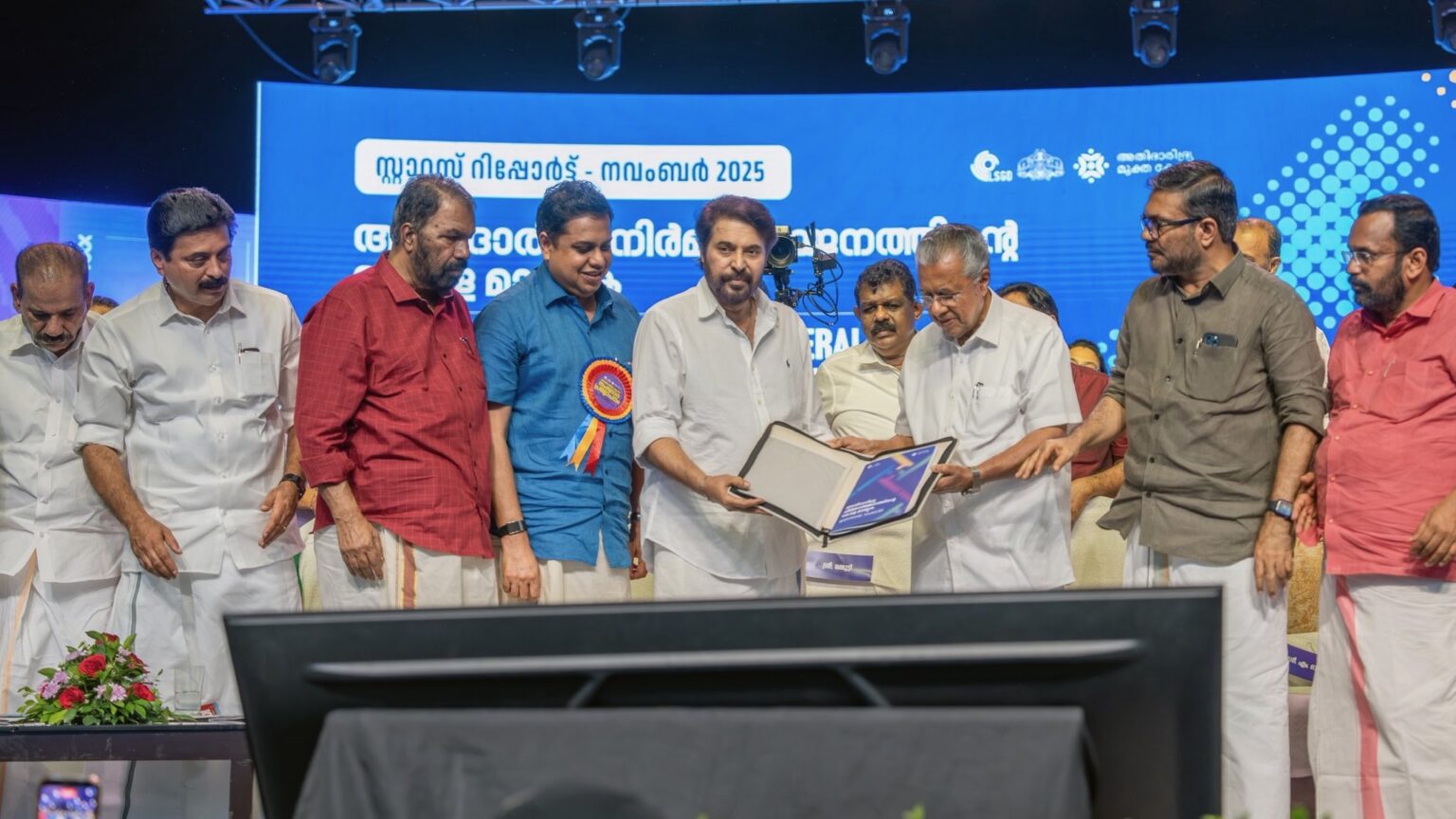
Kerala’s LDF government celebrates the eradication of extreme poverty in the state. Photo: Pinarayi Vijayan
The Communist Party of India (Marxist)-led Left Democratic Alliance (LDF) government achieves a unique feat in India which, according to the World Bank, has the world’s largest number of extremely poor.
On Saturday, November 1, India’s southern state of Kerala officially declared itself free of extreme poverty. This makes the left-ruled state the first and only state in the country to achieve such a milestone.
Announcing the achievement during a session of the state’s legislative assembly, left leader and Chief Minister of the state Pinarayi Vijayan called it a “historic and proud moment” for the state and its people and hoped that “our experiments will become a model that states in the country can benefit from.”
India has the world’s largest population living in extreme poverty, as per the data released by the World Bank last year.
“Kerala has etched a new chapter in history—erasing extreme poverty to become the first place in India and the second in the world to achieve this milestone,”John Brittas, member of India’s parliament from the Communist Party of India (Marxist) said on X.
In February 2021, China became the first country in the world to announce the end of extreme poverty, a decade ahead of the UN schedule under its sustainable goals.
On Saturday, Chinese ambassador to India Xu Feihong also congratulated Kerala’s government for its achievement, saying “to eliminate poverty is the common mission of humanity.”
From long-term policies to micro planning
After being elected to power for the second time in a row in 2021, the Pinarayi-led Left Democratic Front (LDF) government proclaimed that it would eradicate extreme poverty in the state by the end of its term.
In May 2021, the LDF government launched the Extreme Poverty Eradication Project (EPEP). The project had initially identified over 100,000 households as extremely poor. However, after the final analysis on the basis of access to food, income, shelter, and healthcare the number of households in extreme poverty came down to 64,006.
In the last four years extensive targeted attempts were made to provide sustained access to whichever element a particular family was lacking among these 64,006 families. This involved different government agencies and local self government bodies across the state.
In April of this year, after declaring Dharmadam (his own constituency) the first to be free from extreme poverty in the state, Vijayan had announced that by the state formation day on November 1 the state will finally achieve its goal set four years ago.
Socialist policies deliver
Kerala, which has mostly hilly terrain and a very high population density was once one of the poorest states in India with close to 60% of its population living in poverty.
Due to long-term welfare and development policies based on socialist distribution, such as land reforms, decentralization, high social expenditure on health and education, a robust public distribution system, among others adopted by the successive left governments in the state, the percentage of poor decreased drastically to just over 11% in 2011-12, when the last pan-India census was held.
The figure has been substantially lowered even further in the 15 years since then.
According to the central government’s multidimensional poverty index released in 2021, Kerala had the least multidimensional poverty among the Indian states, with less than 1% of its population (0.7%) identified as poor.
Kerala’s achievement is a result of the sustained efforts of successive left governments and their policies, claimed Thomas Issac, former finance minister and a leader of the CPI(M).
“From 60% poverty in 1973, Kerala declares itself free from extreme poverty. This is the real Kerala story of land reforms, increase in wages, universal education, healthcare and social security. Finally, 4 years of micro planning to lift 64,006 from extreme poverty” Issac said in a post on X.
Vijayan also acknowledged the role of long-term policies in achieving zero extreme poverty in the state.
“The process of eradicating extreme poverty is a continuation of the steps taken earlier for universal public distribution system and for the eradication of landlessness and homelessness. Kerala has made remarkable progress in the sustainable development index envisioned by the UN by eradicating extreme poverty,” he said on Saturday.
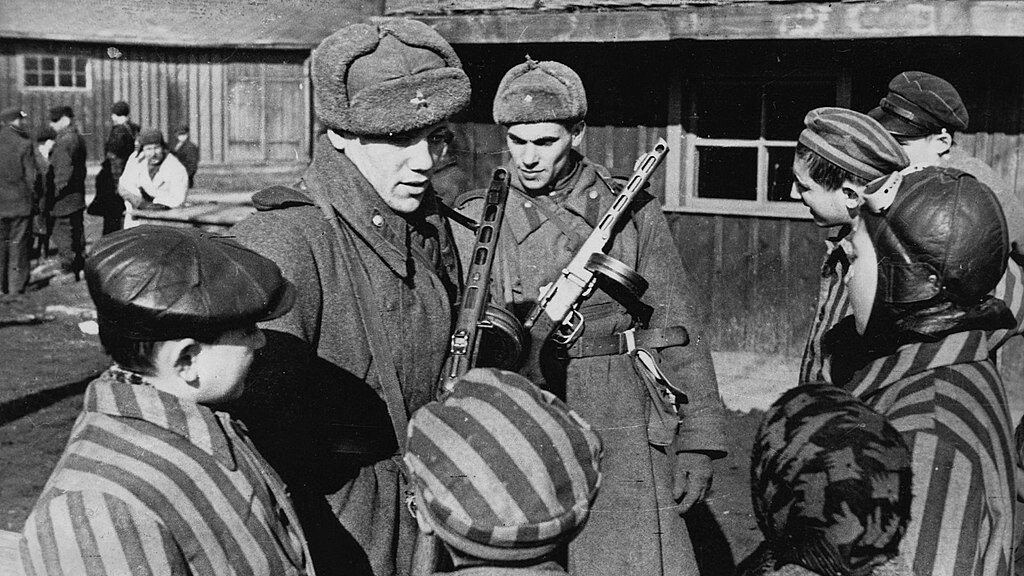
Red Army soldiers with prisoners of Nazi concentration camp, 1945. Source: Wikimedia Commons
As European leaders gathered at Auschwitz to commemorate 80 years since its liberation, they upheld a revisionist narrative that downplays the role of the Red Army in defeating Nazism
On January 27, 1945, soldiers of the Soviet Red Army liberated Auschwitz, the Nazi concentration camp where over one million people—overwhelmingly Jews—were murdered. Eighty years later, European leaders gathered in Poland, now home to the Auschwitz memorial, to hear survivor testimonies and reaffirm the commitment to ensuring such atrocities never happen again.
Yet this year’s commemoration came with a blazing omission. Despite the USSR’s vital role in defeating Nazi Germany and its allies—at the cost of over 20 million Soviets’ lives—there were no representatives of the Russian Federation at Auschwitz. In its pursuit of punishing Russia for the war in Ukraine, the European Union (EU) has virtually erased the Red Army’s contributions from the narrative. Leaders like Ursula von der Leyen and Giorgia Meloni issued statements of remembrance while avoiding any mention of the USSR. Only left politicians dared to talk about the full picture in their messages on the day of remembrance.
These events have to be read as part of a broad revisionist trend spreading through Europe, in which far-right parties, such as Meloni’s Brothers of Italy and France’s National Rally, are using anti-communist tropes to rewrite history. This trend has taken root among mainstream parties as well. Just days before Holocaust remembrance day, the European Parliament adopted a resolution condemning Russia for “exploiting the narrative of the ‘liberation of Europe from Nazism.’” The text of the resolution also criticized the restoration of Lenin’s monuments in Ukraine and called for a “pan-European” memorial for “victims of the 20th century totalitarian regimes,” a vocabulary that aims to equate fascism and communism.
In what can only be described as a severe case of historical amnesia, the parliamentaries proposed a ban on “both Nazi and Soviet communist symbols” across the EU. As some have pointed out, implementing such a ban would complicate commemorations like the one on Monday, given the prominence of Soviet uniforms in archival photographs of liberation.
While the EU is entertaining itself with erasing communism’s role in defeating Nazism in World War II, it seems to have learned extremely little from the Holocaust itself. The first phase of a ceasefire in Gaza had not even begun when Polish authorities announced they would allow Israeli Prime Minister Benjamin Netanyahu to attend the Auschwitz commemoration—despite an International Criminal Court warrant for his arrest on war crimes charges. Though Netanyahu ended up not attending himself, the mere possibility highlights Europe’s willingness to overlook crimes against humanity if committed by its current allies.
“Laying claim to the memory of one genocide in order to justify another genocide is morally and politically unacceptable,” historian Enzo Traverso said in a recent interview with Jacobin, commenting on Europe’s reactions to the genocide in Gaza. “The memory of Auschwitz should be mobilized to impede new genocides, not to justify them.”
By refusing to acknowledge the full history of Nazism’s defeat in 1945—especially the contributions of the Red Army and communist movements—Europe only fuels the rise of the far-right. Parties like Alternative for Germany (AfD), National Rally and Brothers of Italy may avoid explicit antisemitism in their platforms, but their policies thrive on the same hatred and violence that drove the Holocaust. As these parties gain electoral ground, the slogan “Never again is now” is becoming increasingly difficult to believe.
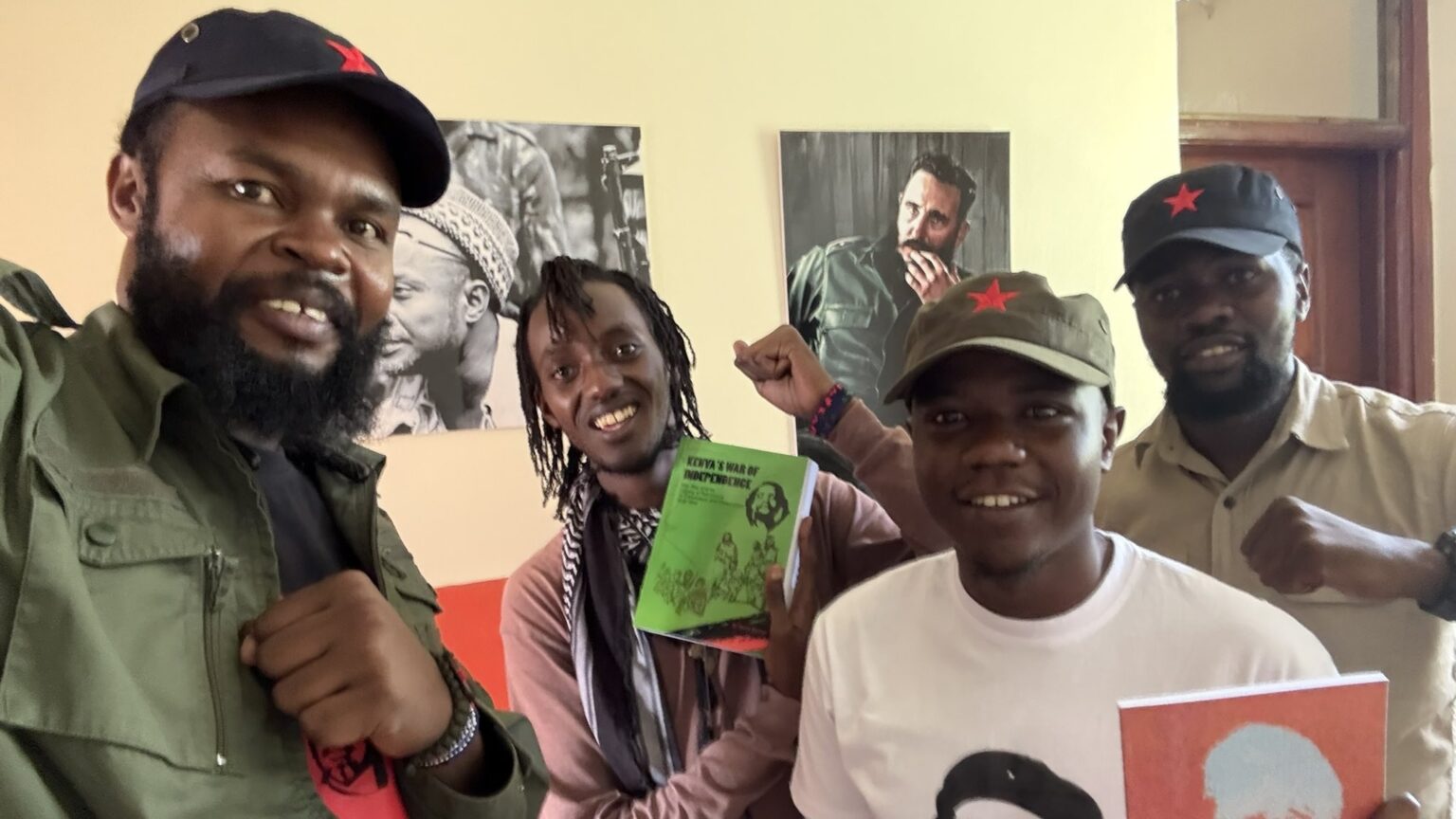
Booker Ngesa Omole with members of CPM-K. Photo: Booker Ngesa Omole
An armed attack on Kenyan communist leader Booker Ngesa Omole has sparked global outrage, with revolutionary groups expressing solidarity.
On Saturday, January 11, 2025, at approximately 3:00 am, an armed attack targeted the residence of Booker Ngesa Omole, General Secretary of the Communist Party Marxist-Kenya (CPMK). According to a statement released by the Party, the assailants—armed with firearms and equipped with night vision goggles—forced their way into the residence. A violent confrontation ensued as Booker defended himself, ultimately forcing the attackers to flee.
While the Kenyan police were quick to label the incident as an attempted burglary, the CPMK described it as a calculated assassination attempt. Booker, an organizer and fearless critic of the government, has been a vocal opponent of oppressive state policies. This shocking attack is seen as a direct assault on his activism, ideas and a broader effort to silence dissent.
“This was not a random act of crime but a direct assault on our General Secretary, who has consistently stood up for justice, democracy, and socialism in Kenya,” the Party declared. “This act of terror is an attack on the revolutionary cause and all Kenyans who are fighting for a better future.”
The Communist Party Marxist Kenya has demanded a full and transparent investigation, calling for the perpetrators to be brought to justice and that urgent measures be taken to protect its leadership and members.
“We will not be silenced,” the Party’s statement declared. “The enemies of the people may attempt to intimidate us, but we remain steadfast in our commitment to the struggle for liberation. No amount of violence will deter us from our revolutionary path.”
A rising tide of repression
The attack on Booker comes amid growing concerns over Kenya’s shrinking democratic space. Since the 2024 youth-led uprising against the controversial finance bill, government critics and activists have faced an alarming rise in abductions and violent attacks. According to the Kenya National Commission on Human Rights (KNCHR), dozens of individuals have been abducted or forcibly disappeared since mid-2024, deepening concerns of state repression.
International solidarity and condemnation
Revolutionary organizations across the continent have rallied in support of Booker and the CPMK, drawing parallels between the Kenyan experience and the broader struggle against neo-colonial exploitation, austerity, and imperialism.
Communist Party of Benin: assassination attempt as a declaration of war
The Communist Party of Benin unequivocally denounced the assassination attempt and the broader campaign of repression against the CPMK. They described the attack as a declaration of war by counter-revolutionary forces linked to the regime. They called for united action among revolutionary organizations worldwide. The Party also expressed confidence that the repression would fail, and the Kenyan people’s democratic national revolution would prevail.
Abahlali baseMjondolo: “an injury to one is an injury to all”
Abahlali baseMjondolo, South Africa’s largest grassroots movement, linked the attack to the broader context of neo-colonial austerity and oppression. Recalling the mass protests against the Ruto government’s Finance Bill and the brutal crackdown that followed, they emphasized the global nature of the fight against imperialist-backed regimes. “An injury to one is always an injury to all,” the movement stated, condemning the attempt on Booker’s life.
Socialist Movement of Ghana: a struggle against neoliberalism
The Socialist Movement of Ghana (SMG) expressed alarm at the assassination attempt and the subsequent arrests of CPMK leaders. They condemned the Kenyan government’s use of brutal force to suppress protests against IMF-driven neoliberal policies, linking the violence to broader struggles against neo-colonial exploitation. The SMG called for accountability for the regime and expressed unwavering solidarity with the CPMK and the Kenyan working people.
Booker responds: “we will prevail”
In a personal statement, Booker expressed his gratitude for the solidarity. “Your messages of support have reminded me, and all of us, that the fight for a just society resonates far beyond our borders,” he said. No force can silence the collective will of the people.”
Booker also revealed that officers from the Serious Crimes Unit had visited his residence and begun an investigation. He emphasized the importance of a transparent and professional inquiry, stating:
“This is a critical opportunity for the state to absolve itself of any suspicion of involvement by ensuring that those behind this heinous act are brought to justice swiftly and decisively. The Kenyan people deserve nothing less, as it is our taxes that entrust the state with the responsibility of protecting the lives of all citizens without exception.”
Addressing his comrades in the CPMK and other progressive forces, Booker called for unity and vigilance in the face of adversity:
“Attempts to disrupt our struggle for a liberated and equitable society only prove the fear our enemies feel in the face of our growing strength,” he declared.
“Let this moment deepen our resolve and ignite revolutionary optimism within our ranks. The path to justice and socialism is never without struggle, but history shows us that the people, united in their determination, will always prevail.”

 People attending the People’s Assembly Against Austerity protest in central London, June 7, 2025