Daring to dream after two years under fire: Life in Gaza

Spread the love

Original article by Hassan Herzallah republished from Open Democracy under a Creative Commons Attribution-NonCommercial 4.0 International licence.

Palestinians follow the news about the ceasefire agreement in Khan Yunis, Gaza, on 9 October 2025 
| Abdallah F.s. Alattar/Anadolu via Getty Images)

For two years, our lives have been on hold amid constant air strikes and fighting. Now, we finally have reason to hope

Growing up in Gaza, my friends and I often heard older relatives’ stories of the Nakba; learning about the homes that Israeli troops forced them out of in 1948, and the keys they forever carried with them in hopes of returning. We never imagined that we would one day carry this pain ourselves.

For the last two years, history has repeated itself before the eyes of the world. Those of us in Gaza who have survived the Israeli genocide have lived a new Nakba, not knowing where to go or if we will ever return home.

This has not been one war, but multiple wars happening at once. It is the war of relentless bombing that destroyed homes and neighbourhoods, the war of forced displacement that has pushed hundreds of thousands into the unknown at a moment’s notice, and the war of tents that offer no protection from the scorching summer heat or the cold and rain of winter.

Today, as we hear news of a ceasefire, we’re caught between feeling joy and fear – between believing and doubting.

I was in my hometown of Rafah in May last year when the Israeli occupation launched its invasion of the city. In a single day, Rafah was transformed from an overcrowded city sheltering more than 1.5 million people – both its own residents and those who’d sought refuge there after being displaced from elsewhere in Gaza – to an empty wasteland.

Within hours, the roads filled with overloaded cars and carts as hundreds of thousands of people, my family included, abandoned their homes and most of their belongings, fleeing towards the unknown. There was no time to think or to salvage what remained; fearing what would happen to those trapped, we all chose survival over everything else.

A few days later, the evacuation operation expanded further, forcing tens of thousands of us to move to the Mawasi area in Khan Younis. I’d never been to Mawasi before, but I had heard about it from friends online: a barren land with sand dunes unlike anything we’d seen before. When we arrived, we found dilapidated plastic tents, extreme overcrowding, no sewage or basic services.

The tents’ flimsy fabric roofs offered no protection from the summer heat or the winter cold. Our daily life turned into a continuous struggle of finding water, trying to charge our phones, and dealing with internet cuts, with scorching days and freezing nights. Even sleeping and talking became difficult amid the complete lack of privacy.

Life in the camps offered no safety at all. One evening, my cousin Ali was returning from the sea at sunset when he was chased by a quadcopter – a small, remote-controlled drone that Israel has used to surveil, intimidate and even kill civilians in Gaza. Ali froze in place for minutes that he said felt like hours before the drone disappeared, and he ran away, terrified. After that, we no longer dared to leave the area once darkness fell.

Every night, we would lay awake listening to stray bullets from occupation snipers piercing the air, planting terror in our hearts. We would lie on the ground instinctively, fearing any bullet that might pierce the tent, and sometimes six of us would gather in a small stone room at my aunt’s place, seeking a sliver of safety. After a neighbour’s child was paralysed by a stray bullet that pierced their tent, some of my relatives dug small trenches inside theirs to hide in.

On 10 September 2024, we lived through a night we will never forget. The evening began like any other; my family was in the tent and I was laying out front, trying to escape the heat, reading Letter from Gaza, a short story about a young man who returns home to Gaza to find his neighbourhood destroyed. It could have been penned any day over the past two years, but was written nearly 70 years ago by Palestinian author and militant Ghassan Kanafani.

I was interrupted by the sound of a military helicopter, followed by five consecutive airstrikes that destroyed much of the camp. My family managed to escape unharmed, which was a miracle, but in an instant, we lost everything we owned for a second time: our tent, our few belongings, my university certificates, and the computer that I used for my studies.

I remember screams, blood, and mothers searching for their children in the smoke. The Palestinian Civil Defence Agency later reported that 40 people had died that night, and 60 others were injured. But we had nowhere else to go, so my mother and sisters moved briefly into a friend’s tent, and within a week my father and I had rebuilt a shelter for us.

Then came the ceasefire on 18 January 2025, bringing a ray of hope. I returned to my home in Rafah, clutching the key as if it were all I had left. But my joy did not last long. When I reached the neighbourhood, I found nothing but rubble. My house, the homes of my relatives and friends, even my grandmother’s house, the place I most loved spending time – they were all gone.

The key I had believed would take me back home became merely a symbol of a Nakba that my ancestors had already endured, a memory of a home that no longer exists. Still, we stayed in Rafah, staying with a relative and trying to rebuild our lives.

My family is far from alone. Since the start of the invasion, 1.9 million people, nearly 90% of Gaza’s population, have been internally displaced – many of them forced to move over and over again as Israel expands its war into areas it told us would be safe. The occupation now controls large parts of the Strip, leaving less than 30% of Gaza’s original area habitable and making freedom of movement impossible.

In mid-March, two months after it started, the ceasefire ended abruptly and the war’s devastation resumed overnight. The bombardment intensified worse than ever, and by the morning, Rafah was surrounded by Israeli tanks. We were forced to evacuate for a fifth time, returning to a tent in Mawasi without any of the belongings I had managed to salvage from our shelled home.

On that day, I realised my old life would never return. For me, it was a new phase of the war, a new chapter of terror. I had to face that the relentless and violent bombing was not just a passing event, but our everyday reality – everything I knew from before the war was gone, just memories.

For more than a year, Rafah has been entirely under occupation, with no news of when we might be able to go home. The city is no longer as I knew it growing up. There is no safety, and freedom of movement is impossible.

Despite all the loss and suffering tied into displacement, it has reunited me with friends whom war stopped me from seeing for over a year. Hamdan, my friend from Khan Younis, Mahmoud from Gaza City, and Ramez from East Khan Younis; we all found ourselves in the same area, a small solace in all the devastation.

My friends and I began sharing our stories and sorrows every day. Mahmoud, with whom I went to university before its buildings were destroyed and our dreams were shattered, told us of how his family spent most of the past two years refusing to leave Gaza City, in the north of the Gaza Strip, choosing to endure the war in their home.

Then, last month, Binyamin Netanyahu’s occupation announced its plan to fully occupy the city. The shelling intensified, and every time Mahmoud looked out of his window, he would see the trucks that were carrying more than half a million people and their belongings south.

Over 200,000 families remained in the city, though. Some had nowhere else to go, some could not afford the up to $5,000 it can cost to transport belongings and purchase tents, and some, like Mahmoud’s family, simply did not want to leave.

Eventually, the shelling hit the neighbourhood where Mahmoud and his family lived, and became a daily occurrence. Several nearby tower blocks were destroyed. All services in the area collapsed; there was no potable water, or even dirty water, and no people on the streets or in the markets. Life became impossible. Mahmoud’s family was finally forced to evacuate.

Mahmoud and I are no longer who we once were. We used to have breakfast together in the university cafeteria, walk through the lecture halls together to attend our daily classes, and go together to Gaza City’s central library to borrow a book or one of the English novels. Now, we still see each other most days – living as we do in nearby camps – but our lives are so different now; we are unrecognisable from who we once were.

Two years have passed in which life has been on hold. Every day we have asked ourselves the same question: will this nightmare ever end? Then, last night, we finally heard the news that we have all been waiting for: Israel and Hamas appear ready to reach a peace deal.

The camp instantly came alive. Women began to ululate and children laughed, it felt as though everyone had been waiting for just one moment to breathe, a brief pause from this long fear. No one knows if this is truly the end or just another pause in the war, but today, we all need to believe that peace – even for a moment – is still possible.


Hassan Herzallah is a Palestinian translator and writer based in Gaza.

Original article by Hassan Herzallah republished from Open Democracy under a Creative Commons Attribution-NonCommercial 4.0 International licence.

Keir Starmer objects to criticism of the IDF. He asks how could anyone object to them starving people to death, forced marches like the Nazis did, bombing Gaza's hospitals and universities, mass-murdering journalists, healthworkers and starving people queuing for food, killing and raping prisoners and murdering children. He calls for people to stop obstructing his genocide for Israel.
Keir Starmer objects to criticism of the IDF. He asks how could anyone object to them starving people to death, forced marches like the Nazis did, bombing Gaza’s hospitals and universities, mass-murdering journalists, healthworkers and starving people queuing for food, killing and raping prisoners and murdering children. He calls for people to stop obstructing his genocide for Israel.
Experiencing issues with this image not appearing. I suspect because it's so critical of Zionist Keir Starmer's support of and complicity in Israel's genocides.
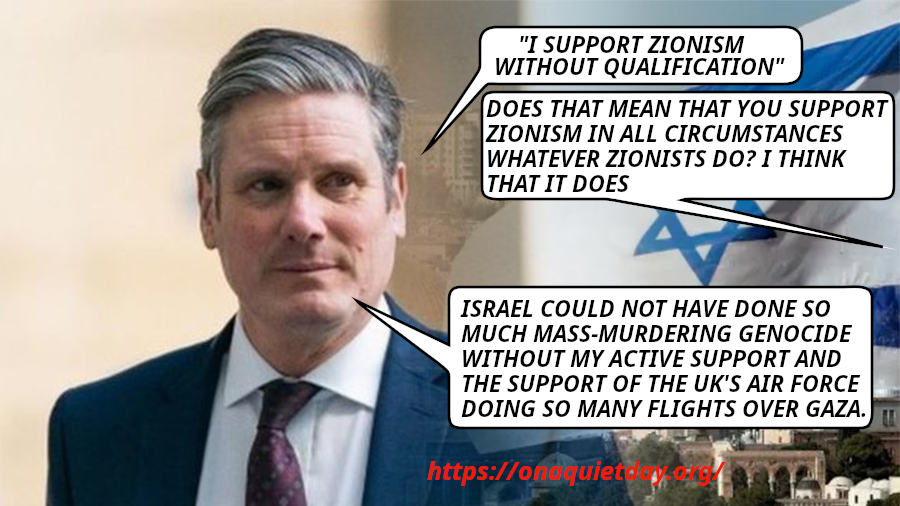
Genocide denier and Current UK Prime Minister Keir Starmer is quoted that he supports Zionism without qualification. He also confirms that UK air force support has been essential in Israel’s mass-murdering genocide. Includes URLs https://www.declassifieduk.org/keir-starmers-100-spy-flights-over-gaza-in-support-of-israel/ and https://youtu.be/O74hZCKKdpA
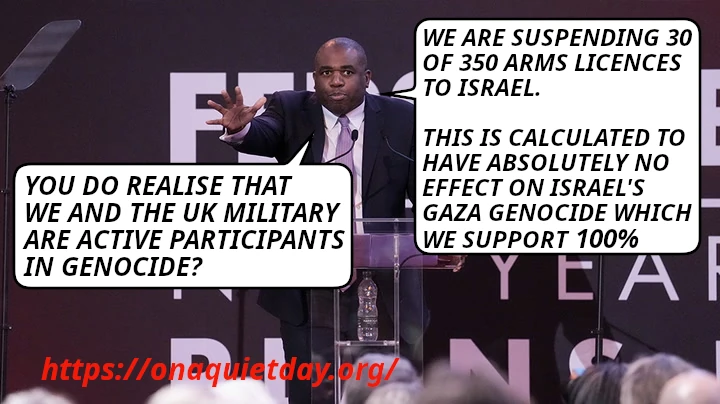
Genocide denying UK Foreign Secretary David Lammy says that UK is suspending 30 of 350 arms licences to Israel. He also confirms the UK government's support for Israel's Gaza genocide and the UK government and military's active participation in genocide.
Genocide denying UK Foreign Secretary David Lammy says that UK is suspending 30 of 350 arms licences to Israel. He also confirms the UK government’s support for Israel’s Gaza genocide and the UK government and military’s active participation in genocide.
Continue ReadingDaring to dream after two years under fire: Life in Gaza

‘We have to break the Tory-Labour duopoly and we will’

Spread the love

https://morningstaronline.co.uk/article/we-have-break-tory-labour-duopoly-and-we-will

 From left to right: La France Insoumise deputy leader Nathalie Oziol, Die Linke general secretary Janis Ehling, Workers’ Party of Belgium general secretary Peter Mertens, British-Palestinian activist Leanne Mohamad, Jeremy Corbyn and Zarah Sultana

Jeremy Corbyn and Zarah Sultana discuss the formation of a new leftwing party 

THE Tories and Labour’s grip on power must come to an end, people attending The World Transformed Festival 2025 in Manchester heard today.

A massive queue wrapped around the Niamos Radical Arts Centre in Manchester’s Moss Side in the afternoon as people waited eagerly to join a panel discussion with former Labour Party leader Jeremy Corbyn and independent MP Zarah Sultana focused on the formation of their new political party.

“For too long, our politics has been trapped in a cycle: the same two parties, the same tired promises, the same broken failures; a nightmare that keeps us stuck divided and ignored,” began prominent British-Palestinian activist Leanne Mohamad.

“The truth is that the two-party system has failed us all,” she said. “Everything that these two parties touch is corrupted. And that is why we have to break this duopoly and we will.”

Ms Sultana began a passionate speech by first addressing the new party’s rocky start. “Obviously, you’ve all seen what’s happened over the past few weeks,” she said. “But I’m here to tell you, the show is back on the road.”

Continues at https://morningstaronline.co.uk/article/we-have-break-tory-labour-duopoly-and-we-will

Keir Starmer says that the Labour Party under his leadership all feel a small part of Scunthorpe.
Keir Starmer objects to criticism of the IDF. He asks how could anyone object to them starving people to death, forced marches like the Nazis did, bombing Gaza's hospitals and universities, mass-murdering journalists, healthworkers and starving people queuing for food, killing and raping prisoners and murdering children. He calls for people to stop obstructing his genocide for Israel.
Keir Starmer objects to criticism of the IDF. He asks how could anyone object to them starving people to death, forced marches like the Nazis did, bombing Gaza’s hospitals and universities, mass-murdering journalists, healthworkers and starving people queuing for food, killing and raping prisoners and murdering children. He calls for people to stop obstructing his genocide for Israel.
UK Conservative Party leader Kemi Badenoch explains her reality that the Earth is flat, the Moon is made of cheese and that she was born from Unicorn horn dust
UK Conservative Party leader Kemi ‘not a genocide’ Badenoch explains her reality that the Earth is flat, the Moon is made of cheese and that she was born from Unicorn horn dust
Continue Reading‘We have to break the Tory-Labour duopoly and we will’

Netanyahu government approves ceasefire agreement proposed by Trump

Spread the love

This work by Middle East Monitor is licensed under a Creative Commons Attribution-NonCommercial-ShareAlike 4.0 International License

Israeli Prime Minister Benjamin Netanyahu (2nd R) meets with US President Donald Trump’s Special Representative for the Middle East Steve Witkoff (2nd L) and Trump’s son-in-law and former advisor Jared Kushner (L) in West Jerusalem on October 9, 2025. [Ma’ayan Toaf / GPO – Anadolu Agency]

The Israeli Prime Minister’s Office announced early on Friday that the government had officially approved a proposal by US President Donald Trump to end the war in Gaza and secure the release of captives.

The PM office said the government had “approved the framework for the release of all hostages.”

Before the announcement, Netanyahu stated that his government continued to work towards achieving the goals of the war, with the main objective being the return of all those held captive.

Netanyahu added that “Israel is in the midst of a decisive development,” stressing that such progress would not have been possible without the “exceptional assistance” provided by President Donald Trump and his team.

He extended special thanks to Trump’s envoys to the region, Steve Witkoff and Jared Kushner, noting that they had “worked tirelessly for many hours and did their utmost to make this happen.”

Netanyahu concluded that “these efforts serve the interests of Israel and the United States, as well as honourable people everywhere, with the aim of reuniting families with their loved ones.”

READ: Hamas official warns of Netanyahu’s attempts to undermine Gaza ceasefire deal

This work by Middle East Monitor is licensed under a Creative Commons Attribution-NonCommercial-ShareAlike 4.0 International License

Current UK Prime Minister Keir Starmer is quoted that he supports Zionism without qualification. He also confirms that his active support and that of UK's air force has been essential in Israel's mass-murdering genocide.
Current UK Prime Minister Keir Starmer is quoted that he supports Zionism without qualification. He also confirms that his active support and that of UK’s air force has been essential in Israel’s mass-murdering genocide.
Vote Labour for Genocide.
Continue ReadingNetanyahu government approves ceasefire agreement proposed by Trump

UN: 170,000 tons of humanitarian aid waiting to enter Gaza

Spread the love

This work by Middle East Monitor is licensed under a Creative Commons Attribution-NonCommercial-ShareAlike 4.0 International License

Aid trucks loaded with humanitarian supplies remain stranded at the Rafah Border Crossing on the Egyptian side due to Israeli attacks and closed border crossings, the delivery of aid is limited and delayed in Rafah, Egypt on August 6, 2025. [Mohamed Elshahed – Anadolu Agency]

The United Nations Office for the Coordination of Humanitarian Affairs (OCHA) said Thursday that around 170,000 tons of humanitarian aid are waiting to enter the Gaza Strip, pending approval from the Israeli occupying authorities that control all border crossings.

Speaking after the announcement of the first phase of US President Donald Trump’s plan to end the war on Gaza, an OCHA spokesperson said the aid—comprising medicines, tents, and other critical supplies—could reach nearly two million Palestinians facing severe shortages of food and basic necessities once access is granted.

OCHA reported earlier this week that Israel has blocked the entry of 45 per cent of registered aid convoys since the genocide began in October 2023, severely limiting relief efforts. The spokesperson emphasised that effective delivery requires open crossings, security guarantees for aid workers and civilians, visas for international staff, and unrestricted entry of supplies. He also underlined the need to revive Gaza’s private sector to restore minimum living conditions.

At dawn Thursday, Trump announced that Israel and Hamas had agreed to the first stage of his proposed peace plan, which includes a prisoner exchange and an Israeli withdrawal to the so-called “Yellow Line” as an initial step.

READ: Hamas leader says resistance heroes thwarted Israeli plans in Gaza

This work by Middle East Monitor is licensed under a Creative Commons Attribution-NonCommercial-ShareAlike 4.0 International License

Keir Starmer objects to criticism of the IDF. He asks how could anyone object to them starving people to death, forced marches like the Nazis did, bombing Gaza's hospitals and universities, mass-murdering journalists, healthworkers and starving people queuing for food, killing and raping prisoners and murdering children. He calls for people to stop obstructing his genocide for Israel.
Keir Starmer objects to criticism of the IDF. He asks how could anyone object to them starving people to death, forced marches like the Nazis did, bombing Gaza’s hospitals and universities, mass-murdering journalists, healthworkers and starving people queuing for food, killing and raping prisoners and murdering children. He calls for people to stop obstructing his genocide for Israel.
Vote Labour for Genocide.
Continue ReadingUN: 170,000 tons of humanitarian aid waiting to enter Gaza

‘Insulting and counterproductive’

Spread the love

https://morningstaronline.co.uk/article/insulting-and-counterproductive

 Protesters take part in a demonstration outside the Foreign, Commonwealth and Development Office (FCDO) in Whitehall, London, calling for the government to protect the crew of Madleen, June 9, 2025

Jewish campaigners condemn Starmer’s claim that demonstrations against genocide are ‘un-British’

JEWISH campaigners have condemned Sir Keir Starmer’s “insulting” claim that demonstrations against genocide were “un-British.”

The Prime Minister’s remarks, made today, came ahead of several student protests on the anniversary of October 7, and the national march for Palestine this weekend.

An inter-university march set off in the capital from King’s College at 2pm, before passing the London School of Economics, University College London and ending at the gates of SOAS.

Joining them was Mark Etkind, the son of a Holocaust survivor, who said: “As we speak today, weapons made in Britain are contributing to the deaths of children and others in Gaza — that has to stop now in order to save those lives, so these brave student protesters have to keep demonstrating until that genocide stops.”

He accused the government of having slandered the students, making them out to be insensitive to October 7, “while ignoring the obvious fact that their priority is to … oppose the ongoing conflict which Britain unfortunately is complicit in.”

Rallies also took place in Sheffield, Glasgow and Edinburgh, where the institution’s principal emailed students warning them to “think carefully about their actions” ahead of the protest.

Edinburgh’s Justice for Palestine Society called it a “blatant attempt to suppress campus discourse on an ongoing genocide.”

Writing in the Times, Sir Keir said it was “un-British to have so little respect for others,” echoing comments made by Home Secretary Shabana Mahmood, who described Palestine protests held following Thursday’s attack on a Manchester synagogue as “fundamentally un-British.”

Naomi Wimborne-Idrissi, media officer for Jewish Voice for Liberation, said: “Those who protest are in despair at our government’s abject failure to take any kind of meaningful action to make the bombing, shooting, burning and starvation stop.

“For leaders of that government to accuse protesters of ‘un-Britishness’ is both insulting and counterproductive.

Article continues at https://morningstaronline.co.uk/article/insulting-and-counterproductive

Keir Starmer objects to criticism of the IDF. He asks how could anyone object to them starving people to death, forced marches like the Nazis did, bombing Gaza's hospitals and universities, mass-murdering journalists, healthworkers and starving people queuing for food, killing and raping prisoners and murdering children. He calls for people to stop obstructing his genocide for Israel.
Keir Starmer objects to criticism of the IDF. He asks how could anyone object to them starving people to death, forced marches like the Nazis did, bombing Gaza’s hospitals and universities, mass-murdering journalists, healthworkers and starving people queuing for food, killing and raping prisoners and murdering children. He calls for people to stop obstructing his genocide for Israel.
Orcas discuss Genocide-supporting and complicit Zionists. Donald Trump, Keith Starmer, David Lammy, Rachel Reeves, Angela Rayner and Wes Streeting are acknowledged as evil genocide-complicit and supporting cnuts.
Vote Labour for Genocide.
Continue Reading‘Insulting and counterproductive’