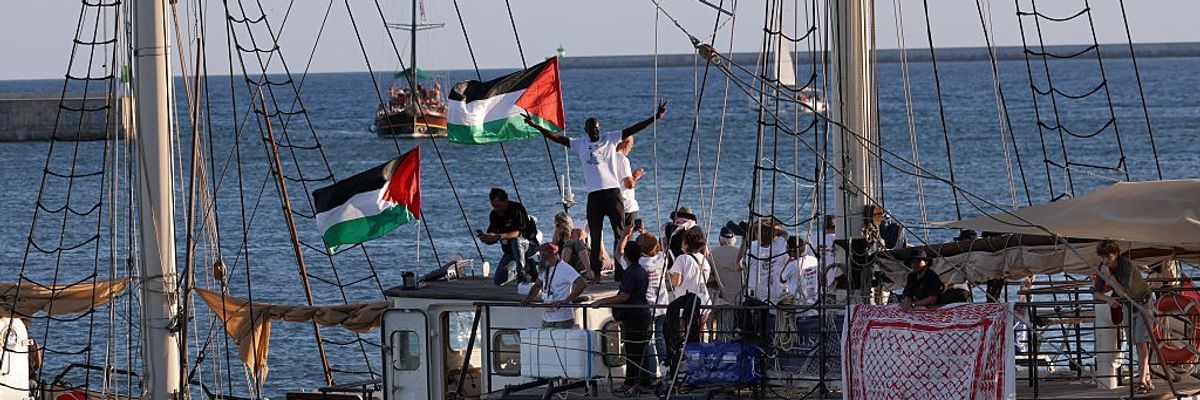
The first vessel “Sirius” of a civilian flotilla, carrying pro-Palestinian activists and humanitarian aid and aiming to break the Israeli blockade of the Gaza Strip, leaves the Barcelona port on September 1, 2025. (Photo by Lluis Gene/AFP via Getty Images)
“We are not sailing simply to deliver our cargo, but to pressure our countries to stop arming and funding Israel,” said one flotilla passenger.
The Global Sumud Flotilla, a fleet of dozens of ships heading toward Gaza to deliver humanitarian aid, has entered the final stretch of its journey in which it could soon face strikes from the Israeli military.
As described by Middle East Eye, the flotilla on Tuesday ventured into the “danger zone” where organizers are likely to be intercepted by the Israeli military.
Middle East Eye also cited reporting from Reuters that “flight tracking websites showed multiple drones originating from Turkey’s Corlu airbase circling over the flotilla” as it entered the zone.
As the flotilla approached its final destination, many organizers reflected on the journey that they’ve made and the goals they are trying to achieve.
David Adler, the co-general coordinator of Progressive International, linked his Jewish faith to the flotilla’s mission to help end mass starvation in Gaza.
“I believe it is a blessing that we are approaching interception at the onset of Yom Kippur—our annual day of atonement—which calls on us to reflect on our sins, and what can be done to repair them in the spirit of tikkun olam,” he wrote. “How can we atone for what has been committed in our name? How can we seek forgiveness for sins that multiply by the hour, as bombs and bullets rain on Gaza?”
Mandla Mandela, the grandson of former South African President Nelson Mandela who is a passenger on the flotilla, toldDemocracy Now that he wanted to show Palestinians the same international solidarity that activists once displayed for his country when his grandfather was working to free it from apartheid.
“Those that rallied behind our cause and stood side by side in supporting the anti-apartheid movement ensured that we attained our freedom in our lifetime,” he explained. “This is why today we utilize our voice to support the oppressed and most vulnerable nations across the globe.”
Another flotilla passenger, Irish writer Naoise Dolan, wrote an editorial for The Guardian in which she acknowledged that her ship was unlikely to reach Gaza while emphasizing the importance of showing solidarity in the face of atrocities being committed against the Palestinians.
“We are not sailing simply to deliver our cargo, but to pressure our countries to stop arming and funding Israel,” she argued. “All of our governments—French, Danish, Irish—participate in the genocide through maintaining ties with its perpetrator. We’re not even protesting inaction, but the active sabotage of Palestinian self-determination.”
The flotilla set sail one month ago with the goal of breaking through the Israeli military blockade that has for months prevented aid from reaching Gaza, which has caused a famine in the exclave, and starving to death at least 440 people, including 147 children, so far.
In addition to Adler, Mandela, and Dolan, other passengers on the flotilla include Swedish climate activist Greta Thunberg, American actress Susan Sarandon, Irish actor Liam Cunningham, Portuguese politician Mariana Mortágua, and former Barcelona Mayor Ada Colau.
Keir Starmer objects to criticism of the IDF. He asks how could anyone object to them starving people to death, forced marches like the Nazis did, bombing Gaza’s hospitals and universities, mass-murdering journalists, healthworkers and starving people queuing for food, killing and raping prisoners and murdering children. He calls for people to stop obstructing his genocide for Israel.
Keir Starmer objects to criticism of the IDF. He asks how could anyone object to them starving people to death, forced marches like the Nazis did, bombing Gaza’s hospitals and universities, mass-murdering journalists, healthworkers and starving people queuing for food, killing and raping prisoners and murdering children. He calls for people to stop obstructing his genocide for Israel.
A party without a soul, a purpose, or tolerance for dissent: that’s the lasting impression of Labour from its annual jamboree in Liverpool.
…
I have been covering Labour and Conservative conferences almost every year for the decade and a half. Each year, I confront ministers with uncomfortable questions – on issues such as benefit cuts, sleaze allegations, or broken promises. This year, I questioned Labour grandees, including the foreign secretary, on Britain’s continued sale of crucial components for Israel’s murderous fighter jets. The next day, the party emailed me to revoke my conference pass, citing “complaints” about my “conduct”. It added that: “After careful consideration, we’ve concluded that we cannot continue your attendance while ensuring we meet our safeguarding obligations to all attendees.” Rivkah Brown, another leftwing journalist, from Novara Media, also had her pass cancelled at almost the exact same time.
Invoking “safeguarding” – as though asking uncomfortable questions about genocide somehow threatens safety – resembles Trumpian attempts to portray critique and dissent as incitement to violence. Nigel Farage similarly claims that Keir Starmer labelling his anti-migrant policies as “racist” is inciting violence against his party. A couple of years ago, I and a number of other leftwing journalists abruptly stopped receiving emails from Labour’s press list. Every rightwing media outlet retained its place, and note how GB News has an on-site studio in the conference zone, fuelled by a constant supply of smiling Labour ministers.
Where has this toxic blend of authoritarianism and soullessness left the party? The country seethes with contempt for the governing party. Starmer is the most unpopular new prime minister since records began in the 1980s, plummeting to depths unseen even by Liz Truss, while just 12% approve of the government’s record, compared with 70% who disapprove. As Britain’s pre-eminent pollster, Sir John Curtice, told a room of depressed-looking delegates, the party began its term in office with weak enthusiasm – securing just over a third of the vote amid record low turnout – and it was downhill from there.
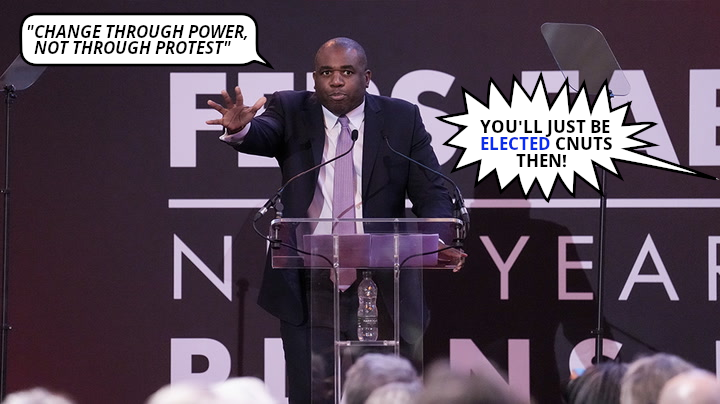
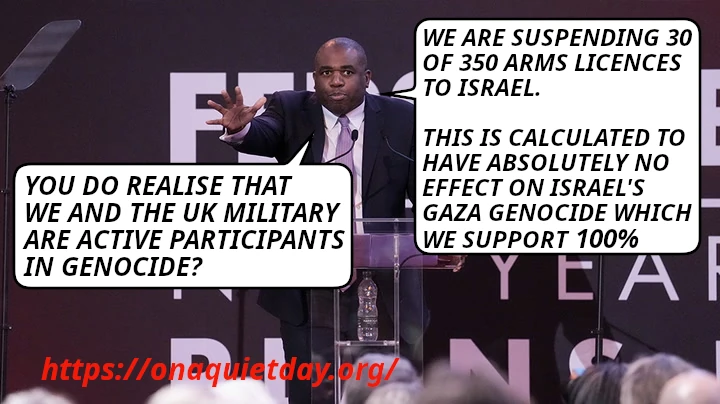
Keir Starmer says that the Labour Party under his leadership all feel a small part of Scunthorpe.Genocide denier and Current UK Prime Minister Keir Starmer is quoted that he supports Zionism without qualification. He also confirms that UK air force support has been essential in Israel’s mass-murdering genocide. Includes URLs https://www.declassifieduk.org/keir-starmers-100-spy-flights-over-gaza-in-support-of-israel/ and https://youtu.be/O74hZCKKdpAUK Labour Party Foreign Secretary David Lammy repeatedly heckled at a speech to the Fabian Society over his and the Labour Party’s support for and complicity in Israel’s genocide of Gaza.
So disjointed is Labour’s annual meet, the messaging differs from room to room. Attendees agree only on fear of Reform
Demonstrators outside the Labour Party Conference get creative | Seth Thévoz
I’ve been attending political party conferences in the UK for over 20 years, but I’ve never seen anything like the Labour conference currently taking place in Liverpool.
The governing party is a broad coalition at the best of times. But this year’s event has been a series of “bubbles” that don’t – and won’t – interact with one another. You can experience a completely different reality from the people 50 feet away, just by going to different events.
That’s why, all week, when people have asked me, “What’s the feeling like at Labour conference?” I’ve replied that it depends on which Labour conference you’re attending. The real conference takes place not on the carefully choreographed main stage, but in a hundred meeting rooms dotted across the city, where fringe events are put on by members, activists and lobbyists – and it’s in those rooms that the party’s deep internal rifts can be seen.
On day one, in the space of four meetings, I was told, firstly, of the importance of immigrants being treated with dignity and respect; secondly, of the need for Labour to go further in cutting immigration as the only way to stop Reform UK; thirdly, of the desperate need for more immigration if we were serious about growing the economy; and fourthly, what a brilliant job the government was already doing of cutting immigration.
As an immigrant, I wasn’t quite sure what to make of this. But then, Labour conferences have always been a performance art – it’s an essential way to square the circle.
Exaggerated patriotism and mockney accents
You learn a lot by watching people at conference. A lot of play-acting goes on at Labour conference.
Take sharp-suited trade secretary Peter Kyle. Introduced to a rally organised by Labour First, a network representing those on the right of the party, Kyle spent a full minute explaining how he didn’t really like wearing suits, and protested: “I don’t own moccasins!”
Kyle isn’t alone. Elsewhere, well-spoken, public school-educated special advisers from the south-east suddenly put on mockney accents, deeply aware of the shame attached to sounding posh in Labour circles. And the party’s traumatised politicians, long nervous about having their patriotism questioned, try to take on the mantle of the keenest flag-shaggers, with fringe venues, exhibition stands, corridors and merchandise all draped in Union flags.
‘Flag-shaggers’: Labour is eager to prove its patriotism and rival Reform’s use of flags | Seth Thévoz
You soon pick up where the centres of power are around the conference hotel, its bar and its private business suites, as key party personnel are bundled away for hush-hush meetings with donors and diplomats. But for the people-watcher, there is a golden rule to observe: doughnutting.
VIPs make up the hole of a doughnut, and they’re surrounded by a gaggle of hangers-on. The more important you are, the bigger the doughnut: a backbench MP merits just one young diary secretary by their side, while a cabinet minister or a city mayor can have half a dozen staff flocking around them at all times. No one wants to be Billy No Mates.
I mention this because it was striking to see Keir Starmer’s chief of staff, Morgan McSweeney, shuttling around the lobby of the Pullman hotel at least eight times – always alone. Whether he prefers to work in isolation or is just being avoided, I don’t know. But I wasn’t the only seasoned conference-goer to observe, “That’s really weird.”
McSweeney has had a tough September. First, he’s synonymous with Starmer’s many resets and changes of strategy, which have seen Labour plummet in the polls. Second, he came under fire for having advocated for Peter Mandelson to be appointed as the UK’s Washington ambassador despite his known friendship with paedophile Jeffrey Epstein and despite concerns raised by the security services during the vetting process (Mandelson was fired after emails he sent to Epstein following his conviction emerged earlier this month). And now, thanks to a new book from investigative journalist Paul Holden, the peculiar tale of how more than £700,000 of donations to Labour Together went undeclared on McSweeney’s watch has resurfaced, heaping further pressure on the man many believe to be the architect of Starmerism.
But it was the sight of him hurrying around the conference on his own, not the many op-eds published questioning his political judgment in recent weeks, that made me realise McSweeney may be in deep trouble. I’ve never seen such a senior government figure alone at a party conference, let alone over and over again.
Reform agenda
Sienna Rodgers of The House magazine wasn’t wrong when she wrote, “the motivation for those targeting McSweeney is clear: Starmer, it is widely believed, is finished without him.” McSweeney has become a lightning rod because he is seen as the cause of so many of Starmer’s changes of direction.
Many of the Labour members who voted for Starmer in the party’s 2020 leadership election expected a more radical figure. Instead, they have been baffled by a series of policy U-turns and an increasingly socially conservative approach to policy, aimed at wooing Reform UK voters. McSweeney is seen as being behind this shift.
The dilemma over the rise and rise of Nigel Farage’s Reform party has hit Labour hard. It’s not just obvious in ministers’ speeches; all around the conference, you can hear the chatter of endless conversations along the same lines. “We’re quite fearful, to be honest,” activists tell one another. “It’s all about how to beat Reform, basically.”
Labour has historically taken its working-class voter base for granted, while it wins or loses elections on the back of middle-class voters. To suddenly find another party, claiming the mantle of being more working class, accusing Labour of being a party of southern elites, has really knocked people’s confidence. It goes to the heart of how Labour politicians see themselves: “Are we the baddies?”
And so activists seek solace in comfortable old certainties. In the conference’s ‘Labour shop’, a whole range of nostalgia merchandise has been launched this year, from mugs to T-shirts, commemorating 80 years since the Labour government of 1945. If Labour in 2025 can’t offer members a better future, it can at least offer up a better yesterday.
The Good Old Days: Labour is flogging a range of 1945 nostalgia merchandise | Seth Thévoz
Ad-libbing policies
This does not feel like a party that won a landslide only 14 months ago. Its conference has had a level of exhaustion normally seen only in parties that have been in power for over a decade. At fringe event after fringe event, the most interesting or lively guest speaker was usually the person brought in from outside the party: a social worker, an economist, or a local imam.
MPs and councillors, by contrast, often sounded shell-shocked and afraid to say too much. Part of this stems from how Starmer led Labour in opposition. The party’s strategists congratulated themselves on a brilliant wheeze, through the years of 2020 to 2024, of not being tied down to anything too specific. They were the textbook opposition, they believed: attacking the Tories in government, without having policies of their own that could be counter-attacked. They had learned from the Corbyn years, when lengthy manifestos were a hostage to fortune. No one wanted a repeat of Labour’s mammoth 1983 policy manifesto under Michael Foot, famously dubbed “The longest suicide note in history.” Policies could be left to the very end of the last Parliament, before being hammered out.
Unfortunately, Rishi Sunak’s call for an early election in May 2024 surprised many people, not least those strategists. And a lot of vital work never happened, from scheduled briefings with civil servants to agreeing on detailed policy proposals. Labour accidentally found itself in power several months too early and has been making up policy as it goes ever since.
This is how the government ended up quietly ditching several of its established policies, such as proportional representation and an elected House of Lords, while spending political capital on major new policies that weren’t even in its manifesto and which often divide people across political lines, such as last week’s new digital ID cards proposal.
Incidentally, a popular topic of conference gossip has been to speculate about which companies might get the lucrative government contract for ID cards, estimated by Labour Together as being worth up to £400m.
‘A ghastly job’
But the existential ennui has not stopped the glad-handing. There are plenty of lobbyists in town to do business, and Labour is in the middle of an election for a new deputy leader.
Education secretary Bridget Phillipson has been pushed by the party machine for that position at every stage, being unveiled at several rallies with slick leaflets promoting her campaign handed out by the entrance. In one flyer, Phillipson promises, “I won’t defend our mistakes” – a bold pitch, since being wheeled out to apologise for the party is basically the deputy leader’s job description. Indeed, earlier this month the role was described as “a terrible job, really ghastly” by Labour peer Margaret Beckett, who held the title in the 1990s.
At the rally by campaign group Labour to Win, Luke Akehurst MP put on a brave face, admitting the party has had “a couple of weeks where things have not gone well for us, and we need to put a stop to them not going well for us”. He pleaded with delegates not to go leaking stories to the press, with “a story of division and chaos and in-fighting”, and “taking the people at the top of the party out in front and critiquing them.”
And he lashed out at hints that Manchester’s Mayor Andy Burnham might challenge Keir Starmer: “Most of the cameras are following someone who isn’t even qualified to run!”
Akehurst – a veteran fixer on the Labour right – knows a thing or two about winning internal Labour elections. At the Labour First rally the next day, he boasted of how he was able to “completely confound” journalists with floor votes still favourable for the leadership, because of “organising all year”, electing “speaker after speaker after speaker” as delegates, “which is like bloody herding cats, trying to get people, just, oooh trust us, here’s seven really obscure topics that would be really quite ideal for us to debate. We got about 67% of the vote or something on that.”
There were theatrical pledges of support, as cabinet ministers at rallies lined up to praise the prime minister.
Health secretary Wes Streeting is an ambitious political operator, whom I’ve known since he was my student union’s president 20 years ago. Even back then, he was clearly already running to be prime minister; like Cassius in Shakespeare’s Julius Caesar, he often “has a lean and hungry look.” Yet at the Labour rally, he was doing his best to channel the manner of a North Korean MP theatrically clapping the Dear Leader, not wanting to be seen as half-hearted in his applause.
Health secretary Wes Streeting is among those keen to be seen loyally applauding | Seth Thévoz
But the mood of delegates was far less chipper. When chancellor Rachel Reeves told the rally, “It’s great to see Keir come out fighting this week!”, the Labour member next to me – who had been loyally applauding up until this point – muttered, “Yeah, too late!”
Ultimately, the Labour conference in Liverpool reminded me of grief. And grief has five stages. I saw plenty of denial, anger, bargaining and depression. I saw little of the last stage, acceptance. But then again, even some of the bargaining was surreal. One delegate I overheard in the café was musing on whether the coming England match might help the government’s popularity. He earnestly predicted, “When England do well, the whole community do well, so maybe if we, er, hope…?”
Keir Starmer objects to criticism of the IDF. He asks how could anyone object to them starving people to death, forced marches like the Nazis did, bombing Gaza’s hospitals and universities, mass-murdering journalists, healthworkers and starving people queuing for food, killing and raping prisoners and murdering children. He calls for people to stop obstructing his genocide for Israel.Keir Starmer says that the Labour Party under his leadership all feel a small part of Scunthorpe.Keir Starmer explains that he feels no shame or guilt benefitting personally from gifts from the rich and powerful while insisting on policies of severe austerity causing suffering and death.
Since being elected to the Green Party leadership, Zack Polanski has impressed people who want a left-wing alternative to Labour. Most recently, his response to a supposed “jibe” has gone down particularly well:
Polanski has been making an effort to speak to anyone who’ll speak to him (including the Canary).
Recently, Polanski appeared on Pod Save the UK with hosts Nish Kumar and Coco Khan. In the clip in question, Khan notes that Zarah Sultana said she’s in a ‘socialist party’ when asked what the difference between Your Party and the Green Party is. As Sultana and Polanski clearly get along well, we’re sure she wasn’t gunning for the man, and Polanski didn’t come out fighting. Offering a thoughtful response, he said:
Do we shout that we’re a socialist party regularly? No, because I think most people don’t know what that means, and you switch people off. So instead, I talk about lowering bills, about the public ownership of public services, and taxes on multimillionaires and billionaires. These are all socialist policies, and they’re all embedded and deep within the Green Party.
Keir Starmer says that the Labour Party under his leadership all feel a small part of Scunthorpe.Keir Starmer explains that he feels no shame or guilt benefitting personally from gifts from the rich and powerful while insisting on policies of severe austerity causing suffering and death.
Genocide denier and Current UK Prime Minister Keir Starmer is quoted that he supports Zionism without qualification. He also confirms that UK air force support has been essential in Israel’s mass-murdering genocide. Includes URLs https://www.declassifieduk.org/keir-starmers-100-spy-flights-over-gaza-in-support-of-israel/ and https://youtu.be/O74hZCKKdpAKeir Starmer objects to criticism of the IDF. He asks how could anyone object to them starving people to death, forced marches like the Nazis did, bombing Gaza’s hospitals and universities, mass-murdering journalists, healthworkers and starving people queuing for food, killing and raping prisoners and murdering children. He calls for people to stop obstructing his genocide for Israel.Genocide denying UK Foreign Secretary David Lammy says that UK is suspending 30 of 350 arms licences to Israel. He also confirms the UK government’s support for Israel’s Gaza genocide and the UK government and military’s active participation in genocide.