A ground war with Iran risks another Vietnam for America

Spread the love

This work by Middle East Monitor is licensed under a Creative Commons Attribution-NonCommercial-ShareAlike 4.0 International License.

The United States announces that the amphibious assault ship USS Tripoli, carrying 3,500 U.S. troops, has reached the area of responsibility of U.S. Central Command in the Middle East on March 2026. [US CENTCOM/Handout – Anadolu Agency]

by Jenny Williams  @Jenny9Williams

Washington has a favourite word for moments like this: options. It sounds sober. Responsible, even. It suggests prudence, flexibility, a commander-in-chief keeping every door open. But in practice, “options” is often just the polite way this town avoids saying what it is really doing. It is preparing itself, step by step, to go further than it said it would.

That is what makes the talk around Iran so unsettling. The administration keeps insisting that it does not need a ground war. Senior officials have said the United States can achieve its aims in Iran without ground troops, even as thousands more U.S. forces are being moved into the region to preserve “maximum optionality.” Read that sentence twice. If ground troops are unnecessary, why is Washington still so determined to keep the idea alive?

Americans know where this language usually leads. First, the war is limited. Then the deployment is precautionary. Then the mission expands by degrees, never quite enough at any one moment to trigger a national reckoning, but enough in aggregate to wake up one morning and realise the country is in another war it was told it would not have to fight.

That is not cynicism. It is memory.

One month into this conflict, even sympathetic observers would struggle to say with confidence what success is supposed to look like. The White House now appears to face only hard choices: escalate further, possibly even on the ground, or try to negotiate an exit from a war whose aims have become harder to define the longer it has gone on. That is often how trouble announces itself in Washington—not with one catastrophic decision, but with a series of smaller ones made in the fog of wanting not to look weak.

And whatever this war is, it is not cost-free. That much is already obvious at home. The Strait of Hormuz is one of those places Americans only hear about in a crisis, but they pay for it almost immediately. In 2024, roughly 20 million barrels of oil a day moved through the strait—about one-fifth of global petroleum liquids consumption—and there are very few practical alternatives if traffic is badly disrupted. In plain English: when that waterway is in trouble, so are gas prices, shipping costs, and household budgets.

That is no abstraction now. Public approval for this war is weak. Polling shows broad disapproval of the strikes on Iran, with a clear majority of Americans also opposed to deploying US ground troops there.

Those numbers matter not because public opinion should dictate strategy minute by minute, but because they show something important: the country is not in the mood for another war sold in the language of control and finished in the language of sacrifice.

There is also a basic military question that should be asked more often and answered more honestly. If Iranian retaliation has already shown that American forces and facilities in the region are vulnerable, what exactly is the theory behind putting more Americans within range? A ground war is not just “more pressure.” It is more funerals. More catastrophic injuries. More families being told that the mission changed after the mission had supposedly already been defined. It is one thing to posture about resolve in a briefing room. It is another thing to ask young Americans to bear the cost of that posture with their bodies.

READ: Israel says it will not join any US ground operation in Iran

Some advocates of escalation seem to think the mere possibility of a ground operation strengthens Washington’s hand. Maybe, in a narrow tactical sense, it does.

But wars are not played on whiteboards. They are lived in real time, by real people, and they have a way of refusing the tidy logic that got them started. If the United States crosses from air and naval pressure into a land war, the result will not be a cleaner version of this crisis. It will be a different crisis altogether—larger, bloodier, and much harder to contain.

America’s allies seem to understand that. European officials have made clear, in public and in diplomatic language, that they see the United States as increasingly unpredictable and insufficiently clear about where this war is headed. Calls for restraint, for protecting civilians, and for restoring safe navigation through Hormuz are not diplomatic noise. They are signals of deep unease. The war already looks wider, messier, and more economically dangerous than Washington’s original rhetoric suggested.

Trump, of all people, should understand the political trap here. He returned to power promising not to repeat the old bipartisan habit of turning the Middle East into a graveyard of American credibility, money, and lives. A ground war with Iran would do exactly that. It would not look like strength. It would look like Washington falling back into its oldest reflex: when the first use of force fails to produce clarity, answer with more force and pretend clarity is right around the corner.

It rarely is.

There is still time to avoid the worst version of this. But avoiding it requires a little more than saying “no plans at this time.” It requires shutting the door on a ground invasion, not theatrically, not temporarily, but decisively. It requires admitting that a policy can be costly even before it becomes catastrophic. And it requires remembering that the most dangerous wars are often the ones launched by leaders who insist, all the way through, that they remain in control.

America does not need another war of drift. It does not need another “limited” mission that expands because nobody in power wants to be the first to say enough. And it certainly does not need to send more Americans into a conflict whose boundaries are already harder to see than its costs.

OPINION: Trump disappointed, Iran resolute: Leadership amid war

This work by Middle East Monitor is licensed under a Creative Commons Attribution-NonCommercial-ShareAlike 4.0 International License.

Keir Starmer explains that UK is actively supporting Israel's genocidal expansion and repeats his previous quotation that he supports Zionism "without qualification". Keir Starmer said “I said it loud and clear – and meant it – that I support Zionism without qualification.” here: https://www.jewishnews.co.uk/keir-starmer-interview-i-will-work-to-eradicate-antisemitism-from-day-one/
Keir Starmer explains that UK is actively supporting Israel’s genocidal expansion and repeats his previous quotation that he supports Zionism “without qualification”. Keir Starmer said “I said it loud and clear – and meant it – that I support Zionism without qualification.” here: https://www.jewishnews.co.uk/keir-starmer-interview-i-will-work-to-eradicate-antisemitism-from-day-one/
Donald Trump calls for help from NATO allies in securing the Straight of Hormuz despite saying on 7 March 2026 that they don't need people to join wars after they've already won. He's challenged with the claim that he lies as much as the IDF.
Donald Trump calls for help from NATO allies in securing the Straight of Hormuz despite saying on 7 March 2026 that they don’t need people to join wars after they’ve already won. He’s challenged with the claim that he lies as much as the IDF.
Greenpeace ship Arctic Sunrise. [Photo by Steve Sharp on Unsplash]
Orcas discuss rotting brain. Front Orca says "Wish someone would lock him up".
Orcas discuss rotting brain. Front Orca says “Wish someone would lock him up”.
Continue ReadingA ground war with Iran risks another Vietnam for America

Palestinian Children’s Day: Tens of thousands orphaned in Gaza

Spread the love

This work by Middle East Monitor is licensed under a Creative Commons Attribution-NonCommercial-ShareAlike 4.0 International License.

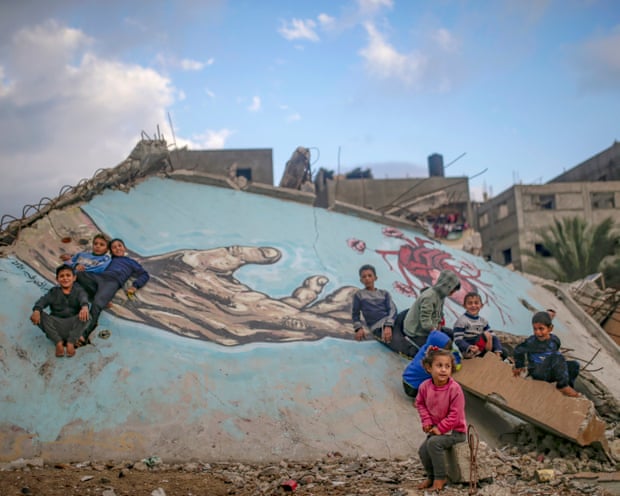
Palestinian children are seen under dire humanitarian conditions despite the ceasefire signed with Israel in Khan Yunis, Palestine on April 03, 2026. [Doaa Albaz – Anadolu Agency]

On Palestinian Children’s Day, the reality for children in Gaza reflects a profound humanitarian crisis, with tens of thousands growing up without parents amid ongoing war and devastation.

Recent data indicates that the number of orphans in the Gaza Strip has reached approximately 64,616 children, most of whom have lost one or both parents during the latest Israeli aggression. The figure underscores the scale of the social catastrophe affecting an entire generation and is expected to rise as the consequences of the war continue to unfold.

Before the war, the number of orphans in Gaza did not exceed 22,000, highlighting the unprecedented increase in a short period.

READ: Palestinian man with special needs killed by Israeli occupation fire in Gaza

Amid ongoing destruction, children in Gaza face a daily reality marked by loss, displacement, and deprivation. In shelters and displacement camps, many are seen waiting in aid lines or sitting silently among the ruins of their homes, having lost the families that once provided stability and protection.

The crisis extends beyond immediate humanitarian needs, posing a long-term societal challenge that requires not only relief efforts but also sustained support to rebuild lives and communities.

For many children in Gaza, orphanhood is not only the loss of a parent, but also the loss of security, stability, and a sense of normal childhood, with lasting psychological and social consequences.

READ: Protest held in Gaza to mark 50th anniversary of Palestinian Land Day

This work by Middle East Monitor is licensed under a Creative Commons Attribution-NonCommercial-ShareAlike 4.0 International License.

Keir Starmer explains that UK is actively supporting Israel's genocidal expansion and repeats his previous quotation that he supports Zionism "without qualification". Keir Starmer said “I said it loud and clear – and meant it – that I support Zionism without qualification.” here: https://www.jewishnews.co.uk/keir-starmer-interview-i-will-work-to-eradicate-antisemitism-from-day-one/
Keir Starmer explains that UK is actively supporting Israel’s genocidal expansion and repeats his previous quotation that he supports Zionism “without qualification”. Keir Starmer said “I said it loud and clear – and meant it – that I support Zionism without qualification.” here: https://www.jewishnews.co.uk/keir-starmer-interview-i-will-work-to-eradicate-antisemitism-from-day-one/
Donald Trump calls for help from NATO allies in securing the Straight of Hormuz despite saying on 7 March 2026 that they don't need people to join wars after they've already won. He's challenged with the claim that he lies as much as the IDF.
Donald Trump calls for help from NATO allies in securing the Straight of Hormuz despite saying on 7 March 2026 that they don’t need people to join wars after they’ve already won. He’s challenged with the claim that he lies as much as the IDF.
Greenpeace ship Arctic Sunrise. [Photo by Steve Sharp on Unsplash]
Orcas discuss rotting brain. Front Orca says "Wish someone would lock him up".
Orcas discuss rotting brain. Front Orca says “Wish someone would lock him up”.
Continue ReadingPalestinian Children’s Day: Tens of thousands orphaned in Gaza

WHO warns of catastrophic risks after strike on Bushehr nuclear plant

Spread the love

This work by Middle East Monitor is licensed under a Creative Commons Attribution-NonCommercial-ShareAlike 4.0 International License.

World Health Organization (WHO) Director-General Tedros Adhanom Ghebreyesus in Geneva on 27 May, 2024 [FABRICE COFFRINI/AFP via Getty Images]

Tedros Adhanom Ghebreyesus has warned of catastrophic consequences following the targeting of Iran’s Bushehr Nuclear Power Plant, amid escalating conflict in the region.

In a statement posted on X, the Director-General of the World Health Organisation said he shares the concerns of the International Atomic Energy Agency regarding the safety of nuclear facilities in Iran.

He stressed that any attack on a nuclear site could trigger a nuclear accident, warning that such an event would have long-term and far-reaching health consequences.

“The recent attack on the Bushehr nuclear plant is a stark reminder,” Tedros said, adding that the risks are increasing with each passing day of the ongoing war.

READ: ‘Radioactive fallout will end life in GCC capitals, not Tehran’: Top Iranian diplomat

He called for urgent de-escalation, stating that peace remains “the best medicine” to prevent further deterioration.

The Bushehr facility was reportedly targeted on Saturday, marking the fourth such attack since the start of the US-Israeli offensive against Iran on 28th February.

Since then, Israel and the United States have been waging a war against Iran that has resulted in thousands of deaths and injuries, while Tehran has responded by launching missiles and drones toward Israeli-controlled areas.

Iran has also targeted what it describes as American sites and interests in Arab countries; however, some of these attacks have caused deaths, injuries, and damage to civilian infrastructure, drawing condemnation from the affected states.

The escalation comes despite reports that Iran had been making progress in negotiations with Washington regarding its nuclear program, with mediation efforts involving Oman.

The United States and Israel accuse Iran of pursuing nuclear and missile programs that threaten regional security, while Tehran maintains that its nuclear program is peaceful and not intended for weapons development.

READ: Russia evacuating employees from Iran’s Bushehr nuclear power plant in wake of attack

Keir Starmer explains that UK is actively supporting Israel's genocidal expansion and repeats his previous quotation that he supports Zionism "without qualification". Keir Starmer said “I said it loud and clear – and meant it – that I support Zionism without qualification.” here: https://www.jewishnews.co.uk/keir-starmer-interview-i-will-work-to-eradicate-antisemitism-from-day-one/
Keir Starmer explains that UK is actively supporting Israel’s genocidal expansion and repeats his previous quotation that he supports Zionism “without qualification”. Keir Starmer said “I said it loud and clear – and meant it – that I support Zionism without qualification.” here: https://www.jewishnews.co.uk/keir-starmer-interview-i-will-work-to-eradicate-antisemitism-from-day-one/
Donald Trump calls for help from NATO allies in securing the Straight of Hormuz despite saying on 7 March 2026 that they don't need people to join wars after they've already won. He's challenged with the claim that he lies as much as the IDF.
Donald Trump calls for help from NATO allies in securing the Straight of Hormuz despite saying on 7 March 2026 that they don’t need people to join wars after they’ve already won. He’s challenged with the claim that he lies as much as the IDF.
Greenpeace ship Arctic Sunrise. [Photo by Steve Sharp on Unsplash]
Orcas discuss rotting brain. Front Orca says "Wish someone would lock him up".
Orcas discuss rotting brain. Front Orca says “Wish someone would lock him up”.
Continue ReadingWHO warns of catastrophic risks after strike on Bushehr nuclear plant

Over 1,460 killed in Lebanon since beginning of Israeli attacks on March 2: Health Ministry

Spread the love

This work by Middle East Monitor is licensed under a Creative Commons Attribution-NonCommercial-ShareAlike 4.0 International License.

Smoke rises from the targeted sites after the Israeli army carried out eight airstrikes on the Dahieh district in the south of the Lebanese capital, Beirut, on April 05, 2026. [Ethem Emre Özcan – Anadolu Agency]

More than 1,460 people have been killed in Lebanon since Israeli attacks began on March 2, the country’s Health Ministry said Sunday, Anadolu reports.

In a statement, the ministry said the death toll has reached 1,461, with 4,430 others wounded over the same period.

It added that 39 people were killed and 136 injured in the past 24 hours alone.

The ministry also mentioned that 129 of those who lost their lives were children and 97 were women.

At least 54 health care workers were killed, and 145 others were injured in Israeli attacks, added the ministry.

Israel has carried out airstrikes and a ground offensive in southern Lebanon since a cross-border attack by the Lebanese group Hezbollah on March 2, despite a ceasefire that took effect in November 2024.

Hezbollah has fired barrages of rockets into Israel since early March, saying the attacks are in response to continued Israeli strikes on Lebanon, as well as the killing of Iran’s then-Supreme Leader Ayatollah Ali Khamenei in a joint US-Israeli airstrike on Feb. 28.

READ: Pope urges ‘those who have the power to unleash wars’ to choose peace

Keir Starmer explains that UK is actively supporting Israel's genocidal expansion and repeats his previous quotation that he supports Zionism "without qualification". Keir Starmer said “I said it loud and clear – and meant it – that I support Zionism without qualification.” here: https://www.jewishnews.co.uk/keir-starmer-interview-i-will-work-to-eradicate-antisemitism-from-day-one/
Keir Starmer explains that UK is actively supporting Israel’s genocidal expansion and repeats his previous quotation that he supports Zionism “without qualification”. Keir Starmer said “I said it loud and clear – and meant it – that I support Zionism without qualification.” here: https://www.jewishnews.co.uk/keir-starmer-interview-i-will-work-to-eradicate-antisemitism-from-day-one/

This work by Middle East Monitor is licensed under a Creative Commons Attribution-NonCommercial-ShareAlike 4.0 International License.

Orcas discuss rotting brain. Front Orca says "Wish someone would lock him up".
Orcas discuss rotting brain. Front Orca says “Wish someone would lock him up”.

Continue ReadingOver 1,460 killed in Lebanon since beginning of Israeli attacks on March 2: Health Ministry

No apologies – Naming Zionism for what it is

Spread the love

This work by Middle East Monitor is licensed under a Creative Commons Attribution-NonCommercial-ShareAlike 4.0 International License

by Ranjan Solomon

Israeli settlers, under the protection of Israeli forces, raid the Old City of Hebron in the southern West Bank on January 31, 2026. [Amer Shallodi – Anadolu Agency]

“A people that oppresses another cannot itself be free” -Friedrich Engels –

Zionism is racism. I state this plainly, not as a slogan designed to provoke, but as a conclusion drawn from history, lived reality, and the political structure that has emerged in what is now called Israel. I am not interested in diluting this claim to make it more comfortable, nor in softening its edges to invite polite debate. Some ideas demand clarity, not compromise.

Zionism presents itself as a movement for Jewish self-determination. In isolation, that principle sounds reasonable—every people should have the right to shape their political future. But no political project exists in isolation.

Zionism did not emerge in an empty land, and it did not unfold without consequence. It took root in a place where another people already lived, and its realization required their displacement, their fragmentation, and their continued subordination.

The events of 1948 are not a tragic misunderstanding or an unfortunate byproduct of state-building. They are central. Hundreds of thousands of Palestinians were expelled or fled from their homes, entire villages were destroyed, and a society that had existed for generations was systematically dismantled. Palestinians remember this as the Nakba – “the catastrophe”—and that name is not rhetorical exaggeration. It is an accurate description of a foundational rupture that continues to shape every aspect of Palestinian life.

What followed was not a temporary injustice but the consolidation of a system. Land laws, citizenship structures, and state policies were crafted in ways that privileged Jewish identity while marginalizing Palestinians, whether they remained within the borders of Israel or lived under military occupation in the West Bank and Gaza. This is not incidental. It is the logical outcome of a state built to maintain a demographic and political majority for one group over others.

READ: Gaza ceasefire “formal” as suffering persists, UNRWA chief warns

Supporters of Zionism often argue that it is not racism but national liberation—a response to centuries of persecution culminating in the Holocaust. That history is undeniable and horrific.

The genocide of European Jews stands as one of the greatest crimes in human history. But historical suffering does not grant moral exemption. It does not justify the dispossession of another people, nor does it transform inequality into justice.

If anything, it should deepen the commitment to universal rights, not narrow them.

To point this out is not to deny Jewish history or identity. It is to reject the idea that safety for one people must be built on the exclusion or subjugation of another. A political ideology that enshrines ethnic or religious preference into law – especially in a land shared by multiple communities—cannot be reconciled with genuine equality. When rights are distributed based on identity, discrimination is not a flaw in the system; it is the system.

This reality is visible not only in historical events but in present-day structures. Palestinians in the occupied territories live under military rule, subject to restrictions on movement, access to resources, and basic civil liberties. Within Israel itself, Palestinian citizens face systemic inequalities in areas such as land allocation, housing, and political power. The fragmentation of Palestinian identity – into citizens, residents, refugees, and those under occupation – is not accidental. It is a method of control.

Language often obscures these realities. Terms like “security,” “conflict,” and “disputed territories” create the impression of symmetry, as though two equal sides are engaged in a balanced struggle. But the lived experience tells a different story: one of power and dispossession, of a state with overwhelming military and political dominance over a stateless people. Naming that imbalance matters, because without it, injustice can be reframed as inevitability.

There are those who challenge this system from within. Voices like Miko Peled—an Israeli raised within the Zionist establishment—have come to reject the ideology precisely because they see its consequences. Their critiques are not born of ignorance or hostility but of proximity and reflection. They demonstrate that opposition to Zionism is not synonymous with hostility toward Jews; it is a political and ethical stance against a specific system of power.

Critics of this position often respond by labelling it extreme or unfair. They argue that Zionism has multiple interpretations, that it can be reformed, or that it simply expresses the desire of a people to live in safety. But the question is not what Zionism claims to be in theory. The question is what it has produced in practice. And in practice, it has created and maintained a reality in which one group’s rights and freedoms are structurally elevated above another’s.

READ: Israeli Knesset passes law mandating death penalty for Palestinian prisoners

If we apply the same moral standards we claim to uphold elsewhere – opposition to segregation, to ethno-national supremacy, to systems that privilege one group over another—then the conclusion becomes difficult to avoid.

When a state defines itself in ways that systematically advantage one identity while disadvantaging others, it enters the realm of discrimination. When that discrimination is entrenched in law, policy, and daily life, it is not incidental. It is foundational.

This is why I say that Zionism is racism. Not as an insult, but as a description. It names a system in which identity determines rights, in which history is used to justify inequality, and in which the pursuit of one group’s security has come at the cost of another’s freedom.

There is a tendency to treat such statements as beyond the bounds of acceptable discourse, to insist that they are too harsh, too absolute, too divisive. But discomfort is not the same as inaccuracy. If anything, the resistance to naming the problem reflects how deeply normalized the system has become.

Conclusion:
No system built on inequality can endure without resistance, and no injustice has ever been resolved by refusing to name it. If we believe in dignity, equality, and freedom as universal principles, then they cannot stop at the borders of Palestine, nor be conditional on identity. The choice is not between politeness and truth – it is between maintaining a system of domination or confronting it honestly. I choose honesty. And honesty demands that we say it without hesitation, without dilution, and without apology: Zionism is racism.

OPINION: Dominance without legitimacy in a changing world: The decline of American power

The views expressed in this article belong to the author and do not necessarily reflect the editorial policy of Middle East Monitor.

This work by Middle East Monitor is licensed under a Creative Commons Attribution-NonCommercial-ShareAlike 4.0 International License

Donald Trump calls for help from NATO allies in securing the Straight of Hormuz despite saying on 7 March 2026 that they don't need people to join wars after they've already won. He's challenged with the claim that he lies as much as the IDF.
Donald Trump calls for help from NATO allies in securing the Straight of Hormuz despite saying on 7 March 2026 that they don’t need people to join wars after they’ve already won. He’s challenged with the claim that he lies as much as the IDF.
Keir Starmer explains that UK is actively supporting Israel's genocidal expansion and repeats his previous quotation that he supports Zionism "without qualification". Keir Starmer said “I said it loud and clear – and meant it – that I support Zionism without qualification.” here: https://www.jewishnews.co.uk/keir-starmer-interview-i-will-work-to-eradicate-antisemitism-from-day-one/
Keir Starmer explains that UK is actively supporting Israel’s genocidal expansion and repeats his previous quotation that he supports Zionism “without qualification”. Keir Starmer said “I said it loud and clear – and meant it – that I support Zionism without qualification.” here: https://www.jewishnews.co.uk/keir-starmer-interview-i-will-work-to-eradicate-antisemitism-from-day-one/
A view of a civilian vehicle caught fire as people gather around it after the Israeli army, violating the ceasefire, targeted it on Salah al-Din Street in central Gaza Strip, Palestine, on April 04, 2026. [Screengrab – Anadolu Agency]
Around 20 boats preparing to join the Global Sumud Flotilla’s “Spring Mission 2026” are set to depart from the southern port city of Marseille, France, as part of an initiative aimed at delivering humanitarian aid to Gaza and challenging the ongoing Israeli policy, with vessels readied for weeks at L’Estaque Port by the France Campaign coalition, including the Thousand Madleens to Gaza movement and the Freedom Flotilla Coalition, on April 03, 2026. [Esra Taşkın – Anadolu Agency]
Orcas discuss how Trump was re-elected and him being an obviously insane, xenophobic Fascist.
Continue ReadingNo apologies – Naming Zionism for what it is