Peter Mandelson’s Consultancy Lobbied New Government on Behalf of Shell

Spread the love

Original article by Adam Barnett republished from DeSmog.

UK Ambassador to the U.S. Peter Mandelson. Credit: Credit: IMF / Flickr (CC BY-NC-ND 2.0)

Labour’s new ambassador to the U.S. founded Global Counsel, a firm with major fossil fuel clients.

Labour’s top diplomat to Donald Trump’s United States leads a public affairs firm that has attempted to influence the new UK government on behalf of the oil and gas giant Shell, and the coal mining company Anglo American.

Peter Mandelson – who was a Cabinet minister under former Labour prime ministers Tony Blair and Gordon Brown – has been accepted as the UK’s ambassador to the U.S. by Trump’s new administration.

In addition to his new diplomatic role, which he will formally begin in February, Mandelson is president and chair of Global Counsel, a London-based political consultancy and lobbying organisation. He will retain shares in the company even after taking up his new position in Washington DC, the Financial Times has reported.

According to official records, after July’s general election Global Counsel lobbied the new Labour government on behalf of Shell, one of the world’s most polluting companies.

Shell is still committed to exploring for new sources of oil and gas and does not have any plans to reduce the overall amount it produces by 2030, in contravention of climate science. In 2021, the District Court of the Hague found that the total CO2 emissions of the Shell group exceeded the emissions of many states, including the Netherlands.

Lobbyists must declare if they have attempted to arrange meetings or influence ministers or senior civil servants on behalf of their clients. However, the contents of these discussions are not publicly available.

Global Counsel seemingly has close ties to the Labour Party. Prior to the 4 July election, the company supplied a staff member to Tulip Siddiq, who served as financial secretary to the Treasury until 14 January, a donation in kind worth £35,835, according to the register of MPs’ financial interests

Global Counsel is one of seven consultancies with a history of donating to Labour that have lobbied on behalf of fossil fuel clients since July’s election.

The client list at Mandelson’s lobbying firm also includes Anglo American, a British mining multinational which is a major producer of coal, and U.S. multinational bank JP Morgan, which has financed $430 billion in fossil fuel projects since the 2015 Paris Agreement, including $40 billion in 2023, according to the NGO Banktrack.

Another client, UK bank Standard Chartered, has financed $71 billion in fossil fuel projects in the same period, including $7 billion in 2023. 

Other Global Counsel clients include food and beverage giant Nestle, which has emissions three times the size of its home country Switzerland, and the controversial tech firm Palantir, founded by Trump ally Peter Thiel

Mandelson, who called Trump “reckless and dangerous to the world” in 2019, this week told Fox News his previous remarks were “ill-judged and wrong”, and that he has a “fresh respect” for the new U.S. president.

Global Counsel, and the Cabinet Office were approached for comment.

Transatlantic Ties

Mandelson’s appointment comes at a crucial time for climate policy, with a transatlantic network of political actors working increasingly closely to derail global action to achieve net zero emissions. 

Since his inauguration last week, President Trump has removed the U.S. from the flagship 2015 Paris climate accord, banned offshore wind farms, and declared a “national energy emergency” in order to open new oil and gas projects. 

His plans could add an extra four billion tonnes of carbon dioxide equivalent to U.S. emissions by 2030, according to the climate publication Carbon Brief. 

Trump received more than $32 million from the oil and gas sector for his 2024 campaign. The fossil fuel industry spent $445 million on political donations, lobbying and advertising between January 2023 and November 2024 to influence Trump and Congress, according to the green advocacy group Climate Power. 

As DeSmog revealed last month, Mandelson’s counterpart, Trump’s ambassador to the UK Warren Stephens, runs a firm with investments in several oil and gas companies, including one wholly owned by his family business. 

The UK government is committed to removing fossil fuels from the UK’s power system by 2030, but this week approved a third runway at Heathrow Airport – the second most polluting airport in the world, according to a 2021 study – and pledged to remove environmental regulations on new building projects. 

According to the UN’s Intergovernmental Panel on Climate Change (IPCC), the world’s foremost climate science body, the next few years are crucial if we want to limit the worst effects of global warming, including drought, flooding, and heat waves.

To keep within the 1.5C warming limit set by the Paris Agreement, the IPCC says that emissions need to be reduced by at least 43 percent by 2030 compared to 2019 levels, and at least 60 percent by 2035.

Original article by Adam Barnett republished from DeSmog.
Continue ReadingPeter Mandelson’s Consultancy Lobbied New Government on Behalf of Shell

Treasury minister: Lobbyists are ‘huge and important part’ of government plans

Spread the love

Original article by Ethan Shone republished from OpenDemocracy under a Creative Commons Attribution-NonCommercial 4.0 International licence.

The Treasury is at the centre of a move to refocus the government’s agenda on ‘growth at all costs’
 | Leon Neal/Getty Images

Exclusive: Government is inviting lobbyists and their clients to play a major role in the deregulatory agenda

“Growth comes from business, not the government.”

That was the message a government minister delivered to hundreds of corporate lobbyists, including those representing banks, arms companies and pharmaceuticals, during a webinar this morning.

Lord Livermore, the financial secretary to the Treasury, made the comments at the online event, which was the first in a series aimed at encouraging lobbyists to play a major role in the government’s ‘growth at all costs’ agenda.

In the call, which openDemocracy attended, Livermore made clear that Number 10 sees this agenda as being driven by corporations, while the government is a secondary actor that “work[s] in partnership with business”.

Also present among the 700 attendees were lobbyists representing tech firms, energy giants and consultancies, and those working for agencies including Hanbury, Headland, Lexington, Brunswick, Cavendish and Grayling.

These people and their clients are a “huge and important part” of the government’s plans, Livermore said, stressing that ministers are “really keen to draw on… the expertise that exists within your organisations and your clients”.

He added that the government’s focus is on getting rid of “stifling regulation that has for too long held business back” and “removing barriers to growth that we, in partnership with business, identify”.

The treasury minister also discussed Great British Energy’s role in “derisking investment” and providing capital for public-private partnerships, to make renewable infrastructure investment more attractive to the market.

While the government has been unapologetic about its outreach to business as a means to drive growth, Labour’s critics say an ever-closer relationship with lobbyists only heightens the impression of a government that does not have an agenda of its own.

Speaking to openDemocracy after the call, Green Party deputy leader Zack Polanski said: “With inequality rife, the government should be listening to the people who keep our country running and those suffering, not hosting desperate mass Zoom calls with arms dealers and oil giants.”

Cutting red tape

Setting out the government’s priorities, Livermore put a particular focus on achieving major reform to the planning system to encourage more commercial and infrastructure projects, and getting rid of regulations that “stand in the way of businesses investing”.

Livermore talked up the recent ousting of the head of the competitions regulator and his replacement with a former Amazon executive as evidence that the government is taking seriously its deregulatory agenda.

He also mentioned the recent push for regulators to submit proposals for growth and said Labour’s National Wealth Fund will “help catalyse private investment into sectors where at the moment, perhaps there’s a too high degree of risk”.

“We can use the National Wealth Fund to help derisk some of those investments,” said the minister. Economists describe this process as the state stepping in to improve the private returns on infrastructure assets.

Livermore continued that the fund could be used to “guide investments, particularly into the kind of clean energy investments of the future that we want to see”.

The government-lobbyist calls are being led by a new partnerships team in No 10 fronted by James Carroll, who has previously worked for the party on external relations and business engagement.

Also on the call was a senior executive at Anacta UK, described by The Times as the “first Starmerite lobbying firm”, and a banking lobbyist who is also involved in the running of Labour in the City, a group which convenes Labour supporters who work in financial services.

Lobbyists were able to submit questions during the call. One criticised “some parts of the business community” which have been “vocally critical about the government’s handling of the economy so far,” describing it as “unhelpful”.

They then asked: “How can firms who don’t want to talk down the UK but would rather promote a more positive narrative about the many opportunities open to British businesses best work with the government to do so?”

This prompted Carroll to quip: “I promise I haven’t planted that question.”

Carroll then rounded out the call by reiterating the importance the government places on developing this relationship with lobbyists.

“Just to emphasise,” he said, “your clients [and] your expertise is critical to delivering these ambitious national missions the prime minister has set out and the chancellor reiterated this week.”

Polanski, the Green’s deputy leader, said the plans to derisk investment “amounts to privatising the rewards and socialising the risks”.

He added: “Regulation exists for a reason, Grenfell stands as a towering reminder of lives lost and the total failure of standards.

“This isn’t growth for the many, just more wealth for the super-rich while the rest of us are told to look up at their private jets and wait for the trickle down.”

Original article by Ethan Shone republished from OpenDemocracy under a Creative Commons Attribution-NonCommercial 4.0 International licence.

Continue ReadingTreasury minister: Lobbyists are ‘huge and important part’ of government plans

Labour’s rush to Thatcherism: what’s going on?

Spread the love

https://morningstaronline.co.uk/article/labours-rush-thatcherism-whats-going

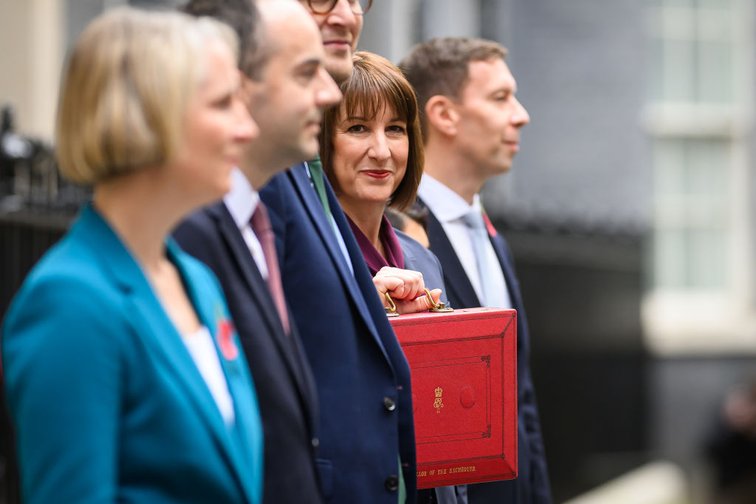
Chancellor of the Exchequer Rachel Reeves during a visit to Premier Modular in Driffield, Humberside, January 30, 2025

SOLOMON HUGHES examines how Labour has gone from blaming Tory deregulation for our economic woes to betting the nation’s future on more of it

WHEN Keir Starmer finally got his prime ministerial phone call with President Trump on Sunday, according to Number 10 the two “discussed trade and the economy, with the Prime Minister setting out how we are deregulating to boost growth.”

Which is odd, because the word “deregulation” isn’t in the Labour manifesto. In fact, before the election Business Secretary Jonathan Reynolds argued deregulation was a Tory sin that didn’t bring growth.

Starmer was telling Trump the truth — Labour are pressing regulators to let business do what it wants in the desperate hope they will get some “growth” to drag up their low polling. But why does Keir tell Trump the truth before British voters?

Perhaps aware that they had stumbled into openly admitting they are a “deregulation” government, despite previous promises, Starmer finally decided to lay this out by writing in The Times, making a Tory argument in the Tory press.

In his Times article Starmer admitted: “This may seem like an unusual goal for Labour politicians. But deregulation is now essential for realising Labour ambitions in this era.”

He referred admiringly to Thatcher’s deregulation and launched into purple prose about the need to hack at “thickets of red tape” to “clear out the regulatory weeds and allow a new era of British growth to bloom” and “curb regulator overreach.”

https://morningstaronline.co.uk/article/labours-rush-thatcherism-whats-going

Keir Starmer, Angela Rayner and Rachel Reeves wear the uniform of the rich and powerful. They have all had clothes bought for them by multi-millionaire Labour donor Lord Alli. CORRECTION: It appears that Rachel Reeves clothing was provided by Juliet Rosenfeld.
Continue ReadingLabour’s rush to Thatcherism: what’s going on?

Optics over outcomes: How the Chancellor’s airport expansion plans don’t add up

Spread the love

https://neweconomics.org/2025/01/optics-over-outcomes-how-the-chancellors-airport-expansion-plans-dont-add-up

By the government’s own analysis, expansion will not improve outcomes for communities across the UK

Source: Civil Aviation Authority and ONS Travelpac

Of the 70-odd million additional passengers the proposed expansions of Heathrow, Gatwick, and Luton would put in the air at their peak, we can expect between two-thirds and three-quarters (or 45 – 50 million) to be UK residents on their way out of the country. Making air travel cheaper while the cost of domestic leisure, hospitality, and overland travel remains prohibitively high leaves many squeezed households with little choice. Between 25 – 50% of travellers report ​‘cost’ as a key factor in their decision whether to stay in the UK or travel abroad.

From a high point in 2022, the UK’s domestic tourism industry has now seen two years of decline, contributing to the very stagnation that troubles the Chancellor. At the same time UK residents have poured overseas in record numbers, taking their hard-earned cash with them. New NEF analysis suggests trips to Mediterranean resort destinations and the Canary Islands hit a new record in 2024. Our top 20 direct routes saw passenger numbers rise from their 2019 peak of 52 million to 56 million last year.

The last line of economic defence of the proposed expansion of Heathrow is perhaps the weakest of them all. Many desire to increase Heathrow’s standing as a hub airport, this means capturing ​”international to international” passengers changing flights in the UK. As these passengers stop in the UK for a matter of a few hours at most they leave little economic value behind. They also pay no air passenger duty so the benefit to the Treasury is minimal. Their flights do, however, come under the UK’s climate responsibilities. Transfer passengers are a boon for the airports and airlines, and the predominantly foreign-domiciled entities which own them, but of little value to the rest of us.

Today’s airport decisions hint of desperation from a government seemingly more interested in optics for a select group of wealthy international investors than actual improvements in economic outcomes for communities all across the UK.

https://neweconomics.org/2025/01/optics-over-outcomes-how-the-chancellors-airport-expansion-plans-dont-add-up

Continue ReadingOptics over outcomes: How the Chancellor’s airport expansion plans don’t add up

‘We’d go absolutely nuts’: PM warned of Labour fight if he backs huge oilfield

Spread the love

https://www.theguardian.com/environment/2025/jan/31/keir-starmer-warned-against-approving-rosebank-oilfield-labour-unease-heathrow

[Guardian] Exclusive: MPs and ministers say they would oppose Starmer if he tries to approve Rosebank development

Senior Labour figures are warning of a serious fight if Keir Starmer tries to give the go-ahead to a giant new oilfield off Shetland later this year.

MPs and ministers have told the Guardian they are prepared to oppose the UK prime minister should he try and give final consent to the Rosebank development, which is Britain’s biggest untapped oilfield.

Many in the party see the battle over Rosebank as the next front in the struggle between its environmental wing and those around Rachel Reeves who want to push for economic growth above all else. The chancellor signalled her support for a third runway at Heathrow this week as part of the government’s latest push to stimulate the economy.

One ally of the energy secretary, Ed Miliband, who is leading the government’s climate agenda, said the former Labour leader would have a “punchy” response for any attempt to give consent to Rosebank. The ally said: “Ed will come to that fight armed with a lot of evidence about what Rosebank will do to our carbon emissions.”

A spokesperson for Miliband declined to comment.

https://www.theguardian.com/environment/2025/jan/31/keir-starmer-warned-against-approving-rosebank-oilfield-labour-unease-heathrow

Orcas are pleased that Rosebank and Jackdaw oil fields are blocked.
Continue Reading‘We’d go absolutely nuts’: PM warned of Labour fight if he backs huge oilfield