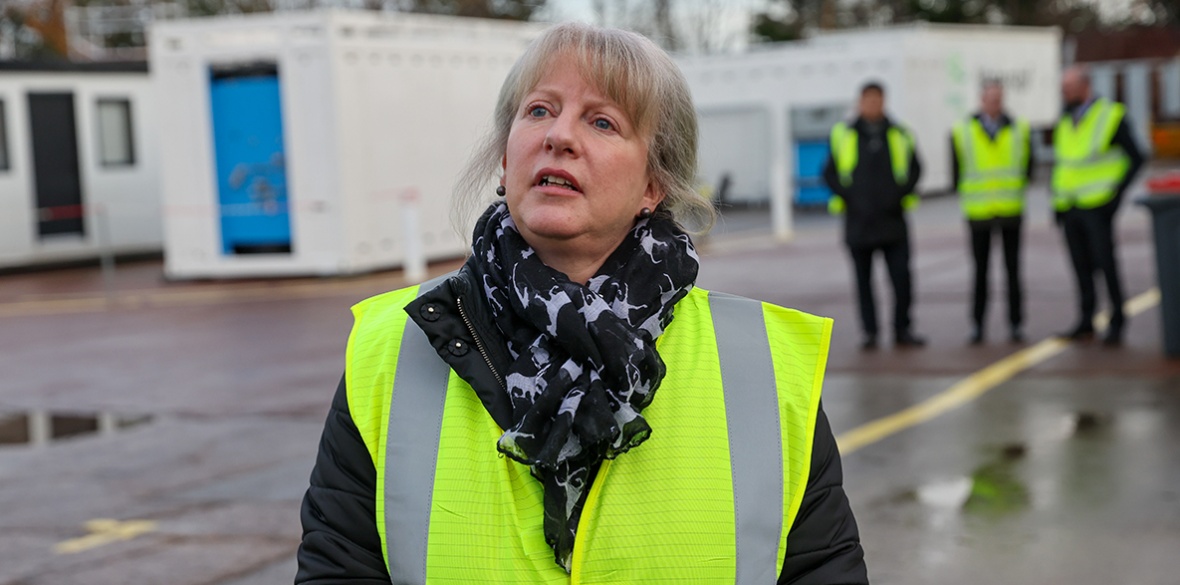
Finance Secretary Shona Robison during a visit to Logan Energy Limited in Edinburgh ahead of the publication of the Scottish Budget, December 4, 2024
SCOTTISH Finance Secretary Shona Robison announced that the two-child cap on benefits will be scrapped in Scotland as she pledged record spending for both the NHS and councils in next year’s Budget today.
The moved to scrap the cap would lift 15,000 children out of poverty, Ms Robison said.
She told MSPs as she outlined her draft Budget plans in Holyrood: “Be in no doubt that the cap will be scrapped.”
Ms Robison slammed the UK Labour government’s inaction on a “pernicious” policy considered to be a key driver of child poverty by organisations such as the Poverty Alliance.
She challenged the UK government to work with them and share the necessary information to “build a system” to mitigate it “as early as we can in 2026.”
Amnesty International’s 296-page report – ‘You Feel Like You Are Subhuman’: Israel’s Genocide Against Palestinians in Gaza – documents how, during its military offensive launched in the wake of the deadly Hamas-led attacks in southern Israel on 7 October 2023, Israel has unleashed hell and destruction on Palestinians in Gaza brazenly, continuously and with total impunity.
Over the past two months the crisis has grown particularly acute in the North Gaza governorate, where a besieged population is facing starvation, displacement and annihilation amid relentless bombardment and suffocating restrictions on life-saving humanitarian aid.
Amnesty’s report examines in detail Israel’s violations in Gaza over the nine months between 7 October 2023 and early July 2024, with Amnesty interviewing 212 people – including Palestinian victims and witnesses, local authorities in Gaza and healthcare workers – while conducting fieldwork and analysing an extensive range of visual and digital evidence, including satellite imagery. Amnesty also analysed statements by senior Israeli government and military officials, and official Israeli bodies. On multiple occasions, Amnesty shared its findings with the Israeli authorities but has received no substantive response.
Agnès Callamard, Amnesty International’s Secretary General, said:
“Amnesty International’s report demonstrates that Israel has carried out acts prohibited under the Genocide Convention, with the specific intent to destroy Palestinians in Gaza.
“These acts include killings, causing serious bodily or mental harm and deliberately inflicting on Palestinians in Gaza conditions of life calculated to bring about their physical destruction.
“Month after month, Israel has treated Palestinians in Gaza as a subhuman group unworthy of human rights and dignity, demonstrating its intent to physically destroy them.
“Our damning findings must serve as a wake-up call to the international community: this is genocide. It must stop now.
“States that continue to transfer arms to Israel at this time must know they are violating their obligation to prevent genocide and are at risk of becoming complicit in genocide.
“All states with influence over Israel, particularly key arms suppliers like the USA and Germany, but also other EU member states – the UK and others – must act now to bring Israel’s atrocities against Palestinians in Gaza to an immediate end.
“The International Criminal Court’s arrest warrants for Prime Minister Benjamin Netanyahu and former Defence Minister Yoav Gallant for war crimes and crimes against humanity issued last month offer real hope of long-overdue justice for victims.
“States must demonstrate their respect for the court’s decision and for universal international law principles by arresting and handing over those wanted by the ICC.”
Sacha Deshmukh, Amnesty International UK’s Chief Executive, said:
“As a state party to the Genocide Convention, the UK has a legal obligation to use all reasonable means to help prevent genocide.
“The UK must take urgent steps to make clear to Israel that this country does not support genocidal acts against Palestinians in Gaza, and those acts must end immediately.
“The UK government must, as an urgent first step, work with other countries by all diplomatic and legal means to press Israel into fully implementing the provisional measures ordered by the International Court of Justice.
“To avoid the risk of itself being complicit in genocide, the UK must immediately end all arms transfers to Israel.
“The UK should also press for multilateral targeted sanctions at the UN Security Council against Israeli and Hamas officials most implicated in crimes under international law.
“The UK must act to ensure justice and accountability, supporting the ongoing International Criminal Court investigation into Palestine and executing any ICC arrest warrants.”
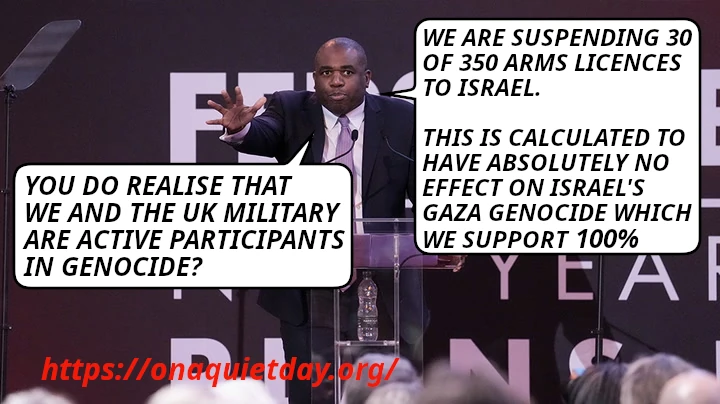
Genocide denying UK Foreign Secretary David Lammy says that UK is suspending 30 of 350 arms licences to Israel. He also confirms the UK government’s support for Israel’s Gaza genocide and the UK government and military’s active participation in genocide.
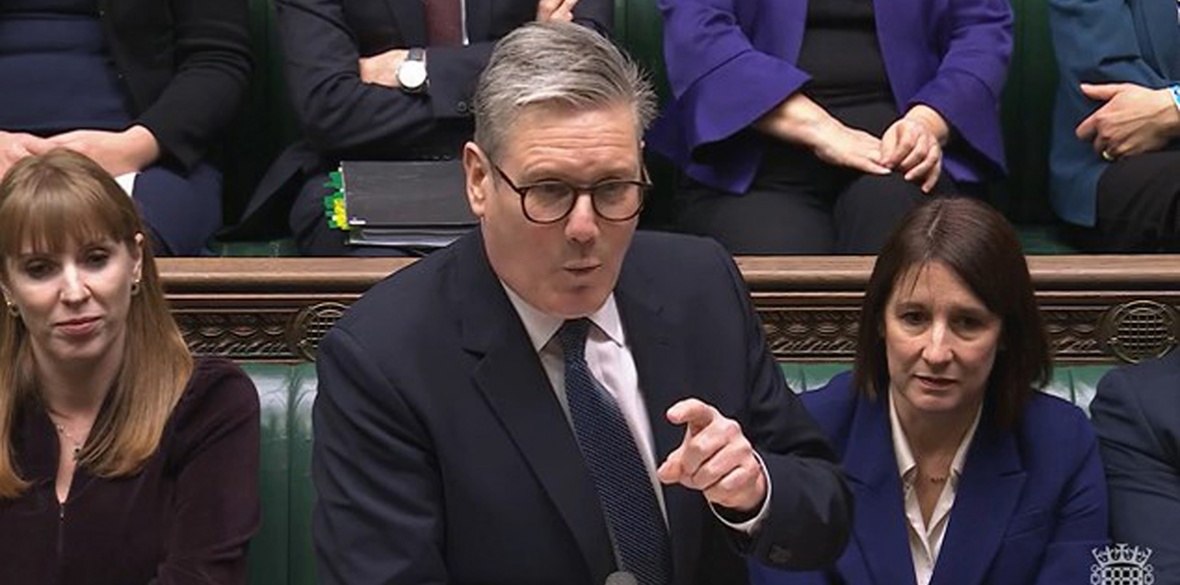
Screen grab of Prime Minister Sir Keir Starmer speaking during Prime Minister’s Questions in the House of Commons, London, December 4, 2024
PRIME Minister … Keir Starmer ruled out electoral reform in the Commons today, brushing aside Labour’s own agreed policy on the issue.
He was challenged by Liberal Democrat leader Sir Ed Davey at Prime Minister’s Questions (PMQs) to give effect to a vote by MPs earlier this week to switch elections to a form of proportional representation.
The Commons voted by 138 to 136, with many abstentions, to approve a Bill introduced by Liberal Democrat MP Sarah Olney to change to PR.
Labour MPs were divided in the vote, with 59 backing Ms Olney’s Bill and 50 opposing.
However, support for electoral reform is official party policy agreed by conference.
None of this cut any ice with Sir Keir when pressed. He told Sir Ed that electoral reform “is not our policy,” which is not true.
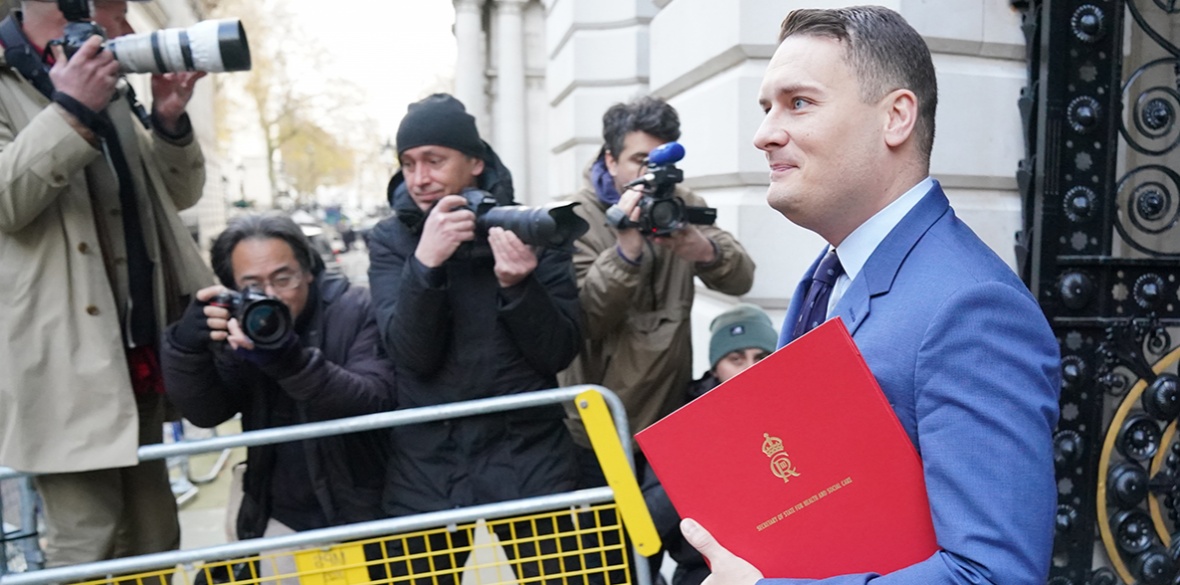
Health Secretary Wes Streeting arrives in Downing Street, London, for a Cabinet meeting, December 3, 2024
HEALTH Secretary Wes Streeting has been urged to honour the New Deal for Working People after failing to back a Unison NHS strike over a £100 million-plus privatisation plan.
More than 350 facilities workers are on a three-week walkout over East Suffolk and North Essex Foundation Trust (ESNEFT’s) plans to outsource their jobs.
Large NHS contracts such as this need Cabinet Office approval but Mr Streeting has said he will not intervene in the trust’s outsourcing bid despite Labour’s promise for the biggest wave of insourcing in a generation, a union source said.
His stance has attracted criticism from Labour MPs, Unison and NHS campaigners, with ESNEFT’s board of directors expected to rubber-stamp the outsourcing of their soft facilities management contract tomorrow.
Eastern Unison head of health Caroline Hennessy said: “Moving these essential teams out of the NHS is a false economy and goes against government pledges on insourcing.
“The trust has spent months trying to justify its ill-thought-out plans to privatise the jobs of these key staff and has failed to win any of the arguments.”
Stocks of food at the Trussell Trust Brent Foodbank, Neasden, London
A COALITION of 120 children’s charities today called for the complete eradication of child poverty in 20 years, increasing pressure for government to scrap the two-child benefit cap.
The End Child Poverty Coalition set out eight tests it said should be met by the government’s taskforce strategy if it is to succeed in tackling and ending child poverty.
Among them was that government must ultimately aim to halve child poverty in the next 10 years, and completely eradicate it in the next 20.
The coalition also said the two-child limit to benefit payments must be scrapped, estimating this could immediately lift around 300,000 children out of poverty, and that “further fundamental reform” to the social security system is needed.
…
End Child Poverty Coalition chair Joseph Howes said: “Child poverty is a blight on our society and is also completely avoidable.
“If the government is serious about tackling and ultimately eradicating child poverty in this country, it needs to be bold and ambitious in its investments, including immediately scrapping the two-child limit to benefit payments.