“The reported decisions by Israel’s security cabinet to make it easier for settlers to buy land in the West Bank and to expand enforcement powers over Palestinians are a profound assault on Palestinian rights, further entrenching occupation and legitimising illegal settlement expansion.
“These measures are built on the foundation of decades of dispossession, subjugation, and military control of Palestinians, and stand against the stark backdrop of the catastrophic genocide committed in Gaza, where swathes of the population remain deprived of vital aid, medical care, and adequate nutrition, and Palestinians in Gaza continue to be killed by Israeli forces despite a ceasefire being in place. These are not the actions of a state seeking peace; they are the latest extension of a long-upheld system that denies Palestinians the right to determine their own future.
“When the Green Party welcomed the UK’s recognition of the state of Palestine last year as a necessary and long-overdue step, we also warned that recognition alone was not enough – it must be accompanied by meaningful action to uphold Palestinian rights. The UK must take those actions now – ban imports from illegal Israeli settlements in Palestine, halt all arms sales to and military cooperation with the Israeli Government, drive independent investigations into war crimes and support justice mechanisms for victims, and impose sanctions on those Israeli Government officials who are responsible, including Benjamin Netanyahu and other senior figures, given the flagrant disregard for international law displayed through the expansion of illegal settlements.”
Genocide denier and Current UK Prime Minister Keir Starmer is quoted that he supports Zionism without qualification. He also confirms that UK air force support has been essential in Israel’s mass-murdering genocide. Includes URLs https://www.declassifieduk.org/keir-starmers-100-spy-flights-over-gaza-in-support-of-israel/ and https://youtu.be/O74hZCKKdpAKeir Starmer objects to criticism of the IDF. He asks how could anyone object to them starving people to death, forced marches like the Nazis did, bombing Gaza’s hospitals and universities, mass-murdering journalists, healthworkers and starving people queuing for food, killing and raping prisoners and murdering children. He calls for people to stop obstructing his genocide for Israel.Orcas discuss Genocide-supporting and complicit Zionists. Donald Trump, Keith Starmer, David Lammy, Rachel Reeves, Angela Rayner and Wes Streeting are acknowledged as evil genocide-complicit and supporting cnuts.
“Donald Trump treats the international stage like a schoolyard playground, attempting to bully and brute force other countries into compliance with his imperialist agenda. The unhinged President’s latest threat to impose tariffs on the UK and a swathe of our European allies is an outrageous abuse of power and a direct attack on the principle of national self-determination, treating the future of Greenland as if it were a piece of spoils to be bought and sold.
“The UK must not be cowed. In an attempt to uphold Britain’s so-called “special relationship” with the US, the UK government has continuously appeased and emboldened the increasingly erratic President as he pursues a dangerous agenda of naked geopolitical vanity. This cannot continue. Chasing the White House’s favour will not secure Britain’s economic future; it leaves us exposed to the whims of a man with no respect for international law and order.
“If we are serious about protecting British jobs and businesses from sudden shocks like this, we need a different strategy: rebuild our relationships with our European neighbours, deepen co-operation across the continent, and rejoin the Customs Union so that our economy is defended by stable, reliable arrangements – not dependent on the fleeting favour of a single foreign leader.
“The UK government must show genuine backbone: publicly reject this brutish manipulation tactic by Trump, stand firm with Greenland’s right to self-determination, and urgently pursue closer, constructive ties with Europe that protect Britain’s long-term interests.
“Greenland cannot be bought – it’s time to prove that Britain can’t be either.”
Elon Musk urges you to be a Fascist like him, says that you can ignore facts and reality then.Donald Fuhrump says that Amerikkka doesn’t bother with crimes or charges anymore, not being 100% Amerikkkan and opposing his real estate intentions is enough.Orcas discuss how Trump was re-elected and him being an obviously insane, xenophobic Fascist.
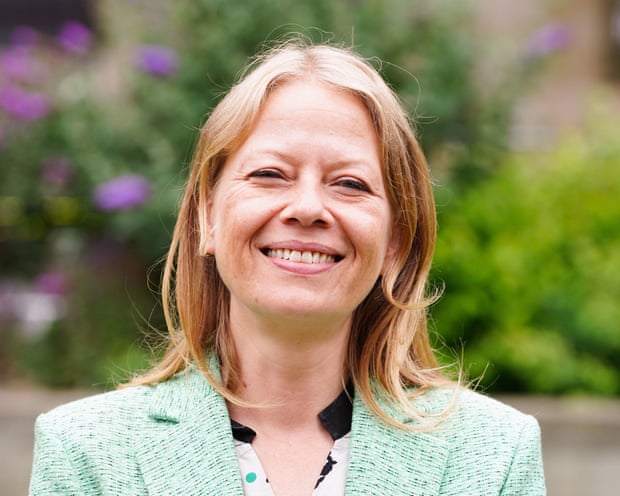
Siân Berry has a long history in politics and success was sweet when she took the Brighton seat. Photograph: Ian West/PA
Since Zack Polanski took over as leader, the party has doubled its membership and its four MPs want to take on Reform’s anger and build community spirit
“Someone has to be out there making the narrative for social security. Someone has to fight the corrosive attitudes to people on benefits,” says Siân Berry, who has just finished her first year as a Green MP in the House of Commons.
She is speaking to the Guardian in her Brighton constituency office, formerly occupied by the legendary Caroline Lucas who flew a lone flag as the only member of parliament for the Green party for 14 years.
Now, however, there are four MPs including Berry, battling together, she says, to hold the space for the left at a moment when it feels the far right has hypnotised the entire political body. “Often Adrian [Ramsay, MP for Waveney Valley] is the only one bringing up animal welfare in Defra questions, or Carla [Denyer, MP for Bristol Central] will be the only person arguing for a refugee’s right to work to the Home Office.” They have all, at different times, been the only party to raise the need for taxes on extreme wealth.
“Caroline was a lone voice in parliament,” she says. ‘But there are four of us so we can share responsibilities. We each shadow six government departments.” Berry’s portfolio covers crime and policing, justice, transport, work and pensions, culture, media and sport and democratic standards. “We absolutely have to be ready if an issue comes up. There are some issues where if a Green isn’t in the chamber asking a question, that question won’t be asked.
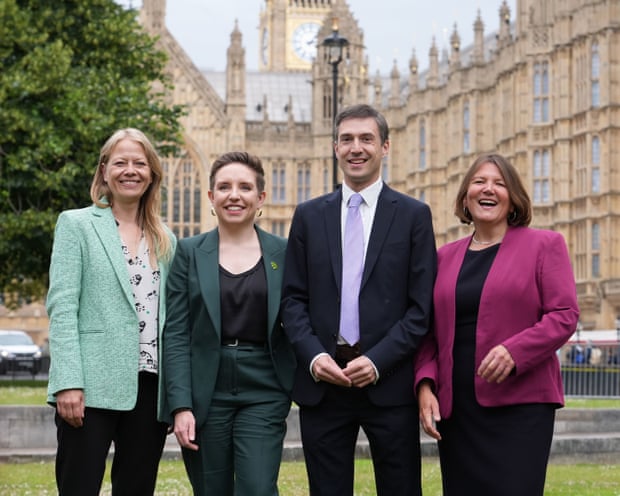
‘There are four of us so we can share responsibilities’: from left, Siân Berry, Carla Denyer, Adrian Ramsay and Ellie Chowns. Photograph: Ian West/PA
…
Most of all, Berry longs to see strong action on climate. “The climate situation is awful. A two degree rise is within sight. We are on a knife-edge of whether we can protect this ecosystem. It’s our only home.”
Nigel Farage urges you to ignore facts and reality and be a climate science denier like him and his Deputy Richard Tice. He says that Reform UK has received £Millions and £Millions from the fossil fuel industry to promote climate denial and destroy the planet.Neo-Fascist Climate Science Denier Donald Trump says Burn, Baby, Burn.
Ellie Chowns, Green Party MP for North Herefordshire. CC image Wikipedia.
Responding to a warning from the UN Secretary General that the world has failed to limit global heating to 1.5C and his call on global leaders to urgently change course at the forthcoming COP30 climate summit in Brazil, Green Party MP Ellie Chowns said:
“It is vital we pay heed to the warnings by the UN Secretary General on the risks posed to the world of breaking through the 1.5C limit, set by the Paris Agreement ten years ago.
“As the birthplace of the industrial revolution, and its legacy of high carbon emissions, the UK has a special responsibility to be a global leader in the shift towards a green economy – and leading by example at home.
“It’s welcome that the PM is attending COP 30 and Keir Starmer must use his voice to demand action that closes the global emissions gap. He must also stand firm against the reckless and dangerous attempts to undermine climate action by Reform UK and the Conservatives. True climate leadership also means resisting pressure from the fossil fuel lobby.
“COP30 is taking place against a backdrop of continued financial support from governments for the fossil fuel industry. This includes an estimated £17.5 billion every year here in the UK.
“The government must also refuse permission for the giant Rosebank oilfield, which would create more emissions than the combined annual CO2 emissions of all 28 low-income countries in the world – the very countries that are bearing the brunt of climate breakdown.”
Nigel Farage urges you to ignore facts and reality and be a climate science denier like him and his Deputy Richard Tice. He says that Reform UK has received £Millions and £Millions from the fossil fuel industry to promote climate denial and destroy the planet.UK Conservative Party leader Kemi ‘not a genocide’ Badenoch explains her reality that the Earth is flat, the Moon is made of cheese and that she was born from
Unicorn horn dustOrcas discuss Donald Trump and the killer apes’ concept of democracy. Front Orca warns that Trump is crashing his country’s economy and that everything he does he does for the fantastically wealthy.
Zack Polanski is the new leader of the Green party in England and Wales after winning a leadership election promising a programme of “eco-populism”. Polanski beat incumbent leader Adrian Ramsay and his partner on the ticket, Ellie Chowns.
It’s been just over a year since the party celebrated its best ever results in the most recent general election. In July 2024, it doubled its vote share and quadrupled its representation in the House of Commons to four MPs.
The same election saw terrible results for the Conservatives and even for Labour, despite its win, raising questions about whether two-party politics was well and truly over. Since then, as professor John Curtice has vividly described, things have started to look even shakier.
This year’s local election saw a “record-breaking” fragmentation of the vote in which less than a quarter of local council seats went to the two main parties. The Greens now hold over 800 seats in more than 170 different councils, adding to their electoral portfolio – which also includes two members of the House of Lords and three London Assembly members.
While Polanski will be celebrating today, party members will look to him to raise their electoral fortunes even further. The electoral challenge for the Greens in England and Wales is two-pronged.
First, the party needs to maintain its position in the seats it has already secured. Its four MPs have fairly comfortable majorities, the smallest being Chowns’ 5,800 majority in North Herefordshire. Second, and perhaps most importantly, it needs to maximise its success in the 40 constituencies where it came second. All but one of these constituencies were won by Labour, which makes Labour voters the prime targets.
My research has shown how the Green party has followed a policy of “total engagement” in recent years. It takes its parliamentary work very seriously, using any and every opportunity to get its message across, even in lower-priority policy areas.
The goal here is to build credibility with the electorate. Small parties tend to want voters to think they are bigger than they are, so they can present themselves as realistic contenders for taking on the heavy work and responsibility of government. Caroline Lucas did a fantastic job of this, punching well above her weight as the party’s only MP between 2010 and 2024.
Together, the Green MPs have made over 380 contributions in the House of Commons. Chowns in particular has been a prolific backbencher, making 161 contributions, while the previous co-leaders Carla Denyer and Ramsay have been much quieter.
With Polanski sitting in the London Assembly rather than the House of Commons, this will inevitably change. The four Green MPs will collectively have more time on their hands and, with the right direction from their new leader, will have the space to be more strategic in their parliamentary activities.
Outsiders
But the Greens have always acted as something of an atypical party too, keeping one foot outside Westminster. Lucas was regularly involved in activism, joining protesters campaigning against tuition fee increases and fracking and to support refugees, to name just a few. She was even arrested in 2013 after joining a protest against energy firm Cuadrilla in Sussex (she was later cleared of all charges in court).
The new Green MPs have continued in this vein, with Sian Berry joining a peaceful protest against far-right agitators in Brighton last year and Chowns pressing the government to water down anti-protest laws.
The new leadership will need to decide whether this strategy enhances their electoral appeal. Does it highlight the Greens’ distinctiveness from the establishment parties, or does it imply they aren’t responsible enough to manage being a party of significant size? The answer depends on who you ask. Polanski has participated in several protests in the past, so chances are this activism will continue to be a core feature of Green party politics.
An added complication for the Greens is that two other parties are also chasing left-leaning voters. One of these is Reform UK. Although associated with rightwing views on social issues, the party came second in many Labour seats in 2024 and needs to appeal to both sides of the political spectrum.
This may explain why the Greens have focused their efforts on highlighting Reform’s failures. Berry, for instance, recently challenged Nigel Farage and his colleagues to publish a log of all their meetings since entering the Commons, arguing that it would be in the public interest.
The other outside threat is Jeremy Corbyn and Zarah Sultana’s new and currently nameless party of the left. While we know little about this party’s policy platform right now, it seems to be veering towards a similarly bottom-up democratic model of organisation which has long been favoured by the Greens – possibly even with co-leaders.
The challenge for the Greens will be to better establish their niche on the left, to ensure they capture voters who are disillusioned with Keir Starmer’s wobbly start. Part of the solution could be to focus on a handful of key policy areas which go beyond the Green party’s niche of environmental issues. At the moment, its MPs take something of a scattergun approach in the Commons, contributing on everything from local buses and universal credit to Ukraine and the Middle East.
Some of the most recent questions asked during Prime Minister’s Questions by Greens hint at the options they might pursue. Ramsay has pushed for a wealth tax on the super rich, and an end to the two-child benefit cap. Both Corbyn and Sultana have, of course, been outspoken on these issues in the past.
If the Greens can’t forge a different path to this new left party, they may have no choice but to consider an electoral pact to avoid splitting the anti-Labour vote right down the middle.