El Niño could push global warming past 1.5℃ – but what is it and how does it affect the weather in Europe?

Spread the love
A natural weather event known as El Niño is underway in the Pacific Ocean.
jon sullivan/Shutterstock

Manoj Joshi, University of East Anglia

Scientists have warned that 2024 could mark the year when global warming exceeds 1.5℃ above pre-industrial levels. They attribute these predictions, at least in part, to the emergence of an El Niño event.

An El Niño is declared when the sea surface temperature in large parts of the central or eastern equatorial regions of the Pacific Ocean warms significantly – sometimes by as much as 2℃. This additional heat in turn warms the atmosphere. During El Niño years, this warming contributes to a temporary rise in the global temperature by a fraction of a degree.


You can listen to more articles from The Conversation, narrated by Noa, here.


El Niño primarily affects weather in the tropics. Intense downpours that would usually fall on parts of south-east Asia or eastern Australia instead fall on the west coast of South America. This change can cause major drought and flooding on different continents, affecting food production and even weather-dependent sports like cricket.

But changes to the weather in these regions can have knock-on effects all over the world. Even thousands of kilometres away in northern Europe, El Niño tends to cause colder and drier winter weather.

Yet many factors affect European weather, especially during winter. So care is needed when linking unusual weather events in Europe to El Niño.
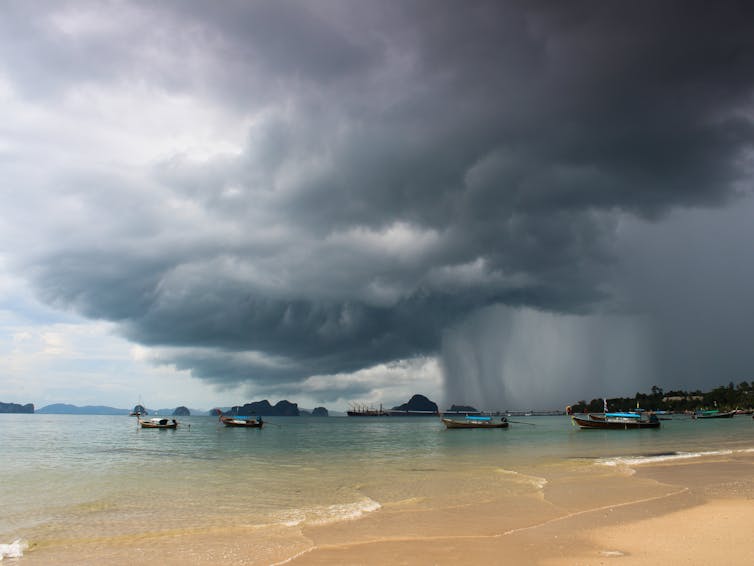
Storm clouds over the Andaman Sea.
Storm clouds over the Andaman Sea, Thailand.
Ian Murdoch/Shutterstock

What is El Niño?

The Pacific Ocean spans over 13,000 kilometres from its eastern edge on the South American coast to its western margins near Indonesia. The sea surface temperature changes considerably over this vast distance.

Normally, the eastern edge of the Pacific Ocean is more than 5℃ colder on average than the western Pacific. This is primarily due to the upwelling of cold water near South America, a process in which colder water is pulled up from deeper down in the ocean.

However, this temperature contrast flattens or steepens every few years in a natural cycle called the El Niño southern oscillation (Enso). During this cycle, the strength of trade winds that blow westwards across the Pacific can strengthen or weaken, causing more or less cold water to upwell and flow along the equator.

We’re currently entering a period where the eastern Pacific will be warmer than it usually is – an El Niño event. Forecasts suggest that a part of the equatorial Pacific, regarded as a key indicator of Enso, has a 50% chance of warming by over 1.5℃ by the start of 2024.

How Pacific Ocean temperatures change during an El Niño event.

La Niña is the opposite phase of the cycle. It is instead characterised by cooler sea surface temperatures in these waters. This year brought an end to three successive La Niña years.

The western tropical Pacific region has some of the warmest ocean temperatures on Earth. Humid air tends to converge here, creating unstable conditions characterised by turbulent rising air known as convection by meteorologists. The result of this is towering clouds and intense rainfall.

The region with the highest ocean temperature tends to experience the greatest amount of rainfall. As the warmest ocean temperatures shift eastward during El Niño, so too does the location of maximum cloud cover and rainfall.

Each El Niño event is different. Some mainly warm the eastern Pacific Ocean, such as the 1997-98 event. Others cause more warming in the central Pacific, like in 2009-10.

How does it affect Europe’s climate?

Towering clouds and intense rains in the western Pacific create atmospheric waves known as Rossby waves. These waves extend over thousands of kilometres and travel into and along the eastward-flowing jet streams that encircle the planet’s mid-latitude regions. When the Rossby waves interact with the jet streams, they cause them to undulate.

As unsettled weather in the Pacific moves eastwards during an El Niño event, it influences the location of the peaks and troughs of these Rossby waves. This results in subtle changes in the positions of the jet streams. These alterations in the jet streams, which play a significant role in shaping weather patterns, can have notable effects on weather conditions worldwide.

Depending on the specific movement of the jet stream in a particular area, the effect can either lead to warmer or cooler weather, despite El Niño warming the global climate as a whole. El Niño tends to slightly warm Europe in summer and slightly cool northern Europe in winter.

External noise

However, a colder-than-average winter in Europe is not guaranteed during an El Niño event. Europe’s winter climate is affected by various factors beyond El Niño, including conditions in the Atlantic, the amount of Arctic sea ice and the state of the stratosphere 15-40km above us (which is itself affected by El Niño).

For instance, the quasi-biennial oscillation – a regular reversal of winds that blow high above the equator – can alter wind patterns in the stratosphere. This can subsequently affect the position of the North Atlantic storm track, which influences Europe’s winter weather.

But even then, the underlying warming trend caused by climate change is making higher temperatures more probable in all seasons. Together, these other factors make any climatic signals from El Niño harder to detect and forecast. Caution must therefore be exercised before attributing anomalies in European winter weather to El Niño alone.


Imagine weekly climate newsletter

Don’t have time to read about climate change as much as you’d like?

Get a weekly roundup in your inbox instead. Every Wednesday, The Conversation’s environment editor writes Imagine, a short email that goes a little deeper into just one climate issue. Join the 20,000+ readers who’ve subscribed so far.The Conversation


Manoj Joshi, Professor of Climate Dynamics, University of East Anglia

This article is republished from The Conversation under a Creative Commons license. Read the original article.
Continue ReadingEl Niño could push global warming past 1.5℃ – but what is it and how does it affect the weather in Europe?

What is a heat dome? An atmospheric scientist explains the weather phenomenon baking Texas and forecast to expand

Spread the love
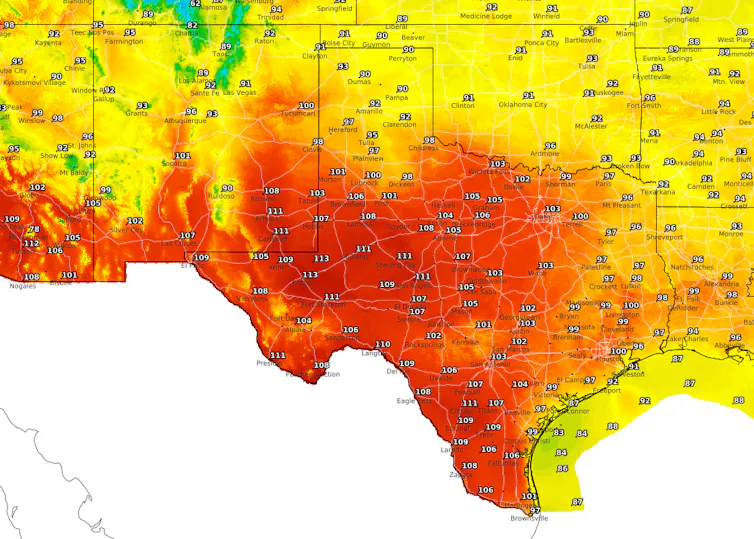
A heat dome began sizzling Texas and its neighbors in mid-June 2023, with warm nights providing little relief. National Weather Service

William Gallus, Iowa State University

A heat dome occurs when a persistent region of high pressure traps heat over an area. The heat dome can stretch over several states and linger for days to weeks, leaving the people, crops and animals below to suffer through stagnant, hot air that can feel like an oven.

Typically, heat domes are tied to the behavior of the jet stream, a band of fast winds high in the atmosphere that generally runs west to east.

Normally, the jet stream has a wavelike pattern, meandering north and then south and then north again. When these meanders in the jet stream become bigger, they move slower and can become stationary. That’s when heat domes can occur.

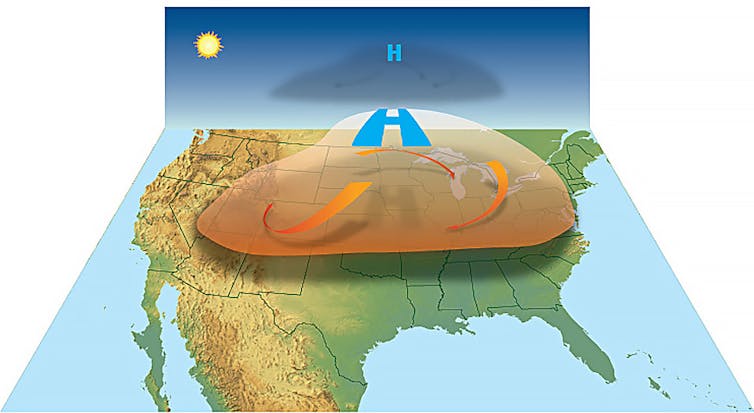
Map of U.S. with a bubble over the Midwest showing arrows moving, with the ridge air sinking
Heat domes involve high-pressure areas that trap and heat up the air below. NOAA

When the jet stream swings far to the north, air piles up and sinks. The air warms as it sinks, and the sinking air also keeps skies clear since it lowers humidity. That allows the sun to create hotter and hotter conditions near the ground.

If the air near the ground passes over mountains and descends, it can warm even more. This downslope warming played a large role in the extremely hot temperatures in the Pacific Northwest during a heat dome event in 2021, when Washington set a state record with 120 degrees Fahrenheit (49 Celsius), and temperatures reached 121 F in British Columbia in Canada, surpassing the previous Canadian record by 8 degrees F (4 C).

The human impact

Heat domes normally persist for several days in any one location, but they can last longer. They can also move, influencing neighboring areas over a week or two. The heat dome involved in the June 2023 heat wave in Texas and Mexico was forecast to expand deeper into the Southwest and South Central U.S.

On rare occasions, the heat dome can be more persistent. That happened in the southern Plains in 1980, when as many as 10,000 people died during weeks of high summer heat. It also happened over much of the United States during the Dust Bowl years of the 1930s.

A heat dome can have serious impacts on people, because the stagnant weather pattern that allows it to exist usually results in weak winds and an increase in humidity. Both factors make the heat feel worse – and become more dangerous – because the human body is not cooled as much by sweating.

The heat index, a combination of heat and humidity, is often used to convey this danger by indicating what the temperature will feel like to most people. The high humidity also reduces the amount of cooling at night. Warm nights can leave people without air conditioners unable to cool off, which increases the risk of heat illnesses and deaths. With global warming, temperatures are already higher, too.

One of the worst recent examples of the impacts from a heat dome with high temperatures and humidity in the U.S. occurred in the summer of 1995, when an estimated 739 people died in the Chicago area over five days.

This article was updated June 26, 2023, with the heat dome in Texas.

William Gallus, Professor of Atmospheric Science, Iowa State University

This article is republished from The Conversation under a Creative Commons license. Read the original article.
Continue ReadingWhat is a heat dome? An atmospheric scientist explains the weather phenomenon baking Texas and forecast to expand

What is a flash drought? An earth scientist explains

Spread the love
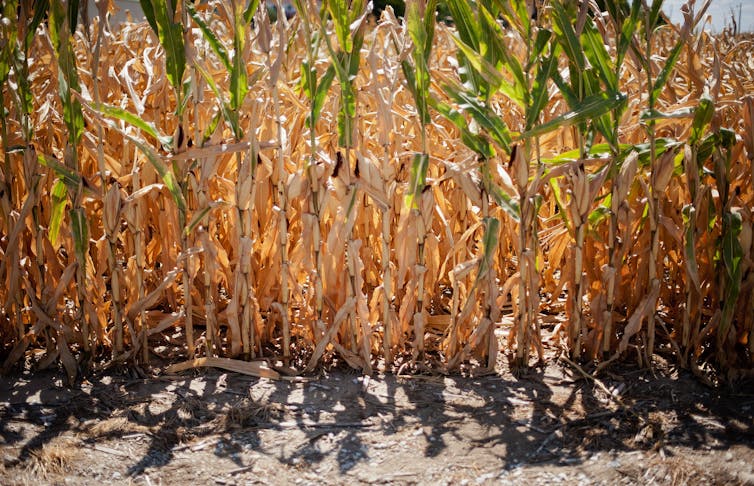
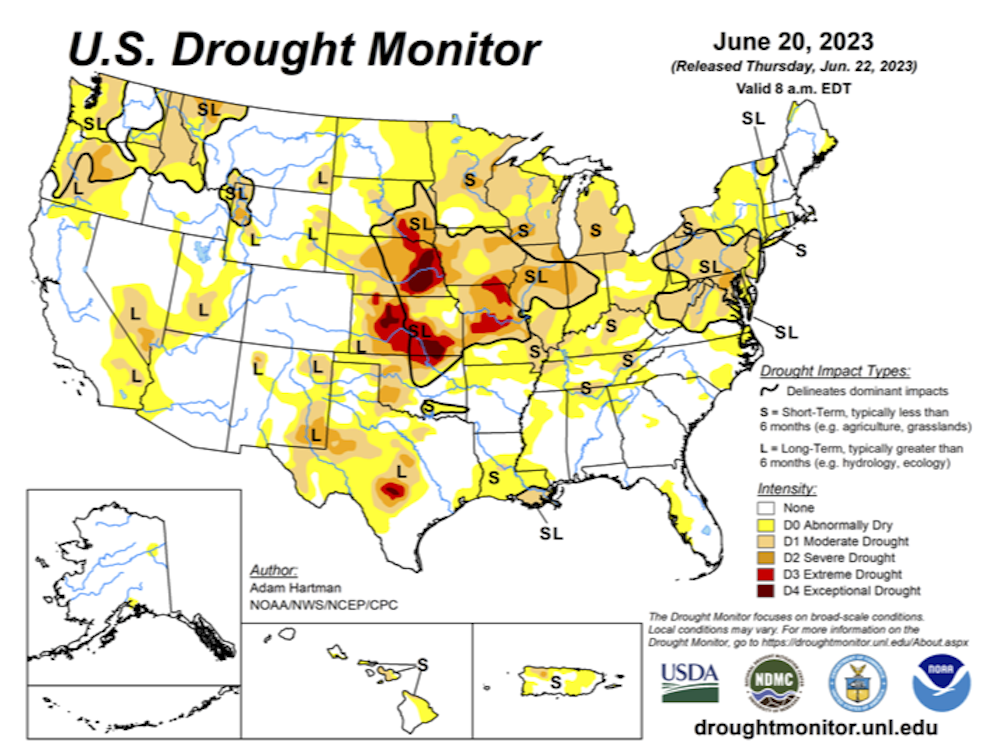
As of June 20, 2023, 64% of the U.S. corn crop faced moderate or more intense drought. Jim Watson/AFP/GettyImages

Antonia Hadjimichael, Penn State

Many people are familiar with flash floods – torrents that develop quickly after heavy rainfall. But there’s also such a thing as a flash drought, and these sudden, extreme dry spells are becoming a big concern for farmers and water utilities.

Flash droughts start and intensify quickly, over periods of weeks to months, compared to years or decades for conventional droughts. Still, they can cause substantial economic damage, since communities have less time to prepare for the impacts of a rapidly evolving drought. In 2017, a flash drought in Montana and the Dakotas damaged crops and grasses that served as forage for cattle, causing US$2.6 billion in agricultural losses.

Flash droughts also can increase wildfire risks, cause public water supply shortages and reduce stream flow, which harms fish and other aquatic life.

Map of drought regions in U.S. with central Plains highlighted.
A developing flash drought in the central U.S. covered 64% of corn territory and 57% of soybean territory in late June 2023. Areas marked S are under short-term drought. U.S. Drought Monitor via USDA

Less rain, warmer air

Flash droughts typically result from a combination of lower-then-normal precipitation and higher temperatures. Together, these factors reduce overall land surface moisture.

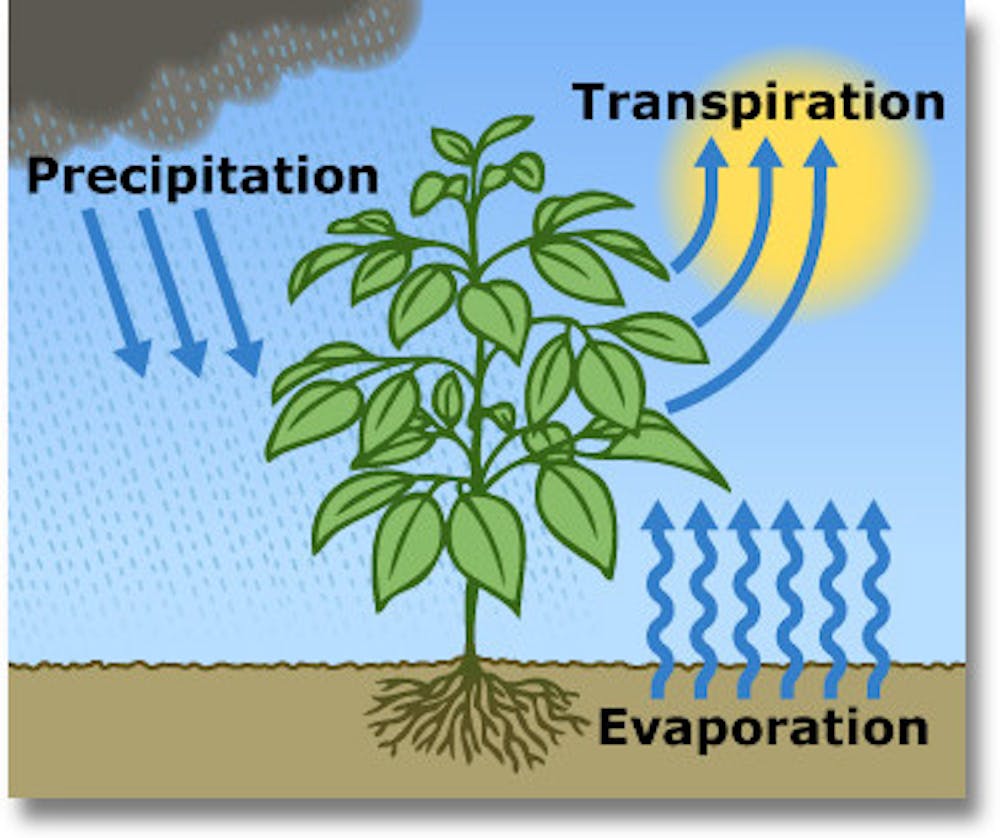
Water constantly cycles between land and the atmosphere. Under normal conditions, moisture from rainfall or snowfall accumulates in the soil during wet seasons. Plants draw water up through their roots and release water vapor into the air through their leaves, a process called transpiration. Some moisture also evaporates directly from the soil into the air.

Graphic showing precipitation, evaporation and transpiration between soil and the atmosphere
Water constantly circulates between soil and the atmosphere – sometimes directly, sometimes via plants. USGS

Scientists refer to the amount of water that could be transferred from the land to the atmosphere as evaporative demand – a measure of how “thirsty” the atmosphere is. Higher temperatures increase evaporative demand, which makes water evaporate faster. When soil contains enough moisture, it can meet this demand.

But if soil moisture is depleted – for example, if precipitation drops below normal levels for months – then evaporation from the land surface can’t provide all the moisture that a thirsty atmosphere demands. Reduced moisture at the surface increases surface air temperatures, drying out the soil further. These processes amplify each other, making the area increasingly hot and dry.

Moist regions can have flash droughts

Flash droughts started receiving more attention in the U.S. after notable events in 2012, 2016 and 2017 that reduced crop yields and increased wildfire risks. In 2012, areas in the Midwest that had had near-normal precipitation conditions through May fell into severe drought conditions in June and July, causing more than $30 billion in damages.

New England, typically one of the wetter U.S. regions, experienced a flash drought in the summer of 2022, with areas including Boston and Rhode Island receiving only a fraction of their normal rainfall. Across Massachusetts, critically low water levels forced towns to issue mandatory water restrictions for residents.

Planning for flash droughts in a changing climate

Conventional droughts, like the Dust Bowl of the 1930s or the current 22-year drought across the southwestern U.S., develop over periods of years. Scientists rely on monitoring and prediction tools, such as measurements of temperature and rainfall, as well as models, to forecast their evolution.

Predicting flash drought events that occur on monthly to weekly time scales is much harder with current data and tools, largely due to the chaotic nature of weather and limitations in weather models. That’s why weather forecasters don’t typically make projections beyond 10 days – there is a lot of variation in what can happen over longer time spans.

And climate patterns can shift from year to year, adding to the challenge. For example, Boston had a very wet summer in 2021 before its very dry summer in 2022.

Scientists expect climate change to make precipitation even more variable, especially in wetter regions like the U.S. Northeast. This will make it more difficult to forecast and prepare for flash droughts well in advance.

But new monitoring tools that measure evaporative demand can provide early warnings for regions experiencing abnormal conditions. Information from these systems can give farmers and utilities sufficient lead time to adjust their operations and minimize their risks.

Antonia Hadjimichael, Assistant Professor of Geosciences, Penn State

This article is republished from The Conversation under a Creative Commons license. Read the original article.
Continue ReadingWhat is a flash drought? An earth scientist explains

Water firm ‘profiteering’ slammed over news of ‘outrageous’ plans to raise bills by 40%

Spread the love

https://leftfootforward.org/2023/06/water-firm-profiteering-slammed-with-news-of-outrageous-over-plans-to-raise-bills-by-40/

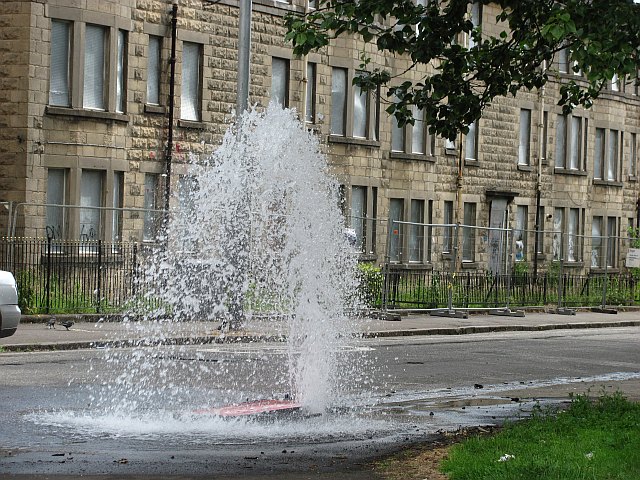
Image of a burst water main.

England’s private water firms are under fire once again today, after reports that they could be set to raise bills by as much as 40%. The touted rise comes as the water industry faces significant pressure to tackle the scandal of sewage being pumped into waterways.

Private companies currently operate thousands of sewer overflows which are used to discharge raw sewage into Britain’s rivers and seas. Last year, private water companies released raw sewage into rivers and seas in England for more than 1.75 million hours, with an average of 825 sewage spills per day.

Critics of the water companies argue that they have prioritised providing returns for shareholders, rather than investment in infrastructure that would have tackled the sewage crisis. Since privatisation in 1989, water companies have paid out more than £70 billion to shareholders.

Anti-privatisation campaign group We Own It has branded reports of major bill rises ‘outrageous’, and has called for water to be taken into public ownership. The group’s director Cat Hobbs told Left Foot Forward: “It’s outrageous. We’ve seen decades of underinvestment in our water system, and now we’re expected to foot the bill for infrastructure improvements.

“What have private companies been doing with their enormous profits for the last 34 years? They’ve paid out £72bn in dividends to shareholders. That’s money that could have been reinvested into our infrastructure to prevent the mess we’re in now. Publicly-owned Scottish water spends £72 more per household per year on tackling infrastructure problems.  

https://leftfootforward.org/2023/06/water-firm-profiteering-slammed-with-news-of-outrageous-over-plans-to-raise-bills-by-40/

Continue ReadingWater firm ‘profiteering’ slammed over news of ‘outrageous’ plans to raise bills by 40%

Dolphins, whales and seals being failed by UK government policy, MPs say

Spread the love

https://www.theguardian.com/environment/2023/jun/28/dolphins-whales-seals-failed-uk-government-policy-environment

UK urged to use trade deals as bargaining tool to protect marine mammals

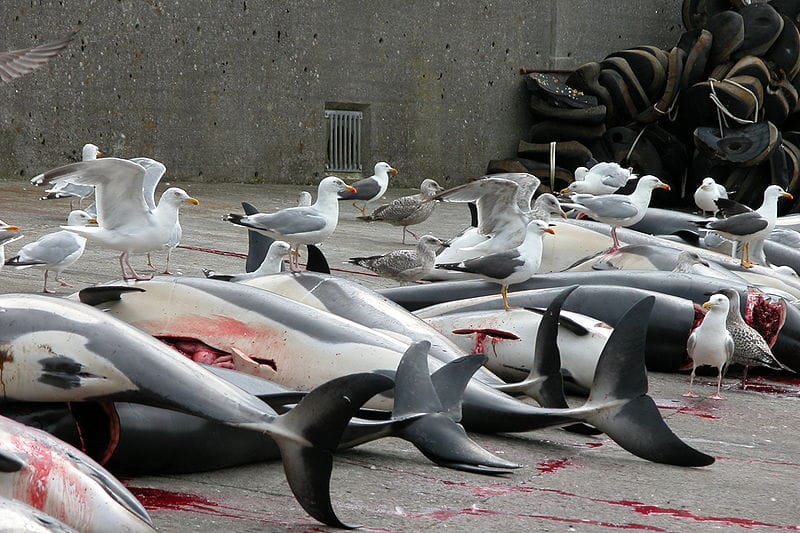
Whales are hunted as part of the traditions of the Faroe Islands, an autonomous Danish territory in the north Atlantic. Image: Arne via wikimedia, Creative Commons Attribution-Share Alike 3.0 Unported

Dolphins and other marine mammals are being failed by the UK government, MPs have said, as they call for ministers not to sign trade deals without considering cetacean welfare.

The UK has poorer protections for dolphins, whales and seals than other countries, a report by the environment, food and rural affairs (Efra) committee has found.

MPs said trade deals were still being struck with countries that hunted whales and dolphins, including Norway, Iceland, Japan and the Faroe Islands, the autonomous Danish territory in the north Atlantic.

Ministers should use their “soft power” to encourage these countries to stop killing marine mammals, the committee recommended, using trade deals to incentivise the halting of the practice.

https://www.theguardian.com/environment/2023/jun/28/dolphins-whales-seals-failed-uk-government-policy-environment

Continue ReadingDolphins, whales and seals being failed by UK government policy, MPs say