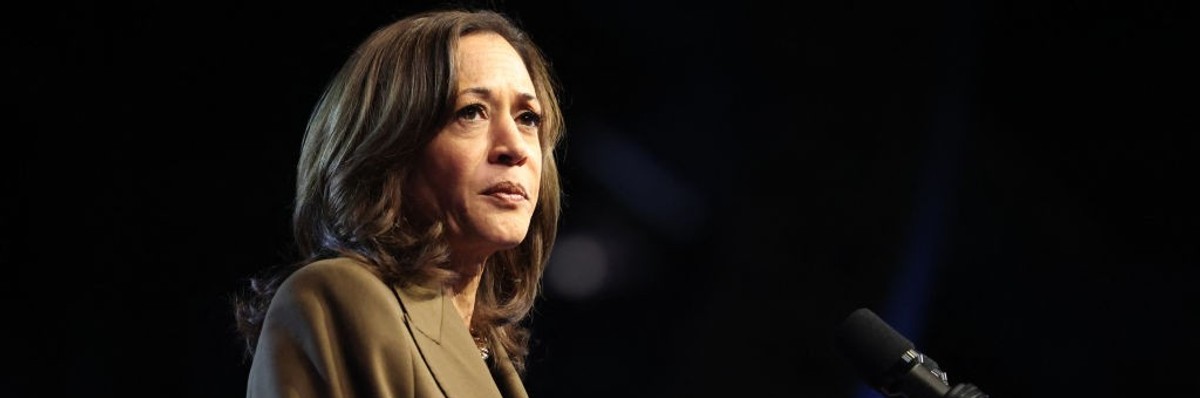
Interview: Harris or Trump doesn’t matter for Gaza genocide

Spread the love

Original article by Nandini Naira Archer republished from Open Democracy under a Creative Commons Attribution-NonCommercial 4.0 International licence.

Pro-Palestine protest outside the Democratic National Convention in Chicago in August 2024. | Fatih Aktas/Anadolu via Getty Images

A year on and no end in sight to genocide – thanks to US support for Israel, which will continue beyond election

A year on from the outset of Israel’s war on Gaza, Israeli forces have killed more than 42,000 Palestinians – and this is just the confirmed death toll. A recent study by the Lancet medical journal projected that the death toll could exceed 186,000 when counting indirect deaths – from starvation and diseases due to the Israeli blockade on humanitarian aid, food, water and medicines.

To take stock of where we’re at and whether this nightmare is likely to end any time soon, openDemocracy spoke to Tariq Kenney-Shawa, a foreign policy analyst based in New York and US Policy Fellow at Al-Shabaka: The Palestinian Policy Network.

openDemocracy: It’s been a year since this latest iteration of Israel’s war on Gaza commenced. Is the end in sight? What’s Israel’s end game?

Tariq: Unfortunately, I don’t see any light at the end of the tunnel here. There is no end in sight to Israel’s genocide in Gaza. And that’s mainly because Israel hasn’t faced an ounce of accountability or pressure to de-escalate from the international community (the US and other western benefactors) to end this.

Get our free Daily Email Get one whole story, direct to your inbox every weekday. Sign up now

I’ve tended to be doubtful when people insist that Israel doesn’t have a plan in Gaza and is just destroying and killing for the sake of it. Israel does have a plan and it has been acting on it. It truly sees this moment in history, as well as the blank check from the US, as a golden strategic opportunity to take leaps towards its ultimate goal of ‘maximum land with minimum Palestinians’ and wider regional domination through brute force.

Israel’s end game in Gaza is erasure, and for the last 12 months, they’ve been laying the foundation for a new reality in Gaza for us all to see. In addition to “thinning out the population,” as Netanyahu said, through genocide, collective punishment, and ethnic cleansing, Israel has been effectively chopping up the Strip into smaller, more controllable enclaves that will come to represent the new “facts on the ground.”

openDemocracy: Has anything about the conflict surprised you?

Tariq: I think one of the most surprising aspects about both the genocide in Gaza and now Israel’s escalation across the region is that it has gone on uninterrupted and without international intervention for so long, despite the fact that just about every massacre has been broadcast for the world to see on social media.

As someone who is part of a generation that grew up being taught that the phrase “never again” really meant something, this is what I have found most jarring. Of course, Gaza is not the first time the international “rules-based” order has been exposed as a crutch for Western hegemony. From Vietnam to Iraq, the West’s selective application of international law has long been exposed for what it is. But Gaza is the first postwar genocide both entirely perpetrated by a Western ally and funded, facilitated, and justified by the West itself, not to mention the first to be so thoroughly recorded for the world to see.

openDemocracy: Now with recent escalations including Iran, do you think realistically we’re on the verge of all-out war in the region?

Tariq: I think we are already seeing an all-out regional war by every definition of the term. Israeli fighter jets are bombing Gaza, the West Bank, Lebanon, Syria, Yemen, and Iran. This is not to mention the strikes the US, UK, and other Israeli benefactors have carried out on Israel’s behalf.

It boils down to this: Israel will continue to escalate across the region in hopes of achieving its extremist, expansionist goals as long as the US taxpayer continues to foot the bill and US assets and personnel are off the coast of Haifa to come to Israel’s defence if need be.

openDemocracy: It seems that the Biden administration actually gave Israel the green light to mount large-scale attacks on Lebanon. Has the US ever really been interested in stabilising the region? Does the US want an all-out war?

Tariq: The Biden Administration has either explicitly or implicitly (through uninterrupted weapons transfers and diplomatic shielding) given Israel the green light for a year of genocide and regional escalation.

I believe it is clear that the US ultimately shares the same strategic objectives as Israel, which range from silencing Palestinians once and for all to destroying groups like Hezbollah to causing significant damage to Iran. These are all outcomes that the US would celebrate (just take the public statement the US made following Israel’s assassination of Hassan Nasrallah as one example).

Does the Biden Administration wish Israel could go about some of their operations differently? Perhaps. But at the end of the day, the costs of Israel’s unparalleled violence, the mass death of Arabs and the destruction of their lands, is a price the US is willing to accept. If the US didn’t want an all-out war, they would stop giving Israel all the weapons and diplomatic space to keep escalating at will. Because while every US administration has been pro-Israel, other US presidents have stood up to Israel when they felt US interests were at risk.

openDemocracy: Do you think things will change after the US elections on November 5?

Tariq: Nothing will fundamentally change, regardless of who wins the elections on November 5. For Palestinians, the genocide will continue because neither candidate has exhibited any indication that they intend to hold Israel accountable for war crimes and genocide or use any of the ample leverage that the US has to influence Israel’s conduct.

In fact, it’s the opposite. Donald Trump insists he would let Israel “finish the job” in Gaza, while Kamala Harris promises that she will continue the Biden Administration’s policy of giving Israel “everything it needs” and continues to make it clear that she intends to be a carbon copy of the Biden Administration. The truth is, both Harris and Trump spell continued disaster for both Palestinians and the wider region, and there is no “lesser evil” here.

The truth is, the Biden administration’s resume on Israel-Palestine, even long before October 7, has in many ways mirrored that of Trump’s.

If Biden wanted to make good on his commitment to a “two-state solution,” he would have at least started by reversing the norm shattering pro-Israel policies of his predecessor. The Biden Administration has actually given Israel more military and diplomatic assistance than any previous administration.

The only substantial difference between Trump and Biden has been their rhetoric. But one could argue that Biden’s lofty, yet empty words actually does more harm than good by distracting us from the fact that he has given Israel everything it needed to get away with genocide right in front of our eyes. If Harris wins in November, it will be more of the same, and you don’t need to take my word for it, she has made it abundantly clear herself.

Original article by Nandini Naira Archer republished from Open Democracy under a Creative Commons Attribution-NonCommercial 4.0 International licence.
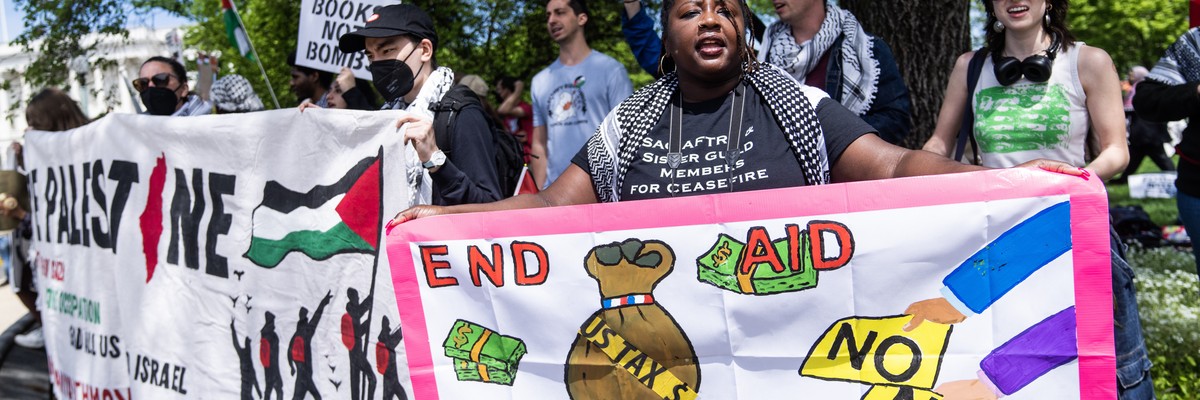
Continue ReadingInterview: Harris or Trump doesn’t matter for Gaza genocide

Israel’s War on Gaza and Beyond Has Cost US Taxpayers At Least $22.76 Billion: Report

Spread the love

Original article by Brett Wilkins republished from Common Dreams under Creative Commons (CC BY-NC-ND 3.0). 

Demonstrators calling for no funding for Israel in the conflict in Gaza are seen outside the U.S. Capitol before the House passed the foreign aid package on Saturday, April 20, 2024. (Photo: Tom Williams/CQ-Roll Call, Inc via Getty Images)

“It has been difficult for the U.S. public, journalists, and members of Congress to get an accurate understanding of the amount of military equipment and financial assistance that the U.S. government has provided.”

U.S. armed aid to Israel and related spending on American militarism in the Middle East cost taxpayers at least $22.76 billion over the past year, according to new research published Monday.

The Costs of War Project at Brown University’s Watson Institute for International & Public Affairs—which has long been the premier source for statistics on the human and economic costs of ongoing U.S.-led post-9/11 wars and militarism in the Middle East and beyond—called the $22.76 billion estimate “conservative.”

“This figure includes the $17.9 billion the U.S. government has approved in security assistance for Israeli military operations in Gaza and elsewhere since October 7—substantially more than in any other year since the U.S. began granting military aid to Israel in 1959,” report authors Linda Bilmes, William Hartung, and Stephen Semler wrote. “Yet the report describes how this is only a partial amount of the U.S. financial support provided during this war.”

In addition to the repeated multibillion-dollar rounds of military aid to Israel, related U.S. operations in the region, particularly bombing and shipping defense in and near Yemen—where Houthi rebels have attacked maritime commerce and launched missiles at Israel—have cost over $2 billion since last October.

“It has been difficult for the U.S. public, journalists, and members of Congress to get an accurate understanding of the amount of military equipment and financial assistance that the U.S. government has provided to Israel’s military during the past year of war,” the report states. “There is likewise little U.S. public awareness of the costs of the United States military’s own related operations in the region, particularly in and around Yemen.”

The analysis adds that regional hostilities “have escalated to become the most sustained military campaign by U.S. forces since the 2016-19 air war” against the so-called Islamic State in Iraq and Syria.

“The Costs of War project has an obligation to look at the consequences of the U.S. backing of Israel’s military operations after October 7, especially as it reverberates throughout the region,” Costs of War director Stephanie Savell said in a statement“Our project examines the human and budgetary costs of U.S. militarism at home and abroad, and for the last year, people in Gaza have suffered the highest consequences imaginable.”

According to the Gaza Health Ministry and international agencies, Israel’s yearlong assault on Gaza has left at least 149,000 Palestinians dead, maimed, or missing, and millions more forcibly displaced, starved, or sickened. U.S. military aid to Israel has continued in successive waves, even as the country stands trial for genocide at the International Court of Justice.

The Hamas-led October 7 attack on resulted in more than 1,100 Israeli and other deaths—at least some of which were caused by so-called “friendly fire” and intentional targeting under the Hannibal Directive—with more than 240 people kidnapped.

Although the Costs of War Project report mainly covers U.S. aid to Israel since last October, it also notes that since 1948—the year the modern state of Israel was founded, largely through the ethnic cleansing of Palestine’s Arabs—American taxpayers have contributed over a quarter trillion inflation-adjusted dollars to the key Mideast ally.

second report published Monday by the Costs of War Project found that around 90% of Gaza’s population has been forcibly displaced by the Israeli onslaught and 96% of Gazans face “acute levels of food insecurity.” The publication cites a letter sent last week by a group of U.S. physicians to President Joe Biden—who has repeatedly declared his “unwavering” support for Israel—stating that “it is likely that the death toll from this conflict is already greater than 118,908, an astonishing 5.4% of Gaza’s population.” That figure includes 62,000 deaths due to starvation.

“In addition to killing people directly through traumatic injuries, wars cause ‘indirect deaths’ by destroying, damaging, or causing deterioration of economic, social, psychological and health conditions,” report author Sophia Stamatopoulou-Robbins wrote. “These deaths result from diseases and other population-level health effects that stem from war’s destruction of public infrastructure and livelihood sources, reduced access to water and sanitation, environmental damage, and other such factors.”

The new report comes less than two weeks after Israel secured yet another U.S. armed aid package, this one worth $8.7 billion. Meanwhile, the Federal Emergency Management Agency said it faced a nearly $9 billion shortfall for Hurricane Helene relief efforts.

Original article by Brett Wilkins republished from Common Dreams under Creative Commons (CC BY-NC-ND 3.0). 

Continue ReadingIsrael’s War on Gaza and Beyond Has Cost US Taxpayers At Least $22.76 Billion: Report

Democrats’ Unquestioning Support of Israeli War Crimes Puts 2024 at Increasing Risk

Spread the love

Original article by James Zogby republished from Common Dreams under Creative Commons (CC BY-NC-ND 3.0). 

U.S. Vice President and Democratic presidential candidate Kamala Harris speaks during a campaign event at the Expo at World Market Center in Las Vegas, Nevada, September 29, 2024  (Photo by Ronda Churchill/AFP via Getty Images)

In our 30 years of polling Arab American voters, we haven’t witnessed anything like the role that the war on Gaza is having on voter behavior.

For Arab Americans, Israel’s war on Palestinians in Gaza looms large and will play a significant role in this November’s election. This is one of the key observations emerging from a mid-September nationwide poll of 500 Arab American registered voters conducted by John Zogby Strategies for the Arab American Institute.

A full year of this devastating assault on Gaza has reshaped the Arab American electorate, souring their attitude toward the Democratic Party, sapping their enthusiasm to vote in this election, and negatively impacting their inclination to vote for Vice President Kamala Harris for President.

Since we first began polling Arab Americans 30 years ago, the community has consistently favored the Democratic Party, with the margin of that support holding steady at nearly two to one for the past decade and a half. The Biden administration’s handling of the crisis in Gaza, however, has eroded that support resulting in Arab Americans now evenly divided between the two parties—38.5% for each. Equally revealing is the fact that by a slight margin (46% to 44%) voters in the community say they would prefer to see Republicans controlling the next Congress.

Arab American voter turnout has consistently been in the 80% range. But this year only 63% of the community say they are enthusiastic about voting in November, likely impacting voter turnout in November.

All of this has taken a toll on Harris’ prospects for winning Arab American votes in her contest with former President Donald Trump. While President Biden won 59% of the Arab American vote in 2020, compared with 35% for Trump, this year’s poll shows that in a multi-candidate matchup both candidates are in a virtual dead heat in the 41-42% range. More ominous for Harris is that when only considering likely voters, Trump leads 46% to 42%.

Arab American voter turnout has consistently been in the 80% range. But this year only 63% of the community say they are enthusiastic about voting in November, likely impacting voter turnout in November.

While a few unscientific “polls” have suggested that a third-party candidate would garner a majority of the Arab American vote, this AAI poll shows that not to be the case. All of the third-party candidates combined receive just 12% of the Arab American vote. Instead, it’s Trump who is the beneficiary of the community’s anger and, I might add, even despair over the Biden administration’s failure in addressing the crisis in Gaza.

This may be surprising given Trump’s record and recent statements, but there are a few factors that may account for this development. On the one hand, it may be that as a result of the year-long trauma, there is a desire to punish Democrats. Additionally, it appears that despite Trump’s dismal record with regard to the Israeli-Palestinian conflict and his total support for Israel’s aims in the war, the data from the AAI poll shows that sub-groups previously aligned with the Republican Party are returning to the fold and voting for that party’s candidate. All of which lends emphasis to the way the Gaza crisis has impacted this election.

Further evidence of Gaza’s role is the 81% of Arab Americans who say that Gaza will be an important consideration in their vote. For example, when asked if Harris were either to demand an immediate ceasefire and unimpeded humanitarian aid to Palestinians in Gaza or to withhold diplomatic support for and arms aid to Israel until it implements a ceasefire and withdraws its forces from Gaza, Harris’ vote among Arab Americans would increase to around 62%. This new Harris tally captures one-third of Trump voters, while virtually wiping out the votes that would go to the third-party candidates. If Trump were to make the same demands on Israel, he too would benefit increasing his vote tally to 56%. This increased vote count for Trump comes from one-quarter of Harris voters and one-half of the votes going to third-party candidates.

The year-long unfolding genocide in Gaza and the catastrophe now facing Lebanon has impacted every component sub-group within the community

While these measures are needed and important to end the war, announcing such a policy change in the midst of a campaign might be considered a heavy lift. Other less dramatic steps could have been taken to win more Arab American support. For example, Harris lost an important opportunity to send a message to Arab Americans demonstrating concern for Palestinians when her campaign refused to include a Palestinian American with family in Gaza to speak at the Democratic convention. When asked if it would have made a difference in how they would vote if the Harris campaign had invited a Palestinian American to speak, the response was a substantial “yes.” If the campaign had done so, Harris’ vote tally from Arab Americans would have increased to 61%. That moment was squandered, but others may still arise and if Harris still wants Arab American support, then these opportunities shouldn’t be passed over.

In our 30 years of polling Arab American voters, we haven’t witnessed anything like the role that the war on Gaza is having on voter behavior. The year-long unfolding genocide in Gaza and the catastrophe now facing Lebanon has impacted every component sub-group within the community, with only slight variations among religious communities and countries of origin, immigrant or native-born, gender and age groups. With little over one month remaining before the election, Arab Americans and, as our polls of U.S. voters have shown, those who share their concerns (young and non-white voters) will be watching to see if their deeply felt concerns with Gaza and now Lebanon will be recognized and respected with a promise for change.

Original article by James Zogby republished from Common Dreams under Creative Commons (CC BY-NC-ND 3.0). 

Continue ReadingDemocrats’ Unquestioning Support of Israeli War Crimes Puts 2024 at Increasing Risk

Murdoch to Musk: how global media power has shifted from the moguls to the big tech bros

Spread the love
The Conversation, Mary Altaffer/AAP, Frederic Legrand/Shutterstock

Matthew Ricketson, Deakin University and Andrew Dodd, The University of Melbourne

Until recently, Elon Musk was just a wildly successful electric car tycoon and space pioneer. Sure, he was erratic and outspoken, but his global influence was contained and seemingly under control.

But add the ownership of just one media platform, in the form of Twitter – now X – and the maverick has become a mogul, and the baton of the world’s biggest media bully has passed to a new player.

What we can gauge from watching Musk’s stewardship of X is that he’s unlike former media moguls, making him potentially even more dangerous. He operates under his own rules, often beyond the reach of regulators. He has demonstrated he has no regard for those who try to rein him in.

Under the old regime, press barons, from William Randolph Hearst to Rupert Murdoch, at least pretended they were committed to truth-telling journalism. Never mind that they were simultaneously deploying intimidation and bullying to achieve their commercial and political ends.

Musk has no need, or desire, for such pretence because he’s not required to cloak anything he says in even a wafer-thin veil of journalism. Instead, his driving rationale is free speech, which is often code for don’t dare get in my way.

This means we are in new territory, but it doesn’t mean what went before it is irrelevant.

A big bucket of the proverbial

If you want a comprehensive, up-to-date primer on the behaviour of media moguls over the past century-plus, Eric Beecher has just provided it in his book The Men Who Killed the News.

Alongside accounts of people like Hearst in the United States and Lord Northcliffe in the United Kingdom, Beecher quotes the notorious example of what happened to John Major, the UK prime minister between 1990 and 1997, who baulked at following Murdoch’s resistance to strengthening ties with the European Union.

In a conversation between Major and Kelvin MacKenzie, editor of Murdoch’s best-selling English tabloid newspaper, The Sun, the prime minister was bluntly told: “Well John, let me put it this way. I’ve got a large bucket of shit lying on my desk and tomorrow morning I’m going to pour it all over your head.”

MacKenzie might have thought he was speaking truth to power, but in reality he was doing Murdoch’s bidding, and actually using his master’s voice, as Beecher confirms by recounting an anecdote from early in Murdoch’s career in Australia.

In the 1960s, when Murdoch owned The Sunday Times in Perth, he met Lang Hancock (father of Gina Rinehart) to discuss potentially buying some mineral prospects together in Western Australia. The state government was opposed to the planned deal.

Beecher cites Hancock’s biographer, Robert Duffield, who claimed Murdoch asked the mining magnate, “If I can get a certain politician to negotiate, will you sell me a piece of the cake?” Hancock said yes. Later that night, Murdoch called again to say the deal had been done. How, asked an incredulous Hancock. Murdoch replied: “Simple […] I told him: look you can have a headline a day or a bucket of shit every day. What’s it to be?”

Between Murdoch in the 1960s and MacKenzie in the 1990s came Mario Puzo’s The Godfather with Don Corleone, aided by Luca Brasi holding a gun to a rival’s head, saying “either his brains or his signature would be on the contract”.

Former British Prime Minister John Major fell foul of Rupert Murdoch – and paid the price. Lynne Sladky/AP/AAP

Changing the rules of the game

Media moguls use metaphorical bullets. Those relatively few people who do resist them, like Major, get the proverbial poured over their government. Headlines in The Sun following the Conservatives’ win in the 1992 election included: “Pigmy PM”, “Not up to the job” and “1,001 reasons why you are such a plonker John”.

If media moguls since Hearst and Northcliffe have tap-danced between producing journalism and pursuing their commercial and political aims, they have at least done the former, and some of it has been very good.

The leaders of the social media behemoths, by contrast, don’t claim any fourth estate role. If anything, they seem to hold journalism with tongs as far from their face as possible.

They do possess enormous wealth though. Apple, Microsoft, Google and Meta, formerly known as Facebook, are in the top ten companies globally by market capitalisation. By comparison, News Corporation’s market capitalisation now ranks at 1,173 in the world.

Regulating the online environment may be difficult, as Australia discovered this year when it tried, and failed, to stop X hosting footage of the Wakeley Church stabbing attacks. But limiting transnational media platforms can be done, according to Robert Reich, a former Secretary of Labor in Bill Clinton’s government.

Despite some early wins through Australia’s News Media Bargaining Code, big tech companies habitually resist regulation. They have used their substantial influence to stymie it wherever and whenever nation-states have sought to introduce it.

Meta’s founder and chief executive, Mark Zuckerberg, has been known to go rogue, as he demonstrated in February 2021 when he protested against the bargaining code by unilaterally closing Facebook sites that carried news. Generally, though, his strategy has been to deploy standard public relations and lobbying methods.

But his rival Musk uses his social media platform, X, like a wrecking ball.

Musk is just about the first thing the average X user sees in their feed, whether they want to or not. He gives everyone the benefit of his thoughts, not to mention his thought bubbles. He proclaims himself a free-speech absolutist, but most of his pronouncements lean hard to the right, providing little space for alternative views.

Some of his tweets have been inflammatory, such as him linking to an article promoting a conspiracy theory about the savage attack on Paul Pelosi, husband of the former US Speaker, Nancy Pelosi, or his tweet that “Civil war is inevitable” following riots that erupted recently in the UK.

As the BBC reported, the riots occurred after the fatal stabbing of three girls in Southport. “The subsequent unrest in towns and cities across England and in parts of Northern Ireland has been fuelled by misinformation online, the far-right and anti-immigration sentiment.”

Nor does Musk bother with niceties when people disagree with him. Late last year, advertisers considered boycotting X because they believed some of Musk’s posts were anti-Semitic. He told them during a live interview to “Go fuck yourself”.

He has welcomed Donald Trump, the Republican Party’s presidential nominee, back onto X after Trump’s account was frozen over his comments surrounding the January 6 2021 attack on the capitol. Since then both men have floated the idea of governing together if Trump wins a second term.

Is the world better off with tech bros like Musk who demand unlimited freedom and assert their influence brazenly, or old-style media moguls who spin fine-sounding rhetoric about freedom of the press and exert influence under the cover of journalism?

That’s a question for our times that we should probably begin grappling with.

Matthew Ricketson, Professor of Communication, Deakin University and Andrew Dodd, Director of the Centre for Advancing Journalism, The University of Melbourne

This article is republished from The Conversation under a Creative Commons license. Read the original article.

Continue ReadingMurdoch to Musk: how global media power has shifted from the moguls to the big tech bros