This work by Middle East Monitor is licensed under a Creative Commons Attribution-NonCommercial-ShareAlike 4.0 International License.
Police detain demonstrators as activists gather outside the Ministry of Justice during the “Lift the Ban” protest launched by the Defend Our Juries campaign group ahead of the judicial review on the designation of Palestine Action as a terrorist organization in London, United Kingdom, on November 20, 2025. [Raşid Necati Aslım – Anadolu Agency]
UK police made a number of arrests Thursday outside the Justice Ministry in London after protesters staged a silent demonstration against the government’s decision to proscribe the Palestine Action activist group, Anadolu reports.
Demonstrators held signs that read: “I oppose genocide. I support Palestine Action.”
Police have not confirmed how many people were detained in London, where around 100 people were gathered.
Protests also took place Tuesday in Nottingham, Gloucester, Truro, Northampton, Oxford, Leeds, Newcastle, Cardiff, Aberystwyth, and Edinburgh.
The protest was organized by Defend Our Juries, which is holding demonstrations in 18 towns and cities from Nov. 18-29, demanding the lifting of the ban.
“The Terrorism Act is being weaponized to silence the public. We will continue to resist until the ban is lifted,” the group said on the US social media company X.
Palestine Action was proscribed July 5 under anti-terror legislation following alleged attacks on the UK facilities of an Israel-based defense firm and damage to two military aircraft at RAF (Royal Air Force) Brize Norton.
The ban makes membership of, or support for, the direct-action network a criminal offense carrying a maximum sentence of 14 years.
Huda Ammori, the group’s co-founder, is taking legal action against then-Home Secretary Yvette Cooper’s decision to outlaw the organization.
A court hearing is scheduled for late November.
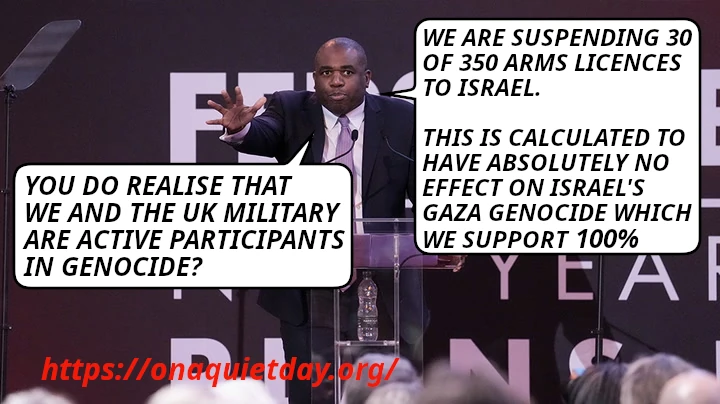
Orcas discuss Genocide-supporting and complicit Zionists. Donald Trump, Keith Starmer, David Lammy, Rachel Reeves, Angela Rayner and Wes Streeting are acknowledged as evil genocide-complicit and supporting cnuts.Keir Starmer objects to criticism of the IDF. He asks how could anyone object to them starving people to death, forced marches like the Nazis did, bombing Gaza’s hospitals and universities, mass-murdering journalists, healthworkers and starving people queuing for food, killing and raping prisoners and murdering children. He calls for people to stop obstructing his genocide for Israel.Genocide denying UK Foreign Secretary David Lammy says that UK is suspending 30 of 350 arms licences to Israel. He also confirms the UK government’s support for Israel’s Gaza genocide and the UK government and military’s active participation in genocide.
This work by Middle East Monitor is licensed under a Creative Commons Attribution-NonCommercial-ShareAlike 4.0 International License.
Rubble removal efforts at the historic Great Omari Mosque and the Palestinian Museum (Qasr al-Basha), which once housed 40,000 archaeological artefacts, in Gaza, on November 20, 2025. The mosque, which holds 14 centuries of history and is considered the third-largest in Palestine, features architectural elements from both the Mamluk and Ottoman periods. The mosque is known as one of the most frequented places of worship for residents during Ramadan. [Mohammed Asad/Middle East Monitor]
This work by Middle East Monitor is licensed under a Creative Commons Attribution-NonCommercial-ShareAlike 4.0 International License.
Orcas discuss Genocide-supporting and complicit Zionists. Donald Trump, Keith Starmer, David Lammy, Rachel Reeves, Angela Rayner and Wes Streeting are acknowledged as evil genocide-complicit and supporting cnuts.Keir Starmer objects to criticism of the IDF. He asks how could anyone object to them starving people to death, forced marches like the Nazis did, bombing Gaza’s hospitals and universities, mass-murdering journalists, healthworkers and starving people queuing for food, killing and raping prisoners and murdering children. He calls for people to stop obstructing his genocide for Israel.Genocide denying UK Foreign Secretary David Lammy says that UK is suspending 30 of 350 arms licences to Israel. He also confirms the UK government’s support for Israel’s Gaza genocide and the UK government and military’s active participation in genocide.
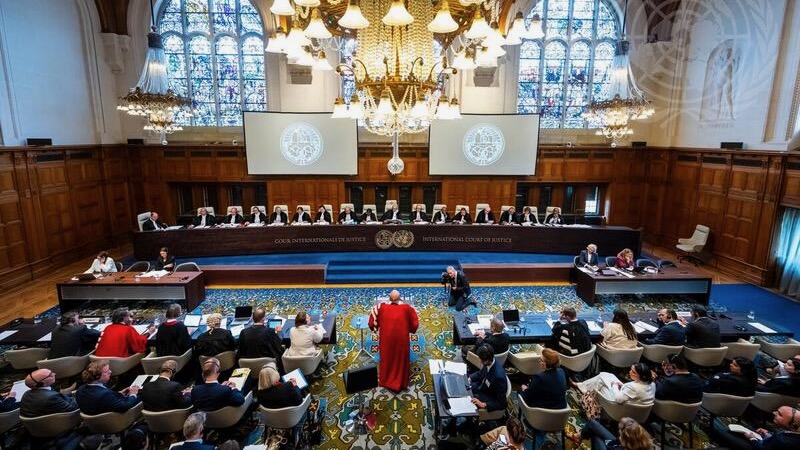
International Court of Justice holds hearing on Nicaragua vs. Germany. Photo: UN
The German Federal Republic may have made false statements at the very beginning of the trial before the UN’s highest court.
Since April 2024, Germany has been on trial before the International Court of Justice (ICJ) in The Hague. Nicaragua had filed a case against the Federal Republic, accusing it of complicity in the genocide in Gaza. As has now become known, German representatives may have made false statements in their very first testimony before the ICJ in April 2024, concerning the arms exports delivered to Israel.
“Not disclosed”
As Drop Site News (DSN) and the liberal German magazine Stern reported in a joint article, there are now serious doubts about Germany’s statements. They cite comments from the German Defense Ministry, obtained through a press law procedure before a German administrative court. According to these documents, the ministry stated that its testimony before the ICJ in April 2024 had been made “in agreement with the affected state,” meaning Israel. The ministry also admitted that “the differentiated information on Bundeswehr exports,” was “not disclosed in the proceedings before the ICJ.” The Defense Ministry argued before the court that it could not release information about transfers to specific countries “for reasons of contractually agreed confidentiality”, since doing so could seriously damage the trust between Germany and Israel.
Following the “Al-Aqsa Flood” operation and the beginning of the Gaza genocide in October 2023, the value of German military exports to Israel increased tenfold overnight. The Federal Republic thus became, after the United States, the second most important supplier of weapons to the Zionist regime; at one point, a third of Israel’s weapons were said to have come from Germany. By mid-May 2025, successive German governments had approved arms deliveries worth 485 million euros. Added to this were donations from the Bundeswehr’s own stocks to the IDF.
It is these donations that DSN and Stern have raised doubts about. German representatives had claimed before the ICJ that in 2023 no weapons of war but only “medical supplies and helmets” had been delivered to Israel from Bundeswehr inventories. Lea Reisner, spokeswoman for the Left Party in the German parliament, commented to the German left-wing daily junge Welt: “For many months, the federal government has been deceiving the public about the extent of German arms deliveries to Israel – and now, apparently, also the International Court of Justice.”
Growing pressure
While the fact that Germany is standing trial in The Hague on charges of complicity in a new genocide has been largely ignored within the dominant discourse in Germany, Nicaragua’s case nonetheless appears to have exerted considerable pressure on the German government. Over the course of 2024, the number of weapons delivered by Germany to Israel fell sharply, without any official explanation. Even the state broadcaster Deutsche Welle (which reports far more critically in English than in German in order to project an image of Germany as a country with a critical media landscape, which is just not true) suggested that the decline may be linked to the ICJ case.
In August 2025, the current chancellor, Friedrich Merz, announced that Germany would no longer supply weapons to Israel “that can be used in Gaza”. It quickly became clear, however, that this referred only to new export licenses, while previously approved arms shipments were unaffected. Moreover, Israel’s navy received new warships and submarines from Germany immediately after Merz’s announcement, even though it plays a central role in the illegal blockade of the Gaza Strip.
Nevertheless, this surprising step by the German government shows that even in Berlin there was a perceived need to take measures that at least appear to resemble sanctions.
And the possible fact that the Federal Republic may have made false statements at the very beginning of the trial before the UN’s highest court can also be seen as an indication that those in power in Berlin are fully aware that their policy of so-called “German Staatsräson” violates international law. This affair, however, is unlikely to do much for Germany’s credibility before the ICJ.
Orcas discuss Genocide-supporting and complicit Zionists. Donald Trump, Keith Starmer, David Lammy, Rachel Reeves, Angela Rayner and Wes Streeting are acknowledged as evil genocide-complicit and supporting cnuts.Keir Starmer objects to criticism of the IDF. He asks how could anyone object to them starving people to death, forced marches like the Nazis did, bombing Gaza’s hospitals and universities, mass-murdering journalists, healthworkers and starving people queuing for food, killing and raping prisoners and murdering children. He calls for people to stop obstructing his genocide for Israel.Genocide denier and Current UK Prime Minister Keir Starmer is quoted that he supports Zionism without qualification. He also confirms that UK air force support has been essential in Israel’s mass-murdering genocide. Includes URLs https://www.declassifieduk.org/keir-starmers-100-spy-flights-over-gaza-in-support-of-israel/ and https://youtu.be/O74hZCKKdpA
The UK has announced much harsher rules for asylum seekers including the prospect of more deportations for those whose applications fail. The US is trebling the size of its deportation force. The EU is doubling its border budgets. And in the coming decades, hundreds of millions of people might be displaced by ecological changes.
In the face of this challenge, those countries which are most responsible for climate change have two options. Either they can share resources more equitably, and fund adaptation plans on a massive scale. Or they can prevent others from accessing resources and liveable land through physical and regulatory walls, enforced through mass deportation.
Recent events show that, faced with this choice, many governments are choosing not to share resources to anywhere near the extend needed, and are instead building higher walls.
Climate change is already making life unliveable in some parts of the world. According to a 2020 report from thinktank the Institute for Economics and Peace (IEP), 2.6 billion people face high or extreme water stress. By 2040, this may jump to 5.4 billion. Droughts, heatwaves, floods, cyclones, food shortages and related conflicts will force millions from their homes.
Most of these people will move internally within nations, but this too is likely to mean more walls and borders. In very unequal countries, internal migration has already triggered security-driven responses, with a rise in gated communities and other segregated living arrangements to keep the poorer away from the wealthy.
Many other climate migrants will be pushed to travel internationally. It’s likely their motivation will be characterised by many as economic rather than due to climate change. But it’s misleading to separate “economic” from “climate” migrants. When drought kills crops in Somalia or floods wash away farmland in Pakistan, the loss of income is inseparable from the climate shocks that caused it.
Even before the worst impacts hit, climate change is already woven into the economic pressures that push people to move – shrinking harvests, emptying wells and ruining livelihoods. The most severe climate-driven displacement is still ahead, but it has already begun.
Importantly, these pressures come with inequalities in causing climate change and bearing the costs. The richest 1% of the world’s population produces as much carbon as the poorest two-thirds, according to a study of global emissions in 2019 by Oxfam. Northern Europe and the US alone account for 92% of historical emissions.
Those who have contributed the least to climate change are the worst affected and often have the fewest resources to adapt, forcing many people to migrate.
More walls, more deportations
In this context, governments of wealthier countries are massively increasing spending on migration policing. In the US, proposed funding levels are extraordinary.
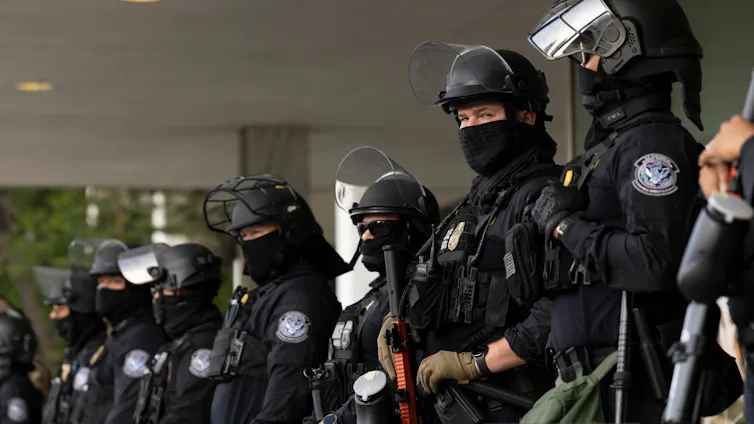
Recent legislation allocates nearly US$30 billion (£22 billion) to the Immigration and Customs Enforcement agency (Ice) for enforcement and deportation operations – roughly three times its current budget.
The US has also authorised US$45 billion for new detention centres – a 265% increase, more than the entire defence budget of Italy – and US$46.6 billion for additional border walls. Under this plan, Ice would become the largest US law enforcement agency, three times the size of the FBI.
Donald Trump’s policies can be easily labelled as the excess of one would-be autocrat, but this is a global trend across the political spectrum, albeit implemented with more acceptable language by the centre-left.
Introducing the UK Labour government’s new asylum and returns policy, Prime Minister Keir Starmer said: “We need an approach with a stronger deterrent effect and rules that are robustly enforced.” But previously-supportive MPs from his own party have warned this will mean “Ice-style raids” to deport asylum seekers.
The European Commission’s 2028–34 budget proposal earmarks €25.2 billion (£21.7 billion) for border management and €12 billion for migration, plus €11.9 billion for the Frontex border agency – more than double its current resources.
All this effectively triples current migration and border spending. In 2024, the EU ordered 453,000 non-EU nationals to leave, and actually deported 110,000 of them.
This is part of a much wider pattern, with borders today being far more militarised than at the end of the cold war. After decades of globalisation, states are now reterritorialising, building armoured fortifications against unwanted flows.
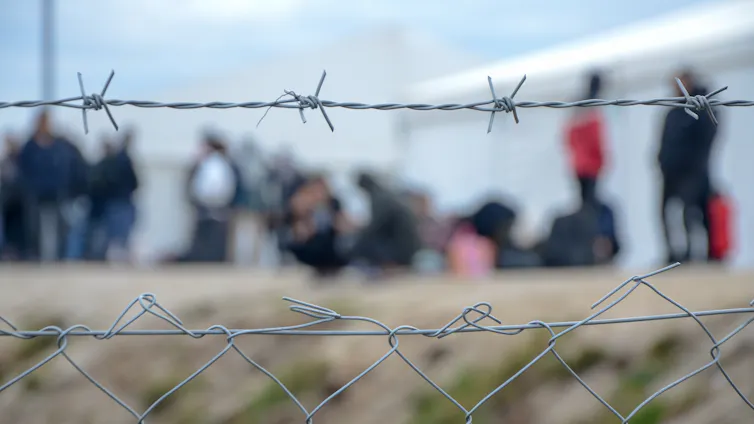
In the past two decades, more than 70 new international barriers have gone up, including Poland’s barbed-wire fence with Belarus, Greece’s steel wall on the Turkish border, Turkey’s stone wall on its Iranian border, and the new sections of the infamous wall between the US and Mexico.
Israel has built an “iron wall” around Gaza and border fences through much of the West Bank. Supposedly built to prevent Palestinians moving into Israel, these barriers have become a clear example of migration control tied to power grabs for land and resources.
A crossroads for human rights
Resource-driven migration pressures are rising just as the world is hardening its borders. In July 2025, the International Court of Justice declared that countries have a legal responsibility to address and compensate for climate change – and can be held accountable for their emissions. It is another signal that as humanity, we are at a crossroads.
The world can either prioritise universal human rights by sharing resources. Or it can attempt to protect a small, wealthy minority through walls, mass deportations and border violence on an unprecedented scale.
Keir Starmer refuses to be outcnuted by Nigel Farage’s chasing the racist bigot vote.Climate science denier Nigel Farage explains that it’s simple to blame asylum-seekers or Muslims for everything.
The UK government’s latest proposals on asylum rest on an incorrect premise. In announcing them, home secretary Shabana Mahmood argued that “illegal migration is tearing our country apart”. But asylum-seeking is not illegal migration.
Asylum is a form of protection granted by a country to a non-citizen who faces persecution in their home country. The right to seek asylum is enshrined in international law, and applies irrespective of how the person travelled to the place where they are seeking protection.
Yet the policies being rolled out collapse two distinct categories into a single threat, to be addressed through deterrence and control. In effect, the category of the asylum seeker is equated to that of “illegal migrant”. Both are discussed as “abusing the system”, “flouting the rules” and “undermining communities”.
The underlying implication is that all asylum seekers are “illegal migrants”. Any system that follows will therefore be built on a distortion. Its consequences will fall not on the minority who try to game the system, but on the overwhelming majority who have legitimate claims for protection.
In 2024, 84,200 applications for asylum were made in the UK, relating to 108,100 individuals. More than 36,500 asylum appeals were lodged against negative decisions, with 48% of them allowed. Recent data show that in the months to March 2025, 47% of initial decisions resulted in the applicant being granted refugee status.
The new asylum measures promise faster decisions on asylum applications, tougher thresholds to be granted status, and expanded detention and removals. In continuity with the previous Conservative government, the rhetoric of “restoring control” makes the direction clear: restrict access to protection, harden the conditions for claiming it, and speed up refusals.
Labour is not hiding its reasoning for this approach. The government explicitly argues that firmer control is needed to prevent “darker forces” from coming into power. This is presented not as a concession to the far right, but as a public rationale for tightening the system. The message is clear: these policies are needed to keep politics steady, not because they improve the asylum system.
The issue is not simply that the proposals are harsh, unethical or likely to be ineffective. They represent a deeper shift: redefining protection as a discretionary favour rather than a legal obligation. Control becomes the primary focus, leaving less space for discussing refugee rights, protection and international obligations.
If asylum is framed as illegality, and settlement is reshaped into a privilege that must be endlessly earned, then our understanding of equal membership – the idea that those lawfully in the UK should enjoy stability and a clear path to full inclusion – is fundamentally altered.
A lifetime review
One of the key proposals is to extend the length of time it takes for a refugee to achieve settlement from five to 20 years. Until recently, settlement – the immigration status that allows a non-UK citizen to live, work and study in the UK without time restrictions – was the expected outcome for anyone granted refugee status. It is also a prerequisite for applying for British citizenship.
The new proposals transform settlement into something that must be continually earned. The path has become longer, more conditional and far more easily disrupted.
This aligns closely with other recent announcements on policies relating to migrants more generally. Higher salary thresholds, more enforcement, extended probationary periods and more complex routes to settlement have all been tabled.
These changes would build a structural disadvantage into the migration system. Non-citizens can live, work and contribute, but their belonging remains conditional. They become long-term residents on a form of probation, their status always open to review. This is more than an administrative change. It creates a hierarchy of membership that shapes lives, futures and families.
For a refugee family, this can mean years of uncertainty: parents unable to plan long-term careers or mortgages; partners and children living with the fear that a change in income, a missed renewal deadline or a shift in political priorities could jeopardise their right to remain.
It can also mean delays or barriers to family reunification, with spouses or children abroad left in limbo while the principal applicant waits to demonstrate continuous compliance. In practice, what should be a path to stability becomes a prolonged period of vulnerability, in which everyday life is overshadowed by the possibility of losing one’s status.
Nando Sigona, Professor of International Migration and Forced Displacement and Director of the Institute for Research into International Migration and Superdiversity, University of Birmingham


![Rubble removal efforts at the historic Great Omari Mosque and the Palestinian Museum (Qasr al-Basha), which once housed 40,000 archaeological artefacts, in Gaza City, Gaza, on November 20, 2025. [Mohammed Asad/Middle East Monitor]](https://i0.wp.com/www.middleeastmonitor.com/wp-content/uploads/2025/11/PHOTO-2025-11-20-08-38-35.jpg?w=610&h=457&ssl=1 "PHOTO-2025-11-20-08-38-35")
![Rubble removal efforts at the historic Great Omari Mosque and the Palestinian Museum (Qasr al-Basha), which once housed 40,000 archaeological artefacts, in Gaza City, Gaza, on November 20, 2025. [Mohammed Asad/Middle East Monitor]](https://i0.wp.com/www.middleeastmonitor.com/wp-content/uploads/2025/11/PHOTO-2025-11-20-08-38-36.jpg?w=302&h=227&ssl=1 "PHOTO-2025-11-20-08-38-36")
![Rubble removal efforts at the historic Great Omari Mosque and the Palestinian Museum (Qasr al-Basha), which once housed 40,000 archaeological artefacts, in Gaza City, Gaza, on November 20, 2025. [Mohammed Asad/Middle East Monitor]](https://i0.wp.com/www.middleeastmonitor.com/wp-content/uploads/2025/11/PHOTO-2025-11-20-08-38-36-7.jpg?w=302&h=226&ssl=1 "PHOTO-2025-11-20-08-38-36 7")
![Rubble removal efforts at the historic Great Omari Mosque and the Palestinian Museum (Qasr al-Basha), which once housed 40,000 archaeological artefacts, in Gaza City, Gaza, on November 20, 2025. [Mohammed Asad/Middle East Monitor]](https://i0.wp.com/www.middleeastmonitor.com/wp-content/uploads/2025/11/PHOTO-2025-11-20-08-38-36-8.jpg?w=303&h=227&ssl=1 "PHOTO-2025-11-20-08-38-36 8")
![Rubble removal efforts at the historic Great Omari Mosque and the Palestinian Museum (Qasr al-Basha), which once housed 40,000 archaeological artefacts, in Gaza City, Gaza, on November 20, 2025. [Mohammed Asad/Middle East Monitor]](https://i0.wp.com/www.middleeastmonitor.com/wp-content/uploads/2025/11/PHOTO-2025-11-20-08-38-36-6.jpg?w=303&h=227&ssl=1 "PHOTO-2025-11-20-08-38-36 6")
![Rubble removal efforts at the historic Great Omari Mosque and the Palestinian Museum (Qasr al-Basha), which once housed 40,000 archaeological artefacts, in Gaza City, Gaza, on November 20, 2025. [Mohammed Asad/Middle East Monitor]](https://i0.wp.com/www.middleeastmonitor.com/wp-content/uploads/2025/11/PHOTO-2025-11-20-08-38-36-5.jpg?w=302&h=227&ssl=1 "PHOTO-2025-11-20-08-38-36 5")
![Rubble removal efforts at the historic Great Omari Mosque and the Palestinian Museum (Qasr al-Basha), which once housed 40,000 archaeological artefacts, in Gaza City, Gaza, on November 20, 2025. [Mohammed Asad/Middle East Monitor]](https://i0.wp.com/www.middleeastmonitor.com/wp-content/uploads/2025/11/PHOTO-2025-11-20-08-38-36-3.jpg?w=456&h=342&ssl=1 "PHOTO-2025-11-20-08-38-36 3")
![Rubble removal efforts at the historic Great Omari Mosque and the Palestinian Museum (Qasr al-Basha), which once housed 40,000 archaeological artefacts, in Gaza City, Gaza, on November 20, 2025. [Mohammed Asad/Middle East Monitor]](https://i0.wp.com/www.middleeastmonitor.com/wp-content/uploads/2025/11/PHOTO-2025-11-20-08-38-36-2.jpg?w=456&h=342&ssl=1 "PHOTO-2025-11-20-08-38-36 2")