This work by Middle East Monitor is licensed under a Creative Commons Attribution-NonCommercial-ShareAlike 4.0 International License.
Aid trucks loaded with humanitarian supplies remain stranded at the Rafah Border Crossing on the Egyptian side due to Israeli attacks and closed border crossings, the delivery of aid is limited and delayed in Rafah, Egypt on August 6, 2025. [Mohamed Elshahed – Anadolu Agency]
The United Nations Office for the Coordination of Humanitarian Affairs (OCHA) said Thursday that around 170,000 tons of humanitarian aid are waiting to enter the Gaza Strip, pending approval from the Israeli occupying authorities that control all border crossings.
Speaking after the announcement of the first phase of US President Donald Trump’s plan to end the war on Gaza, an OCHA spokesperson said the aid—comprising medicines, tents, and other critical supplies—could reach nearly two million Palestinians facing severe shortages of food and basic necessities once access is granted.
OCHA reported earlier this week that Israel has blocked the entry of 45 per cent of registered aid convoys since the genocide began in October 2023, severely limiting relief efforts. The spokesperson emphasised that effective delivery requires open crossings, security guarantees for aid workers and civilians, visas for international staff, and unrestricted entry of supplies. He also underlined the need to revive Gaza’s private sector to restore minimum living conditions.
At dawn Thursday, Trump announced that Israel and Hamas had agreed to the first stage of his proposed peace plan, which includes a prisoner exchange and an Israeli withdrawal to the so-called “Yellow Line” as an initial step.
This work by Middle East Monitor is licensed under a Creative Commons Attribution-NonCommercial-ShareAlike 4.0 International License.
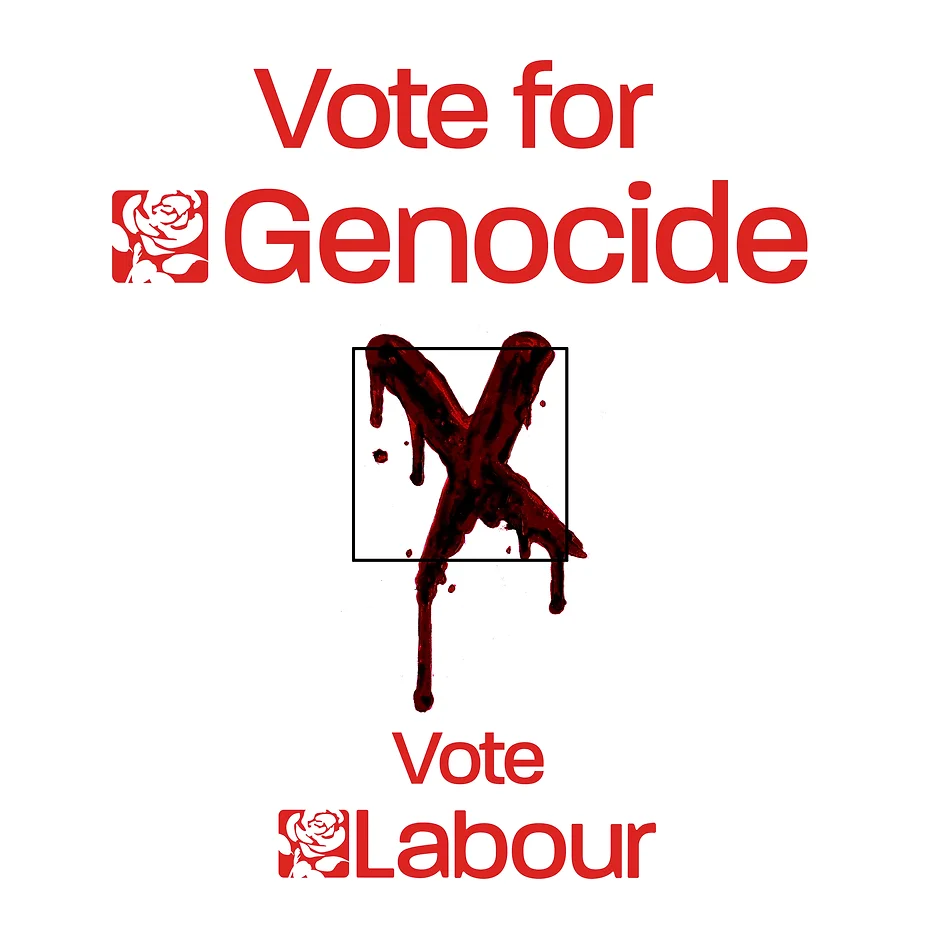
Keir Starmer objects to criticism of the IDF. He asks how could anyone object to them starving people to death, forced marches like the Nazis did, bombing Gaza’s hospitals and universities, mass-murdering journalists, healthworkers and starving people queuing for food, killing and raping prisoners and murdering children. He calls for people to stop obstructing his genocide for Israel.Vote Labour for Genocide.
Protesters take part in a demonstration outside the Foreign, Commonwealth and Development Office (FCDO) in Whitehall, London, calling for the government to protect the crew of Madleen, June 9, 2025
Jewish campaigners condemn Starmer’s claim that demonstrations against genocide are ‘un-British’
JEWISH campaigners have condemned Sir Keir Starmer’s “insulting” claim that demonstrations against genocide were “un-British.”
The Prime Minister’s remarks, made today, came ahead of several student protests on the anniversary of October 7, and the national march for Palestine this weekend.
An inter-university march set off in the capital from King’s College at 2pm, before passing the London School of Economics, University College London and ending at the gates of SOAS.
Joining them was Mark Etkind, the son of a Holocaust survivor, who said: “As we speak today, weapons made in Britain are contributing to the deaths of children and others in Gaza — that has to stop now in order to save those lives, so these brave student protesters have to keep demonstrating until that genocide stops.”
He accused the government of having slandered the students, making them out to be insensitive to October 7, “while ignoring the obvious fact that their priority is to … oppose the ongoing conflict which Britain unfortunately is complicit in.”
Rallies also took place in Sheffield, Glasgow and Edinburgh, where the institution’s principal emailed students warning them to “think carefully about their actions” ahead of the protest.
Edinburgh’s Justice for Palestine Society called it a “blatant attempt to suppress campus discourse on an ongoing genocide.”
Writing in the Times, Sir Keir said it was “un-British to have so little respect for others,” echoing comments made by Home Secretary Shabana Mahmood, who described Palestine protests held following Thursday’s attack on a Manchester synagogue as “fundamentally un-British.”
Naomi Wimborne-Idrissi, media officer for Jewish Voice for Liberation, said: “Those who protest are in despair at our government’s abject failure to take any kind of meaningful action to make the bombing, shooting, burning and starvation stop.
“For leaders of that government to accuse protesters of ‘un-Britishness’ is both insulting and counterproductive.
Keir Starmer objects to criticism of the IDF. He asks how could anyone object to them starving people to death, forced marches like the Nazis did, bombing Gaza’s hospitals and universities, mass-murdering journalists, healthworkers and starving people queuing for food, killing and raping prisoners and murdering children. He calls for people to stop obstructing his genocide for Israel.Orcas discuss Genocide-supporting and complicit Zionists. Donald Trump, Keith Starmer, David Lammy, Rachel Reeves, Angela Rayner and Wes Streeting are acknowledged as evil genocide-complicit and supporting cnuts.Vote Labour for Genocide.
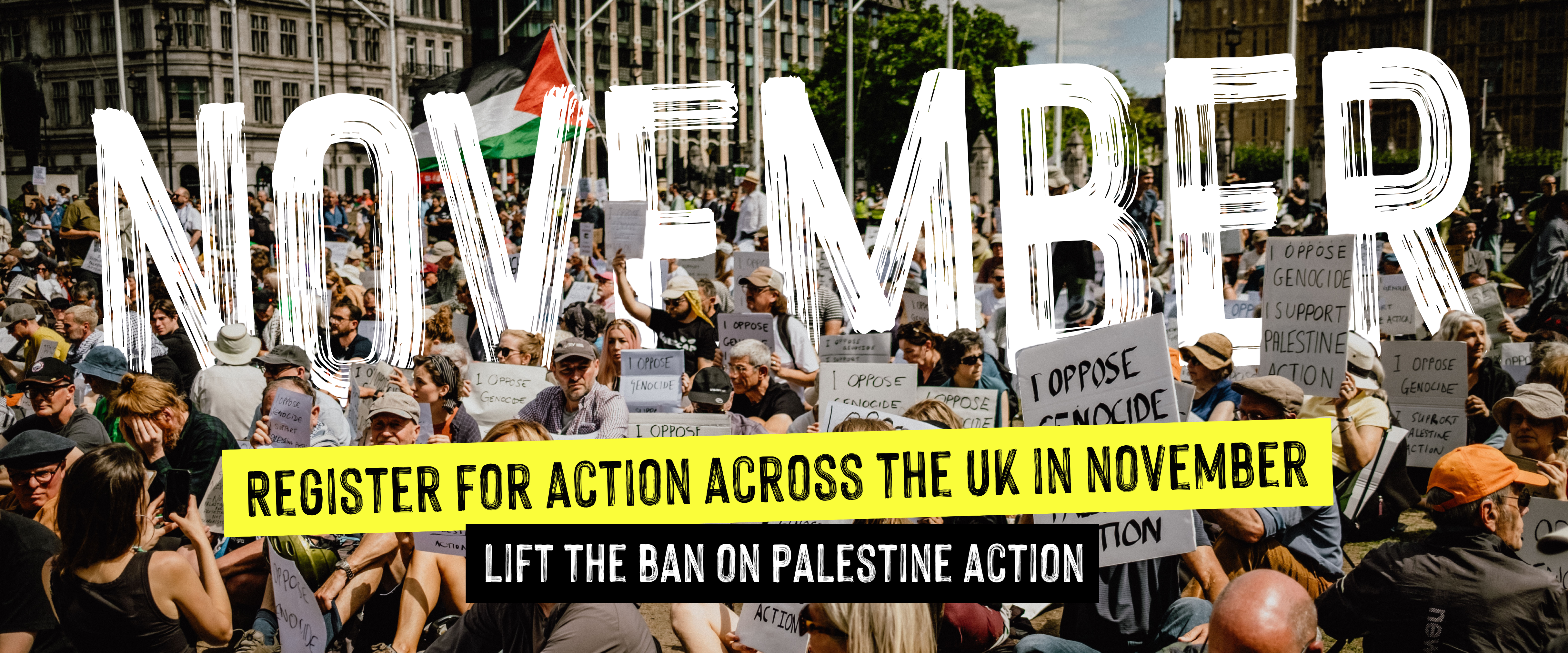
In November, Defend Our Juries will be escalating the campaign to Lift The Ban on Palestine Action ahead of the Judicial Review against the ban.
From Tuesday 18th November to Saturday 29th November, join thousands of others across the UK and in London on key dates, for the opportunity to hold seven peaceful words in unity.
There are signs that the authoritarian powers are cracking, the police are struggling to enforce this absurd law, with some police forces outright refusing to make arrests. International and national human rights groups, politicians and United Nations representatives have condemned both the ban and the subsequent attacks on our civil liberties. Unions are declaring that they will not recognise the ban, while over 1600 people were arrested prior to our October 4th action.
We will be holding our signs around the UK in key cities and towns, as well as converging on London for the Judicial Review Itself (25-27 November). Book time off now, and sign the form to tell us where you’ll be taking action.
We will not comply with anti-democratic laws. We call on the UK Government to Lift The Ban on Palestine Action and to end UK complicity in Israel’s genocide.
In unity, not uniformity, we join together.
*Please note that these actions come with significant risk of arrest and other legal consequences. Legal briefings and ongoing support are offered by Defend Our Juries and supporting organisations, to help ensure you are informed prior to taking action.
Keir Starmer objects to criticism of the IDF. He asks how could anyone object to them starving people to death, forced marches like the Nazis did, bombing Gaza’s hospitals and universities, mass-murdering journalists, healthworkers and starving people queuing for food, killing and raping prisoners and murdering children. He calls for people to stop obstructing his genocide for Israel.Palestine Action joke that appeared in the UK satirical magazine ‘Private Eye’.Orcas discuss Genocide-supporting and complicit Zionists. Donald Trump, Keith Starmer, David Lammy, Rachel Reeves, Angela Rayner and Wes Streeting are acknowledged as evil genocide-complicit and supporting cnuts.
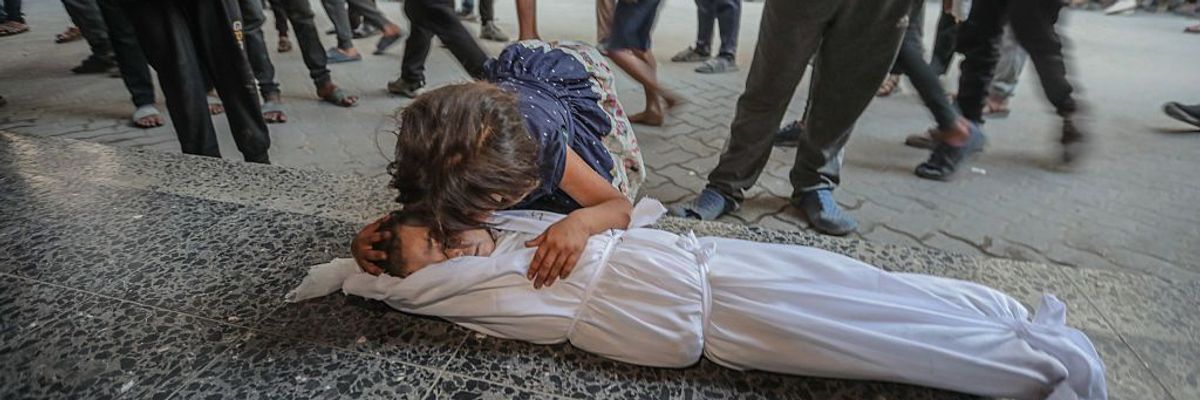
The body of a Palestinian child, who was killed in an Israeli attack on al-Tuffah neighborhood, is brought to al-Ahli Hospital in Gaza City, Gaza on October 4, 2025. (Photo by Hamza ZH Qraiqea/Anadolu via Getty Images)
“Our research highlights numbers, but we must never lose sight of this key fact: What we’re talking about is human suffering.”
Tuesday marked two years since the Hamas-led attack on southern Israel that killed more than 1,100 people and provoked the Israeli military’s slaughter of over 67,000 Palestinians in Gaza, and a new report provides an accounting of the United States’ support for the latter—support that made possible the mass destruction and killing that Israel continues to carry out across Gaza, as one analyst said.
“The devastating damage the current Israeli government has done to Gaza and its people would not have been possible without US financing, US-supplied weapons, and US assistance with spare parts and maintenance,” said Bill Hartung, a senior research fellow at the Quincy Institute for Responsible Statecraft and author of a new report published by the organization along with the Costs of War Project at Brown University.
The report—published alongside another analysis that details the human toll of Israel’s US-backed bombardment of Gaza—finds that the Biden and Trump administrations provided at least $21.7 billion in military aid to Israel since the start of the war on October 7, 2023.
Over the same period, the US has also spent at least $9.65 billion on military operations in Yemen, Iran, and the wider region.
BREAKING: The post-10/7 wars have killed or injured at least 236,505 people in Gaza alone.
The U.S. has spent over $31 billion and counting in the wider region since Oct. 7, 2023, where millions have been displaced, according to new Costs of War research. [THREAD]
In the first year of the war, when President Joe Biden was in office, the US provided $17.9 billion. Another $3.8 billion has been sent to the Israel Defense Forces (IDF) since October 2024. Some of the military aid that’s been allocated to Israel is set to be supplied in the coming years.
The Costs of War Project emphasized that there are also billions of dollars in arms sales agreements that are set to be paid for in the years to come and are not included in the figure.
The Biden and Trump administrations have financed the IDF even as Israeli officials have spelled out their intention of killing civilians as well as Hamas combatants—and as Israeli soldiers have said they’ve been directed to target civilians. Their funding of Israel’s military has also been in violation of US laws including Section 6201 of the Foreign Assistance Act, which prohibits the US from transferring weapons or military aid to countries that block humanitarian assistance, as Israel has done since October 2023.
As the US has sent more than $8 billion in military financing, $725 million in ”offshore procurement“ to support Israel’s own arms industry, $4.4 billion in weapons, $801 million in ammunition procurement, and more to the IDF, the near-total blockade on humanitarian aid had pushed Gaza into a famine.
More than half a million people in the Gaza Strip were facing ”catastrophic conditions characterized by starvation, destitution, and death“ in August when the Integrated Food Security Phase Classification declared that famine had taken hold in the exclave.
”Without U.S. support, the Israeli government would have no combat aircraft to drop bombs and many fewer bombs.“
At least 453 people, including 150 children have starved to death in Gaza since Israel first began blocking humanitarian aid, with many dying in recent weeks.
At least 67,173 Palestinians have also been killed and 169,780 have been injured, according to the Gaza Ministry of Health, which does not distinguish between militants and civilians. Out of the approximately 2.2 million people who were living in Gaza in July 2023, more than 10% have either been killed or injured. The Costs of War Project said that while some supporters in Israel have claimed the Ministry of Health’s numbers are an ”exaggeration“—including Biden in the first weeks of the war—”they are likely an undercount.“
Another report released Tuesday by Neta Crawford, co-founder and strategic adviser at the Costs of War Project, detailed The Human Toll of the Gaza War, including:
1,048 people who have been killed and 10,320 people who have been injured by ”direct violence“ in the West Bank;
The forced displacement of approximately 90% of Gaza’s population;
The killing of at least 554 aid workers;
The killing of 248 journalists, according to the United Nations Human Rights Office;
Bombings of hospitals such as Nasser Hospital, the only remaining healthcare center in southern Gaza, where 20 people including five journalists were killed on August 25;
The killing of more than 18,000 children under the age of 18;
The destruction of 90% of housing units and at least 78% of all buildings and structures;
The creation of the world’s ”largest orphan crisis,“ with at least 39,000 children having lost one or both parents; and
The creation of the world’s largest population of child amputees, with many having lost limbs and had surgeries ”without even anesthesia,“ as UN Secretary-General António Guterres said earlier this year.
”For well over a decade, the Costs of War Project has shed light on the costs of the so-called US ‘War on Terror’; now we’re examining the devastating costs of US military spending and operations in the post-October 7 wars—which in the case of Gaza, many experts call a genocide,” said Stephanie Savell, director of the Costs of War Project. “Our research highlights numbers, but we must never lose sight of this key fact: What we’re talking about is human suffering. This research shows that the suffering is unthinkably vast.“
Savell said the group’s aim is for its research to ”inform efforts to stop the mass killing and displacement, move beyond the war paradigm, and explore true solutions towards peace.”
The reports were released as Hamas and Israel began the latest indirect peace talks in Egypt, with US representatives expected to join the negotiations in the coming hours. Hamas and Israel have both expressed willingness to move forward with the release of Israelis and Palestinians who have been held captive and imprisoned, a key point in a peace plan proposed by President Donald Trump last week. Since the plan was announced and Trump called on Israel to halt its bombing of Gaza, the IDF has continued attacking parts of the exclave, killing at least 104 people.
Despite Israel’s dependence on the US for military aid, said Hartung, since October 2023, “neither former President Joe Biden nor current President Donald Trump have used Israel’s reliance on US weapons as a tool to pressure Tel Aviv to change its conduct.”
To be effective, said the report released Tuesday, ”any U.S. government effort to impede Israel’s military operations in Gaza and beyond must include a ban on new sales, a suspension of arms in the pipeline that have been committed but are yet to be delivered, and a cut off of spare parts and support for the maintenance of Israeli weapons systems already in use.“
”Without U.S. support, the Israeli government would have no combat aircraft to drop bombs and many fewer bombs,“ the report reads. ”An increasing share of Israel’s arsenal would be down for maintenance without US government or US contractor mechanics and spare parts. In addition, Israel’s government could not have built a military of its current size and sophistication without US financial backing.“
”Thus far,“ it adds, ”the US government has not acted to stop the killing by cutting off military aid.“
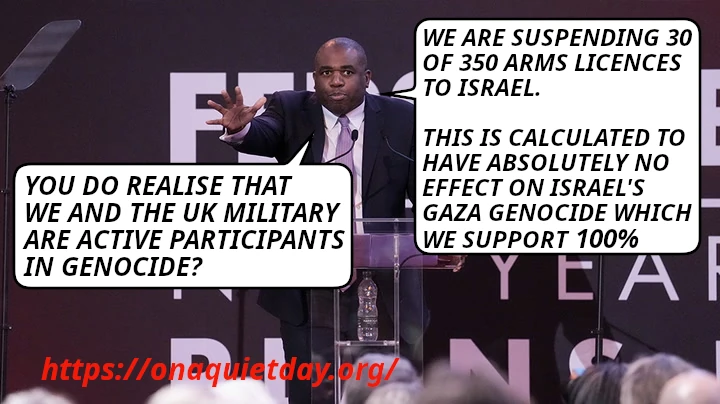
Keir Starmer objects to criticism of the IDF. He asks how could anyone object to them starving people to death, forced marches like the Nazis did, bombing Gaza’s hospitals and universities, mass-murdering journalists, healthworkers and starving people queuing for food, killing and raping prisoners and murdering children. He calls for people to stop obstructing his genocide for Israel.Orcas discuss Genocide-supporting and complicit Zionists. Donald Trump, Keith Starmer, David Lammy, Rachel Reeves, Angela Rayner and Wes Streeting are acknowledged as evil genocide-complicit and supporting cnuts.Genocide denying UK Foreign Secretary David Lammy says that UK is suspending 30 of 350 arms licences to Israel. He also confirms the UK government’s support for Israel’s Gaza genocide and the UK government and military’s active participation in genocide.
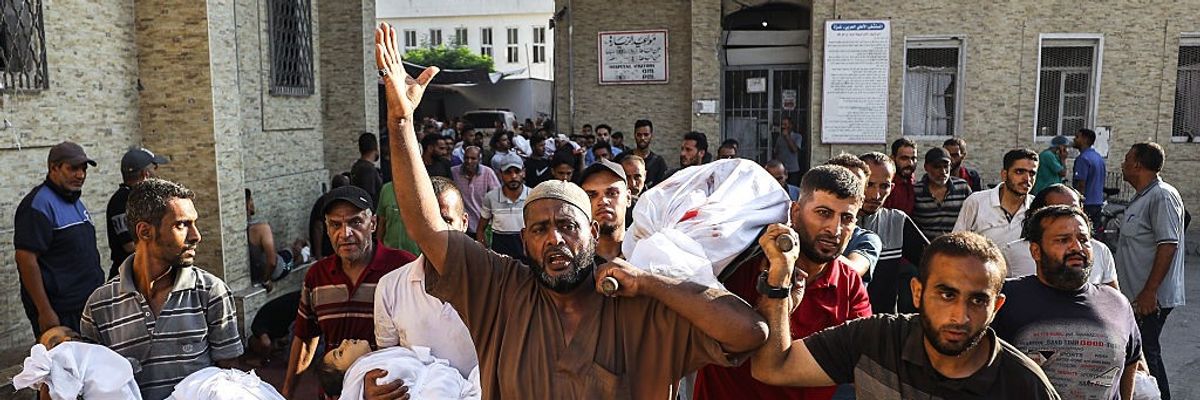
Bodies of Palestinians killed in an Israeli attack on a house of the Abu Sharia family located in Sabra neighborhood in southern Gaza City are carried in Gaza on August 21, 2025. (Photo by Khames Alrefi/Anadolu via Getty Images)
For too long, our elected officials have hidden behind euphemisms like “tragedy” or “conflict.” But history will not remember their silence kindly.
Over the past two years, Gaza has been turned into rubble and starvation by one of the most relentless bombing campaigns in modern history. This is not a conflict. It is not a “war between two sides.” It is genocide—the deliberate destruction of a people, carried out in full view of the world.
More than 66,000 Palestinians have been confirmed killed, most of them women and children. But that number only scratches the surface. Humanitarian agencies estimate that over 680,000 people may have died—buried under collapsed buildings, starved to death, or left to suffer without medicine or clean water as Israel continues to blockade aid. The death toll grows daily as people die unseen beneath the rubble.
I speak not only as an advocate for justice, but as someone personally scarred by this horror. Over 200 members of my own family have been killed in this genocide. Their lives ended in the same way as tens of thousands of others—bombed in their homes, trapped without food, or killed while trying to flee. These were teachers, children, and parents. They were human beings who deserved to live in peace.
Across the world, millions are refusing to look away. From Amsterdam to Istanbul, from New York to Johannesburg, protesters are filling the streets to call this what it is: genocide. Even many who once hesitated to use that word now recognize it as the only accurate description.
The question now is not whether this is genocide. The question is: what will we do about it?
This genocide has extended beyond Gaza’s borders. In the West Bank, Israeli incursions continue—raids, home demolitions, mass arrests, and settler violence, all designed to displace Palestinians from their homeland.
Meanwhile, Gaza is being starved. Thousands are dying for lack of food, water, and medicine. Hospitals have been reduced to ashes, and more than 560 aid workers and medical personnel have been killed. This is not an accident—it is strategy. Starvation and disease have become weapons of war.
It is clear: Israel’s campaign can only have been made possible by US weapons and funding. Every bomb dropped on Gaza carries the imprint “Made in America.” Every home destroyed is a reminder that the US continues to arm and defend a government committing crimes against humanity. This does not serve America’s interests. It only increases anger and resentment toward our country.
There can be no moral ambiguity left. The bombing must stop—permanently. Israel must end its incursions into the West Bank and allow full humanitarian access for rebuilding Gaza. Palestinians have the right to live freely and safely on their own land.
For too long, our elected officials have hidden behind euphemisms like “tragedy” or “conflict.” But history will not remember their silence kindly. It will remember who stood by as a people were starved and buried alive—and who had the courage to speak.
The United States cannot continue to claim moral leadership while enabling genocide. Every day that our government sends weapons to Israel, it deepens our complicity.
The question now is not whether this is genocide. The question is: what will we do about it?
For many, the response has been philanthropy; protesting; and participation in the Boycott, Divestment, and Sanctions movement—all vital and powerful tools for change. But if we want lasting impact, we must also build political power.
That is why CAIR Action was created: to turn outrage into organization, and compassion into change. Through our educational campaigns, voter guides, endorsements, and candidate amplification, we are helping communities of conscience identify and elect leaders who will stand up against genocide and vote for peace and justice.
We are organizing to shape the next generation of politicians—leaders who will not shrink from truth, who will end U. complicity, and who will fight for human rights everywhere.
Keir Starmer objects to criticism of the IDF. He asks how could anyone object to them starving people to death, forced marches like the Nazis did, bombing Gaza’s hospitals and universities, mass-murdering journalists, healthworkers and starving people queuing for food, killing and raping prisoners and murdering children. He calls for people to stop obstructing his genocide for Israel.Orcas discuss Genocide-supporting and complicit Zionists. Donald Trump, Keith Starmer, David Lammy, Rachel Reeves, Angela Rayner and Wes Streeting are acknowledged as evil genocide-complicit and supporting cnuts.Vote Labour for Genocide.



 Protesters take part in a demonstration outside the Foreign, Commonwealth and Development Office (FCDO) in Whitehall, London, calling for the government to protect the crew of Madleen, June 9, 2025